Exam
Name___________________________________
SHORT ANSWER. Write the word or phrase that best completes each statement or answers the question.
Provide an appropriate response.
1)
Give an example of a situation in which a logistic function f(x) =a
1 + be–kx would be a
more appropriate model than an exponential function f(x) = aekx. Explain why you think
the logistic model would be more appropriate.
1)
MULTIPLE CHOICE. Choose the one alternative that best completes the statement or answers the question.
For the given function, find the requested relative extrema or extreme value.
2)
y =x2e6x; minimum value on [–2, 0]
2)
A)
0
B)
1
3
C)
1
3e–1
3
D)
1
9e–2
3)
Find the tangent line to the graph of f(x) = –2e6x at the point (0, –2).
3)
A)
y =12x +2
B)
y =2x +2
C)
y = –12x –2
D)
y = –2x –2
Solve the problem.
4)
A business estimates that the salvage value V of a piece of machinery after t years is given by
V(t) = $39,000e–0.41t.
What is the salvage value after 5 years?
4)
A)
$302,948
B)
$4674
C)
$5744
D)
$5021
5)
f(x) =exlog6 x
5)
A)
ex
x(ln 6)
B)
exln 6
x+log6 x
C)
ex1
x(ln 6) +log6 x
D)
ex1
x+log6 x
6)
log81=0
6)
A)
80=1
B)
10=8
C)
08=1
D)
81=0
Solve the problem.
7)
The acidity of a solution can be gauged by measuring the concentration of hydrogen ions in the
solution. This ion concentration is usually given in units of moles per liter (mols) and is denoted by
[H+]. For distilled water, [H+] 10–7 mols indicating that each liter of water contains
approximately 10–7 moles of hydrogen ions. The pH of a solution is defined by
pH =log10 1
[H+] .
Thus the pH of distilled water is about 7. Find the concentration of hydrogen ions, [H+], in a
solution having a pH equal to 8.8. Express your answer to three significant digits using scientific
notation.
7)
A)
1.58 × 10⁻⁸mols
B)
9.44 × 10⁻¹mols
C)
1.58 × 10⁻⁹mols
D)
1.51 × 10⁻⁴mols
8)
f(x) =e8x ln x
8)
A)
e8x
x
B)
e8x (1 + ln x)
x
C)
8e8x
x
D)
e8x (1 +8x ln x)
x
9)
ln (16e)
9)
A)
0.6931
B)
1.6931
C)
16
D)
3.7724
10)
y = – 6e–x2; relative extrema
10)
A)
(6, –6e–36), relative minimum
B)
(12, 12e–144), relative maximum
C)
(0, 0), relative minimum
D)
(0, –6), relative minimum
Solve the problem.
11)
When a particular circuit containing a resistor, an inductor, and a capacitor in series is connected to
a battery, the current i (in amperes) is given by i =29e–3t(e2.6t – e–2.6t) where t is the time (in
seconds). Find the time at which the maximum current occurs.
11)
A)
0.6 sec
B)
0.5 sec
C)
1.5 sec
D)
1.4 sec
12)
104=10,000
12)
A)
log410 =10,000
B)
log410,000 = 10
C)
log10 10,000 =4
D)
log10 4=10,000
13)
y =log5(7x)
13)
A)
1
x
B)
7
x(ln 5)
C)
1
x(ln 5)
D)
ln 5
x
14)
y =2ex
2ex+ 1
14)
A)
ex
(2ex+ 1)2
B)
2ex
(2ex+ 1)2
C)
2ex
(2ex+ 1)
D)
2ex
(2ex+ 1)3
Solve the problem.
15)
An amount is invested at 7.6% per year compounded continuously. What is the effective annual
yield?
15)
A)
7.33%
B)
7.9%
C)
7.81%
D)
7.47%
16)
y = ln (x – 6)
16)
A)
1
x + 6
B)
1
x – 6
C)
1
6– x
D)
–1
x + 6
B
17)
y =8ex+ 5e–x; relative extrema
17)
A)
(–0.47, 8.13), relative minimum
B)
(–0.24, 12.65), relative minimum
C)
(0.24, 14.07), relative minimum
D)
(–0.24, 10.28), relative maximum
B
Solve the problem.
18)
How old is a skeleton that has lost 19% of its carbon–14? The decay rate, k, of carbon–14 is
0.01205% per year.
18)
A)
13,782 years
B)
17 years
C)
1171 years
D)
1749 years
D
B
Differentiate.
19)
y =e(10 x+x5)
19)
A)
(10 x +5x4) ln(10 x +x5)
B)
5x+5x4e(10 x+x5)
C)
e(5 x +5x4)
D)
(10 x +5x4)e(10 x+x5)
Solve the problem.
20)
Following the birth of a child, a parent wants to make an initial investment P0 that will grow to
$33,000 by the child’s 20th birthday. Interest is compounded continuously at 7%. What should the
initial investment be?
20)
A)
$133,821.6
B)
$7730.81
C)
$8137.7
D)
$13,750
21)
Let logb 2 =2.212 and logb 3 =3.415. Find logb 24.
21)
A)
12.457
B)
10.051
C)
5.627
D)
27.32
22)
ln 30
22)
A)
3.4012
B)
1.4771
C)
11.0701
D)
0.2931
Solve the problem.
23)
The following formula accurately models the relationship between the size of a certain type of
tumor and the amount of time that it has been growing:
V(t) =450(1 –e–.0016t)3,
where t is in months and V(t) is measured in cubic centimeters. Calculate the rate of change of
tumor volume at 90 months.
23)
A)
0.053 cm3/month
B)
0.146 cm3/month
C)
0.025 cm3/month
D)
0.034 cm3/month
24)
Let logb A =3 and logb B = –4. Find logb AB.
24)
A)
7
B)
12
C)
–1
D)
–12
25)
FW=A
25)
A)
logFW=A
B)
logFA=W
C)
logWA=F
D)
logAF=W
26)
Let logb 2 =2.217 and logb 3 =3.417. Find logb 3b.
26)
A)
4.417
B)
2.217
C)
3.417
D)
3.217
27)
et=51
27)
A)
3.932
B)
18.769
C)
138.632
D)
1.708
28)
f(x) =e3x
28)
A)
3ex
B)
3e3x
C)
1
3e3x
D)
e3x
29)
y = 5x2e3x
29)
A)
5xe3x(3x + 2)
B)
10xe3x(2x + 3)
C)
5xe3x(2x + 3)
D)
10ex3x(3x + 2)
30)
f(x) =47x
30)
A)
(4 ln 7)47x
B)
(7) 47x
C)
(ln 4) 47x
D)
(7ln 4 )47x
31)
y = ln 9x
31)
A)
–1
x
B)
–1
9x
C)
1
x
D)
1
9x
32)
P = $10,000; i = 12%; t = 4 yr, compounded monthly
32)
A)
$263.34
B)
$1205.23
C)
$259.15
D)
$263.53
33)
ln e6
33)
A)
6
B)
0
C)
3
D)
1
34)
The sales in thousands of a new type of product are given by S(t) =170 – 80e–0.7t, where t
represents time in years. Find the rate of change of sales at the time when t =2.
34)
A)
–13.9 thousand per year
B)
–226.1 thousand per year
C)
226.1 thousand per year
D)
13.9 thousand per year
35)
Ben Franklin bequeathed $4000.00 to the city of Boston in 1790. Assuming the fund grew to
$8 million in 200 years, find the interest rate compounded continuously that would yield this total
value.
35)
A)
3.8%
B)
6%
C)
2.9%
D)
1.9%
36)
The population of a particular city (in thousands) can be modeled by the function
P(t) =500
1 + 20e–0.05x,
where x is the number of years after 1920. In what year was the growth rate of the population the
fastest?
36)
A)
1960
B)
1990
C)
1970
D)
1980
37)
The Henderson’s borrow $407,000 to purchase a new home. They finance the amount through a 30
–yr mortgage at an annual interest rate of 5.6%, compounded monthly. Find the Henderson’s
monthly mortgage payment.
37)
A)
$2336.50
B)
$1899.33
C)
$14,570.06
D)
$3957.24
38)
Students in a math class took a final exam. They took equivalent forms of the exam in monthly
intervals thereafter. The average score S(t), in percent, after t months was found to be given by
S(t) =80 –15ln (t + 1), t 0
What was the average score after 9 months?
38)
A)
43.5%
B)
48.5%
C)
50.5%
D)
45.5%
39)
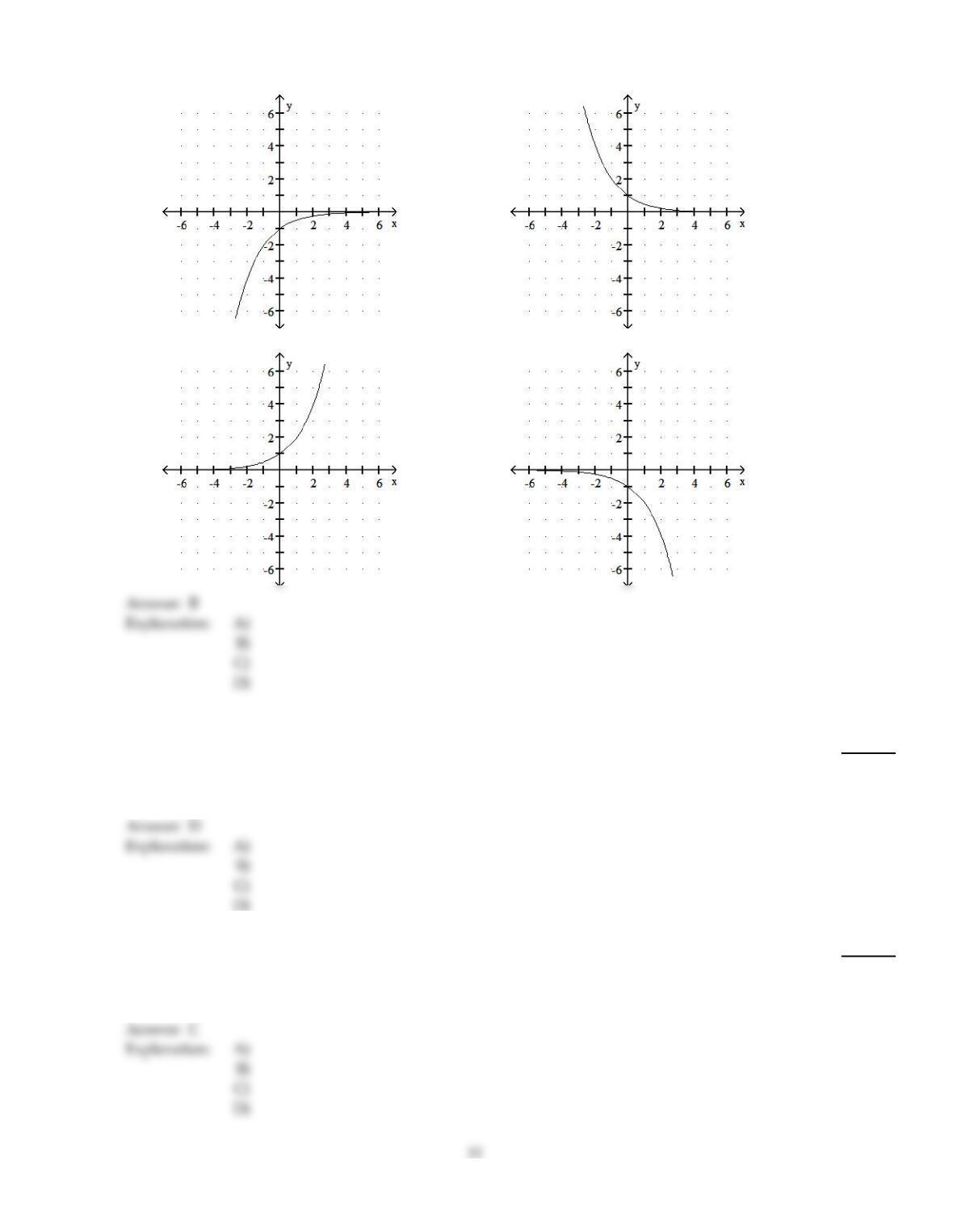
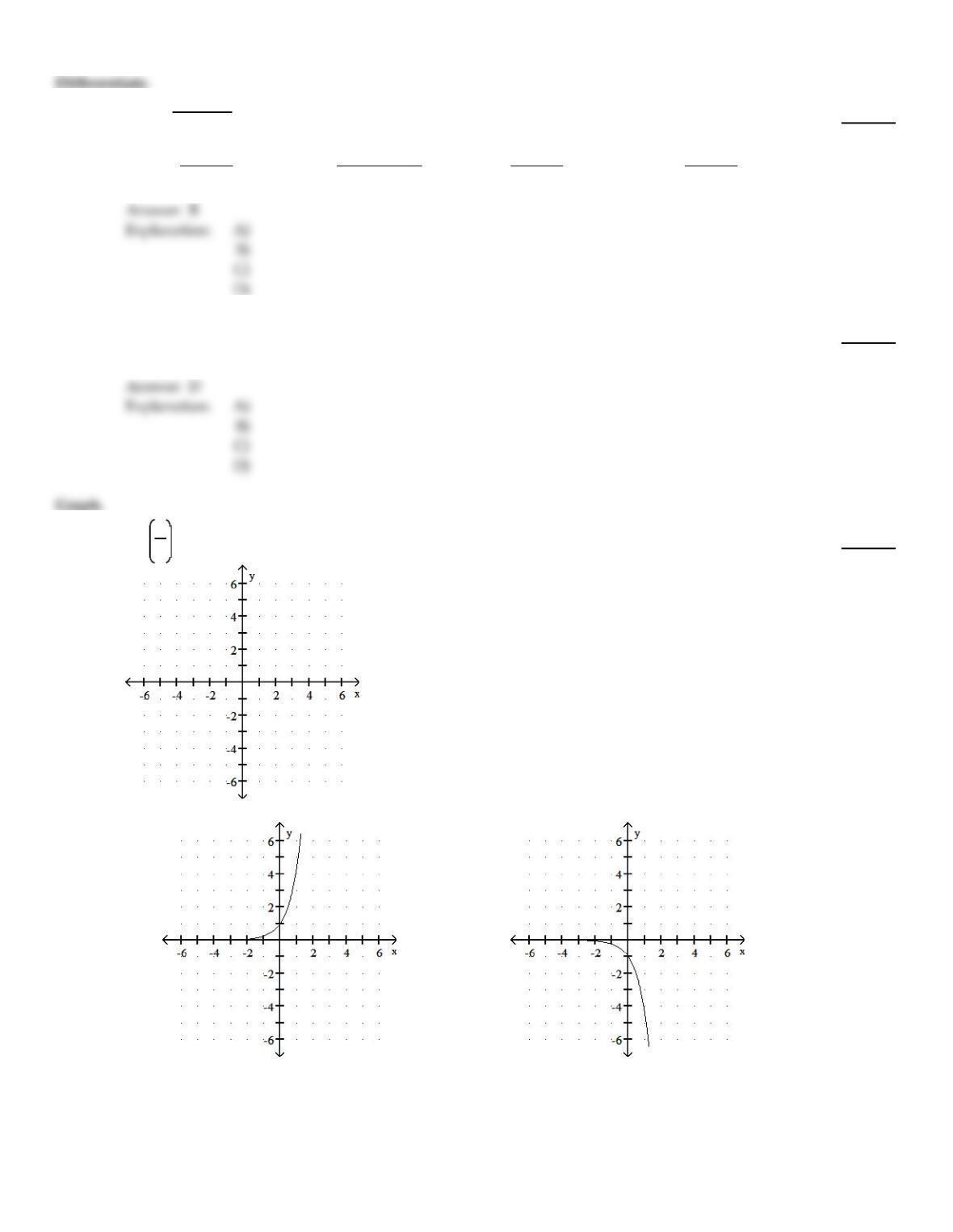
y =2–x
39)
10
A)
B)
C)
D)
Solve the problem.
40)
In 1990, a company‘s profit was 44.0 million dollars. In 2000, the company’s profit was 119.6
million dollars. Assume that the growth of the company’s profit follows the exponential model and
use 1990 as the base (t = 0). When will the company’s profit be 217.9 million dollars?
40)
A)
2011
B)
2009
C)
2004
D)
2006
41)
The population of a town was about 51,000 in 1910. In 1935, the population was about 86,000.
Assuming the exponential model, what was the growth rate of the town, to the nearest hundredth
of a percent, during this period?
41)
A)
1.16 % per year
B)
4.78 % per year
C)
2.09 % per year
D)
20.9 % per year
42)
Let logb A =2 and logb B = –5. Find logb4AB.
42)
A)
–1.778
B)
1.778
C)
4–10
D)
–0.750
Solve the problem.
43)
The intensity I of an earthquake is given by
I =I010R,
where R = the magnitude on the Richter scale, I0 is the minimum intensity, and R = 0 is used for
comparison. Find I, in terms of I0 , for an earthquake of magnitude 3.3 on the Richter scale.
43)
A)
33I0
B)
1995.3 I03.3
C)
1995.3 I0
D)
0.52 – log I0
44)
ln 0.000632
44)
A)
3.1993
B)
–7.3666
C)
7.3666
D)
–3.1993
45)
y =3xex; minimum value on [–2, 0]
45)
A)
0
B)
3
e
C)
–9e3
D)
–3
e
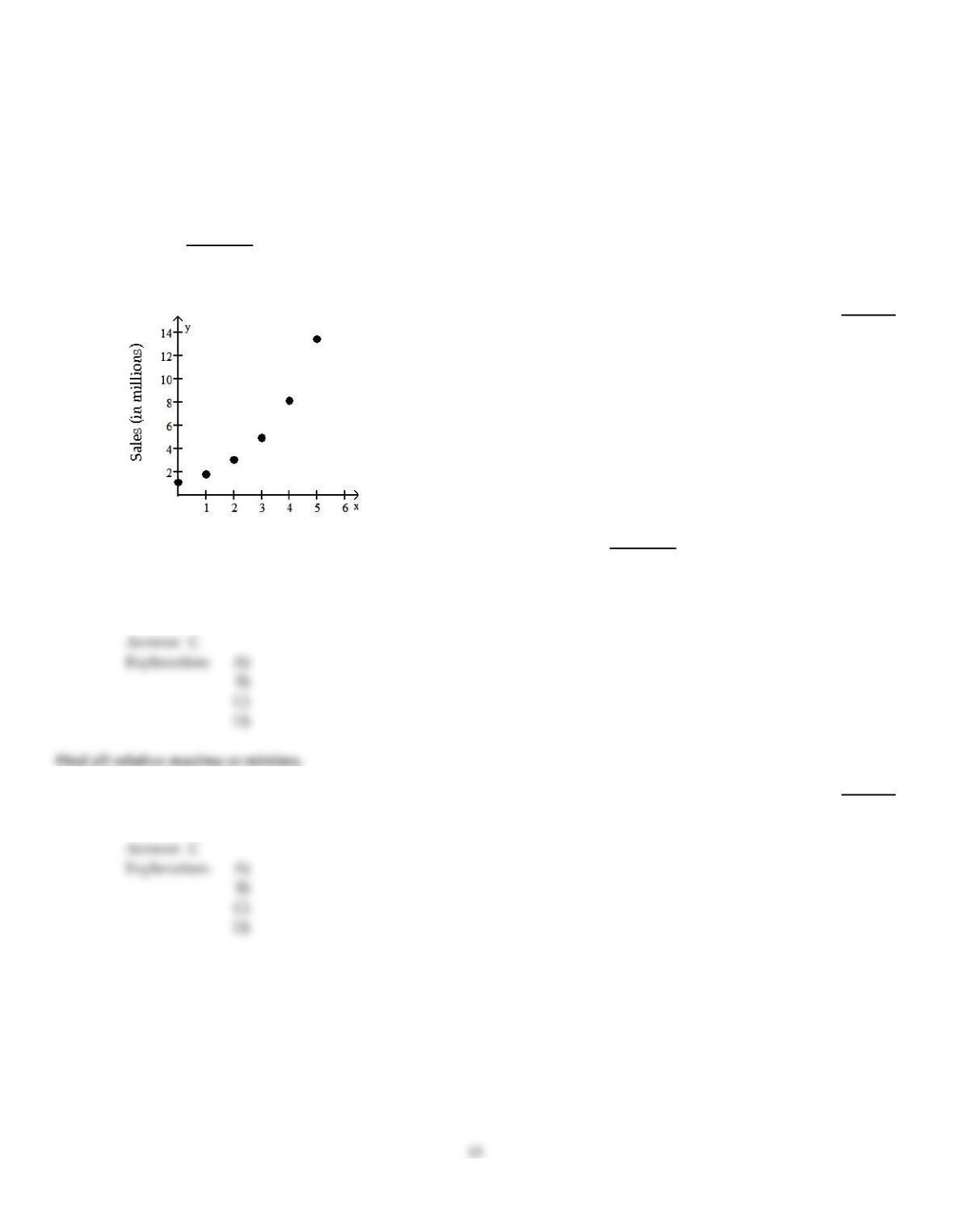
For the scatterplot below, determine which, if any, of the following functions might be used as a model for the data.
Quadratic: f(x) = ax2+ bx + c
Polynomial, not quadratic
Exponential, f(x) = aekx, k > 0
Exponential, f(x) = ae–kx, k > 0
Logarithmic, f(x) = a + b ln x
Logistic, f(x) =a
1 + be–kx
46)
46)
A)
Logarithmic, f(x) = a + b ln x
B)
Logistic, f(x) =a
1 + be–kx
C)
Exponential, f(x) = aekx, k > 0
D)
Exponential, f(x) = ae–kx, k > 0
47)
y = (ln x)2
47)
A)
(–1, –1), relative maximum
B)
(1, –1), relative maximum
C)
(1, 0), relative minimum
D)
(–1, 0), relative minimum
C
C
48)
f(x) =490x
48)
A)
(ln 490)490x
B)
(log 490)490x
C)
(ln x)490x
D)
490x
Solve the problem.
49)
Find the doubling time for an amount invested at a growth rate 6% per year compounded
continuously.
49)
A)
10 years
B)
7.4 years
C)
11.6 years
D)
4.2 years
50)
y = ln (xn)
50)
A)
1
xn
B)
n ln (xn–1)
C)
n
x
D)
n (ln x)n–1
x
51)
loga X = Y
51)
A)
YX= a
B)
XY= a
C)
aX= Y
D)
aY= X
52)
True or false, for the graph of y =log8x, the slope of the tangent line at any x is equal to the
reciprocal of x.
52)
A)
True
B)
False
53)
y = ln 1 – x
(x +3)5
53)
A)
ln 6x –8
(x +3)6
B)
4x –8
(x +3)(1 – x)
C)
4x –8
(x +3)6
D)
(x +3)5
1 – x
54)
y = 4ex2
54)
A)
8xe2x
B)
8xex2
C)
8xe4x2
D)
8xe
55)
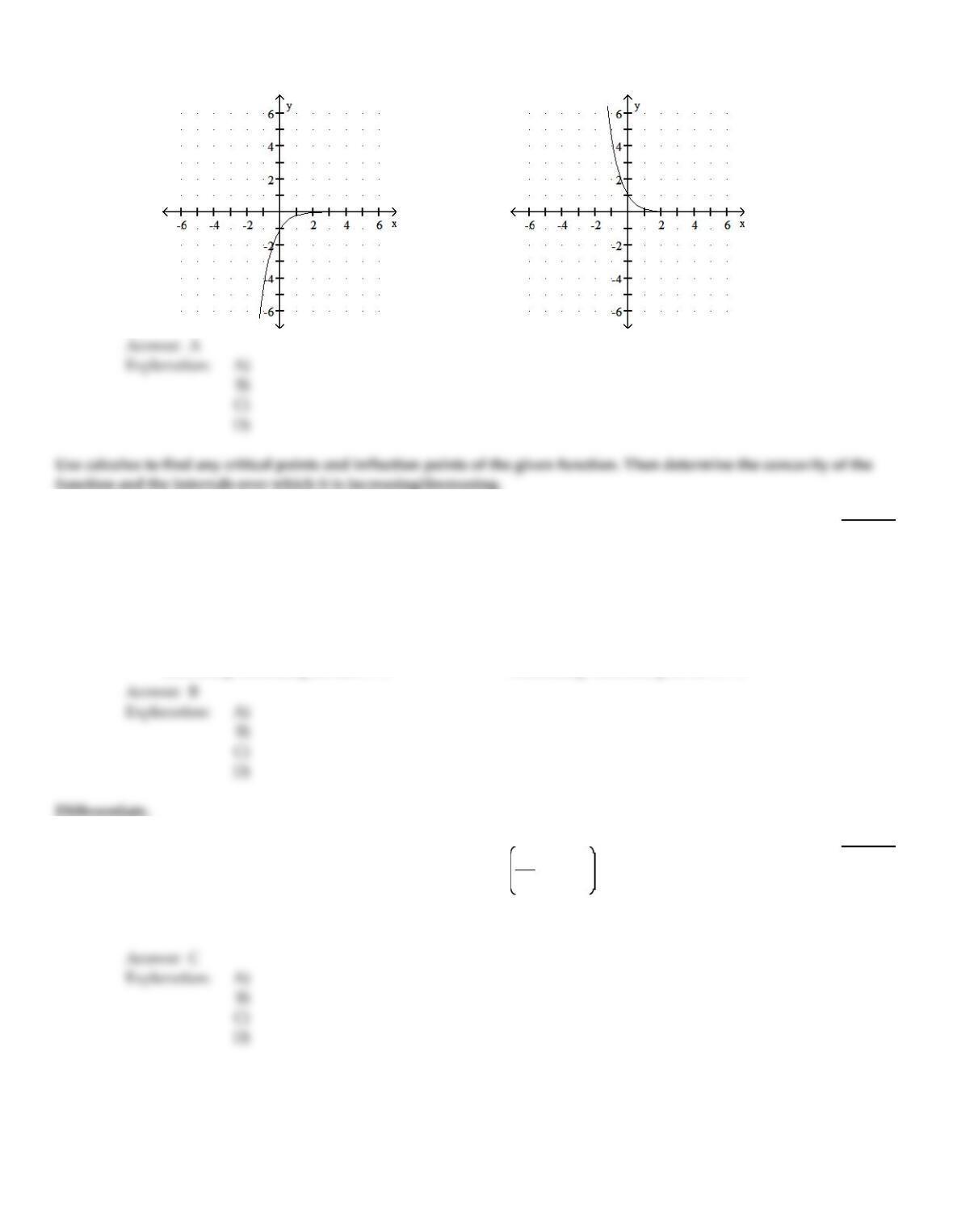
y =9
2 x
55)
A)
B)
15
C)
D)
56)
f(x) =7 ( 1 – e–x) for nonnegative values of x
56)
A)
Critical points: none
Inflection points: none
Concavity: concave up for all x
0
Decreasing: decreasing for all x 0
B)
Critical points: none
Inflection points: none
Concavity: concave down for all x 0
Increasing: increasing for all x 0
C)
Critical points: none
Inflection points: none
Concavity: concave up for all x
0
Increasing: increasing for all x 0
D)
Critical points: none
Inflection points: none
Concavity: concave down for all x 0
Decreasing: decreasing for all x 0
57)
y = (x2– 2x +7) ex
57)
A)
(x2+ 4x + 5) ex
B)
x3
3+ 5x +7 ex
C)
(x2+ 5) ex
D)
(2x – 2) ex
16

Solve the problem.
58)
The pH scale is used by chemists to measure the acidity of a solution. It is a base 10 logarithmic
scale. The pH, P, of a solution and its hydronium ion concentration in moles per liter, H, are
related as follows:
H =10–P
Find the formula for the rate of change dH
dP .
58)
A)
dH
dP = – 10–P
ln 10
B)
dH
dP = –(ln 10 )10–P
C)
dH
dP = (ln 10 )10–P
D)
dH
dP = –(ln P)10–P
59)
The number of employees of a company, N(t), who have heard a rumor t days after the rumor is
started is given by the logistic equation
N(t) =290
1 +55.3e–0.2t.
How many employees have heard the rumor 15 days after it is started?
59)
A)
70 employees
B)
6 employees
C)
62 employees
D)
77 employees
Find the derivative.
60)
f(x) = ln (e4x + 6)
60)
A)
4e4x
e4x + 6
B)
1
4e4x
C)
4e4x
x
D)
1
e4x + 6
17
61)
y =(ln x)ln x
61)
A)
ln x ln (ln x)
B)
(ln x)ln x
x
C)
ln (ln x) + 1
x(ln x)ln x
D)
ln (ln x) + 1
x
62)
ln 1
5
62)
A)
0
B)
1.6094
C)
–1.6094
D)
0.6213
63)
y =6x2
63)
A)
6x2· 2x · ln x
B)
2x(ln 6)
C)
6x2· x · ln 6
D)
6x2· 2x · ln 6
64)
The demand function for a certain book is given by the function x = D(p) =70e–0.005p. Find the
marginal demand D'(p).
64)
A)
D'(p) = –0.005e–0.005p
B)
D'(p) =0.35e–0.005p
C)
D'(p) = –0.35e–0.005p
D)
D'(p) = –0.35pe–0.005p–1
65)
f(x) =9–e–x
65)
A)
Critical points: critical point at x = 0
Inflection points: none
Concavity: concave down for all real numbers
Increasing: increasing for all x < 0 and decreasing for all x > 0
B)
Critical points: none
Inflection points: none
Concavity: concave down for all real numbers
Increasing: increasing for all real numbers
C)
Critical points: none
Inflection points: none
Concavity: concave up for all real numbers
Decreasing: decreasing for all real numbers
D)
Critical points: none
Inflection points: point of inflection at x = 0
Concavity: concave down for all x < 0 and concave up for all x > 0
Increasing: increasing for all real numbers
66)
y =e5x/4
66)
A)
e5x/4
B)
5
4e5x/4– 1
C)
5
4xe5x/4
D)
5
4e5x/4
67)
The loudness L of a sound of intensity I is defined as
L = 10 log I
I0,
where L = the loudness of the sound as measured in decibels and I0= the minimum intensity
detectable by the human ear. Find L for a sound whose intensity, I, is 105.4 I0.
67)
A)
0.7 decibels
B)
54 decibels
C)
124.3 decibels
D)
496.8 decibels
68)
The pH scale is used by chemists to measure the acidity of a solution. It is a base 10 logarithmic
scale. The pH, P, of a solution is defined as
P = – log10H,
where H = [H3O+] is the hydronium ion concentration in moles per liter. Find the rate of change
dP
dH.
68)
A)
dP
dH = – 1
H
B)
dP
dH = – 1
Hln H
C)
dP
dH = – 1
Hln 10
D)
dP
dH = – ln 10
H
69)
y =xf(x), f(x) positive
69)
A)
xf(x) – 1 f(x)
B)
f'(x) ln x +f(x)
x
C)
xf(x) f'(x) ln x
D)
xf(x) f'(x) ln x +f(x)
x
70)
The Smith’s borrow $75,000 to purchase a new home. They finance the amount through a 20–yr
mortgage at an annual interest rate of 5.51%, compounded monthly. Find the Smith’s monthly
mortgage payment.
70)
A)
$573.98
B)
$17.22
C)
$516.34
D)
$344.38
71)
A radioactive substance has a decay rate of 9.3% per day. What is its half–life?
71)
A)
0.07 days
B)
6.4 days
C)
8.6 days
D)
7.5 days
72)
y =2xe– x; maximum value on [0, 2]
72)
A)
2e
B)
4e–2
C)
–2e
D)
2
e
73)
In one city, 35% of all aluminum cans distributed will be recycled each year. A juice company
distributes 110,000 cans. The number still in use after time t, in years, is given by
N(t) =110,000(0.35)t.
Find N'(t).
73)
A)
N'(t) =110,000t(0.35)t–1
B)
N'(t) =110,000(0.35)t
C)
N'(t) =110,000(ln t)(0.35)t
D)
N'(t) =110,000(ln 0.35)(0.35)t
74)
f(x) = –2e6x
74)
A)
–2e6x
B)
6e6x
C)
–12ex
D)
–12e6x
75)
y =6xx2
75)
A)
6xx2(2x ln 6x +x)
B)
6xx2(2x ln 6x )
C)
x2 ln 6x
D)
2x ln 6x +x
Solve the problem.
76)
A company’s total cost, in millions of dollars, is given by C(t) =140–30e–t where t = time in years.
Find the marginal cost when t =6.
76)
A)
0.07 million dollars per year
B)
0.35 million dollars per year
C)
0.45 million dollars per year
D)
0.16 million dollars per year
77)
f(x) =(ln x)7
77)
A)
1
x7
B)
7(ln x)6
C)
7(ln x)6
x
D)
1
(ln x)7
Solve the problem.
78)
A model for advertising response is given by
N(a) =6000 +400 ln a, a 1
where N(a) = the number of units sold and a = the amount spent on advertising, in thousands of
dollars. Find N'(2).
78)
A)
160
B)
200
C)
277
D)
6200
79)
f(x) =6e–2x
79)
A)
–12e–2x
B)
6e–2x
C)
–2e–2x
D)
12e–2x
80)
f(t) = ln [(t6–2)(t5+3)]
80)
A)
ln[6t5(t5+3) +5t4(t6–2)]
B)
30t9
(t6–2)(t5+3)
C)
1
(t6–2)(t5+3)
D)
6t5(t5+3) +5t4(t6–2)
(t6–2)(t5+3)
Solve the problem.
81)
A pharmaceutical company introduces a new headache medication on the market. They advertise
the product on television and find that the percentage P of people who buy the product after t
weeks satisfies the function
P(t) =100%
1 +38e–0.11t.
Find the formula for the rate of change P'(t).
81)
A)
P'(t) =418e–0.11t%
1 +38e–0.11t
B)
P'(t) =418e–0.11t%
(1 +38e–0.11t)2
C)
P'(t) =3800e–0.11t%
(1 +38e–0.11t)2
D)
P'(t) =(100 –418e–0.11t)%
(1 +38e–0.11t)2
82)
x =9y
82)
23
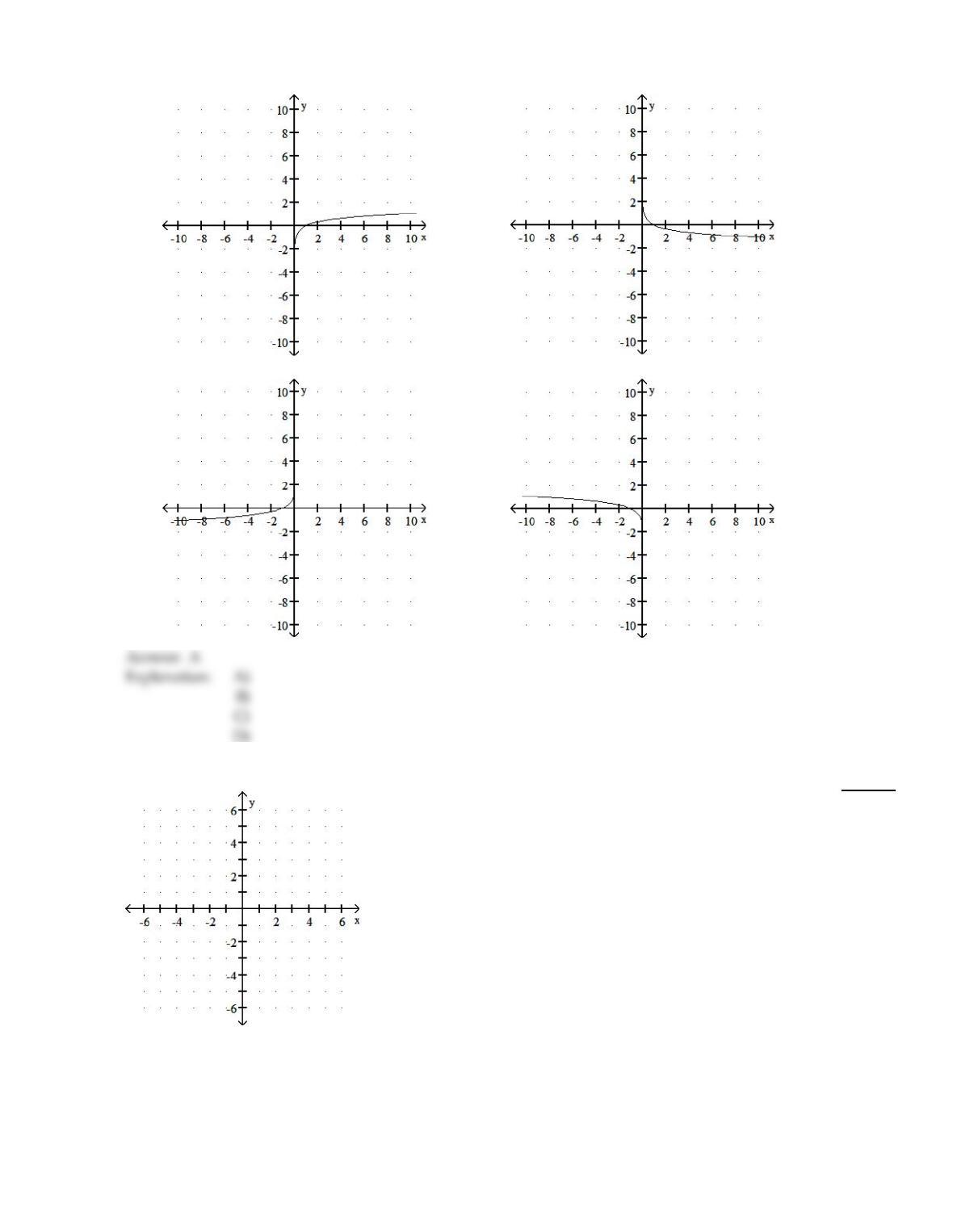
A)
B)
C)
D)
83)
y =5x – 3
83)
24
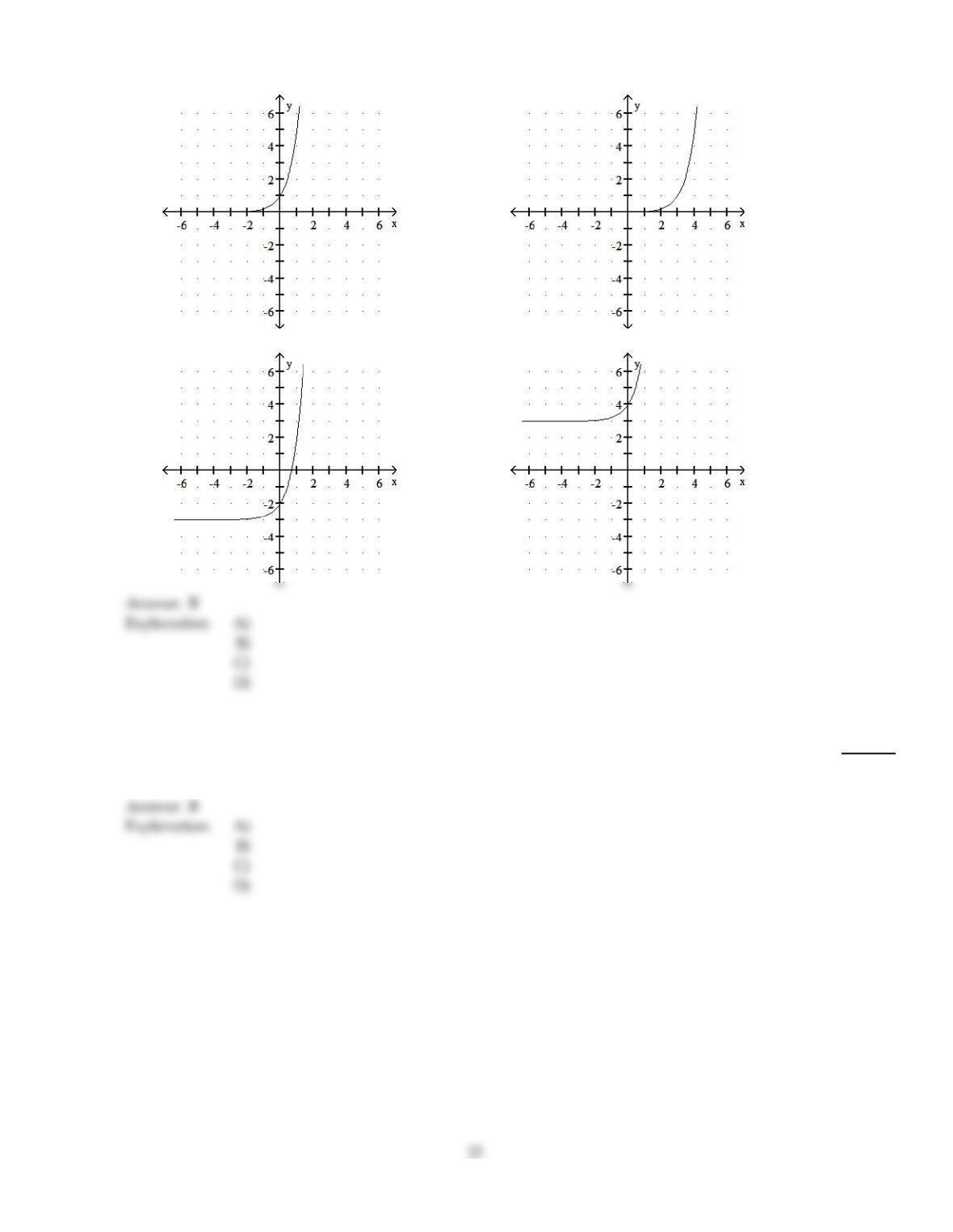
A)
B)
C)
D)
Solve the problem.
84)
The effective annual yield on an investment compounded continuously is 6.3%. At what rate was it
invested?
84)
A)
6.1%
B)
6.11%
C)
6.5%
D)
6.5%
85)
A company begins an advertising campaign in a certain city to market a new product. The
percentage of the target market that buys the product is a function of the length of the advertising
campaign. The company estimates this percentage as 1 –e–0.03t where t = number of days of the
campaign. The target market is estimated to be 1,000,000 people and the price per unit is $0.40.
The cost of advertising is $3000 per day. Find the length of the advertising campaign that will
result in the maximum profit.
85)
A)
46 days
B)
42 days
C)
58 days
D)
39 days
86)
Suppose that the amount in grams of a radioactive substance present at time t (in years) is given by
A(t) =540e–0.19t. Find the rate of change of the quantity present at the time when t =4.
86)
A)
48 grams per year
B)
–48 grams per year
C)
–2.1 grams per year
D)
2.1 grams per year
B
87)
Find the tangent line to the graph of f(x) =e2x at the point (0, 1).
87)
A)
y =2x + 1
B)
y =2x +2
C)
y = x + 1
D)
y =2e + 1
A
88)
y =(x +5)x
88)
A)
x +5)x–1
B)
x ln(x +5)
C)
(x +5)xln(x +5) +x
x +5
D)
ln(x +5) +x
x +5
C
26
A
Solve the problem.
89)
An artifact is discovered at a certain site. If it has 57% of the carbon–14 it originally contained, what
is the approximate age of the artifact to the nearest year? (carbon–14 decays at the rate of 0.0125%
annually.)
89)
A)
3440 years
B)
4497 years
C)
1953 years
D)
4560 years
90)
log1024 4=1
5
90)
A)
41/5=1024
B)
41024 =5
C)
10241/5=4
D)
1/54=1024
91)
y =(5x +5)x
91)
A)
(5x +5)xln (5x +5) +5x
5x +5
B)
x ln (5x +5)
C)
(5x +5)xln (5x +5) +1
5
D)
ln (5x +5) +5x
5x +5
Solve the problem.
92)
Initially, a population of rabbits was found to contain 190 rabbits. It was estimated that the
population was growing exponentially at the rate of 11% per day. How long, to the nearest tenth of
a day, will it take the population to double?
92)
A)
6.3 days
B)
0.1 days
C)
63 days
D)
17.3 days
Solve.
93)
In 1970, the population of a particular city is 785,000. In 1980, the population of the city is 689,300.
Assume the population is decreasing according to the exponential–decay model. When will the
population of the city be 100,000?
93)
A)
2139
B)
2129
C)
2124
D)
2134
94)
ln 0.997
94)
A)
–0.0013
B)
0.0030
C)
0.0013
D)
–0.0030
95)
y =117x
95)
A)
11 · (ln 7) ·117x
B)
77 · (ln 7) ·117x
C)
77 · (ln 11) ·117x
D)
7· (ln 11) ·117x
96)
y = ln [ln x]5
96)
A)
5
x ln x
B)
1
(ln x)5
C)
n
x (ln x)5
D)
5
ln x
97)
Find the tangent line to the graph of f(x) =6e–8x at the point (0, 6).
97)
A)
y =8x –6
B)
y = –48x +6
C)
y =48x –6
D)
y =6x +6
Solve the problem.
98)
The half–life of an element is 4.9 × 10⁸ yr. How long does it take a sample of the element to decay
to 2
5 of its original mass? Express results in scientific notation, rounded to the nearest hundredth.
98)
A)
5.36 × 10⁸ yr
B)
3.11 × 10⁸ yr
C)
1.09 × 10⁸ yr
D)
6.48 × 10⁸ yr
99)
y = log(8x)
99)
A)
1
x
B)
1
x(ln 10)
C)
1
x(ln 8)
D)
1
ln 10
B
100)
y = 2xe–x; relative extrema
100)
A)
(1, 2/e), relative minimum
B)
(–1, –2e), relative maximum
C)
(–1, –2e), relative minimum
D)
(1, 2/e), relative maximum
D
101)
81/3=2
101)
A)
log 2 1/3=8
B)
log 28= 1/3
C)
log 1/38=2
D)
log 82= 1/3
D
102)
e–0.05t=0.6
102)
A)
–12
B)
0.511
C)
–10.217
D)
10.217
D
D
Solve the problem.
103)
Students in a math class took a final exam. They took equivalent forms of the exam in monthly
intervals thereafter. The average score S(t), in percent, after t months was found to be given by
S(t) =74 –16ln (t + 1), t 0
Find S'(t).
103)
A)
S'(t) =16
t + 1
B)
S'(t) = – 16 ln ( 1
t + 1)
C)
S'(t) = – 16
t + 1
D)
S'(t) =74 –16
t + 1
104)
The percentage P of doctors who accept a new medicine is given by
P(t) = 100(1 –e–0.30t), where t = time in months.
How many months will it take for 82% of the doctors to accept the new medicine?
104)
A)
8 months
B)
5 months
C)
7 months
D)
6 months
105)
Assume the cost of a gallon of milk is $3.00. With continuous compounding, find the time it would
take the cost to be 2 times as much (to the nearest tenth of a year), at an annual inflation rate of 6%.
105)
A)
0.2 years
B)
4.2 years
C)
0.1 years
D)
11.6 years
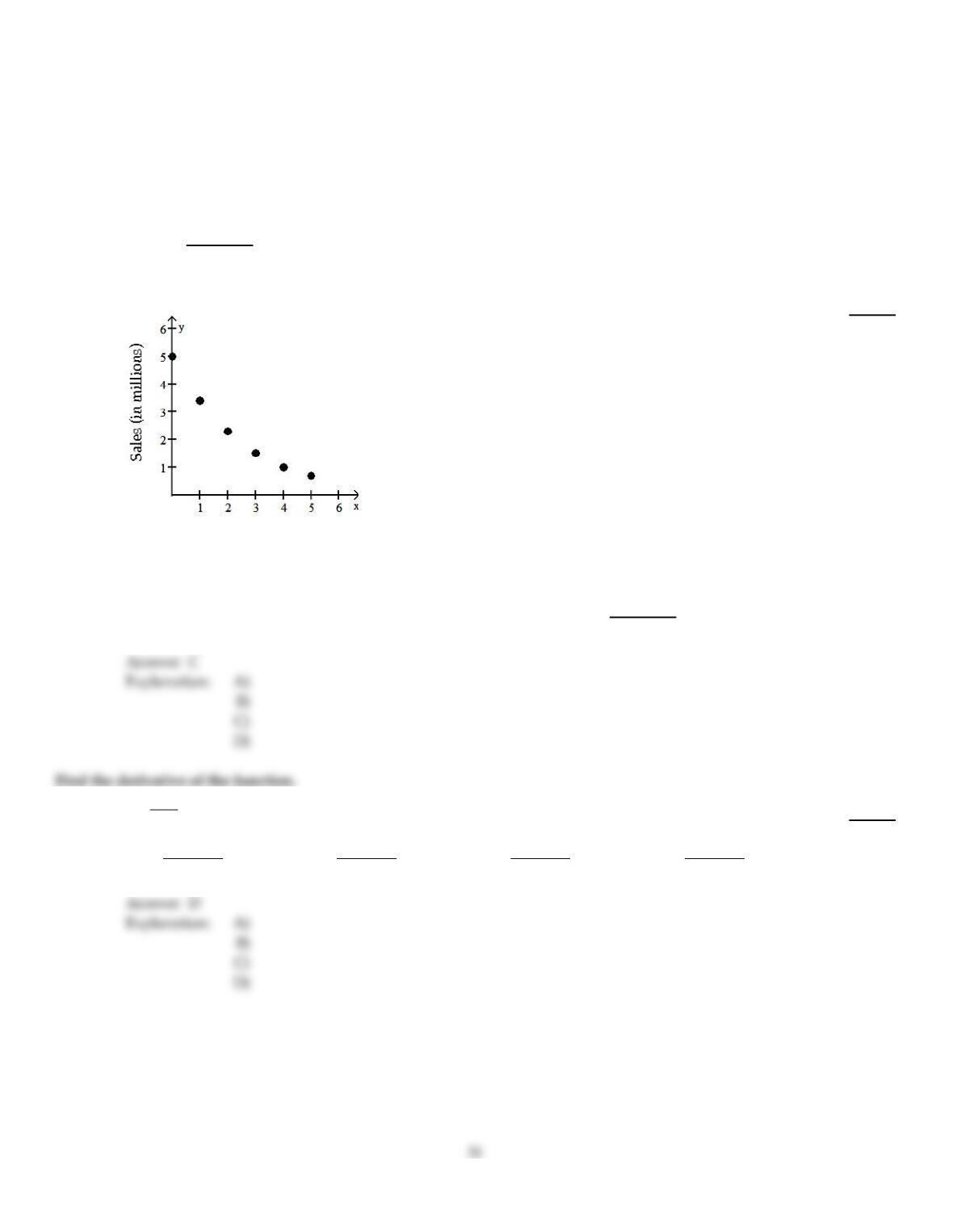
For the scatterplot below, determine which, if any, of the following functions might be used as a model for the data.
Quadratic: f(x) = ax2+ bx + c
Polynomial, not quadratic
Exponential, f(x) = aekx, k > 0
Exponential, f(x) = ae–kx, k > 0
Logarithmic, f(x) = a + b ln x
Logistic, f(x) =a
1 + be–kx
106)
Year
106)
A)
Exponential, f(x) = aekx, k > 0
B)
Polynomial, not quadratic
C)
Exponential, f(x) = ae–kx, k > 0
D)
Logistic, f(x) =a
1 + be–kx
107)
y =ln x
x6
107)
A)
1 +6ln x
x12
B)
6ln x – 1
x7
C)
1 –6ln x
x12
D)
1 –6ln x
x7
108)
f(x) =x5log6 x
108)
A)
(ln 6)x4+5x4(log6x)
B)
x4+5x4(log6x)
C)
5x3
ln 6
D)
x4
ln 6+5x4(log6x)
Solve the problem.
109)
The nationwide attendance per day for a certain motion picture can be approximated using the
equation A(t) =12t2e–t, where A is the attendance per day in thousands of persons and t is the
number of months since the release of the film. Find and interpret the rate of change of the daily
attendance after 4 months.
109)
A)
3.517 thousand persons/day · month; the daily attendance is increasing.
B)
–3.517 thousand persons/day · month; the change in daily attendance is decreasing.
C)
–1.758 thousand persons/day · month; the daily attendance is decreasing.
D)
1.758 thousand persons/day · month; the change in the daily attendance is increasing.
110)
A consumer group in one city compares the costs of goods and services in that city over various
years, and uses 1970 as a base. The same goods and services that cost $100 in 1970 cost $42 in 1941.
Assuming the exponential–decay model, find the value of k, and write the equation. Round the
value of k to the nearest thousandth. Let t be the number of years before 1970.
110)
A)
P(t) =P0e–0.03t
B)
P(t) =P0e–0.035t
C)
P(t) =P0e–0.032t
D)
P(t) =P0e–0.028t
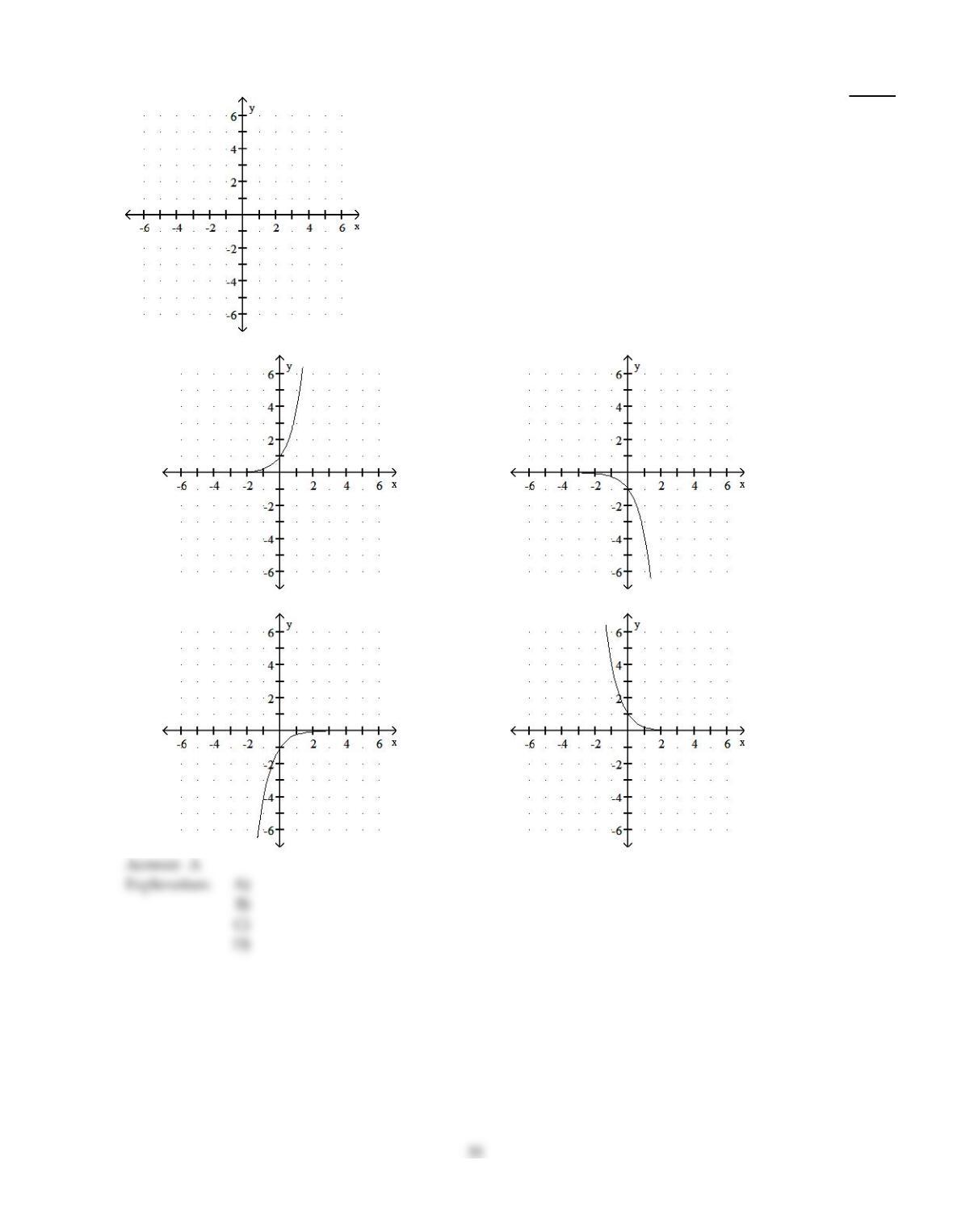
111)
y =4x
111)
A)
B)
C)
D)
Solve.
112)
The power supply of a satellite is a radioisotope. The power output P, in watts (W), decreases at a
rate proportional to the amount present. P is given by P = 50e–0.006t, where t is the time in days.
How much power will be available after 333 days? What is the half–life of the power supply? How
much power did the satellite have to begin with?
112)
A)
6.78 W; 116 days; 5 W
B)
6.78 W; 116 days; 50 W
C)
6.78 W; 117 days; 500 W
D)
3390 W; 117 days; 50 W
113)
et=100
113)
A)
36.788
B)
271.828
C)
2
D)
4.605
D
114)
y = ln x – x
114)
A)
(–1, –1), relative maximum
B)
(1, –1), relative maximum
C)
(1, 0), relative minimum
D)
(–1, 0), relative minimum
B
115)
y =(ex3–1)4
115)
A)
4(3x2ex3)3
B)
12x2ex3(ex3–1)3
C)
4x3ex3–1(ex3–1)3
D)
4(ex3–1)3
B
B
116)
Let logb A =3.391 and logb B =0.288. Find logb AB.
116)
A)
11.774
B)
3.679
C)
0.977
D)
3.103
117)
If $3500 is invested in an account that pays interest compounded continuously, how long will it
take to grow to $10,500 at 9%?
117)
A)
15.1 years
B)
9.9 years
C)
12.2 years
D)
8.0 years
118)
y = 4ex2
118)
A)
8xe4x2
B)
8xex2
C)
8xe2x
D)
8xe
119)
y =e–x+ 1
ex
119)
A)
–ex+ 2
e2x
B)
ex– 2
e2x
C)
–ex– 2
e2x
D)
ex+ 2
e2x
120)
f(x) =3–e–x
120)
A)
e–x
B)
3–e–x
C)
–e–x
D)
3+e–x
121)
2–2=1
4
121)
A)
log 2–2=1
4
B)
log 21
4= –2
C)
log 1/4 2= –2
D)
log –21
4=2
122)
logw Q =5
122)
A)
Q5= w
B)
w5= Q
C)
Qw=5
D)
5w= Q
123)
If $4000 is invested in an account that pays interest compounded continuously, how long will it
take to grow to $8000 at 7%?
123)
A)
12.1 years
B)
9.9 years
C)
4.9 years
D)
10.0 years
124)
Let logb A =5 and logb B = –4. Find logb B2.
124)
A)
–16
B)
16
C)
10
D)
–8
125)
P = $10,000; i = 6%; t = 7 yr, compounded annually
125)
A)
$1808.84
B)
$1610.36
C)
$1791.34
D)
$2033.64
126)
y =9x – 1
126)
A)
9 ln 9
B)
9x – 1(ln 9x – 1)
C)
9x – 1(ln 9)
D)
9x – 1(ln x)
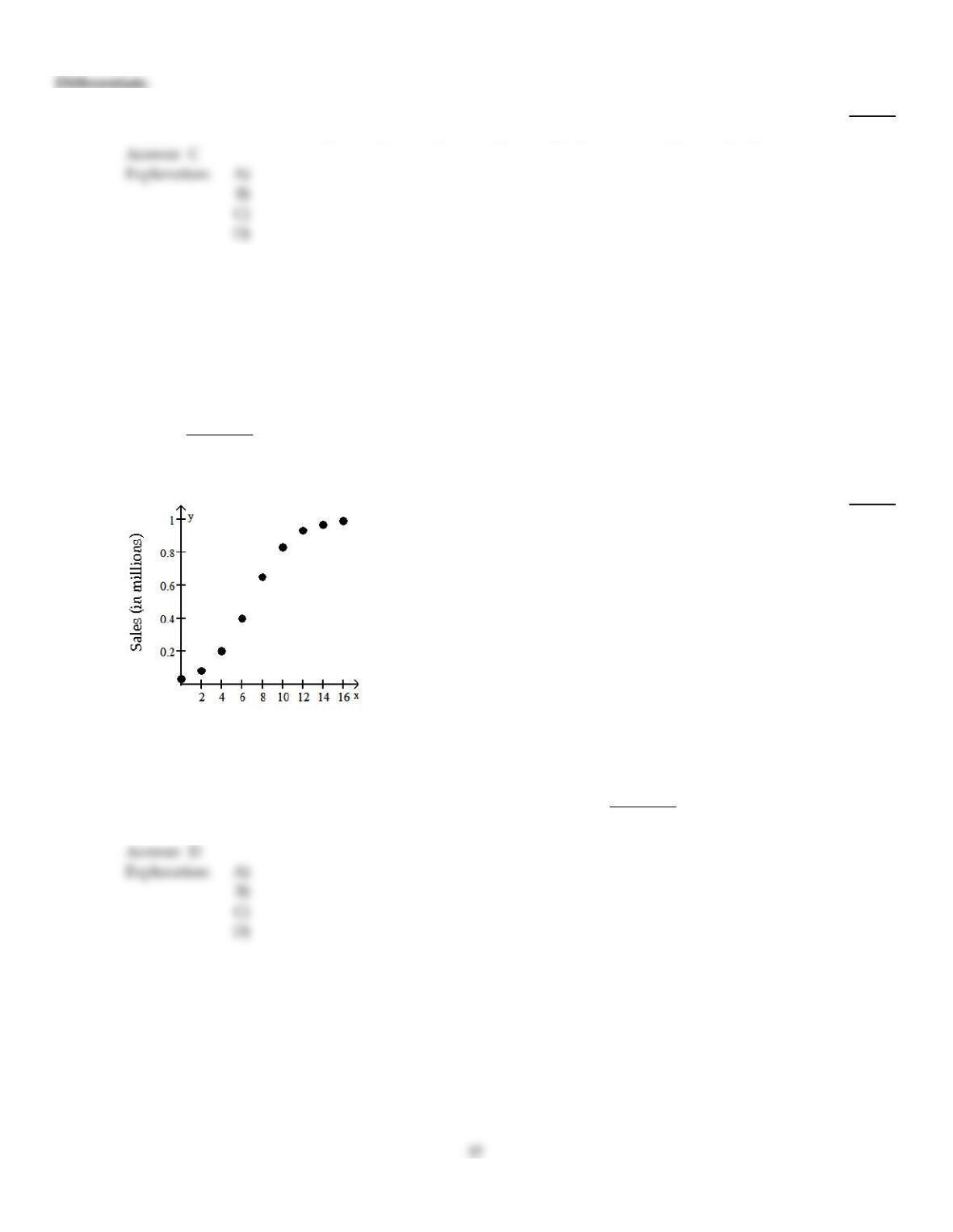
For the scatterplot below, determine which, if any, of the following functions might be used as a model for the data.
Quadratic: f(x) = ax2+ bx + c
Polynomial, not quadratic
Exponential, f(x) = aekx, k > 0
Exponential, f(x) = ae–kx, k > 0
Logarithmic, f(x) = a + b ln x
Logistic, f(x) =a
1 + be–kx
127)
Year
127)
A)
Logarithmic, f(x) = a + b ln x
B)
Quadratic, f(x) = ax2+ bx + c
C)
Exponential, f(x) = ae–kx, k > 0
D)
Logistic, f(x) =a
1 + be–kx
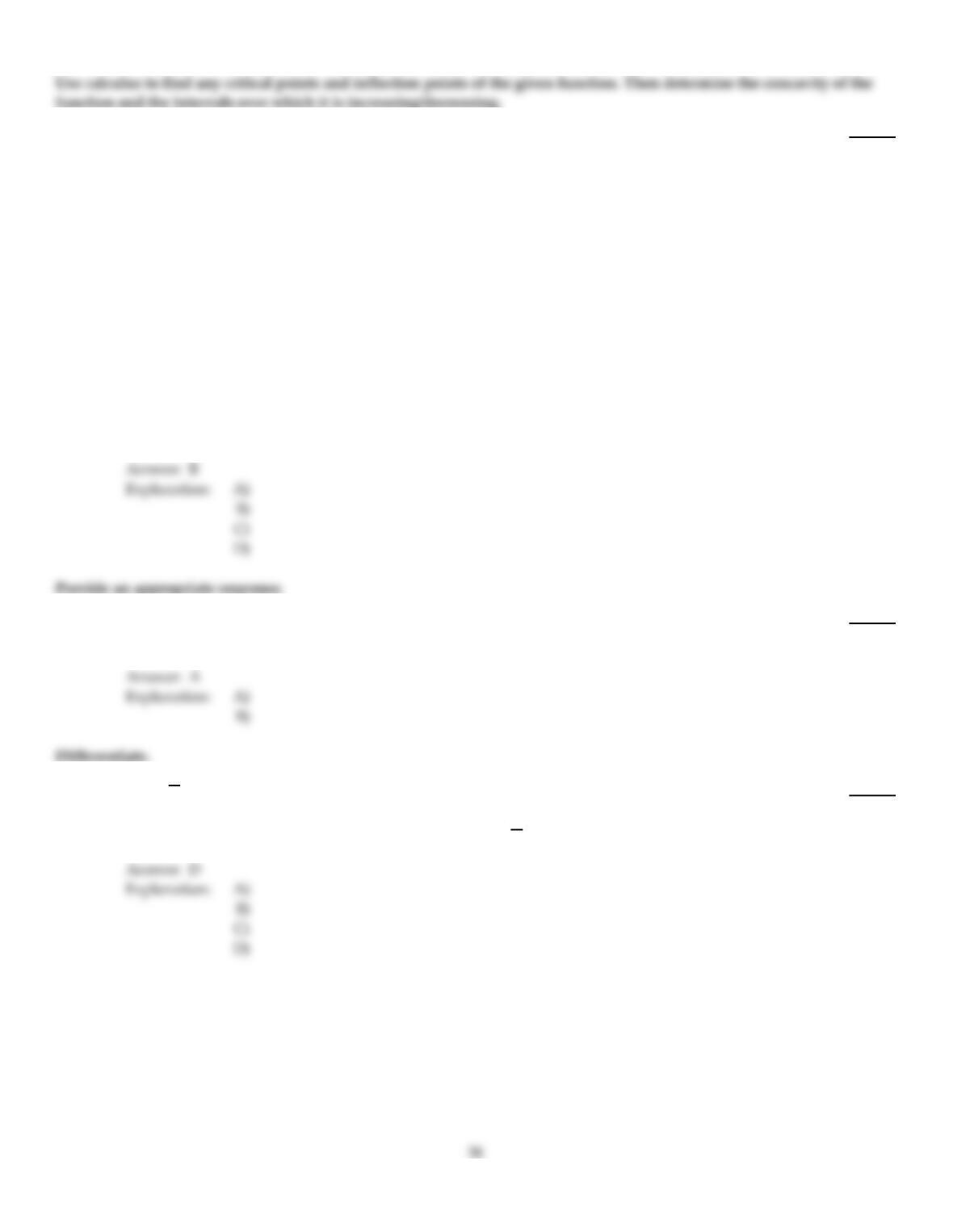
128)
f(x) =e(1/7)x
128)
A)
Critical points: none
Inflection points: point of inflection at x = 0
Concavity: concave down for all x < 0 and concave up for all x > 0
Increasing: increasing for all real numbers
B)
Critical points: none
Inflection points: none
Concavity: concave up for all real numbers
Increasing: increasing for all real numbers
C)
Critical points: critical point at x = 0
Inflection points: none
Concavity: concave up for all real numbers
Increasing: increasing for all x < 0 and decreasing for all x > 0
D)
Critical points: none
Inflection points: none
Concavity: concave down for all real numbers
Increasing: increasing for all real numbers
129)
True or false, for the graph of y =ex, the slope of the tangent line is the same as the function value
at any x.
129)
A)
True
B)
False
130)
f(x) =1
3e3x
130)
A)
ex/3
B)
3e3x
C)
1
3e3x
D)
e3x
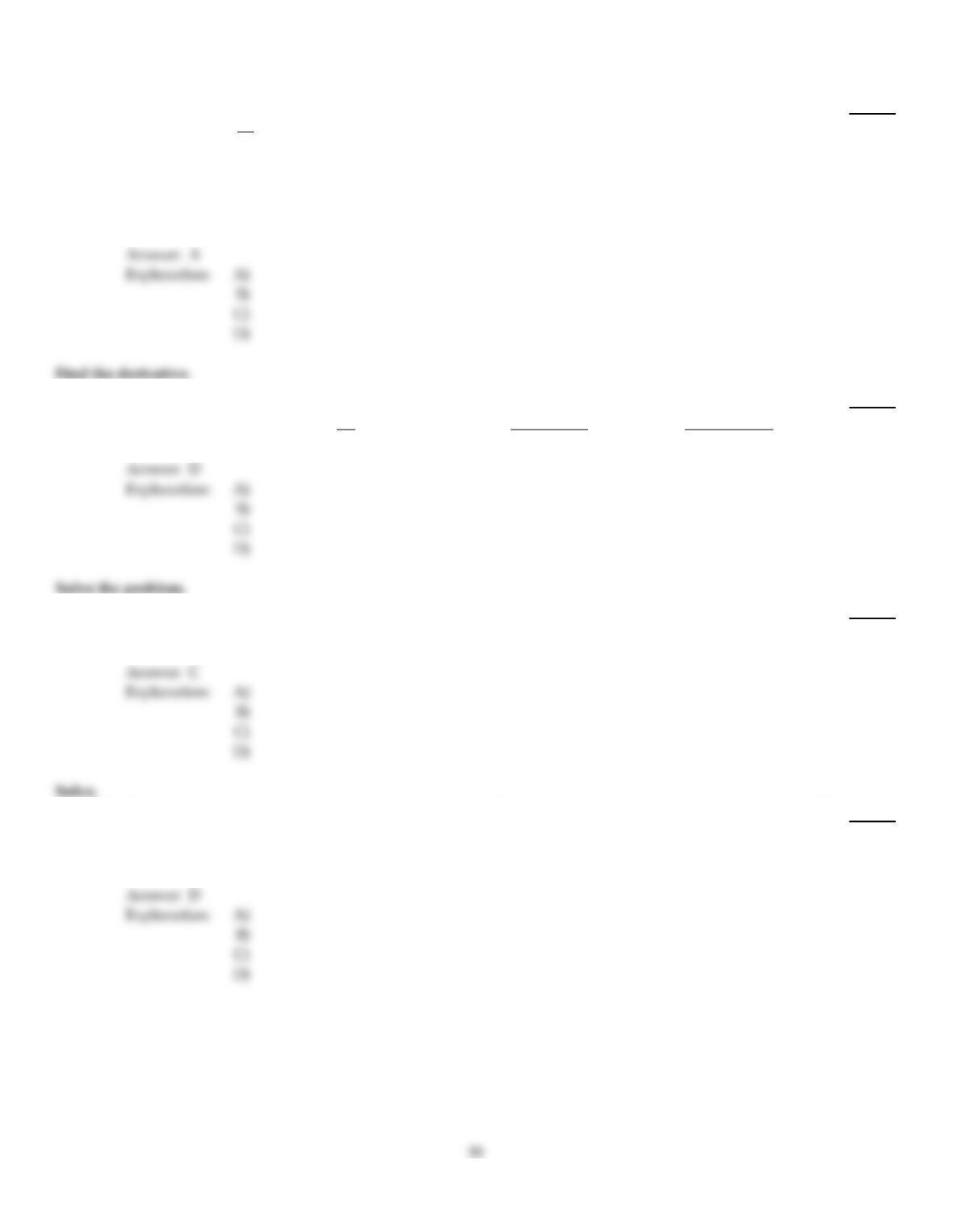
Solve the problem.
131)
The magnitude R (measured on the Richter scale) of an earthquake of intensity I is defined as
R = log I
I0.
where I0 is a minimum intensity used for comparison. What is the magnitude on the Richter scale
of an earthquake whose intensity, I, is 107I0 ?
131)
A)
7
B)
16.1
C)
0.8
D)
7 I0
132)
y = ex ln x
132)
A)
ex ln x
B)
ex
x
C)
ex(ln x + x)
x
D)
ex(x ln x + 1)
x
Solve the problem.
133)
A certain radioactive isotope has a half–life of approximately 2000 years. How many years to the
nearest year would be required for a given amount of this isotope to decay to 45% of that amount?
133)
A)
1100 years
B)
1725 years
C)
2304 years
D)
2259 years
134)
The coroner arrives at the scene of a murder at 11 p.m. She takes the temperature of the body and
finds it to be 86.7° F. She waits 1 hour, takes the temperature again, and finds it to be 84.9° F. She
notes that the room temperature is 67° F. When was the murder committed?
134)
A)
7 p.m.
B)
8 p.m.
C)
5 p.m.
D)
6 p.m.
Solve the problem.
135)
A radioactive substance has a decay rate of 2.1% per minute. Of an initial amount of 1000 g of the
substance, how much will remain after 70 minutes?
135)
A)
206.9 g
B)
310.4 g
C)
257.5 g
D)
229.9 g
136)
y =8xex–8ex
136)
A)
8xex
B)
8xex+16ex
C)
8x
D)
8ex
Solve the problem.
137)
An amount is invested at a certain growth rate, k, per year compounded continuously. The
doubling time is 14 years. What is the growth rate k?
137)
A)
9.7%
B)
4.95%
C)
7.39%
D)
5.71%
138)
Find the equation of the line tangent to the graph of y =e2x * ln(6x) at x =2 .
138)
A)
y =298.642x – 461.613
B)
y = –461.613x +135.671
C)
y = –461.613x +298.642
D)
y =298.642x +135.671
139)
y =4
5 x
139)
A)
B)
C)
D)
Write an equivalent exponential equation.
140)
log10 10,000,000 =7
140)
A)
107=10,000,000
B)
10,000,0007= 10
C)
710 =10,000,000
D)
10,000,00010 =7
141)
ln 97,100,000
141)
A)
0.0542
B)
18.3913
C)
7.9872
D)
6.8783
B
142)
y =e9x2+ x
142)
A)
18xe9x2+ 1
B)
18xe + 1
C)
18xe2x + 1
D)
18xex2+ 1
A
For the given function, find the requested relative extrema or extreme value.
143)
y =6ex+ xex; relative extrema
143)
A)
(7, 13e7), relative maximum
B)
(–6, 0), relative minimum
C)
(–7, –e–7), relative minimum
D)
(6, 12e6), relative maximum
C
42
A
Differentiate.
144)
f(x) =log7(x5+ 1)
144)
A)
1
(ln 7)(x5+ 1) +5x4
B)
5x4
(ln 7)(x5+ 1)
C)
5x4(ln 7)
(x5+ 1)
D)
5x4
(x5+ 1)
Find the value of the expression.
145)
Let logb A =1.613 and logb B =0.265. Find logbA
B.
145)
A)
1.878
B)
1.613
C)
0.427
D)
1.348
146)
True or false, for the graph of y =2x, the slope of the tangent line is the same as the function value
at any x.
146)
A)
True
B)
False
Solve the problem.
147)
Initially, a population of rabbits was found to contain 192 rabbits. It was estimated that the
population was growing exponentially at the rate of 10% per day. Estimate the population after 52
days.
147)
A)
181
B)
355
C)
3229
D)
34,804
148)
At what interest rate would a deposit of $30,000 grow to $70,895 in 20 years with continuous
compounding?
148)
A)
2.3%
B)
4.3%
C)
7.3%
D)
5.3%
149)
P = $1200; i = 12%; t = 2yr, compounded quarterly
149)
A)
$241.57
B)
$170.99
C)
$170.95
D)
$154.12
Solve the problem.
150)
The natural resources of an island limit the growth of the population to a limiting value of 2803.
The population of the island is given by the logistic equation
P(t) =2803
1 +4.67e–0.32t
where t is the number of years after 1980. What is the formula for the rate of change P'(t) ?
150)
A)
P'(t) =2803 –4188.8e–0.32t
(1 +4.67e–0.32t)2
B)
P'(t) =4188.8e–0.32t
(1 +4.67e–0.32t)2
C)
P'(t) =4188.8e–0.32t
1 +4.67e–0.32t
D)
P'(t) =13,090e–0.32t
(1 +4.67e–0.32t)2
151)
log525 =2
151)
A)
25=25
B)
525 =2
C)
252=5
D)
52=25
Solve the problem.
152)
A consumer group in one city compares the costs of goods and services in that city over various
years, and uses 1970 as a base. The same goods and services that cost $100 in 1970 cost $37 in 1941.
Assume the exponential–decay model in which t is the number of years before 1970. Estimate
what the same goods and services cost in 1900. (You will need to find the value of k)
152)
A)
$9
B)
$8
C)
$11
D)
$1080
153)
y =3–x
153)
A)
3–x
B)
–3–x
C)
(ln 3)3–x
D)
(–ln 3)3–x
154)
f(x) =e–(1/4)x
154)
A)
Critical points: none
Inflection points: point of inflection at x = 0
Concavity: concave down for all x < 0 and concave up for all x > 0
Decreasing: decreasing for all real numbers
B)
Critical points: critical point at x = 0
Inflection points: none
Concavity: concave up for all real numbers
Increasing: increasing for all x < 0 and decreasing for all x > 0
C)
Critical points: none
Inflection points: none
Concavity: concave up for all real numbers
Decreasing: decreasing for all real numbers
D)
Critical points: none
Inflection points: none
Concavity: concave down for all real numbers
Decreasing: decreasing for all real numbers
155)
The natural resources of an island limit the growth of the population to a limiting value of 3636.
The population of the island is given by the logistic equation
P(t) =3636
1 +4.39e–0.4t ,
where t is the number of years after 1980. What is the population of the island in 1983?
155)
A)
1566 people
B)
1487 people
C)
1409 people
D)
922 people
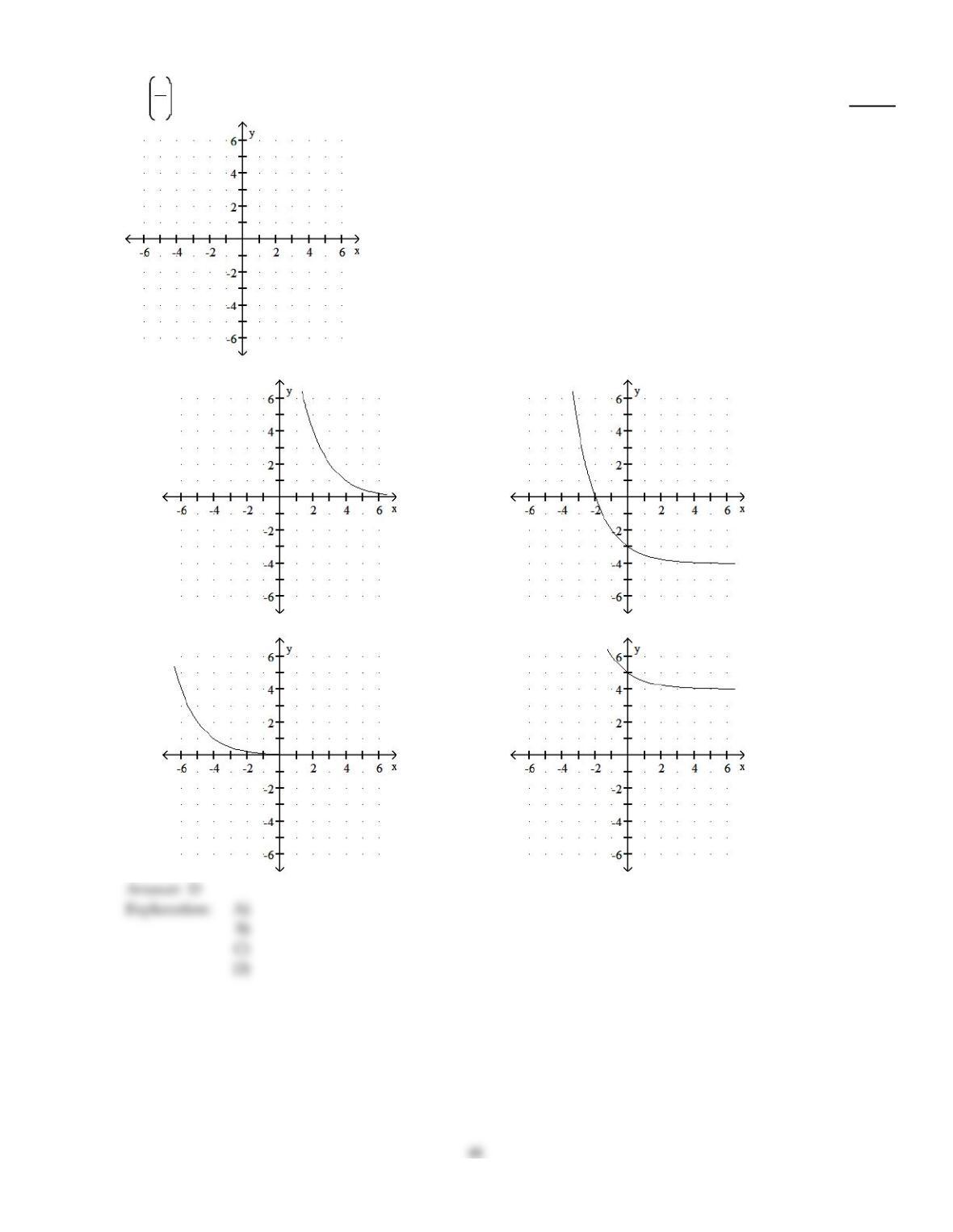
156)
y =1
2x+ 4
156)
A)
B)
C)
D)
157)
ln 20
157)
A)
3.9119
B)
2.3025
C)
2.23095028
D)
2.9956
158)
y =xln x
158)
A)
2 ln x
x
B)
(ln x)2
C)
xln x – 1ln x
D)
2xln x – 1ln x
159)
log71
343 = –3
159)
A)
7343=3
B)
(–3)7=1
343
C)
1
343 3=7
D)
7–3=1
343
160)
The number of employees of a company, N(t), who have heard a rumor t days after the rumor is
started is given by the logistic equation
N(t) =383
1 +53.6e–0.2t.
What is the rate of change N'(t) ?
160)
A)
N'(t) =4105.8e–0.2t
(1 +53.6e–0.2t)2
B)
N'(t) =383–4105.8e–0.2t
(1 +53.6e–0.2t)2
C)
N'(t) =4105.8e–0.2t
1 +53.6e–0.2t
D)
N'(t) =20,528.8e–0.2t
(1 +53.6e–0.2t)2
161)
Gretta wants to retire in 13 years. At that time she wants to be able to withdraw $12,500 at the end
of each 6 months for 15 years. Assume that money can be deposited at 8% per year compounded
semiannually. What exact amount will Gretta need in 13 years?
161)
A)
$408,849.63
B)
$212,296.37
C)
$219,856.12
D)
$216,150.38
162)
y =x6ln x –1
3x3
162)
A)
7x5–x2
B)
x6ln x –x2+6x5
C)
x5–x2+6x5ln x
D)
6x5–x2
163)
y = ln 1 +x
x3
163)
A)
–6–5 x
2x(1 +x)
B)
–6–5 x
2x
C)
–6–5 x
2(1 +x)
D)
–6–5 x
2x(1 –x)
164)
62=36
164)
A)
log 62=36
B)
log 636 =2
C)
log 36 6=2
D)
log 236 =6
Solve the problem.
165)
Management at a factory has found that the maximum number of units a worker can produce in a
week is given by P(t) =52 (1 –e–0.4t), where t is the number of weeks the worker has been on the
job. How many units can a worker produce in a week after being on the job for 3 weeks?
165)
A)
36 units
B)
68 units
C)
17 units
D)
6 units
166)
y =(x + 1)x
166)
A)
x(x + 1)x–1
B)
(x + 1)x ln(x + 1)
C)
(x + 1)xln(x + 1) +x
x + 1
D)
(x + 1)x–1ln(x + 1) +x
x + 1
Solve the problem.
167)
If a population doubles every 39 years, what is its growth rate to the nearest hundredth of a
percent?
167)
A)
1.78 % per year
B)
1.89 % per year
C)
17.77 % per year
D)
5.63 % per year
168)
The percentage P of doctors who accept a new medicine is given by
P(t) = 100(1 –e–0.16t),
where t = time in months. Find P’(2).
168)
A)
73%
B)
14%
C)
12%
D)
88%
Write an equivalent exponential equation.
169)
loge18 =2.890
169)
A)
e2.890 =18
B)
182.890 = e
C)
18e=2.890
D)
e18 =2.890
Solve the problem.
170)
A certain radioactive isotope decays at a rate of 0.3% annually. Determine the half–life of this
isotope, to the nearest year.
170)
A)
2 yr
B)
231 yr
C)
167 yr
D)
100 yr
B
171)
y =x8
8ln x –1
8
171)
A)
x7ln x
B)
x6
C)
x7ln x –x7
8
D)
x7ln x –1
8
A
172)
y = xe2x; relative extrema
172)
A)
(– 1/2, – 1/(2e)), relative minimum
B)
(1/2, e/2), relative minimum
C)
(– 1/2, – e/2), relative maximum
D)
(1/2, 1/(2e)), relative maximum
A
173)
The temperature of a hot liquid is 100° F and the room temperature is 70° F. The liquid cools to
95.9° F in 3 minutes. What is the temperature after 10 minutes? Round your answer to the nearest
degree.
173)
A)
89° F
B)
86° F
C)
87° F
D)
88° F
D
A
174)
10–2=0.01
174)
A)
log0.01 10 = –2
B)
log10 –2=0.01
C)
log–20.01 = 10
D)
log10 0.01 = –2
175)
Let I0 be the intensity of sound at the threshold of human hearing. The decibel level of a sound with
intensity I is given by
dB = 10 log10 I
I0 .
If the intensity of a sound increases by a factor of 30, how is the decibel level affected? Round your
answer to the nearest tenth.
175)
A)
The decibel level increases by 1.5.
B)
The decibel level increases by 2.5.
C)
The decibel level increases by 3.0.
D)
The decibel level increases by 14.8.
176)
Find the general form of f if f'(x) =5f(x).
176)
A)
f(x) =5ce5x
B)
f(x) = ce5x
C)
f(x) =5e5x
D)
f(x) =5c5x
177)
f(x) = ln x3– 4
x
177)
A)
2x3+ 4
x(x3– 4)
B)
3x2
x3– 4
C)
x
x3– 4
D)
3x2– 1
x(x3– 4)
178)
If a population has a growth rate of 7.5% per year, how long to the nearest tenth of a year will it
take the population to double?
178)
A)
9.9 years
B)
0.1 years
C)
0.9 years
D)
9.2 years
D
179)
y = (ln 3x)2
179)
A)
(–2, 0), relative minimum
B)
(3e, 0), relative minimum
C)
(1/3, 0), relative minimum
D)
(1, 0), relative minimum
C
180)
y = ln 6x2
180)
A)
2
x
B)
2x
x2+ 6
C)
12
x
D)
1
2x + 6
A
181)
A quantity Q1 grows exponentially with a tripling time of 1 year. A quantity Q2 grows
exponentially with a tripling time of 2 years. If the initial amounts of Q1 and Q2 are the same,
when will Q1 be three times the size of Q2 ?
181)
A)
after 9 years
B)
after 2 years
C)
after 1.5 years
D)
after 3 years
B
182)
f(x) =4 log x
182)
A)
4
x(ln 10)
B)
4(ln 10)
x
C)
1
x(ln 4)
D)
4
x(ln x)
A
183)
f(x) =9x
x
183)
A)
x ln 9–9x
x2
B)
9x– x ·9x· ln 9
x2
C)
x ·9x· ln 9–9x
x2
D)
x(9x) –9x
x2
184)
The decay of 955 mg of an isotope is given by A(t) =955e–0.016t, where t is time in years. Find the
amount left after 93 years.
184)
A)
940 mg
B)
216 mg
C)
212 mg
D)
108 mg
185)
y =24x – 4
185)
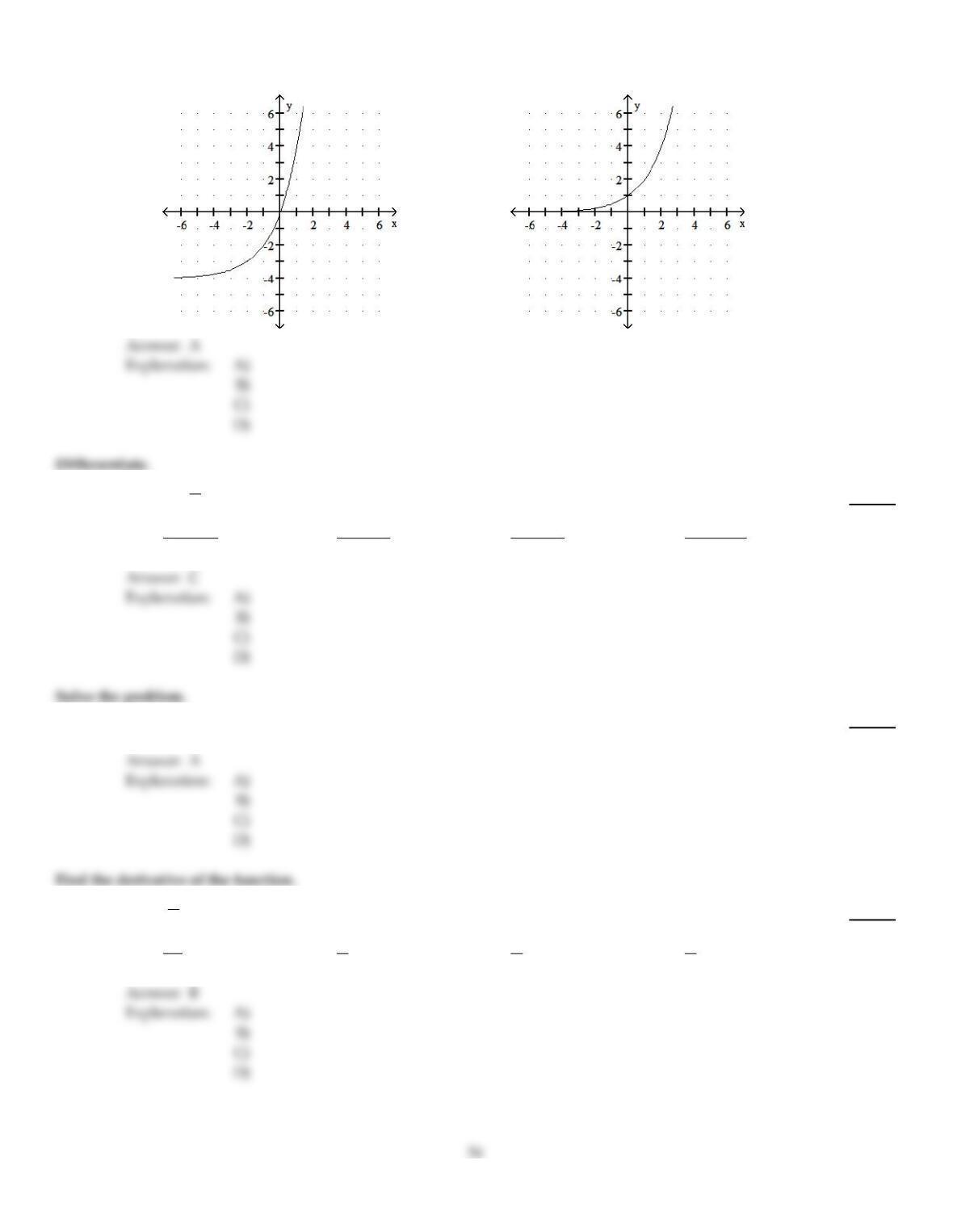
A)
B)
53
C)
D)
186)
f(x) = log x
6
186)
A)
1
6x(ln x)
B)
6
x(ln 10)
C)
1
x(ln 10)
D)
1
6x(ln 10)
187)
Find the present value of $57,000 due 15 years later at 8%, compounded continuously.
187)
A)
$17,168.07
B)
$16,206.66
C)
$285,000
D)
$189,246.66
188)
y = ln x
3
188)
A)
1
3x
B)
1
x
C)
1
x– ln 3
D)
3
x
Differentiate.
189)
y = ln 7+x2
189)
A)
ln x
x2+7
B)
1
2(x2+7)
C)
x
x2+7
D)
1
7+x2
190)
Which of the following statements regarding the graph of y =ex is false?
I. The graph lies above the x–axis for all values of x.
II. The graph is increasing over the entire real number line.
III. The graph is concave up over the entire real number line.
IV. The graph has an inflection point at x = 0.
190)
A)
II
B)
III
C)
IV
D)
I
191)
Let I0 be the intensity of sound at the threshold of human hearing. The decibel level of a sound with
intensity I is given by
dB = 10 log10 I
I0 .
If the decibel ratings of two sounds differ by 2, how do the intensities of the sounds compare?
Round your answer to the nearest tenth.
191)
A)
One sound is 1.3 times as loud as the other.
B)
One sound is 1.6 times as loud as the other.
C)
One sound is 1.2 times as loud as the other.
D)
One sound is 3.0 times as loud as the other.
192)
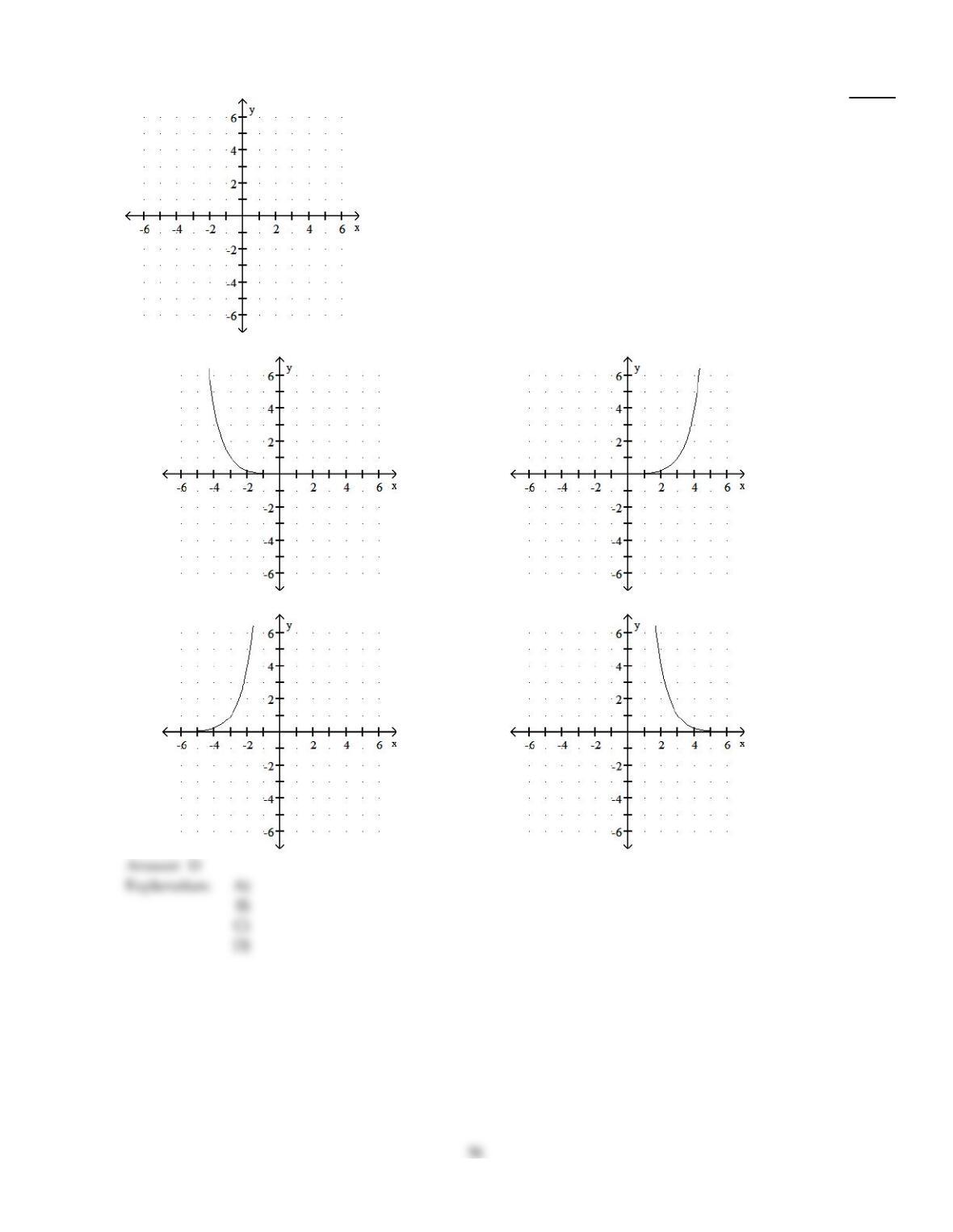
y =43– x
192)
A)
B)
C)
D)
Solve the problem.
193)
An artifact is discovered at a certain site. If it has 72% of the carbon–14 it originally contained, what
is the approximate age of the artifact? (carbon–14 decays at the rate of 0.0125% annually.) (Round
to the nearest year.)
193)
A)
1141 yr
B)
5760 yr
C)
2240 yr
D)
2628 yr
194)
y = ln (ln 6x)
194)
A)
1
6x
B)
1
x
C)
1
ln 6x
D)
1
x ln 6x
Solve the problem.
195)
The supply and demand for the sale of television sets by an electronics company are given by
S(p) = ln p and D(p) = ln 177,000
p,
where S(p) = the number of television sets that the company is willing to sell at $p and D(p) = the
quantity that the public is willing to buy at $p. Find the equilibrium point.
195)
A)
$421
B)
$461
C)
$399
D)
$498
196)
Find the general form of the function that satisfies the equation dN
dt = kN.
196)
A)
N(t) = cekt
B)
t = cekN
C)
k =etc
D)
N = cekx
197)
e0.06t=3
197)
A)
50
B)
18.31
C)
7.952
D)
0.066
198)
–log29 X = Y
198)
A)
29–Y= X
B)
Y–X=29
C)
29X= –Y
D)
XY= –29
199)
Suppose that the population of a town can be approximately modeled by the formula
P =4 ln 5t +7 where t is the time in years after 1980 and P is the population of the town in
thousands. Find an expression for dP/dt in terms of t.
199)
A)
dP/dt =4
5t +7
B)
dP/dt =2
5t +7
C)
dP/dt =10 ln 5t +7
5t +7
D)
dP/dt =10
5t +7
200)
The natural resources of an island limit the growth of the population. The population of the island
is given by the logistic equation
P(t) =2520
1 +3.71e–0.3t
where t is the number of years after 1980. What is the limiting value of the population?
200)
A)
535 people
B)
2520 people
C)
672 people
D)
10 people
201)
A radioactive substance has a half–life of 43,800 years. What is its decay rate?
201)
A)
0.0000158% per year
B)
0.000913% per year
C)
0.00158% per year
D)
0.0000183% per year
202)
f(x) =e–2x
202)
A)
Critical points: critical point at x = 0
Inflection points: none
Concavity: concave up for all real numbers
Increasing: increasing for all x < 0 and decreasing for all x > 0
B)
Critical points: none
Inflection points: none
Concavity: concave down for all real numbers
Decreasing: decreasing for all real numbers
C)
Critical points: none
Inflection points: point of inflection at x = 0
Concavity: concave down for all x < 0 and concave up for all x > 0
Decreasing: decreasing for all real numbers
D)
Critical points: none
Inflection points: none
Concavity: concave up for all real numbers
Decreasing: decreasing for all real numbers
203)
A business estimates that the salvage value V of a piece of machinery after t years is given by
V(t) = $30,000e–43t.
Find the formula for the rate of change of the salvage value.
203)
A)
V'(t) = –1,290,000e–t
B)
V'(t) =30,000e–43t
C)
V'(t) =1,290,000e–43t
D)
V'(t) = –1,290,000e–43t
204)
P = $8000; i = 9%; t = 5 yr, compounded semiannually
204)
A)
$1011.03
B)
$1009.88
C)
$1100.59
D)
$1246.55
205)
f(t) = ln (t3+ t)5
205)
A)
5 ln (t3+ t)4
B)
5
t3+ t
C)
1
(t3+ t)5
D)
5(3t2+ 1)
t3+ t
206)
52=25
206)
A)
log 52=25
B)
log 25 5=2
C)
log 525 =2
D)
log 225 =5
207)
Management at a factory has found that the maximum number of units a worker can produce in a
week is given by P(t) =51 (1 –e–0.3t), where t is the number of weeks the worker has been on the
job. Find the rate of change P(t).
207)
A)
P(t) =15.3 e–0.3t
B)
P(t) = – 15.3 e–0.3t
C)
P(t) =51 e–0.3t
D)
P(t) =51 (1 +0.3e–0.3t)
208)
y =ex
7x2+8
208)
A)
ex+7x2–14x +8
(7x2+8)2
B)
ex(7x2–14x +8)
(7x2+8)2
C)
ex–1(7x2–14x +8)
(7x2+8)2
D)
ex–1(7x2+8) –14x ex
(7x2+8)2
209)
A business estimates that the salvage value V of a piece of machinery after t years is given by
V(t) = $36,000e–0.42t.
After what amount of time will the salvage value be $639?
209)
A)
After 9.6 years
B)
After 8.6 years
C)
After 10.6 years
D)
After 11.6 years
210)
f(x) =e7x
210)
A)
Critical points: none
Inflection points: none
Concavity: concave down for all real numbers
Decreasing: decreasing for all real numbers
B)
Critical points: none
Inflection points: none
Concavity: concave up for all real numbers
Increasing: increasing for all real numbers
C)
Critical points: critical point at x = 0
Inflection points: none
Concavity: concave up for all real numbers
Increasing: increasing for all x < 0 and decreasing for all x > 0
D)
Critical points: none
Inflection points: point of inflection at x = 0
Concavity: concave down for all x < 0 and concave up for all x > 0
Increasing: increasing for all real numbers
211)
The initial weight of a starving animal is W0. Its weight after t days is given by
W =W0e–0.005t.
What percentage of its initial weight remains after 22 days?
211)
A)
10.4%
B)
93.2%
C)
89.6%
D)
84.2%
212)
y =ex
ln x
212)
A)
ex+ x ex ln x
x
B)
x ex
C)
x ex ln x –ex
x ln2x
D)
ex– x ex ln x
x ln2x
213)
ln 5
8
213)
A)
3.6887
B)
0.4699
C)
0.77401048
D)
–0.4699
214)
y =x ln x – 1
(ln x)2
214)
A)
(ln x)2– ln x + 2
(ln x)3
B)
(ln x)2– ln x + (2/x)
(ln x)3
C)
(ln x)2– 2 ln x + (2/x)
(ln x)3
D)
(ln x)2+ (2/x)
(ln x)3
215)
y = xe–x+3e–x; maximum value on [–3, 0]
215)
A)
0
B)
6e–3
C)
5e2
D)
e2
216)
y =x2e3x; maximum value on [–2, 0]
216)
A)
2
3e–2
3
B)
1
36e1/2
C)
0
D)
4
9e–2
217)
The Fergusons borrow $153,200 to purchase a new home. They finance the amount through a 25–yr
mortgage at an annual interest rate of 9.5%, compounded monthly. Determine the portion of
payment applied to principal in the second month.
Balance Payment
Portion of
payment
applied
to interest
Portion of
payment
applied
to principal New
balance
______ ______ ______ ______ ______
______ ______ ______ ______ ______
217)
A)
$1211.84
B)
$126.67
C)
$125.67
D)
$150.40
218)
f(x) =x6
2lnx
218)
A)
(0, 0), relative minimum
B)
(0, 0), relative maximum; e1/6, 3e , relative minimum
C)
e–1/6, – 3e–1, relative minimum
D)
e1/6, 3e , relative minimum
219)
f(x) =9x3
219)
A)
3(x2) 9x3
B)
ln 9 9x3
C)
9ln 3(x2) 9x3
D)
3ln 9(x2) 9x3
220)
Of the graphs listed below, which rises the fastest for large values of x? Which rises the slowest for
large values of x?
the graph of y =x3
the graph of y =3x
the graph of y =log3 x
220)
A)
y =log3 x; y =x3
B)
y =3x; y =log3 x
C)
y =3x; y =x3
D)
y =x3; y =log3 x
221)
y =e6–6x
221)
A)
e–6
B)
–6e6–6x
C)
6e6–6x
D)
–6 ln (6–6x)
222)
The Hogans borrow $77,000 to purchase a new home. They finance the amount through a 15–yr
mortgage at an annual interest rate of 8.5%, compounded monthly. Complete the first line of an
amortization schedule for the situation, using the given table.
Balance Payment
Portion of
payment
applied
to interest
Portion of
payment
applied
to principal New
balance
$77,000 $758.25 (a)______ (b)______ (c)______
222)
A)
(a) $532.48
(b) $225.77
(c) $76,774.23
B)
(a) $545.42
(b) $212.83
(c) $76,454.58
C)
(a) $545.42
(b) $240.67
(c) $76,759.33
D)
(a) $545.42
(b) $212.83
(c) $76,787.17
Differentiate.
223)
y =6e4x +6
223)
A)
1
2 6e4x +6
B)
3e4x
6e4x +6
C)
12e4x
6e4x +6
D)
1
2 24e4x
Solve.
224)
Find the equation of the line tangent to the graph of y = (x2– x) ln (8x) at x =2 .
224)
A)
y = –13.091x + 9.318
B)
y = –13.091x + 5.545
C)
y =9.318x – 13.091
D)
y =9.318x + 5.545
Differentiate.
225)
y =log2 x
225)
A)
1
x(log 2)
B)
1
x(ln x)
C)
1
x(ln 2)
D)
ln 2
x
Solve.
226)
A beam of light enters sea water with initial intensity I0. Its intensity at a depth of x meters is given
by
I =I0e–1.4x.
What percentage of I0 remains at a depth of sea water of 1.5 meters?
226)
A)
11%
B)
12.2%
C)
11.5%
D)
87.8%
Solve the problem.
227)
The demand function for a certain product is given by
D(p) =200e–0.1p,
where p is price per unit. Recall that total revenue is given by R(p) = pD(p). At what price per unit
p will the revenue be maximum?
227)
A)
$5
B)
$10
C)
$20
D)
$9
228)
y = ln (9x3– x2)
228)
A)
9x – 2
9x2– x
B)
27x – 2
9x3– x
C)
27x – 2
9x2– x
D)
27x – 2
9x2
229)
Atmospheric pressure P at altitude a is given by P =P0e–0.00006a, where P0 is the pressure at sea
level. Assume that P0= 14.7 lb/in2 (pounds per square inch).
Find the pressure at an altitude of 12,000 ft. At what altitude is the pressure 14.7 lb/in2?
229)
A)
7.155 lb/in2; 100 ft
B)
7.155 lb/in2; 0 ft
C)
7.301 lb/in2; 0 ft
D)
7.155 lb/in2; 10 ft
230)
e–t=0.03
230)
A)
–0.011
B)
–0.082
C)
3.507
D)
–3.507
231)
Let logb A =2 and logb B = –4. Find logbA
B.
231)
A)
–2
B)
6
C)
–1
2
D)
1
2
232)
A model for advertising response is given by
N(a) =1000 +700 ln a, a 1
where N(a) = the number of units sold and a = the amount spent on advertising, in thousands of
dollars. How many units are sold after spending $4000 (a =4) on advertising?
232)
A)
1970
B)
1776
C)
6805
D)
1421
233)
Which of the following statements regarding the graph of y =2–x is false?
I. The graph lies above the x–axis for all values of x.
II. The graph is decreasing over the entire real number line.
III. The graph is concave down over the entire real number line.
IV. The graph has no critical points.
233)
A)
IV
B)
III
C)
I
D)
II
234)
P = $120,000; i = 8%; t = 10 yr, compounded annually
234)
A)
$19,209.53
B)
$17,880.82
C)
$16,809.08
D)
$17,883.49
235)
y = ex5 ln x
235)
A)
ex5+5ex5 ln x
x
B)
ex5+5x4 ex5 ln x
x
C)
ex5+5x5 ex5 ln x
x
D)
5x5 ex5+ 1
x
236)
y =6x
236)
A)
(ln x)6x
B)
6x
C)
(ln 6)6x
D)
(log 6)6x
237)
y = ln (7+ x2)
237)
A)
1
2x + 7
B)
2
x
C)
14
x
D)
2x
x2+ 7
238)
f(x) =x46x
238)
A)
4x36x+ (ln x) ·x4·6x
B)
4x36x+x46x
C)
4· (ln 6) ·x36x
D)
4x36x+ (ln 6) ·x4·6x
Solve.
239)
In a chemical reaction, substance A decomposes at a rate proportional to the amount of A present.
It is found that 10 g of A will reduce to 5 g in 3.5 hours. After how long will there be only 1 g left?
239)
A)
15.8 hours
B)
8.1 hours
C)
8.8 hours
D)
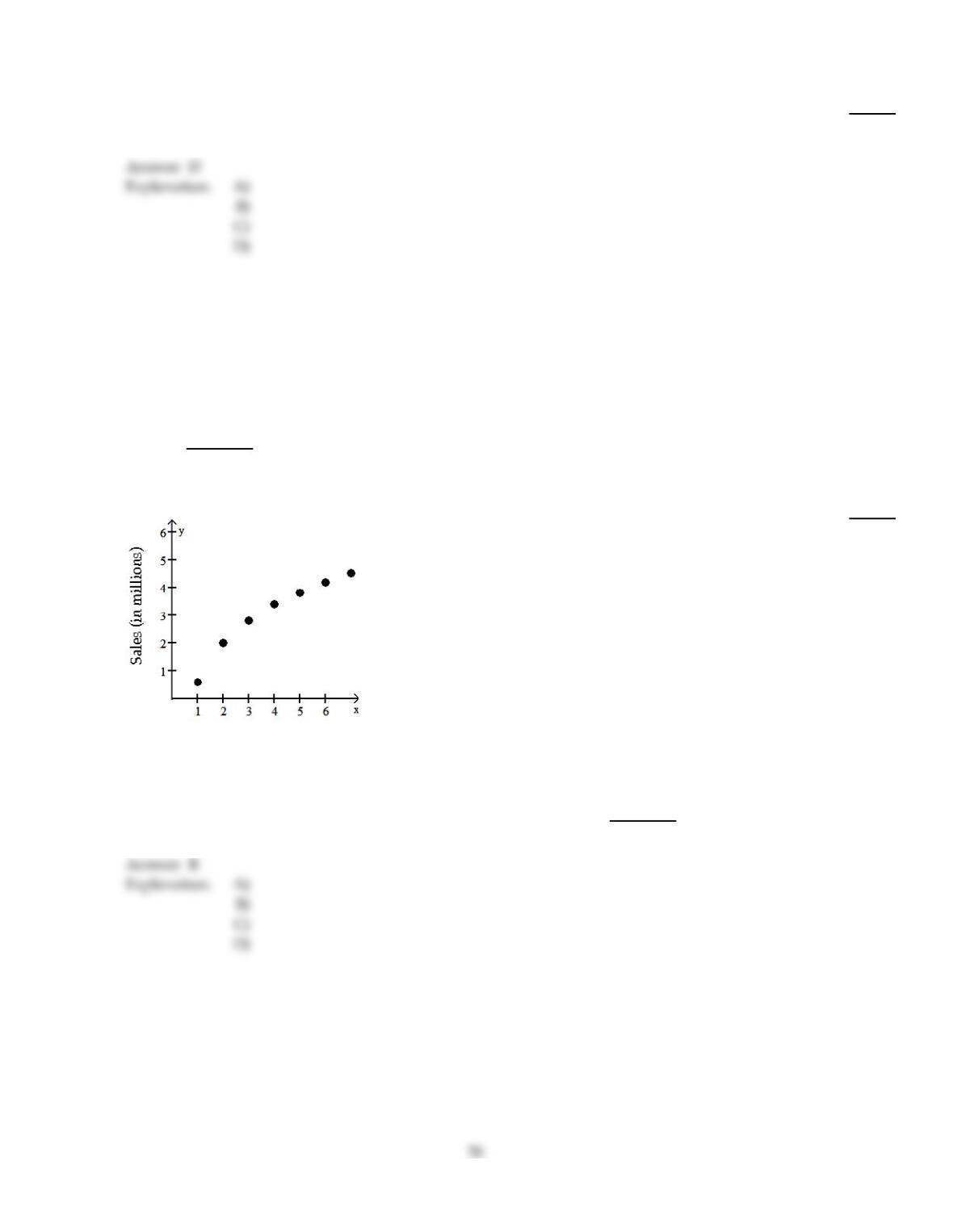
11.6 hours
For the scatterplot below, determine which, if any, of the following functions might be used as a model for the data.
Quadratic: f(x) = ax2+ bx + c
Polynomial, not quadratic
Exponential, f(x) = aekx, k > 0
Exponential, f(x) = ae–kx, k > 0
Logarithmic, f(x) = a + b ln x
Logistic, f(x) =a
1 + be–kx
240)
Year
240)
A)
Exponential, f(x) = aekx, k > 0
B)
Logarithmic, f(x) = a + b ln x
C)
Exponential, f(x) = ae–kx, k > 0
D)
Logistic, f(x) =a
1 + be–kx
Provide an appropriate response.
241)
Which of the following statements regarding the graph of y = log x is false?
I. The graph lies below the x–axis for 0 < x < 1.
II. The graph is increasing over the entire real number line.
III. The graph is concave down over the entire real number line.
IV. The domain is [0, ).
241)
A)
IV
B)
II
C)
I
D)
III
242)
ln 50
242)
A)
2.9956
B)
3.9119
C)
1.1155
D)
2.231
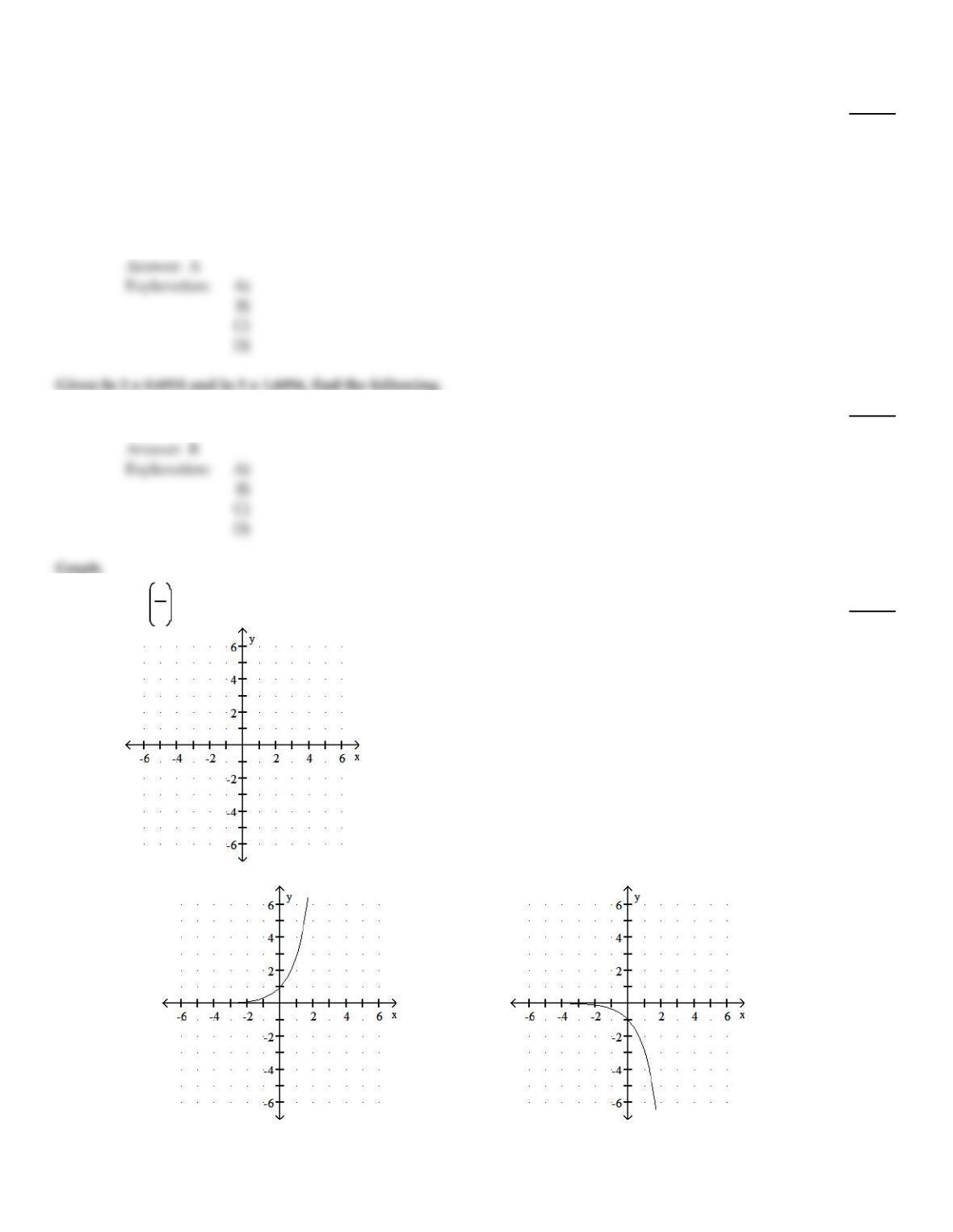
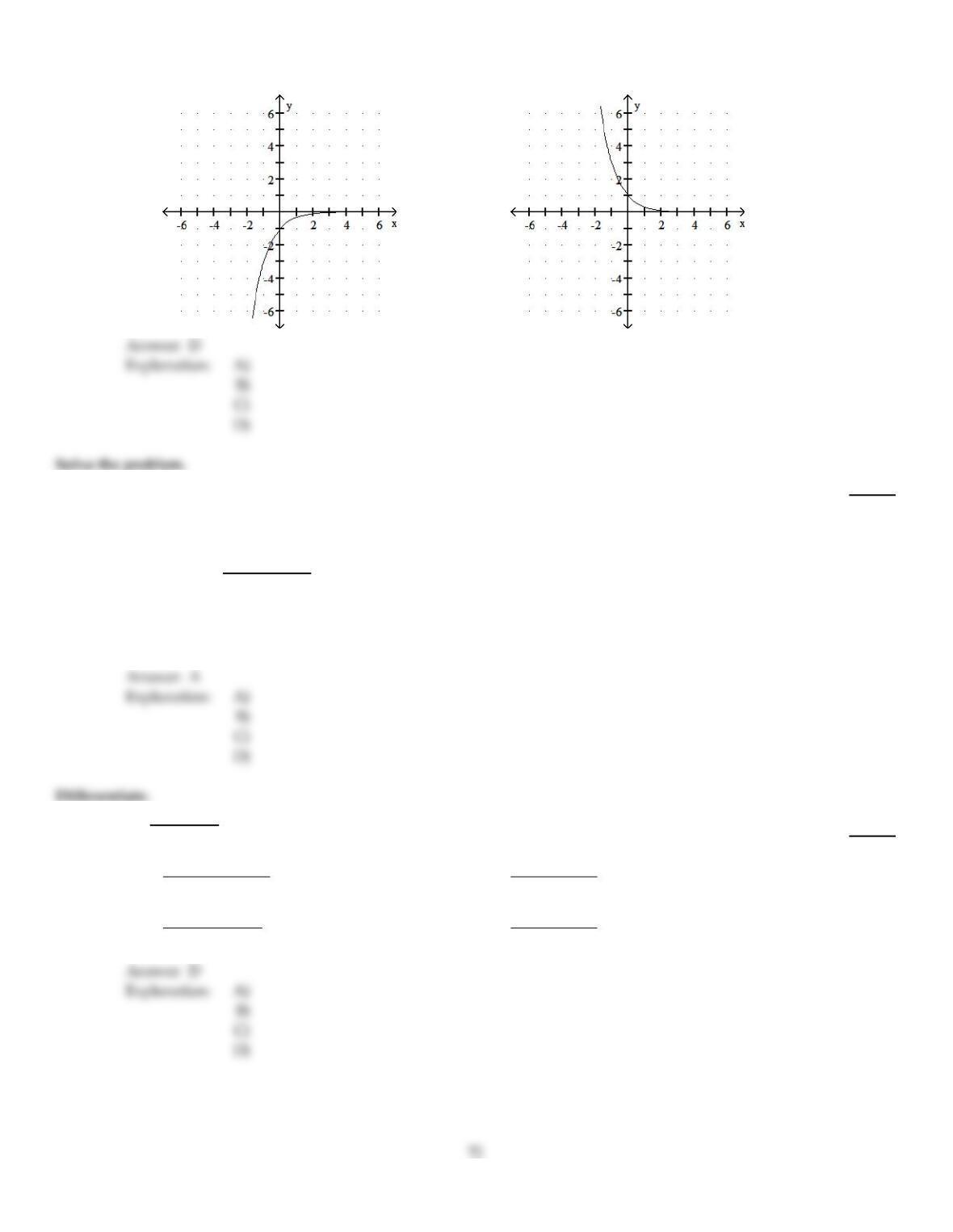
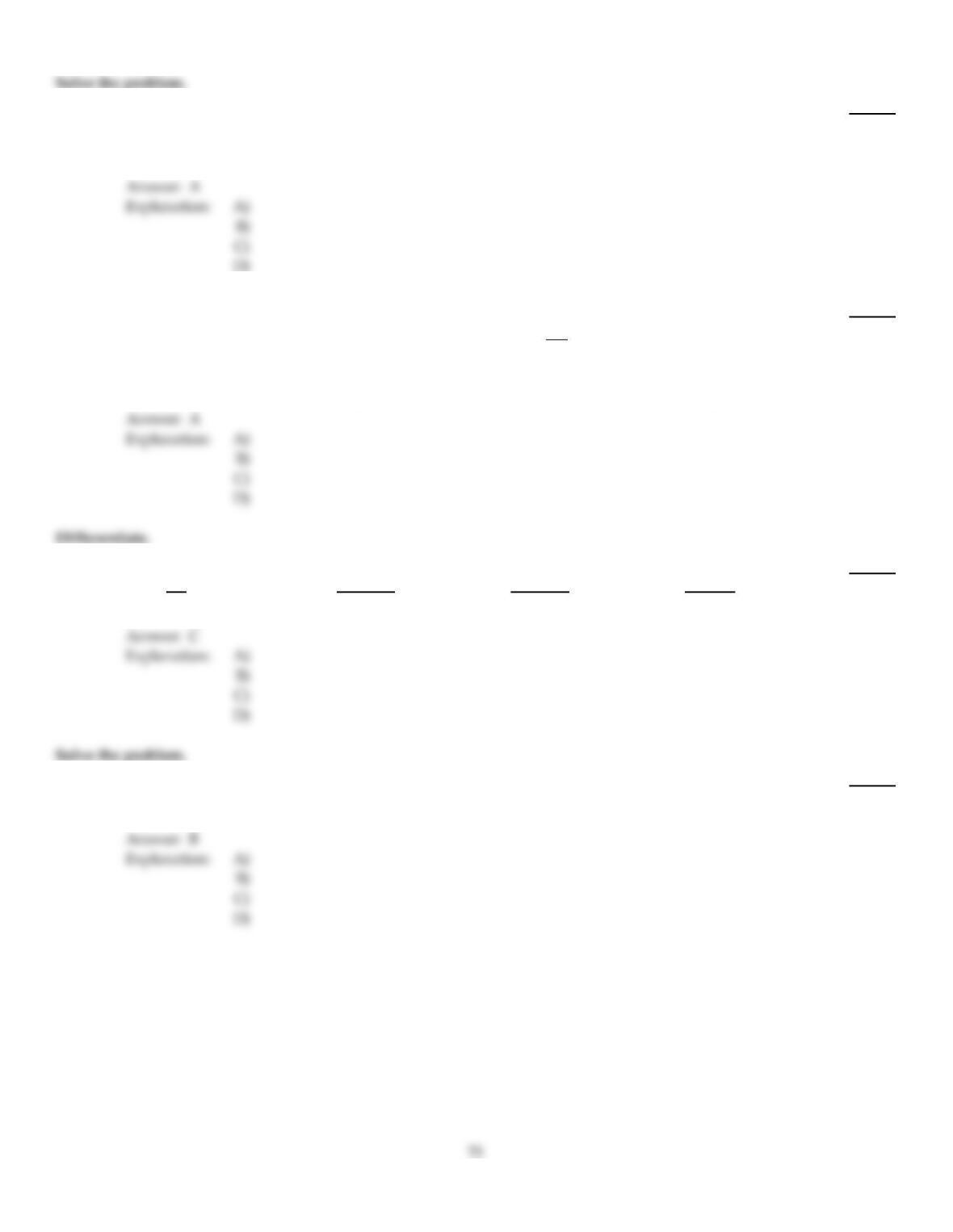
243)
y =1
3x
243)
A)
B)
71
C)
D)
244)
A pharmaceutical company introduces a new headache medication on the market. They advertise
the product on television and find that the percentage P of people who buy the product after t
weeks satisfies the function
P(t) =100%
1 +40e–0.14t.
What percentage buy the product after 4 weeks?
244)
A)
4.2%
B)
3.4%
C)
5%
D)
4.6%
245)
y =100
2 + 9e0.3x
245)
A)
200 + 1170e0.3x
(2 + 9e0.3x)2
B)
270e0.3x
(2 + 9e0.3x)2
C)
200 + 630e0.3x
(2 + 9e0.3x)2
D)
–270e0.3x
(2 + 9e0.3x)2
246)
In 1990, a company‘s profit was 44.6 million dollars. In 2000, the company’s profit was 121.2 million
dollars. Assume that the growth of the company’s profit follows the exponential model and use
1990 as the base (t = 0). Estimate what the company’s profit will be in 2010.
246)
A)
$329.6 million
B)
$593.2 million
C)
$247.2 million
D)
$659.1 million
247)
Suppose that P0 is invested in a savings account in which interest is compounded continuously at
5.5% per year. That is, the balance P grows at the rate given by dP
dt =0.055P. Suppose that $9000 is
invested. When will the investment double?
247)
A)
12.6 years
B)
0.3 years
C)
18.9 years
D)
25.2 years
248)
y =(ln x)–6
248)
A)
–6
x7
B)
–6
x (ln x)5
C)
–6
x (ln x)7
D)
–6
(ln x)7
249)
Find the tripling time for an amount invested at a growth rate 6% per year compounded
continuously.
249)
A)
11.6 years
B)
18.3 years
C)
6.6 years
D)
20 years
250)
The Jeffersons borrow $152,400 to purchase a new home. They finance the amount through a 25–yr
mortgage at an annual interest rate of 9.5%, compounded monthly. Determine the new balance at
the end of the second month.
Balance Payment
Portion of
payment
applied
to interest
Portion of
payment
applied
to principal New
balance
______ ______ ______ ______ ______
______ ______ ______ ______ ______
250)
A)
$151,996.58
B)
$152,148.98
C)
$152,274.99
D)
$151,194.49
251)
Find the tangent line to the graph of f(x) =7e4x at the point (0, 7).
251)
A)
y =7x +7
B)
y = –28x +7
C)
y =28x +7
D)
y =4x +7
252)
f(x) = x(7.4)x
252)
A)
(7.4)x+ x(7.4x)
B)
(7.4)x+ (ln 7.4)7.4x
C)
(ln 7.4) · x ·7.4x
D)
(7.4)x+ (ln 7.4) · x ·(7.4)x
253)
Suppose that P0 is invested in a savings account in which interest is compounded continuously at
5.9% per year. That is, the balance P grows at the rate given by dP
dt =0.059P. Suppose that $8000 is
invested. What is the balance after 3 years?
253)
A)
$4774.52
B)
$2387.26
C)
$7161.79
D)
$9549.05
254)
Tasha borrows $13,000 to purchase a new car. She finances the amount through an amortized loan
at an annual interest rate of 7.2%, compounded monthly for 3 yr. How much interest does Tasha
pay over the life of the loan. Round the final answer to the nearest dollar.
254)
A)
$1044
B)
$2892
C)
$1493
D)
$78
255)
Tasha borrows $9000 to purchase a new car. She finances the amount through an amortized loan at
an annual interest rate of 9.9%, compounded monthly for 3 yr. Find Tasha’s monthly car payment?
255)
A)
$74.25
B)
$24.75
C)
$289.98
D)
$339.88
256)
eY=B
256)
A)
logeB=Y
B)
logYB= e
C)
logeY=B
D)
logB e =Y
Answer Key
Testname: C3
Answer Key
Testname: C3
Answer Key
Testname: C3
Answer Key
Testname: C3
Answer Key
Testname: C3

Answer Key
Testname: C3