CHAPTER 3: COST BEHAVIOR
1. Costs can display variable, fixed, or mixed behavior, and it important that they are classified accurately.
a. True
b. False
2. A cost that does not change as output changes is a variable cost, and one that changes is a fixed cost.
a. True
b. False
3. A cost object is the item for which managers want cost information, so the first step is to determine
appropriate cost objects.
a. True
b. False
4. Fixed costs are costs that, in total, are constant within the relevant range as the level of the associated driver varies.
a. True
b. False
5. Variable costs are defined as costs that, in total, are constant regardless of change in an activity driver.
a. True
b. False
6. Mixed costs are costs that have both a fixed and a variable component.
a. True
b. False
7. Resources, such as direct materials, direct labor, electricity, equipment, and so on, are economic elements
that enable one to perform activities.
a. True
b. False

Chapter 3: Cost Behavior
8. The level of activity performance where the amount of activity capacity needed corresponds to the level
of efficiency required is called the activity capacity.
a. True
b. False
9. Resources are categorized as flexible, which are supplied as needed, and committed, which are supplied in advance
of usage.
a. True
b. False
10. Activity-based use of resources can improve both managerial control and decision making because it
encourages managers to pay more attention to controlling resource usage and spending.
a. True
b. False
11. Methods of estimating costs used by companies include the industrial engineering method, the account analysis
method, and the instant decision method.
a. True
b. False
12. The industrial engineering method is used to determine which activities, and in what amounts, are necessary
to complete a process.
a. True
b. False
13. The account analysis method can be used to estimate costs by classifying accounts in the general ledger
as variable.
a. True
b. False

Chapter 3: Cost Behavior
14. The three widely used quantitative methods of separating a mixed cost into its fixed and variable components
are the high-low method, the scatter plot method, and the method of least squares.
a. True
b. False
15. The high-low method preselects the two points that are used to compute the parameters F and X in the
expression Y = F + VX
a. True
b. False
16. The plot of data points showing the relationship between materials handling costs and activity output is called a
scattergraph.
a. True
b. False
17. In the method of least squares, each single measure of closeness is first squared. Squaring the deviations avoids
problems caused by a mix of positive and negative numbers.
a. True
b. False
18. A feature of regression routines, not provided by the scatter plot of high–low methods, is to provide information to
and in the assessment of reliability of the estimated costs formula.
a. True
b. False
19. The percentage of variability in the dependent variable explained by an independent variable (i.e. measure of
activity output) is called the coefficient of correlation.
a. True
b. False
20. An alternative measure of goodness of fit is the coefficient of determination.
a. True
b. False
Chapter 3: Cost Behavior
21. Finding a strong statistical association between an activity cost and an activity driver can provide evidence
to managers about the correctness of a driver selection.
a. True
b. False
22. Whenever least squares is used to fit an equation involving two or more independent variables, the method is
called multiple regression.
a. True
b. False
24. Multiple regression is a dependable tool for identifying the behavior of activity costs.
a. True
b. False
25. Multiple regression can be useful to assess cost behavior when dependent variable is affected by only one
independent variable.
a. True
b. False
26. A number of cost behavior patterns do not follow a linear pattern, instead, they follow a nonlinear cost curve called
the learning curve.
a. True
b. False
27. Managers agree that the ideas behind the learning curve can extend to the service industry only.
a. True
b. False

Chapter 3: Cost Behavior
28. The basis of the learning curve is that as we perform an action over and over, we improve, and each additional
performance takes less time than the preceding ones.
a. True
b. False
29. The experience curve relates cost to increased efficiency, such that the more a task is performed, the lower the
cost of doing will be.
a. True
b. False
30. The cumulative average–time learning curve model states that the cumulative average time per unit increases by a
constant percentage.
a. True
b. False
31. The most widely used method to determine cost behavior is managerial judgement.
a. True
b. False
32. Managerial judgement includes the possibility of mixed costs.
a. True
b. False
33.
Before opting to use managerial judgment, management should make sure that each cost is predominantly fixed or
variable.
a. True
b. False
Chapter 3: Cost Behavior
34. Based on managerial judgement, the best predictor of manufacturing costs is the units available.
a. True
b. False
35. If a company changes from skilled labor to robots, the previous data are of little value in predicting future costs.
a. True
b. False
36. explain changes in costs as units produced change.
37. explain changes in cost factors other than changes in units produced.
38. analysis focuses on how costs react to changes in activity levels.
39. are assumed to be the sole drivers of a traditional cost management system.
40. result when organizations acquire many multiperiod service capacities by paying cash up front.
41. are those acquired from outside sources where the terms of acquisition do not require any long-term
commitments.
42. are costs incurred that provide long-term activity capacity.
43. A function displays a constant level of cost for a range of output and then jumps to a higher level.
Chapter 3: Cost Behavior
44. Costs that follow a step-cost behavior are defined as costs.
45. The analysis method is a method of determining cost behavior.
46. The method may be used to determine the activities and amounts for cost behavior.
47. and studies may be used in conjunction with the industrial engineering method.
48. The three quantitative methods of separating a mixed cost into its fixed and variable components are: the high-low
method, the scatter plot method and the method of .
49. The method of least squares requires a in order to be utilized.
50. The Y in the equation Y = F + VX represents the , the dependent variable
51. The parameter is the point at which the mixed cost line intercepts the cost (vertical) axis.
52. The graph showing the relationship between activity costs and drivers/outputs is
called the __________ .
53. The hypothesis test of cost parameters indicates whether the parameters are different
from __________ .
54. A interval provides a range of values for the actual cost with a prespecified degree of confidence.
Chapter 3: Cost Behavior
55. A correlation coefficient near +1 means that two variables are moving in the direction.
56. A correlation coefficient near 0 means that two variables are .
57. A correlation coefficient near -1 means that two variables are moving in the direction
58. The method is used whenever least squares is used to fit an equation involving two or more
independent variables.
59. Multiple regression has or independent variables.
60. is useful when the dependent variable is affected by more than one independent variable.
61. When a cost behavior pattern does not follow a linear pattern, a non linear cost curve is used called the
__________ curve.
62. Each time cumulative volume doubles, fall by a constant and predictable percentage.
63. Costs in marketing, distribution, and service after the sale as number of units produced and sold
__________ .
64. Cumulative average-time curve assumes the cumulative average time per unit decreases by a
constant percentage each time the cumulative quantity of units produced doubles.
65. Knowledge of cost and activity-level relationship is used by experienced .

Chapter 3: Cost Behavior
66. Cost behavior analysis focuses on how costs
a. react to changes in profit.
b. react to changes in activity level.
c. change over time.
d. both a and c.
67. The drivers that explain changes in costs as units produced change are called:
a. Non–unit–level drivers
b. Activity based cost drivers
c. Unit-level drivers
d. All of these
68. Drivers that explain changes in costs as factors other than changes in units produced are called:
a. Functional based cost drivers
b. Non-unit-based cost drivers
c. Unit-based cost drivers
d. None of these
69. In a traditional cost management system, cost behavior is assumed to be driven only by
a. unit based cost drivers.
b. non–unit level cost drivers.
c. activity-based cost drivers.
d. none of these.
70. Which of the following would be an example of a unit-based cost driver?
a. engineering orders
b. material moves
c. inspection hours
d. direct labor hours
Chapter 3: Cost Behavior
71. A $4,000 per month salary paid to a supervisor is an example of a:
a. fixed cost.
b. variable cost.
c. step cost.
d. mixed cost.
72. When the volume of activity increases within the relevant range, the fixed cost per unit
a. decreases at first, then increases.
b. remains the same.
c. decreases.
d. increases.
73. Fixed cost per unit is $7 when 25,000 units are produced and $5 when 35,000 units are produced. What is the
total fixed cost when nothing is produced?
a.
$130,000 b.
$200,000
c. $12
d. $175,000
74. The range of activity within which a linear cost function is valid is called the
a. normal range.
b. relevant range.
c. activity range.
d. none of these.
75. Assuming costs are represented on the vertical axis and volume of activity on the horizontal axis, which of the
following costs would be represented by a line that is parallel to the horizontal axis?
a. total direct material costs
b. a consultant paid $75 per hour with a maximum fee of $1,200
c. employees who are paid $10 per hour and guaranteed a minimum weekly wage of $200
d. rent on exhibit space at a convention
Chapter 3: Cost Behavior
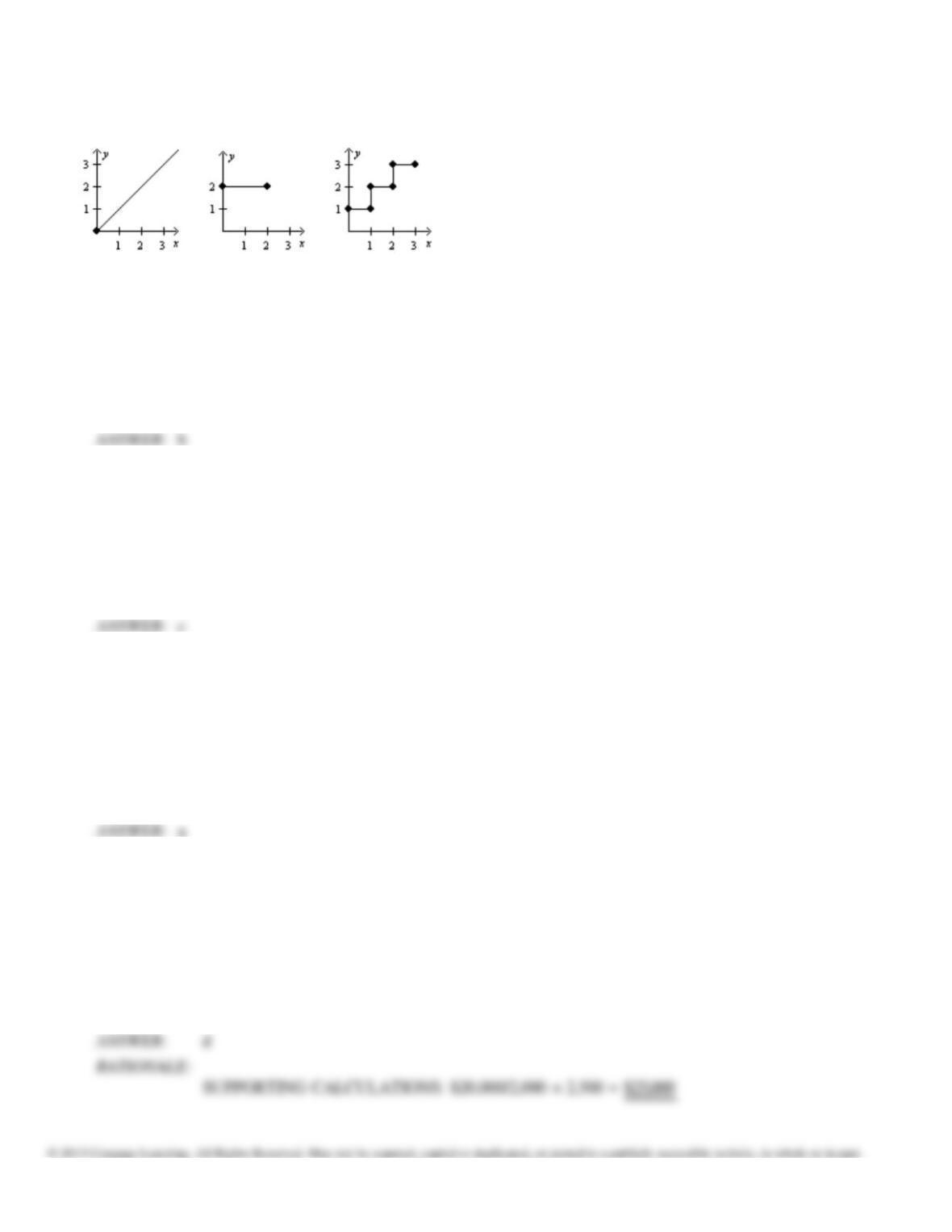
76. Given the following graphs, which graph represents fixed costs?
I
II
III
a. I
b. II
c. III
d. none of these
77. As the volume of activity increases within the relevant range, the variable cost per unit
a. decreases.
b. decreases at first, then increases.
c. remains the same.
d. increases.
78. A manufacturing company pays an assembly line worker $12 per hour. What is the proper classification of this
labor cost?
a. variable cost
b. semivariable cost
c. fixed cost
d. mixed cost
79. The direct material cost is $20,000 when 2,000 units are produced. What is the direct material cost for 2,500 units
produced?
a. $15,000
b. $ 5,000
c. $20,000
d. $25,000
Chapter 3: Cost Behavior
80. Sandusky Corporation has the following costs for 1,000 units:
Total Cost
Cost per Unit
Direct materials
$1,500
$1.50
Direct labor
7,500
7.50
Depreciation on building
30,000
30.00
What is the total cost of direct materials for 100 units?
a. $1.50
b. $ 3.00
c. $150.00
d. $225.00
81. Which of the following costs is a variable cost?
a. materials used in production
b. research and development
c. supervisors’ salaries
d. rent
82. Direct materials are an example of a
a. fixed cost.
b. variable cost.
c. step cost.
d. mixed cost.

Chapter 3: Cost Behavior
83. Which of the following statements is TRUE about fixed and variable costs?
a. Variable costs are constant in total and fixed costs are constant per unit.
b. Both costs are constant when considered on a total basis.
c. Both costs are constant when considered on a per–unit basis.
d. Fixed costs are constant in total and variable costs are constant per unit.
84. Which of the following statements is TRUE about relevant range?
a. When costs reach a level above the relevant range, they are considered appropriate for analysis.
b. Linear estimates of an economist‘s curvilinear cost function is only valid within the relevant range.
c. When costs reach a level below the relevant range, they are considered appropriate for analysis.
d. The nonlinear relevant range is ignored, and only those costs outside of this range may be considered.
85. Which of the following is NOT a correct statement concerning cost behavior?
a. According to economics, in the long run, all costs are variable.
b. Variable costs increase in total in relation to the activity driver.
c. Unit fixed costs increase or decrease inversely in relation to the activity driver.
d. None of the above
86. The following is an example of a mixed cost:
a. direct materials
b. materials used in production
c. salary plus commission on sales
d. supervisors’ salaries
87. The linearity assumption is most likely to be a close approximation for an underlying nonlinear cost function
a. within a relevant range of activity.
b. over the long run.
c. for short–run periods.
d. both a and c.

Chapter 3: Cost Behavior
88. Mixed costs, by definition, contain both
a. product and period costs.
b. fixed and variable costs.
c. direct and indirect costs.
d. Controllable and no controllable costs.
89. Assuming costs are represented on the vertical axis and volume of activity on the horizontal axis, which of the
following costs would be represented by a line that starts at the origin and reaches a maximum value beyond
which the line is parallel to the horizontal axis?
a. total direct material costs
b. a consultant paid $100 per hour with a maximum fee of $2,000
c. employees who are paid $15 per hour and guaranteed a minimum weekly wage of $300
d. rent on exhibit space at a convention
90. Longhorn Enterprises rents a truck for a flat fee plus an additional charge per mile. What type of cost is the rent?
a. step cost
b. fixed cost
c. variable cost
d. mixed cost
91. If production volume increases from 16,000 to 20,000 units,
a. total costs will increase by 20 percent.
b. total costs will increase by 25 percent.
c. total variable costs will increase by 25 percent.
d. mixed and variable costs will increase by 25 percent.
92. Marlowe Company currently leases a delivery truck from Burton Enterprises for a fee of $250 per month plus
$0.40 per mile. Management is evaluating the desirability of switching to a modern, fuel–efficient truck, which
can be leased from Goliath, Inc., for a fee of $600 per month plus $0.05 per mile. All operating costs and fuel
are included in the rental fees. In general, a lease from
a. Goliath, Inc., is economically preferable to a lease from Burton Enterprises regardless of the monthly use.
b. Burton Enterprises is economically preferable below 1,000 miles per month.
c. Burton Enterprises is economically preferable to a lease from Goliath, Inc., regardless of the monthly use.
d. Burton Enterprises is economically preferable above 1,000 miles per month.
Chapter 3: Cost Behavior
93. An equipment lease that specifies a payment of $8,000 per month plus $7 per machine hour used is an
example of a
a. fixed cost.
b. variable cost.
c. step cost.
d. mixed cost.
Figure 3-1
Sonor Systems undertakes its own machine maintenance. The depreciation on the equipment is $20,000 per year
and operating cost is $2 per machine hour. Last year 275,000 machine hours were used to produce 100,000 units.
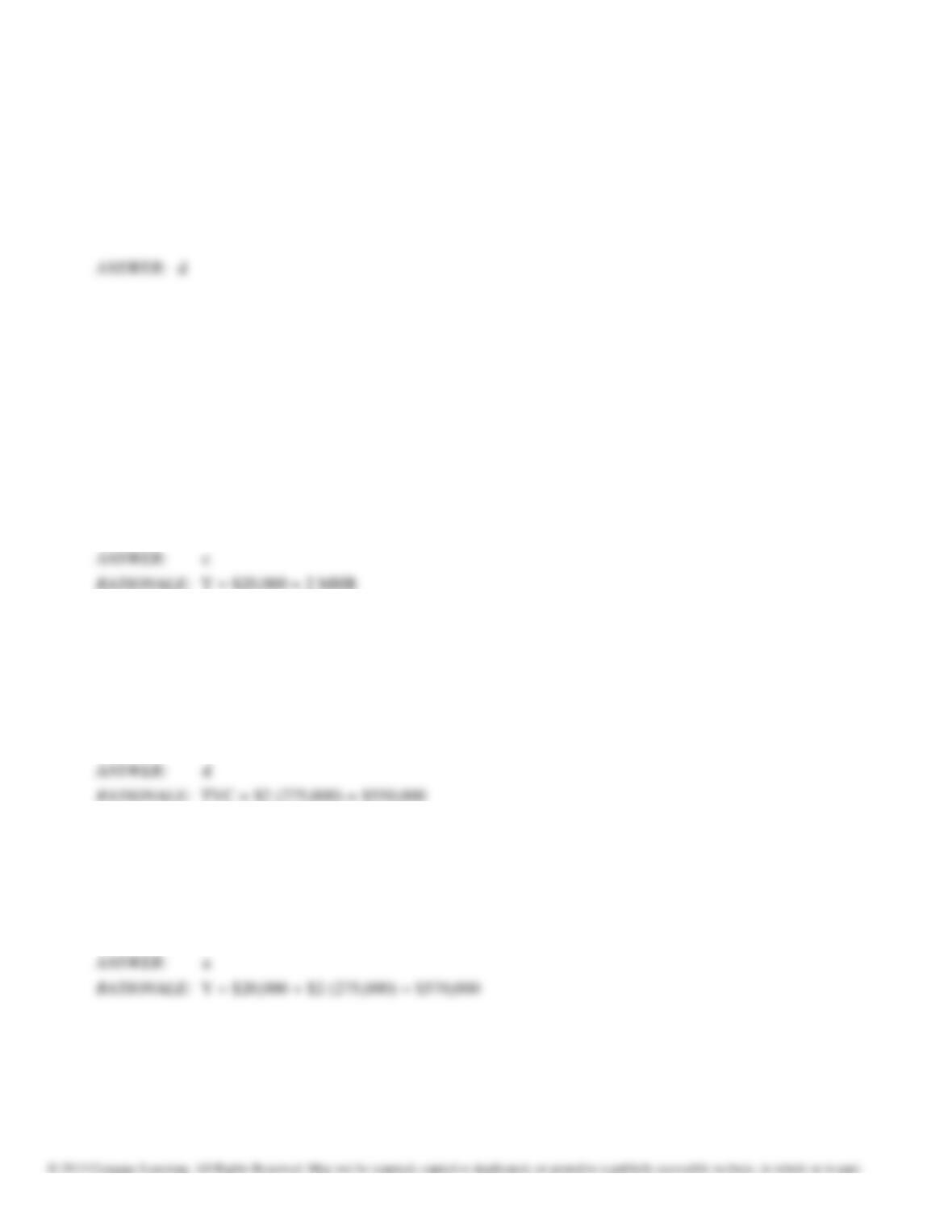
94. See Figure 3-1. Develop a cost equation for the total machine maintenance cost.
a. Y= $275,000
b. Y = $20,000
c. Y = $20,000 + $2 MHR
d. Y = $2 MHR
95. Refer to Figure 3-1. Compute the total variable machine maintenance cost last year.
a. $275,000
b. $240,000
c. $220,000
d. $550,000
96. See Figure 3-1. Compute the total machine maintenance cost for last year.
a. $570,000
b. $550,000
c. $420,000
d. $20,000
Chapter 3: Cost Behavior
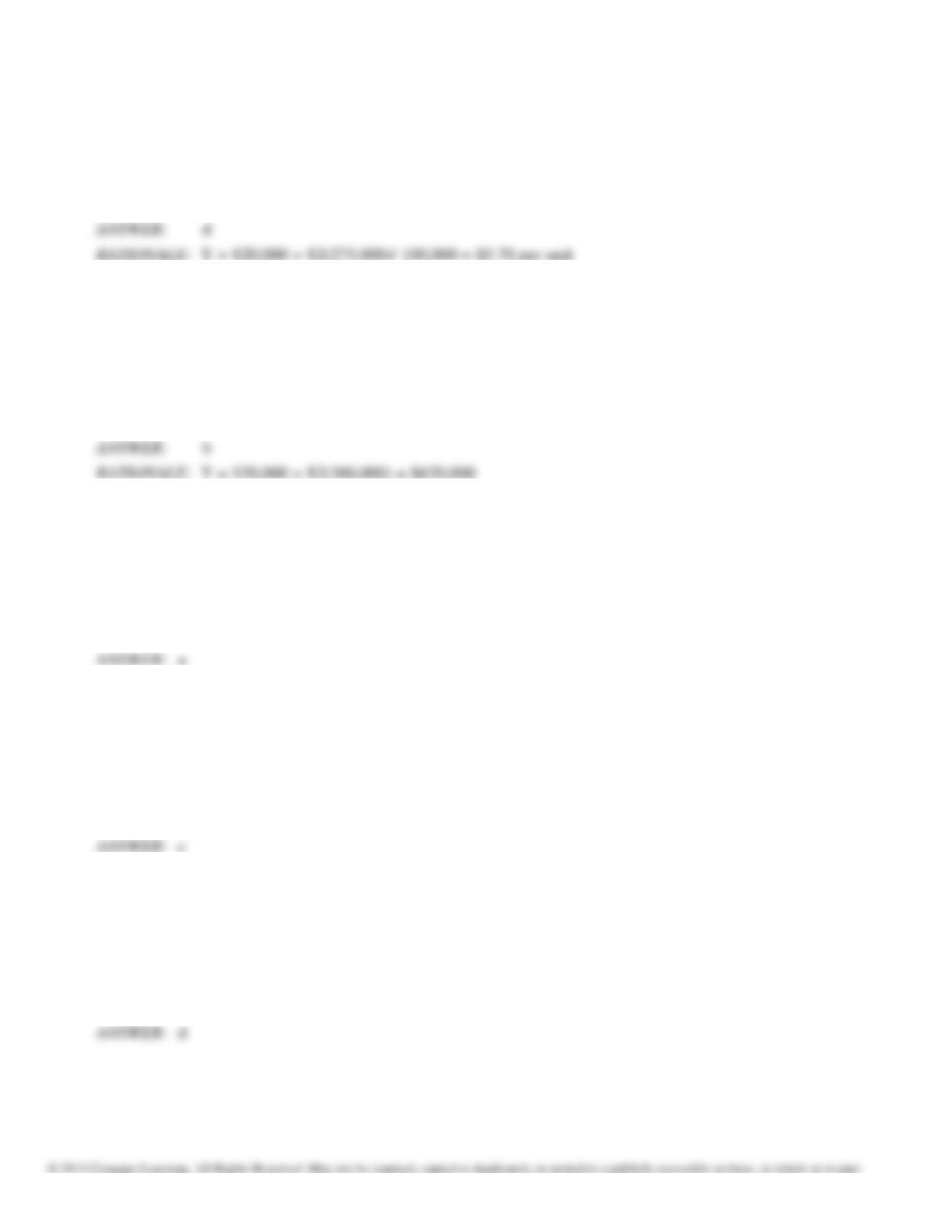
97. See Figure 3-1. What is the total maintenance cost per unit produced?
a. $0.55
b. $4.20
c. $5.50
d. $5.70
98. See Figure 3-1. If 300,000 machine hours had been worked last year, what would be the total machine
maintenance cost?
a. $600,000
b. $620,000
c. $420,000
d. $220,000
99. The efficient level of activity performance is called
a. practical capacity.
b. activity capacity.
c. unused capacity.
d. acquired capacity.
100. If all the activity capacity acquired is not used, this is an example of
a. practical capacity.
b. activity capacity.
c. unused capacity.
d. ideal capacity.
101. Flexible resources
a. are supplied as needed.
b. are acquired from outside sources, not requiring a long–term commitment.
c. have no unused capacity.
d. all of the above.

Chapter 3: Cost Behavior
102. Committed resources
a. are supplied as needed.
b. are acquired by a contract for the exact amount of their usage.
c. may exceed the demand for their usage.
d. all of the above.
103. Which of the following is an example of a committed fixed expense?
a. depreciation on a factory building
b. supervisor’s salary
c. direct labor
d. insurance on a building
104. The expenses that result when organizations acquire many multiperiod service capacities by paying cash up front
or by entering into an explicit contract that requires periodic cash payments are called:
a. Managed fixed expenses
b. Committed fixed expenses
c. Discretionary fixed expenses
d. Period expenses
105. The type of resources that are acquired from outside sources, where the terms of acquisition do NOT require
any long-term commitment for any given amount of the resource are called:
a. Flexible resources
b. Committed resources
c. Discretionary fixed expenses
d. Committed fixed expenses
106. The costs incurred that provide long-term activity capacity, usually as the result of strategic planning are called:
a. Discretionary fixed expenses
b. Committed fixed expenses
c. Mixed costs
d. Step-variable costs

Chapter 3: Cost Behavior
107. Which of the following is an example of a discretionary fixed expense?
a. contract workers
b. property taxes on a factory building
c. depreciation on a factory building
d. insurance on a building
108. The costs incurred for the acquisition of short-run activity capacity, usually as the result of yearly planning
are called:
a. Discretionary fixed expenses
b. Committed fixed expenses
c. Mixed costs
d. Step-variable costs
109. When a firm acquires the resources needed to perform an activity, it is obtaining
a. practical capacity.
b. resource usage.
c. activity capacity.
d. unused capacity.
110. The activity-based resource usage model allows managers to better calculate the changes in resource supply and
demand resulting from decisions such as:
a. to make or buy production components.
b. maximization of individual unit performance.
c. increasing the allocation of costs.
d. focusing on managing costs rather than activities.
111. A nursing home requires one nurse for each six patients. This is an example of a
a. fixed cost.
b. variable cost.
c. step cost.
d. mixed cost.
Chapter 3: Cost Behavior
112. Which of the following is an example of a step-fixed cost?
a. cost of disposable gowns used by patients in a hospital
b. cost of soaking solution to clean jewelry (Each jar can soak 50 rings before losing effectiveness.)
c. cost of tuition at $300 per credit hour up to 15 credit hours (Hours taken in excess of 15 hours are free.)
d. cost of disposable surgical scissors, which are purchased in increments of 100
113. Salaries paid to shift supervisors are an example of a
a. step-variable cost.
b. mixed cost.
c. step-fixed cost.
d. variable cost.
Figure 3-2
A company usually processes 20,000 orders at a total cost of $300,000. During the year, only 16,000 orders were
processed.
114. Refer to Figure 3-2. What is the cost of unused activity?
a. $300,000
b. $240,000
c. $30
d. $60,000
115. Refer to Figure 3-2. What is the cost of resource usage?
a. $300,000
b. $240,000
c. $30
d. $60,000
Chapter 3: Cost Behavior
Figure 3-3
The Sandoval Company has four process engineers that are each able to process 1,500 design changes. Last year
5,250 design changes were produced by the four engineers. Each engineer is paid $60,000 per year
116. Refer to Figure 3-3. Calculate the activity rate per change order.
a. $4 per change order
b. $10 per change order
c. $40 per change order
d. $15 per change order
117. Refer to Figure 3-3. Calculate the unused capacity.
a. 750 change orders
b. 1,375 change orders
c. 4,000 change orders
d. 2,000 change orders
118. Refer to Figure 3-3. What is the unused capacity in dollars?
a. $60,000
b. $30,000
c. $240,000
d. $15,000
119. Which of the following is NOT a method of determining cost behavior?
a. industrial engineering method
b. account analysis method
c. statistical and quantitative methods
d. confidence interval model