4. You need to accumulate $fv at the end of t years to fund your child’s education. Your investment rate
of return is i percent. If you have $pv in your savings account, how much additional money will you
need to set aside per year to fund your child’s education?
5. Part I: Assuming an interest rate of i percent, calculate the present value (to four digits after the
decimal) of $pmt received at the end of each year
a.
for the next 1 year
b.
for the next t2 years
c.
for the next 50 years
d.
for the next 100 years
e.
forever
Part II: Reconsider the annuity in Part I. Describe how the present values increase with increases in the
length of the annuity. Interpret the difference in present values between parts d. and e. from Part I.
N
6. What is the primary concern of finance?
N
t
7. Identify the forms of transferring wealth across time.
8. What do you need to know to amortize a loan?
9. What happens to the present value of an annuity as the interest rate increases?
10. Explain how to set up a loan amortization schedule.
11. What is the future value at the end of t years of depositing $pv into a mutual fund today, assuming the
fund is expected to earn i% a year?
12. How much would you be willing to invest today to receive $fv t years from now if your opportunity
cost is i% for investments with this level of risk?
13. Calculate the future value at the end of year 3 of an investment fund earning i% annual interest and
funded with the following end-of-year deposits: $p1 in at the end of year 1, $p2 at the end of year 2,
and $p3 at the end of year 3.
14. Calculate the future value of an investment fund earning i% annual interest with t equal-annual end-of-
year deposits of $pmt.
15. Calculate the future value t years from now of an investment fund earning i% annual interest with t
equal, annual beginning-of-year deposits of $pmt.
16. Calculate the present value of an ordinary annuity of $pmt at i% for t years.
17. Calculate the present value of an annuity due of $pmt at i% for t years.
18. How is the equilibrium interest rate determined?
19. You deposit $dep today into a retirement account that earns i% annual interest. You continue to
deposit $dep each year for a total of 42 payments. One year after the last deposit, you make your first
annual withdrawal, and continue to receive level annual cash flows for 20 total payments. Immediately
after the last withdrawal, you want to have a remaining balance of $rb. How much can you withdraw
each year over the 20 years following your deposits?
20. One year from now, you deposit $p1 in a savings account. You deposit $p2 the next year. Then you
wait two more years (until 4 years from now) and deposit $p3. If your account always earns i% annual
interest and you make no withdrawals, how much will be in the account t years from now?
21. A scholarship endowment has balance $b. t1 one-year scholarships are to be awarded each year, with
the first disbursements of $d per scholarship coming one year from now. The endowment earns i%
annual interest. If the scholarships are to be offered in perpetuity and the scholarship board wishes to
raise the amount of the scholarships by a constant percentage amount each year, what amount of
growth is feasible each year? How much will each scholarship be t years from now?
22. You deposit $pv1 for t1 years at i1% annual interest. In t1 years, you add $p to your account, but the
rate on your account changes to i2% annual interest (for existing balance and new deposit). You leave
the account untouched for an additional t2 years. How much do you accumulate?
23. You take out a $pv t year mortgage with monthly payments and a rate of i%, monthly compounded.
What will your mortgage balance be after your first monthly payment?
24. If you make an initial contribution of $pmt to a retirement account 5 years from now and make annual
contributions of $pmt thereafter, after how many contributions will your balance have reached at least
$fv if your account earns i% annual interest?
25. What is the Effective Annual Rate earned on an account that receives APR of i% compounded daily
(given 365 days per year)?
26. Best Bank is offering an interest rate of i% compounded quarterly on their CDs. New Bank wants to
match an investor’s return, but compounds on a monthly basis. What APR should New Bank pay on
its CD to match Best Bank?
27. Jamie wants to buy a new car on her a2th birthday. She is a1 now. She expects her new car to cost $fv.
If she can earn i% interest on her savings account, which is quarterly compounded, how much does she
need to deposit at the end of each quarter?
28. You are offered an investment today by your broker. This investment offers the following stream of
cash flows:
Yr1 = $y1
Yr2 = $y2
Yr3 = $y3
Yr4 = $y4
If you require a return of r% for investments of this type of risk, how much should you pay for the
investment today?
29. You have just entered into the NBA draft. As draft day gets closer, you believe that you can receive a
contract that calls for a signing bonus of $b1 and a 3 year contract for $ay1 a year. Your coach
believes if you stay at college one more year you could probably get a contract that called for a signing
bonus of $b2 million and a 2 year contract for $ay2 a year. Given either decision, your prospects
beyond the next 3 years should be the same. Should you go pro? (assume you can earn r% on your
money)
30. Joan is depositing money into a fund for her daughter’s college that earns an APR of r%, monthly
compounded. If Joan wants her daughter to have $s in the account, y years from now, how much will
she have to deposit monthly?
31. You can invest in a private business that will pay you a dividend of $d every two years. If you require
an annually compounded return of r% for investments of this type of risk, how much will you pay for
this stream of cash flows today?
32. You are offered an investment that will pay you on an annual basis. The first payment (one year from
now) will be $p. This amount is expected to grow at a constant g% forever. If the investment costs you
$pv today, what rate of return is implicit in this investment?
33. You can invest in a firm that will make you a payment (call it a dividend) of $d next year. If this
investment costs $pv today and you require a r% return, what is the assumed perpetual rate of growth?
34. Amy wants to save for her upcoming graduation trip to Europe in 2 years. She is planning on making
monthly deposits into her account earning an APR of r% compounded monthly. She estimates she will
need $s in the account to leave. She knows that she will need to make a withdrawal from this account
of $p in one year to cover an expense. How much will she have to deposit on a monthly basis to assure
she will have the required cash in the account for Europe?
35. You are offered a choice of two investments. The first offers a cash flow of $cf next year which will
grow at a g% rate forever. This investment costs $c1 today. The second investment (which is much
riskier) offers a cash flow of $cf1 next year, which will grow at a g1% rate forever. This investment
costs $c2. Should you buy the riskier investment?
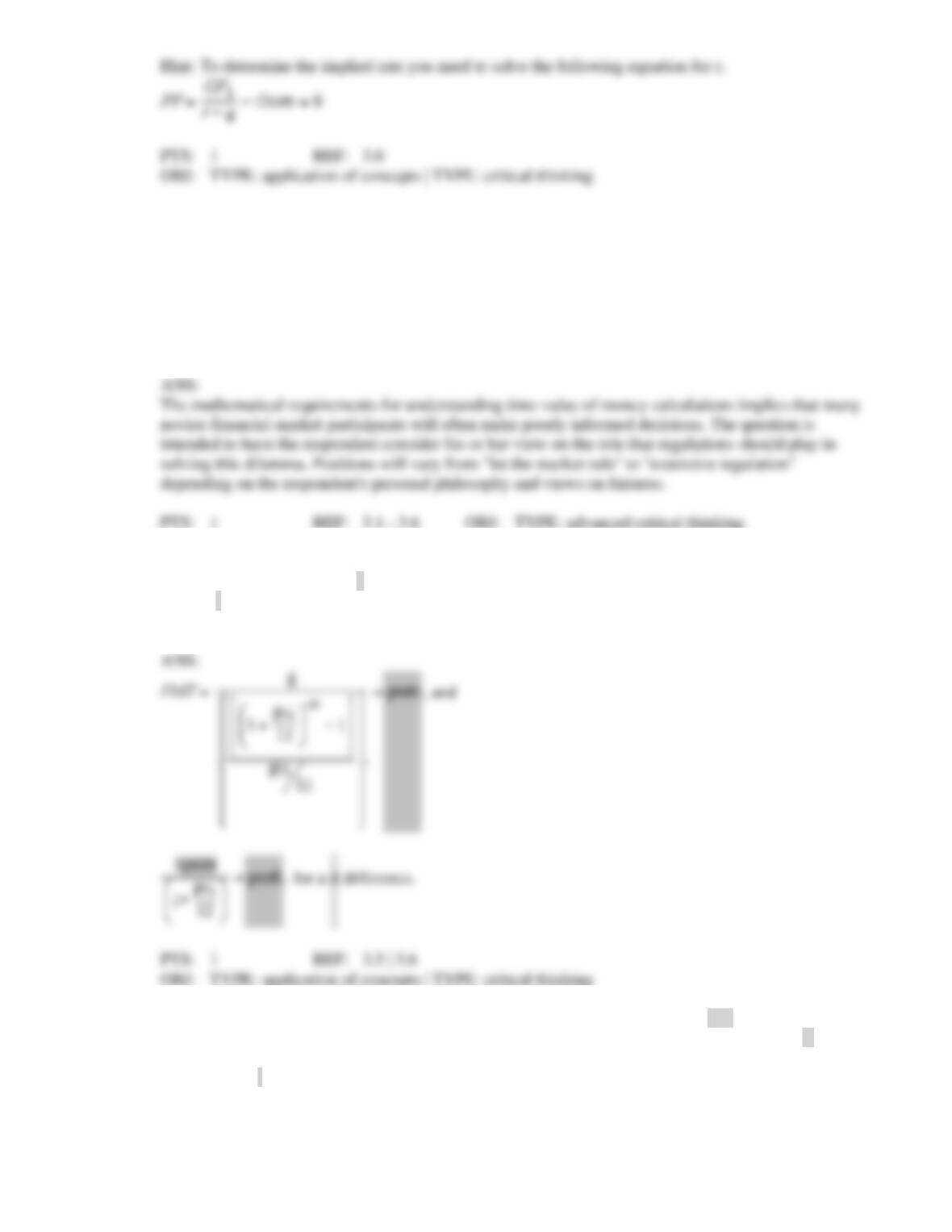
ESSAY
1. After reading the chapter, it should be apparent that many financial market participants do not have a
good understanding of how the time value of money affects their lives. To what extent do you believe
that regulators and governments should protect these individuals? (You may wish to consider
differences between stated and effective annual rates on credit cards as one particularly important
example.)
2. Richard Rich wants to buy a new automobile in 5 years for traveling the country when he retires. If the
new car is expected to cost $c, how much must Richard deposit monthly into an investment fund
earning r% annual interest, monthly compounded? If he is to make 60 payments, how will the monthly
amount differ between making beginning-of-month deposits and end-of-month deposits?
3. Great news, you have the winning ticket to the Midwest Powerball Lottery for $win million. As the
winner, you can choose between receiving an immediate lump-sum payment (after taxes) of $at
million and receiving $10 million (before taxes) at the beginning of each year for 25 years. Assuming
you are in the t% state and federal tax bracket, what is your choice and why?
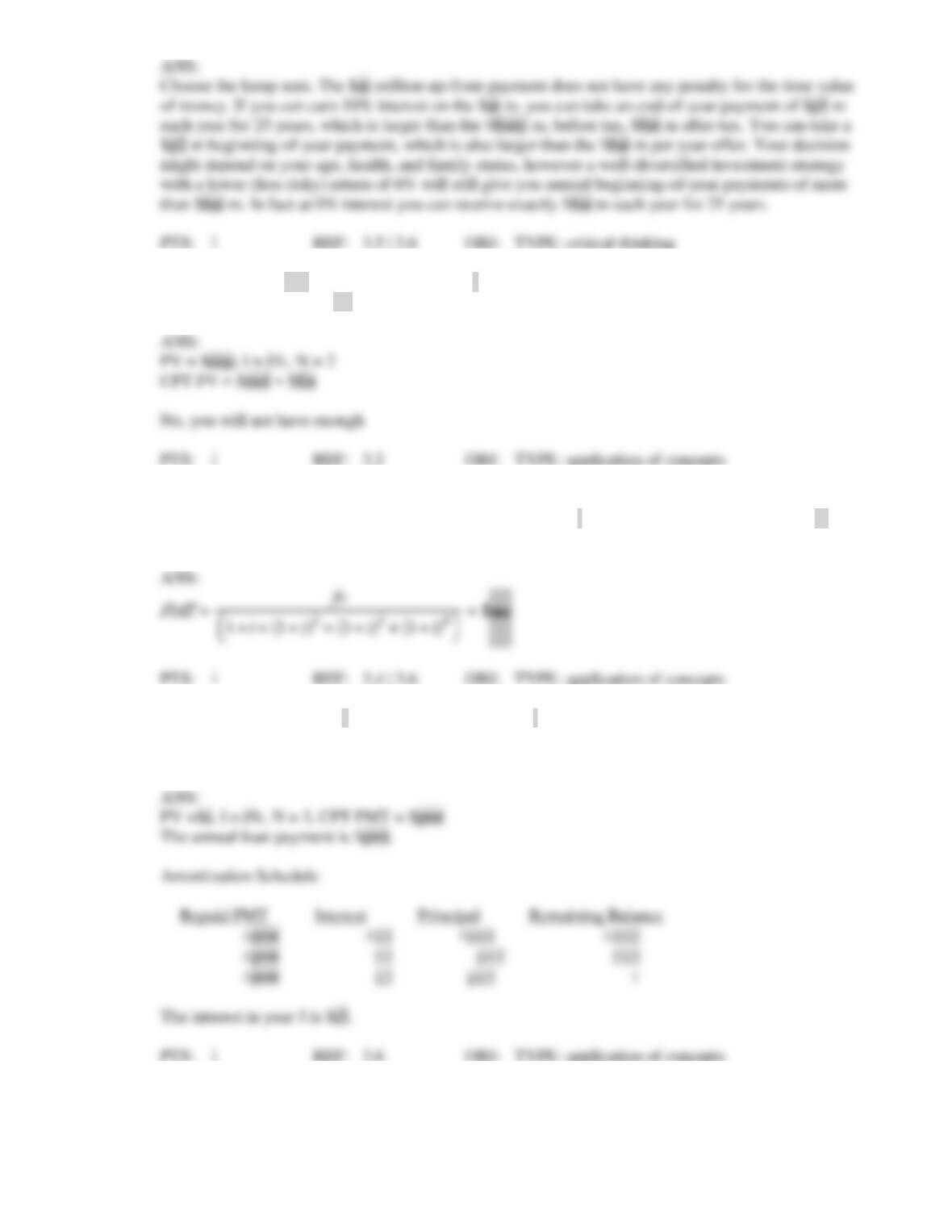
4. Assume you put $dep into an account paying r% interest. Will you have enough money at the end of
two years to purchase a $fin computer system?
5. You are planning on taking a vacation in four years. You intend to put an equal amount at the
beginning of each year for four years into an account paying i% interest. You expect it to cost $fv for
your vacation. How much must you deposit each period to fund your planned vacation?
6. You are going to borrow $s for three years at a rate of i%. Payments are to be made at the end of each
year. Calculate the loan payment and prepare the loan amortization schedule. How much interest will
be paid in year 3?
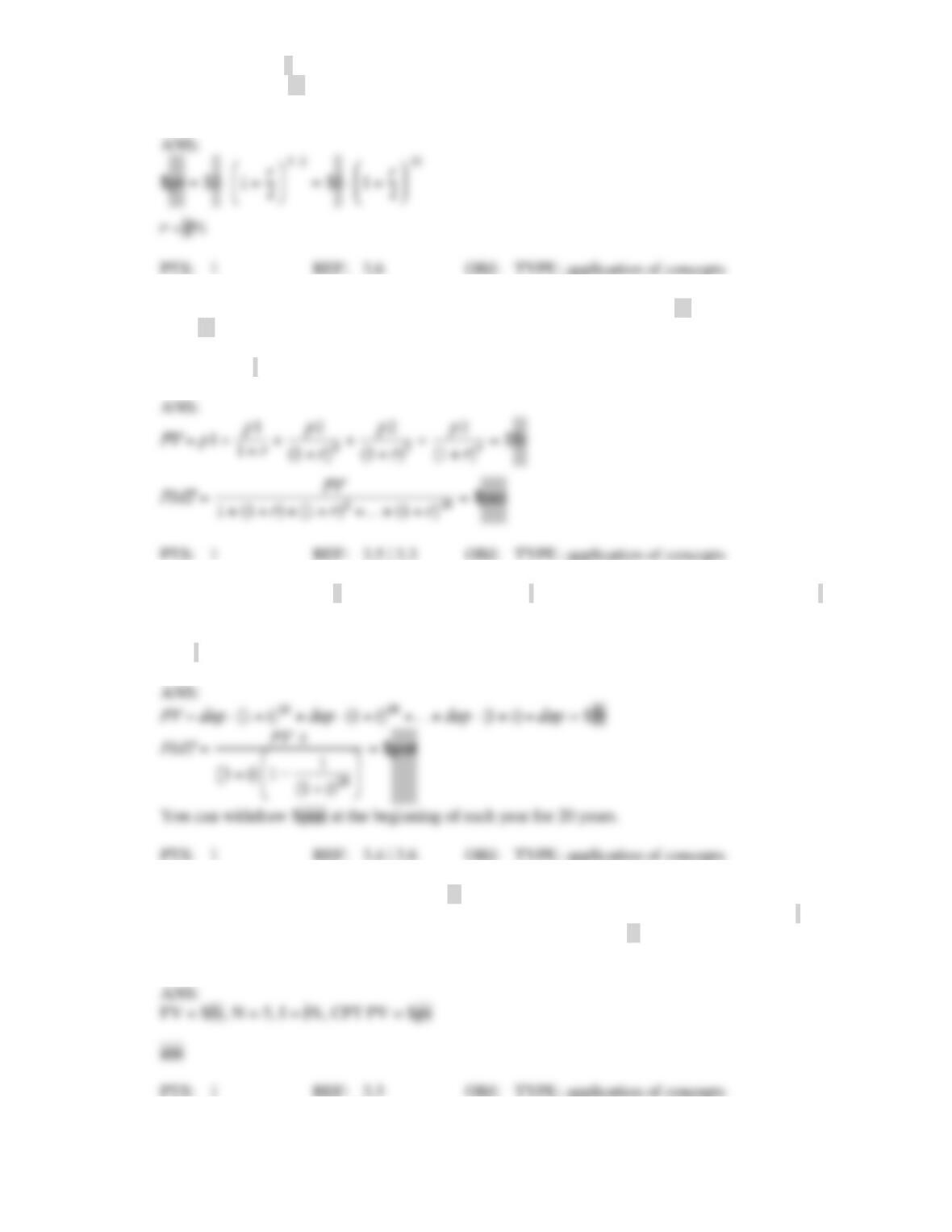
7. Assume you put $d into an account today at a bank and leave it there for five years. The bank promises
that there will be $pv in the account at the end of the five years. What is the stated rate of interest on
the account if interest is compounded semiannually?
8. Your child will start college 15 years from today. You believe it will cost $p1 for the first two years
and $p2 for the last three, payable at the beginning of each year of college. How much do you have to
save at the end of each year for 15 years starting now in order to pay tuition and book costs if the
account pays i% interest?
9. You plan on depositing $d at the end of each year for t years into a retirement account that pays i%
interest. How much could you withdraw annually in equal beginning of year amounts starting at the
time you make your last deposit and continuing for a total of 20 years, assuming balances continue to
earn i% until withdrawn?
10. Assume a friend has offered to give you $fv at the end of five years if you will invest in your friend’s
new business today. In considering the friend’s proposal, you believe you would only need a i% rate of
return (since it is your friend). Your friend has asked you to invest $in. Would you make the
investment today?