
Chapter 3—The Global Environment
MULTIPLE CHOICE
1. Which industrialized nation emerged as the only intact major power after World War II?
a.
The United States
b.
Japan
c.
Germany
d.
Canada
e.
Africa
2. All EXCEPT which of the following countries are considered the leading industrial powers in today’s
global economy?
a.
The United States
b.
Japan
c.
Germany
d.
India
e.
All of these are considered leading industrial powers.
3. Which of the following trends is NOT true of developed nations today (such as the United States, Japan,
the United Kingdom, and so on)?
a.
Population growth is slowing.
b.
International trade is expanding.
c.
The labor force is growing quickly.
d.
Competition from foreign countries is increasing.
e.
Countries are becoming increasingly interdependent.
4. Which country is NOT experiencing rapid population growth?
a.
China
b.
Canada
c.
India
d.
Indonesia
e.
Mexico
5. Under a geocentric staffing model,
a.
host-country nationals are used heavily because they know the local markets.
b.
the organization will have a skeleton human resource department at the host-country
location, while the home-country human resource department retains all control.

c.
the organization seeks to hire the best person available for a position regardless of where the
individual comes from.
d.
expatriate home-country nationals are hired to fill higher-level foreign positions.
e.
the home-office perspective takes precedence over local issues.
6. Which international staffing model involves staffing high-level foreign jobs with parent-country
nationals?
a.
Globalcentric
b.
Polycentric
c.
Geocentric
d.
Egocentric
e.
None of these
7. No outplacement firms exist in several Middle Eastern countries because the religion of Islam specifies
that individuals should not benefit financially from other people’s misfortunes. This cultural factor
pertains to what type of difference?
a.
Language
b.
Business practices
c.
Children’s rights
d.
Roles
e.
Personal norms
8. Dietrich prefers structured circumstances instead of situations that are relatively ambiguous. Which
cultural dimension does he exhibit?
a.
Individualism
b.
Collectivism
c.
Masculinity
d.
Time orientation
e.
Uncertainty Avoidance
9. What aspect of international business do NAFTA and the EU represent?
a.
Tariff systems
b.
Economic communities
c.
Trade controls
d.
Export regulations
e.
Quota guidelines

10. John prefers to work by himself on projects and avoids group work that requires him to monitor the
actions of others. He would score highly on the ____ dimension of Hofstede’s model of culture.
a.
power distance
b.
individualism
c.
masculinity
d.
uncertainty avoidance
e.
time orientation
11. Siemens has a complex matrix organization structure. Managers who have been with the company for
years and built relationships are the most effective. Someone with a cultural dimension of ______ is
more likely to experience success there.
a.
femininity
b.
uncertainty avoidance
c.
time orientation
d.
power distance
e.
collectivism
12. What is the term used when a company lets a foreign firm make and/or distribute its products in a local
market?
a.
Exporting
b.
Licensing
c.
Direct investment
d.
Joint venture
e.
Strategic alliance
13. Under which two approaches to international business will the human resource function be LEAST
affected?
a.
Licensing and joint ventures
b.
Direct investment and strategic alliances
c.
Exporting and licensing
d.
Joint ventures and strategic alliances
e.
Exporting and direct investment
14. What is an advantage of direct investment in another country?
a.
Less risk is involved.
b.
It is not expensive.
c.
There is more profit potential.

d.
The facility is less integrated in the foreign market.
e.
Synergy between business partners is achieved.
15. Under which international strategy will several companies agree to cooperate for mutual benefit?
a.
Exporting
b.
Importing
c.
Direct investment
d.
Multinational organization
e.
Strategic alliance
16. Local issues that must be dealt with by firms conducting business in foreign markets include all of the
following EXCEPT
a.
recruiting.
b.
compensation.
c.
selection.
d.
human resource technology.
e.
training.
17. Locating a facility in a relatively underdeveloped area will impact all of the following human resource
activities EXCEPT
a.
training needs.
b.
recruitment activities.
c.
selection requirements.
d.
development issues.
e.
production design.
18. Celebrity Cruises is based in Florida, but it hires workers from various countries to communicate with
and serve guests from around the world. Which of the following is an accurate statement?
a.
Celebrity will need to provide the same training to all of its foreign workers.
b.
Celebrity will need to provide the same training to all of its workers.
c.
Celebrity will need to tailor training to best develop workers from various countries.
d.
Celebrity will not need to train its workers.
e.
Celebrity will only need to train workers who have contact with customers; other workers
need no training.

19. Prakash is a human resource manager for an Indian company that is building a manufacturing plant in
Singapore. The plant will be staffed with Indian managers and local workers. Which advice would NOT
be appropriate for Prakash?
a.
You must understand legal requirements for compensation in Singapore.
b.
You must consider the Indian government’s legal requirements for compensation.
c.
Compensation for workers in Singapore will likely be the same as for workers in India.
d.
Workers in Singapore will have different preferences for compensation and benefits than
will Indian workers.
e.
The cost of living is different in Singapore than it is in India, so compensation policy must
account for that difference.
20. When a company hires host-country nationals to staff foreign locations in underdeveloped countries, it
must often
a.
offer exercise classes.
b.
provide extensive training and development.
c.
hire a consultant.
d.
seek permission from competitors.
e.
cut the benefits package provided to employees.
21. Which of the following is NOT likely to be a part of a compensation package designed for an expatriate?
a.
Housing benefits
b.
Job location assistance for the spouse
c.
A cost-of-living allowance
d.
A hardship premium
e.
Unlimited travel to and from the home country
22. Wangkyo is an electrical engineer who designs power systems for factories. His employer is sending
him on a foreign assignment for one month, to design a system for a new factory that is being built
overseas. Which skills will be MOST important to Wangkyo in his foreign assignment?
a.
Technical skills
b.
Language skills
c.
Cultural skills
d.
Financial skills
e.
Leadership skills
23. Disney chose Andre Lacroix to be CEO of Euro Disney, following his success as CEO of Burger King
International. Disney chose an experienced international manager who lived in France, rather than send
an American manager overseas, in part to eliminate the risk of expatriate failure. Expatriate failure
occurs when the
a.
expatriate needs extensive training before he or she is able to accept the assignment.
b.
cost of sending the manager to the foreign assignment is greater than the benefit gained.
c.
expatriate’s coworkers report that he or she is not fitting in well.

d.
business that is managed by the expatriate loses money.
e.
expatriate returns early because of an inability to perform.
24. Repatriation occurs when a(n)
a.
company sends a manager to a second foreign assignment.
b.
expatriate manager comes home from a foreign assignment.
c.
manager likes a foreign assignment so much that he or she remains in the foreign country.
d.
manager is sent on a foreign assignment.
e.
manager on a foreign assignment is compensated in the local currency.
25. Which of the following is an accurate statement about labor unions outside the United States?
a.
In foreign countries, few workers belong to labor unions.
b.
Labor unions outside the United States are regulated by U.S. laws.
c.
Foreign labor unions are more likely to be involved in political and social issues.
d.
Outside the United States, labor contracts are formal legal contracts and employers can be
sued in court by the unions for breaking them.
e.
Foreign employers rarely negotiate with unions in their home country.
26. More than ______ the world ’s workforce outside the United States belongs to labor unions.
a.
half
b.
a third
c.
a quarter
d.
two thirds
e.
three fourths
27. In ______ , labor “contracts ” are not really legal contracts at all but are merely understandings that can
be broken at any time by either party with no penalty.
a.
France
b.
England
c.
Germany
d.
Japan
e.
the United States
28. Labor relations in ______ tend to be cordial.
a.
France
b.
England
c.
Japan

d.
the United States
e.
Germany
29. HCNs are LEAST likely to work in ______ positions.
a.
clerical
b.
line worker
c.
maintenance
d.
management
e.
office worker
30. Some countries, such as ______, focus compensation on assessing an individual’s performance and then
compensating that individual accordingly.
a.
Japan
b.
India
c.
Sweden
d.
France
e.
the United States
Scenario 3.1
Mini-PC is a Houston-based maker of handheld computers. In response to high European demand,
Mini-PC purchased Marstrand Electronics, a handheld manufacturer in Stockholm, Sweden. Mini-PC
allowed the management of Marstrand to continue in their jobs rather than sending U.S. managers to
oversee Swedish operations. Mini-PC decided to purchase Marstrand because virtually all Swedes speak
English, value women’s rights, and are predominantly Christian in religious beliefs. Sweden has an
extremely stable political system, a sound economy, a highly educated workforce, and it is a member of
the European Union. However, Swedes do take a different view of work time, in that they expect at least
two months of vacation per year. Also, the Swedish workforce is about 80% unionized, in comparison to
Mini-PC’s nonunionized workforce. Sweden has a socialist approach to health benefits, which means
higher personal taxes for workers but lower health benefits costs for employers. When comparing
average national scores on Hofstede’s dimensions of culture, the United States and Sweden are about the
same in power distance and long-term orientation, but the United States is higher than Sweden in
individualism and uncertainty avoidance and much higher in masculinity.
31. Refer to Scenario 3.1. Which staffing model is Mini-PC using for its Swedish unit?
a.
Geocentric
b.
Ethnocentric
c.
Polycentric
d.
Egocentric
e.
Multicentric

32. Refer to Scenario 3.1. Which aspect of culture will MOST likely affect Mini-PC’s human resource
activities at the corporate level because of differences between its U.S. and Swedish business units?
a.
Language
b.
Religious differences
c.
Gender roles
d.
Personal norms
e.
Differences in views of child labor
33. Refer to Scenario 3.1. On the basis of scores on Hofstede’s dimensions of culture, which organization
cultural values will create the most discomfort and resistance among Swedish workers?
a.
Swedes will resist Mini-PC’s policy of calling everyone, from the CEO to the lowest
worker, by his or her first name.
b.
Swedes will place a much greater value on patience and persistence than do Mini-PC‘s
American workers.
c.
Swedes will prefer to emphasize individual contributions, as opposed to Mini-PC workers
in the United States, who value team or group contributions.
d.
Swedes will be much less competitive, ambitious, and driven than Mini-PC’s American
workers.
e.
Swedes will not be comfortable when given tasks that are too structured, as opposed to
American workers, who prefer lots of structure.
34. Refer to Scenario 3.1. Which international strategy is Mini-PC using to expand its international
operations?
a.
Exporting
b.
Licensing
c.
Direct investment
d.
Joint venture
e.
Strategic alliance
35. Refer to Scenario 3.1. Which of the domestic human resource issues is most likely affected (i.e.,
different at Marstrand than at Mini-PC) by conditions described in the scenario?
a.
Local compensation issues
b.
Local selection issues
c.
Local training issues
d.
Local recruiting issues
e.
Local development issues
TRUE/FALSE
36. The United States and Japan have experienced slowing growth rates in employment in recent years.
37. The interrelatedness of global markets was demonstrated by the recent economic downturn in the United
States that affected many other parts of the world.
38. The ethnocentric staffing model utilizes host-country nationals extensively throughout the company.
39. A joint venture might not involve ownership but still involves cooperation between firms.
40. In a relatively underdeveloped country, training and development needs will be very extensive.
41. Benefit packages are remarkably similar across most countries.
42. Training is instruction directed at enhancing specific job-related skills and abilities and most often
focuses on managers.
43. Most companies follow the advice of experts and complete the repatriation process successfully.
44. During contract negotiations at French operations for Caterpillar, Sony, and 3M, angry labor officials
took senior managers hostage in efforts to win better employment contracts.
45. Labor relations are not heavily regulated by law.
SHORT ANSWER
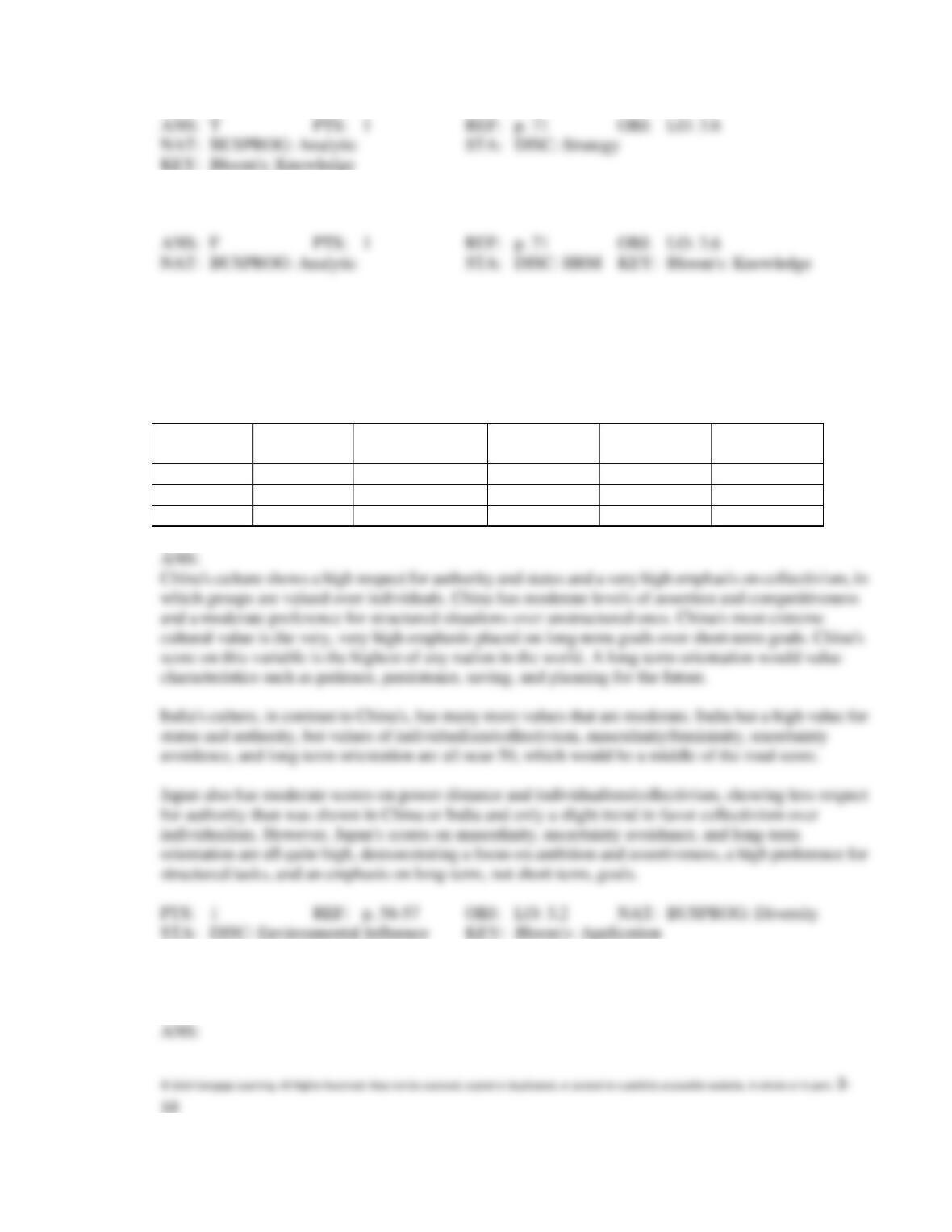
46. The following chart reports the average national scores of Hofstede’s five dimensions of culture for three
different countries. Using the relative differences on these dimensions as the basis of your answer,
briefly describe in words each country’s national culture.
Country
Power
Distance
Individualism
Masculinity
Uncertainty
Avoidance
Long-Term
Orientation
China
80
15
55
40
114
India
77
48
56
40
61
Japan
54
46
95
92
80
47. How may an organization choose to compete in the international environment, and how does each
strategy affect its human resource function?
48. When a multinational firm hires local workers, what types of training are needed?
49. How do businesses compensate expatriates?
50. How does the area of labor relations affect international human resource management?