
1. Which of the following suggests that a nation will export the commodity in the production of which a great deal of its
relatively abundant and cheap factor is used?
a.
The Linder theory
b.
The product life cycle theory
c.
The MacDougall theory
d.
The Heckscher-Ohlin theory
2. According to Staffan Linder, trade between two countries tends to be most pronounced when the countries:
a.
Find their tastes and preferences to be quite harmonious
b.
Experience economies of large-scale production over large output levels
c.
Face dissimilar relative abundances of the factors of production
d.
Find their per capita income levels to be approximately the same
United States – BPROG: Reflective Thinking – BPROG: Analysis
Overlapping Demands as a Basis for Trade
BLOOM’S: Knowledge
3. Which of the following is a long-run theory, emphasizing changes in the trading position of a nation over a number of
years?
a.
Theory of factor endowments
b.
Comparative advantage theory
c.
Theory of the product cycle
d.
Overlapping demand theory
United States – BPROG: Reflective Thinking – BPROG: Analysis
Technology as a Source of Comparative Advantage: The Product Cycle Theory
BLOOM’S: Comprehension
4. The Leontief paradox questioned the validity of the theory of:
a.
Comparative advantage
b.
Factor endowments
United States – BPROG: Reflective Thinking – BPROG: Analysis
Factor Endowments as a Source of Comparative Advantage
BLOOM’S: Knowledge
c.
Overlapping demands
d.
Absolute advantage
5. Which of the following would least likely apply to the product life cycle theory?
a.
Calculators and computers
b.
Coal and crude oil
c.
Home movie cameras
d.
Office machinery
Moderate
United States – BPROG: Reflective Thinking – BPROG: Analysis
Technology as a Source of Comparative Advantage: The Product Cycle Theory
BLOOM’S: Knowledge
6. Classical trade theory emphasized which of the following as an underlying explanation of the basis for trade?
a.
Productivities of labor inputs
b.
Tastes and preferences among nations
c.
Changes in technologies over time
d.
Quantities of economic resources
a
Moderate
United States – BPROG: Reflective Thinking – BPROG: Analysis
Factor Endowments as a Source of Comparative Advantage
BLOOM’S: Comprehension
7. Concerning the influence that transportation costs have on the location of industry, which of the following industries
has generally attempted to locate production facilities close to resource supplies?
a.
Autos
b.
Steel
c.
Soft drinks
d.
Valuable electronics goods
Moderate
United States – BPROG: Reflective Thinking – BPROG: Analysis
Skill as a Source of Comparative Advantage
BLOOM’S: Comprehension
8. Assume that Country A, in the absence of trade, finds itself relatively abundant in labor and relatively scarce in land.
The factor endowment theory reasons that with free trade, the internal distribution of national income in Country A will
change in favor of:
a.
Labor
b.
Land
c.
Both labor and land
d.
Neither labor nor land
a
Moderate
United States – BPROG: Reflective Thinking – BPROG: Analysis
Factor Endowments as a Source of Comparative Advantage
BLOOM’S: Comprehension
9. When considering the effects of transportation costs, the conclusions of our trade model must be modified. This is
because transportation costs result in:
a.
Lower trade volume, higher import prices, smaller gains from trade
b.
Lower trade volume, lower import prices, smaller gains from trade
c.
Higher trade volume, higher import prices, smaller gains from trade
d.
Higher trade volume, lower import prices, greater gains from trade
a
Moderate
United States – BPROG: Reflective Thinking – BPROG: Analysis
Transportation Costs and Comparative Advantage
BLOOM’S: Comprehension
10. Chinese manufacturers face rising wages because of:
a.
China’s one-child policy
b.
land policies
c.
bureaucratic delay in being declared an urban dweller
d.
all of these
Moderate
Easy
United States – BPROG: Reflective Thinking – BPROG: Analysis
Factor Endowments as a Source of Comparative Advantage

11. Assume the cost of transporting autos from Japan to Canada exceeds the pretrade price difference for autos between
Japan and Canada. Trade in autos is:
a.
Impossible
b.
Possible
c.
Highly profitable
d.
Moderately profitable
a
Easy
United States – BPROG: Reflective Thinking – BPROG: Analysis
specialization and trade
Transportation Costs and Comparative Advantage
BLOOM’S: Comprehension
12. Eli Heckscher and Bertil Ohlin are associated with the theory of comparative advantage that stresses differences in:
a.
Income levels among countries
b.
Tastes and preferences among countries
c.
Resource endowments among countries
d.
Labor productivities among countries
c
Easy
United States – BPROG: Reflective Thinking – BPROG: Analysis
specialization and trade
Factor Endowments as a Source of Comparative Advantage
BLOOM’S: Comprehension
13. Hong Kong is relatively abundant in labor, while Canada is relatively abundant in capital. In both countries the
production of shirts is relatively more labor intensive than the production of computers. According to the factor
endowment theory, Hong Kong will have a(n):
a.
Absolute advantage in the production of shirts and computers
b.
Absolute advantage in the production of computers
c.
Comparative advantage in the production of shirts
d.
Comparative advantage in the production of computers
c
Moderate
United States – BPROG: Reflective Thinking – BPROG: Analysis
United States – PA – DISC: Gains from trade, speciali – DISC: Gains from trade,
United States – BPROG: Reflective Thinking – BPROG: Analysis
specialization and trade
Factor Endowments as a Source of Comparative Advantage
BLOOM’S: Comprehension
14. If Japanese workers receive lower wages in the production of autos than do American workers:
a.
Japan will have a comparative advantage in the production of autos
b.
Japan will have an absolute advantage in the production of autos
c.
Production costs will be lower in Japan than in the U.S.
d.
Production costs could be lower in the U.S. if American labor productivity is higher than the Japanese
Moderate
United States – BPROG: Reflective Thinking – BPROG: Analysis
Factor Endowments as a Source of Comparative Advantage
BLOOM’S: Analysis
15. Which trade theory suggests that a newly produced good, once exported, could ultimately end up being imported as
the technology is transferred to lower- cost nations?
a.
Factor endowment theory
b.
Product life cycle theory
c.
Overlapping demand theory
d.
Comparative advantage theory
Moderate
United States – BPROG: Reflective Thinking – BPROG: Analysis
Technology as a Source of Comparative Advantage: The Product Cycle Theory
BLOOM’S: Comprehension
16. A firm is said to enjoy economies of scale over the range of output for which the long-run average cost is:
a.
Increasing
b.
Constant
c.
Decreasing
d.
None of the above
c
Easy
United States – BPROG: Reflective Thinking – BPROG: Analysis
specialization and trade
Economies of Scale and Comparative Advantage
BLOOM’S: Comprehension
specialization and trade
Factor Endowments as a Source of Comparative Advantage
BLOOM’S: Analysis
17. A product will be internationally traded as long as the pretrade price differential between the trading partners is:
a.
Greater than the cost of transporting it between them
b.
Equal to the cost of transporting it between them
c.
Less than the cost of transporting it between them
d.
None of the above
18. Which of the following suggests that by widening the market’s size, international trade can permit longer production
runs for manufacturers, which leads to increasing efficiency?
a.
Economies of scale
b.
Diseconomies of scale
c.
Comparative cost theory
d.
Absolute cost theory
a
Moderate
United States – BPROG: Reflective Thinking – BPROG: Analysis
Economies of Scale and Comparative Advantage
BLOOM’S: Comprehension
19. The Leontief paradox:
a.
Was applied to the product life cycle theory
b.
Suggested that the U.S. exports labor-intensive goods
c.
Found that national income differences underlie world trade patterns
d.
Implied that diseconomies of scale occur at low output levels
Moderate
United States – BPROG: Reflective Thinking – BPROG: Analysis
Skill as a Source of Comparative Advantage
BLOOM’S: Comprehension
20. Which of the following best applies to the theory of overlapping demands?
a.
Manufactured goods
b.
Services
c.
Primary products
a
Moderate
United States – BPROG: Reflective Thinking – BPROG: Analysis
Transportation Costs and Comparative Advantage
BLOOM’S: Comprehension
d.
None of the above
21. The Heckscher-Ohlin theory explains comparative advantage as the result of differences in countries’:
a.
Economies of large-scale production
b.
Relative abundance of various resources
c.
Relative costs of labor
d.
Research and development
United States – BPROG: Reflective Thinking – BPROG: Analysis
Factor Endowments as a Source of Comparative Advantage
BLOOM’S: Comprehension
22. Boeing aircraft company was able to cover its production costs of the first “jumbo jet” in the 1970s because Boeing
could market it to several foreign airlines in addition to domestic airlines. This illustrates:
a.
How economies of scale make possible a larger variety of products in international trade
b.
A transfer of wealth from domestic consumers to domestic producers as the result of trade
c.
How a natural monopoly is forced to behave more competitively with international trade
d.
How a natural monopoly is forced to behave less competitively with international trade
United States – BPROG: Reflective Thinking – BPROG: Analysis
Economies of Scale and Comparative Advantage
BLOOM’S: Comprehension
23. Which trade theory contends that a country that initially develops and exports a new product may eventually become
an importer of it and may no longer manufacture the product?
a.
Theory of factor endowments
b.
Theory of overlapping demands
c.
Economies of scale theory
d.
Product life cycle theory
United States – BPROG: Reflective Thinking – BPROG: Analysis
Overlapping Demands as a Basis for Trade
BLOOM’S: Knowledge
24. The theory of overlapping demands predicts that trade in manufactured goods is unimportant for countries with very
different:
a.
Tastes and preferences
b.
Expectations of future interest rate levels
c.
Per-capita income levels
d.
Labor productivities
United States – BPROG: Reflective Thinking – BPROG: Analysis
Overlapping Demands as a Basis for Trade
BLOOM’S: Comprehension
25. The trade model of the Swedish economists Heckscher and Ohlin maintains that:
a.
Absolute advantage determines the distribution of the gains from trade
b.
Comparative advantage determines the distribution of the gains from trade
c.
The division of labor is limited by the size of the world market
d.
A country exports goods for which its resource endowments are most suited
United States – BPROG: Reflective Thinking – BPROG: Analysis
Factor Endowments as a Source of Comparative Advantage
BLOOM’S: Comprehension
26. According to the factor endowment model, countries heavily endowed with land will:
a.
Devote excessive amounts of resources to agricultural production
b.
Devote insufficient amounts of resources to agricultural production
c.
Export products that are land-intensive
d.
Import products that are land-intensive
United States – BPROG: Reflective Thinking – BPROG: Analysis
specialization and trade
United States – BPROG: Reflective Thinking – BPROG: Analysis
Technology as a Source of Comparative Advantage: The Product Cycle Theory
BLOOM’S: Comprehension
27. For the United States, empirical studies indicate that over the past two decades the cost of international transportation
relative to the value of U.S. imports has:
a.
Increased
b.
Decreased
c.
Not changed
d.
None of the above
Moderate
United States – BPROG: Reflective Thinking – BPROG: Analysis
Transportation Costs and Comparative Advantage
BLOOM’S: Knowledge
28. Should international transportation costs decrease, the effect on international trade would include:
a.
An increase in the volume of trade
b.
A smaller gain from trade
c.
A decline in the income of home producers
d.
A decrease in the level of specialization in production.
a
Moderate
United States – BPROG: Reflective Thinking – BPROG: Analysis
Transportation Costs and Comparative Advantage
BLOOM’S: Comprehension
29. That the division of labor is limited by the size of the market best applies to which explanation of trade?
a.
Factor endowment theory
b.
Product life cycle theory
c.
Economies of scale theory
d.
Overlapping demand theory
c
Challenging
United States – BPROG: Reflective Thinking – BPROG: Analysis
specialization and trade
Economies of Scale and Comparative Advantage
BLOOM’S: Comprehension
30. A larger variety of products results from international trade especially if:
Factor Endowments as a Source of Comparative Advantage
BLOOM’S: Comprehension
a.
International trade affords producers monopoly power
b.
National governments levy import tariffs and quotas
c.
Producing goods entails increasing costs
d.
Economies of scale exist for producers
31. With economies of scale and decreasing unit costs, a country has the incentive to:
a.
Specialize completely in the product of its comparative advantage
b.
Specialize partially in the product of its comparative advantage
c.
Specialize completely in the product of its comparative disadvantage
d.
Specialize partially in the product of its comparative disadvantage
United States – BPROG: Reflective Thinking – BPROG: Analysis
BLOOM’S: Comprehension
32. Proponents of ____ maintain that government should enact policies that encourage the development of emerging,
“sunrise” industries.
a.
Product life cycle policy
b.
Static comparative advantage policy
c.
Intra-industry trade policy
d.
Industrial policy
United States – BPROG: Reflective Thinking – BPROG: Analysis
Government Regulatory Policies and Comparative Advantage
BLOOM’S: Comprehension
33. Legislation requiring domestic manufacturers to install pollution abatement equipment tends to promote:
a.
Higher production costs and an increase in output
b.
Higher production costs and a decrease in output
c.
Lower production costs and an increase in output
United States – BPROG: Reflective Thinking – BPROG: Analysis
Economies of Scale and Comparative Advantage
BLOOM’S: Comprehension
d.
Lower production costs and a decrease in output
34. Stringent governmental regulations (e.g., air quality standards) imposed on domestic steel manufacturers tend to:
a.
Enhance their competitiveness in the international market
b.
Detract from their competitiveness in the international market
c.
Increase the profitability and productivity of domestic manufacturers
d.
Reduce the market share of foreign firms selling steel in the domestic market
United States – BPROG: Reflective Thinking – BPROG: Analysis
specialization and trade
Government Regulatory Policies and Comparative Advantage
BLOOM’S: Comprehension
35. Among the determinants underlying a country’s international competitiveness in business services (e.g., construction)
are:
a.
The potential scale economies afforded by a market’s size
b.
Abundance of equipment including data processing facilities and computers
c.
Skills and capabilities of employees and their wage rates
d.
All of the above
United States – BPROG: Reflective Thinking – BPROG: Analysis
Dynamic Comparative Advantage: Industrial Policy
BLOOM’S: Comprehension
36. The simultaneous import and export of computers by Germany is an example of:
a.
Intra-industry trade
b.
Inter-industry trade
c.
Perfect competition
d.
Imperfect competition
United States – BPROG: Reflective Thinking – BPROG: Analysis
Government Regulatory Policies and Comparative Advantage
BLOOM’S: Comprehension

37. Linder’s theory of overlapping demand provides an explanation of:
a.
Product life cycle theory
b.
Factor endowment model
c.
Economies of large-scale production
d.
Intra-industry trade
United States – BPROG: Reflective Thinking – BPROG: Analysis
specialization and trade
Overlapping Demands as a Basis for Trade
BLOOM’S: Comprehension
38. Intra-industry trade can be explained in part by:
a.
Adam Smith’s principle of absolute advantage
b.
Perfect competition in product markets
c.
Diseconomies of large scale production
d.
Transportation costs between and within nations
United States – BPROG: Reflective Thinking – BPROG: Analysis
specialization and trade
Intra-industry Trade
BLOOM’S: Comprehension
39. The Leontief paradox provided:
a.
Support for the principle of absolute advantage
b.
Support for the factor endowment model
c.
Evidence against the factor endowment model
d.
Evidence against the principle of absolute advantage
United States – BPROG: Reflective Thinking – BPROG: Analysis
United States – BPROG: Reflective Thinking – BPROG: Analysis
Intra-Industry Trade
BLOOM’S: Comprehension
40. Which trade theory suggests that comparative advantage tends to shift from one nation to another as a product
matures?
a.
Interindustry trade theory
b.
Intraindustry trade theory
c.
Product life cycle theory
d.
Overlapping demand theory
United States – BPROG: Reflective Thinking – BPROG: Analysis
United States – PA – DISC: Gains from trade, speciali – DISC: Gains from trade,
specialization and trade
Technology as a Source of Comparative Advantage: The Product Cycle Theory
BLOOM’S: Comprehension
41. Which trade theory is tantamount to a short-run version of the factor price equalization theory?
a.
Specific factors theory
b.
Product life cycle theory
c.
Economies of scale theory
d.
Overlapping demand theory
United States – BPROG: Reflective Thinking – BPROG: Analysis
United States – PA – DISC: Gains from trade, speciali – DISC: Gains from trade,
specialization and trade
Factor Endowments as a Source of Comparative Advantage
BLOOM’S: Comprehension
42. According to the specific factors trade theory:
a.
Owners of factors specific to export industries suffer from trade, while owners of factors specific to import-
competing industries gain
b.
Owners of factors specific to export industries gain from trade, while owners of factors specific to import-
competing industries suffer
c.
Both owners of factors specific to export industries and owners of factors specific to import-competing
industries gain from trade
d.
Both owners of factors specific to export industries and owners of factors specific to import-competing
industries suffer from trade
United States – BPROG: Reflective Thinking – BPROG: Analysis
United States – PA – DISC: Gains from trade, speciali – DISC: Gains from trade,
specialization and trade
Skill as a Source of Comparative Advantage
BLOOM’S: Comprehension
43. From 2000-2010, which nation lost thousands of jobs to China, whose average wages were half of those of this
country?
a.
Japan
b.
Canada
c.
Germany
d.
Mexico
Moderate
United States – BPROG: Reflective Thinking – BPROG: Analysis
Is International Trade a Substitute for Migration?
BLOOM’S: Knowledge
44. Boeing Inc. has criticized The Airbus Company’s competitiveness on the grounds that Airbus benefits from:
a.
Import tariffs protecting Airbus in the European market
b.
Import quotas protecting Airbus in the European market
c.
Lenient environmental standards of European governments
d.
Production subsidies supplied by European governments
Moderate
United States – BPROG: Reflective Thinking – BPROG: Analysis
BLOOM’S: Comprehension
45. To justify the subsidies it has received from European governments, The Airbus Company has used all of the
following arguments except:
a.
Its subsidies have prevented U.S. aircraft firms from holding a world-wide monopoly
b.
U.S. aircraft firms have benefited from military-sponsored programs of the U.S. government
c.
Airbus’ subsidies were totally repaid as the firm realized profits on its aircraft sales
d.
Without subsidies to Airbus, Europe would be dependent on the United States as a supplier of aircraft
c
Moderate
United States – BPROG: Reflective Thinking – BPROG: Analysis
BLOOM’S: Comprehension
Factor Endowments as a Source of Comparative Advantage
BLOOM’S: Comprehension
46. Expanding trade or technological improvements
a.
Increases the demand for skilled workers in the U.S.
b.
Decreases the demand for unskilled workers in the U.S.
c.
Increases the demand for unskilled workers in the U.S.
d.
Both a and b.
47. Economists agree that wages of unskilled workers are being held down by
a.
International trade
b.
Technology improvements
c.
Lack of education
d.
A combination of a, b, and c
United States – BPROG: Reflective Thinking – BPROG: Analysis
Skill as a Source of Comparative Advantage
BLOOM’S: Comprehension
48. The factor endowment theory states that comparative advantage is explained
a.
Exclusively by differences in relative supply conditions
b.
Exclusively by differences in relative national demand conditions
c.
Both supply and demand conditions
d.
None of the above
United States – BPROG: Reflective Thinking – BPROG: Analysis
Factor Endowments as a Source of Comparative Advantage
BLOOM’S: Comprehension
49. The factor endowment theory assumes
a.
Same tastes and preferences
b.
Factor inputs of uniform quality
c.
Same technology
United States – BPROG: Reflective Thinking – BPROG: Analysis
Skill as a Source of Comparative Advantage
BLOOM’S: Comprehension
d.
All of the above
50. In explaining international trade, the product life cycle theory focuses on
a.
Tastes and preferences
b.
The role of technological innovation
c.
Per-capita income levels of nations
d.
Both b and c
United States – BPROG: Reflective Thinking – BPROG: Analysis
Technology as a Source of Comp. Ad. and Prod. Cycl
BLOOM’S: Comprehension
Figure 3.1 China – US Trade Possibilities
United States – BPROG: Reflective Thinking – BPROG: Analysis
Factor Endowments as a Source of Comparative Advantage
BLOOM’S: Comprehension
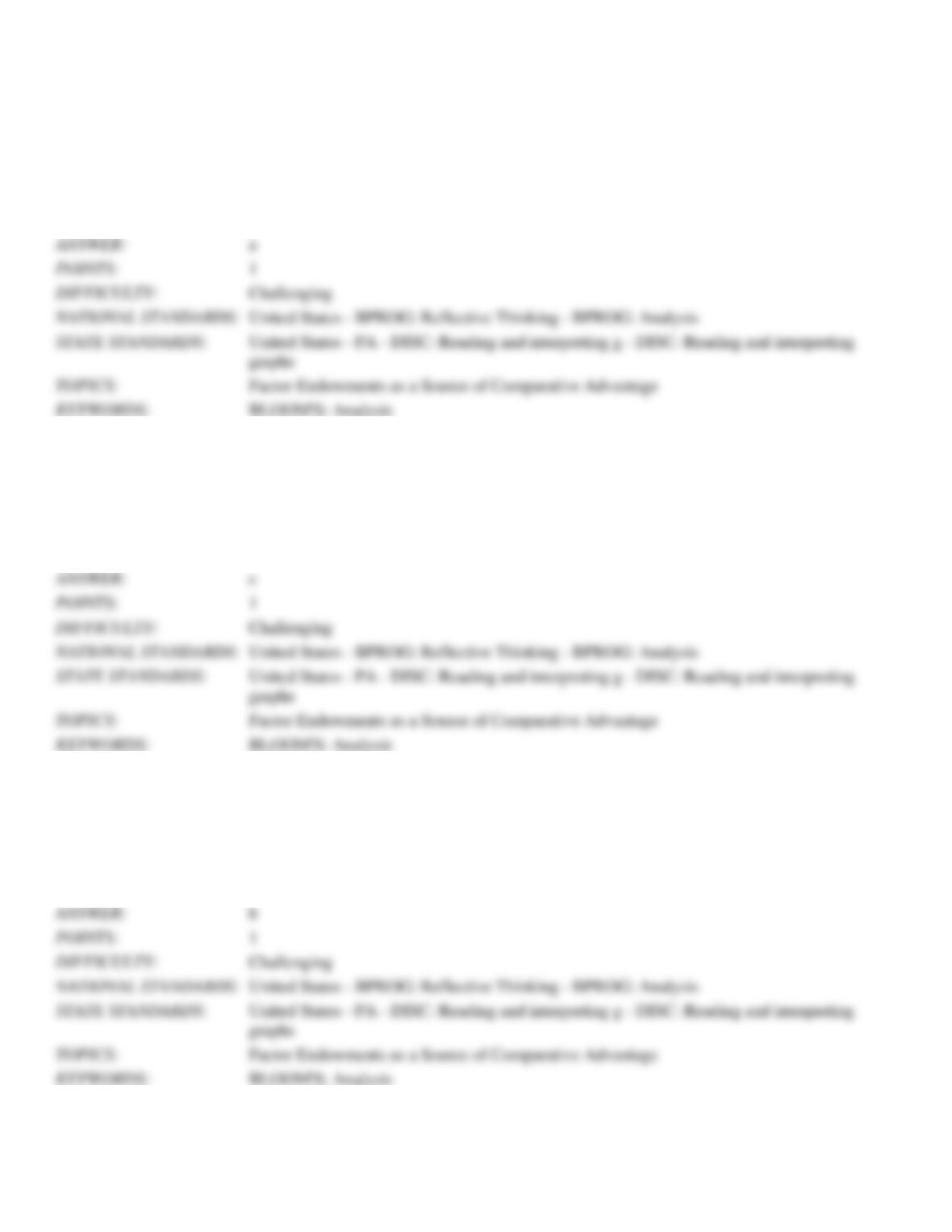
51. Considering Figure 3.1 prior to trade both China’s and the US production of textiles and aircraft is 19 and 9. Which of
the following represents the pre-trade situation?
a.
China has a comparative advantage in the production of textiles and the US has a comparative advantage in the
production of aircraft.
b.
China has a comparative advantage in the production of aircraft and the US has a comparative advantage in the
production of textiles.
c.
China has an absolute advantage in the production of both textiles and aircraft.
d.
The US has an absolute advantage in the production of both textiles and aircraft.
52. Considering Figure 3.1 which of the following would be true?
a.
China has more of both labor and capital than the US.
b.
The US has more of both labor and capital than China.
c.
The US is relatively capital abundant and China is relatively labor abundant.
d.
The US is relatively labor abundant and China id relatively capital abundant.
c
Challenging
United States – BPROG: Reflective Thinking – BPROG: Analysis
graphs
Factor Endowments as a Source of Comparative Advantage
BLOOM’S: Analysis
53. Considering Figure 3.1, what are the terms of trade represented?
a.
The terms of trade are 1½ aircraft per textile.
b.
The terms of trade are 1½ textiles per aircraft.
c.
The terms of trade are 1 textile per aircraft.
d.
The terms of trade are 2/3 textile per aircraft.
Challenging
United States – BPROG: Reflective Thinking – BPROG: Analysis
United States – PA – DISC: Reading and interpreting g – DISC: Reading and interpreting
Factor Endowments as a Source of Comparative Advantage
BLOOM’S: Analysis
54. According to Ricardian theory, comparative advantage depends on relative differences in labor productivity.
a.
True
a
Challenging
United States – BPROG: Reflective Thinking – BPROG: Analysis
graphs
Factor Endowments as a Source of Comparative Advantage
BLOOM’S: Analysis