156. Cabana Club
The company’s consolidated statement of income is provided below:
Years Ended December 31,
(in millions of dollars)
2014
2013
Revenues
Sales by company-operated restaurant stores
$8,894.9
$8,136.5
Revenue from franchised stores
3,526.5
3,272.3
Total revenues
12,421.4
11,408.8
Operating costs and expenses
Company-operated restaurant expenses:
Food and packaging
2,997.4
2,772.6
Payroll and other employee benefits
2,220.3
2,025.1
Occupancy and other operating expenses
2,043.9
1,851.9
7,261.6
6,649.6
Franchised restaurants-occupancy expenses
678.0
613.9
General, administrative and selling expenses
1,458.5
1,450.5
Made-for-You and special charges
321.6
Other operating (income) expense
(60.2)
(113.5)
Total operating costs and expenses
9,659.5
8,600.5
Operating income
2,761.9
2,808.3
Interest expense
393.8
364.4
Other nonoperating expenses
60.7
36.6
Income before provision for income taxes
2,307.4
2,407.3
Income tax expense
757.3
764.8
Net income
$1,550.1
$1,642.5
Refer to Cabana Club. Identify three specific expenses that might be accrued as a result of adjusting journal entries. Show what these entries would
look like in journal format. Ignore amounts.
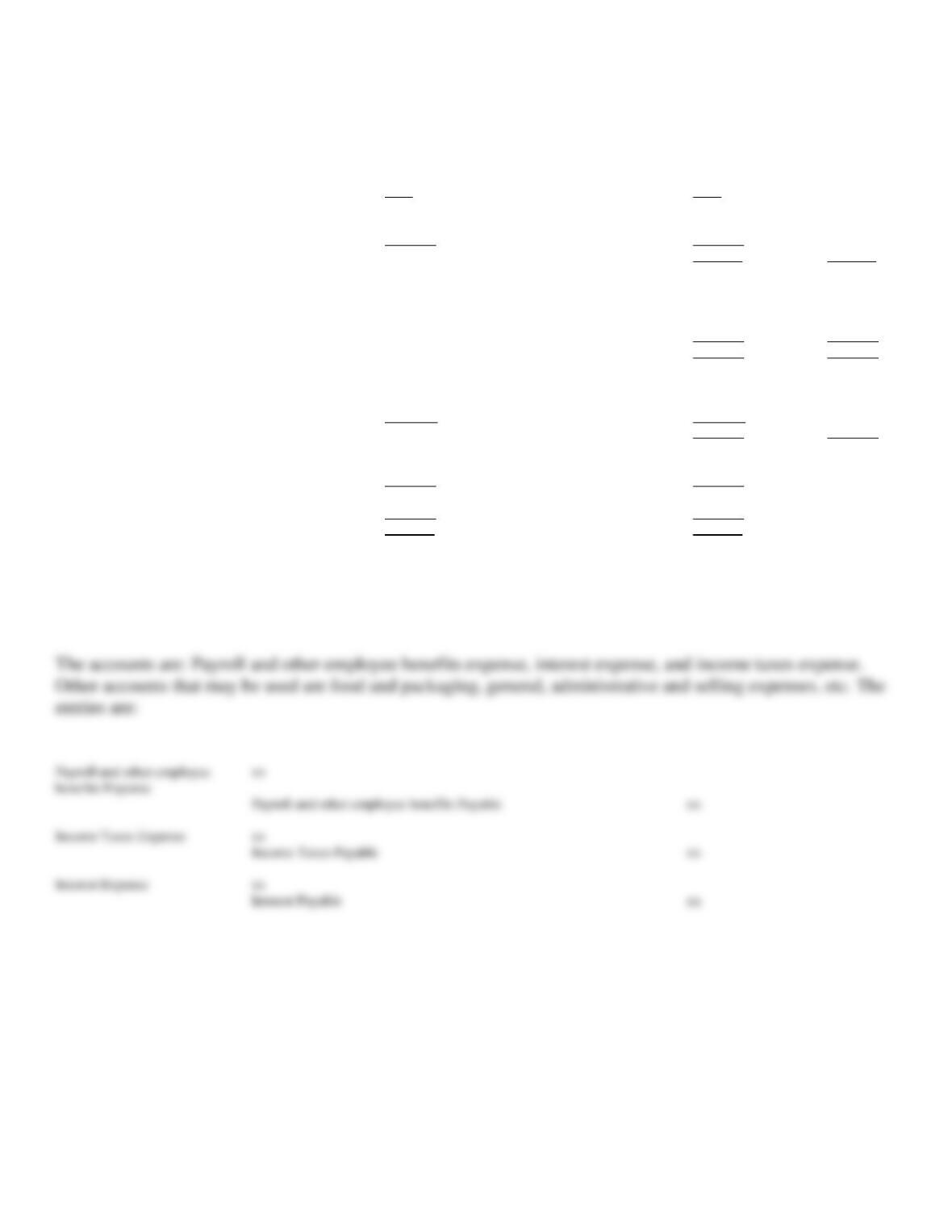
Payroll and other employee benefits Payable
Income Taxes Expense
Income Taxes Payable
Interest Expense
Interest Payable
157. Cabana Club
The company’s consolidated statement of income is provided below:
Years Ended December 31,
(in millions of dollars)
2014
2013
Revenues
Sales by company-operated restaurant stores
$8,894.9
$8,136.5
Revenue from franchised stores
3,526.5
3,272.3
Total revenues
12,421.4
11,408.8
Operating costs and expenses
Company-operated restaurant expenses:
Food and packaging
2,997.4
2,772.6
Payroll and other employee benefits
2,220.3
2,025.1
Occupancy and other operating expenses
2,043.9
1,851.9
7,261.6
6,649.6
Franchised restaurants-occupancy expenses
678.0
613.9
General, administrative and selling expenses
1,458.5
1,450.5
Made-for-You and special charges
321.6
Other operating (income) expense
(60.2)
(113.5)
Total operating costs and expenses
9,659.5
8,600.5
Operating income
2,761.9
2,808.3
Interest expense
393.8
364.4
Other nonoperating expenses
60.7
36.6
Income before provision for income taxes
2,307.4
2,407.3
Income tax expense
757.3
764.8
Net income
$1,550.1
$1,642.5
Refer to Cabana Club. Prepare all closing entries necessary based on the income statement for the year ended December 31, 2014.
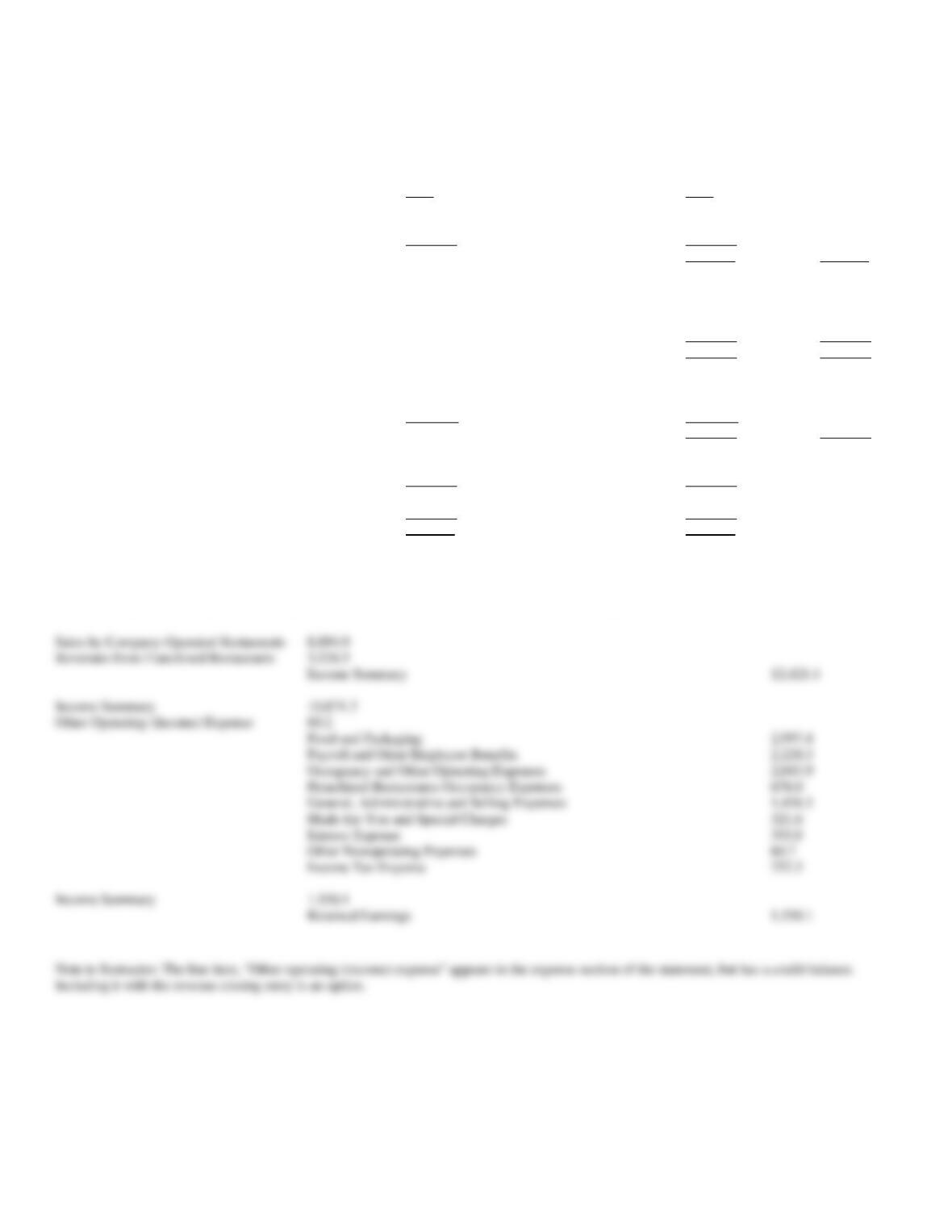
Sales by Company-Operated Restaurants
8,894.9
Revenues from Franchised Restaurants
3,526.5
Income Summary
12,421.4
Income Summary
10,871.3
Other Operating (Income) Expense
60.2
Food and Packaging
2,997.4
Payroll and Other Employee Benefits
2,220.3
Occupancy and Other Operating Expenses
2,043.9
Franchised Restaurants-Occupancy Expenses
678.0
General, Administrative and Selling Expenses
1,458.5
Made-for-You and Special Charges
321.6
Interest Expense
393.8
Other Nonoperating Expenses
60.7
Income Tax Expense
757.3
Income Summary
1,550.1
Retained Earnings
1,550.1
158. Given below are the accounts from the ledger AFTER adjustments have been posted at December 31,
2014.
Sales Revenue
$60,000
Accounts Receivable
$ 8,200
Accounts Payable
1,500
Rent Expense
2,100
Cash
25,600
Prepaid Rent
1,500
Interest Expense
2,900
Interest Payable
800
Retained Earnings, Jan. 1
22,100
Dividends
5,000
Depreciation Expense
1,000
Supplies
900
Supplies Expense
2,200
Cost of Sales
40,000
Notes Payable
3,000
Common Stock
2,000
A)
Identify which adjustments were likely made that are:
1.
Accrued assets
2.
Accrued liabilities
B)
Which accounts listed above would not be used in a cash-
basis system?
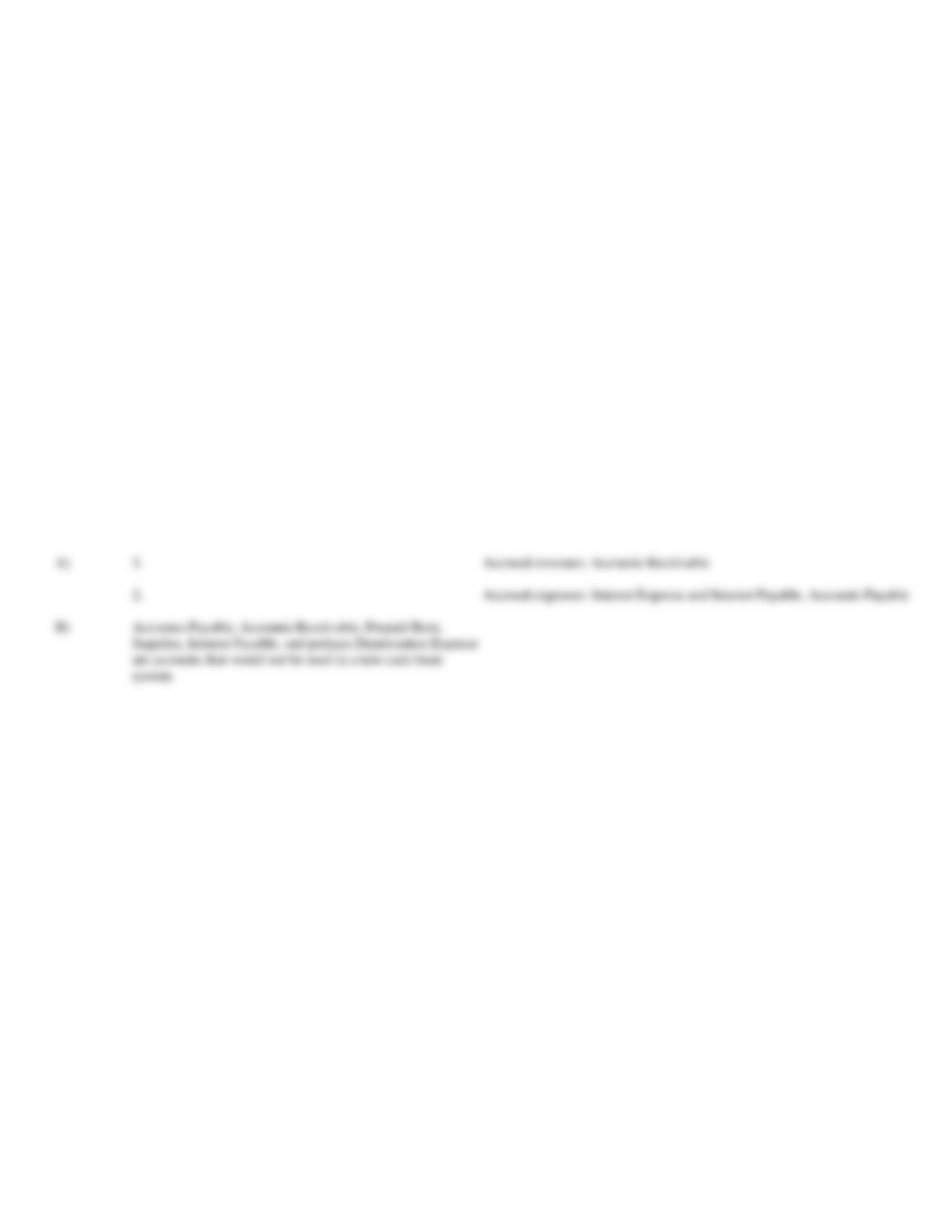
A)
1.
159. At the end of 2013, the unadjusted accounting records contain the following selected accounts and
balances:
Other revenue
$ 13,600
Salary Expense
$32,200
Supplies Expense
16,500
Rent Expense
12,400
Depreciation Expense
22,000
Legal Fees Earned
64,300
Utilities Expense
22,400
Income Tax Expense
15,800
Accounts Receivable
22,300
Dividends
13,000
A)
The company has not paid its employees for the final 3 days in 2013. The amount owed is $2,500. How much salary expense should
be reported for the year ended December 31, 2013?
B)
What additional adjustments would you expect the company to make at year end that would result in additional revenue as a result of
the accounts listed?
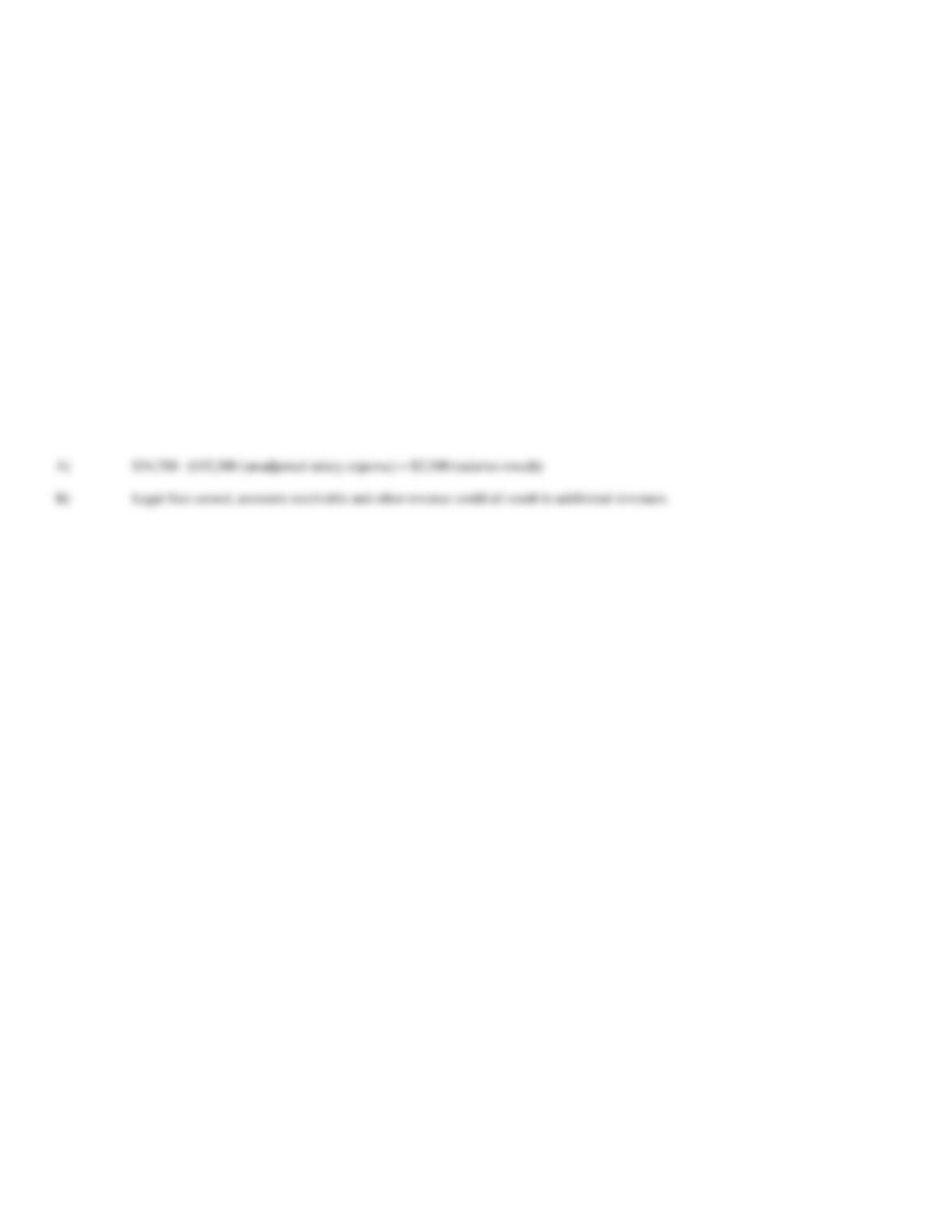
$34,700 ($32,200 (unadjusted salary expense) + $2,500 (salaries owed))
Legal fees earned, accounts receivable and other revenue could all result in additional revenues.
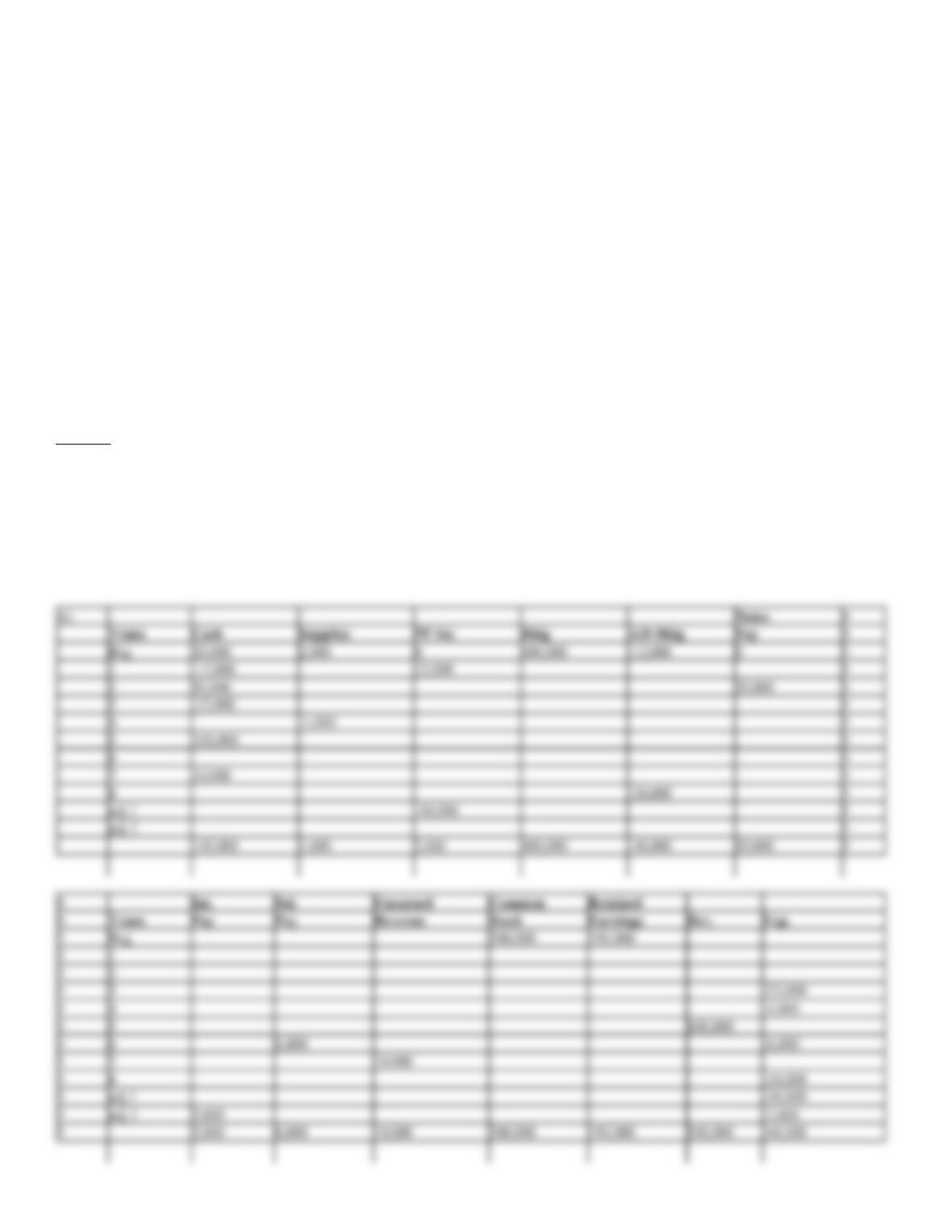
160. Can We Help?, a local walk-in medical practice, had the following account balances at December 31,
2012:
Building
$480,000
Accumulated Depreciation—Bldg
$12,000
Cash
$20,000
Common Stock
$300,000
Supplies
$2,000
Retained Earnings
$190,000
During 2013, the following transactions occurred:
1.
On March 1, purchased a one-year mal-practice insurance policy for $12,000 cash.
2.
On July 1, borrowed $50,000 cash from First American Bank. The interest rate on the note payable is 8%. Principal and interest is due in
cash in one year.
3.
Employee salaries in the amount of $23,000 were paid in cash.
4.
At the end of the year, $1,000 of the supplies remained on hand.
5.
Earned $100,000 in consulting revenue during 2013 in cash.
6.
At December 31, $6,000 in employee salaries were accrued.
7.
On December 31, received $10,000 in cash representing advance payment for services to be provided in February 2014.
8.
Annual depreciation on the building is based on a useful life of 20 years and no salvage value.
Required:
A)
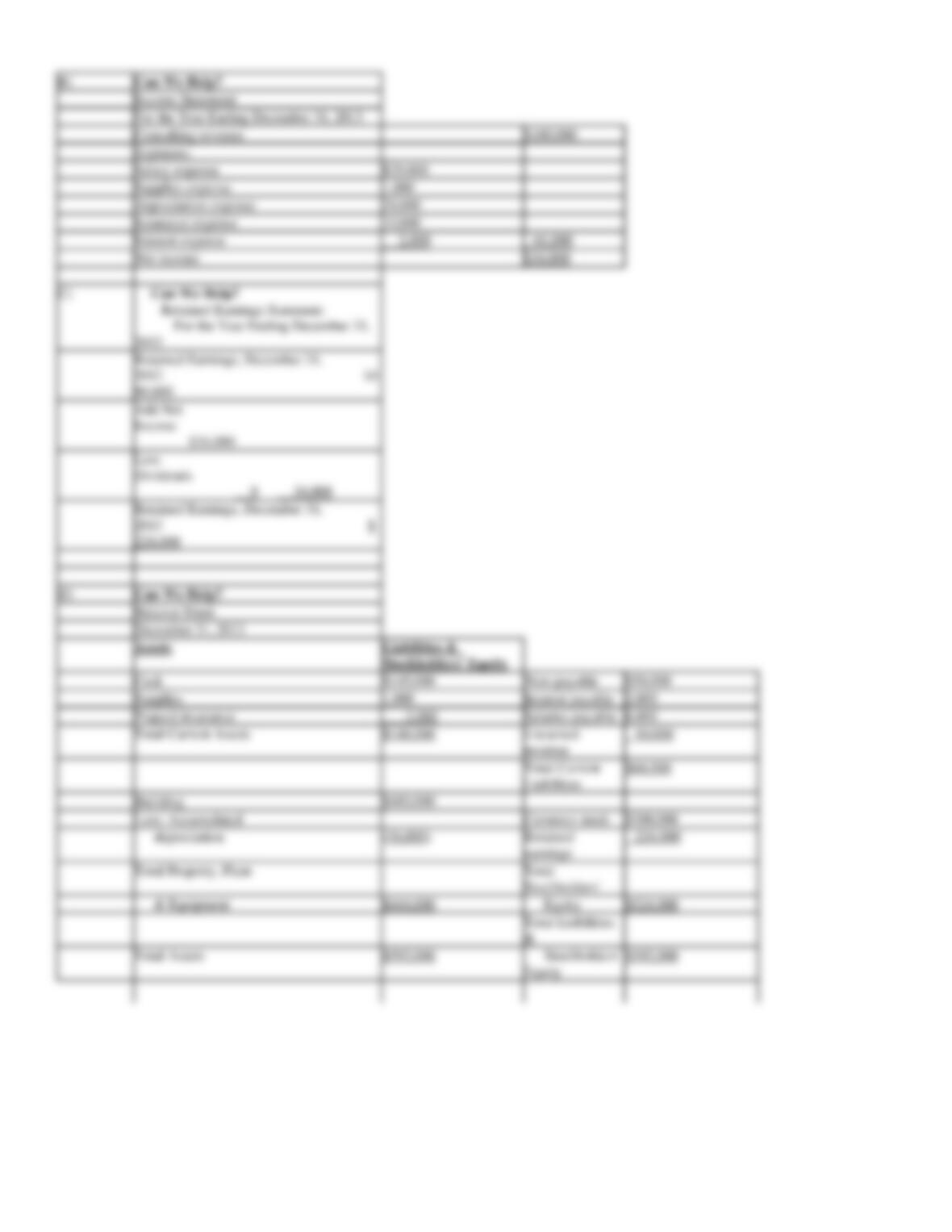
Determine the effect on the accounting equation of the preceding transactions including any related year-end adjusting entries that
may be required. Hint: It may be helpful to create a table to reflect the increases and decreases in accounts.
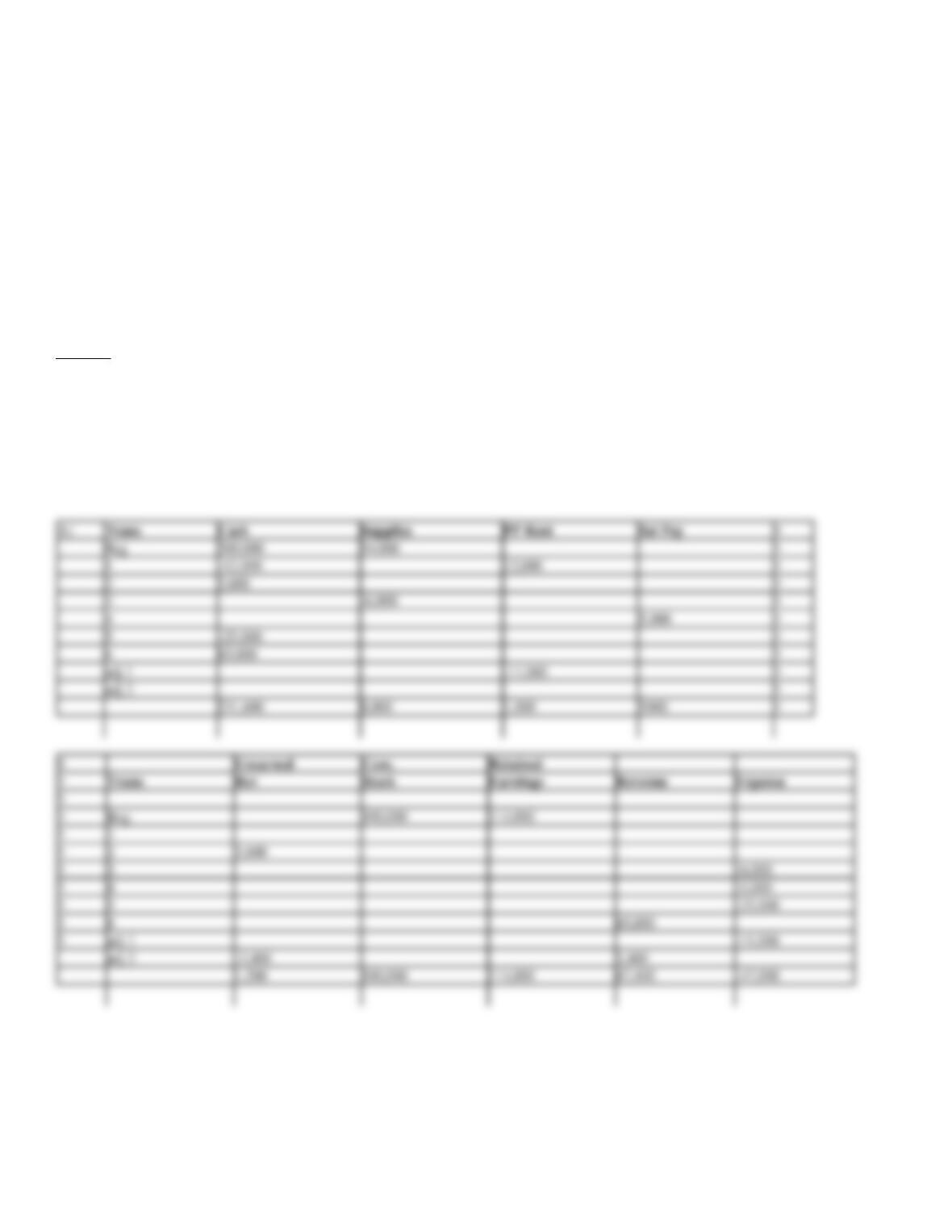
B)
Prepare an income statement for 2013 ignoring income taxes.
C)
Prepare a statement of retained earnings for 2013 assuming no dividends were paid.
D)
Prepare a classified balance sheet at December 31, 2013.
A)
Beg
20,000
2,000
0
480,000
-12,000
0
>
1
-12,000
12,000
>
2
50,000
50,000
>
3
-23,000
>
4
-1,000
>
5
100,000
>
6
>
7
10,000
>
8
-24,000
>
adj 1
-10,000
>
adj 2
>
145,000
1,000
2,000
480,000
-36,000
50,000
>
>
Beg
300,000
190,000
>
1
>
2
>
3
-23,000
>
4
-1,000
>
5
100,000
>
6
6,000
-6,000
>
7
10,000
>
adj 2
2,000
-2,000
>
2,000
6,000
10,000
300,000
190,000
100,000
-66,000
161. The accounting records of Cary’s Magic Shows reflect the following account balances at January 1, 2013:
Cash
$200,000
Supplies
$ 14,000
Common Stock
$100,000
Retained Earnings
$114,000
During 2013, the following transactions occurred:
1.
On February 1, rented a small office for a one year period of time. Paid $12,000 cash.
2.
On November 1, received $3,600 cash for magic lessons to be provided evenly over November, December, and January.
3.
By December 31, used 6,000 of the supplies.
4.
At December 31, accrued $5,000 in wages and salaries.
5.
During the year, paid cash for $25,000 in wages and salaries.
6.
During the year, earned $65,000 cash in magic lesson revenue.
Required:
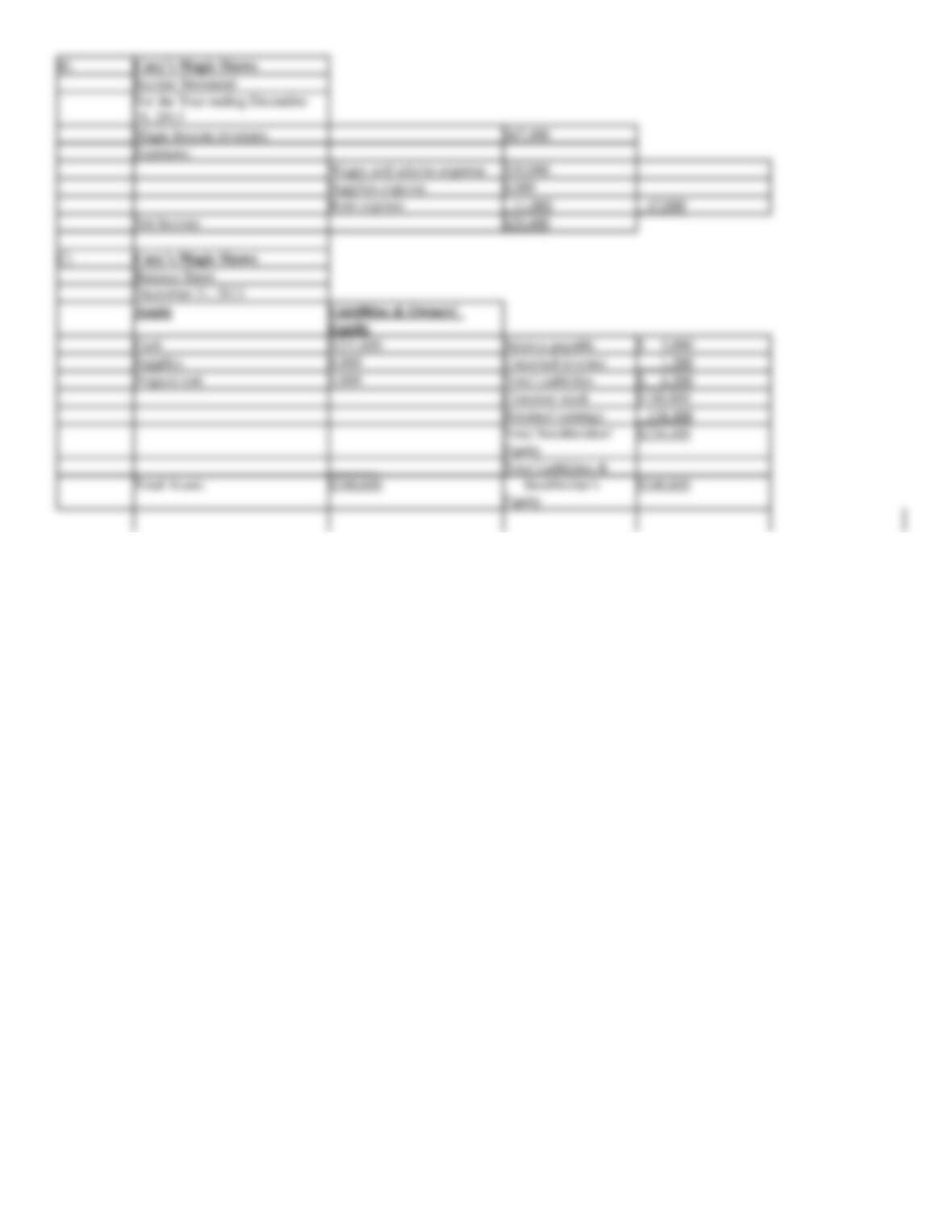
A)
Determine the effect on financial statement accounts of the preceding transactions.
Hint: It may be helpful to create a table to reflect the increases and decreases in account.
B)
Prepare an income statement for 2013 ignoring income taxes.
C)
Prepare a classified balance sheet at December 31, 2013.
A)
Beg
200,000
14,000
>
1
-12,000
12,000
>
2
3,600
>
3
-6,000
>
4
5,000
>
5
-25,000
>
6
65,000
>
adj 1
-11,000
>
adj 2
>
231,600
8,000
1,000
5000
>
>
>
>
Beg
100,000
114,000
>
1
>
2
3,600
>
3
-6,000
>
4
-5,000
>
5
-25,000
>
6
65,000
>
adj 1
-11,000
adj 2
-2,400
2,400
1,200
100,000
114,000
67,400
-47,000
162. C2IT Corporation
The C2IT Corporation was organized on July 1, 2013 after the two principal owners each contributed $100,000
and received shares of stock in exchange. The company’s year-end is December 31. The following events
occurred during the first year of operations:
July 1
Acquired a building by paying $100,000 cash and borrowing $375,000 from the Big Bank. Depreciation expense per year is
$12,500. The note payable will be due in full in ten years. Interest is payable annually. The interest rate on the note is 10%.
Sept. 1
Paid cash in the amount of $12,000 for a one-year property insurance policy.
Oct. 1
Purchased computers for $10,000 cash. The computers will be depreciated using the straight line method and will have $2,000
depreciation expense per year.
Nov. 1
Received $240,000 in cash for services to be provided evenly during the next six months.
Refer to C2IT Corporation. Answer each of the following:
A)
Prepare the necessary adjustment at December 31 for
each of the following:
1.
Depreciation on the building
2.
Interest on the promissory note
3.
Recognition of the expired portion of the insurance policy
4.
Depreciation on the computers
5.
Recognition of the revenue earned during the current period
B)
For each of the adjusting entries, indicate which of the
following type of entry was recorded: accrued expense,
accrued revenue, deferred expense or deferred revenue.
1.
Depreciation expense ($12,500 ´ 6/12 = $6,250)
6,250
Accumulated Depreciation
6,250
2.
Interest Expense ($375,000 ´ 10% ´ 6/12)
18,750
Interest Payable
18,750
3
Insurance Expense ($12,000 ´ 4/12)
4,000
Prepaid Insurance
4,000
4
Depreciation Expense ($2,000 x 3/12)
500
Accumulated Depreciation
500
5
Unearned Revenue ($240,000 x 2/6)
80,000
Service Revenue
80,000
2) Accrued expense as the expense was
incurred before cash was paid.
3) Deferred expense as cash was paid before
4) Deferred expense as cash was paid before
the expense was incurred.
5) Deferred revenue as cash was received
before the service was provided.

163. C2IT Corporation
The C2IT Corporation was organized on July 1, 2013 after the two principal owners each contributed $100,000
and received shares of stock in exchange. The company’s year-end is December 31. The following events
occurred during the first year of operations:
July 1
Acquired a building by paying $100,000 cash and borrowing $375,000 from the Big Bank. Depreciation expense per year is
$12,500. The note payable will be due in full in ten years. Interest is payable annually. The interest rate on the note is 10%.
Sept. 1
Paid cash in the amount of $12,000 for a one-year property insurance policy.
Oct. 1
Purchased computers for $10,000 cash. The computers will be depreciated using the straight line method and will have $2,000
depreciation expense per year.
Nov. 1
Received $240,000 in cash for services to be provided evenly during the next six months.
Refer to C2IT Corporation. Answer the following:
Required:
A)
Determine the effect on the accounting equation of each
transaction.
B)
Determine the effect on the accounting equation of the
necessary adjustments at December 31 for each of the
following:
1.
Depreciation on the building
2.
Interest on the promissory note
3.
Recognition of the expired portion of
the insurance
4.
Depreciation on the computers
5.
Cash received in advance of services
provided
C)
Prepare an income statement for the six months ended
December 31, 2013. C2IT has a tax rate of 30%.
164. A calendar year company paid $24,000 on October 1, 2012 to purchase two years of insurance coverage
for its retail shop. The prepayment was initially recorded as an asset.
A)
What adjusting journal entry is necessary at December 31, 2012?
B)
How much will be reported on the balance sheet at December 31, 2012, for prepaid insurance?
C)
How much will be reported on the income statement for the year ended December 31, 2012, for insurance expense?
D)
If the adjustment in part A is not recorded, by what amount will net income be over or understated at December 31, 2012?
E)
What adjusting journal entry is necessary at December 31, 2013?
F)
How much will be reported on the balance sheet at December 31, 2013, for prepaid insurance?
G)
How much will be reported on the income statement for the year ended December 31, 2013, for insurance expense?
A)
Insurance Expense
3,000
Prepaid Insurance
(3 months ´ ($24,000/24 months))
B)
Prepaid Insurance = $21,000
C)
Insurance Expense = $3,000
D)
Overstated by $3,000
Insurance Expense
12,000
Prepaid Insurance
Prepaid Insurance = $9,000
165. A photo processing store purchased office supplies on January 15 by paying cash of $5,000. On January
1, the Supplies account had a beginning balance of $500. On December 31, an inventory revealed that supplies
on hand amounted to $500.
A)
What adjusting journal entry is necessary at December 31st?
B)
How much will be reported on the balance sheet at December 31 for Supplies?
C)
How much supplies expense will be reported on the income statement?
D)
If the adjustment in part A is not recorded, what will be the impact on the income statement, retained earnings statement, and balance
sheet?
A)
Supplies Expense
5,000
Supplies
5,000
($500 + $5,000 – $500 = $5,000)
B)
Supplies = $500
C)
Supplies Expense = $5,000
166. The following amounts were taken from a company’s unadjusted trial balance at December 31, 2012:
Prepaid Rent
$ 12,000
Wages Expense
122,100
Unearned Rent Revenue
9,200
Prepare any adjusting entries necessary at December 31, 2012, for each of the transactions that follow.
A)
The rent collected in advance represents rent for the period of December 1, 2012, through January 31, 2013.
B)
In addition to the wages paid during the year, employees have not been paid for the last week of December, which amounts to
$1,900.
167. The bookkeeper for City Rentals closed the books before the accountant had had a chance to prepare the
financial statements. Use the bookkeeper’s closing entries to prepare, in good form, a statement of retained
earnings for the year ended December 31, 2012, the first year of operations for this company.
Closing Entries:
Dec. 31
Sales Revenue
125,000
Rent Revenue
22,000
Income Summary
147,000
Income Summary
78,400
Salaries and Wages Expense
45,000
Rent Expense
18,000
Utilities Expense
9,200
Supplies Expense
1,000
Insurance Expense
5,200
Retained Earnings
22,000
Dividends
22,000
Statement of Retained Earnings
For the Year Ended December 31, 2012
Retained earnings, January 1, 2012
Add: Net income ($147,000 – $78,400)
68,600
Less: Dividends
(22,000)
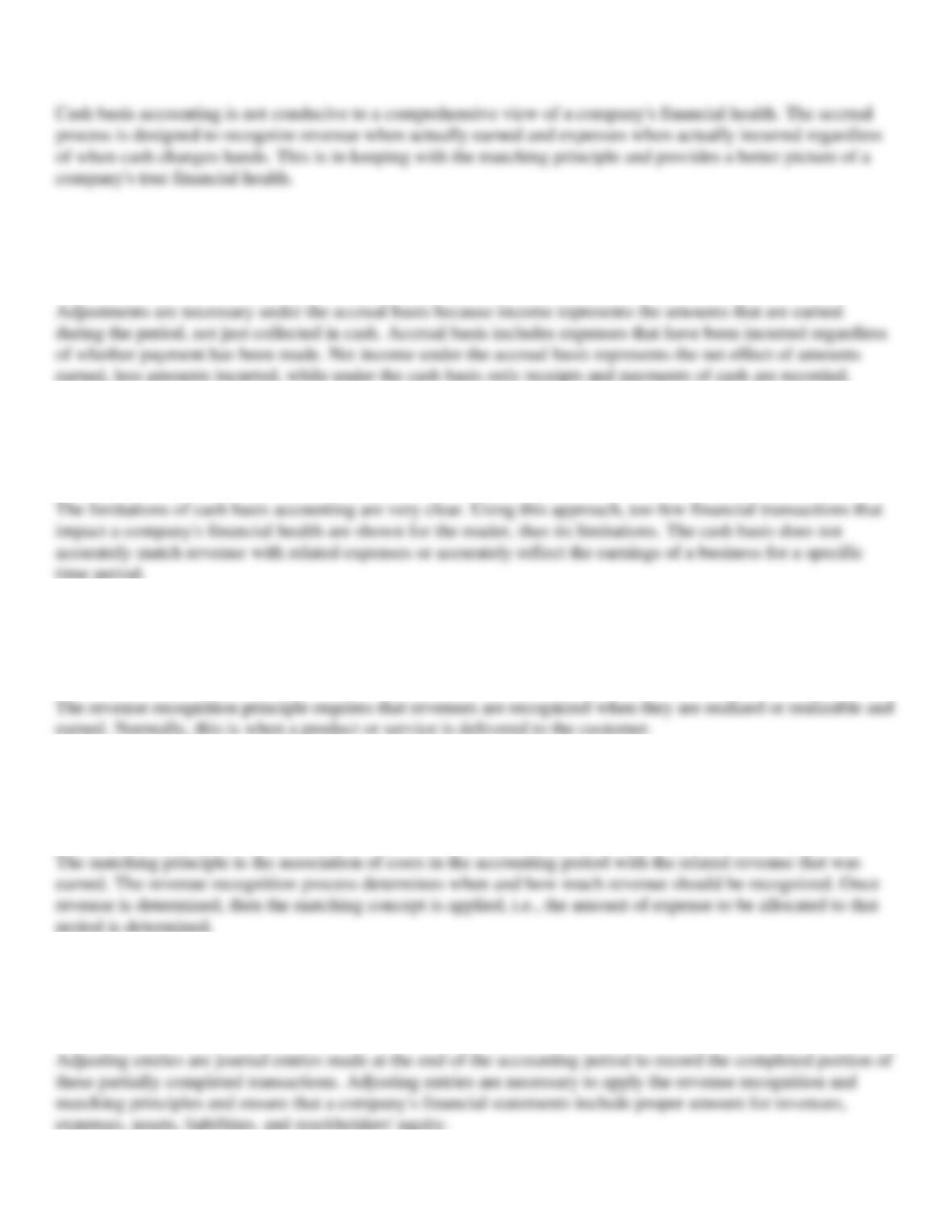
Unearned Rent Revenue
4,600
Rent Revenue
4,600
Wages Expense
1,900
Wages Payable
1,900
168. Describe why the accrual basis of accounting is preferred for financial reporting over the cash basis.
169. Why does the accrual basis of accounting require adjustments, while the cash basis does not?
170. Why is the cash basis of accounting too limited for proper financial reporting?
171. What is the revenue recognition principle?
172. What is the matching principle? How does it relate to the revenue recognition process?
173. What are adjusting entries and what is their purpose?
174. What is the significance of the timing in which cash is paid or received as it relates to the adjusting
process?
175. Explain the differences between the cash and accrual basis of accounting and how the adjusting process fits
in.
176. “You Decide” Essay
You are the CFO for Cabbage Patch Toys. The Board of Directors is meeting this afternoon. While reviewing
your company’s financial statements just minutes before the meeting you notice that no depreciation expense
has been reported.
A) Describe to the board the impact that omitting this adjustment has had on your financial statements.
B) The Board has asked you whether this mistake would impact their plan to declare a cash dividend during the
meeting. Respond.
177. “You Decide” Essay
You are the owner and operator of a catering business. In addition to catering a wide variety of functions such
as business meetings, weddings, birthday parties, etc., you sell decorated cakes in your store. A particular
business customer has signed a $12,000 contract with you to provide refreshments for its monthly business
meetings with the total contract amount due at the contract signing.