Chapter 03 – The Chemical Building Blocks of Life
Clarify Question
•
What is the key concept addressed by the question?
•
What type of thinking is required?
•
What key words does the question contain and what do they mean?
Gather Content
•
What do you know about molecules that contain phosphorus? How does it relate to the
question?
Consider Possibilities
•
What other information is related to the question? Which information is most useful?
Choose Answer
•
Given what you now know, what information and/or problem solving approach is most
likely to produce the correct answer?
Reflect on Process
•
Did your problem-solving process lead you to the correct answer? If not, where did the
process break down or lead you astray? How can you revise your approach to produce a
more desirable result?
Chapter 03 – The Chemical Building Blocks of Life
67. This is a nucleotide containing molecule that is commonly used to carry electrons in the
cell.
68. Benedict’s reagent is a chemical that is used as a test for the presence of a free aldehyde
functional group on glucose. The aldehyde is used when glucose and fructose bind together
to form sucrose, and the Benedict’s test is negative. Starch contains a great deal of glucose but
gives a negative Benedict’s test because:
Chapter 03 – The Chemical Building Blocks of Life
Clarify Question
•
What is the key concept addressed by the question?
starch.
•
What type of thinking is required?
•
What key words does the question contain and what do they mean?
Gather Content
•
What do you know about the structure of starch? How does it relate to the question?
Consider Possibilities
•
What other information is related to the question? Which information is most useful?
Choose Answer
•
Given what you now know, what information and/or problem solving approach is most
likely to produce the correct answer?
Reflect on Process
•
Did your problem-solving process lead you to the correct answer? If not, where did the
process break down or lead you astray? How can you revise your approach to produce a
more desirable result?
Chapter 03 – The Chemical Building Blocks of Life
69. What characteristic would the R groups of amino acids have if they are located within the
interior of biological membranes?
Chapter 03 – The Chemical Building Blocks of Life
Clarify Question
•
What is the key concept addressed by the question?
•
What type of thinking is required?
•
What key words does the question contain and what do they mean?
Gather Content
•
What do you know about proteins in membranes? How does it relate to the question?
Consider Possibilities
•
What other information is related to the question? Which information is most useful?
Choose Answer
•
Given what you now know, what information and/or problem solving approach is most
likely to produce the correct answer?
hydrophobic or non-polar amino acids.
Reflect on Process
•
Did your problem-solving process lead you to the correct answer? If not, where did the
process break down or lead you astray? How can you revise your approach to produce a
more desirable result?

Chapter 03 – The Chemical Building Blocks of Life
70. Sudan IV, a dye that binds to nonpolar molecules, is used to detect the presence of
macromolecules in food. Sudan IV would test positive in the presence of what
macromolecule?
Chapter 03 – The Chemical Building Blocks of Life
Clarify Question
•
What is the key concept addressed by the question?
•
What type of thinking is required?
•
What key words does the question contain and what do they mean?
Gather Content
•
What do you know about nonpolar molecules? How does it relate to the question?
Consider Possibilities
•
What other information is related to the question? Which information is most useful?
Choose Answer
•
Given what you now know, what information and/or problem solving approach is most
likely to produce the correct answer?
Reflect on Process
•
Did your problem-solving process lead you to the correct answer? If not, where did the
process break down or lead you astray? How can you revise your approach to produce a
more desirable result?

Chapter 03 – The Chemical Building Blocks of Life
Blooms Level: 3. Apply
Gradable: automatic
LO: 03.05.01 Describe the structure of triglycerides.
Section: 03.05
Topic: Lipids: Hydrophobic Molecules
71. How many water molecules are produced during the formation of a triglyceride from
fatty acids and glycerol?
Chapter 03 – The Chemical Building Blocks of Life
Clarify Question
•
What is the key concept addressed by the question?
•
What type of thinking is required?
•
What key words does the question contain and what do they mean?
Gather Content
•
What do you know about triglycerides? How does it relate to the question?
Consider Possibilities
•
What other information is related to the question? Which information is most useful?
Choose Answer
•
Given what you now know, what information and/or problem solving approach is most
likely to produce the correct answer?
Reflect on Process
•
Did your problem-solving process lead you to the correct answer? If not, where did the
process break down or lead you astray? How can you revise your approach to produce a
more desirable result?
Chapter 03 – The Chemical Building Blocks of Life
Blooms Level: 4. Analyze
Gradable: automatic
LO: 03.05.01 Describe the structure of triglycerides.
Section: 03.05
Topic: Lipids: Hydrophobic Molecules
72. Acyclovir is an antiviral chemical that resembles a nucleotide but lacks a 3′ OH
group and cannot form phosphodiester bonds. Why is Acyclovir useful in treating some viral
infections?
Chapter 03 – The Chemical Building Blocks of Life
Clarify Question
•
What is the key concept addressed by the question?
•
What type of thinking is required?
•
What key words does the question contain and what do they mean?
Gather Content
•
What do you know about the synthesis of DNA? How does it relate to the question?
Consider Possibilities
•
What other information is related to the question? Which information is most useful?
Choose Answer
•
Given what you now know, what information and/or problem solving approach is most
likely to produce the correct answer?
Reflect on Process
•
Did your problem-solving process lead you to the correct answer? If not, where did the
process break down or lead you astray? How can you revise your approach to produce a
more desirable result?
Chapter 03 – The Chemical Building Blocks of Life
Blooms Level: 4. Analyze
Gradable: automatic
LO: 03.03.01 Describe the structure of nucleotides.
Section: 03.03
Topic: Nucleic Acids: Information Molecules
73. – glucose is present in potatoes and – glucose is present in wood. Both are glucose
molecules but one can be used by humans to synthesize ATP and one cannot. Based on this
information, what is the best explanation on why humans can only digest one of the glucose
types?
Chapter 03 – The Chemical Building Blocks of Life
Clarify Question
•
What is the key concept addressed by the question?
•
What type of thinking is required?
•
What key words does the question contain and what do they mean?
Gather Content
•
What do you know about the structure of carbohydrates? How does it relate to the
question?
Consider Possibilities
•
What other information is related to the question? Which information is most useful?
Choose Answer
•
Given what you now know, what information and/or problem solving approach is most
likely to produce the correct answer?
Reflect on Process
•
Did your problem-solving process lead you to the correct answer? If not, where did the
process break down or lead you astray? How can you revise your approach to produce a
more desirable result?
Chapter 03 – The Chemical Building Blocks of Life
74. You label cells with a radioactive isotope of sulfur (35S). The only molecules that would
be radioactively labeled in these cells are:
Chapter 03 – The Chemical Building Blocks of Life
Clarify Question
•
What is the key concept addressed by the question?
•
What type of thinking is required?
•
What key words does the question contain and what do they mean?
Gather Content
•
What do you know about the composition of different monomers? How does it relate to
the question?
Consider Possibilities
•
What other information is related to the question? Which information is most useful?
Choose Answer
•
Given what you now know, what information and/or problem solving approach is most
likely to produce the correct answer?
Reflect on Process
•
Did your problem-solving process lead you to the correct answer? If not, where did the
process break down or lead you astray? How can you revise your approach to produce a
more desirable result?
Chapter 03 – The Chemical Building Blocks of Life
Blooms Level: 3. Apply
Gradable: automatic
LO: 03.01.03 List the different kinds of biological macromolecules.
Section: 03.01
Topic: Carbon: The Framework of Biological Molecules
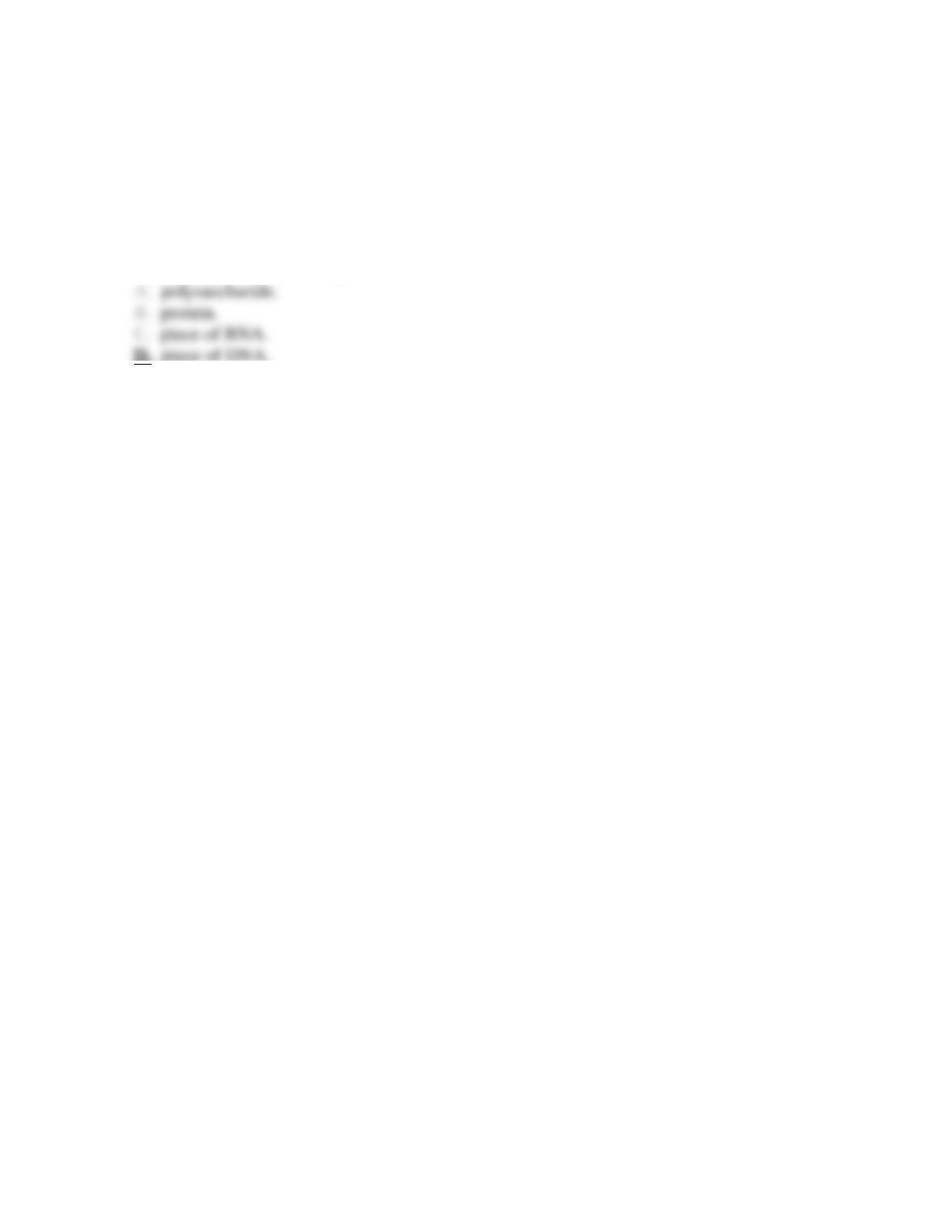
75. A polymer with the sequence 5′ ACGTACGAATAG 3′ is a:
Chapter 03 – The Chemical Building Blocks of Life
Clarify Question
• What is the key concept addressed by the question?
• What type of thinking is required?
• What key words does the question contain and what do they mean?
Gather Content
• What do you know about nucleic acid structure? How does it relate to the question?
Consider Possibilities
• What other information is related to the question? Which information is most useful?
Choose Answer
• Given what you now know, what information and/or problem solving approach is most
likely to produce the correct answer?
Reflect on Process
• Did your problem-solving process lead you to the correct answer? If not, where did the
process break down or lead you astray? How can you revise your approach to produce a
more desirable result?
Blooms Level: 3. Apply
Gradable: automatic
LO: 03.03.02 Contrast the structures of DNA and RNA.
Section: 03.03
Topic: Nucleic Acids: Information Molecules