Chapter 3
Foreign Exchange Determination
and Forecasting
Note: In the sixth edition of Global Investments, the exchange rate quotation symbols differ from previous
editions. We adopted the convention that the first currency is the quoted currency in terms of units
of the second currency.
For example, €:$ = 1.4 indicates that one euro is priced at 1.4 dollars. In previous editions we used
the reversed convention $/€ = 1.4, meaning 1.4 dollars per euro.
All problems in this test bank still use the old convention and have not been adapted to reflect the
new quotation symbols used in the 6th edition.
◼ Questions and Problems
1. In 1995, the Thai baht is pegged to a basket of currencies. Assume that the baht exchange rate is set
at 25 baht per U.S. dollar. Thailand is experiencing rapid economic growth, with extensive ongoing
foreign investment. Consumer price index (CPI) inflation in Thailand is somewhat higher than in the
United States, and the current account in Thailand is in deficit. Nevertheless, Thailand has no
problem maintaining its fixed exchange rate with the dollar.
a. Explain why the Thai baht does not depreciate as suggested by purchasing power parity (PPP).
b. Two years later, prospects for economic growth are much lower and investors are worried about
the political and financial uncertainties in Thailand. Explain why the Thai baht depreciates
strongly against the U.S. dollar.
Solution
2. In the 1970s, France had a dual exchange rate system in place for its residents. All business trade
transactions took place at the official, or “commercial,” exchange rate (say, 5 francs per U.S. dollar).
All foreign investments by French industrial corporations were subject to prior government authorization.
The regulation was even stricter for French financial institutions or private residents. They were not
allowed to transfer currency abroad. French tourists could not take abroad more than FF 5,000 (or its
equivalent in foreign currency) per year. French residents could buy foreign securities, but had to use
20 Solnik/McLeavey • Global Investments, Sixth Edition
a special “financial” rate to purchase these foreign currencies. Basically, the supply of foreign currency
assigned to “financial” francs was fixed. To buy foreign securities, residents had to use the proceeds
of the sales of foreign securities by other French residents. This led to a separate market for the
“financial” franc with a different exchange rate. Foreign income and dividends paid were repatriated
at the “commercial” franc rate and did not increase the supply of “financial” currency available. By
contrast, foreigners were free to buy and sell French securities at the “commercial” rate, but they
were not allowed to borrow francs.
a. Explain why this type of control imposed on French residents helps defend the French franc,
which was periodically under devaluation pressure.
b. Would you expect the financial exchange rate to be higher or lower than the commercial rate?
Solution
3. In the early 1990s, France and Germany had similar current and forecasted inflation rates. However,
political/economic uncertainties were higher in France, where several political changes in the 1980s
had led to several devaluations of the French franc. Do you expect to observe equal interest rates in
the two countries? Why or why not?
4. The euro was introduced in 1999 as the common currency of eleven European countries (Euroland).
What should happen to the inflation rates of France, Germany, and Italy after the introduction of the
common currency?
Chapter 3 Foreign Exchange Determination and Forecasting 21
5. Assume that foreign exchange rates are totally unpredictable, as some theories and empirical studies
claim, so that the best prediction of the future spot rate is the current spot rate.
a. Back in 1982, would you have suggested investing in U.S. dollar bills or in German bills?
b. What about in 1992?
c. What about in 1997?
(Look at Exhibit 3.1 of the fifth edition, knowing that inflation rates were similar in the two countries.)
6. In late 1994, it was announced that Japan’s monthly current account was shrinking and that this effect
could be permanent. Is this news good or bad for the Japanese yen? Why?
7. The domestic economy seems to be overheating, with rapid economic growth and low unemployment.
News has just been released that the monthly activity level is even higher than expected (as measured
by new orders to factories and unemployment figures). This news leads to renewed fears of inflationary
pressures and likely action by the monetary authorities to raise interest rates to slow the economy
down. Why is this news good or bad for the exchange rate?
8. The current Swiss franc/euro rate is 1.5 francs per euro. Inflation rates are approximately 1% in
Switzerland and between 1.8% and 2.2% in the various countries of the euro zone. One-year interest
rates are 2% in Swiss francs and 3% in euros. What would be a natural forecast for the Swiss franc/euro
exchange rate next year?
22 Solnik/McLeavey • Global Investments, Sixth Edition
Solution
9. Foreign companies are complaining that they are prevented from exporting to Japan by all kinds of
official or unwritten impediments. Try to list some of these impediments. What are the implications
in terms of using PPP to forecast the yen exchange rate?
10. You believe that the U.S. dollar will strongly appreciate against the euro in the next few weeks. What
action can you take?
Chapter 3 Foreign Exchange Determination and Forecasting 23
11. An asset manager has conducted an extensive econometric study and proposes a forecasting model.
He has found that a currency with a high interest rate tends to appreciate relative to a currency with
a low interest rate. The simple forecasting model for the one-year exchange rate is that a currency
should appreciate over the year by the amount of the interest rate differential quoted today. For
example, if the Australian dollar exchange rate is AUD/$ = 2 and the one-year interest rates in AUD
and $ are 4% and 7%, respectively, the U.S dollar should move up by 3% relative to the Australian
dollar, and your forecast for the exchange rate at the end of the year is AUD/$ = 2.06.
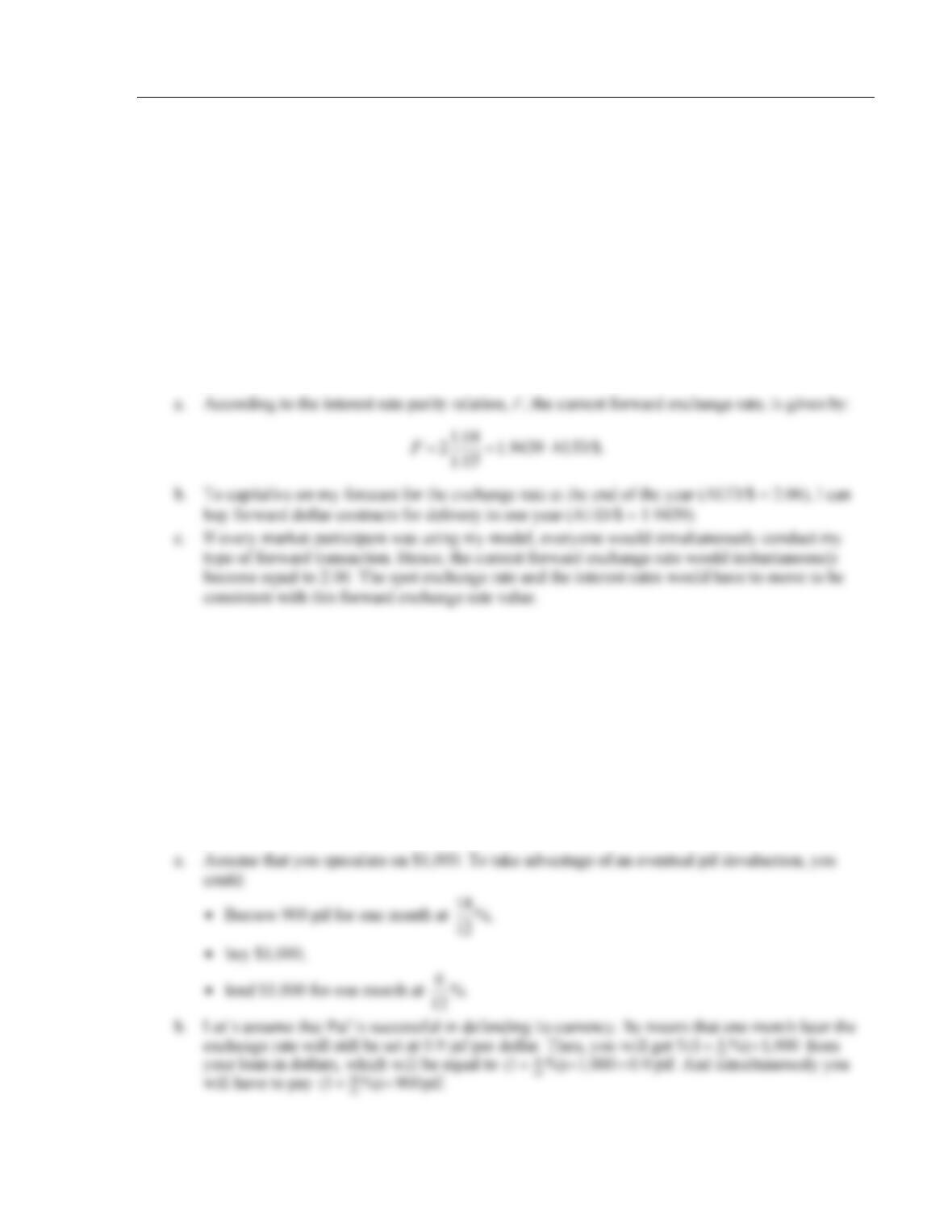
a. What is the current forward exchange rate?
b. What type of forward transaction would you conduct to capitalize on your forecast?
c. If everyone were using your model and following your strategy, what would happen to the
exchange and interest rates?
Solution
12. Paf is a country with a fixed exchange rate with the U.S. dollar, set at 0.9 pifs per dollar. The Paf
government intends to defend this central parity but has no exchange controls; it can only use an
interest rate policy to defend its national currency, the pif. The pif comes under severe speculative
devaluation pressures because of a drop in the official reserves of Paf. The current (annualized)
one-month interest rates are 18% for the pif and 6% for the dollar.
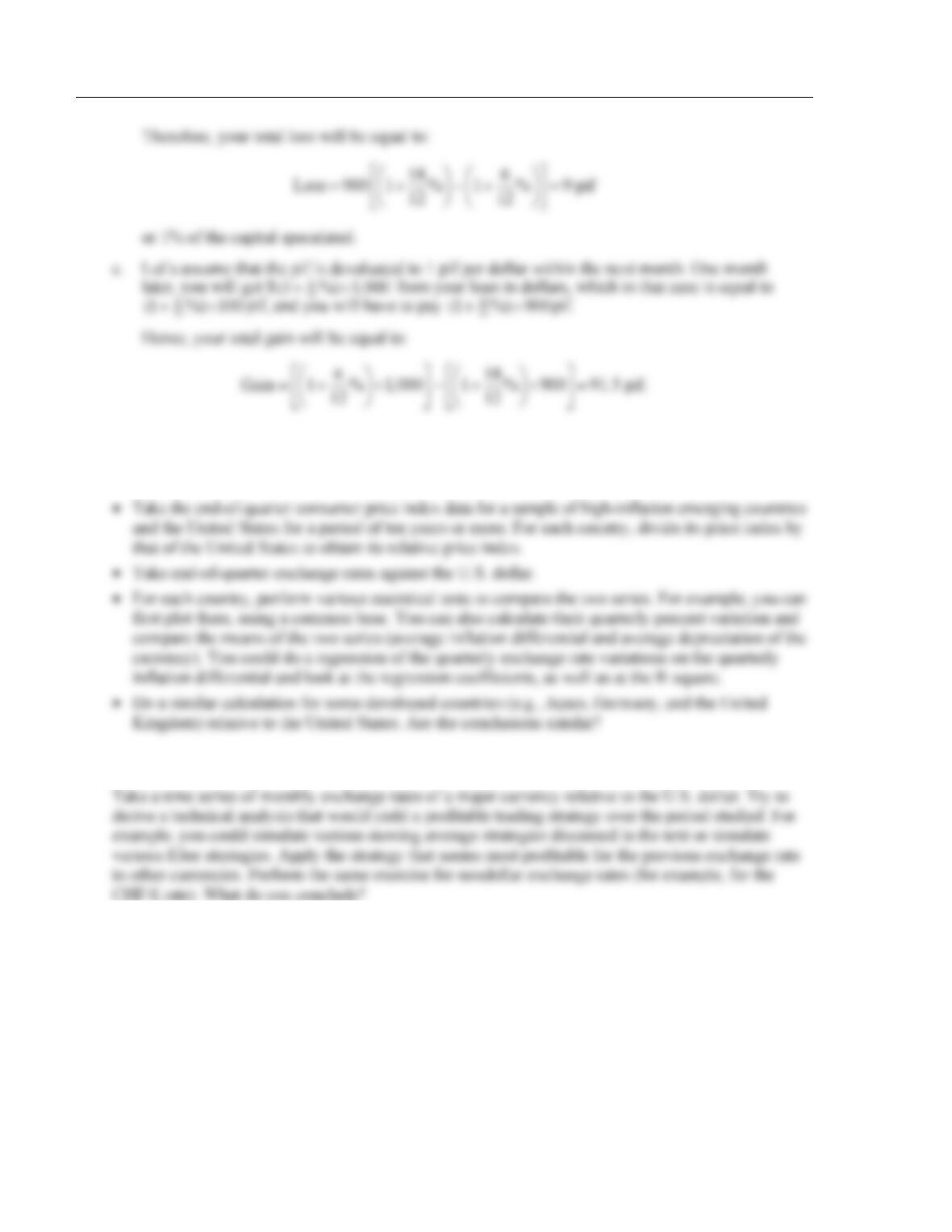
a. What type of borrowing/lending action could you take to try to take advantage of a devaluation
of the pif?
b. How much would you stand to lose if Paf is successful in defending its currency?
c. How much would you stand to gain if the pif is devalued to 1 pif per dollar within the next month?
Solution
24 Solnik/McLeavey • Global Investments, Sixth Edition
13. Project using the Web site database:
One would expect that PPP would be better verified for countries with high inflation. Look at the
validity of PPP for Latin American countries relative to the United States.
14. Project using the Web site database: