
Exam
Name___________________________________
MULTIPLE CHOICE. Choose the one alternative that best completes the statement or answers the question.
1)
Cell phones are often recycled to collect gold and other metals from them. This is profitable because
________.
1)
A)
the demand for the precious metals has increased.
B)
technological advances allow the metals to be extracted more efficiently.
C)
it is a renewable resource.
D)
A and B
E)
B and C
2)
Which common nonsilicate mineral is used in wallboard?
2)
A)
gypsum
B)
bentonite
C)
pyrite
D)
halite
A
3)
Each atom of the same element, zinc for example, has the same number of ________.
3)
A)
protons in the nucleus
B)
electrons in the valence bond level
C)
electrons in the nucleus
D)
neutrons in the outer nuclear shell
A
4)
Which of the following minerals is a ferromagnesian silicate?
4)
A)
hornblende
B)
muscovite
C)
orthoclase
D)
quartz
A
5)
A ________ denotes the purity of gold used in jewelry.
5)
A)
carnot
B)
karat
C)
carlot
D)
carette
B
D

6)
Silicate minerals polymerize to form a variety of structures. Three–dimensional structures have
________ silicon than those composed of independent tetrahedra.
6)
A)
less
B)
more
7)
What element is the most abundant in the Earth’s crust by weight?
7)
A)
chlorine
B)
sodium
C)
oxygen
D)
carbon
8)
How do the electrons behave in a mineral with metallic bonding?
8)
A)
They are tightly bound to certain atoms and cannot readily move.
B)
They move to adjacent negative ions, forming positive ions.
C)
They react with protons to make neutrons in the outer valence shells.
D)
They can move relatively easily from atom to atom inside the mineral.
9)
In which type of chemical bonding are electrons shared between adjacent atoms?
9)
A)
isotopic
B)
subatomic
C)
covalent
D)
ionic
10)
What is the name of the dark–colored mica?
10)
A)
olivine
B)
calcite
C)
quartz
D)
biotite
11)
________ is not a mineral.
11)
A)
Gold
B)
Oxygen
C)
Calcite
D)
Halite

12)
How does one classify a nonsilicate mineral group?
12)
A)
positively charged ion or complex ion
B)
silicon tetrahedra
C)
negatively charged ion or complex ion
13)
Which one of the following is a typical product of weathering?
13)
A)
ferromagnesians
B)
clays
C)
micas
D)
feldspars
B
14)
All silicate minerals contain ________ and ________.
14)
A)
iron; silicon
B)
silicon; sodium
C)
silicon; oxygen
D)
oxygen; carbon
C
15)
Which of the following minerals is a silicate?
15)
A)
halite
B)
muscovite
C)
calcite
D)
hematite
B
16)
How many elements compose the majority of rock–forming minerals?
16)
A)
4
B)
6
C)
8
D)
10
C
17)
The strong tendency of certain minerals to break along smooth, parallel planes is known as
________.
17)
A)
cracking luster
B)
crystal form
C)
streak
D)
cleavage
D
C

18)
________ has the highest specific gravity.
18)
A)
Quartz
B)
Gold
C)
Wood
D)
Water
19)
A cubic centimeter of quartz, olivine, and gold weigh 2.5, 3.0, and 19.8 grams respectively. This
indicates that ________.
19)
A)
gold has a higher density and specific gravity than quartz and olivine
B)
gold and olivine are silicates, quartz is elemental silicon
C)
olivine and quartz powders are harder than metallic gold
D)
gold is 6 to 7 times harder than olivine and quartz
20)
Which of the following is an accurate description of ionic bonding?
20)
A)
Nuclei of two different atoms share electrons, and the resulting compound is tightly bonded
by the very strong, induced, electronuclear bonds.
B)
Atoms of different elements, having gained or lost electrons, form negative and positive ions
that are bonded together by attractive forces between ions with opposite charges.
C)
Nuclei of bonding atoms exchange electrons; the resulting ions are bonded together by the
attractive forces between the negative and positive nucleons.
D)
Atoms of two different elements share electrons and protons; the resulting compound is
bonded together by the strong, binding energy of shared protons.
21)
An atom’s mass number is 14 and its atomic number is 7. How many neutrons are in its nucleus?
21)
A)
6
B)
7
C)
21
D)
14
22)
A(n) ________ is not a fundamental particle found in atoms.
22)
A)
proton
B)
electron
C)
selectron
D)
neutron

23)
________ denote positively charged, nuclear particles.
23)
A)
Isotrons
B)
Electrons
C)
Neutrons
D)
Protons
24)
Gold’s tenacity can be described as ________.
24)
A)
elastic
B)
malleable
C)
sectile
D)
brittle
25)
Which group of minerals are the most abundant in the Earth’s crust?
25)
A)
silicates
B)
sulfides
C)
carbonates
D)
chlorides
26)
What mineral is the hardest known substance in nature?
26)
A)
silicate
B)
native gold
C)
muscovite
D)
diamond
27)
Which of the following describes the light reflecting characteristics of a mineral?
27)
A)
color streak
B)
luster
C)
virtual absorption
D)
fluorescence
28)
Hornblende and the other amphiboles have what type of silicate structure?
28)
A)
sheet
B)
double chains
C)
metallic
D)
3–D framework

29)
________ reacts readily with acids such as hydrochloric.
29)
A)
Talc
B)
Calcite
C)
Diamond
D)
Quartz
30)
The ion at the center of a silicate tetrahedron is surrounded by ________.
30)
A)
4 sodium ions
B)
6 oxygen ions
C)
6 sodium ions
D)
4 oxygen ions
31)
Which mineral is composed of silicon dioxide (SiO2)?
31)
A)
calcite
B)
quartz
C)
olivine
D)
diamond
32)
________ exhibit a sheet–like silicate structure.
32)
A)
Clays
B)
Feldspars
C)
Carbonates
D)
Pyroxenes
33)
What are the lightest or least massive of the fundamental atomic particles?
33)
A)
electrons
B)
protons
C)
uranium nuclei
D)
neutrons
34)
Which one of the following is a sodium and calcium feldspar with striations?
34)
A)
sanidine
B)
microcline
C)
plagioclase
D)
orthoclase

35)
What in the name given to an atom that gains or loses electrons in a chemical reaction?
35)
A)
nucleon
B)
ion
C)
molecule
D)
isotope
36)
Which of the following best defines a mineral and a rock?
36)
A)
A rock consists of atoms bonded in a regular, geometrically predictable arrangement; a
mineral is a consolidated aggregate of different rock particles.
B)
A rock has an orderly, repetitive, geometrical, internal arrangement of minerals; a mineral is a
lithified or consolidated aggregate of rocks.
C)
A mineral consists of its constituent atoms arranged in a geometrically repetitive structure; in
a rock, the atoms are randomly bonded without any geometric pattern.
D)
In a mineral the constituent atoms are bonded in a regular, repetitive, internal structure; a
rock is a lithified or consolidated aggregate of different mineral grains.
37)
Ruby and sapphire are red and blue forms of the mineral ________.
37)
A)
turquoise
B)
emerald
C)
corundum
D)
diamond
38)
Which of the following minerals is in the mineral group known as mica?
38)
A)
augite
B)
orthoclase
C)
muscovite
D)
olivine
39)
Which of the following best characterizes ferromagnesian silicates?
39)
A)
They are black to dark–green silicate minerals containing iron and magnesium.
B)
They are mostly clear, colorless, and rich in the elements magnesium and ferrium.
C)
They contain iron and magnetite, are black in color, and they have metallic lusters.
D)
They contain magnetite and ferroite, and they are clear to light green.

40)
Which one of the following is NOT true for minerals?
40)
A)
They can be identified by characteristic physical properties.
B)
They have a specific, predictable chemical composition.
C)
They can be a liquid, solid, or gas.
D)
They have a specific, internal, crystalline structure.
41)
Why does garnet have less silicon than quartz?
41)
A)
As more oxygen atoms are shared in a silicate polymer, the percentage of silicon increases.
B)
Garnet has a three–dimensional structure.
C)
As more silicon atoms are shared in a silicate polymer, the percentage of silicon increases.
D)
A and C
C
SHORT ANSWER. Write the word or phrase that best completes each statement or answers the question.
42)
The physical property denoting a mineral’s tendency to crack along parallel, planar
surfaces is known as what?
42)
43)
In atoms, which electrons are involved in chemical bonding?
43)
44)
What physical property denotes the color of a powdered mineral?
44)
45)
Parallel, straight, linear imperfections visible on the cleavage surfaces of plagioclase
feldspar are called what?
45)
46)
What is the chemical composition of graphite and diamond?
46)
C

Word Analysis. Examine the words and/or phrases for each question below and determine the relationship among the
majority of words/phrases. Choose the option that does not fit the pattern.
47)
a. galena b. calcite c. gypsum d. halite
47)
48)
Moh’s scale is a relative measure of which physical property of minerals?
48)
49)
What is the smallest particle of matter that exhibits and defines the distinctive chemical
characteristics of the individual elements?
49)
Word Analysis. Examine the words and/or phrases for each question below and determine the relationship among the
majority of words/phrases. Choose the option that does not fit the pattern.
50)
a. electron b. atom c. proton d. neutron
50)
51)
A compound is a stable chemical substance composed of two or more what?
51)
52)
What is the dominant form of chemical bonding exhibited by minerals such as native gold,
native copper and copper–rich sulfides?
52)
53)
What two major characteristics differentiate minerals from the noble gases?
53)
54)
What is the hardest mineral known?
54)
55)
Most glasses and some minerals exhibit a type of fracture characterized by nested and
curved, cracked surfaces. What term describes this property?
55)

Word Analysis. Examine the words and/or phrases for each question below and determine the relationship among the
majority of words/phrases. Choose the option that does not fit the pattern.
56)
a. quartz b. olivine c. feldspar d. calcite
56)
57)
What mineral group forms by the breakdown and weathering of rock–forming silicate
minerals and are important constituents of soils?
57)
TRUE/FALSE. Write ‘T’ if the statement is true and ‘F’ if the statement is false.
58)
Orthoclase and plagioclase feldspars have quite different forms of cleavage.
58)
59)
Positive ions are atoms that have gained electrons during a chemical reaction.
59)
60)
In a silicon–oxygen structural unit, silicon atoms occupy corners of a tetrahedron.
60)
61)
The micas, biotite and muscovite, exhibit one direction of cleavage.
61)
62)
Rock–forming silicate minerals have higher specific gravities than water.
62)
63)
Calcite and halite react with dilute acids to evolve carbon dioxide.
63)
64)
Rock–forming minerals and economic minerals are mutually exclusive groups.
64)
65)
All atoms of the same element have the same atomic number.
65)
66)
Rocks are aggregates of one or more minerals.
66)
67)
Calcite and dolomite are both carbonate minerals.
67)
68)
Ferromagnesian silicate minerals contain some magnesium and/or iron.
68)
69)
Diamond and quartz are both minerals composed of a single element.
69)
70)
Nonmetallic minerals such as quartz and gypsum have no industrial uses.
70)
ESSAY. Write your answer in the space provided or on a separate sheet of paper.
Critical thinking and discussion questions. Use complete sentences, correct spelling, and the information presented in
chapter 3 to answer the questions below.
71)
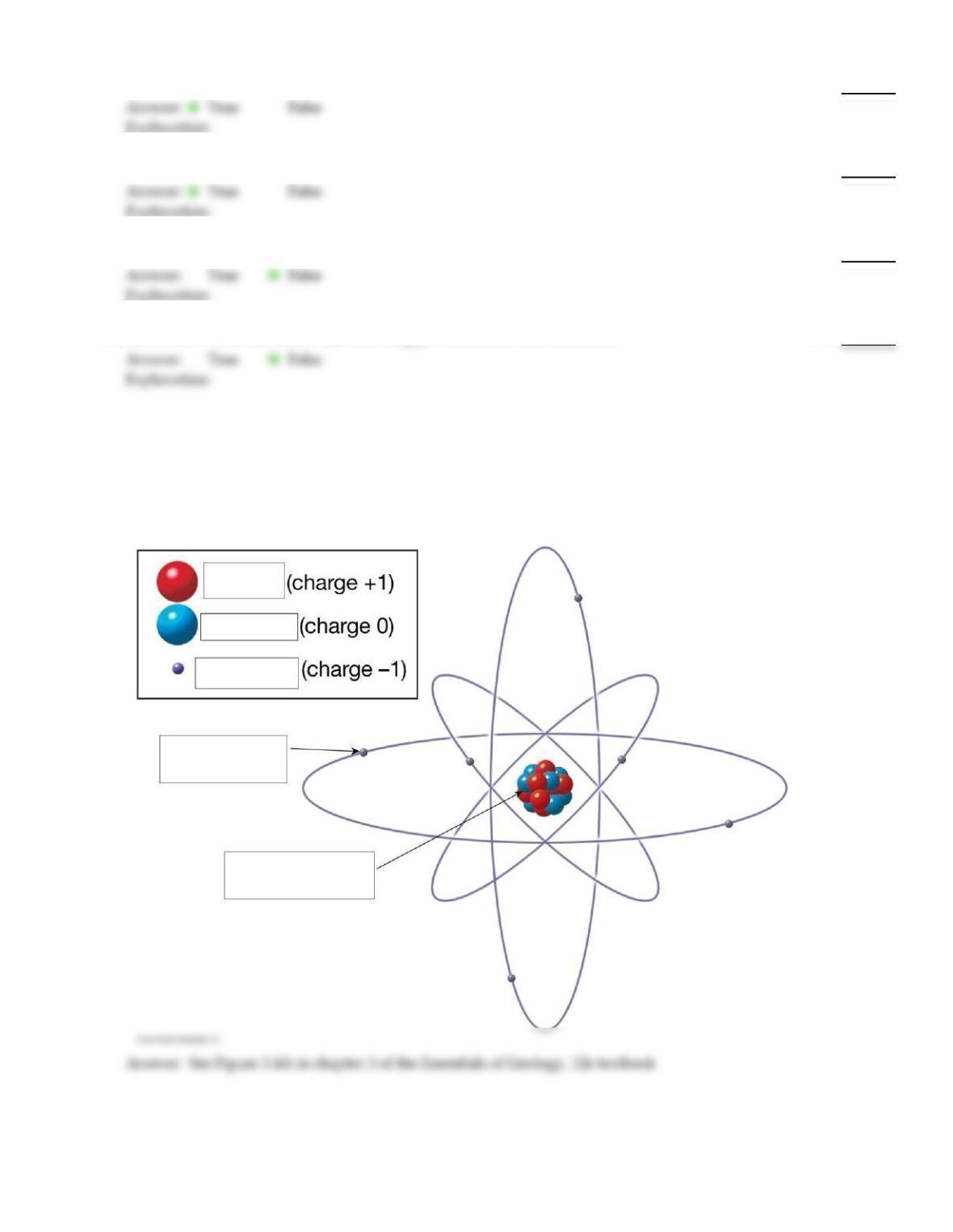
Label the various parts of an atom in the diagram below.
11
72)
Based on the brief discussion of chemistry and chemical bonding in chapter 3, why do minerals rarely exhibit
pure chemical compositions (100% always the same chemical composition)?
73)
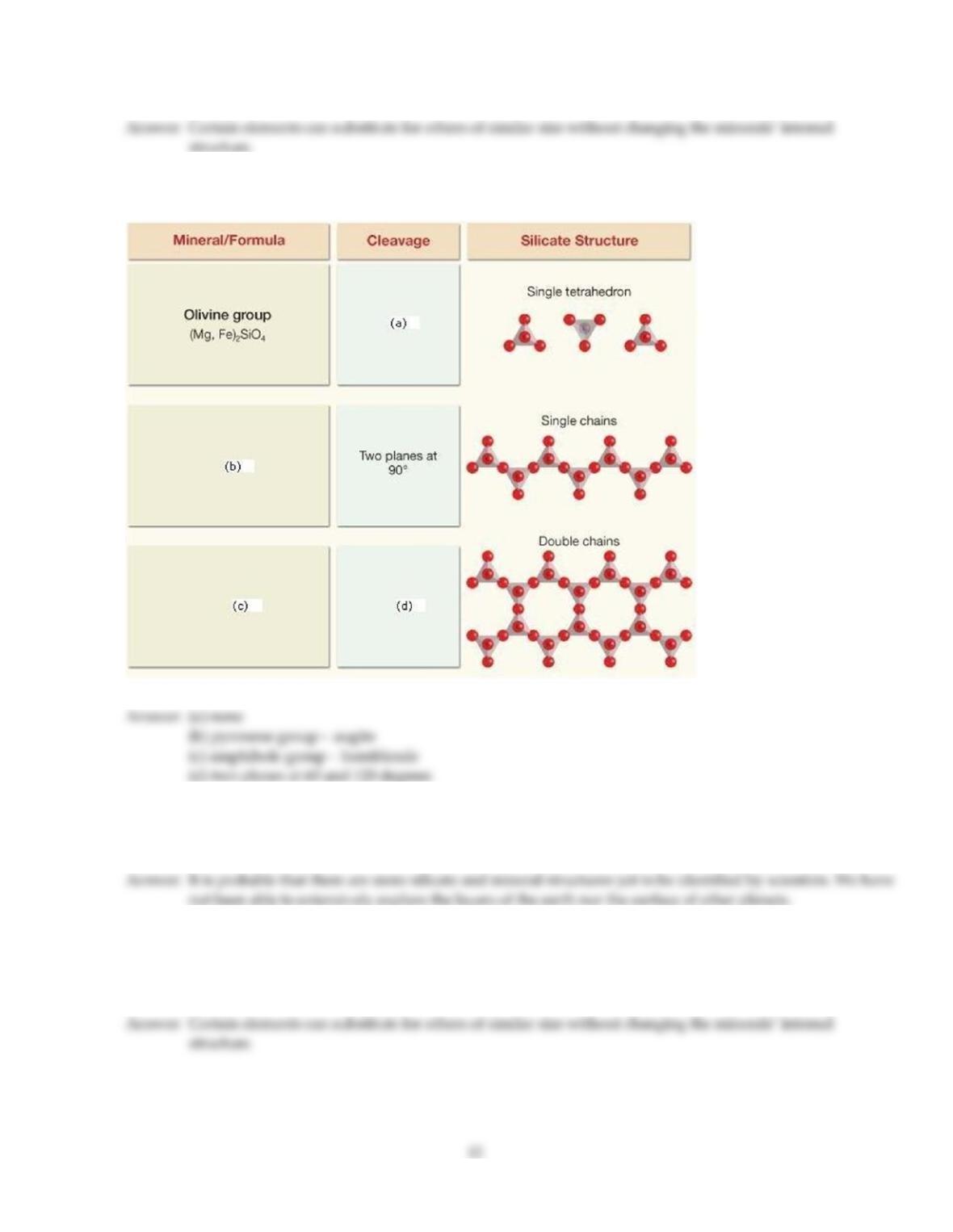
Fill in the table below on silicate minerals.
74)
Considering the composition and structure of Earth discussed in chapter 1, do you think all of the possible
silicate (and even mineral) structures have been identified by scientists? Discuss why or why not. Also, does this
same reasoning apply to all possible chemical elements of Earth?
75)
Overall, the physical properties of minerals provide a reliable means to identify common minerals. However,
certain properties can exhibit a range of characteristics or values making them less useful for identification
purposes. Choose three physical properties that might vary considerably between samples of the same mineral
and explain why such variability would exist.

Answer Key
Testname: C3
13
Answer Key
Testname: C3