Chapter 3 Test Questions
3.4.1 Customers walk into a bank and are served at an average rate of 20 per hour. One average
there are 5 people waiting in queue to be served. How long does the average customer
wait in queue?
Answer to 3.4.1:
3.4.2 At a hospital emergency room, patients come in at the rate of 20 per hour and on average,
are processed at the rate as well. Patients wait in queue till they are called in for
registration. After registration, patients are taken to an inner area where they are assigned
a bed where they wait till an intern is ready to see them. Once an intern sees them, she
either identifies them to be a routine case, prescribes medication and releases them, or she
admits them to the hospital for further tests and treatment. On average, it is found that
there are 30 patients waiting for registration and another 20 waiting to be seen by an
intern.
A study has determined that 75% of the patients simply require routine treatment. A new
system separates the emergency room into two treatment areas, one for routine care and
another for emergency cases. A triage nurse who assigns the patient to one of the two
tracks sees a patient after registration. Patients for routine care are seen by an intern who
either prescribes medication and releases them or determines that the triage nurse has
made a mistake and the patient really needs emergency care. In this case the patient is
moved to the emergency track. Patients for emergency care are seen by an intern who
either admits them for further treatment or determines that they really are routine cases,
prescribes medication and releases them. It is determined that there are, on average, 20
people waiting to be registered, 5 waiting to be seen by the triage nurse, 10 waiting to be
seen by an intern in the emergency area, and 10 waiting to be seen by an intern in the
routine care area. One average, 75% of the patients are classified by the triage nurse as
needing routine care.
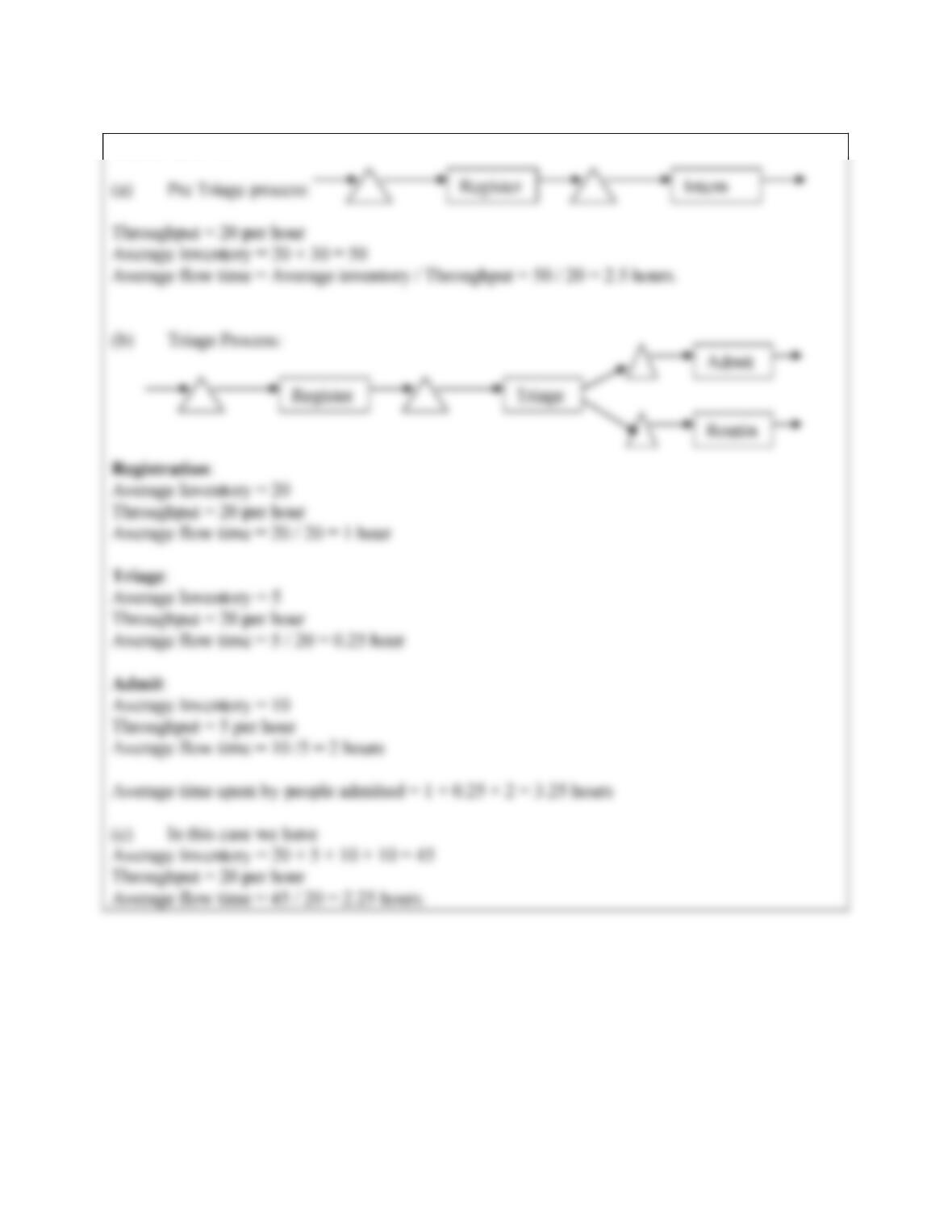
(a) On average, how long did patients spend in the emergency room before the triage system
(either before being released or admitted)?
(b) On average, how long do patients that are finally admitted to the hospital spend in the
emergency room after the introduction of the triage system? Assume that the triage nurse
makes no mistake in identifying a patient as needing routine or emergency care.
(c) On average, how long do patients spend in the emergency room after the triage system is
introduced (either before being released or admitted)? Assume that the triage nurse makes
no mistake in identifying a patient as needing routine or emergency care.
Answer to 3.4.2:
3.4.3 A car repair shop has two hoists where cars can be lifted for repair work. Currently
customers come in at the rate of 4 per hour and are processed at a similar rate. On
average 8 cars are waiting to be processed, 4 needing routine repairs and 4 needing major
repairs. People are served on a first come first serve basis.
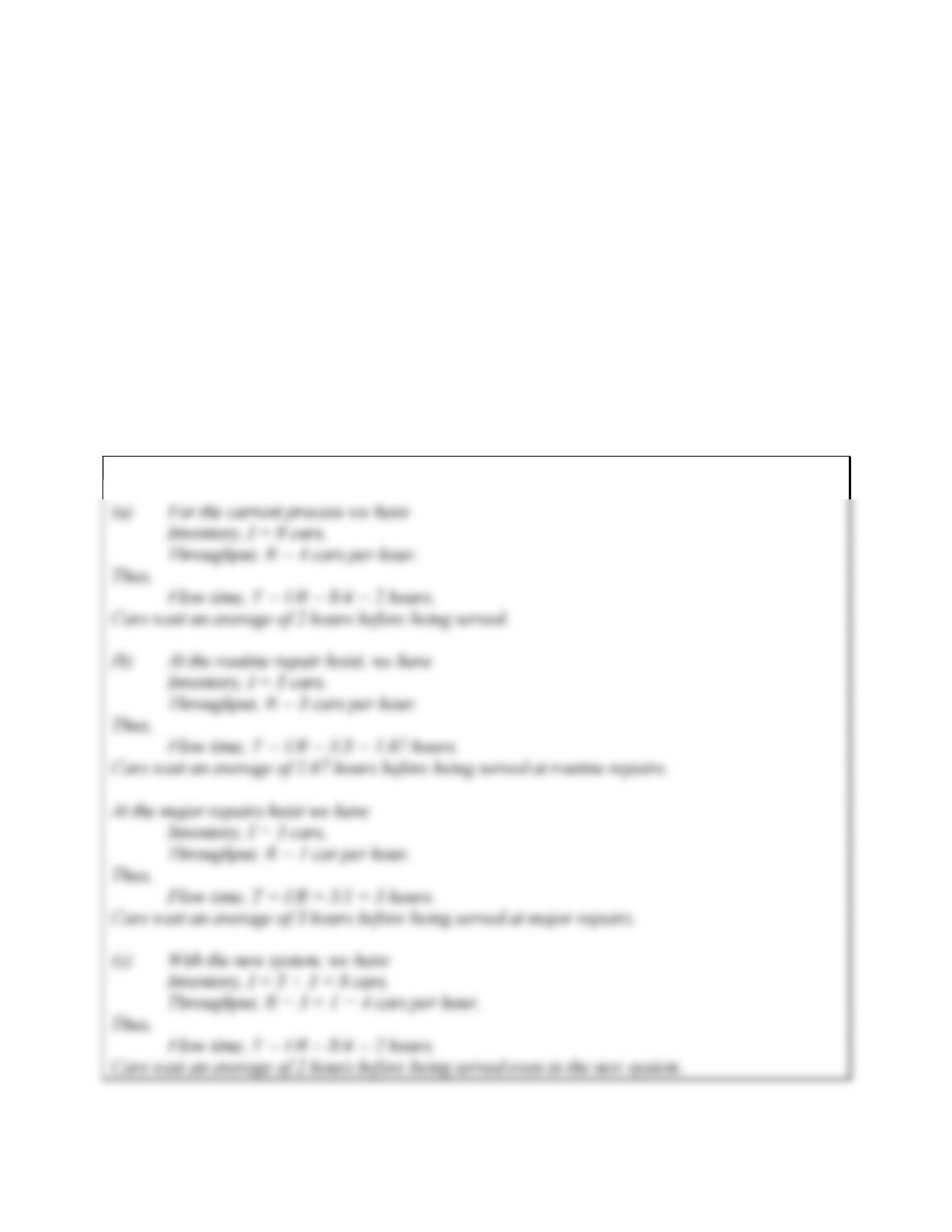
(a) How long do customers wait on average before being processed?
(b) The repair shop owner feels that he is losing many customers needing routine repair
because of the long wait. He dedicates one hoist for routine repair and one for major
repairs. A study indicates that routine repairs are processed at the rate of 3 per hour and
major repairs at the rate of 1 per hour. There are now 5 people waiting on average for
routine repairs and 3 waiting on average for major repairs. How long does each type of
customer now wait before being served?
(c) With the new system, what is the average waiting time over all customers?
Answers to 3.4.2:
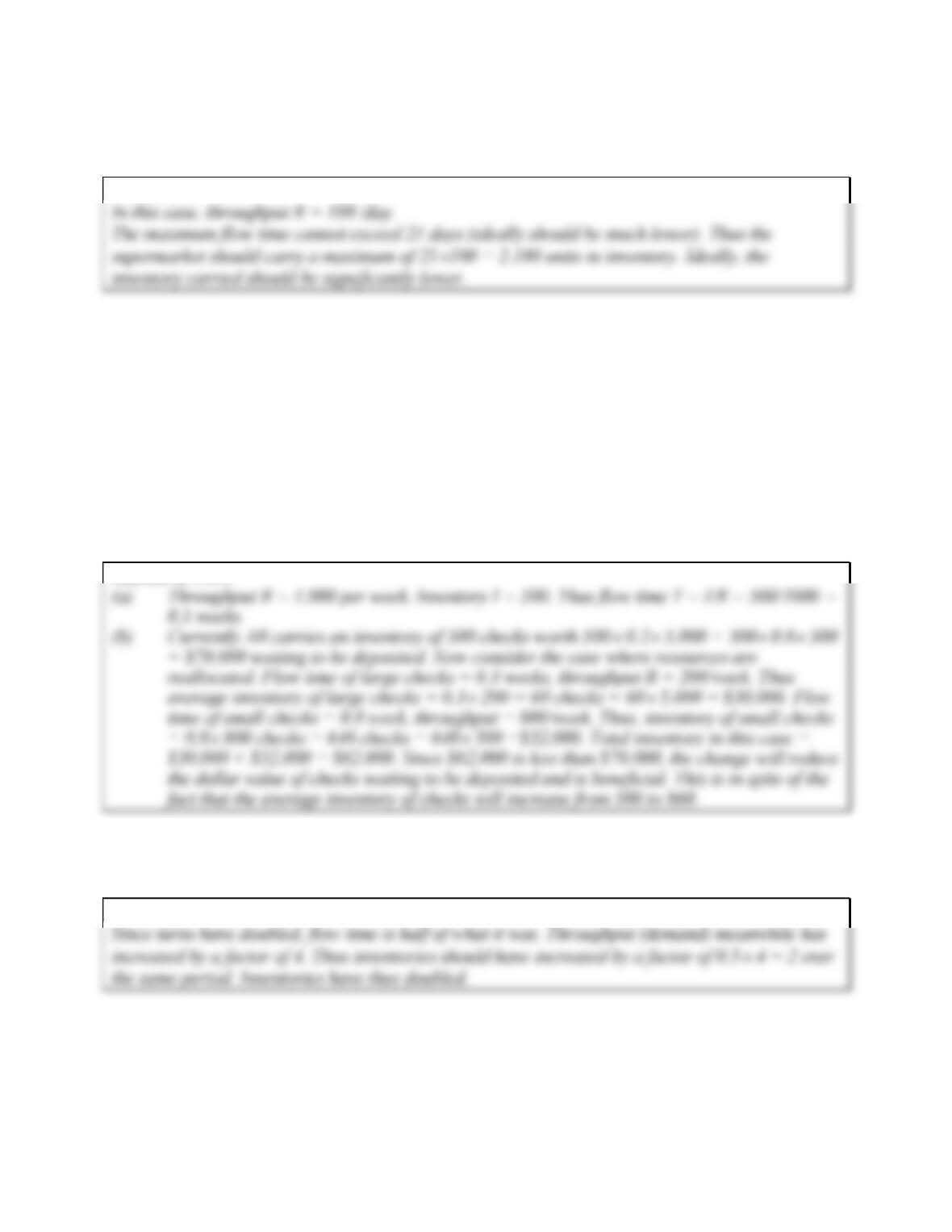
3.4.4 A product sold at a supermarket has a shelf life of 21 days. If daily demand averages 100
units, what is the maximum inventory that the supermarket should carry.
Solution to 3.4.4:
3.4.5 Accounts Receivable (AR) receives an average of 1,000 payments per week. There is an
average of 500 checks waiting to be deposited.
(a) What is the average time spent by each check waiting to be deposited?
(b) Assume that the checks coming in are either small or large. Small checks are for an
average of $500 and large checks are for an average of $5,000. 20% of the checks
coming in are large with the rest being small. Currently no distinction is made between
the large and small checks. As a result 20% of the checks waiting to be processed are
large. Is it worth reallocating resources so that large checks wait an average of 0.3 weeks
while small checks wait an average of 0.8 week before being processed?
Answer to 3.4.5:
3.4.6 A firm has seen its demand quadruple over a 2 year period. During the same period, the
number of turns has doubled. What has happened to inventories over the same period?
Answer to 3.4.6: