Exam
Name___________________________________
MULTIPLE CHOICE. Choose the one alternative that best completes the statement or answers the question.
1)
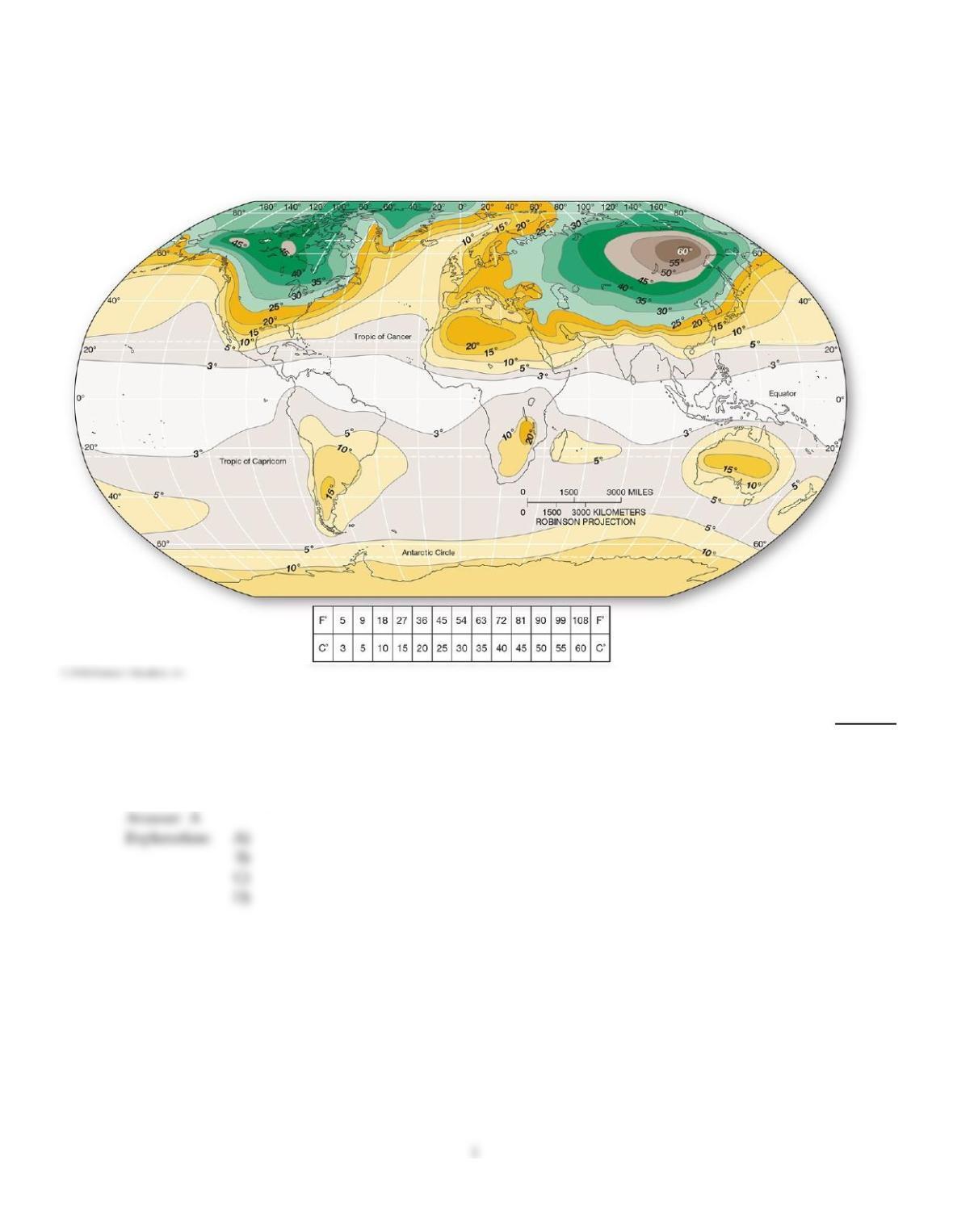
Which is TRUE for global annual temperature ranges?
1)
A)
The greatest ranges occur in east central Siberia in Russia.
B)
The greatest ranges occur over the continental masses in the Southern Hemisphere.
C)
The greatest ranges occur in the subtropics over the oceans.
D)
The lowest ranges occur over continental interiors in the Northern Hemisphere.
2)
Which of the following is NOT true of the freezing point of water?
2)
A)
Freezing point ranges from 0°C to –40°C (32°F to –40°F).
B)
There is a single freezing point, 0°C (32°F).
C)
Freezing point varies with volume and atmospheric conditions.
D)
Purity of water can influence freezing point.
3)
If the temperature at the surface of Earth (at sea level) is 40°C, what is the temperature at 2000 m if
the normal lapse rate is 6.4°C/1000 m?
3)
A)
27.2°C
B)
52.8°C
C)
33.6°C
D)
46.4°C
4)
Which of the following is NOT true of solar energy?
4)
A)
It can provide both heat and electricity.
B)
Photovoltaic capacity has not increased in recent years.
C)
The United States receives as much energy in 35 minutes of insolation as we produce by
burning fossil fuels in the United States in a year.
D)
Experimental photovoltaic cells have broken the 40% efficiency barrier.
5)
The single most important control on temperature is
5)
A)
altitude.
B)
insolation.
C)
latitude.
D)
distribution of land and water.
6)
The principal controls and influences of temperature patterns include
6)
A)
the distance of Earth from the sun and sunspot activity.
B)
the seasons and human activity.
C)
latitude, altitude, land–water heating differences, cloud cover, ocean currents, and surface
conditions.
D)
Earth’s tilt, rotation, revolution, and sphericity.
7)
In general, more moderate temperature patterns
7)
A)
are exemplified by Winnipeg and Wichita.
B)
indicate maritime influences.
C)
occur in continental interiors.
D)
are created by continentality.
8)
________ is a prolonged period of abnormally high temperatures, usually in association with
humid weather.
8)
A)
Apparent temperature
B)
A temperature anomaly
C)
A heat wave
D)
Sensible heat
9)
Sensible heat transfer (H) refers to energy transfer between the air and the surface by
9)
A)
evaporation of water.
B)
ground heating.
C)
reflection of insolation.
D)
turbulent eddies, convection, and conduction.

10)
Which of the following is CORRECTLY matched?
10)
A)
Advection strongly vertical mixing
B)
Convection strongly horizontal mixing
C)
Conduction molecule–to–molecule heat transfer
D)
Radiation assimilation and conversion of
11)
Which of the following is TRUE regarding the specific heat of land and water?
11)
A)
Land and water have very similar specific heat values.
B)
Land surfaces have a higher specific heat than water surfaces.
C)
The temperature of water will rise faster than that of land when exposed to the same amount
of insolation.
D)
Water can hold more heat energy than a comparable volume of rock.
12)
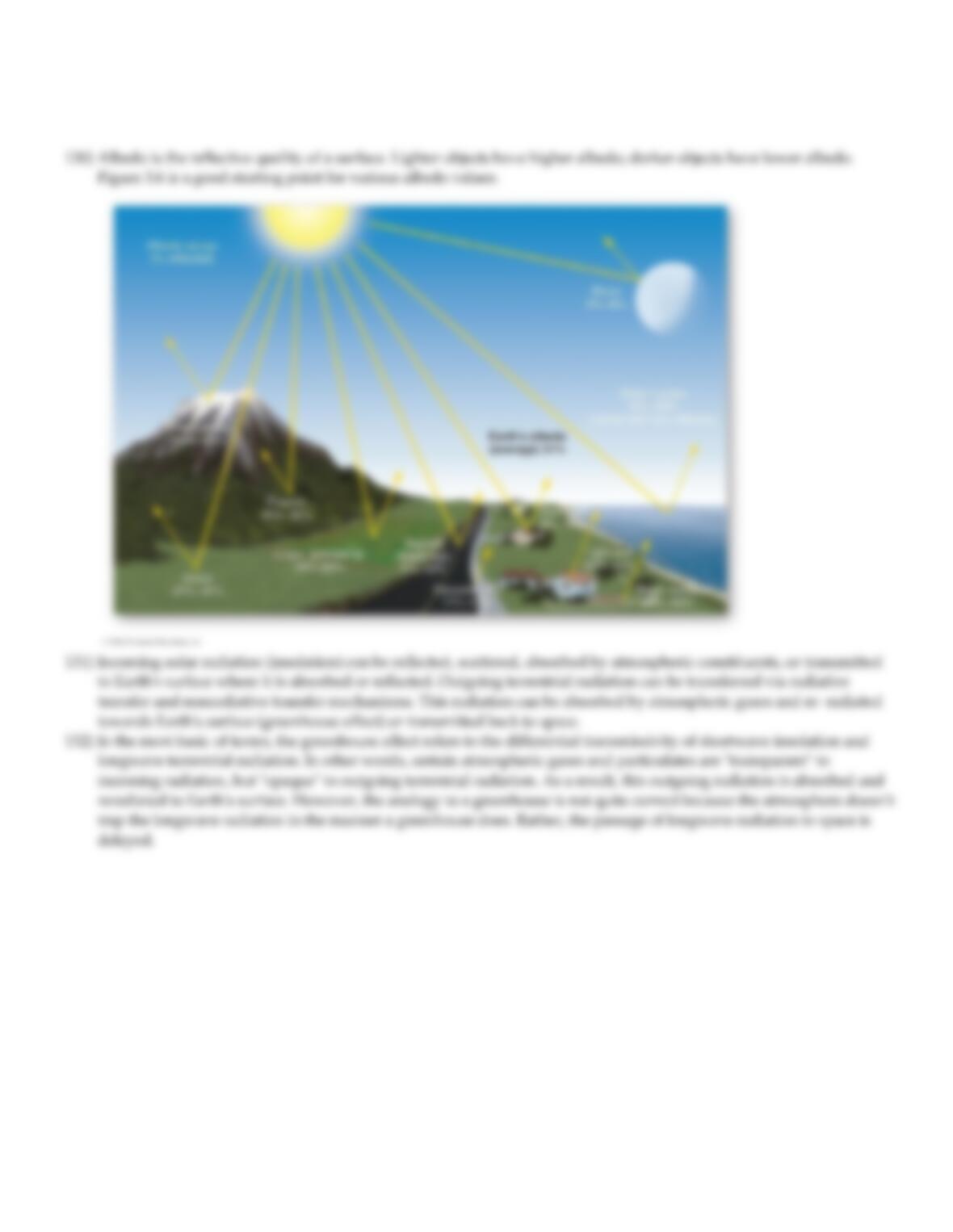
Temperature is
12)
A)
measure of the average kinetic energy of individual molecules in matter.
B)
heat, as perceived by humans and other living things.
C)
a form of energy.
D)
a function of insolation and windspeed.
13)
Salvador, Brazil is located at 13° S (and at an elevation of 9 m). Based on its latitudinal position,
which of the following likely best describes its temperature.
13)
A)
The temperature is consistently high throughout the year.
B)
Cool and mild temperatures predominate throughout the year.
C)
Temperatures can range from –10°C (14°F) in the winter to 21°C (70°F) in the summer.
D)
Summers are exceptionally hot, but winters are typically quite mild.
E)
Seasonal variations of temperature are most pronounced in the summer.

14)
When water evaporates, the energy that was used to evaporate the water
14)
A)
is stored as latent heat in the evaporated water.
B)
is conducted into the underlying layer of water.
C)
is transferred to the air by advection when the water evaporates.
D)
is stored as sensible heat in the evaporated water.
15)
How does evaporation effect land–water heating differences?
15)
A)
Evaporation affects the temperature of land surfaces and water bodies the same amount.
B)
Evaporation tends to increase temperatures over land.
C)
Evaporation tends to increase the temperature over water.
D)
Evaporation affects land more than ocean surfaces.
E)
Evaporation tends to lower temperatures more over water bodies than over land.
E
16)
The general term describing the pollution–related decline in insolation reaching Earth’s surface is
16)
A)
atmospheric albedo.
B)
global dimming.
C)
greenhouse effect.
D)
earthshine.
B
A
17)
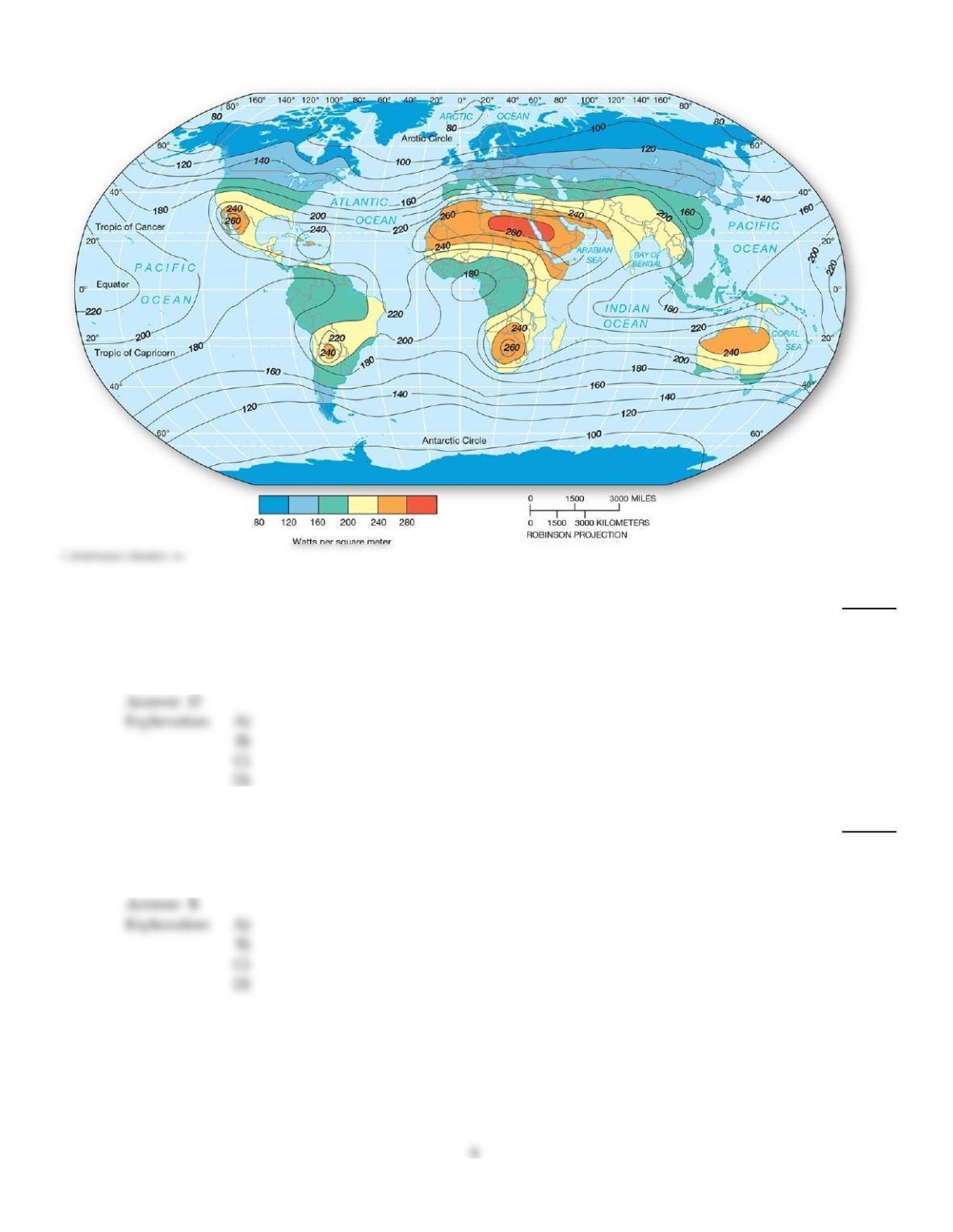
Which of the following is TRUE?
17)
A)
The poles receive the highest amount of insolation.
B)
There is always a very predictable latitudinal gradient of insolation.
C)
Insolation is equal at all surfaces across the globe.
D)
The highest levels of insolation occur in the equatorial and tropical latitudes.
18)
During summer, cities located near the coast are ________ than those in the interior at the same
latitude, while in the winter they are ________.
18)
A)
warmer; warmer
B)
cooler; warmer
C)
cooler; cooler
D)
warmer; cooler

19)
Which of the following is TRUE?
19)
A)
Northern Hemisphere temperatures are more strongly dominated by continentality than are
Southern Hemisphere temperatures.
B)
The Northern and Southern hemispheres are dominated equally by maritime influences.
C)
Southern Hemisphere temperatures are more strongly dominated by continentality than are
Northern Hemisphere temperatures.
D)
The Northern and Southern hemispheres are dominated equally by continentality.
20)
Within the troposphere, temperatures and density________ with increasing altitude above Earth’s
surface.
20)
A)
both decrease
B)
both increase
C)
increase and decrease, respectively
D)
decrease and increase, respectively
A
21)
The region with the highest average ocean temperatures in the world are
21)
A)
near the Benguela Current in the South Atlantic.
B)
along the Gulf Stream in the North Atlantic.
C)
in the Western Pacific Warm Pool in the southwestern Pacific Ocean.
D)
east of the Humboldt Current long South America’s Pacific Coast.
C
22)
The albedo of a surface is a measure of which of the following processes?
22)
A)
Reflection
B)
Solar radiation receipt
C)
Scattering
D)
Transmission
A
23)
As a result of the characteristics of water, cities located near a coast should experience a
temperature range that is ________ those of cities located in the interior at the same latitude.
23)
A)
larger than
B)
the same as
C)
smaller than
C
A

24)
Which of the following is NOT a reason for the energy deficit in the polar regions?
24)
A)
Up to six months without insolation
B)
Little seasonal variability
C)
Low sun angle
D)
High albedo due to snow and ice
25)
On a cold, windy day, the air feels ________ because the wind ________.
25)
A)
warmer; mitigates against the cold temperatures.
B)
warmer; disperses clouds, allowing more sunlight to reach the ground.
C)
colder; increases the cooling effect of the air.
D)
colder; increases evaporative heat loss from our skin.
Explanation:
26)
________ is the general term for the outdoor temperature as it is perceived by humans.
26)
A)
Sensible heat
B)
Wind chill
C)
Apparent temperature
D)
Latent heat
Explanation:
27)
Which of the following is NOT responsible for the urban heating effect?
27)
A)
Increased albedo of urban environments relative to that of natural landscapes.
B)
Increased air pollution that absorbs and reradiates heat to surface.
C)
Heat generated by homes, vehicles, and factories.
D)
The concentration of people, machines and heat generating devices adds more heat to the
environment.
E)
Increase in human–made materials that conduct more energy than natural surfaces.
Explanation:
28)
An increase in the amount of high altitude, thin clouds would
28)
A)
warm the planet in a process called cloud–greenhouse forcing.
B)
have no effect on the planet’s temperature because insolation is constant.
C)
cool the planet in a process called cloud–albedo forcing.
Explanation:
Explanation:
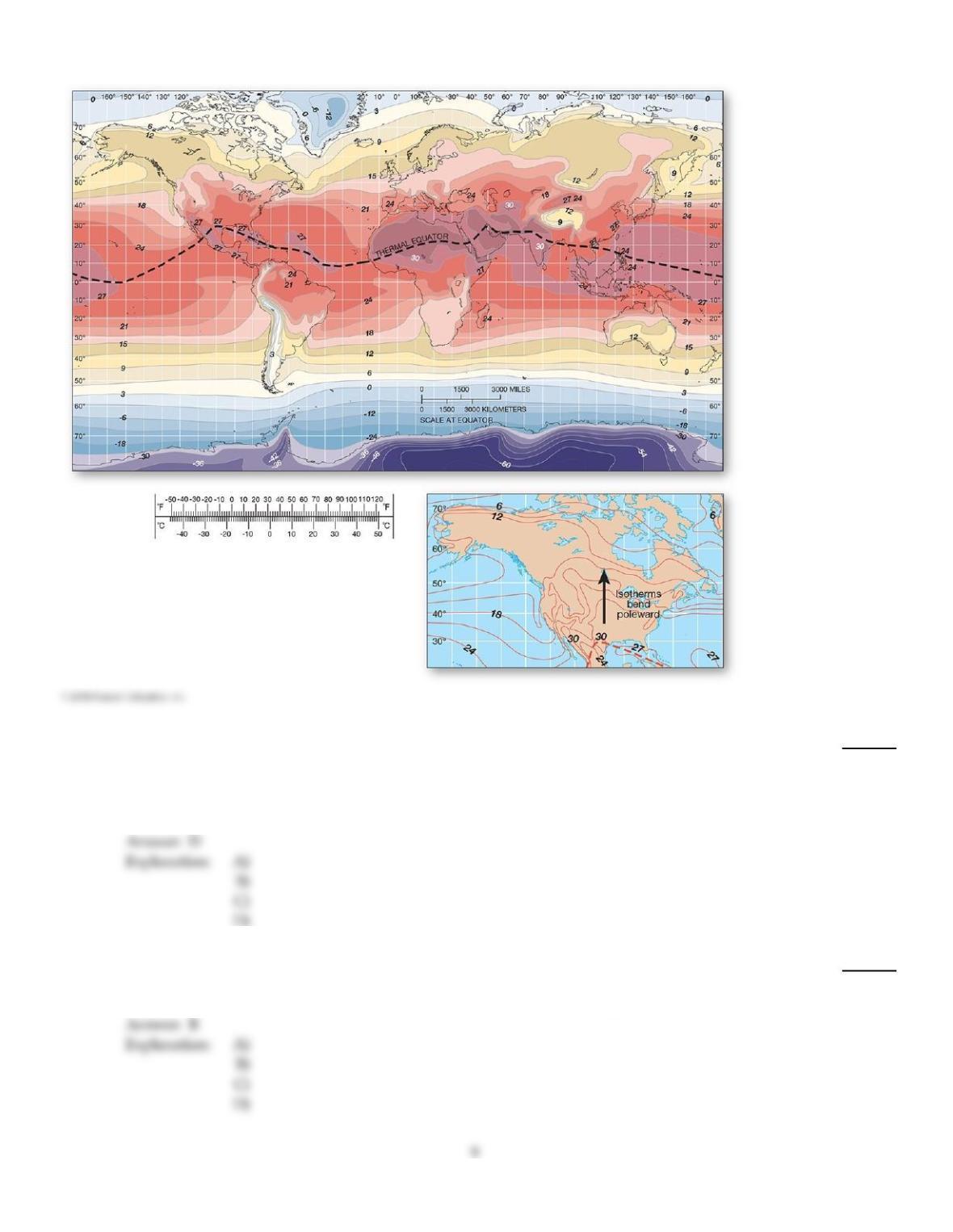
29)
In July, the thermal equator
29)
A)
is apparently random and has yet to be adequately explained.
B)
trends equatorward over continents and poleward over the oceans.
C)
assumes an orientation that closely parallels that of the equator.
D)
trends poleward over continents and equatorward over the oceans.
30)
In the surface energy budget, – SW represents
30)
A)
NET R.
B)
shortwave reflectance.
C)
heat.
D)
incoming energy.
31)
If the surface of Earth were to suddenly turn white, the temperature of the planet would ________
because ________ insolation would be absorbed.
31)
A)
decrease; less
B)
increase; more
C)
decrease; more
D)
increase; less
32)
The 1991 eruption of Mount Pinatubo in the Philippines ________ the global albedo, resulting in a
temporary ________ of Earth.
32)
A)
increased; warming
B)
decreased; cooling
C)
increased; cooling
D)
decreased; warming
33)
An estimated ________ percent of all evaporation on Earth is from oceans.
33)
A)
37
B)
76
C)
84
D)
22
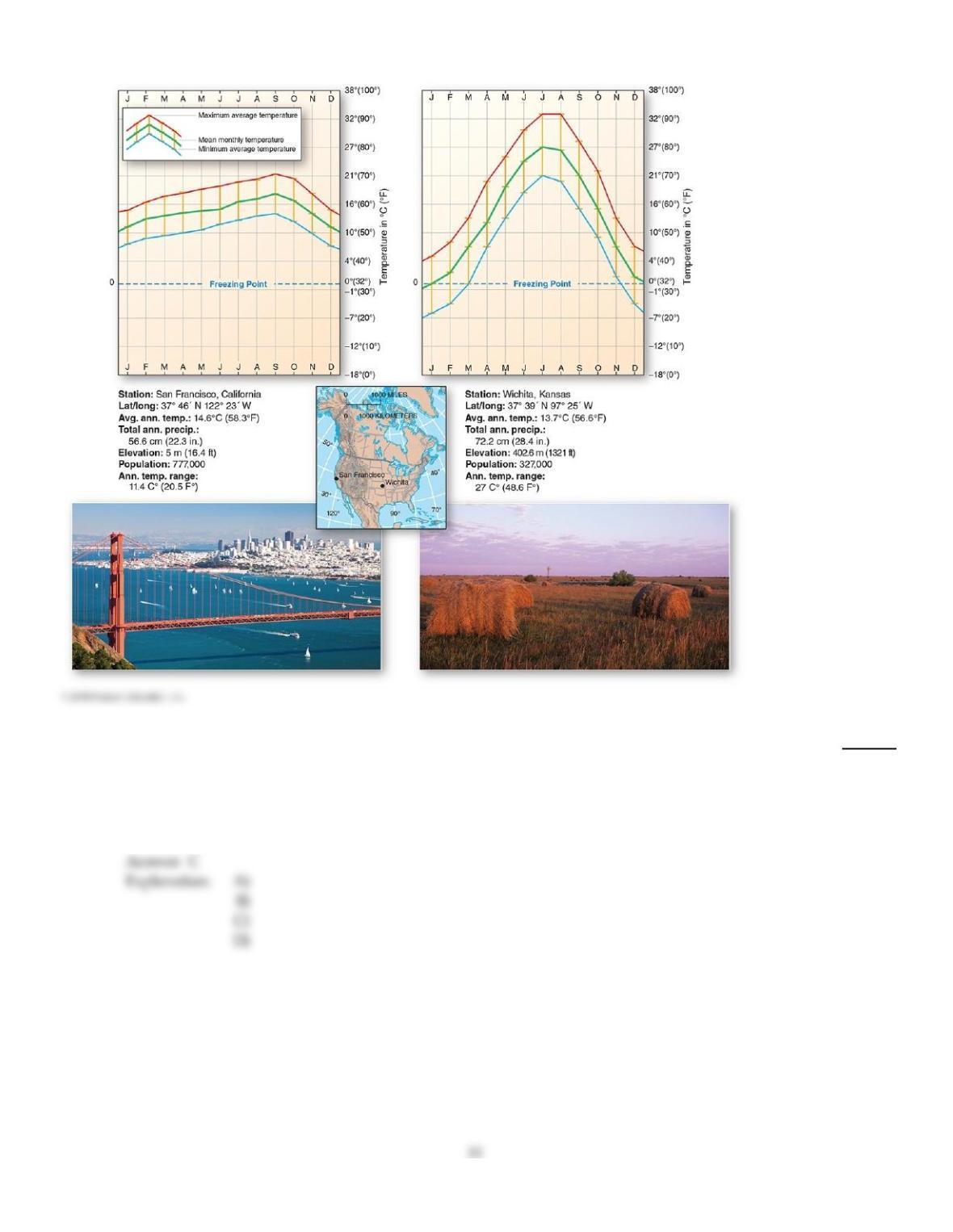
34)
San Francisco, CA and Wichita, KS are located at approximately the same latitude. Which of the
following is TRUE?
34)
A)
Maximum average temperatures are higher year–round in Wichita
B)
San Francisco is more influenced by continentality than Wichita.
C)
San Francisco’s average monthly temperature peak occurs later than that of Wichita.
D)
San Francisco experiences more days below the freezing point than Wichita.

35)
When water evaporates from a surface, which of the following occurs?
35)
A)
Energy is stored within the water.
B)
Heat is transferred back and forth between the air and surface.
C)
Energy is released to the surface.
D)
The surface is warmed.
36)
On the average, which of the following is TRUE regarding the distribution of shortwave and
longwave energy at Earth‘s surface by latitude?
36)
A)
More energy is lost than is gained in the equatorial regions.
B)
The distribution shows an imbalance of net radiation from equator to poles.
C)
The equatorial zone is a region of net deficits.
D)
The polar regions are areas of net surpluses.
37)
Which of the following is CORRECT regarding the Northwest and Northeast Passages?
37)
A)
They have been blocked since 2007 by increasing ice.
B)
They are expected to remain open until 2015.
C)
They have been used for shipping and circumnavigation since the 1800s.
D)
Until recently, sea ice blocked the routes, making them unavailable for shipping.
38)
A(n) ________ is trapped airborne pollution that can raise temperatures by absorbing insolation
and reradiating heat to the surface.
38)
A)
“cool” roof
B)
dust dome
C)
urban canyon effect
D)
urban heat island (UHI)

39)
The passage of either shortwave and longwave energy through the atmosphere and water is an
example of
39)
A)
refraction.
B)
insolation.
C)
transmission.
D)
absorption
40)
The insolation received at Earth’s surface is
40)
A)
generally greater at high latitudes because of daylength.
B)
usually low at the equator.
C)
greatest over low–latitude deserts with their cloudless skies.
D)
inadequate to sustain life.
C
Explanation:
41)
An image that appears near the horizon when layers of air are at different temperatures and
densities is a(n) ________ and an example of ________.
41)
A)
reflection; refraction.
B)
mirage; refraction.
C)
reflection; albedo
D)
Rayleigh scatter; albedo
B
Explanation:
42)
NET R values are positive
42)
A)
during the daylight hours, peaking just after sunrise.
B)
during daylight hours, peaking just after noon with the peak of insolation.
C)
during the night when +LW is at a maximum.
D)
after dusk due to a lag effect of outgoing infrared radiation.
B
Explanation:
43)
Which two gases are primarily responsible for the greenhouse effect because of their ability to
absorb infrared energy?
43)
A)
Ozone and dust
B)
Oxygen and hydrogen
C)
Nitrogen and oxygen
D)
Water vapor and carbon dioxide
D
Explanation:
C
Explanation:
44)
An isoline that connects all points of highest mean temperature on a world map is called
44)
A)
the highest mean temperature isoline.
B)
the thermal equator.
C)
an isobar.
D)
the temperature range line.
E)
min/max line.
45)
Imagine a profile of soil going to a depth of approximately 10 ft. On a sunny day, the soil at a depth
of 5ft will be ________ the soil at the surface because ________.
45)
A)
warmer; geothermal processes heat the deeper soils.
B)
warmer; soil is a good conductor of heat.
C)
cooler; land is opaque preventing heating at depths.
D)
cooler; plate movement mixes the soils and dissipates the heat.
C
46)
From 1982 through 2010, average annual sea–surface temperature (SST)
46)
A)
remained fairly constant.
B)
followed an opposite trend of air temperature and decreased.
C)
increased until 1993, then slightly decreased.
D)
steadily increased.
D
47)
Which of the following is FALSE?
47)
A)
Urban surfaces have lower albedos and higher NET R values.
B)
The amount of Human–produced heat is not significant in New York City.
C)
A city responds much as a desert surface during and after a rainstorm.
D)
Urbanized surfaces tend to be sealed.
B
B

48)
The temperature on a cloudy night is likely to be ________ the temperature on a clear nightall
other factors being equal.
48)
A)
the same as
B)
warmer than
C)
colder than
49)
Longwave radiation (+ LW) arriving at Earth’s surface
49)
A)
comes from diffuse solar radiation.
B)
comes from UV radiation reflected from the bottoms of clouds.
C)
comes primarily from infrared energy absorbed and re–radiated by the atmosphere.
D)
comes directly from the Sun.
C
50)
Earth’s main energy outputs are
50)
A)
ultraviolet radiation and visible radiation.
B)
reflected light and thermal infrared radiation.
C)
gamma rays, X–rays, and ultraviolet radiation.
D)
visible and infrared radiation.
B
51)
Conduction refers to
51)
A)
the molecule–to–molecule transfer of heat energy.
B)
strong vertical movement of air in the atmosphere.
C)
strong horizontal movement of air in the atmosphere.
D)
the behavior of something.
A
52)
Which of the following is CORRECTLY matched?
52)
A)
Insolation shortwave radiation UV, visible, and near infrared
B)
Insolation longwave radiation thermal infrared radiation
C)
Terrestrial radiation shortwave radiation thermal infrared radiation
D)
Terrestrial radiation shortwave radiation UV, visible, and near infrared
A
B

53)
Which of the following is a nonradiative transfer of longwave radiation to the atmosphere?
53)
A)
Latent heat transfer.
B)
Conduction from the surface.
C)
Stratospheric ozone radiation.
D)
The greenhouse effect.
54)
The best thermometer to use where temperatures drop below –39°C (–38.2°F) is
54)
A)
a mercury thermometer.
B)
an alcohol thermometer.
C)
a barometric thermometer.
D)
a bulb mounted in direct sunshine.
55)
As reported by the National Weather Service, the heat index
55)
A)
combines air pressure and temperature in a comfort index.
B)
relates temperature and relative humidity.
C)
is generally reported during critical winter months.
D)
gives you an indication of the effect of wind on the skin.
56)
Elevation typically refers to ________ whereas altitude refers to ________.
56)
A)
the height above sea level of a point on Earth’s surface; the height of an object in the air above
a point on Earth’s surface
B)
both refer to the height of a point on Earth’s surface
C)
both refer to the height above Earth’s surface
D)
the height of an object in the air above a point on Earth’s surface; the height above sea level of
a point on Earth’s surface

57)
Because of the process known as ________ the Sun appears above the horizon ________ it has
actually risen.
57)
A)
transmission; before
B)
refraction; after
C)
reflection; before
D)
transmission; after
E)
refraction; before
58)
Which of the following is NOT a reason for the energy surplus between the tropics?
58)
A)
Little seasonal variations
B)
High insolation
C)
Transfer of heat from the poles
D)
Consistent daylength
59)
Earth‘s main energy inputs are
59)
A)
longwave radiation and ultraviolet light.
B)
near infrared and far infrared (i.e., longwave radiation).
C)
gamma rays, X–rays, and ultraviolet radiation.
D)
ultraviolet, visible, and near infrared radiation.
60)
The Celsius scale
60)
A)
is used exclusively in the United States.
B)
places freezing at 32° and boiling at 212°.
C)
places freezing at 0° and was formerly called centigrade.
D)
was developed by the British physicist Lord Kelvin.
E)
was developed by Fahrenheit, who also developed the alcohol and mercury thermometers.

61)
Which of the following is NOT a strategy used planners and architects to mitigate against the
effects of the urban heat island?
61)
A)
Planting of urban forests (parks and open spaces).
B)
Designing rooftop gardens (“green” roofs)
C)
Using dark covered asphalt.
D)
Using lighter–colored materials on roofs and other surfaces.
62)
Which of the following is TRUE of the albedo of water?
62)
A)
It is less for frozen water than for liquid water.
B)
It never changesalbedos are constant values
C)
It is greatest when the Sun is low in the sky.
D)
It changes, depending upon the Sun altitude.
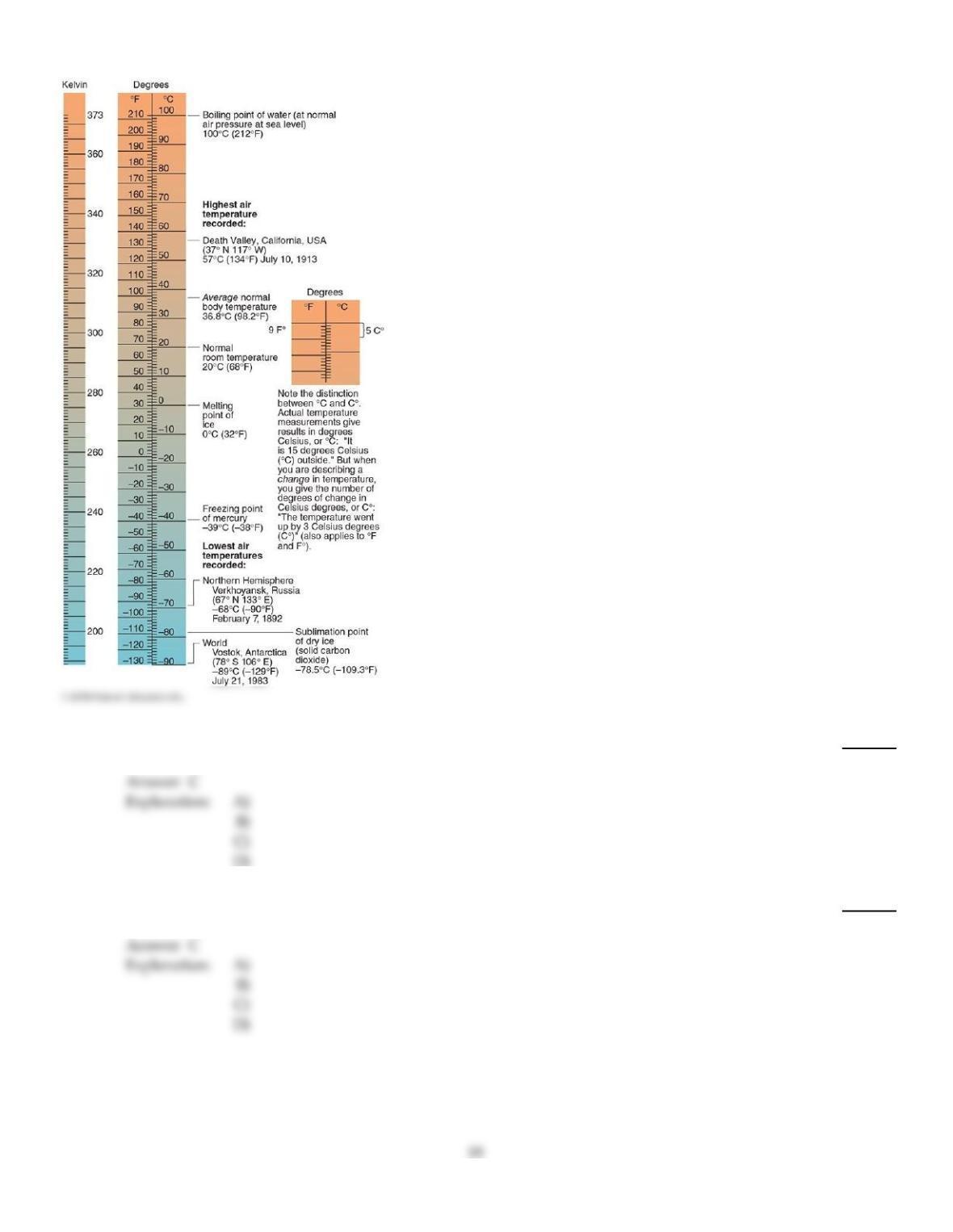
63)
The Celsius and Fahrenheit scales only coincide at
63)
A)
0°.
B)
212°.
C)
–40°.
D)
–273°.
64)
A stove that circulates heated air to uniformly cook food is an example of ________ heat transfer.
64)
A)
conductional
B)
kinetic
C)
convectional
D)
latent

65)
Global average air temperatures worldwide
65)
A)
are at present demonstrating no apparent trend one way or another.
B)
are generally lower than 20 years ago.
C)
have appeared to stabilize after a century of increase.
D)
are being influenced by human–induced changes in the greenhouse effect.
66)
________ refers to the greater range between maximum and minimum temperatures that occurs in
inland areas distant from large bodies of water.
66)
A)
Heat dome
B)
Continentality
C)
Specific heat
D)
The maritime effect
67)
Refraction results in changes in both ________ of light.
67)
A)
color and reflection
B)
Rayleigh scattering and mie scattering
C)
albedo and absorption
D)
speed and direction
E)
conduction and convection
68)
The principle that explains the scattering of shortwave radiation and accounts for Earth’s blue sky
is
68)
A)
refraction.
B)
transmission.
C)
Rayleigh scattering.
D)
Mie scattering.
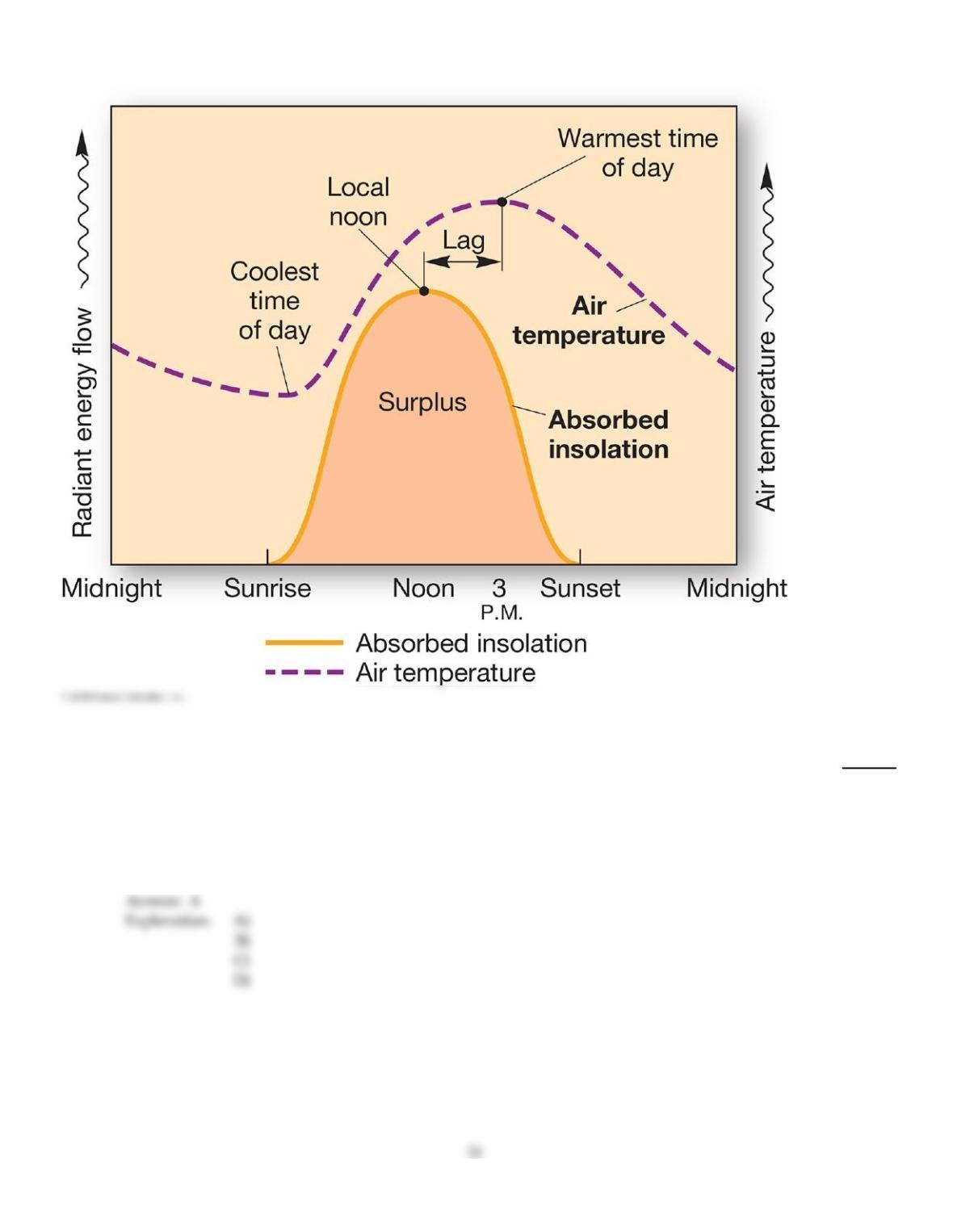
69)
The relationship between the insolation curve and the air temperature curve on a graph of daily
surface energy
69)
A)
exhibits a lag of several hours between the plotted lines.
B)
coincide at noon.
C)
shows that peak temperatures occur near noon, whereas peak insolation receipt is at 3:00 or
4:00 P.M.
D)
shows little or no relationship between the two variables.

70)
Kinetic energy is defined as
70)
A)
energy gained or lost when a substance changes states.
B)
energy flow between molecules.
C)
the energy of motion.
D)
stored energy.
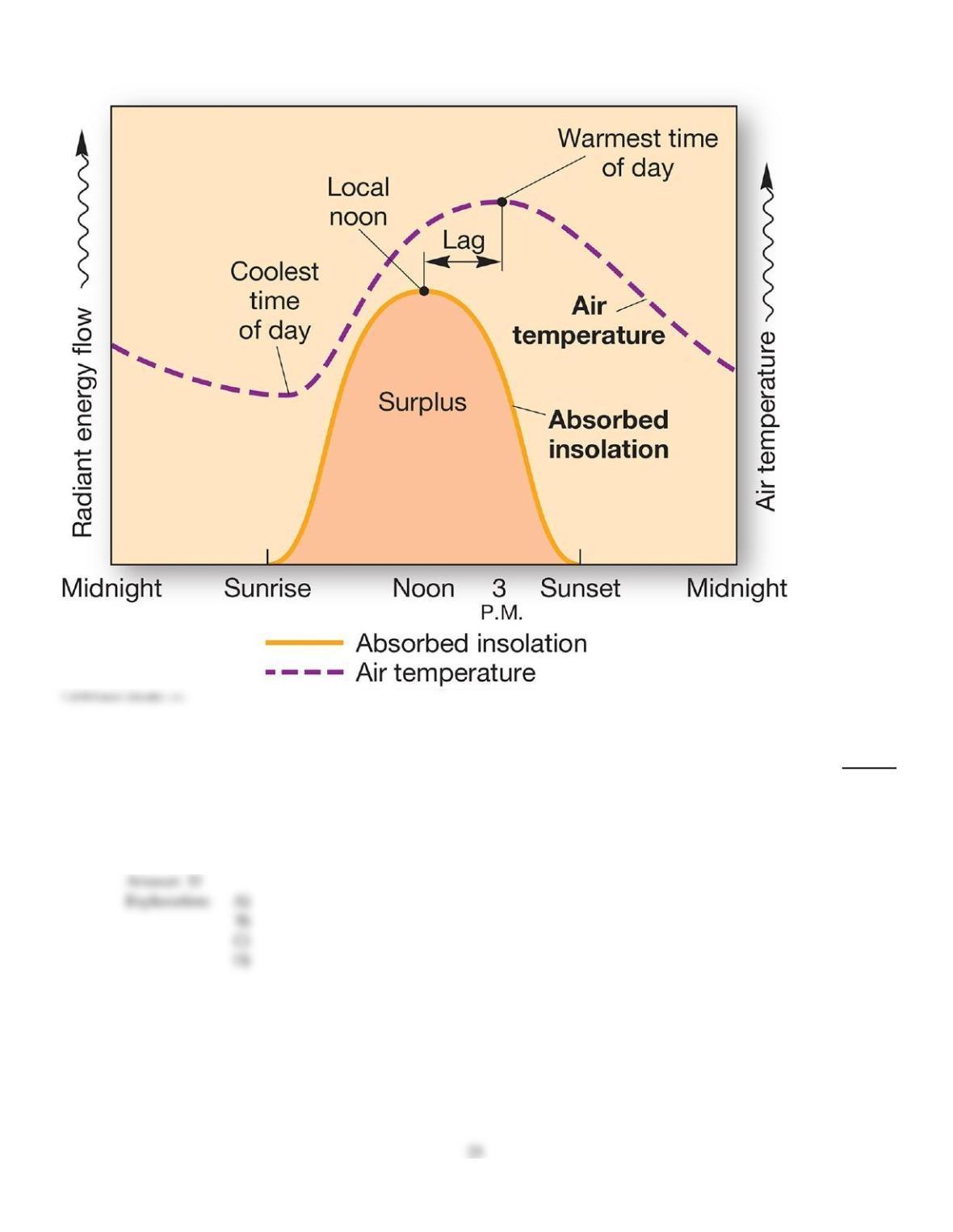
71)
The relationship between insolation and air temperature through the course of day shows
71)
A)
air temperature reaches a minimum at midnight when there is no insolation.
B)
air temperature reaches a maximum at noon when insolation also reaches a maximum.
C)
air temperature maximum and minimums are not related to insolation.
D)
air temperature reaches a maximum after noon, whereas insolution reaches a maximum at
noon.
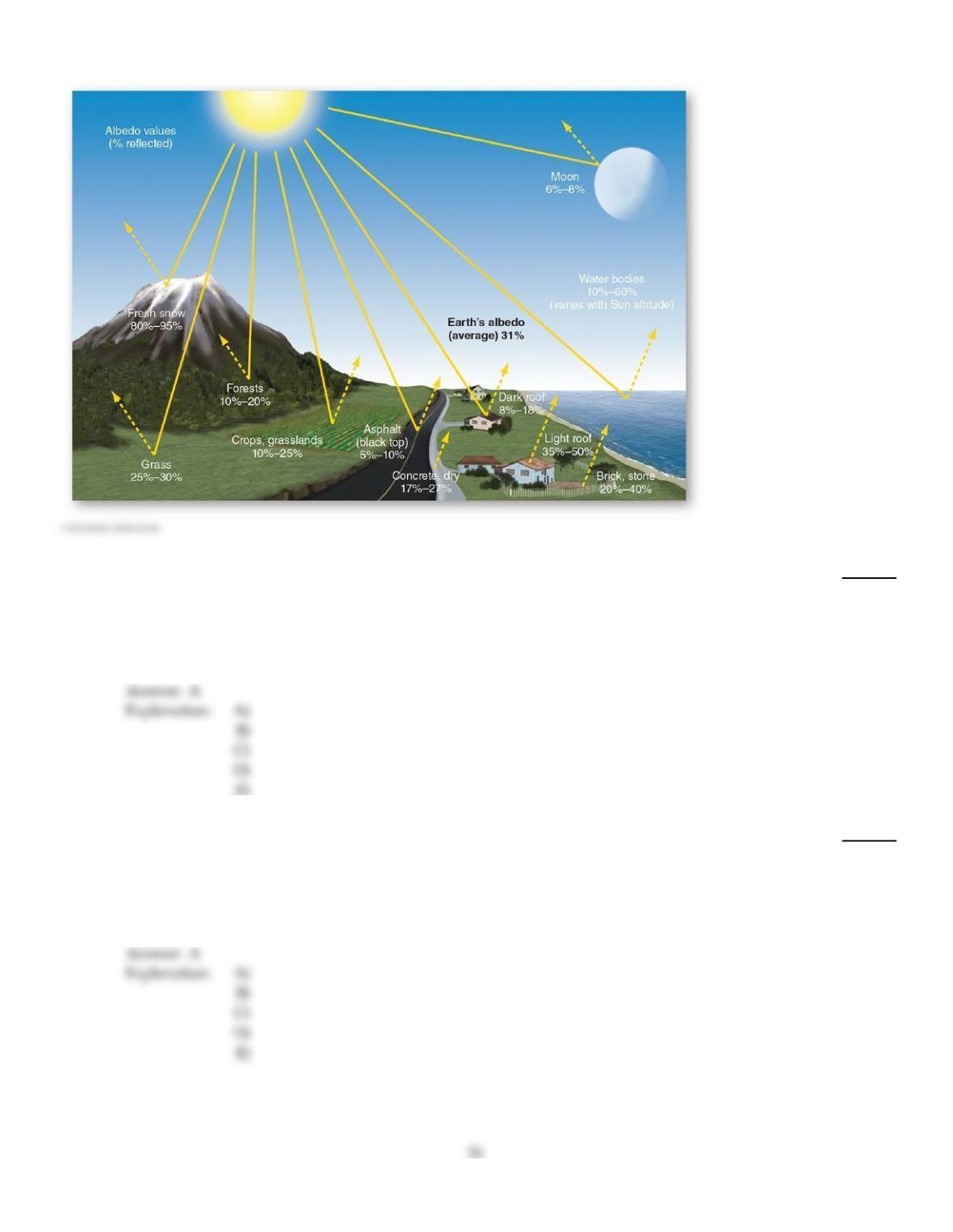
72)
Which of the following has the lowest albedo?
72)
A)
The Moon
B)
Dry, light sandy soils
C)
Pack ice off the coast of Antarctica
D)
Forests
E)
Snow that is polluted and several days old
73)
If a surface absorbs insolation
73)
A)
its temperature increases.
B)
its temperature decreases.
C)
refraction occurs.
D)
diffuse radiation occurs.
E)
its temperature is unaffected.

74)
In colder temperatures, alcohol thermometers are preferred to mercury thermometers because
74)
A)
mercury freezes at –39°C (–38.2°F), whereas alcohol freezes at –120°C (–170°F).
B)
alcohol thermometers are generally more accurate, especially in cold temperatures.
C)
mercury is poisonous and are rarely used in modern thermometers any more.
D)
alcohol thermometers are less expensive and more easily to replace if broken in extreme
temperatures.
75)
–273°C (–459.4°F) is
75)
A)
an average boiling temperature.
B)
0°absolute temperature.
C)
the same as 273 Kelvin.
D)
not possible on any scale.
76)
Solar cookers could replace ________ as an affordable source of energy in rural villages in third
world countries.
76)
A)
fusion power
B)
fire wood
C)
natural gas
D)
nuclear power
77)
The Gulf Stream
77)
A)
creates a warming effect on Japan and the Aleutians.
B)
moves northward in the western Atlantic, moderating temperatures in Iceland.
C)
moves southward and moderates temperatures in eastern South America.
D)
moves equatorward, warming the California coast.
78)
The size of one Kelvin unit is
78)
A)
twice as large as one Celsius degree.
B)
two times smaller than one Celsius degree.
C)
the same size as one Fahrenheit degree.
D)
the same size as one Celsius degree.

79)
Which of the following is INCORRECT regarding the differences in the heating of land and water?
79)
A)
Water transmits through water better than soil.
B)
A greater amount of evaporation occurs over oceans than over land.
C)
Soil has a higher specific heat than water.
D)
Water has mobility and is mixed in ocean currents.
80)
Which of the following is TRUE regarding clouds?
80)
A)
They decrease nighttime temperatures and increase daytime temperatures.
B)
They cover about 15 percent of Earth’s surface at any one time.
C)
They increase temperature minimums and temperature maximums.
D)
They have a moderating influence on temperatures.
81)
Which of the following is NOT true about heat stress?
81)
A)
The National Weather Service reports a heat index to cause the human body’s probable
reaction to the combined effects of temperature and relative humidity.
B)
Heat stress can results in cramps, exhaustion, and even heat stroke.
C)
Heat stress can lead to potentially life–threatening conditions.
D)
Heat stress poses little threat to human health.
82)
For Earth’s energy budget, ________ is energy income and ________ energy expenditures.
82)
A)
insolation; radiation to space
B)
reflection; albedo
C)
refraction; scatter
D)
transmission; reflection
83)
Earth‘s average overall albedo is
83)
A)
31 percent.
B)
51 percent.
C)
69 percent.
D)
unknown.

84)
Global temperatures are
84)
A)
increasing at a decreasing rate.
B)
rising at a rate of 0.17°C (0.3°F) per decade.
C)
higher than any time in the last 800,000 years.
D)
increasing by 3% per year.
85)
On average, the illuminated zone in oceans is to a depth of ________, but in some oceans may be as
deep as ________.
85)
A)
60 m (200 ft); 300 m (1,000 ft)
B)
20 m (66 ft); 30 m (100 ft)
C)
100 m (330 ft); 500 m (1,640 ft)
D)
30 m (100 ft); 900 m (3,000 ft)
86)
The reflective quality of a surface is known as its
86)
A)
conduction.
B)
absorption.
C)
scattering.
D)
albedo.
87)
Net radiation (NET R) refers to
87)
A)
the balance of all radiation incoming and outgoing at Earth’s surface.
B)
the net energy expended for ground heating and cooling.
C)
the amount of insolation coming into the surface.
D)
the amount of insolation not absorbed at the surface.
88)
Which of the following is TRUE of differences in latitudinal energy?
88)
A)
There is year–round energy deficit at the Tropic of Capricorn.
B)
Energy imbalances betweens the tropics and the poles are negligible.
C)
There is an energy balance between energy gains and losses around 36° latitude.
D)
The equator has an energy balance in the summer, but a deficit in the winter.

89)
During the day, clouds ________ insolation, lowering daily maximum temperatures; at night,
clouds ________ longwave energy, thereby raising minimum nighttime temperatures.
89)
A)
reflect; scatter
B)
absorb; reflect
C)
reflect; absorb and reradiate
D)
scatter; refract
90)
The Mount Pinatubo eruption in June 1991 affected the atmosphere in all of the following ways
EXCEPT which?
90)
A)
A worldwide decrease in surface temperatures occurred in the two years after the eruption.
B)
An increase occurred in the amount of energy absorbed in the atmosphere.
C)
A decrease in atmospheric aerosols.
D)
The atmospheric albedo increased.
C
91)
6.4°C/1000 m (3.5°F/1000 ft.) refers to
91)
A)
a latitudinal lapse rate.
B)
a measure of air pressure.
C)
an environmental lapse rate.
D)
the normal lapse rate.
D
92)
Land surface temperature (LST) is
92)
A)
highest in areas with high albedo and dense cloud cover.
B)
a measure of the heating of the land surface and is distinct from air temperature.
C)
measured using a ground network of at least one station per 250,000 km2 across the globe.
D)
often much cooler than air temperature due to vegetation cover.
B
C

93)
The land surface cools more rapidly at night than water does because
93)
A)
heat is transferred to deeper depths on land via conduction.
B)
the amount of energy stored in the water column is less than that stored in land.
C)
water, on average, has a specific heat about four times that of land.
D)
there is more ocean than land, so more ocean is being heated than land.
94)
The effect of wind and temperature on the human skin is called the
94)
A)
apparent temperature index.
B)
sensible heat measurement.
C)
wind–chill factor.
D)
heat index.
C
Explanation:
95)
On land, the highest annual values for latent heat of evaporation (LE) occur
95)
A)
in the midlatitudes.
B)
over the subtropics.
C)
near the poles.
D)
in the tropics.
D
Explanation:
96)
Trondheim, Norway is located at approximately 63° N. Despite its high latitude, it has a relatively
moderate annual temperature regime. What likely accounts for this moderation?
96)
A)
Thick cloud cover in Trondheim traps in longwave radiation.
B)
Trondheim’s high degree of continentality.
C)
Trondheim’s maritime location.
D)
The urban heat island of Trondheim.
C
Explanation:
97)
Which of the following is INCORRECTLY matched?
97)
A)
Trondheim continentality
B)
Verkhoyansk continentality
C)
Wichita continentality
D)
San Francisco marine
A
Explanation:
C
Explanation:
98)
When light passes from one medium to another, resulting in a change in its speed and direction
98)
A)
refraction occurs.
B)
transmission happens.
C)
Rayleigh scattering is the predominant effect.
D)
it is usually not affected physically.
99)
The assimilation of radiation by molecules of matter is
99)
A)
absorption.
B)
transmission.
C)
refraction.
D)
reflection.
100)
A vertical air current that is generated by temperature–induced density differences is an example
of heat transfer by
100)
A)
transmission.
B)
conduction.
C)
advection.
D)
diffusion.
E)
convection.
TRUE/FALSE. Write ‘T’ if the statement is true and ‘F’ if the statement is false.
101)
The daily temperature curve exhibits a lag of about three hours relative to the insolation curve.
101)
102)
Ice has only one melting point, but water has many freezing points depending on the purity and
volume of water and certain atmospheric conditions.
102)
103)
On cold, windy days, the air feels cooler due to evaporative heat loss from skin.
103)
104)
Daily mean temperature is factored in one of two ways: either the average of hourly temperature
readings taken over a 24–hour day or the average of the daily minimum–maximum reading.
104)
105)
The normal lapse rate of temperature change is 6.4°C/1000 m (3.5°/1000 ft).
105)
106)
Ocean currents along midlatitude west coasts, even near deserts, are cool.
106)
107)
Heat energy flows from objects that are warmer to those that are cooler.
107)
108)
Temperatures are usually quite uniform and unchanging with altitude.
108)
109)
The intensity of solar radiation decreases away from the equator and poleward.
109)
110)
Maritime locales tend to have much larger daily and annual temperature ranges than areas in the
interior of continents.
110)
ESSAY. Write your answer in the space provided or on a separate sheet of paper.
111)
Describe the different methods of heat transfer.
112)
Review the climatic differences in urban and rural environments.
113)
What are the factors that tend to raise the temperature of an urban area relative to its surrounding rural areas?
114)
Why do continental locations usually have greater extremes of temperature than do maritime locations at the
same latitude?
115)
Where should you move to if you wanted to live an a region with the greatest annual range of temperatures? If
you changed your mind and wanted to live in the region with the lowest annual temperature range where
should you go? What are the qualities that create each of these situations?
116)
Distinguish between temperature and heat. Then describe the important characteristics of the three main
temperature scales.
117)
Why do the tropics have a positive net radiation while the poles have a negative value? How is the energy
difference equalized?
118)
Discuss the components of the the surface energy budget.
119)
How do ocean currents affect both water and air temperatures? Use the Humboldt Current and Gulf Stream as
examples.
120)
Why is there a lag in daily temperature patterns? Discuss the roles of different sources of surface heating.
121)
Describe different ways in which anthropogenic activity can affect the energy balance.
122)
Compare and contrast Northern and Southern temperature ranges. Also, compare tropical and midlatitude
temperature ranges.
123)
Why is the higher specific heat of water as compared to rock or soil an important factor in determining
temperature characteristics and changes?
124)
Describe the energy pathways of insolation as it enters Earth’s atmosphere.
125)
Describe the components of net radiation (NET R).
126)
Discuss the similarities and differences of cloud–albedo forcing and cloud–greenhouse forcing.
127)
Compare, contrast, and explain maritime and continental conditions.
128)
Discuss how latitude, altitude/elevation, cloud cover, and land–water heating differences can influence global
temperature patterns.
129)
What is Rayleigh scatter? What is mie scatter? How does scattering contribute to the color of the sky.
130)
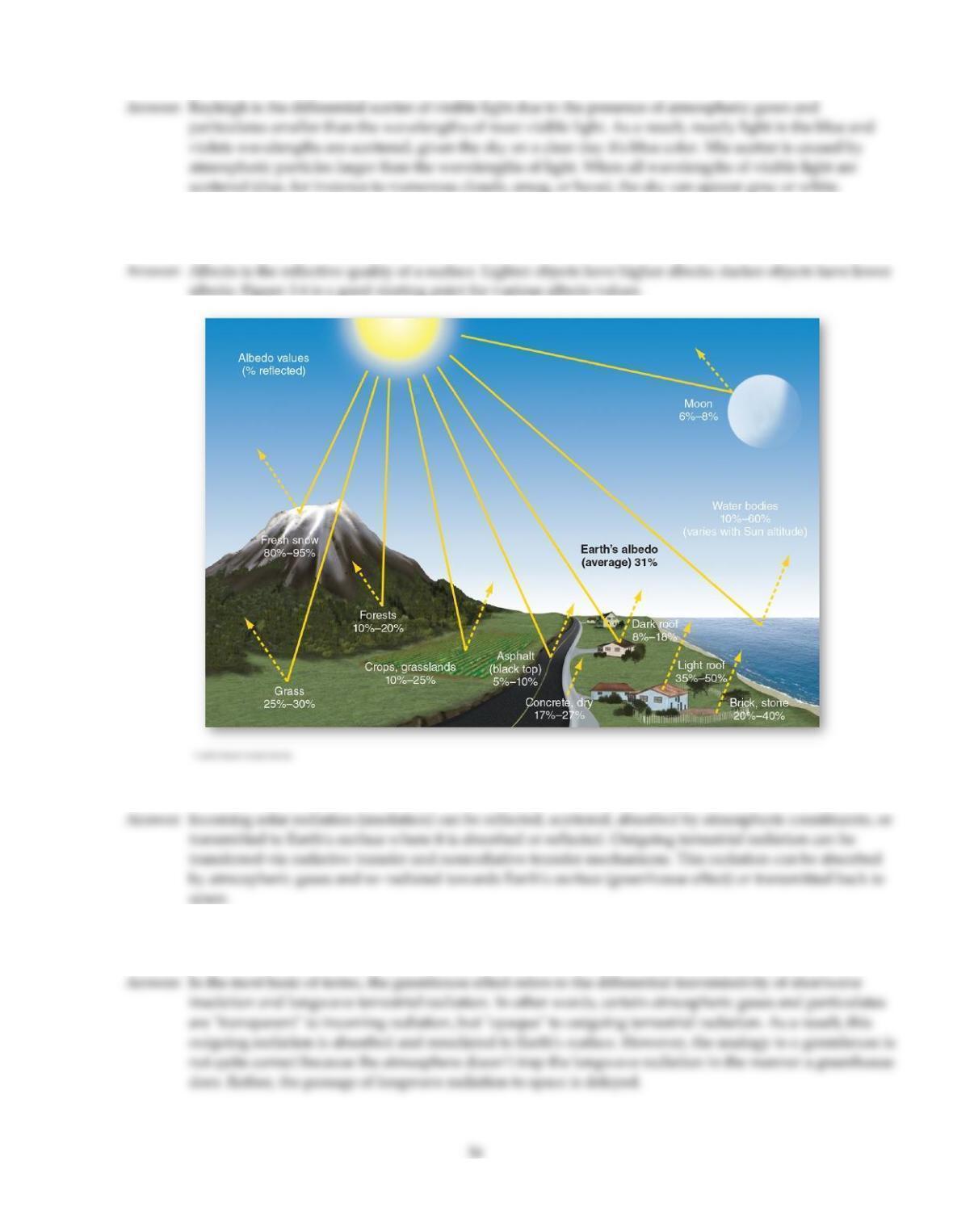
What does “albedo” mean? Discuss the albedo of different surfaces including several not explicitly discussed in
the textbook.
131)
Follow the flow of energy from the Sun, into Earth’s atmosphere and to the surface, and back out into space.
132)
What is the “greenhouse effect” as applied to Earth‘s atmosphere? How is Earth similar and different than a
greenhouse?
Answer Key
Testname: C3
35
Answer Key
Testname: C3
Answer Key
Testname: C3
37
Answer Key
Testname: C3
38
Answer Key
Testname: C3
39