Chapter 03 – The Chemical Building Blocks of Life
53. The human immunodeficiency virus (HIV) uses RNA, rather than DNA, to encode
genetic information. During infection, however, HIV uses an enzyme known as reverse
transcriptase to generate double-stranded DNA. Generally speaking, how would the enzyme
generate a double strand of DNA from a single strand of RNA?
Chapter 03 – The Chemical Building Blocks of Life
Clarify Question
•
What is the key concept addressed by the question?
•
What type of thinking is required?
•
What key words does the question contain and what do they mean?
Gather Content
•
What do you know about transcription? How does it relate to the question?
Consider Possibilities
•
What other information is related to the question? Which information is most useful?
Choose Answer
•
Given what you now know, what information and/or problem solving approach is most
likely to produce the correct answer?
Reflect on Process
•
Did your problem-solving process lead you to the correct answer? If not, where did the
process break down or lead you astray? How can you revise your approach to produce a
more desirable result?
Chapter 03 – The Chemical Building Blocks of Life
54. You have recently identified a novel protein and obtained its sequence. How could you
use this sequence to predict the function of the protein?
Chapter 03 – The Chemical Building Blocks of Life
Clarify Question
•
What is the key concept addressed by the question?
•
What type of thinking is required?
•
What key words does the question contain and what do they mean?
Gather Content
•
What do you know about protein function? How does it relate to the question?
Consider Possibilities
•
What other information is related to the question? Which information is most useful?
Choose Answer
•
Given what you now know, what information and/or problem solving approach is most
likely to produce the correct answer?
Reflect on Process
•
Did your problem-solving process lead you to the correct answer? If not, where did the
process break down or lead you astray? How can you revise your approach to produce a
more desirable result?
Chapter 03 – The Chemical Building Blocks of Life
55. At the pH of most bodily fluids, which functional group will lose a proton and which
functional group will accept a proton?
Chapter 03 – The Chemical Building Blocks of Life
Clarify Question
•
What is the key concept addressed by the question?
•
What type of thinking is required?
•
What key words does the question contain and what do they mean?
Gather Content
•
What do you know about functional groups? How does it relate to the question?
Consider Possibilities
•
What other information is related to the question? Which information is most useful?
Choose Answer
•
Given what you now know, what information and/or problem solving approach is most
likely to produce the correct answer?
Reflect on Process
•
Did your problem-solving process lead you to the correct answer? If not, where did the
process break down or lead you astray? How can you revise your approach to produce a
more desirable result?
Chapter 03 – The Chemical Building Blocks of Life
56. A bobcat is feeding on a white-tailed deer. It first eats the liver, which is rich in stored
sugars. In what form would sugar be stored in the deer’s liver?
Chapter 03 – The Chemical Building Blocks of Life
Clarify Question
•
What is the key concept addressed by the question?
•
What type of thinking is required?
•
What key words does the question contain and what do they mean?
Gather Content
•
What do you know about stored sugars in animals? How does it relate to the question?
Consider Possibilities
•
What other information is related to the question? Which information is most useful?
Choose Answer
•
Given what you now know, what information and/or problem solving approach is most
likely to produce the correct answer?
Reflect on Process
•
Did your problem-solving process lead you to the correct answer? If not, where did the
process break down or lead you astray? How can you revise your approach to produce a
more desirable result?
Chapter 03 – The Chemical Building Blocks of Life
57. Seth purchased five pounds of live crayfish and realized that the outer shells were made
of a tough carbohydrate similar to that used to make the carapace of a cockroach. What do
you think the outer shells of the crawfish are made of?
58. Yogurt contains galactose and glucose, which are generated when bacterial enzymes act
on milk sugars. What is the main source of the galactose in yogurt?
Chapter 03 – The Chemical Building Blocks of Life
59. Hemoglobin transports oxygen in the blood and consists of a chain of 146 amino acids.
How many different types of amino acids are used to construct proteins?
60. Luke sprained his ankle, tearing some of the collagen protein that forms his ligaments.
Some types of collagen consist of three polypeptide chains twisted together to form a rope-
like strand. What level of protein structure does this rope-like strand represent?
61. If all functional groups are removed from an organic molecule, leaving only a
hydrocarbon chain, the molecule becomes a:

Chapter 03 – The Chemical Building Blocks of Life
62. Which amino acid is least soluble in water?
Chapter 03 – The Chemical Building Blocks of Life
Clarify Question
•
What is the key concept addressed by the question?
•
What type of thinking is required?
•
What key words does the question contain and what do they mean?
Gather Content
•
What do you know about solubility in water? How does it relate to the question?
Consider Possibilities
•
What other information is related to the question? Which information is most useful?
Choose Answer
•
Given what you now know, what information and/or problem solving approach is most
likely to produce the correct answer?
Reflect on Process
•
Did your problem-solving process lead you to the correct answer? If not, where did the
process break down or lead you astray? How can you revise your approach to produce a
more desirable result?
Chapter 03 – The Chemical Building Blocks of Life
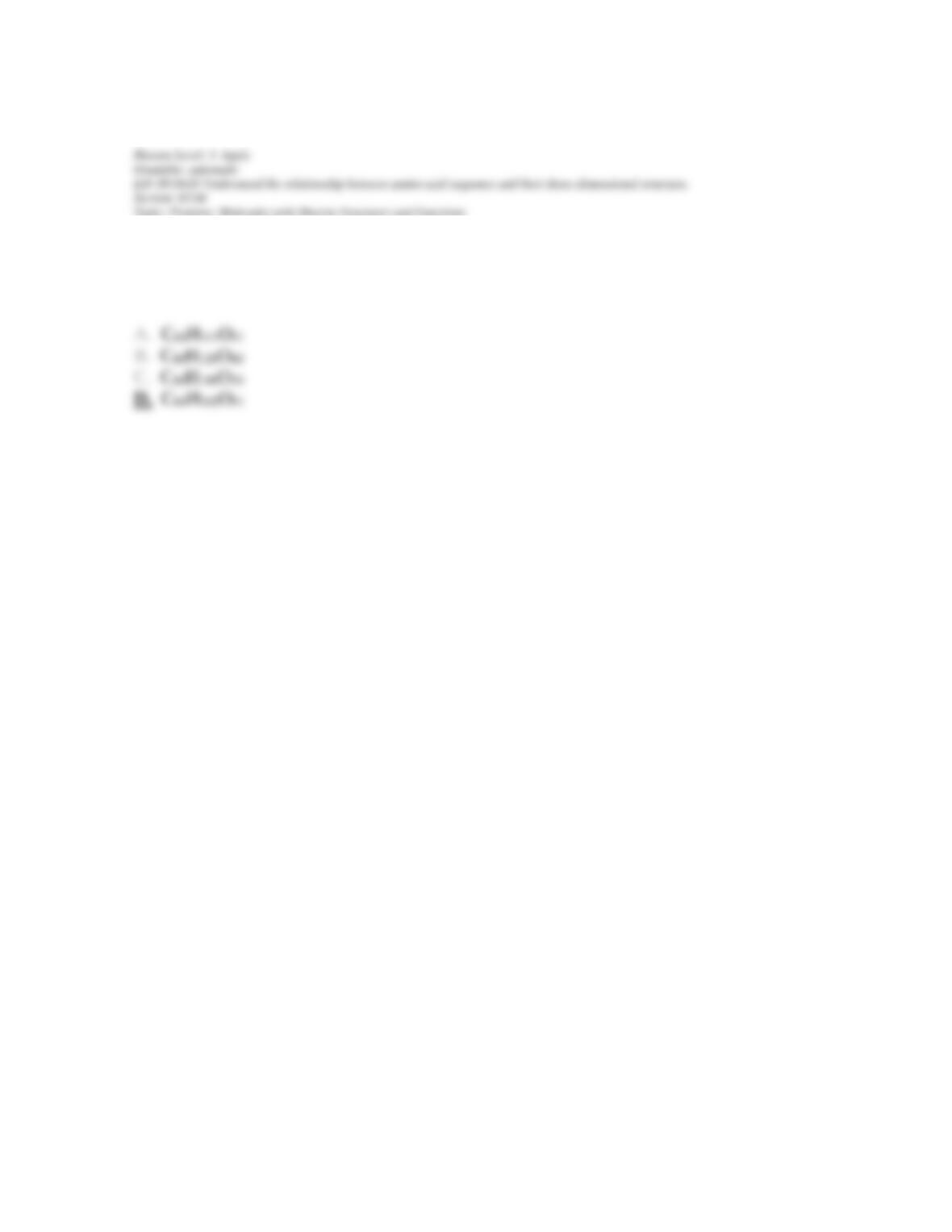
63. Which amino acid is most soluble in water?
Chapter 03 – The Chemical Building Blocks of Life
Clarify Question
•
What is the key concept addressed by the question?
•
What type of thinking is required?
•
What key words does the question contain and what do they mean?
Gather Content
•
What do you know about solubility in water? How does it relate to the question?
Consider Possibilities
•
What other information is related to the question? Which information is most useful?
Choose Answer
•
Given what you now know, what information and/or problem solving approach is most
likely to produce the correct answer?
Reflect on Process
•
Did your problem-solving process lead you to the correct answer? If not, where did the
process break down or lead you astray? How can you revise your approach to produce a
more desirable result?
Chapter 03 – The Chemical Building Blocks of Life
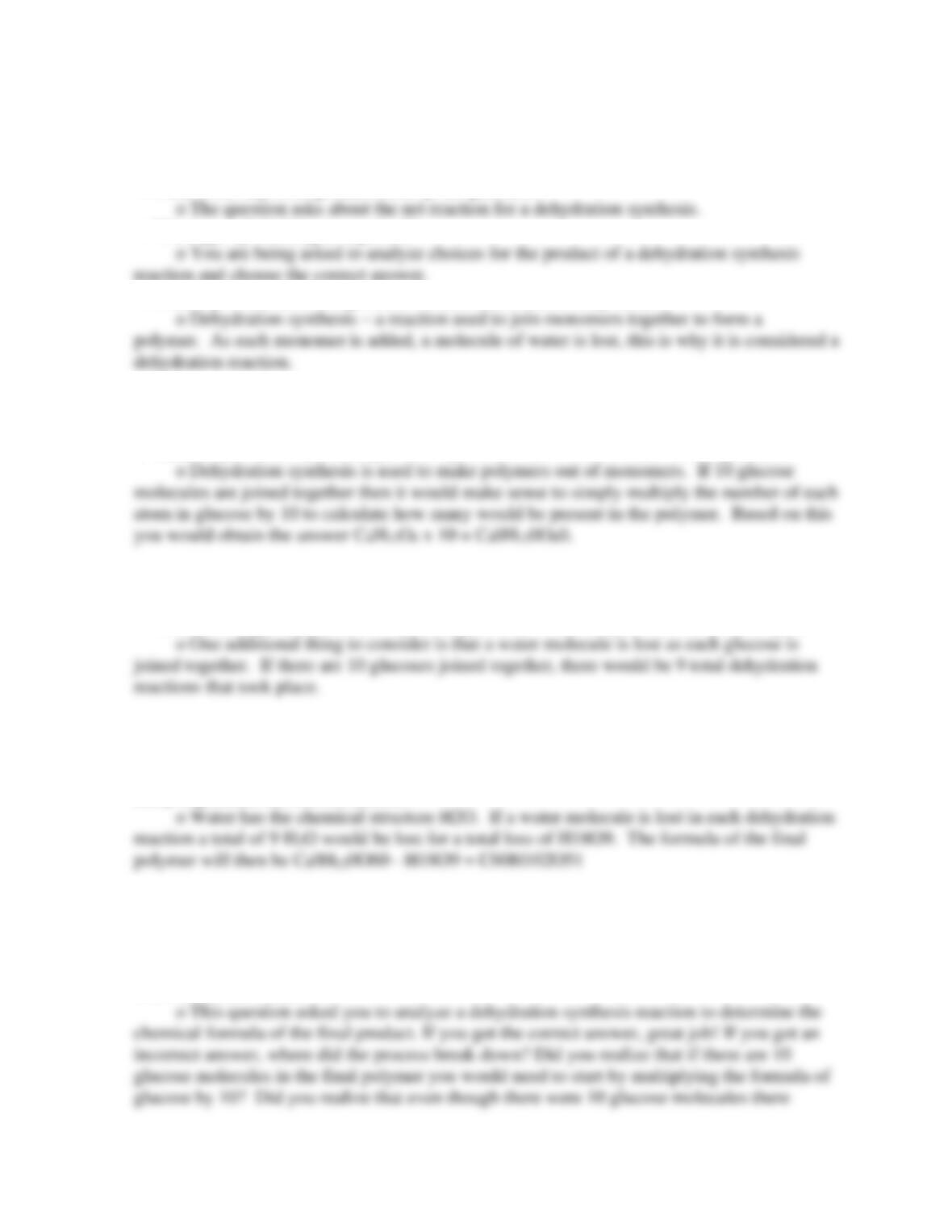
64. The formula for glucose is C6H12O6. What is the formula for a polymer made by linking
ten glucose molecules together by dehydration synthesis?
Chapter 03 – The Chemical Building Blocks of Life
Clarify Question
•
What is the key concept addressed by the question?
•
What type of thinking is required?
reaction and choose the correct answer.
•
What key words does the question contain and what do they mean?
Gather Content
•
What do you know about dehydration synthesis? How does it relate to the question?
Consider Possibilities
•
What other information is related to the question? Which information is most useful?
Choose Answer
•
Given what you now know, what information and/or problem solving approach is most
likely to produce the correct answer?
Reflect on Process
•
Did your problem-solving process lead you to the correct answer? If not, where did the
process break down or lead you astray? How can you revise your approach to produce a
more desirable result?
Chapter 03 – The Chemical Building Blocks of Life
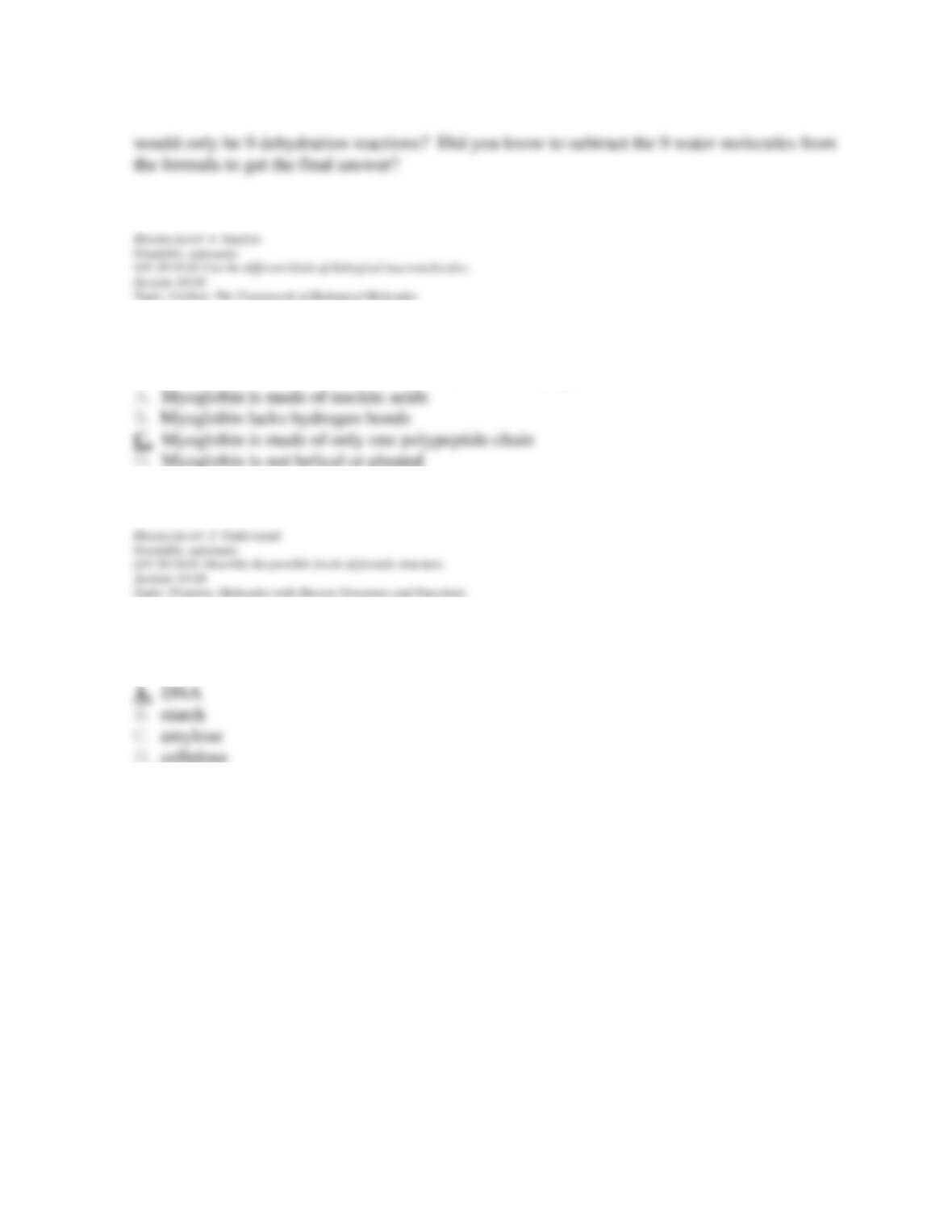
65. The myoglobin protein, which carries oxygen in muscle cells, has only the first three
levels of protein structure. What can you infer about myoglobin?
66. A phosphorus shortage in soil would make it difficult for plants to produce: