Cost Accounting: A Managerial Emphasis, 6e
Chapter 3 – Cost-Volume-Profit Analysis
27) The Holiday Card Company, a producer of specialty cards, has asked you to complete several
calculations based upon the following information:
Income tax rate 30%
Selling price per unit $6.60
Variable cost per unit $5.28
Total fixed costs $46,200.00
Required:
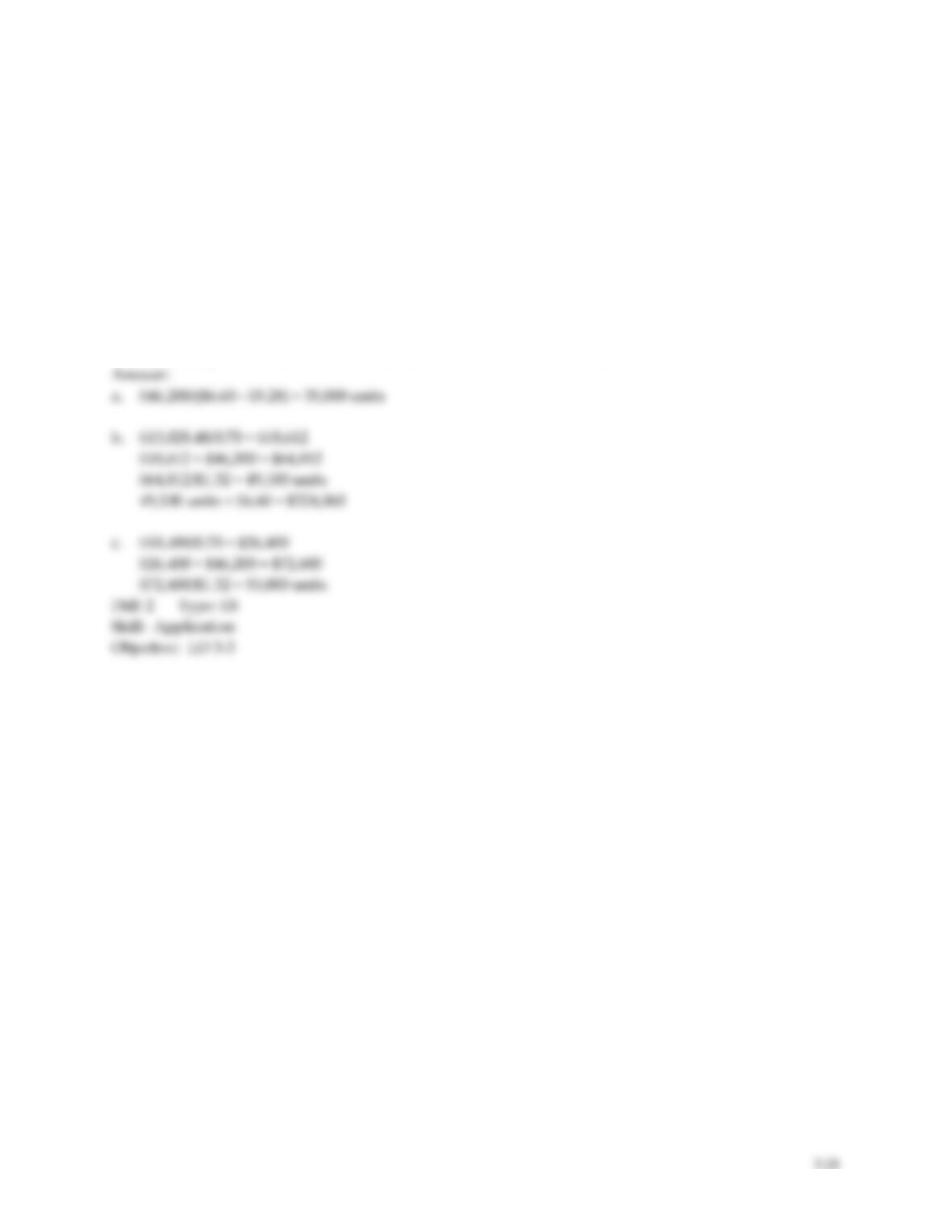
a. What is the break-even point in cards?
b. What sales volume is needed to earn an after-tax net income of $13,028.40?
c. How many cards must be sold to earn an after-tax net income of $18,480?
Cost Accounting: A Managerial Emphasis, 6e
Chapter 3 – Cost-Volume-Profit Analysis
28) Heady Company sells headbands to retailers for $5. The variable cost of goods sold per headband is
$1, with a selling commission of 10 percent of sales. Fixed manufacturing costs total $25,000 per month,
while fixed selling and administrative costs total $10,500. The income tax rate for Heady Company is 30
percent.
Required:
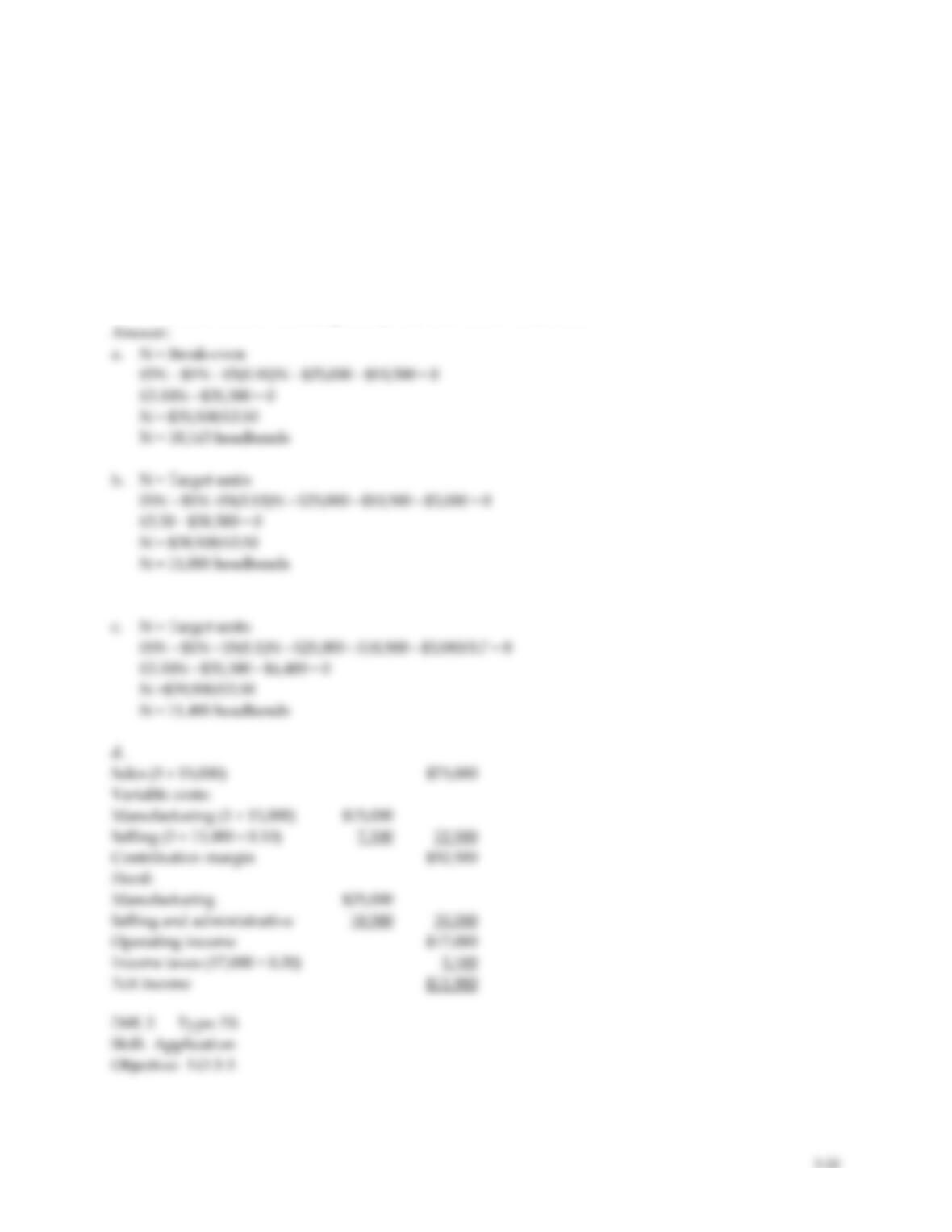
a. What is the break-even point in headbands?
b. What are target sales in headbands to generate a before tax income of $3,000?
c. What are target sales in headbands to generate an after tax income of $3,080?
d. What is net income assuming Heady sells total 15,000 headbands?
Cost Accounting: A Managerial Emphasis, 6e
Chapter 3 – Cost-Volume-Profit Analysis
29) Better Battery has been in the battery renewal business for four years. It rents a building but owns all
of its equipment. All employees are paid a fixed salary except for the busy season (April – June), when
temporary help is hired by the hour. Utilities and other operating charges remain fairly constant during
each month, except those in the busy season.
Selling prices per battery average $100, except during the busy season. Because a large number of
customers buy batteries prior to winter, discounts run above average during the busy season. A 15
percent discount is given when two batteries are purchased at one time. During the busy months selling
prices per battery average $90.
The president of Better Battery is somewhat displeased with the company’s management accounting
system because the cost behaviour pattern displayed by the monthly break-even charts are inconsistent;
the busy months’ charts are different from the other months of the year. The president is never sure if the
company has a satisfactory margin of safety or if it is just above the break-even point.
Required:
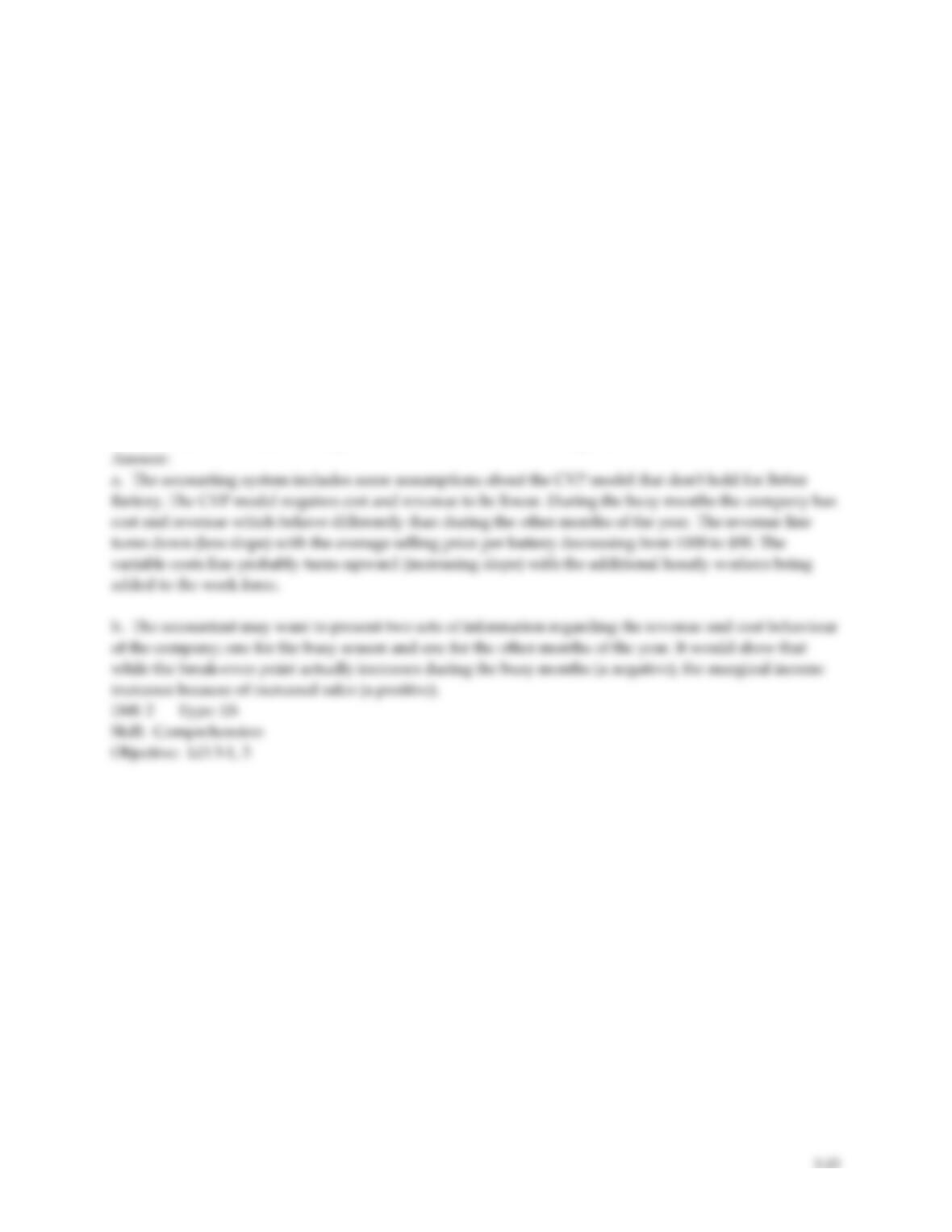
a. What is wrong with the accountant’s computations?
b. How can the information be presented in a better format for the president?
Cost Accounting: A Managerial Emphasis, 6e
Chapter 3 – Cost-Volume-Profit Analysis
30) Blankinship, Inc., sells a single product. The company’s most recent income statement is given below.
Sales $200,000
Less variable expenses (120,000)
Contribution margin 80,000
Less fixed expenses (50,000)
Net income $30,000
Required:
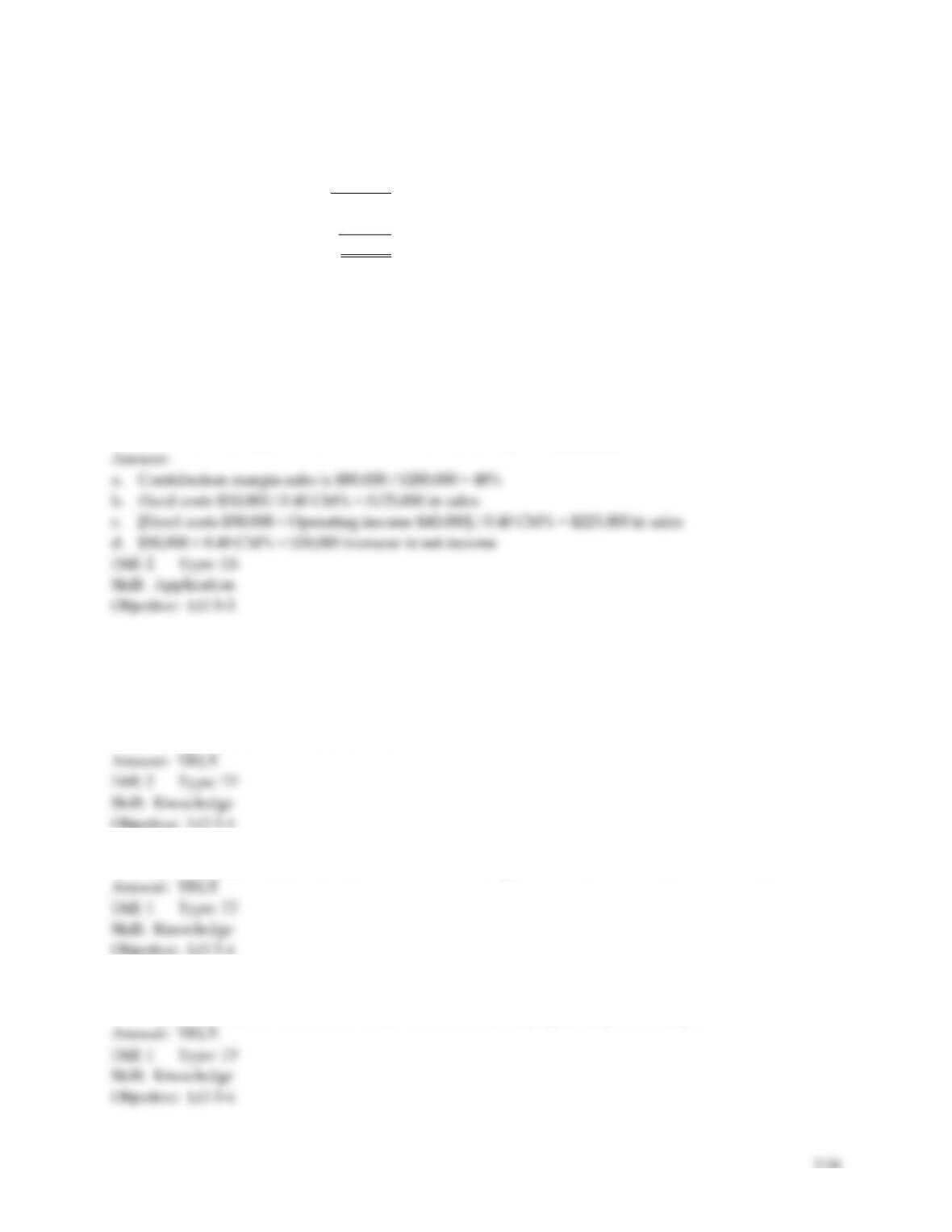
a. Contribution margin ratio is ________ %
b. Break-even point in total sales dollars is $ ________
c. To achieve $40,000 in operating income, sales must total $ ________
d. If sales increase by $50,000, net income will increase by $ ________
3.4 Apply the CVP model in decision making and explain how sensitivity analysis can
help managers both identify and manage risk.
1) Sensitivity analysis may be used to determine how a result will change if the original data are changed
or if the original results are not achieved.
2) Margin of safety measures the difference between budgeted revenues and break-even revenues.
3) Sensitivity analysis is a “what-if” technique that managers use to examine how a result will change if
the originally predicted data are not achieved or if an underlying assumption changes.
Cost Accounting: A Managerial Emphasis, 6e
Chapter 3 – Cost-Volume-Profit Analysis
4) A probability distribution describes the likelihood of each of the mutually exclusive and collectively
exhaustive set of events.
5) An expected value is the weighted-average of the outcomes based on the percentage combinations of
the incomes.
6) Companies with a greater proportion of fixed costs have a greater risk of loss from changes in demand
than companies with a greater proportion of variable costs.
7) The degree of operating leverage at a specific level of sales helps the managers calculate the effect that
potential changes in sales will have on operating income.
8) “Uncertainty” may be defined as
A) the possibility that an actual amount will be the same as an expected amount.
B) the possibility that an actual amount will be either higher or lower than the expected amount.
C) the possibility that a budgeted amount will be the same as an estimated amount.
D) the possibility that the budgeted amount will be lower than the estimated amount.
E) the possibility that the budgeted amount will be either higher or lower than the expected amount.
Cost Accounting: A Managerial Emphasis, 6e
Chapter 3 – Cost-Volume-Profit Analysis
9) Which of the following statements about sensitivity analysis is true?
A) It is a technique which is used to examine past results.
B) It can be used in CVP to show changes in operating income if variable costs per unit change.
C) It examines the relationship between production and service departments.
D) It shows the impact of a manager’s behaviour.
E) It is relevant for isolating conversion costs.
10) Chris Muss is going to sell Ad-hoc compact disks for $40 a box; one box is considered to be one unit.
The disks cost Chris $10 a unit. She is planning to rent a booth at the up-coming Area Computer Show.
She has three options for attending the show:
1. paying a fixed fee of $3,000;
2. paying a $1,000 fee plus 10% of her revenue made at the convention, or;
3. paying 25% of her revenue made at the convention.
Which of the following statements is true?
A) CVP analysis can show that the risks are identical in each case.
B) The break-even point is the identical in each case.
C) One of the options will allow Chris Muss to break-even, even if she doesn’t sell any disks, assuming
she can return any unsold disks for a full refund.
D) Fixed costs are inherent in all of the options.
E) Operating income per unit is the same in each case, as both selling price and costs are the same.
11) Which of the following statements is true concerning operating leverage?
A) It summarizes the risk-return tradeoff across alternate revenue possibilities.
B) It measures the change in operating income when costs change proportionately with the change in the
number of units sold.
C) The degree of operating leverage increases inversely to the number of units sold.
D) The degree of operating leverage remains constant (in the relevant range) when there is a change in
the number of units sold.
E) The degree of operating leverage equals contribution margin divided by operating income, at any
specific sales level.
Cost Accounting: A Managerial Emphasis, 6e
Chapter 3 – Cost-Volume-Profit Analysis
12) Which of the following factors would be relevant in classifying costs as fixed or variable in a specific
decision situation?
A) if the time horizon is short or long
B) the relevant range of the next best alternative situation
C) the mix of revenues
D) the sales mix
E) if the time horizon is shorter in another alternative
Cost Accounting: A Managerial Emphasis, 6e
Chapter 3 – Cost-Volume-Profit Analysis
Use the information below to answer the following question(s).
Big Sports University is planning to hold a fund raising banquet at one of the local country clubs. It has
two options for the banquet:
1. Foothills Country Club
a. Fixed rental cost of $600
b. plus $15.00 per person for food.
2. Downhill Country Club
a. Fixed rental cost of $1,080
b. It will have to hire a caterer who charges $12.00 per person for food.
Big Sports has budgeted $900 for administrative and marketing expenses. It plans to hire a band, which
will cost another $400. Tickets are expected to be $40 per person. Any other items required for the event
will be donated by its local business supporters.
13) What is the break-even point in tickets sold of option one?
A) 85 tickets
B) 80 tickets
C) 76 tickets
D) 60 tickets
E) 24 tickets
Cost Accounting: A Managerial Emphasis, 6e
Chapter 3 – Cost-Volume-Profit Analysis
14) The break-even point in tickets sold of option two?
A) 85 tickets
B) 80 tickets
C) 76 tickets
D) 39 tickets
E) 71 tickets
15) What is the “operating income” assuming 250 people attend and option one is chosen?
A) $4,400
B) $4,350
C) $4,000
D) $6,250
E) $4,750
Cost Accounting: A Managerial Emphasis, 6e
Chapter 3 – Cost-Volume-Profit Analysis
16) What is the “operating income” assuming 250 people attend and option two is chosen?
A) $7,000
B) $2,900
C) $2,750
D) $4,620
E) $5,080
17) How many people must purchase tickets assuming option two is chosen, and Big Sports expects to
raise $4,820 for the athletic fund? Assume no one pays more than the cost of his/her ticket.
A) 258 people
B) 173 people
C) 243 people
D) 276 people
E) 310 people
18) An expected value decision model is used for
A) determining if a budgeted amount will deviate from an actual amount.
B) determining if a budgeted amount will be the same as an actual amount.
C) enabling managers to deal with events using a qualitative analysis method.
D) enabling managers to deal with uncertainty using quantitative analyses.
E) identifying factors that distinguish an action from an event.
Cost Accounting: A Managerial Emphasis, 6e
Chapter 3 – Cost-Volume-Profit Analysis
19) Events, as distinguished from actions, would include
A) personnel policy options.
B) decisions on time schedules.
C) decisions on direct material vendors.
D) a financial recession.
E) price changes of the company’s products.
20) Expected monetary value may be defined as
A) the weighted average of all possible outcomes.
B) the probability that each outcome will not occur.
C) the weighted average of the financial outcomes with the probability of each outcome serving as the
weight.
D) the average of all possible outcomes.
E) the weighted average of all mutually exclusive outcomes.
21) What would be the expected monetary value for the following data using the probability method?
Probability
Cash Inflows
0.15
$200,000
0.25
$175,000
0.30
$160,000
0.40
$0
A) $535,000
B) $250,000
C) $121,750
D) $200,000
E) $30,000
Cost Accounting: A Managerial Emphasis, 6e
Chapter 3 – Cost-Volume-Profit Analysis
Use the information below to answer the following question(s).
Joan Perry has three booth rental options at the bridal fair where she plans to sell her new product. The
booth rental options are:
Option 1: $4,000 fixed fee
Option 2: $3,000 fixed fee + 5% of all revenues generated at the fair
Option 3: 20% of all revenues generated at the fair.
The product sells for $150 per unit. She is able to purchase the units for $50.00 each.
22) How many actions and alternatives exist in this situation?
A) 1 action and 3 alternatives
B) 1 action and 1 alternative
C) 2 actions and 3 alternatives
D) 3 actions and 3 alternatives
E) 3 actions and 1 alternative
23) Which option should Joan choose in order to maximize income assuming there is a 40% probability
that 70 units will be sold and a 60% probability that 40 units will be sold?
A) Option one with expected operating income of $1,200
B) Option two with expected operating income of $1,810
C) Option three with expected operating income of $3,640
D) Option three with expected operating income of $4,160
E) Option two with expected operating income of $4,060
Cost Accounting: A Managerial Emphasis, 6e
Chapter 3 – Cost-Volume-Profit Analysis
Use the information below to answer the following question(s).
Dr. Mickey Finn performs a certain procedure for $400.00. The fixed costs are $8,000 and variable costs
are $200.00 per procedure.
24) What is the budgeted revenue assuming the procedure is performed 200 times?
A) $40,000
B) $80,000
C) $120,000
D) $160,000
E) $320,000
25) What is the budgeted contribution margin assuming the procedure is performed 200 times?
A) $20,000
B) $30,000
C) $8,000
D) $80,000
E) $40,000
26) What is the margin of safety assuming the procedure is performed 200 times?
A) $80,000
B) $64,000
C) $40,000
D) $32,000
E) $16,000
Cost Accounting: A Managerial Emphasis, 6e
Chapter 3 – Cost-Volume-Profit Analysis
27) What is the margin of safety in units assuming the procedure is performed 200 times?
A) 200 units
B) 130 units
C) 140 units
D) 160 units
E) 20 units
28) What is the margin of safety assuming 100 procedures are performed?
A) $16,000 or 40 times
B) $20,000 or 50 times
C) $24,000 or 60 times
D) $40,000 or 100 times
E) $50,000 or 110 times
29) Lobster Liquidators will make $500,000 if the fishing season weather is good, $200,000 if the weather
is fair, and would actually lose $50,000 if the weather is poor during the season. If the weather service
gives a 40% probability of good weather, a 25% probability of fair weather, and a 35% probability of poor
weather, what is the expected monetary value for Lobster Liquidators?
A) $500,000
B) $750,000
C) $267,500
D) $200,000
E) $232,500
Cost Accounting: A Managerial Emphasis, 6e
Chapter 3 – Cost-Volume-Profit Analysis
Answer the following question(s) using the information below.
Southwestern College is planning to hold a fund raising banquet at one of the local country clubs. It has
two options for the banquet:
OPTION 1: Crestview Country Club
a. Fixed rental cost of $1,000
b. $12 per person for food
OPTION 2: Tallgrass Country Club
a. Fixed rental cost of $3,000
b. A caterer who charges $8.00 per person for food
Southwestern College has budgeted $1,800 for administrative and marketing expenses. It plans to hire a
band which will cost another $800. Tickets are expected to be $30 per person. Local business supporters
will donate any other items required for the event.
30) Which option provides the least amount of risk?
A) Option one
B) Option two
C) Both options provide the same amount of risk.
D) Neither option has risks.
E) Without probability assignments it is not possible to determine the riskier option.
31) What is the break-even point in units for each option?
A) 96 units and 114 units respectively
B) 120 units and 187 units respectively
C) 56 units and 137 units respectively
D) 200 units and 255 units respectively
E) 156 units and 219 units respectively
Cost Accounting: A Managerial Emphasis, 6e
Chapter 3 – Cost-Volume-Profit Analysis
32) What is the operating income for each option if 600 people attend?
A) $14,400 and $12,400 respectively
B) $9,800 and $10,200 respectively
C) $8,000 and $8,400 respectively
D) $7,900 and $8,000 respectively
E) $7,200 and $7,600 respectively
33) What is the degree of operating leverage for both options if 600 people attend?
A) 1.37 and 1.75 times respectively
B) 1.5 times and 1.74 times respectively
C) 1.10 and 1.29 times respectively
D) 0.75 and 1.07 times respectively
E) Operating leverage is indeterminable.
Cost Accounting: A Managerial Emphasis, 6e
Chapter 3 – Cost-Volume-Profit Analysis
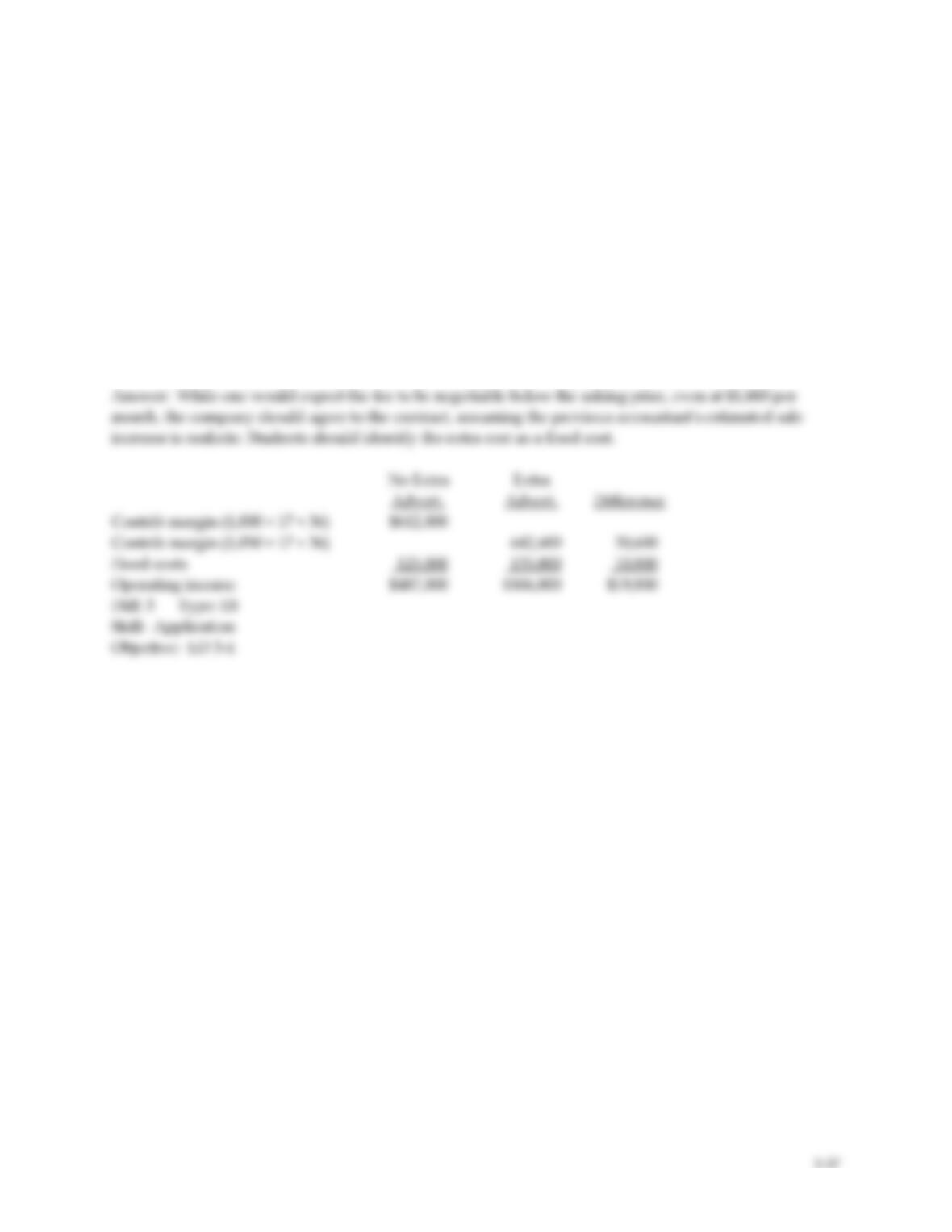
34) You have just been hired as the new management accountant for a pool chemical wholesaler. The
company sells packages of pool chemicals to retail stores, consisting of all of the chemicals a typical pool
would need for a week, for a price of $25, and a variable cost of $8. The company has fixed costs of
$125,000. The previous accountant was promoted to an associated company but has left you her working
papers for a project she was working on. The project involves advising management whether to accept an
advertising arrangement with an industry publication. The arrangement being offered is a contract
calling for a set payment per month (amount to be negotiated) for 6 months. The industry is cyclical and
has no sales for 4 months [16 weeks] of the year. The previous accountant notes show her projection that
this would result an increase of 50 units per week, above the normal 1,000 units per week that the
company sells currently. The increased demand would arise from more customers to existing outlets, and
from new outlets as well. The advertiser is suggesting a monthly fee of $1,800.
What is your advice, based on the previous accountant’s notes and your own analysis?
Cost Accounting: A Managerial Emphasis, 6e
Chapter 3 – Cost-Volume-Profit Analysis
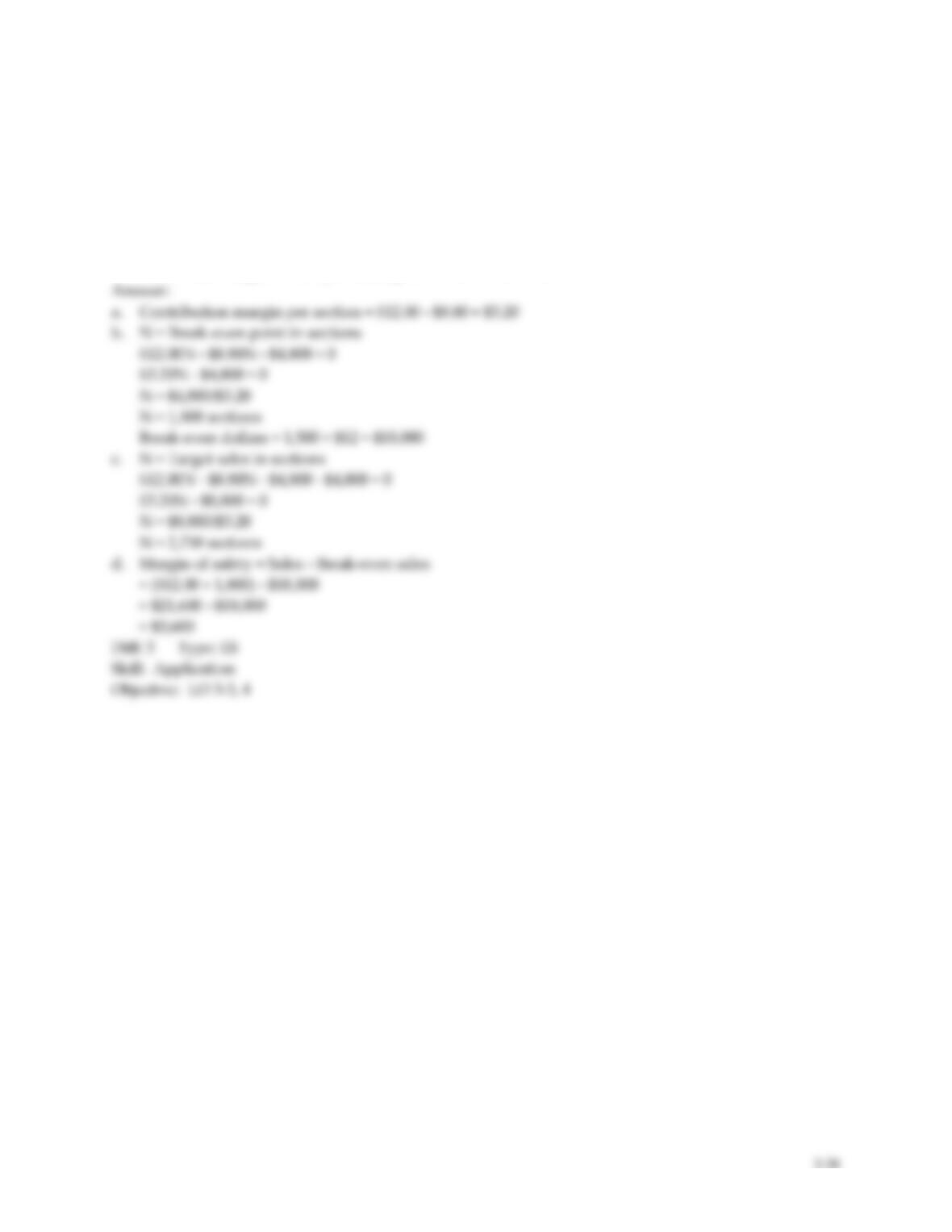
35) Seamless Gutter sells 10 metre sections of eaves trough for $12. The unit variable costs per section are
$8.80. Fixed costs total $4,800.
Required:
a. What is the contribution margin per section?
b. What is the break-even point in sections? . . . in dollars?
c. How many sections must be sold to earn a pretax income of $4,000?
d. What is the margin of safety assuming 1,800 sections are sold?
Cost Accounting: A Managerial Emphasis, 6e
Chapter 3 – Cost-Volume-Profit Analysis
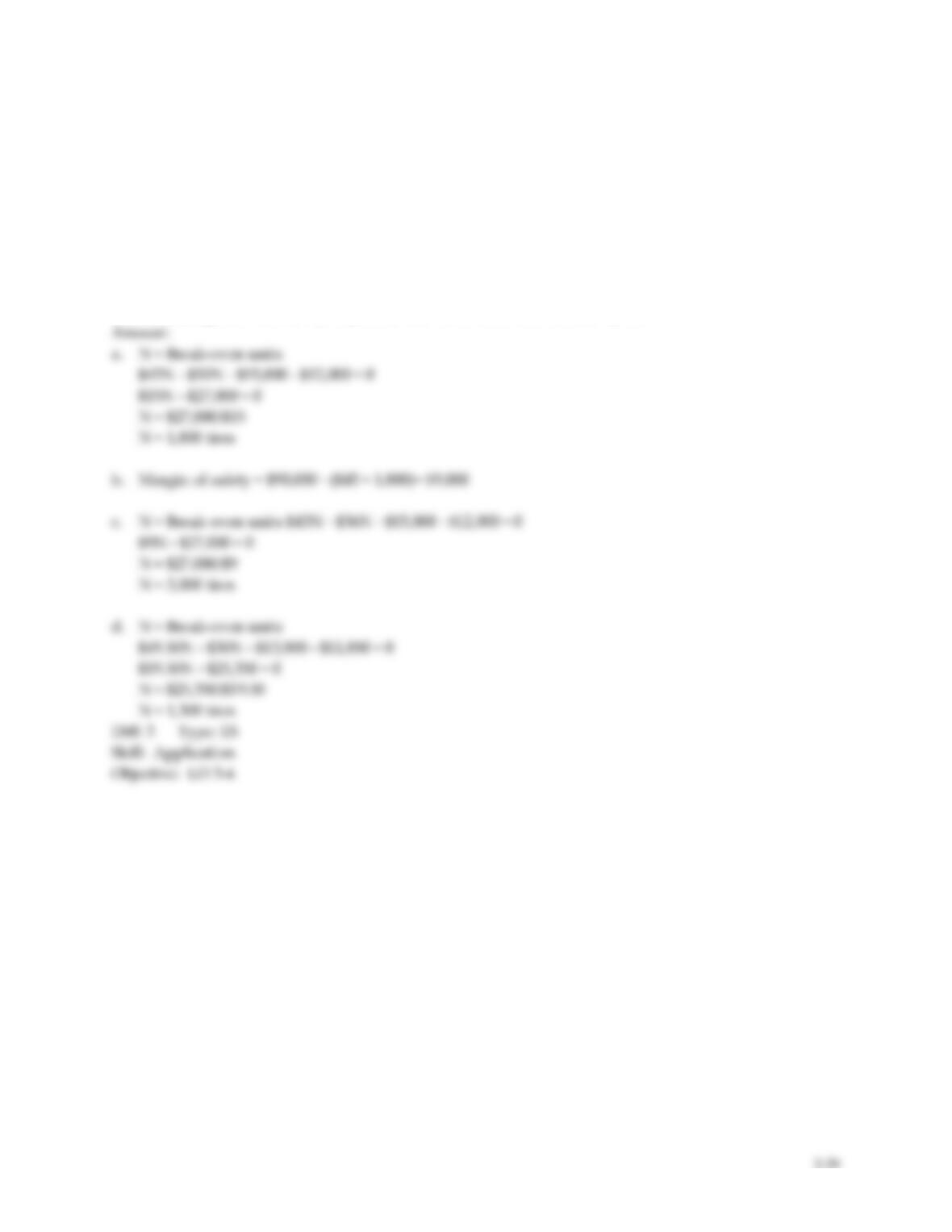
36) Auto Tires Inc. sells tires to service stations for an average of $45 each. The variable costs of each tire
are $30 and monthly fixed manufacturing costs total $15,000. Other monthly fixed costs of the company
total $12,000.
Required:
a. What is the break-even level in tires?
b. What is the margin of safety assuming sales total $90,000?
c. What is the break-even level in tires assuming variable costs increase by 20 percent?
d. What is the break-even level in tires assuming the selling price goes up by 10 percent, fixed
manufacturing costs decline by 10 percent and other fixed costs decline by $150?
Cost Accounting: A Managerial Emphasis, 6e
Chapter 3 – Cost-Volume-Profit Analysis
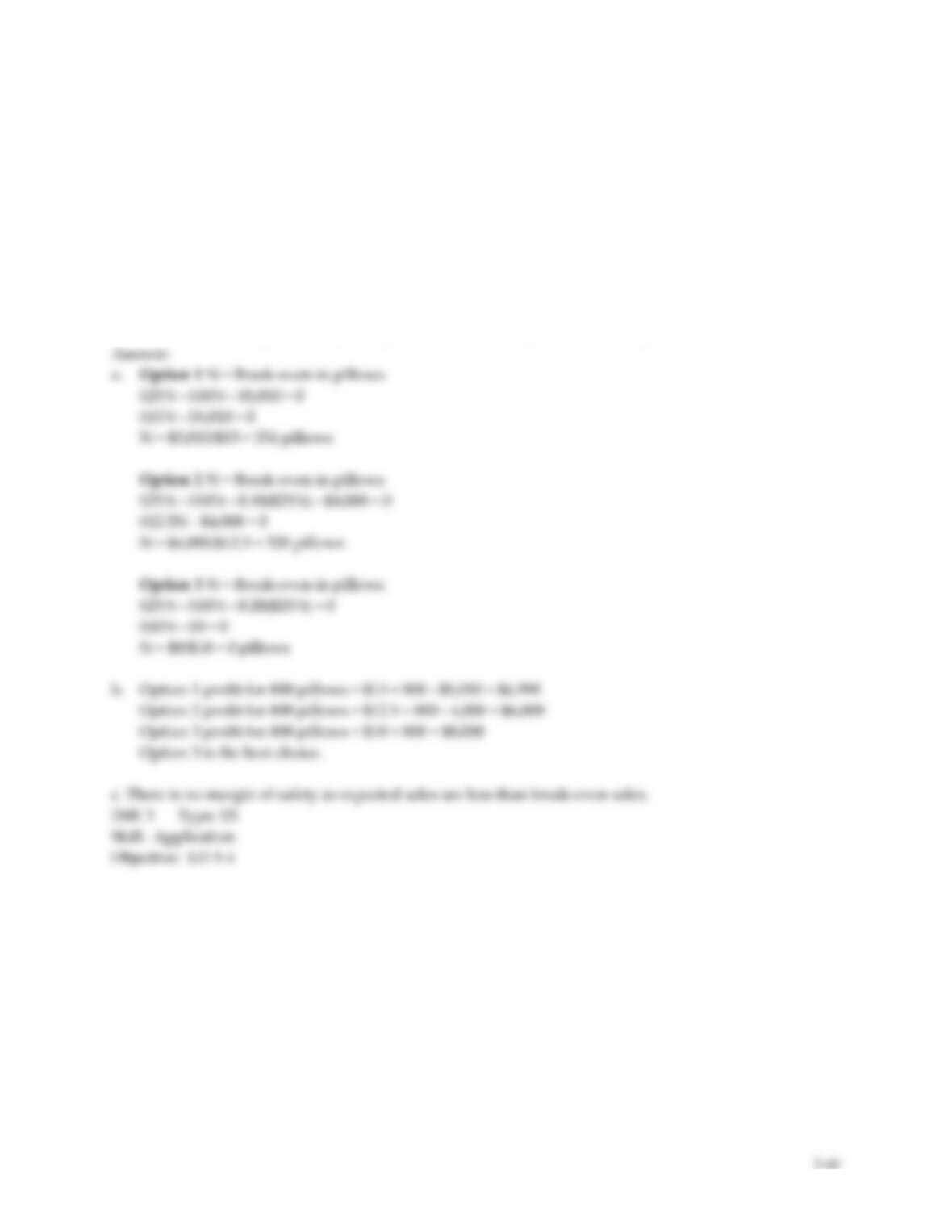
37) Query Company sells pillows for $25.00 each. The manufacturing cost, all variable, is $10 per pillow.
The company is planning on renting an exhibition booth at the annual crafts and art convention. The
convention coordinator allows three options for each participating company. They are:
1. paying a fixed booth fee of $5,010, or;
2. paying an $4,000 fee plus 10% of revenue made at the convention, or;
3. paying 20% of revenue made at the convention.
Required:
a. Compute the break-even sales in pillows of each option.
b. Which option should Query Company choose, assuming sales are expected to be 800 pillows?
c. Calculate the margin of safety for Option 1 if sales are expected to be 300 pillows.