Chapter 3—Time Value of Money
MULTIPLE CHOICE
1. Financial markets allow savers and borrowers to meet differing consumption preferences if:
a.
a limited number of financial intermediaries exist
b.
riskier borrowers are able to access funds at the equilibrium riskless interest rate
c.
savers have the ability to sell loans easily and at low cost
d.
regulatory agencies establish mandated interest rates
e.
all of the above
2. The separation of investment and financing decision rule suggests:
a.
firms need not worry about satisfying financial market demands
b.
firms should accept all positive-NPV investment projects
c.
firms should accept positive-NPV projects only if they are financed by external investors
d.
firms must satisfy the personal preferences of present and potential investors
e.
firms should be concerned that investors in the market will capitalize an investment
project’s positive-NPV value
3. When compounding occurs annually and the investment lasts longer than one year, compound interest:
a.
will always provide higher earnings than simple interest
b.
will always yield a higher future value than simple interest
c.
is always preferable to simple interest
d.
all of the above
e.
none of the above
4. The higher the interest rate and the longer the period of time:
a.
the higher the future value and the lower the present value
b.
the higher the future value and the higher the present value
c.
the lower the future value and the lower the present value
d.
the lower the future value and the higher the present value
e.
the less present values and future values will be considered by investors
5. Which of the following is not a commonly used term for the interest rate employed in present value
calculations?
a.
required return
b.
hurdle rate
c.
discount rate
d.
cost of capital
e.
investment rate

6. Mixed stream cash flows and annuities differ because:
a.
mixed streams are inflows and annuities are outflows
b.
mixed stream payments occur at the end of each period, whereas annuity payments occur
at the beginning of each period
c.
the future value of a mixed stream is the sum of the future values of the individual cash
flows, but the future value of an annuity is simply the future value of the annuity’s annual
payment
d.
the present value of a mixed stream is easier to calculate than the present value of an
annuity
e.
mixed streams follow no particular pattern of cash flows; however, annuities are streams
of equal periodic cash flows
7. Which statement is false?
a.
The future value of an annuity due would be greater than the future value of a comparable
ordinary annuity.
b.
The present value of an annuity due would be smaller than the present value of a
comparable ordinary annuity.
c.
Equations for the present value (future value) of an ordinary annuity can be converted to
the present value (future value) of an annuity due by multiplying by (1 + r).
d.
The future value of an annuity due is always greater than the future value of a comparable
ordinary annuity because each cash flow of an annuity due earns an additional year of
interest.
e.
The equation for the present value of an annuity due accounts for the fact that each cash
flow for an annuity due occurs one period earlier than for an ordinary annuity.
8. The present value of a perpetuity:
a.
equals the annual, end-of-year payment divided by the discount rate
b.
is calculated using the same equation as the present value of an annuity due
c.
is found by dividing the present value of the infinite annuity stream by (1 + r)
d.
cannot be calculated if the cash flows do not remain constant over time
e.
none of the above
9. Sue was evaluating an investment opportunity with equal end of period cash flows, when she realized
she would need a 10% return rather than an 8% return. Since the equal expected cash flows did not
change, Sue should:
a.
pay the same amount in present dollars for the investment
b.
make certain the investment is not an annuity due
c.
pay less in present dollars for the investment
d.
try to increase the length of time she will hold the investment
e.
pay more in present dollars for the investment
10. For a given stated annual rate, the effective annual rate (EAR):
a.
can be found by dividing the stated rate by the number of compounding periods
b.
increases as compounding frequency increases

c.
is at a minimum when interest is continuously compounded
d.
decreases if the number of compounding periods is greater than the number of holding
periods
e.
is greater in all cases
11. Under current U.S. law, “truth-in–lending” and “truth-in-savings” laws result in:
a.
disclosure of actual cost on credit cards and loans
b.
disclosure of stated annual and effective annual rates in all lending and savings
transactions
c.
disclosure of effective annual rates on credit cards and loans, and stated annual rates on
savings deposits
d.
disclosure of annual percentage rates on credit cards and loans, and annual percentage
yields on savings deposits
e.
more financially accurate quoted rates on credit cards and loans than on savings deposits
12. Ashley makes monthly mortgage payments of $925.00. This year she was able to make an additional
payment to principal of $7,000.00. This decrease in principal will cause:
a.
an increase in the proportion of total interest paid over the life of the loan
b.
a decrease in the number of payments Ashley will need to make this year
c.
a decrease in both the term of the loan and the total interest paid over the life of the loan
d.
an increase in the term of the loan, but a decrease in the total interest paid over the life of
the loan
e.
a decrease in the rate of interest charged on the loan
13. The term __________ is used to describe the process of calculating present value.
a.
valuation
b.
compounding
c.
discounting
d.
amortization
e.
annuity
14. Because the cash flow of the annuity due occurs at the __________ of the period rather than at the
__________, its future value is __________.
a.
end; beginning; greater
b.
end; beginning; smaller
c.
beginning; end; smaller
d.
beginning; end; greater
e.
none of the above
15. Calculate the effective annual rate associated with a psr percent stated rate that is compounded
quarterly.
a.
psr%
b.
w1%
c.
ear%
d.
w2%
e.
w3%
16. Calculate the effective annual rate associated with a psr percent stated rate when interest compounds
continuously.
a.
psr%
b.
w1%
c.
w2%
d.
ear%
e.
an infinite rate
17. Increasing the frequency of compounding increases the __________.
a.
future value
b.
present value
c.
discount value
d.
liquidity
18. An annuity due is:
a.
A loan payment schedule with the interest paid periodically and the principal due at
maturity.
b.
A series of equal periodic payments made at the end of each period.
c.
A payment due to be deposited today to cover a future retirement annuity.
d.
A series of equal beginning-of-period payments.
e.
An account payable required to be paid today.
19. The present value of a stream of cash flows can be found by:
a.
Finding the present value of the sum of all the future cash flows.
b.
Calculating the sum of the present values of the individual cash flows.
c.
Taking the square root of the sum of the future value of the cash flows.
d.
Finding the sum of the future values of the individual cash flows.
e.
None of the above.
20. The effective annual rate (EAR) is:
a.
The annual rate of interest actually paid or earned.
b.
The annual rate of interest in affect during the current year.
c.
The contractual annual rate charged by a lender or promised by a borrower.

d.
The annual rate to be used in continuous compounding situations.
e.
The stated rate of interest.
21. In 5 years, what will be the value of the following stream of end-of-year cash flows if you can earn
10% compounded quarterly:
year 1 – $y1
year 2 – $y2
year 4 – $y3
year 5 – $y4
a.
$w1
b.
$fv
c.
$w2
d.
$w3
22. You have an opportunity to invest in a deal that will make yearly payments forever. These payments
will grow at a rate of r1% per year. You will receive your first payment of $p one year from today.
Due to the risks associated with this investment, you will require a return of r2%. How much are you
willing to pay for this deal today?
a.
$pv
b.
$w1
c.
$w2
d.
$w3
23. You invest $i at an APR of apr%. If interest is continuously compounded, how much will your
investment grow to be in t years?
a.
$w1
b.
$w2
c.
$fv
d.
$w3
24. If $p1 will grow to $fv1 in t1 years, using the same rate of interest, how much will $p2 be in t2 years?
a.
$w1
b.
$fv2
c.
$w2
d.
$w3
25. If you could invest $i at r% interest compounded monthly, how long would it be before your account
grew to be $p?
a.
t years
b.
w1 years
c.
w2 years
d.
w3 years
26. You can receive $p t years from now. You can earn r% on your money with continuous compounding.
What amount would you be willing to sell this future cash flow stream for today?
a.
$w1
b.
$w2
c.
$pv
d.
$w3
27. Bank A compounds interest on a quarterly basis. It offers a high yield savings account that pays a r%
APR. If bank B wanted to match the annual interest for bank A, but bank B compounds interest on a
daily basis (365 days/year), what APR would B have to offer customers?
a.
ans%
b.
w1%
c.
w2%
d.
w3%
28. How much would a bank be willing to loan if the borrower offered terms of repaying $p every other
year for 40 years (i.e. first payment 2 years from today, the second payment is received 4 years from
today, etc.) and the relevant rate of interest is r% compounded annually?
a.
$w1
b.
$avp
c.
$w2
d.
$w3
29. A contract specifies that you will receive $p in one year, $p2 in two years, and annual payments that
continue to grow at a g% rate forever. If the appropriate discount rate is dr%, what is the value of this
contract?
a.
$w1
b.
infinity
c.
$w3
d.
$w2
e.
$ans
30. You are given a choice of the following savings accounts, which is the choice that maximizes your
return?
a.
a% compounded annually
b.
b % compounded monthly
c.
c % compounded quarterly
d.
d % compounded continuously
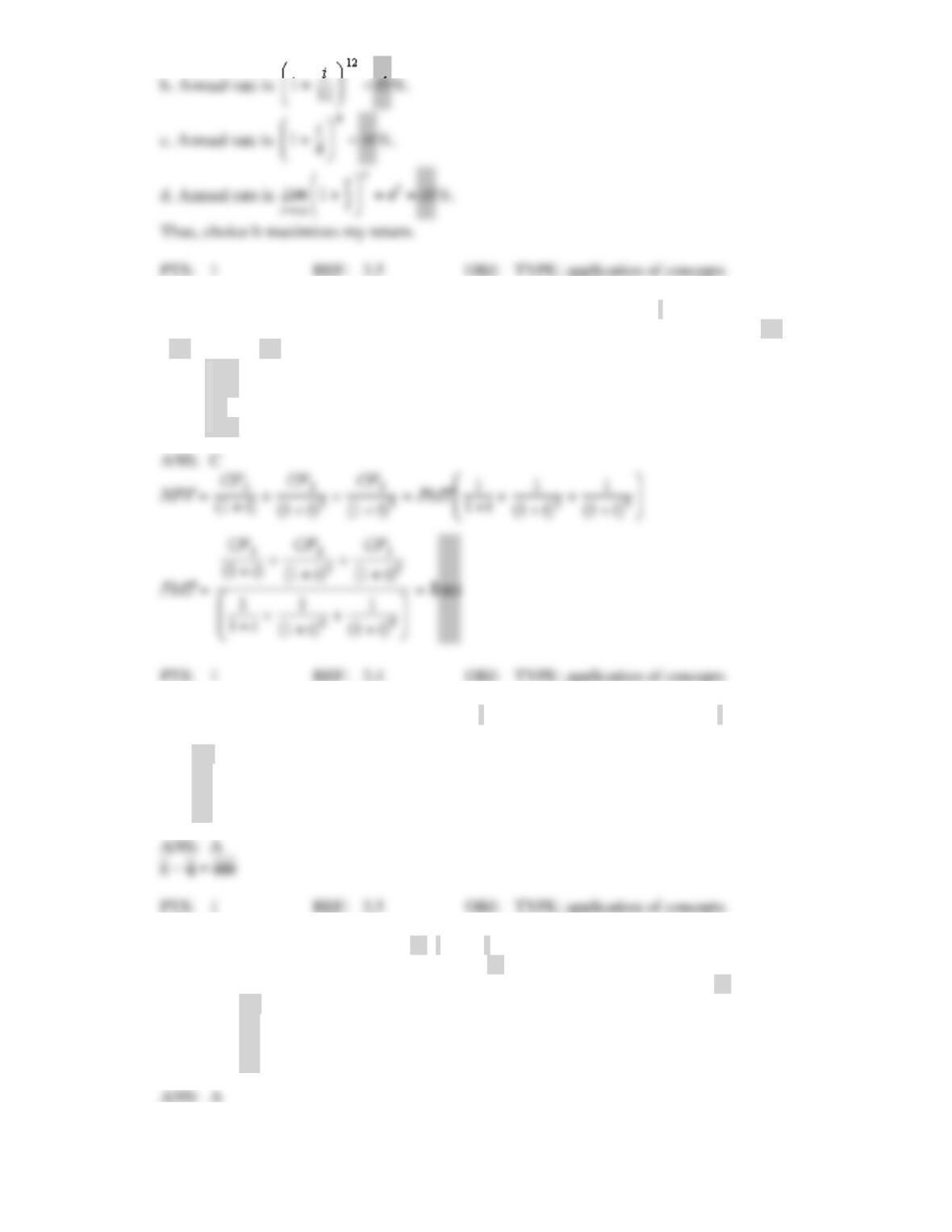
31. Given the following stream of unequal cash flows and a discount rate of i%, what is the equivalent
annuity (hint: find the annuity with the same present value)? Cash flows are: Year 1, $cf1; Year 2
$cf2; Year 3 $cf3.
a.
$ dstr1
b.
$ dstr3
c.
$ ans
d.
$ dstr4
32. What is the difference in the effective rates of r% compounded continuously and r% compounded
quarterly?
a.
ans %
b.
w1 %
c.
w2 %
d.
w3 %
33. You purchased a house and have a $pv, t-year, r percent mortgage, with monthly payments. You
decide to save money by adding an additional $dp a month to your payment (starting with the first
payment), how much sooner will you retire your mortgage given the additional $dp?
a.
About ans years
b.
About w1 years
c.
About w2 years
d.
About w3 years
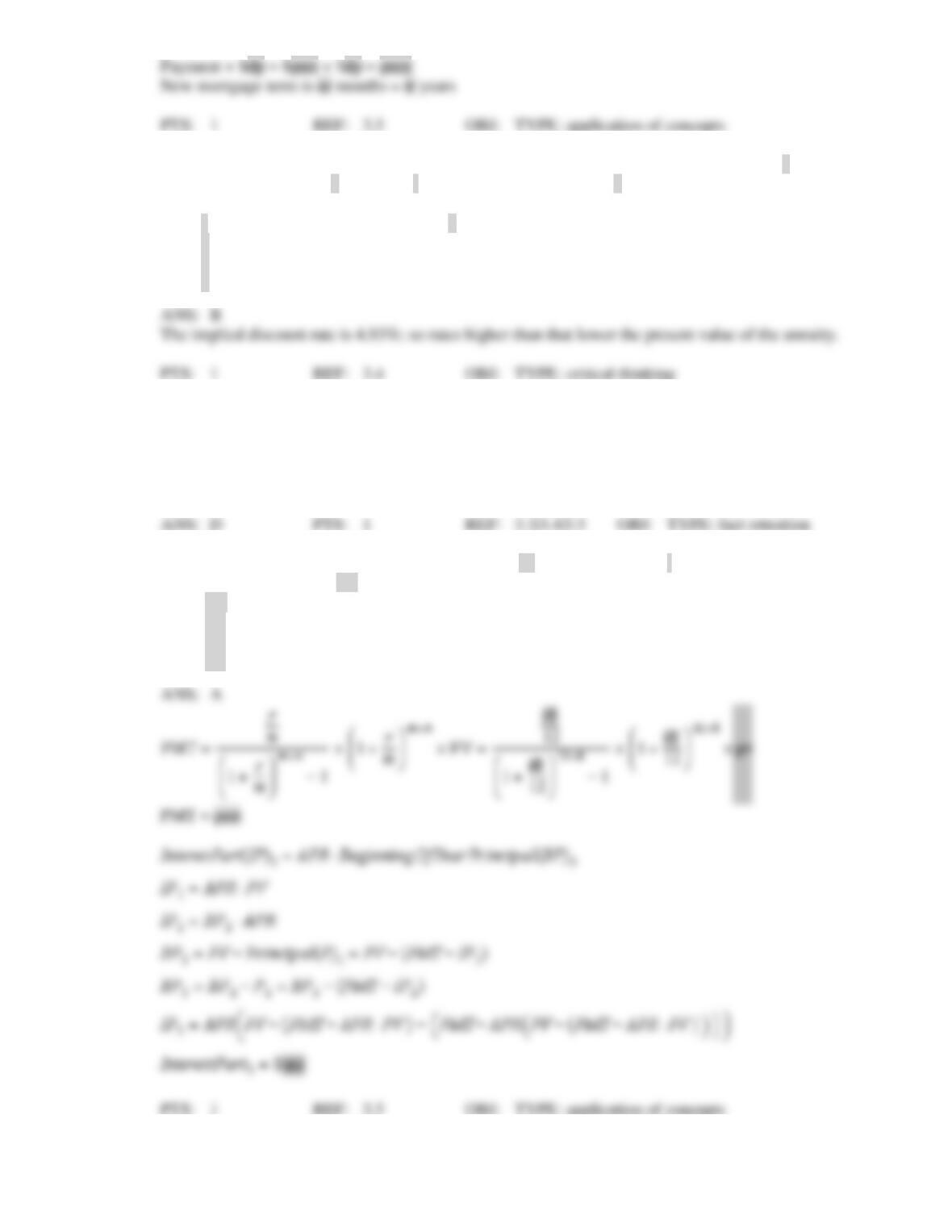
34. Congratulations! You have a winning lottery ticket worth, according to the lottery office, $a million.
The payout options are $p a year for t years or a payout today of $b million. Which option (and why)
should you choose?
a.
$a million because it is greater than $b million
b.
$b million because you can earn 5.5% on your money
c.
$b million because you can earn 4.3% on your money
d.
$b million because you can earn 3.8% on your money
35. Which of the following is correct?
a.
Preferred shares are often priced as perpetuities
b.
Common shares are often priced as growing perpetuities
c.
Bonds are often priced as a mixed stream present value
d.
All of the above are correct
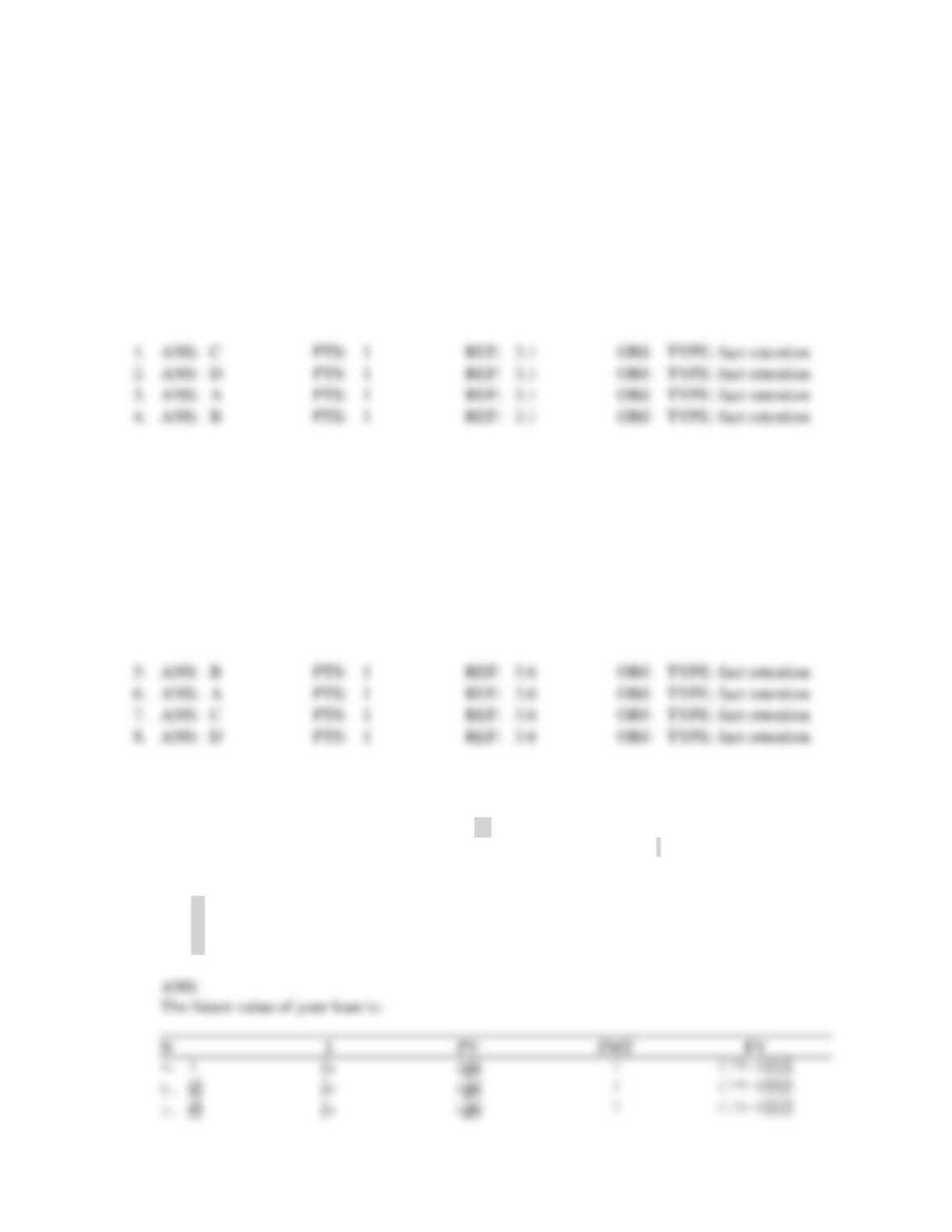
36. Consider a home mortgage with a present value of $pv, is amortized over t years with monthly
payments and an APR of apr percent, what is the interest portion of the third payment?
a.
$ ans
b.
$ w1
c.
$ w2
d.
$ w3
MATCHING
Match the following terms to their definitions:
a.
liquidity
b.
equilibrium interest rate
c.
firm’s required return
d.
capitalizing
1. corporation’s cost of capital
2. determining today’s asset value of a stream of future cash flows
3. ability to resell an investment easily and at a low cost
4. market wide interest rate
Match the following terms to their definitions:
a.
stated annual rate
b.
EAR
c.
APR
d.
APY
5. annual rate of interest actually paid
6. contractual annual rate
7. periodic rate number of periods per year
8. same as the effective annual rate
SHORT ANSWER
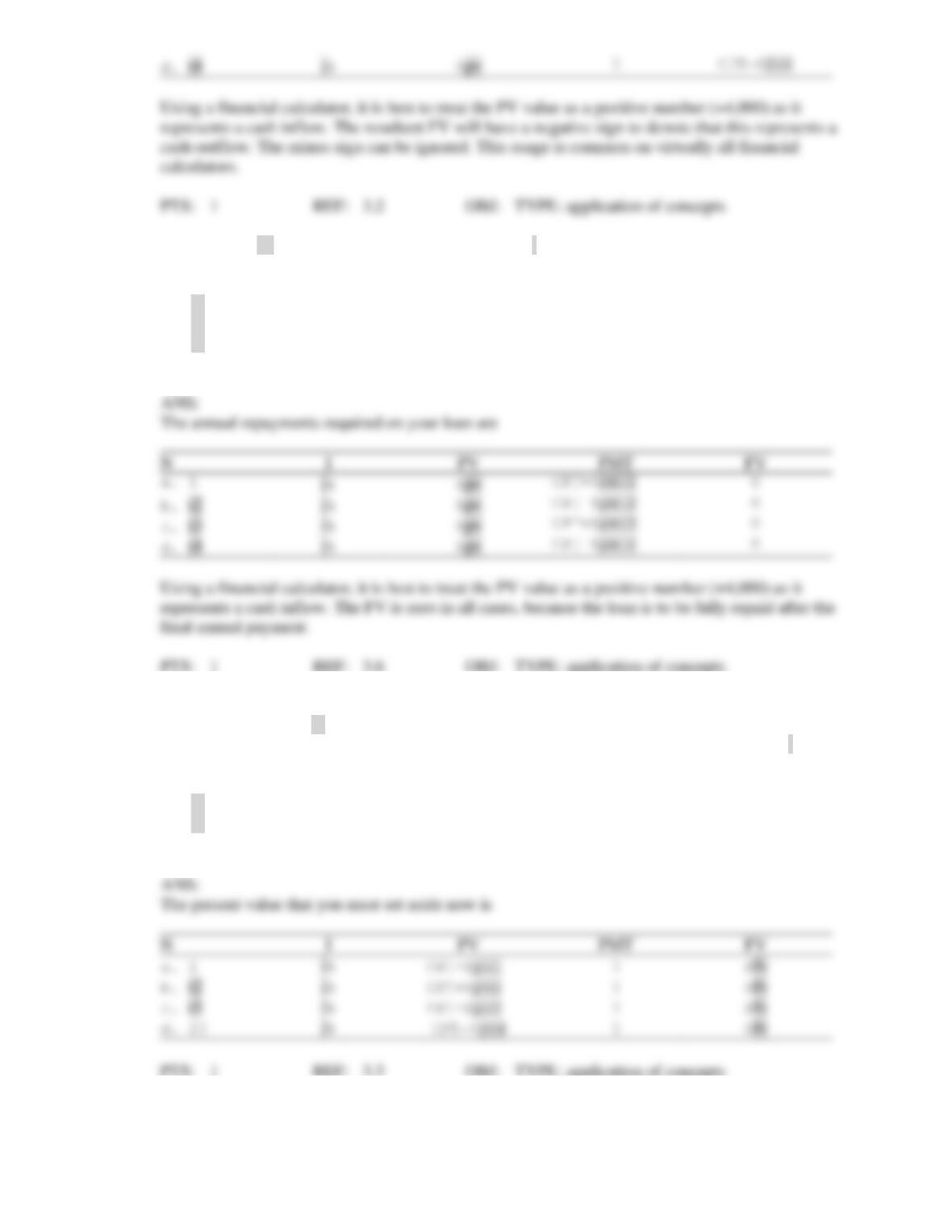
1. You agreed to pay your parents back for the $pv loan they extended you for your college education.
You and your parents agree that a fair effective annual rate of interest is i percent. If you will repay the
loan in a single lump sum, how much do you need to repay at the end of
a.
1 year
b.
t2 years
c.
t3 years
d.
t4 years
N
2. You borrow $pv at an effective annual interest rate of i percent and are required to repay the loan in
equal annual installments over the next
a.
1 year
b.
t2 years
c.
t3 years
d.
t4 years
What are the annual payments required under each of these different assumptions?
N
3. You expect your child to enroll in college and you would like to help subsidize the effort. You have
promised your child $fv upon their acceptance to a college of their choice. How much money must
you set aside now to fund your child’s cost of education, if your investment rate of return is i percent
and your child will enter college in
a.
1 year
b.
t2 years
c.
t3 years
d.
20 years
N