Test Bank Chapter 3
Chapter 3—Demand Analysis
MULTIPLE CHOICE
1. Suppose we estimate that the demand elasticity for fine leather jackets is -.7 at their current prices. Then
we know that:
a. a 1% increase in price reduces quantity sold by .7%.
b. no one wants to buy leather jackets.
c. demand for leather jackets is elastic.
d. a cut in the prices will increase total revenue.
e. leather jackets are luxury items.
2. If demand were inelastic, then we should immediately:
a. cut the price.
b. keep the price where it is.
c. go to the Nobel Prize Committee to show we were the first to find an upward sloping demand curve.
d. stop selling it since it is inelastic.
e. raise the price.
3. In this problem, demonstrate your knowledge of percentage rates of change of an entire demand
function (HINT: %Q = EP•%P + EY•%Y). You have found that the price elasticity of motor con-
trol devices at Allen-Bradley Corporation is -2, and that the income elasticity is a +1.5. You have been
asked to predict sales of these devices for one year into the future. Economists from the Conference
Board predict that income will be rising 3% over the next year, and AB’s management is planning to
raise prices 2%. You expect that the number of AB motor control devices sold in one year will:
a. fall .5%.
b. not change.
c. rise 1%r.
d. rise 2%.
e. rise .5%.
4 A linear demand for lake front cabins on a nearby lake is estimated to be: QD = 900,000 – 2P. What is
the point price elasticity for lake front cabins at a price of P = $300,000? [HINT: Ep = (Q/P)(P/Q)]
a. EP = -3.0
b. EP = -2.0
c. EP = -1.0
d. EP = -0.5
e. EP = 0
5. Property taxes are the product of the tax rate (T) and the assessed value (V). The total property tax
collected in your city (P) is: P = T•V. If the value of properties rise 4% and if Mayor and City Council
reduces the property the tax rate by 2%, what happens to the total amount of property tax collected?
[HINT: the percentage rate of change of a product is approximately the sum of the percentage rates of
change.}
a. It rises 6 %.
b. It rises 4 %.
c. It rises 3 %.
d. It rises 2 %
e. If falls 2%.
6. Demand is given by QD = 620 – 10·P and supply is given by QS = 100 + 3·P. What is the price and
quantity when the market is in equilibrium?
a. The price will be $30 and the quantity will be 132 units.
b. The price will be $11 and the quantity will be 122 units.
c. The price will be $40 and the quantity will be 220 units.
d. The price will be $35 and the quantity will be 137 units
e. The price will be $10 and the quantity will be 420 units.
7. Which of the following would tend to make demand INELASTIC?
a. the amount of time analyzed is quite long
b. there are lots of substitutes available
c. the product is highly durable
d. the proportion of the budget spent on the item is very small
e. no one really wants the product at all
8. Which of the following best represents management’s objective(s) in utilizing demand analysis?
a.
it provides insights necessary for the effective manipulation of demand
b.
it helps to measure the efficiency of the use of company resources
c.
it aids in the forecasting of sales and revenues
d.
a and b
e.
a and c
9. Identify the reasons why the quantity demanded of a product increases as the price of that product
decreases.
a.
as the price declines, the real income of the consumer increases
b.
as the price of product A declines, it makes it more attractive than product B
c.
as the price declines, the consumer will always demand more on each successive price
reduction
d.
a and b
e.
a and c
10. An increase in the quantity demanded could be caused by:
a.
an increase in the price of substitute goods
b.
a decrease in the price of complementary goods
c.
an increase in consumer income levels
d.
all of the above
e.
none of the above
11. Iron ore is an example of a:
a.
durable good
b.
producers’ good
c.
nondurable good
d.
consumer good
e.
none of the above
12. If the cross price elasticity measured between items A and B is positive, the two products are referred
to as:
a.
complements
b.
substitutes
c.
inelastic as compared to each other
d.
both b and c
e.
a, b, and c
13. When demand is ____ a percentage change in ____ is exactly offset by the same percentage change in
____ demanded, the net result being a constant total consumer expenditure.
a.
elastic; price; quantity
b.
unit elastic; price; quantity
c.
inelastic; quantity; price
d.
inelastic; price; quantity
e.
none of the above
14. Marginal revenue (MR) is ____ when total revenue is maximized.
a.
greater than one
b.
equal to one
c.
less than zero
d.
equal to zero
e.
equal to minus one
15. The factor(s) which cause(s) a movement along the demand curve include(s):
a.
increase in level of advertising
b.
decrease in price of complementary goods
c.
increase in consumer disposable income
d.
decrease in price of the good demanded
e.
all of the above
16. An increase in each of the following factors would normally provide a subsequent increase in quantity
demanded, except:
a.
price of substitute goods
b.
level of competitor advertising
c.
consumer income level
d.
consumer desires for goods and services
e.
a and b
17. Producers’ goods are:
a.
consumers’ goods
b.
raw materials combined to produce consumer goods
c.
durable goods used by consumers
d.
always more expensive when used by corporations
e.
none of the above
18. The demand for durable goods tends to be more price elastic than the demand for non-durables.
a.
true
b.
false
19. A price elasticity (ED) of −1.50 indicates that for a ____ increase in price, quantity demanded will
____ by ____.
a.
one percent; increase; 1.50 units
b.
one unit; increase; 1.50 units
c.
one percent; decrease; 1.50 percent
d.
one unit; decrease; 1.50 percent
e.
ten percent; increase; fifteen percent

20. Those goods having a calculated income elasticity that is negative are called:
a.
producers’ goods
b.
durable goods
c.
inferior goods
d.
nondurable goods
e.
none of the above
21. An income elasticity (Ey) of 2.0 indicates that for a ____ increase in income, ____ will increase by
____.
a.
one percent; quantity supplied; two units
b.
one unit; quantity supplied; two units
c.
one percent; quantity demanded; two percent
d.
one unit; quantity demanded; two units
e.
ten percent; quantity supplied; two percent
22. When demand elasticity is ____ in absolute value (or ____), an increase in price will result in a(n)
____ in total revenues.
a.
less than 1; elastic; increase
b.
more than 1; inelastic; decrease
c.
less than 1; elastic; decrease
d.
less than 1; inelastic; increase
e.
none of the above
23. Empirical estimates of the price elasticity of demand [in Table 3.4] suggest that the demand for
household consumption of alcoholic beverages is:
a.
highly price elastic
b.
price inelastic
c.
unitarily elastic
d.
an inferior good
e.
none of the above
24. Auto dealers slash prices at the end of the model year in response to deficient demand/excess
inventory but restaurants facing the same problem slash production because
a. auto customers are less price sensitive than restaurant customers
b. price elasticity of demand (in absolute values) is higher for auto than restaurant customers
c. price elasticity of supply is lower in auto than in restaurants
d. restaurant food spoils quickly and is much more perishable
e. price elasticity of supply in autos is smaller than the absolute value of price elasticity of demand but
the reverse is true for restaurants
25. Songwriters and composers press music companies to lower the price for music downloads because
a. demand for on-line music is inelastic
b. profits are maximized where price elasticity of demand is -1.0
Test Bank Chapter 3
c. songwriter royalties are a percentage of sales revenue
d. profits and total revenue are maximized at different quantities
e. profits are maximized at the same prices as sales revenue
PROBLEM
1. The manager of the Sell-Rite drug store accidentally mismarked a shipment of 20-pound bags of
charcoal at $4.38 instead of the regular price of $5.18. At the end of a week, the store’s inventory of
200 bags of charcoal was completely sold out. The store normally sells an average of 150 bags per
week.
(a)
What is the store’s arc elasticity of demand for charcoal?
(b)
Give an economic interpretation of the numerical value obtained in part (a)
(b)
A 1 percent increase in price will result in a 1.71 percent decrease in demand for
charcoal.
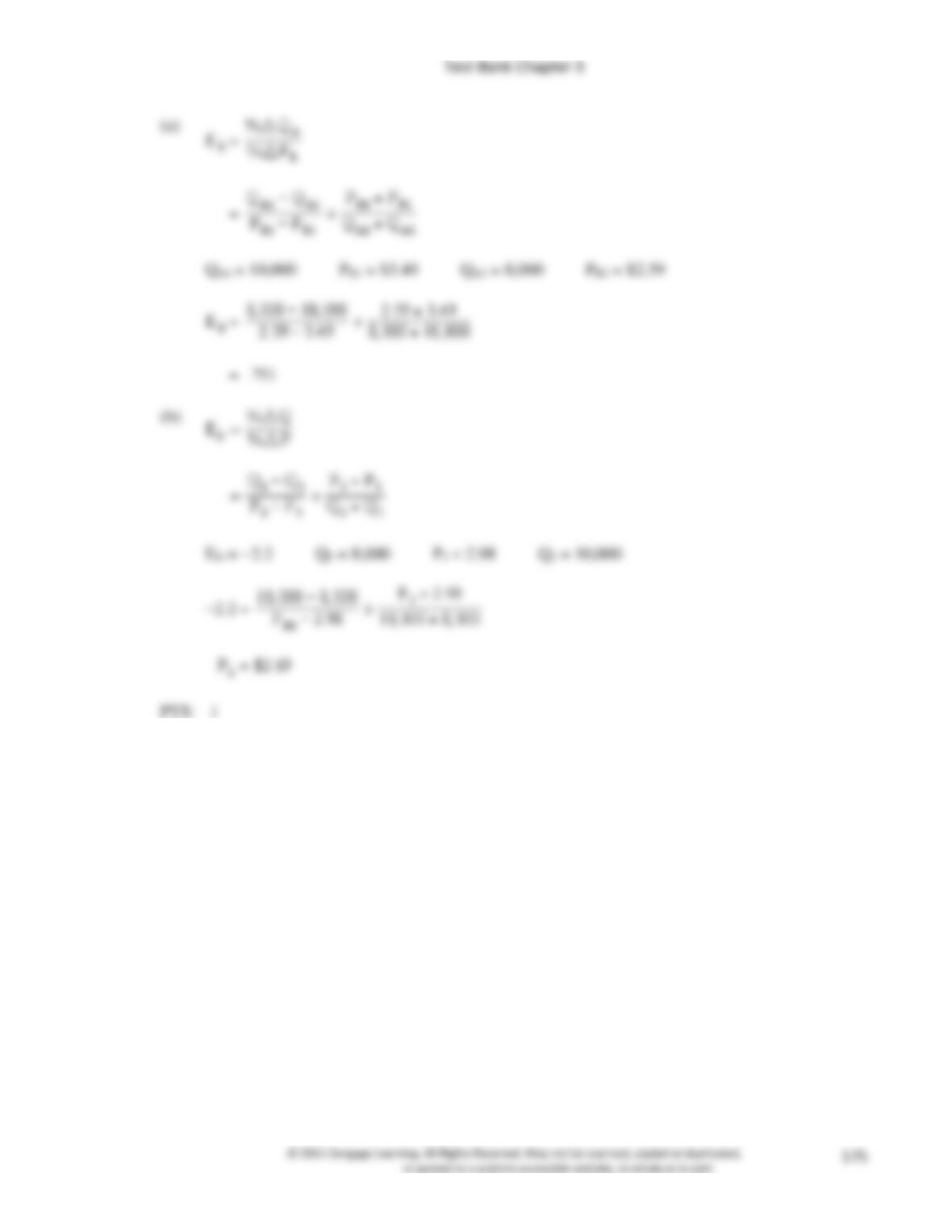
2. The Future Flight Corporation manufactures a variety of Frisbees selling for $2.98 each. Sales have
averaged 10,000 units per month during the last year. Recently Future Flight’s closest competitor,
Soaring Free Company, cut its prices on similar Frisbees from $3.49 to $2.59. Future Flight noticed
that its sales declined to 8,000 units per month after the price cut.
(a)
What is the arc cross elasticity of demand between Future Flight’s and Soaring Free’s
Frisbees?
(b)
If Future Flight knows the arc price elasticity of demand for its Frisbees is −2.2, what
price would they have to charge in order to obtain the same level of sales as before
Soaring Free’s price cut?
ANS:
3. The British Automobile Company is introducing a brand new model called the “London Special.”
Using the latest forecasting techniques, BAC economists have developed the following demand
function for the “London Special“:
QD = 1,200,000 − 40P
What is the point price elasticity of demand at prices of (a) $8,000 and (b) $10,000?
ANS:
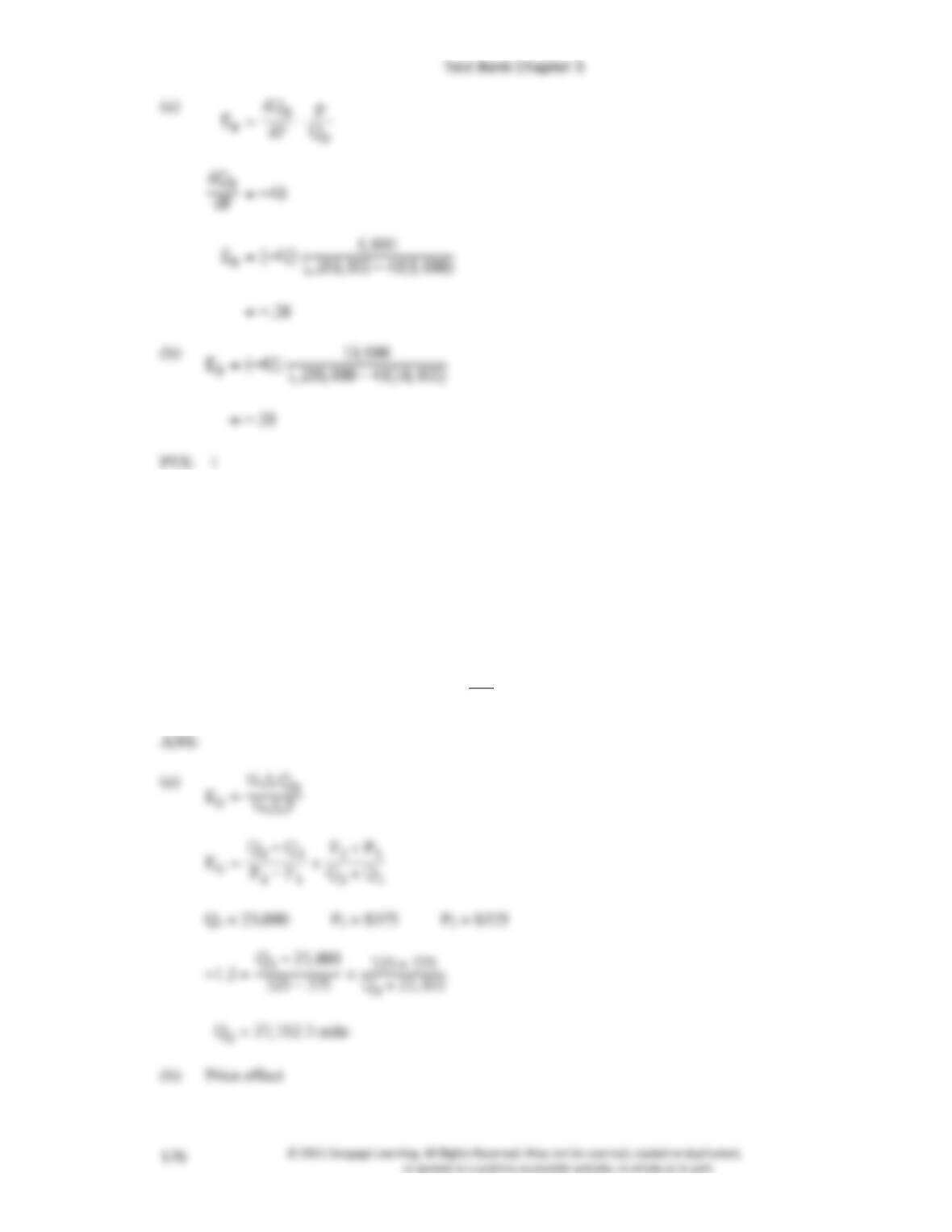
4. Hanna Corporation markets a compact microwave oven. In 2010 they sold 23,000 units at $375 each.
Per capita disposable income in 2010 was $6,750. Hanna economists have determined that the arc
price elasticity for this microwave oven is −1.2.
(a)
In 2011 Hanna is planning to lower the price of the microwave oven to $325. Forecast
sales volume for 2011 assuming that all other things remain equal.
(b)
However, in checking with government economists, Hanna finds that per capita
disposable income is expected to rise to $7,000 in 2011. In the past the company has
observed an arc income elasticity of +2.5 for microwave ovens. Forecast 2011 sales
given that the price is reduces to $325 and that per capita disposable income increases to
$7,000. Assume that the price and income effects are independent and additive.
(b)
Price effect