Chapter 3 – Cost Behavior
A.
Using the high-low method compute the variable rate for the electricity cost.
B.
Using the high-low method compute the fixed cost of electricity.
C.
Estimate the total electricity cost to be incurred in December if 5,300 machine hours are
incurred.
A.
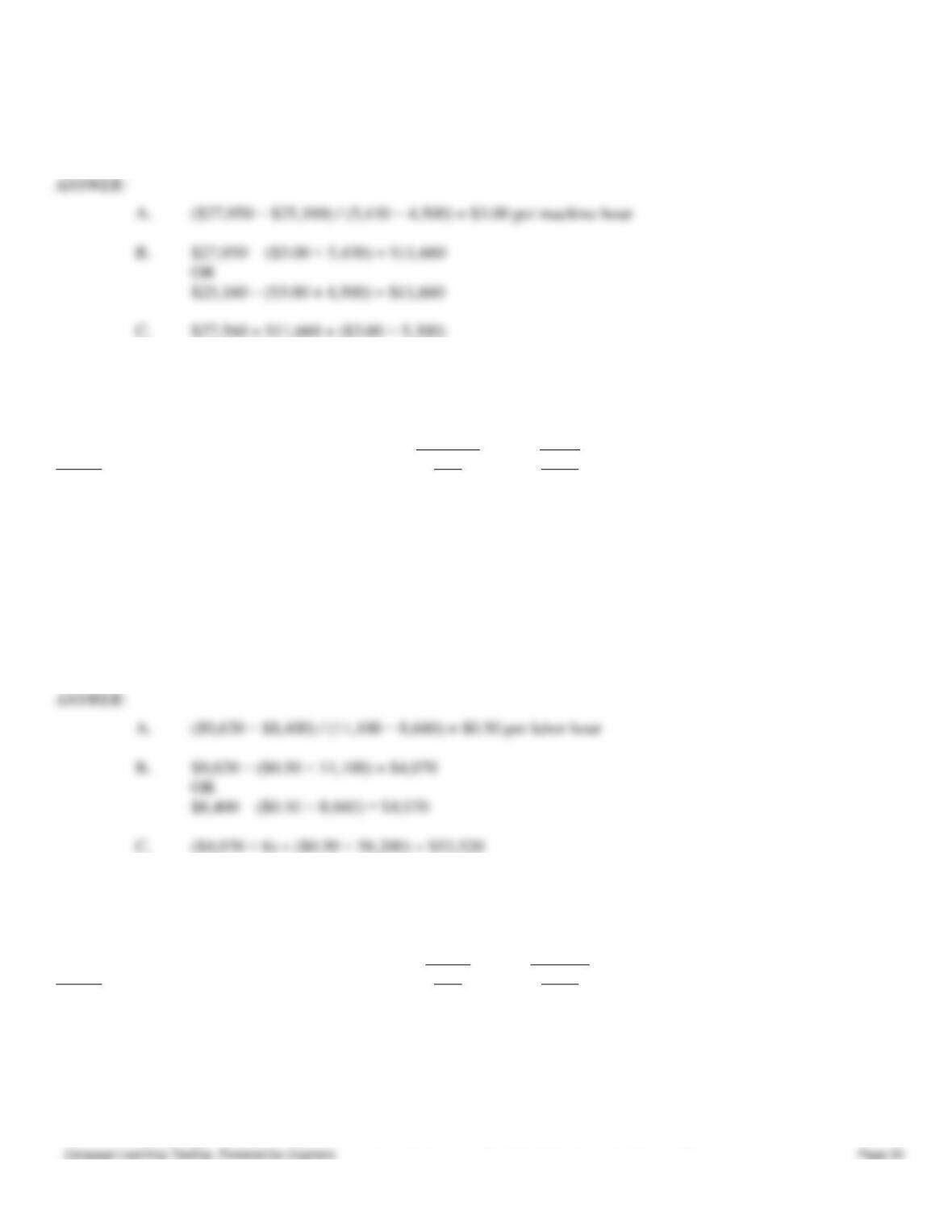
($27,950 − $25,160) / (5,430 − 4,500) = $3.00 per machine hour
B.
$27,950 − ($3.00 × 5,430) = $11,660
OR
$25,160 – ($3.00 × 4,500) = $11,660
C.
$27,560 = $11,660 + ($3.00 × 5,300)
161. Margolo Company makes cross-country skis. The company controller wants to calculate the fixed and variable costs
associated with janitorial services incurred by the factory. Data for the past six months were collected.
Janitorial
Labor
Month
cost
hours
January
$9,200
10,120
February
8,800
9,500
March
9,350
10,500
April
9,620
11,100
May
8,400
8,660
June
9,400
10,650
Required:
A.
Using the high-low method compute the variable rate of the janitorial cost.
B.
Using the high-low method compute the fixed cost of janitorial services.
C.
Compute the estimated janitorial cost to be incurred during the next six months assuming
that 58,200 labor hours will be worked.
A.
($9,620 − $8,400) / (11,100 − 8,660) = $0.50 per labor hour
B.
$9,620 − ($0.50 × 11,100) = $4,070
OR
$8,400 − ($0.50 × 8,660) = $4,070
C.
($4,070 × 6) + ($0.50 × 58,200) = $53,520
162. Blacken Company manufactures motorcycles. The company’s management accountant wants to calculate the fixed
and variable costs associated with utility cost incurred by the factory. Data for the past six months were collected.
Utility
Machine
Month
cost
hours
March
$30,255
2,200
April
32,750
2,525
May
34,712
2,710
June
31,850
2,410
July
30,720
2,290
August
29,980
2,150
Required:
A.
Using the high-low method calculate the variable rate per machine hour for the utility
Chapter 3 – Cost Behavior
cost.
B.
Using the high-low method calculate the fixed cost of utilities.
C.
Construct a cost formula for total utility cost.
D.
Estimate the cost of utilities if 2,425 machine hours are used.
A.
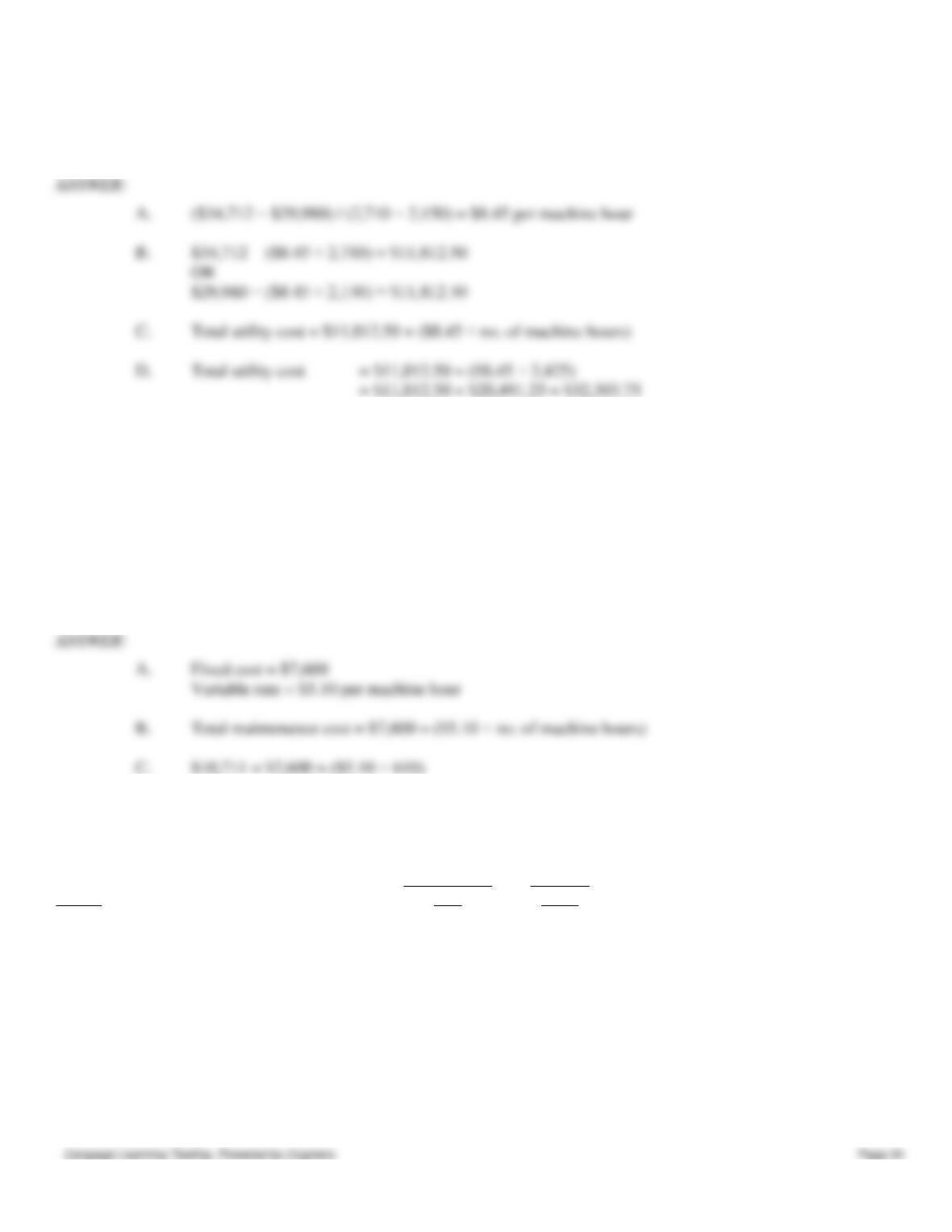
($34,712 − $29,980) / (2,710 − 2,150) = $8.45 per machine hour
B.
$34,712 − ($8.45 × 2,710) = $11,812.50
OR
$29,980 − ($8.45 × 2,150) = $11,812.50
C.
Total utility cost = $11,812.50 + ($8.45 × no. of machine hours)
D.
Total utility cost
= $11,812.50 + ($8.45 × 2,425)
= $11,812.50 + $20,491.25 = $32,303.75
163. Coefficients shown by a regression program are:
Intercept
7,600
X Variable 1
5.10
Required:
A.
Using the results of regression calculate the fixed cost of maintenance and the variable
rate per machine hour.
B.
Using the results of regression, construct the cost formula for the total maintenance cost.
C.
Calculate the budgeted cost for maintenance assuming that 610 hours are worked next
month.
A.
Fixed cost = $7,600
Variable rate = $5.10 per machine hour
B.
Total maintenance cost = $7,600 + ($5.10 × no. of machine hours)
C.
$10,711 = $7,600 + ($5.10 × 610)
164. Andover Company makes weather balloons. The company controller wanted to calculate the fixed and variable costs
associated with the maintenance costs incurred by the factory. Data for the past six months were collected.
Maintenance
Machine
Month
cost
hours
January
$10,120
526
February
9,560
389
March
9,712
412
April
10,460
569
May
10,226
541
June
9,686
399
Required:
A.
Using the high-low method, calculate the fixed cost of maintenance and the variable rate
per machine hour.
B.
Using the high-low method, construct the cost formula for the total maintenance cost.
C.
Calculate the budgeted cost for maintenance assuming that 485 hours are worked next
month.
Chapter 3 – Cost Behavior
A.
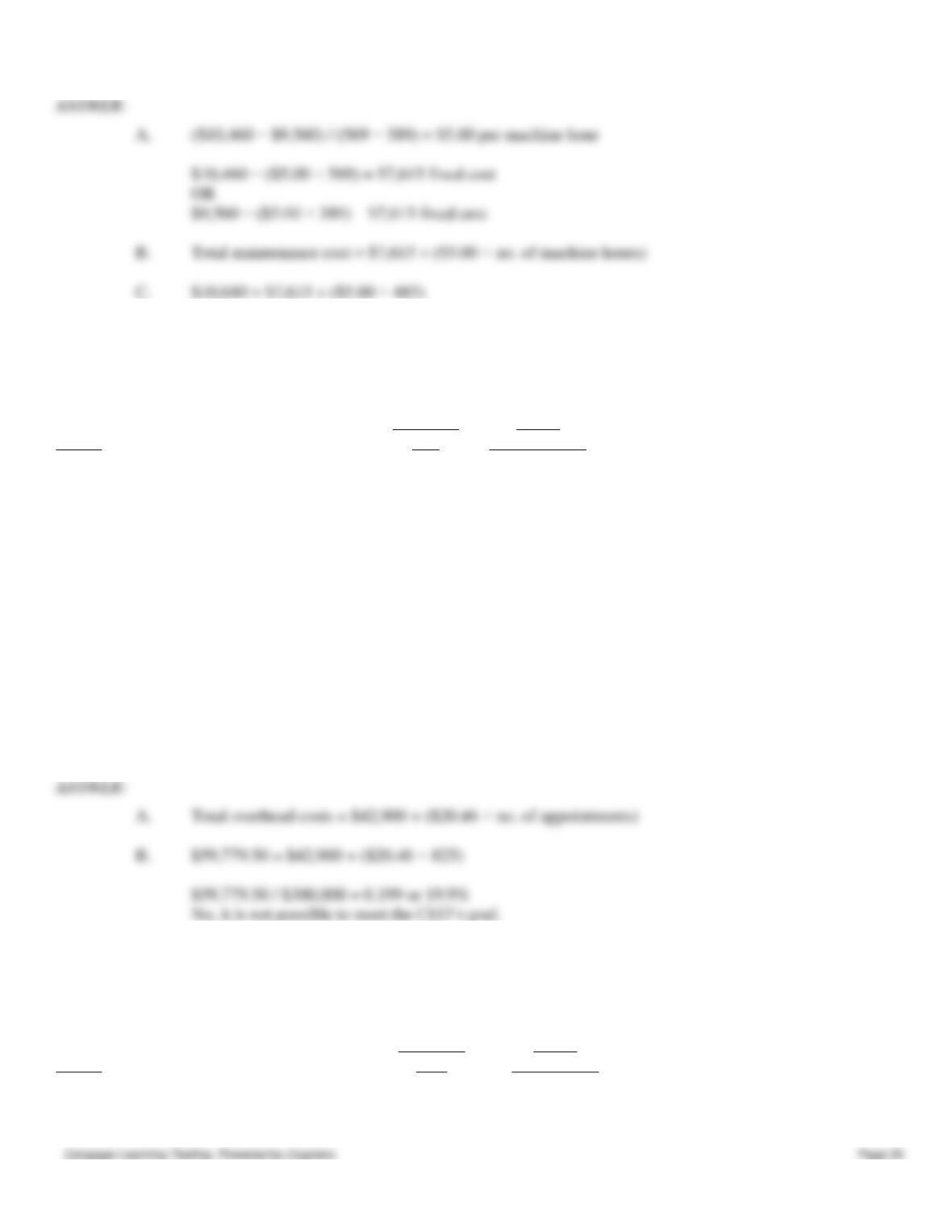
($10,460 − $9,560) / (569 − 389) = $5.00 per machine hour
$10,460 − ($5.00 × 569) = $7,615 fixed cost
OR
$9,560 − ($5.00 × 389) = $7,615 fixed cost
Total maintenance cost = $7,615 + ($5.00 × no. of machine hours)
$10,040 = $7,615 + ($5.00 × 485)
165. Hipcuts Company operates a chain of trendy beauty salons. The company’s chief executive officer is interested in
accumulating some information on the overhead costs incurred by the company. You have been asked to analyze the
following six months’ worth of data.
Overhead
No. of
Month
cost
Appointments
April
$60,160
867
May
56,500
624
June
58,900
689
July
63,500
974
August
59,325
730
September
62,400
901
A regression analysis produced the following coefficients.
Intercept
42,900
X Variable 1
20.46
Required:
A.
Using the results of regression, construct a cost formula for the total overhead cost.
B.
The CEO would like to limit total overhead cost in future months to 16% of total
revenues. Will that be possible if total revenues are expected to average $300,000 per
month and total appointments per month are expected to average 825? Show all of your
calculations.
A.
Total overhead costs = $42,900 + ($20.46 × no. of appointments)
$59,779.50 = $42,900 + ($20.46 × 825)
$59,779.50 / $300,000 = 0.199 or 19.9%
No, it is not possible to meet the CEO’s goal.
166. Grindgood Company operates a chain of cozy coffee shops. The company’s chief executive officer is interested in
accumulating some information on the overhead costs incurred by the company. You have been asked to analyze the
following six months worth of data.
Overhead
No. of
Month
Cost
Labor Hours
April
$60,160
867
May
56,500
624
June
58,900
689
Chapter 3 – Cost Behavior
July
63,500
974
August
59,325
730
September
62,400
901
Required:
A.
Using the high-low method, construct a cost formula for the total overhead cost.
B.
The CEO would like to limit total overhead cost in future months to 20% of total
revenues. Will that be possible if total revenues are expected to average $300,000 per
month and total labor hours per month are expected to average 780? Show all of your
calculations.
C.
Compute the total cost of overhead assuming 925 labor hours are incurred in a given
month.
A.
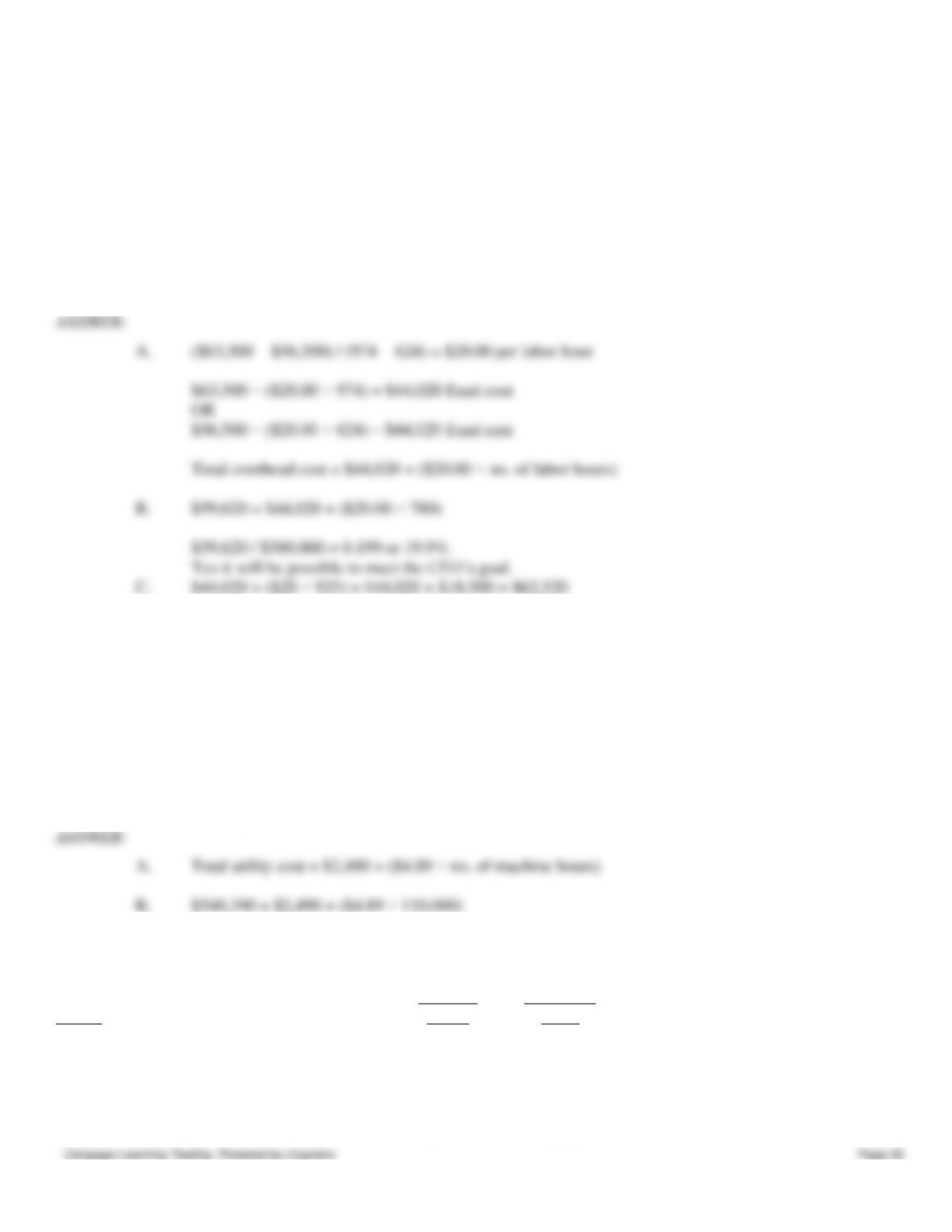
($63,500 − $56,500) / (974 − 624) = $20.00 per labor hour
$63,500 − ($20.00 × 974) = $44,020 fixed cost
OR
$56,500 − ($20.00 × 624) = $44,020 fixed cost
Total overhead cost = $44,020 + ($20.00 × no. of labor hours)
$59,620 = $44,020 + ($20.00 × 780)
$59,620 / $300,000 = 0.199 or 19.9%.
Yes it will be possible to meet the CEO’s goal.
$44,020 + ($20 × 925) = $44,020 + $18,500 = $62,520
167. The cost accountant for Bolagio Company used an Excel spreadsheet program to run ordinary least squares on a set
of cost data for its utility cost. Bolagio‘s cost driver for utility cost is machine hours. The following results were produced.
Intercept
2,490
X Variable
4.89
Required:
A.
Construct the cost formula for Bolagio’s utility cost using the results from the method of
least squares.
B.
Using the formula computed in (A), what is the estimated cost of utilities for May
assuming that Bolagio will incur 110,000 machine hours?
A.
Total utility cost = $2,490 + ($4.89 × no. of machine hours)
$540,390 = $2,490 + ($4.89 × 110,000)
168. Machine hours and electricity costs for Wells Industries for last year were as follows:
Machine
Electricity
Month
Hours
Costs
January
2,000
$ 9,200
February
2,320
10,500
March
1,520
6,750
April
2,480
11,500
May
3,040
14,125
June
2,640
11,000
Chapter 3 – Cost Behavior
July
3,280
12,375
August
2,800
11,375
September
1,600
7,750
October
2,960
13,000
November
3,760
15,500
December
3,360
13,875
Required:
A.
Using the high-low method, develop an estimate of variable electricity costs per machine
hour.
B.
Using the high-low method, develop an estimate of fixed electricity costs per month.
C.
Using the high-low method, develop a cost function for monthly electricity costs.
D.
Estimate electricity costs for a month in which 3,000 machine hours are worked.
A.
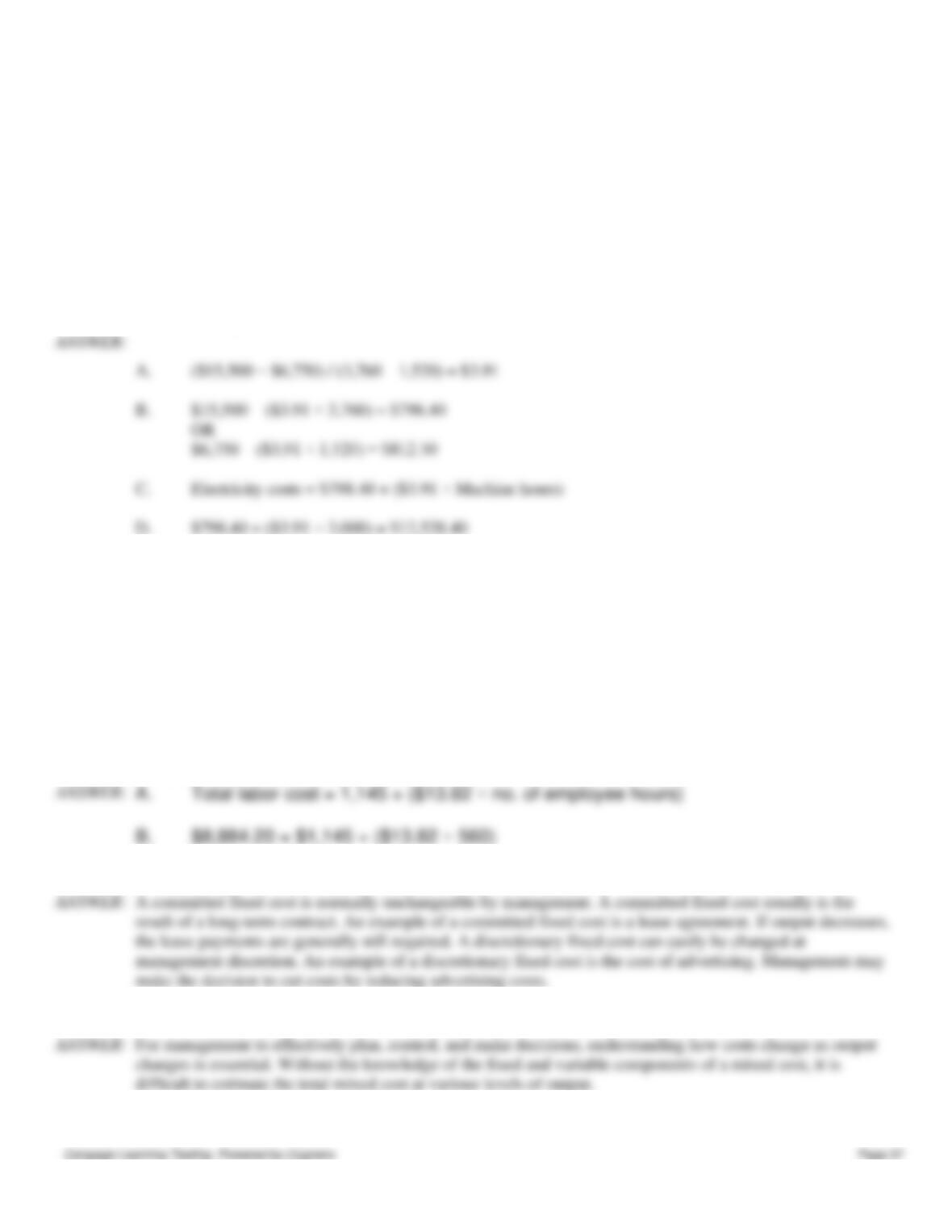
($15,500 − $6,750) / (3,760 – 1,520) = $3.91
B.
$15,500 − ($3.91 × 3,760) = $798.40
OR
$6,750 − ($3,91 × 1,520) = $812.50
C.
Electricity costs = $798.40 + ($3.91 × Machine hours)
D.
$798.40 + ($3.91 × 3,000) = $12,528.40
169. Tamo Company used an Excel spreadsheet program to run ordinary least squares on a set of cost data for its utility
cost. The cost driver for labor cost is employee hours. The following results were produced.
Intercept
1,145
X Variable
13.82
Required:
A.
Construct the cost formula for Tamo’s labor cost using the results from the method of
least squares.
B.
Using the formula computed in (A), what is the estimated cost of utilities for October
assuming that Tamo will incur 560 employee hours?
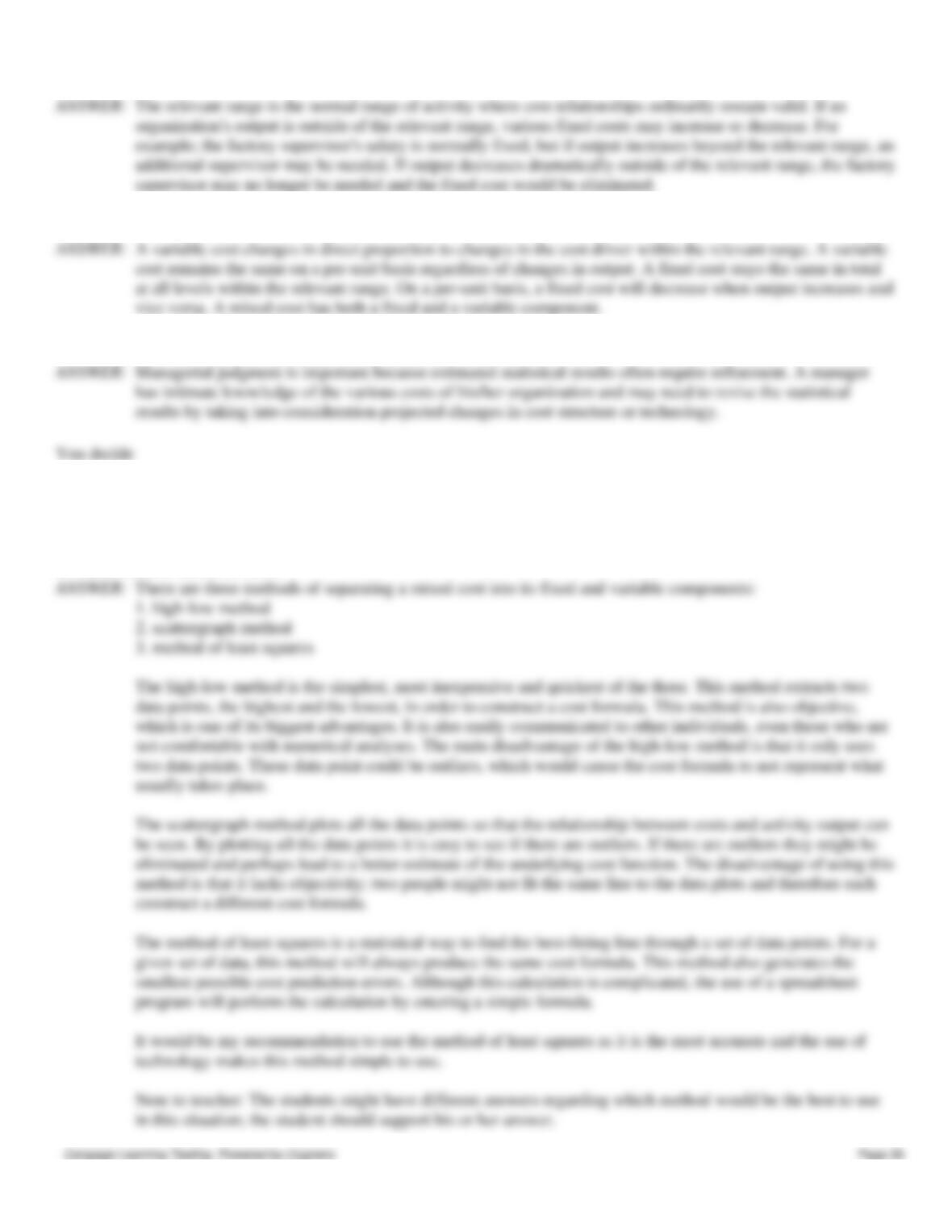
170. Explain the difference between a committed and a discretionary fixed cost.
management discretion. An example of a discretionary fixed cost is the cost of advertising. Management may
171. Why is it necessary to separate a mixed cost into its variable and fixed components?
difficult to estimate the total mixed cost at various levels of output.
172. Why would cost behavior change outside of the relevant range?
Chapter 3 – Cost Behavior
173. Explain the differences between a variable, fixed, and a mixed cost.
174. Why is managerial judgment essential to predicting cost behavior?
175. The controller of Lamps Limited is concerned about the how much the company’s costs have risen over the past few
months. Since the majority of the company’s costs are mixed, it is hard to tell if the increasing costs are due to variable
costs or fixed costs. The controller asks that you research the different ways to separate mixed costs and then to present a
report showing the advantages and disadvantages of each method. He would also like you to make a recommendation as
to which method should be used.
Chapter 3 – Cost Behavior
Select the appropriate cost behavior for each of the costs listed below.
a.
variable
b.
fixed
176. factory supervisor’s salary
177. factory supplies
a
178. direct labor
a
179. factory insurance
180. controller’s salary
181. depreciation
182. direct materials
a
183. indirect materials
a
Select the appropriate type of fixed cost for each cost listed below.
a.
discretionary
b.
committed
184. property taxes
185. advertising
a
186. cost of leasing
187. travel costs
a
188. cost of executive training seminars
a
189. depreciation
Chapter 3 – Cost Behavior
190. rent of building
191. salary of receptionist
Select the appropriate item for each of the definitions listed below.
a.
relevant range
b.
cost behavior
c.
driver
d.
variable cost
e.
fixed cost
192. a factor that causes a change in cost or activity
c
193. may be discretionary or committed
e
194. total cost depends on the level of output
195. a description of how a cost changes when the level of output changes
196. the range of output over which the assumed cost relationship is valid
a
Select the appropriate cost behavior for the following costs incurred by an automobile manufacturer.
a.
variable
b.
fixed
197. cost of windshields
a
198. cost of assembly line workers
a
199. depreciation on robotic equipment
200. cost of car stereos
a
201. cost of transporting cars to dealerships
a
202. cost of inspections
Chapter 3 – Cost Behavior
a
203. factory supervisor’s salary
204. cost of rework
a
Select the appropriate cost behavior for each of the costs listed below.
a.
variable
b.
fixed
205. cost of lubricating machinery
a
206. sales commissions
a
207. salary of chief executive officer
208. real estate taxes
209. license fees on automobiles
210. factory supplies
a
211. rental cost of warehouse
212. raw materials
a
Select the appropriate type of cost for each of the definitions below.
a.
variable
b.
fixed
c.
mixed
d.
step
213. remains the same in total within the relevant range
214. will increase in total in direct proportion to an increase in the cost driver
a
215. has an increased fixed component at specific intervals
Chapter 3 – Cost Behavior
216. has both a variable and a fixed component
c
Select the appropriate item for each of the definitions listed below.
a.
committed fixed cost
b.
discretionary fixed cost
c.
mixed cost
d.
step cost
217. the y-intercept corresponds to the fixed cost
c
218. must be purchased in chunks
219. can be changed by management
220. may involve a long-term contract
a
Select the appropriate type of cost for each of the definitions listed below.
a.
variable
b.
fixed
c.
mixed
d.
step
221. total cost = total fixed cost + total variable cost
c
222. remains constant on a per-unit basis within the relevant range
a
223. will decrease on a per-unit basis as output increases
224. has a discontinuous cost function
Select the appropriate item for each of the definitions listed below.
a.
dependent variable
b.
independent variable
c.
intercept
d.
slope
225. it corresponds to the variable rate
Chapter 3 – Cost Behavior
d
226. it corresponds to the fixed cost
c
227. it measures output and explains changes in cost
b
228. its value depends on the value of another variable
a
Select the appropriate item for each of the definitions listed below.
a.
high-low method
b.
scatter-graph method
c.
method of least squares
229. results in the best-fitting line through a set of data points
c
230. may reveal the presence of outliers
b
231. involves plotting data points on a graph
b
232. allows a cost analyst to inspect the data visually
b
233. relies on the quality of the subjective judgment of the analyst
b
234. is a statistical method
c
Select the best description for the following:
SUMMARY OUTPUT
Regression Statistics
Multiple R
1
R Square
0.99
Adjusted R Square
0.99
Standard Error
195.35
Observations
5
ANOVA
df
SS
MS
F
Significance F
Regression
1
12492415.96
12492415.96
327.37
0
Residual
3
114479.24
38159.75
Total
4
12606895.2
Chapter 3 – Cost Behavior
Standard
Lower
Upper
Lower
Upper
Coefficients
Error
t Stat
P-value
95%
95%
95%
95.%
Intercept
10630.8
1187.44
8.95
0
6851.83
14409.76
6851.83
14409.76
X Variable 1
8.83
0.49
18.09
0
7.28
10.38
7.28
10.38
a.
variable rate
b.
fixed cost
c.
variable cost
d.
cost equation
e.
coefficient of determination
235. $8.83 × independent variable
c
236. $10,630.80
b
237. 8.83
a
238. 99%
e
239. cost = intercept + X variable 1 × driver
d