
TOP: 3-5 HOW DO SCIENTISTS STUDY ECOSYSTEMS?
BLOOM’S TAXONOMY: COMPREHENSION
In the Sonoran desert of the southwestern United States, scientists observed that population clusters of
a small cactus were very pronounced around nests of desert woodrats. They began to think the
woodrat was somehow connected to the seeding of these cactus plants.
After years of counting and observing the woodrat nests and cactus plants, they collected the
droppings of the woodrats and took them back to the lab to analyze them to see if they contained seeds
of the cactus. They also collected the droppings and transported them to other areas to see if this
would bring about new population clusters of the cactus.
They also programmed the data they had collected into a computer. The computer program allowed
the scientists to predict that increases in the woodrat population would result in increases in the cactus
population, and likewise a decrease in woodrats would signal an impending decrease in cactus.
76. Which phase of the above-described situation could be called computer simulation?
a.
when the scientists gathered woodrat dropping for lab analysis
b.
when the scientists learned from the computer that woodrat nest numbers would impact
cactus populations
c.
when the scientists first observed the proximity of woodrat nests and cactus plants
d.
all of these answers
e.
none of these answers
77. The study described above is best categorized as
a.
field research
b.
laboratory research
c.
computer modeling
d.
a combination of all three types of research
e.
a combination of laboratory and field research, but no computer modeling
78. Which of the following best describes the scientists’ initial observations?
a.
Woodrat nests had no apparent effect on cactus populations.
b.
Cactus plants were less common close to woodrat nests.
c.
Cactus plants were more common close to woodrat nests.
d.
Cactus plants and woodrat nests were mutually exclusive.
e.
The effect of woodrats on cactus plants was different from season to season.

TRUE/FALSE
1. Ecology is the study of connections in the natural world.
2. Populations make up communities.
3. Ozone gas, a chemical in the atmosphere that helps filter out harmful UV sunlight, is located in the
troposphere.
4. An ecosystem’s nutrient cycle cannot be described.
5. “Muddy boots biology” is actually a description of typical research by geologists
6. Increasing levels of carbon dioxide are one of the major contributors to global warming.
7. Within the ‘levels of organization’, the molecular level contains the smallest of all forms of matter.
8. Despite the ocean’s low NPP, it creates more of the Earth’s NPP than any of the other ecosystems.
9. Detritivores are consumers that release nutrients from the dead bodies of living organisms and return
them to the soil, water, and air.
10. A deer is both a primary consumer and in the second trophic level.

BLOOM’S TAXONOMY: COMPREHENSION
11. The mantle and core of the earth are both contained in the geosphere.
12. Plants utilize a portion of their GPP for respiration.
13. There are examples of microbial bacteria that are beneficial to humans.
14. According to the second law of thermodynamics, energy can be recycled.
15. In terms of inputs of matter, the Earth is a closed system. As a result, nutrients must be recycled to
support life.
16. Green plants undergo aerobic respiration.
17. The process by which many decomposers are able to convert glucose into useable energy in the
absence of oxygen is known as transpiration.
18. Given the nature of the carbon cycle, it is possible that a single atom of carbon that is in your skin
could have once been part of your own great grandmother, or even a dinosaur.
19. Water has the ability to filter out wavelengths of the sun’s ultraviolet radiation that would harm some
aquatic organisms.

20. Lightning is one of the natural mechanisms by which atmospheric nitrogen fixation is accomplished.
21. Ammonia (NH4+) is a form of nitrogen that is readily accessible and useable by plants.
22. Highly specialized bacteria are an essential component of the phosphorous cycle.
23. The processes that lead to geological erosion are essential to the movement of phosphorous through
the biosphere.
24. Food chains and food webs are basically the same thing.
25. A type of acid rain is produced because of sulfur dioxide in the air.
26. The burning of coal releases sulfur dioxide into the atmosphere. However, smelting is a clean process
that does not deposit sulfur dioxide.
27. Gravity is one of the three factors that sustain life on Earth.
28. The nitrogen cycle and the carbon cycle are virtually identical.
29. Water exists as a liquid over a wide range of temperatures because of the lack of attractive forces
between its molecules.

30. It can be said that trees can actually produce their own rainfall.
31. Liquid water changes temperature rapidly because it can store a large amount of heat.
COMPLETION
1. A(n) ____________________ consists of populations of different species living in a particular place
and potentially interacting with each other.
2. ____________________ feed on the wastes or dead bodies of other organisms.
3. The ____________________ involves precipitation, transpiration, evaporation, and condensation.
4. Photosynthesis requires both carbon dioxide and water, but could not occur without the input
of____________ ______________.
5. Another word for consumer is ____________________.

6. Bacteria, deer, humans, and spiders are all examples of ____________________.
7. The water cycle, hydrogen cycle, phosphorous cycle, and sulfur cycle are all ____________________.
8. CO2 promotes the ____________________ that warms the troposphere.
9. Bacteria are more important in the ____________________ than in the carbon or phosphorous cycle.
10. Chemical combinations of two or more atoms of the same or different elements make up
_____________.
11. The ____________________ occupies those parts of the atmosphere, hydrosphere, and geosphere
where life is found.

12. The process by which ____________________ obtain their energy is photosynthesis.
13. Carnivores such as tigers, hawks and killer whales that feed on the flesh of other carnivores are known
as _______________ consumers.
14. The process by which water is evaporated from the surface of plants is called
____________________.
15. The metabolic process by which plants are able to draw ____________________ out of the
atmosphere is known as photosynthesis.
16. ____________________ is the most abundant element in the Earth’s atmosphere.
17. Phytoplankton in the ocean help to regulate the earth’s temperature by removing some of the
____________ ____________produced when we burn fossil fuels..

18. Tropical rainforests typically are found near the Equator, and are considered centers of
____________________.
19. Ecologists study ____________________ in nature.
20. The planet’s NPP ultimately limits the number of _____________that can live on the earth..
21. A ____________________ is similar to a food chain, but is much more complex and shows many
interconnected feeding relationships.
22. The planet’s ____________________ ultimately limits the number of consumers that can live on the
planet.
23. The aquatic ecosystems that show the highest net primary productivity are ____________________.
65
24. Tropical rainforests cover about__________% of the earth’s surface, but contain about ________% of
the earth’s known terrestrial plant and animal species.
25. The majority of the Earth’s carbon is stored in ____________________.
26. Ammonia that is not taken up by plants may undergo ____________________.
BLOOM’S TAXONOMY: KNOWLEDGE
MATCHING
Match the items listed below with the appropriate choice
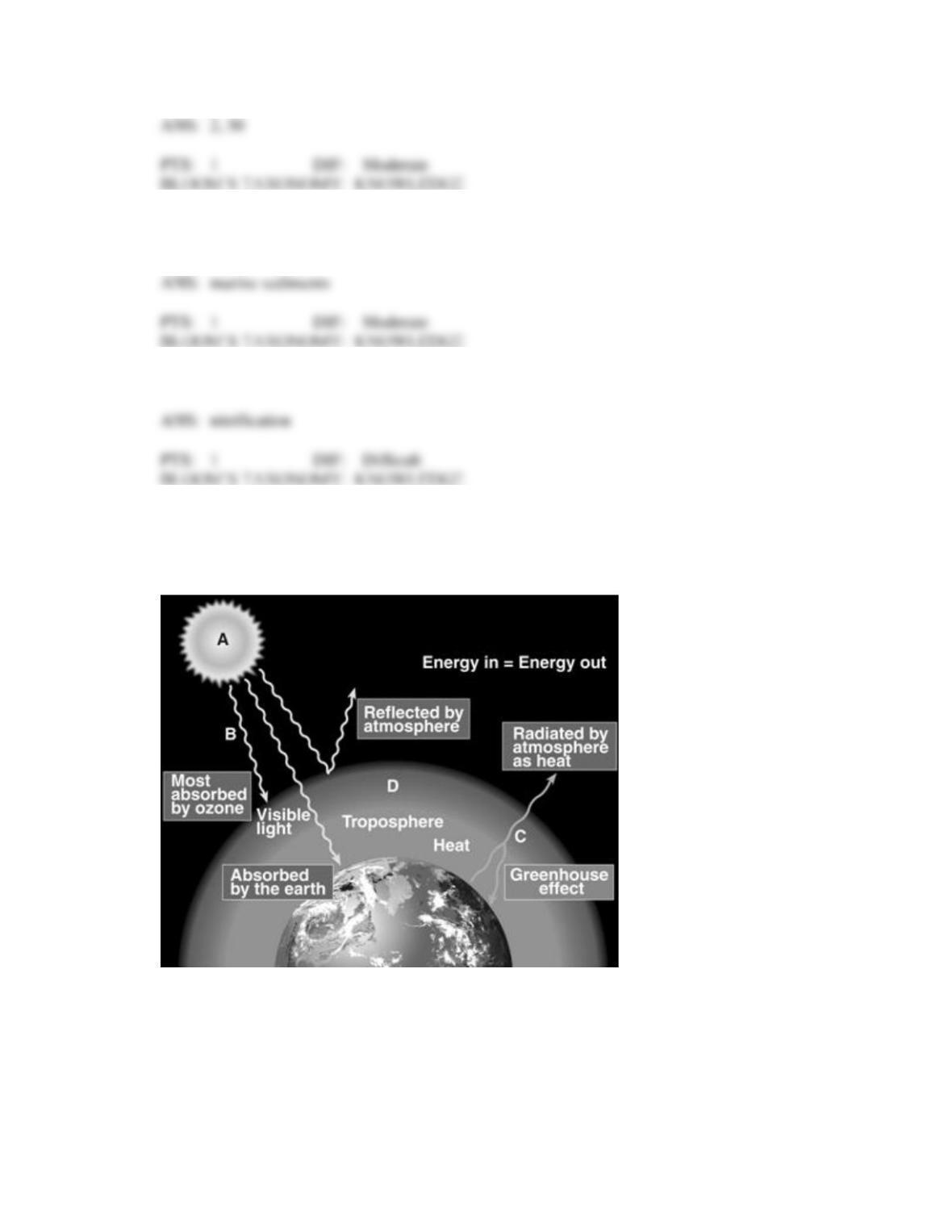
1. On the figure of the Earth, choose the letter that represents heat added to the atmosphere.
2. On the figure of the Earth, choose the letter that represents the ozone layer.
3. On the figure of the Earth, choose the letter that represents solar radiation.
4. On the figure of the Earth, choose the letter that represents UV radiation.
66
Match the items listed below with the appropriate choice
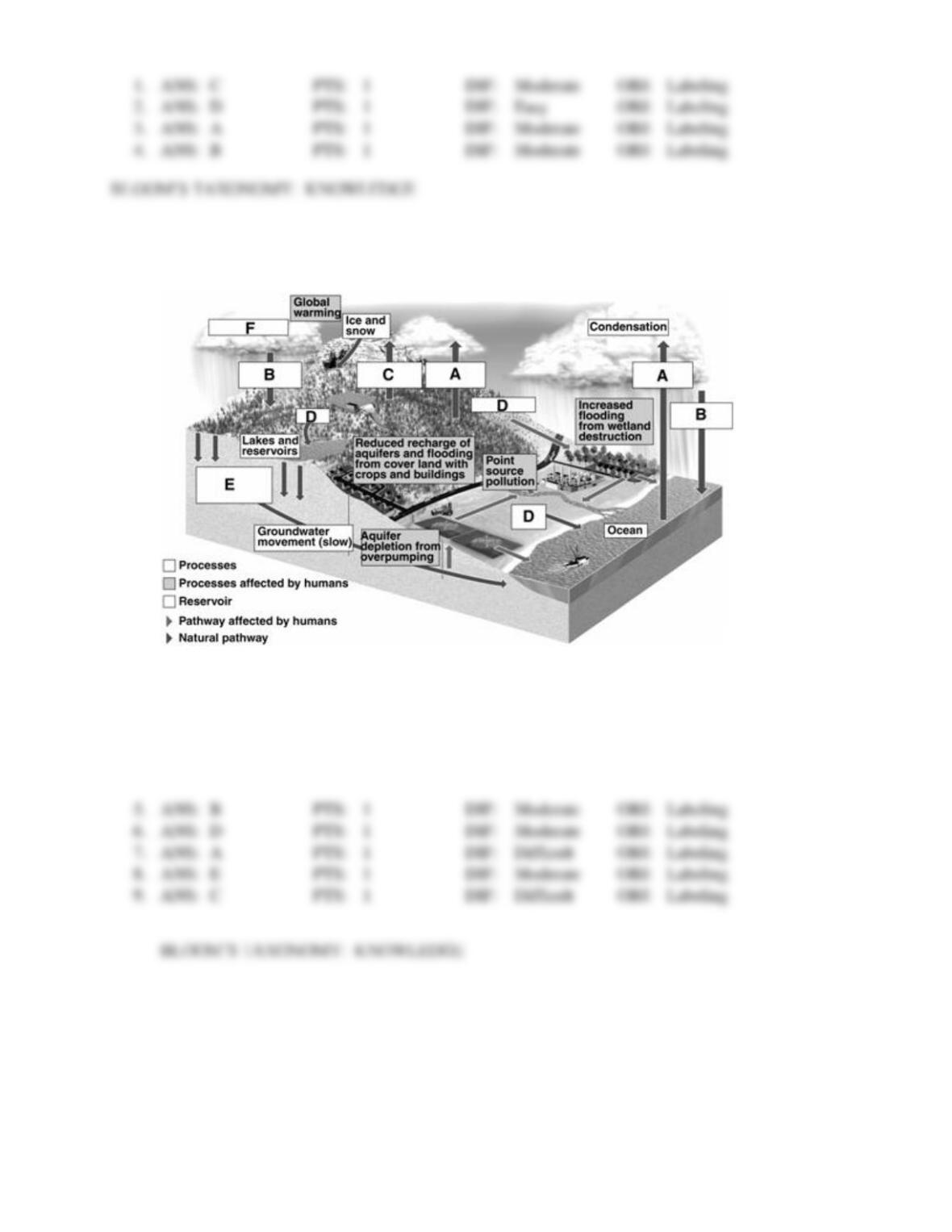
5. On the figure of the hydrological cycle, choose the letter that represents precipitation.
6. On the figure of the hydrological cycle, choose the letter that represents runoff.
7. On the figure of the hydrological cycle, choose the letter that represents evaporation.
8. On the figure of the hydrological cycle, choose the letter that represents infiltration.
9. On the figure of the hydrological cycle, choose the letter that represents transpiration.
67
Match the items listed below with the appropriate choice
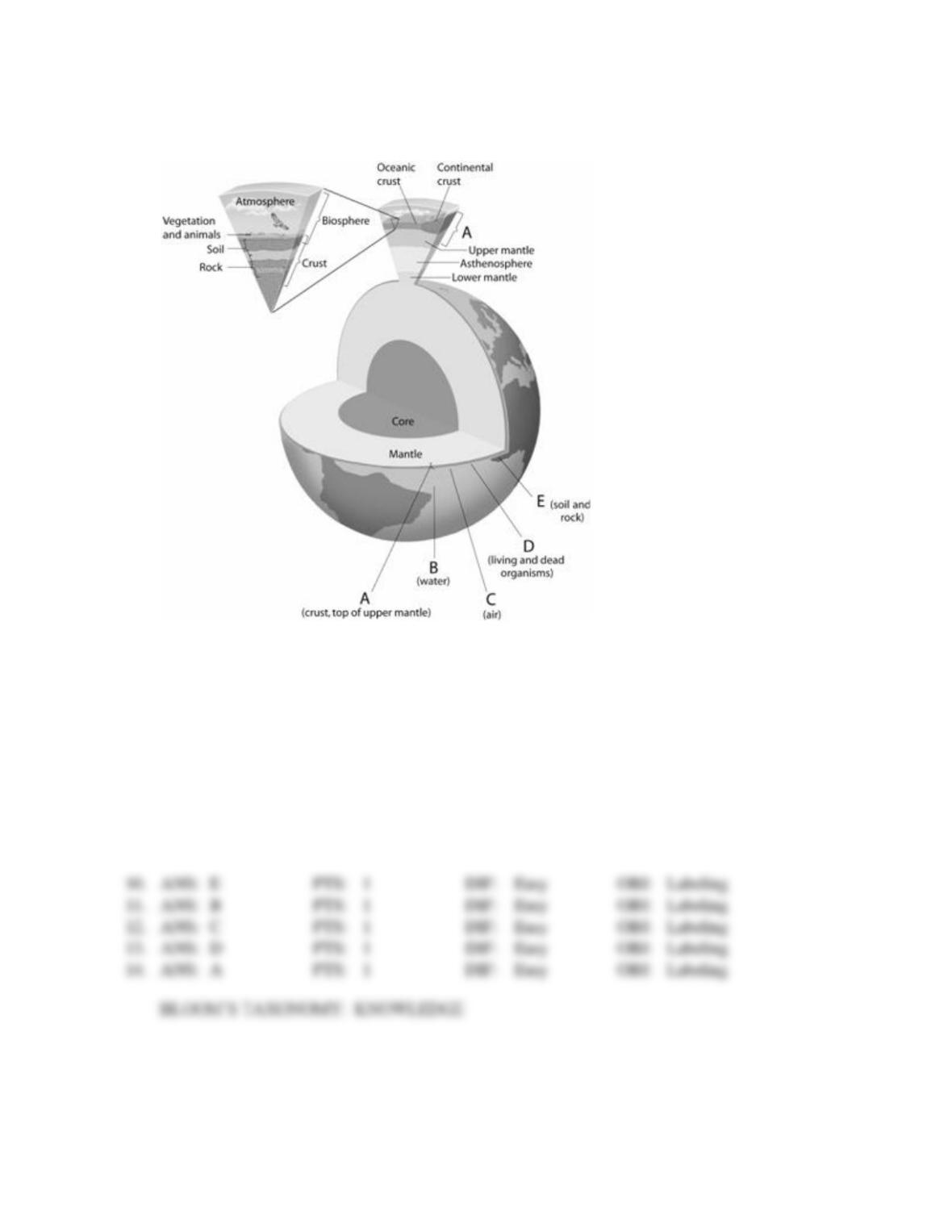
10. On the generalized structure of the Earth figure, choose the letter of the layer that contains
nonrenewable fossil fuels and minerals.
11. On the generalized structure of the Earth figure, choose the letter of the layer that is comprised of
water, ice, and water vapor.
12. On the generalized structure of the Earth figure, choose the letter of the layer that is made up of the
troposphere and the stratosphere.
13. On the generalized structure of the Earth figure, choose the letter of the layer that is composed of all of
the Earth’s ecosystems.
14. On the generalized structure of the Earth figure, choose the letter of the layer that consists of the
Earth’s crust and upper mantle.

68
Match the descriptive phrase below with its appropriate cycle.
a.
Hydrologic
d.
phosphorus
b.
Carbon
e.
sulfur
c.
Nitrogen
15. Fixation into soil accomplished by bacteria and algae
16. Cycles are slower than others
17. Transpiration from plants
18. Affects global warming
19. Forms acid rain
20. Affected by burning coal
21. Infiltration and percolation into aquifers
22. Electrical storms affect deposition into soil
23. Deposits found in limestone or dolomite
24. Does not cycle through atmosphere
SHORT ANSWER
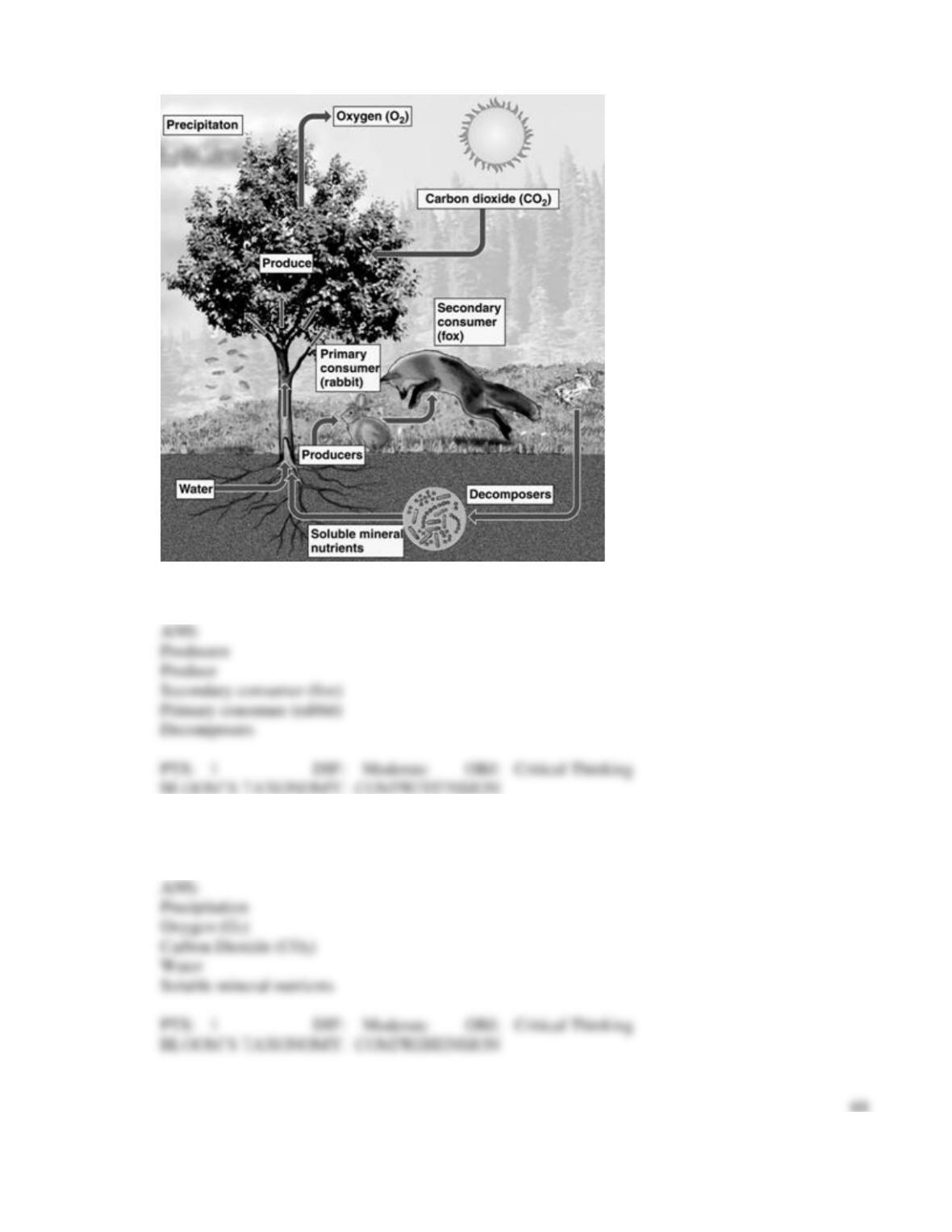
1. In the figure of an ecosystem, choose which of the components are categorized as biotic.
2. On the figure of an ecosystem, choose which of the components in the figure are categorized as
abiotic.
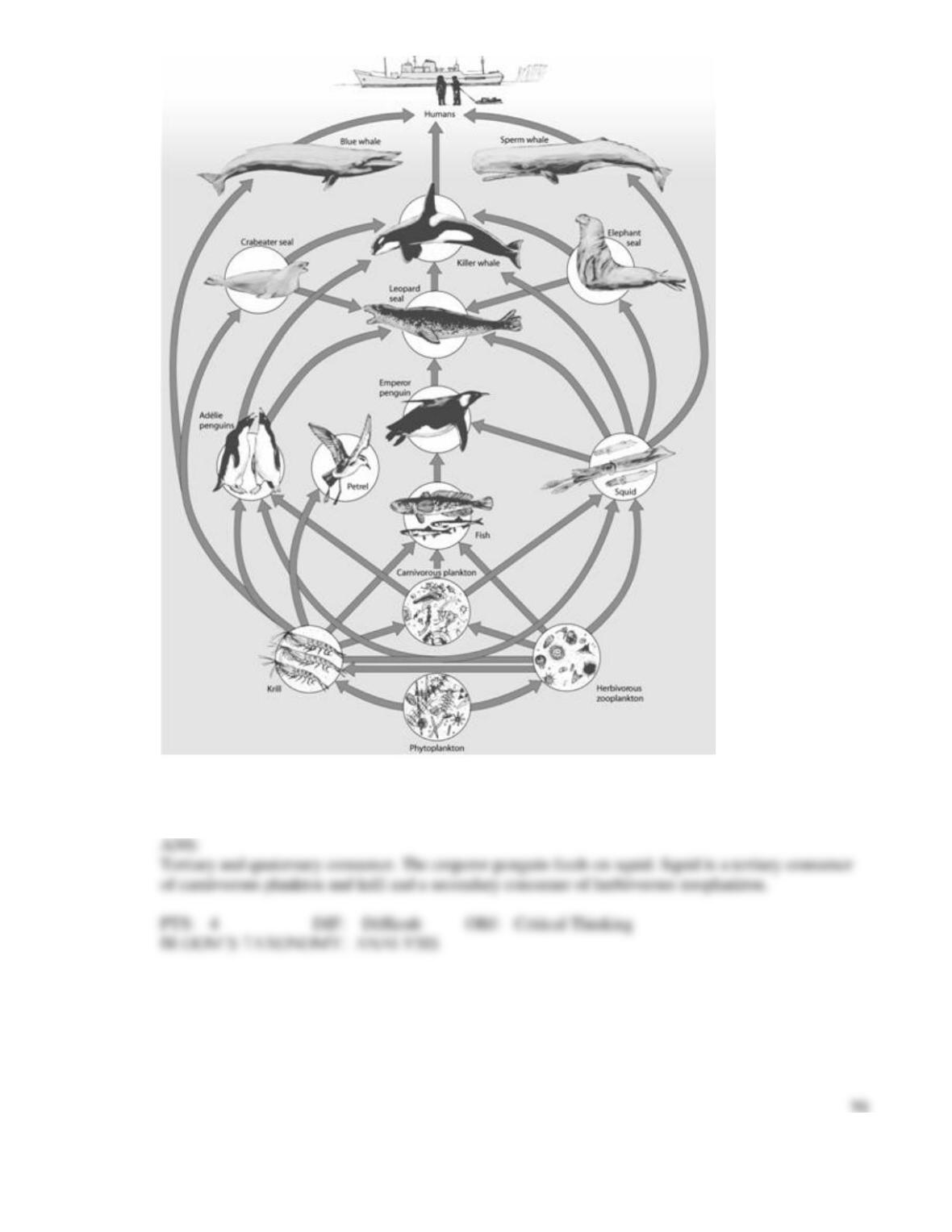
3. What trophic level is occupied by the emperor penguin in the above food web? Briefly state the reason
for your choice.
4. What trophic level does the blue whale occupy in this food web?
5. Which animal consumes energy from the highest number of links in the food web? Name a possible
problem that this animal could be subjected to that others in the food web do not risk.
6. Briefly explain why clearing a rainforest can affect local weather.
ESSAY
1. Clearly explain the significant differences between UV and infrared radiation and how this relates to
the greenhouse effect.
2. Clearly explain the relationship between the Second Law of Thermodynamics and the typical pyramid
of biomass.
3. Why is it that most top predators (e.g., lions, tigers, bears, and wolves) have extremely large territories
and are relatively rare?
4. Clearly explain the distinction between Gross Primary Productivity (GPP) and Net Primary
Productivity (NPP).
5. Given the nature of the phosphorous cycle, what are the long-term impacts on South American soil
quality through the exportation of beef cattle?
6. When sulfur dioxide in the atmosphere combines with water in precipitation, sulfuric acid rain is
deposited on the Earth. What human activities contribute to this process?
7. A critically important part of the hydrologic cycle is the transpiration of water through plants into the
atmosphere. This water has traveled from the roots up to the top leaves and then moves out as water
vapor. In the case of some plants, such as redwood trees, this can be a distance of hundreds of feet.
Explain how it is that water can move up naturally, when forces of gravity might make one think that
this is impossible.