Chapter 3 – The Adjusting Process
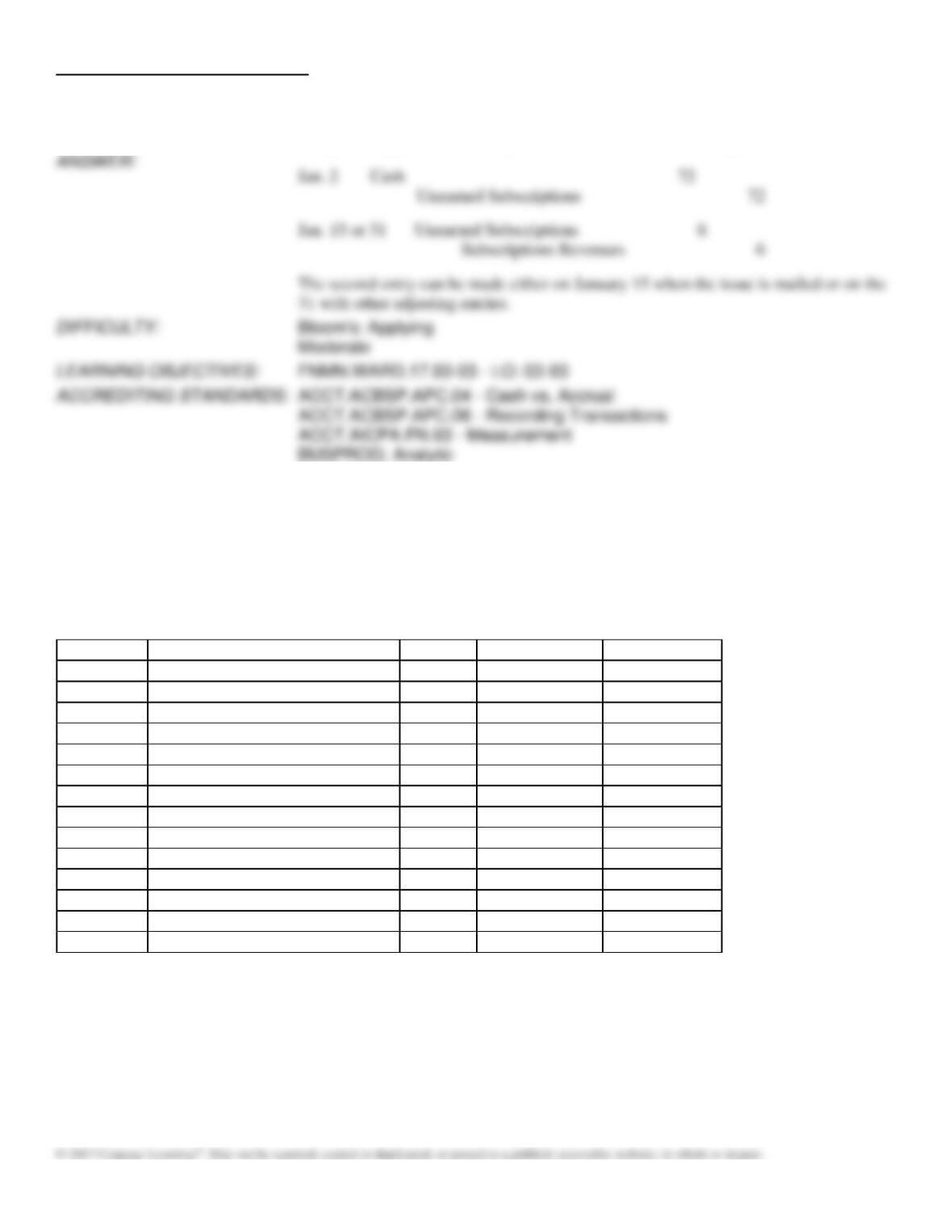
166. On January 2, Safe Motorcycling Monthly received a check for $72 from a subscriber for a 12-month subscription.
The January issue was mailed on January 15. Prepare the necessary entries for the month of January.
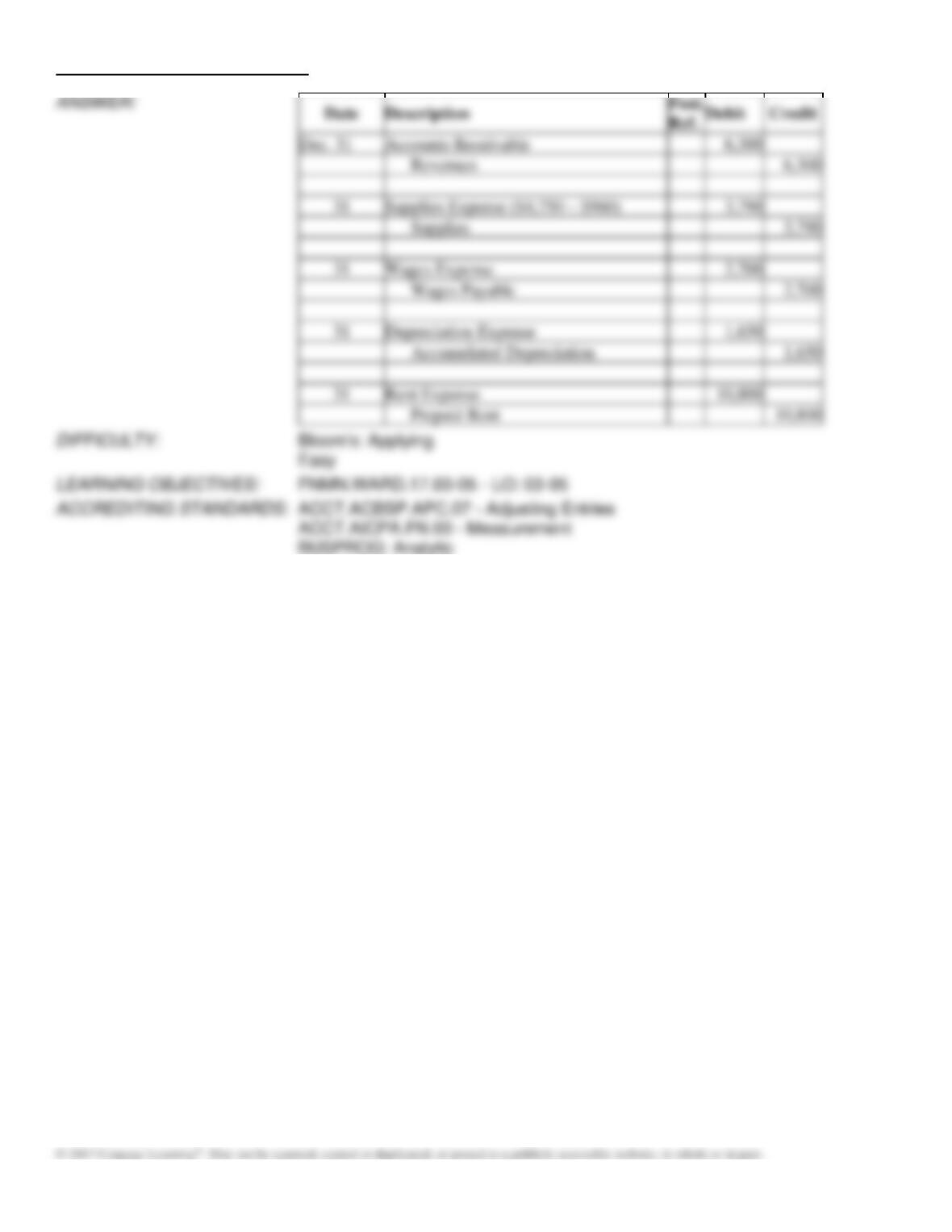
167. Prepare the December 31 adjusting entries for the following transactions. Omit explanations.
1. Fees accrued but not billed, $6,300
2. The Supplies account balance on December 31, $4,750; Supplies on hand, $960
3. Wages accrued but not paid, $2,700
4. Depreciation of office equipment, $1,650
5. Rent expired during year, $10,800
Date
Description
Post. Ref.
Debit
Credit
Chapter 3 – The Adjusting Process
Dec. 31
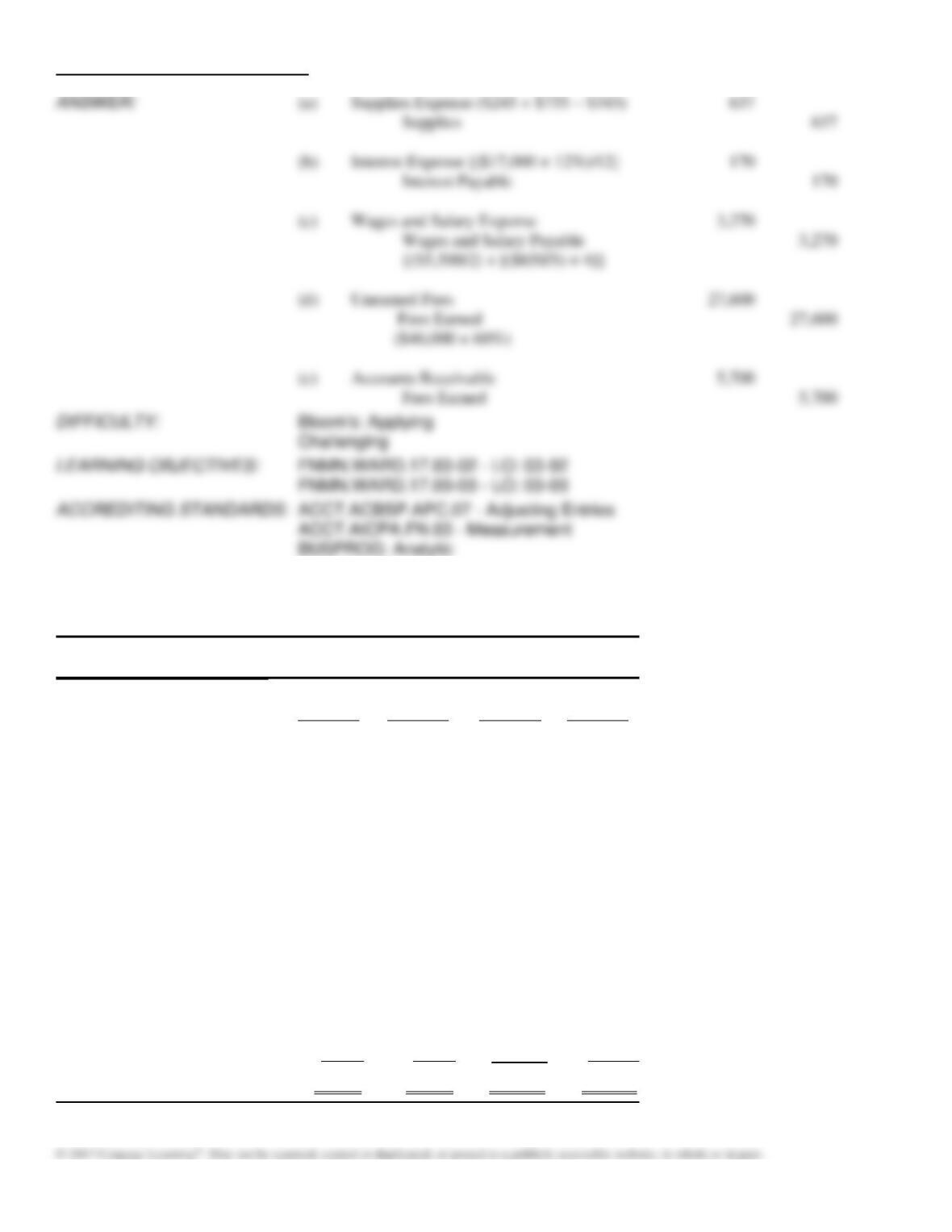
168. Prepare adjusting entries for the following transactions:
(a)
The beginning balance of the supplies account was $245. During the month the
company bought additional supplies in the amount of $735. At the end of the month a
physical inventory showed $343 of unused supplies.
(b)
The company has a 12% note payable in the amount of $17,000 due in 6 months. The
interest expense of $170 for the month has not been recorded.
(c)
The company has two employees. The manager is paid on the 15th of every month for
work performed during the first half of the month and on the 1st of the following month
for the work performed during the second half of the month. His monthly salary is
$5,500. The other employee is paid $650 for each 5-day work week (Monday –
Friday). The last day of the month fell on Thursday.
(d)
The unearned fees account shows a balance of $46,000. According to the manager 60%
of that amount has been earned.
(e)
At the end of the month $5,700 of services had been performed but not yet billed.
Chapter 3 – The Adjusting Process
Supplies Expense ($245 + $735 – $343)
Interest Expense [($17,000 × 12%)/12]
Wages and Salary Expense
Unearned Fees
($46,000 × 60%)
Accounts Receivable
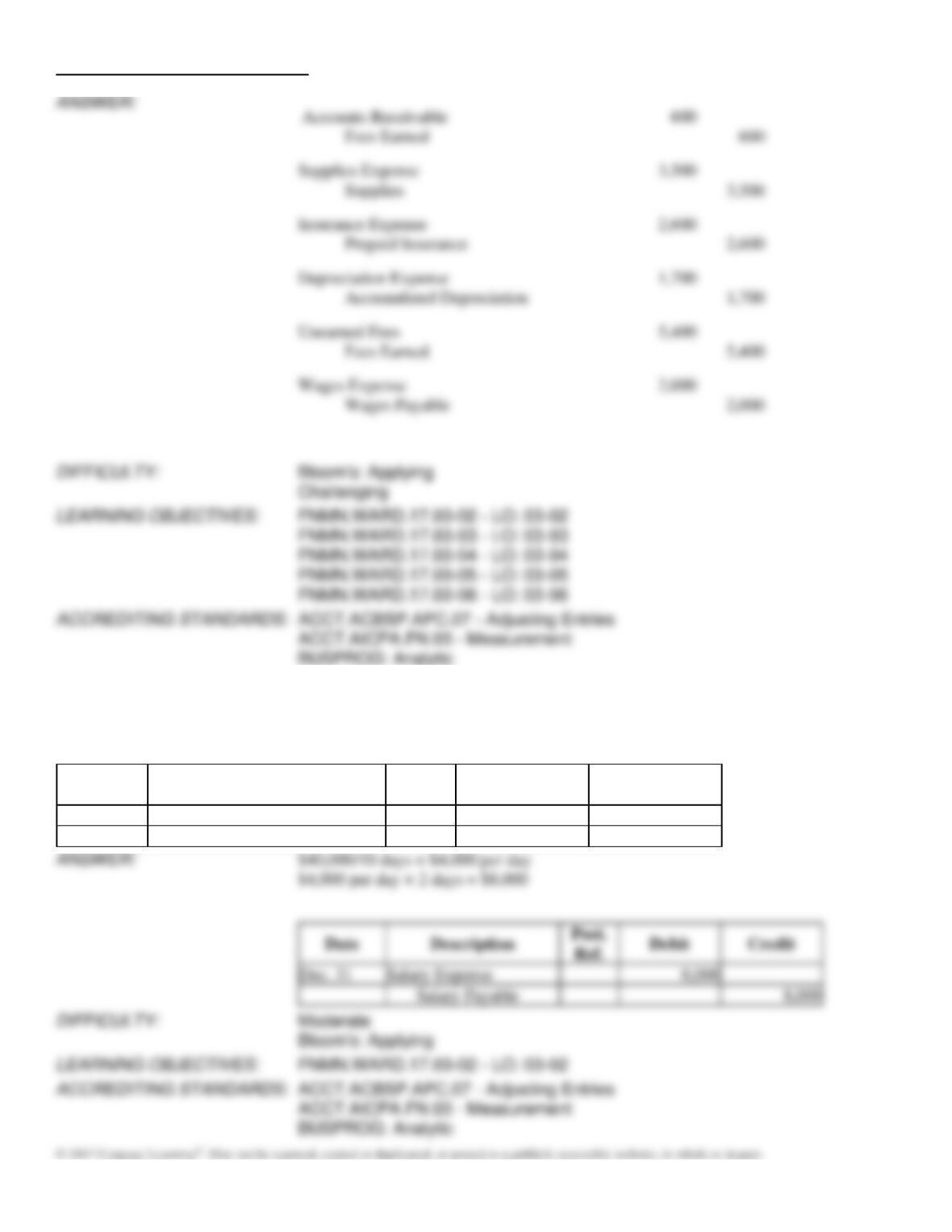
169. Journalize the six entries to adjust the accounts at December 31. (Hint: One of the accounts was affected by two
different adjusting entries).
Unadjusted
Trial Balance
Adjusted
Trial Balance
Debit
Balances
Credit
Balances
Debit
Balances
Credit
Balances
Cash
5,000
5,000
Accounts Receivable
32,000
32,600
Supplies
3,600
100
Prepaid Insurance
4,000
1,400
Equipment
11,000
11,000
Accumulated Depreciation
1,700
Wages Payable
2,000
Unearned Fees
8,900
3,500
Common Stock
22,000
22,000
Fees Earned
69,000
75,000
Wages Expense
44,300
46,300
Supplies Expense
3,500
Insurance Expense
2,600
Depreciation Expense
1,700
Totals
99,900
99,900
104,200
104,200
Chapter 3 – The Adjusting Process
170. Bloom’s Company pays biweekly salaries of $40,000 every other Friday for a ten-day period ending on that day. The
last payday of December is Friday, December 27. Assuming the next pay period begins on Monday, December 30,
journalize the adjusting entry necessary at the end of the fiscal period (December 31).
Date
Description
Post.
Ref.
Debit
Credit
Chapter 3 – The Adjusting Process
171. A business pays biweekly salaries of $20,000 every other Friday for a ten-day period ending on that day. The last
payday of December is Friday, December 27. Assume the next pay period begins on Monday, December 30 and the
proper adjusting entry is journalized at the end of the fiscal period (December 31). Journalize the entry for the payment of
the payroll on Friday, January 10.
Date
Description
Post.
Ref.
Debit
Credit
172. At January 31, the end of the first month of the year, the usual adjusting entry transferring expired insurance to an
expense account is omitted. Which items will be incorrectly stated, because of the error, on (a) the income statement for
January and (b) the balance sheet as of January 31? Also indicate whether the items in error will be overstated or
understated.
Chapter 3 – The Adjusting Process
173. At the end of April, the first month of the company’s year, the usual adjusting entry transferring rent earned to a
revenue account from the unearned rent account was omitted. Indicate which items will be incorrectly stated, because of
the error, on (a) the income statement for April and (b) the balance sheet as of April 30. Also indicate whether the items
in error will be overstated or understated.
174. Salaries of $6,400 are paid for a five-day week on Friday. Prepare the adjusting journal entry that is required if the
month ends on Thursday.
175. Accrued salaries of $600 owed to employees for December 29, 30, and 31 are not taken into consideration in
preparing the financial statements for the year ended December 31. Indicate which items will be erroneously stated,
because of the error, on (a) the income statement for the year and (b) the balance sheet as of December 31. Also indicate
whether the items in error will be overstated or understated.
Chapter 3 – The Adjusting Process
176. For the year ending December 31, Beard Clinical Supplies Co. mistakenly omitted adjusting entries for (1) $9,800 of
unearned revenue that was earned, (2) earned revenue that was not billed of $10,200, and (3) accrued wages of
$7,000. Indicate the combined effect of the errors on (a) revenues, (b) expenses, and (c) net income.
177. On January 1, Great Designs Company had a debit balance of $1,450 in the office supplies account. During the
month, Great Designs purchased $115 and $160 of office supplies and journalized them to the asset account upon
purchasing. On January 31, an inspection of the office supplies cabinet shows that only $350 of office supplies remains.
Prepare the January 31 adjusting entry for office supplies.
178. For the year ending June 30, Island Clinical Services mistakenly omitted adjusting entries for (1) $1,500 of supplies
that were used, (2) unearned revenue of $4,200 that was earned, and (3) insurance of $5,000 that expired. What is the
combined effect of these errors on (a) revenues, (b) expenses, and (c) net income for the year ending June 30?
Chapter 3 – The Adjusting Process
179. On December 31, a business estimates depreciation on equipment used during the first year of operations to be
$2,900. (a) Journalize the adjusting entry required on December 31. (b) If the adjusting entry in (a) were omitted, which
items would be erroneously stated on (1) the income statement for the year and (2) the balance sheet as of December 31?
(b)
(1) Depreciation expense would be understated. Net income
would be overstated.
180. At the end of the fiscal year, the following adjusting entries were omitted:
(a)
No adjusting entry was made to transfer the $1,750 of prepaid insurance from the
asset account to the expense account.
(b)
No adjusting entry was made to record accrued fees of $525 for services provided
to customers.
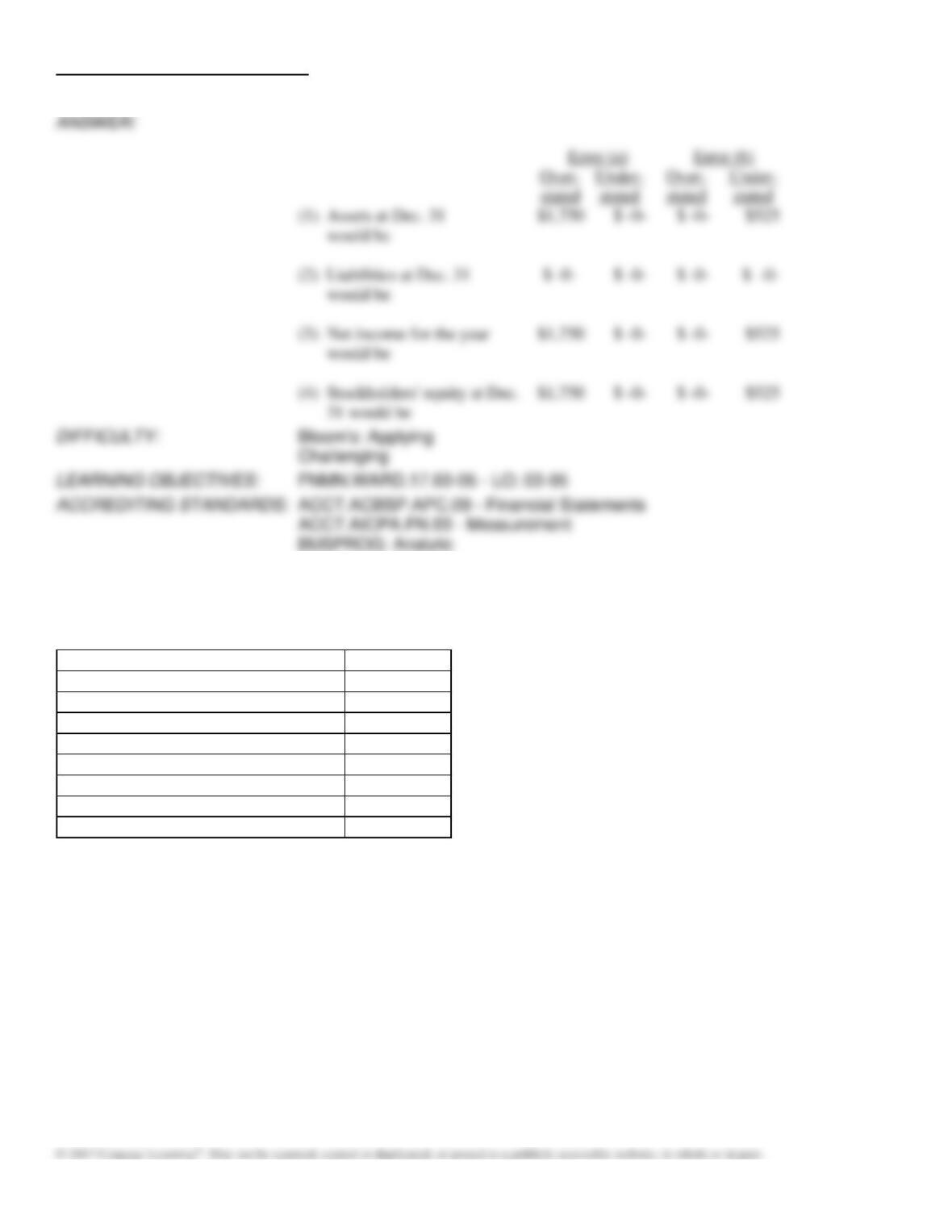
Assuming that financial statements are prepared before the errors are discovered, indicate the effect of each error,
considered individually, by inserting the dollar amount in the appropriate spaces. Insert “0” if the error does not affect the
item.
Error (a)
Error (b)
Over-
stated
Under-
stated
Over-
stated
Under-
stated
(1) Assets at Dec. 31
would be
$
$
$
$
(2) Liabilities at Dec. 31
would be
$
$
$
$
Net income for the year
would be
$
$
$
$
Stockholders’ equity at Dec. 31
would be
$
$
$
$
Chapter 3 – The Adjusting Process
would be
181. Jordon James started JJJ Consulting on January 1. The following are the account balances at the end of the first
month of business, before adjusting entries were recorded:
Accounts Payable
$ 300
Accounts Receivable
750
Cash
6,300
Consulting Revenue
4,925
Equipment
7,000
Common Stock
15,000
Dividends
1,375
Prepaid Rent
4,000
Supplies
800
Adjustment data:
Supplies on hand at the end of the month, $200
Unbilled consulting revenue, $700
Rent expense for the month, $1,000
Depreciation on equipment, $90
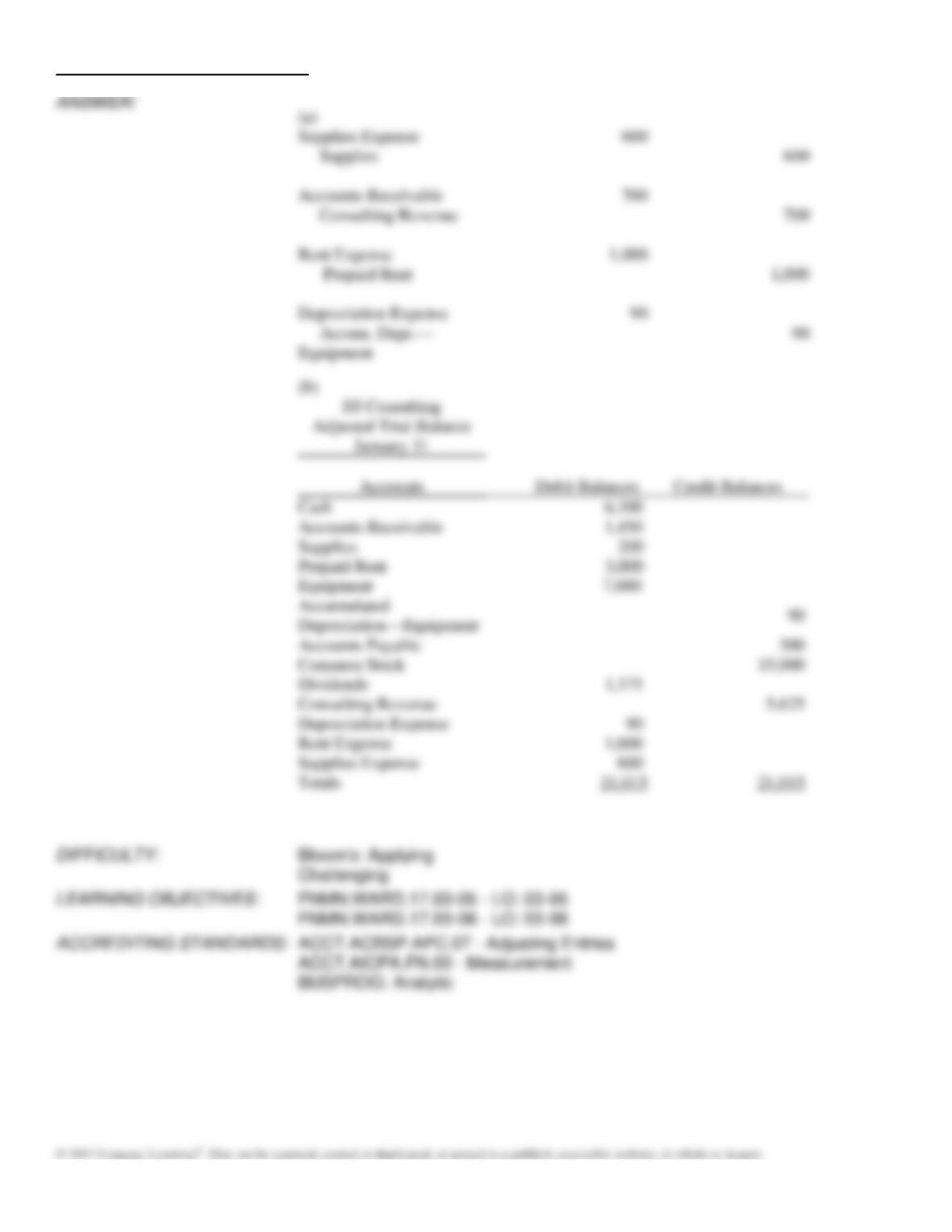
(a) Prepare the required adjusting entries, adding accounts as needed.
(b) Prepare an adjusted trial balance for JJJ Consulting as of January 31.
Chapter 3 – The Adjusting Process
Chapter 3 – The Adjusting Process
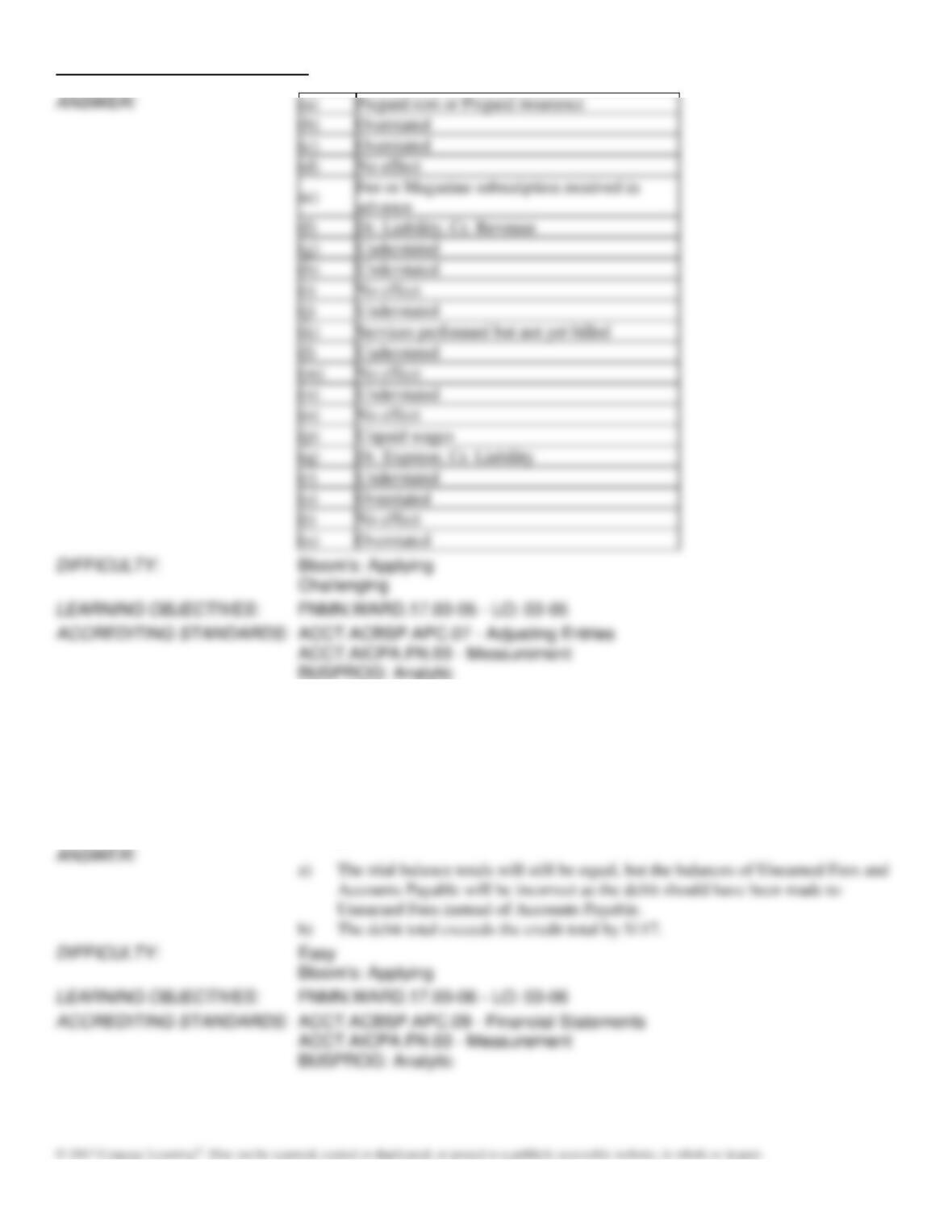
182. Complete the missing items in the Summary of Adjustments chart:
Prepaid Expenses
Examples
Adjusting Entry
Financial Statement Impact
if Adjusting Entry is Omitted
Supplies,
(a)
Dr. Expense
Cr. Asset
Income Statement:
Revenues: No effect
Expenses: Understated
Net income: (b)
Balance Sheet:
Assets: (c)
Liabilities: (d)
Stockholders’ equity: Overstated
Unearned Revenues
Examples
Adjusting Entry
Financial Statement Impact if
Adjusting Entry is Omitted
Unearned Rent,
(e)
(f)
Income Statement:
Revenues: (g)
Expenses: No effect
Net income: (h)
Balance Sheet:
Assets: (i)
Liabilities: Overstated
Stockholders’ equity: (j)
Accrued Revenues
Examples
Adjusting Entry
Financial Statement Impact if
Adjusting Entry is Omitted
Interest income
due on a note,
(k)
Dr. Asset
Cr. Revenue
Income Statement:
Revenues: (l)
Expenses: (m)
Net income: Understated
Balance Sheet:
Assets: (n)
Liabilities: (o)
Stockholders’ equity: Understated
Accrued Expenses
Examples
Adjusting Entry
Financial Statement Impact if
Adjusting Entry is Omitted
Interest due on a
note payable,
(p)
(q)
Income Statement:
Revenues: No effect
Expenses: (r)
Net income: (s)
Balance Sheet:
Assets: (t)
Liabilities: Understated
Stockholders’ equity: (u)
Chapter 3 – The Adjusting Process
Prepaid rent or Prepaid insurance
Fee or Magazine subscription received in
Dr. Liability, Cr. Revenue
Services performed but not yet billed
Unpaid wages
Dr. Expense, Cr. Liability
183. For each of the following errors, considered individually, indicate whether the error would cause the adjusted trial
balance totals to be unequal. If the error would cause the adjusted trial balance total to be unequal, indicate whether the
debit or credit total is higher and by how much.
a)
The adjustment for unearned fees of $3,260 was journalized as a debit to Accounts
Payable for $3,260 and a credit to Fees Earned of $3,260.
b)
The adjustment for supplies expense of $425 was journalized as a debit to Supplies
Expense for $542 and a credit to Supplies for $425.
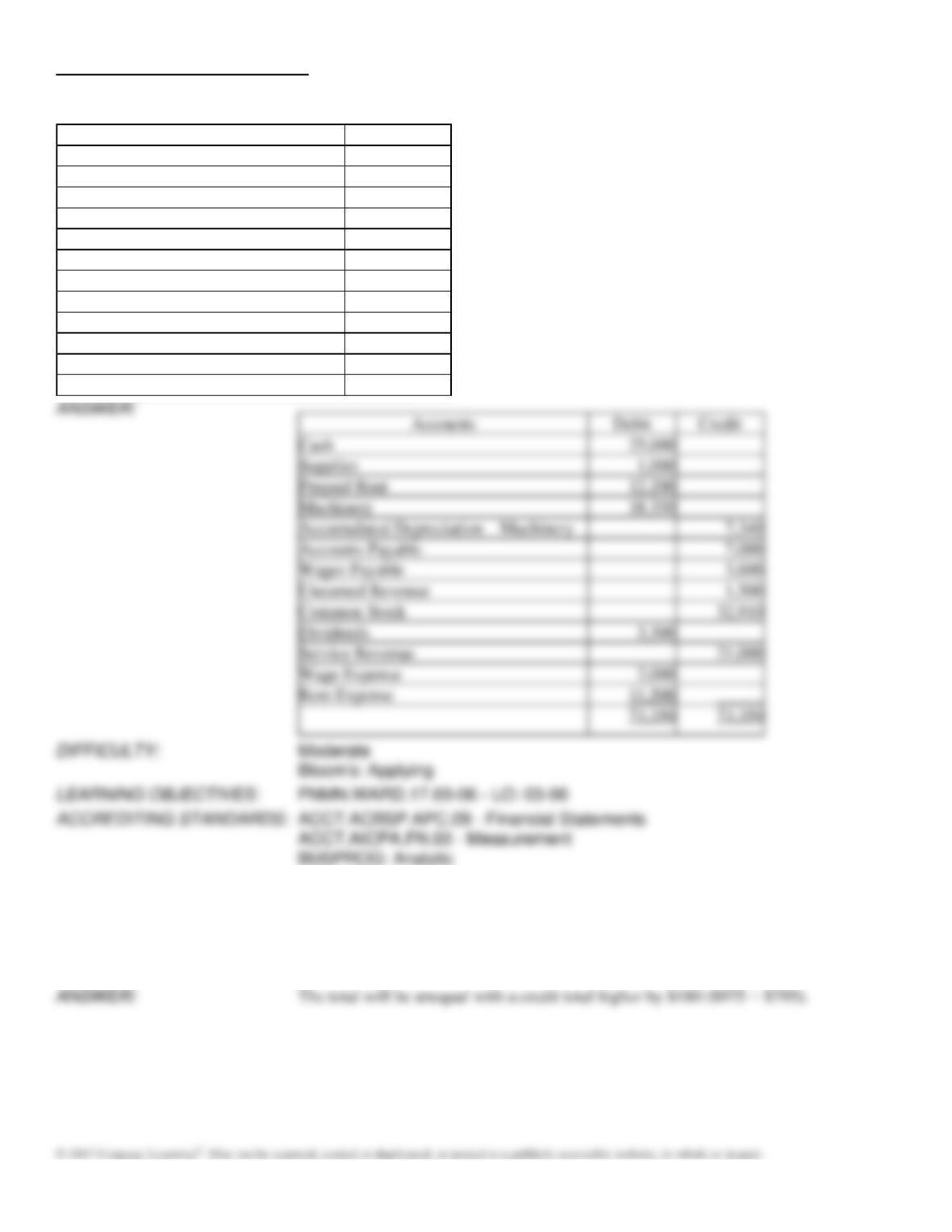
Accounts Payable will be incorrect as the debit should have been made to
Unearned Fees instead of Accounts Payable.
The debit total exceeds the credit total by $117.
Chapter 3 – The Adjusting Process
184. Using the following account balances for Garry’s Tree Service, prepare a trial balance.
Cash
$25,000
Supplies
1,000
Accounts Payable
7,000
Common Stock
32,910
Wage Expense
2,000
Machinery
18,350
Wages Payable
3,600
Service Revenue
21,000
Rent Expense
11,500
Unearned Revenue
1,500
Accumulated Depreciation—Machinery
7,340
Prepaid Rent
12,200
Dividends
3,300
Cash
Supplies
Prepaid Rent
Machinery
Accumulated Depreciation—Machinery
Accounts Payable
Wages Payable
Unearned Revenue
Common Stock
Dividends
Service Revenue
Wage Expense
Rent Expense
185. Indicate whether the following error would cause the adjusted trial balance totals to be unequal. If the error would
cause the adjusted trial balance totals to be unequal, indicate whether the debit or credit total is higher and by how much.
The entry for $975 of supplies used during the period was journalized as a debit to Supplies Expense for $795 and credit
to Supplies for $975.
The total will be unequal with a credit total higher by $180 ($975 − $795).
Chapter 3 – The Adjusting Process
186. Indicate whether the following error would cause the adjusted trial balance totals to be unequal. If the error would
cause the adjusted trial balance totals to be unequal, indicate whether the debit or credit total is higher and by how much.
The adjustment for accrued fees of $1,170 was journalized as a debit to Accounts Receivable for $1,170 and a credit to
Fees Earned for $1,107.
The total will be unequal with a debit total higher by $63 ($1,170 − $1,107).
187. What is the purpose of an adjusted trial balance? What type(s) of error does it detect? What type(s) of error does it
not detect?
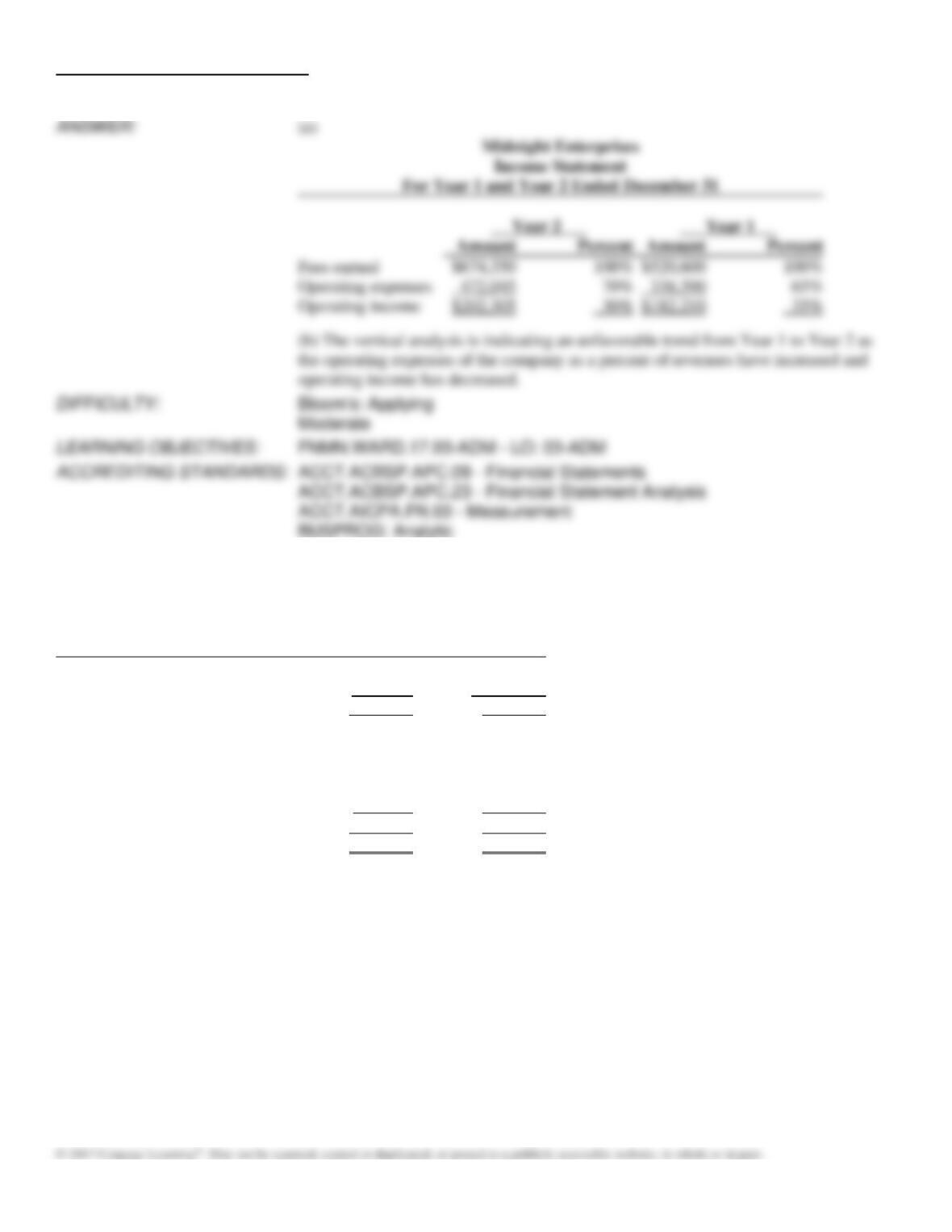
188. Two income statements for Midnight Enterprises are shown below:
Midnight Enterprises
Income Statement
For Year 1 and Year 2, Ended December 31
Year 2
Year 1
Fees earned
$674,350
$520,600
Operating expenses
472,045
338,390
Operating income
$202,305
$182,210
(a) Prepare a vertical analysis of Midnight Enterprises’ income statements.
(b) Does the vertical analysis indicate a favorable or unfavorable trend?
Chapter 3 – The Adjusting Process
Fees earned
Operating expenses
Operating income
LEARNING OBJECTIVES:
189. Two income statements for Danielle’s Design Services are shown below:
Danielle’s Design Services
Income Statements
For Years 1 and 2 Ending December 31
Year 2
Year 1
Fees earned
$765,340
$696,520
Operating expenses:
Wages expense
$254,000
$214,600
Rent expense
120,000
108,000
Supplies expense
76,500
98,715
Miscellaneous expense
11,680
16,420
Total operating expenses
$462,180
$437,735
Net income
$303,160
$258,785
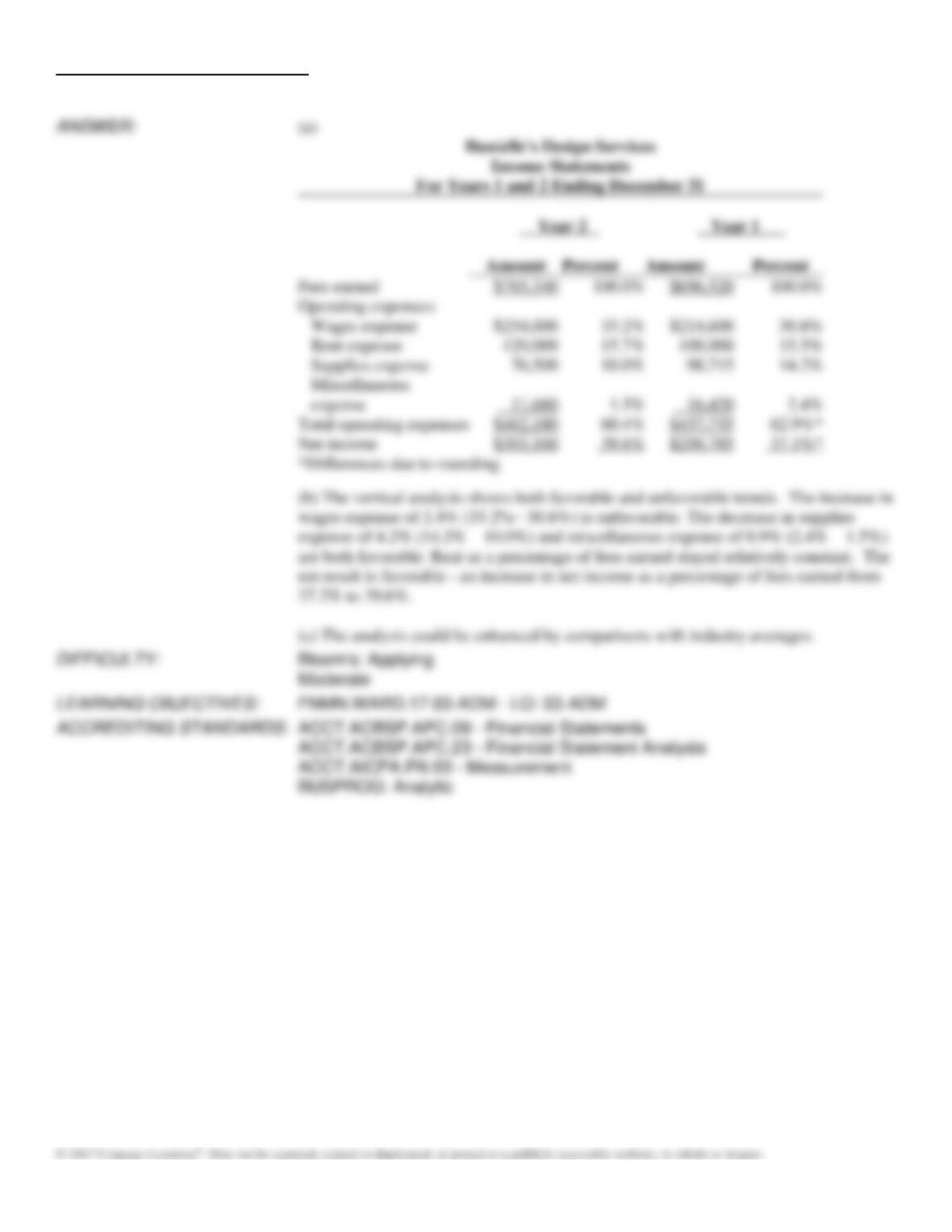
(a) Prepare a vertical analysis of Danielle’s Design Services income statements.
(b) What types of trends are indicated: favorable or unfavorable?
(c) What other information would enhance the analysis?
Chapter 3 – The Adjusting Process
Chapter 3 – The Adjusting Process
Match the type of account (a – e) with the business transactions that follow.
a.
Prepaid expense
b.
Accrued expense
c.
Unearned revenue
d.
Accrued revenue
e.
None of these
DIFFICULTY:
Bloom’s: Remembering
Moderate
LEARNING OBJECTIVES:
FNMN.WARD.17.03-05 – LO: 03–05
ACCREDITING STANDARDS:
ACCT.ACBSP.APC.05 – Accounting Cycle
ACCT.ACBSP.APC.07 – Adjusting Entries
ACCT.ACBSP.APC.15 – Current Assets Reporting
ACCT.ACBSP.APC.16 – Current Liabilities Reporting
ACCT.AICPA.FN.03 – Measurement
BUSPROG: Analytic
190. Services provided that have not been recorded.
191. Paid for one year’s insurance policy.
192. Retainer fee received from a client for future legal representation.
193. Annual property taxes that are paid at the end of the year.
194. Electric bill to be paid next month.
195. Paid for a 6-month magazine subscription.
196. Received payment covering a 6-month magazine subscription.
197. Provided tutoring for a student that will be invoiced next month.
198. Received 6 months of rental payments from a tenant.
199. Paid 6 months of rental payments to the landlord.
200. Annual depreciation on equipment, recorded on a monthly basis.

Chapter 3 – The Adjusting Process
201. A contract to provide tutoring services beginning next month was signed.
Identify the effect (a – h) that omitting each of the following items would have on the balance sheet.
a.
Assets and stockholders’ equity overstated
b.
Assets and stockholders’ equity understated
c.
Assets overstated and stockholders’ equity understated
d.
Assets understated and stockholders’ equity overstated
e.
Liabilities and stockholders’ equity overstated
f.
Liabilities and stockholders’ equity understated
g.
Liabilities overstated and stockholders’ equity understated
h.
Liabilities understated and stockholders’ equity overstated
DIFFICULTY:
Moderate
Bloom’s: Remembering
LEARNING OBJECTIVES:
FNMN.WARD.17.03-05 – LO: 03-05
ACCREDITING STANDARDS:
ACCT.ACBSP.APC.07 – Adjusting Entries
ACCT.AICPA.FN.03 – Measurement
BUSPROG: Analytic
202. No adjustment was made for supplies used up during the month.
203. Wages are paid every Friday for the 5-day work week. The month ended on Monday and no adjustment was
recorded.
204. Interest earned on a note receivable was not recorded.
205. Services provided to customers on the last day of the month were not billed.
206. An attorney has earned 1/2 of a retainer fee that was received and recorded last month. No adjustment was recorded
for the amount earned.
207. Property taxes are paid annually. The estimated monthly amount for the taxes was not recorded.
208. Depreciation on equipment was not recorded.
209. A tenant paid 6 months’ rent in advance when he moved in on the first day of the month. No entry was made on the
last day of the month.