
Chapter 3: Review of a Company’s Accounting System
Chapter 3: Review of a Company’s Accounting System
Calculations:
141. Selected adjusting entries are shown below:
a.
Insurance Expense
2,500
Prepaid Insurance
2,500
b.
Rent Revenue
1,250
Unearned Rent
1,250
c.
Salaries Expense
2,900
Salaries Payable
2,900
d.
Interest Expense
1,300
Interest Payable
1,300
e.
Interest Receivable
1,800
Interest Revenue
1,800
f.
Depreciation Expense
2,600
Accumulated Depreciation-Equipment
2,600
g.
Bad Debts Expense
275
Allowance for Doubtful Accounts
275
Required:
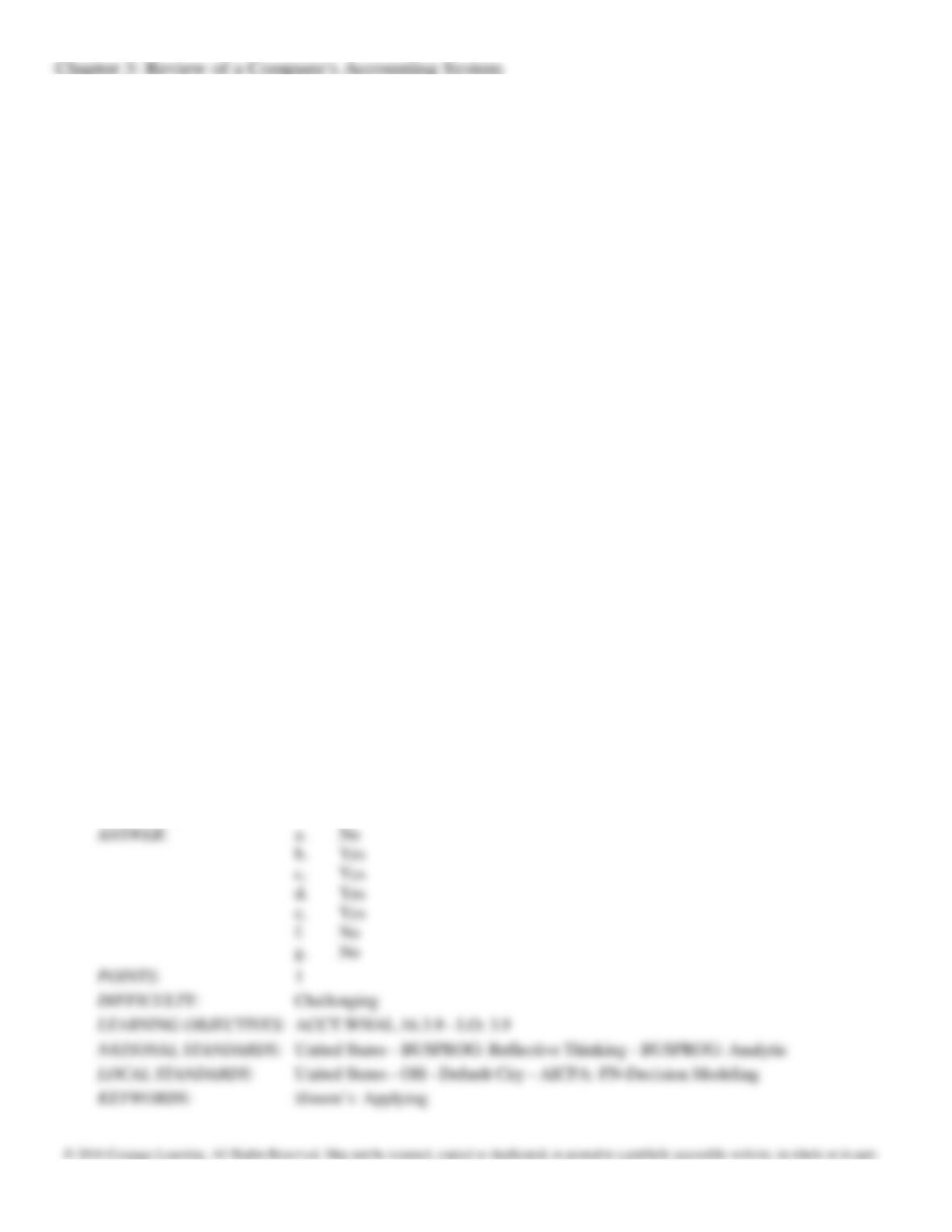
Indicate by Yes or No which of the preceding adjusting entries could be reversed
a.
________
b.
________
c.
________
d.
________
e.
________
f.
________
g.
________
a.
b.
c.
d.
e.
g.
142. Garrison Company has provided you with the following information relating to four transactions during the month of
March:
a.
Garrison acquired $18,000 of office supplies for cash. Office supplies on hand at the
beginning of March totaled $3,400, while $2,000 remained at the end of March.
b.
Garrison pays salaries monthly on the 2nd day of the month. Salaries earned by employees
in March totaled $56,000. Salaries owed on March 1 and paid on March 2 totaled $51,000.
c.
Advance deposits on hand at the beginning of March for work orders to be completed in
March and April for customers totaled $75,000. Work completed and delivered during
March on those work orders was $35,000. No new advance deposits were received in
March.
d.
Garrison had uncollected account receivables at March 1 totaling $38,000. Collections
during March totaled $136,000, which included the entire March 1 receivables balance.
New, end-of March billings to customers who bought goods in March on account and will
pay in April totaled $40,000.
Garrison records operating revenues and expenses on the cash basis during the month. Adjusting entries are recorded
monthly, the books are closed at the end of each month, and appropriate reversing entries are prepared as the first
entries of each new month.
Required:
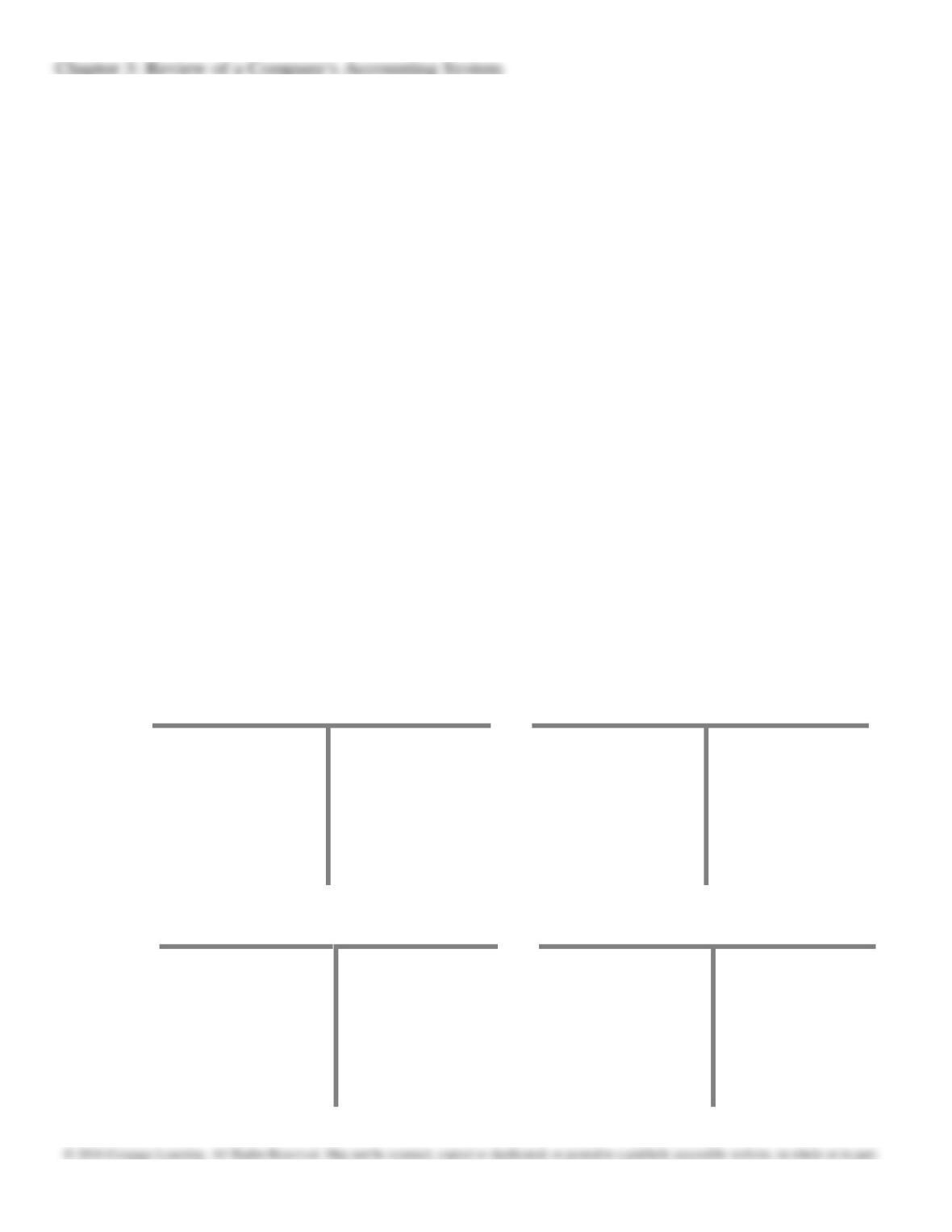
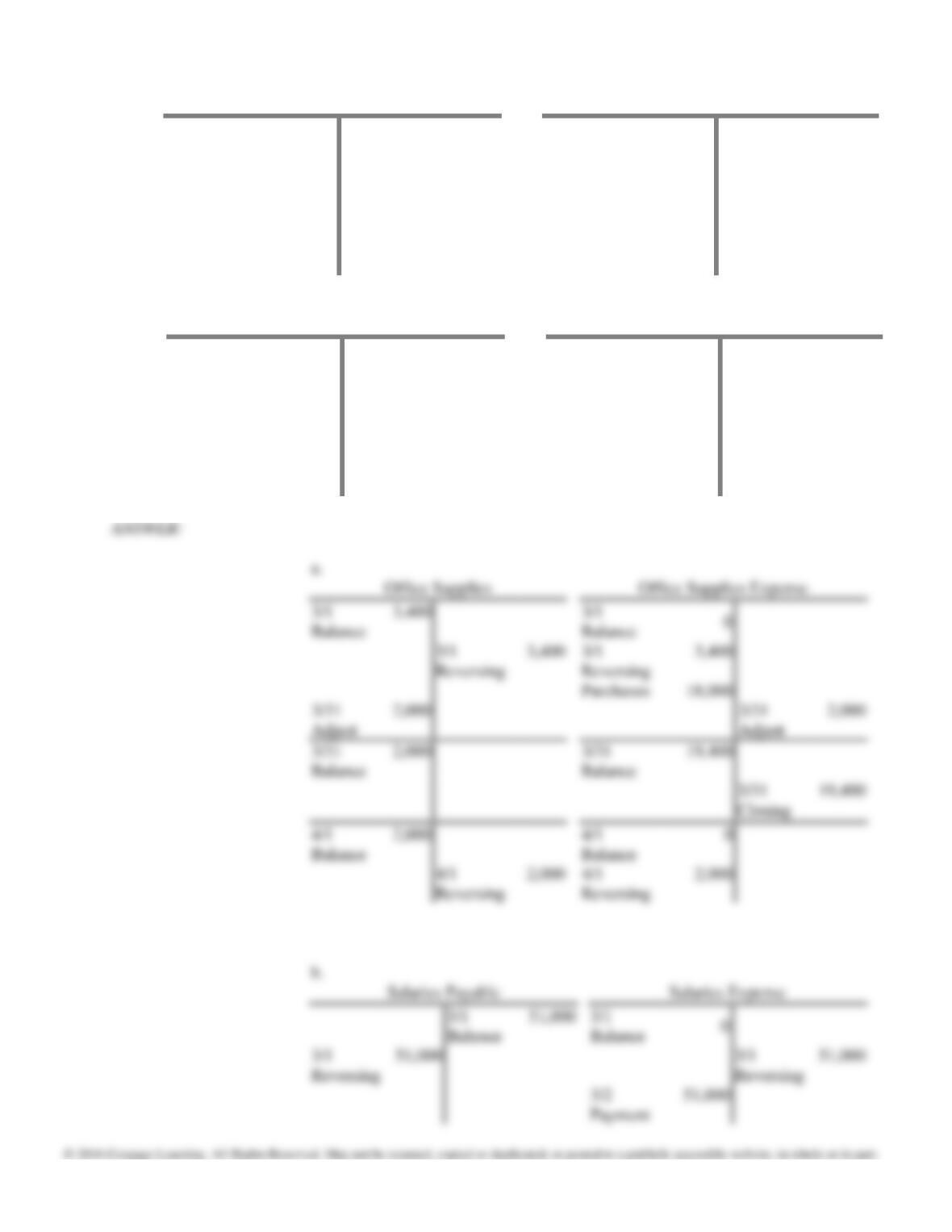
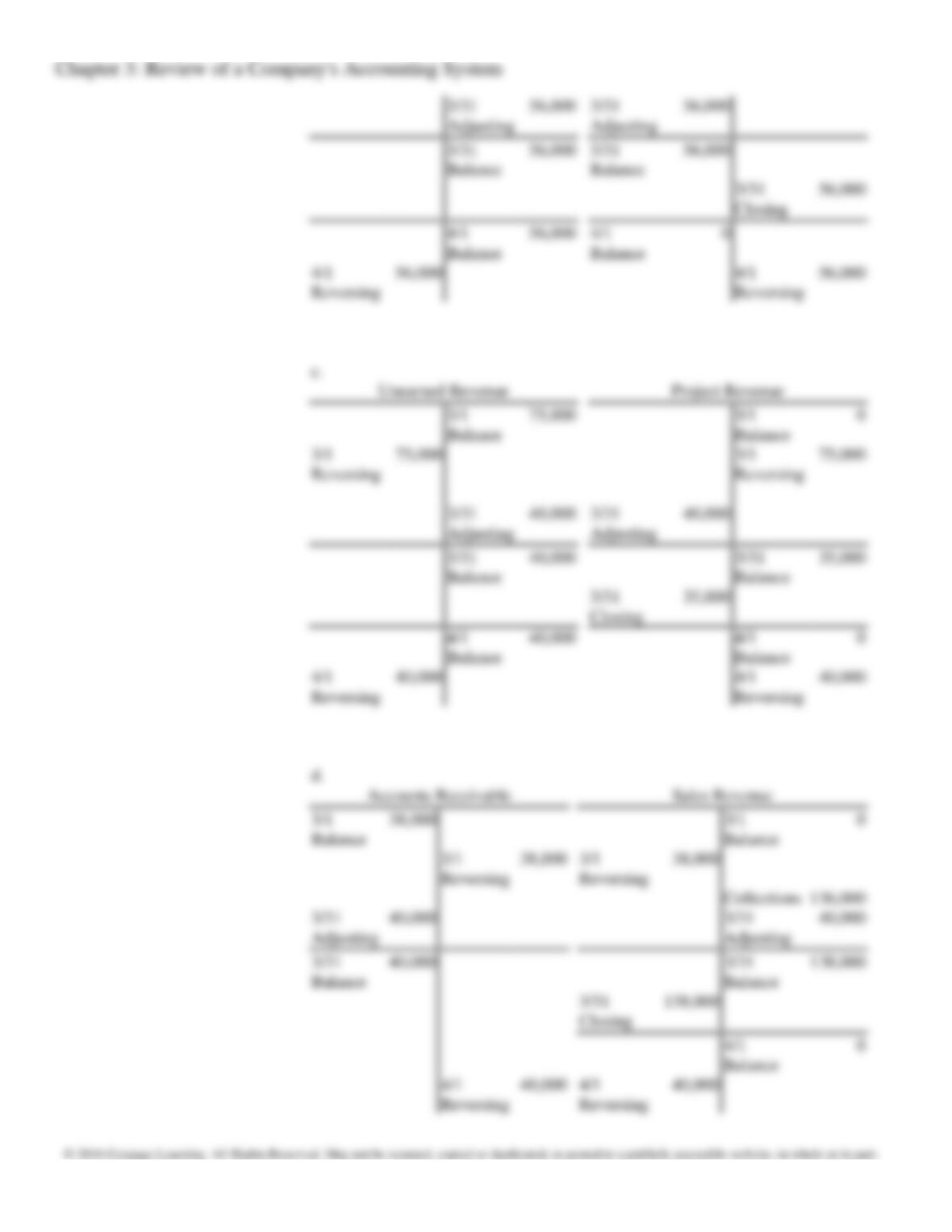
For each of the four transaction information sets (a-d), complete the t-accounts below showing
(1)
the appropriate March 1 balances
(2)
all changes to the accounts that would be posted during March, including adjusting and
closing entries as are appropriate
(3)
all April 1 reversing entries
a.
Office Supplies
Office Supplies Expense
b.
Salaries Payable
Salaries Expense
Chapter 3: Review of a Company’s Accounting System
c.
Unearned Revenue
Project Revenue
d.
Accounts Receivable
Sales Revenue
Chapter 3: Review of a Company’s Accounting System
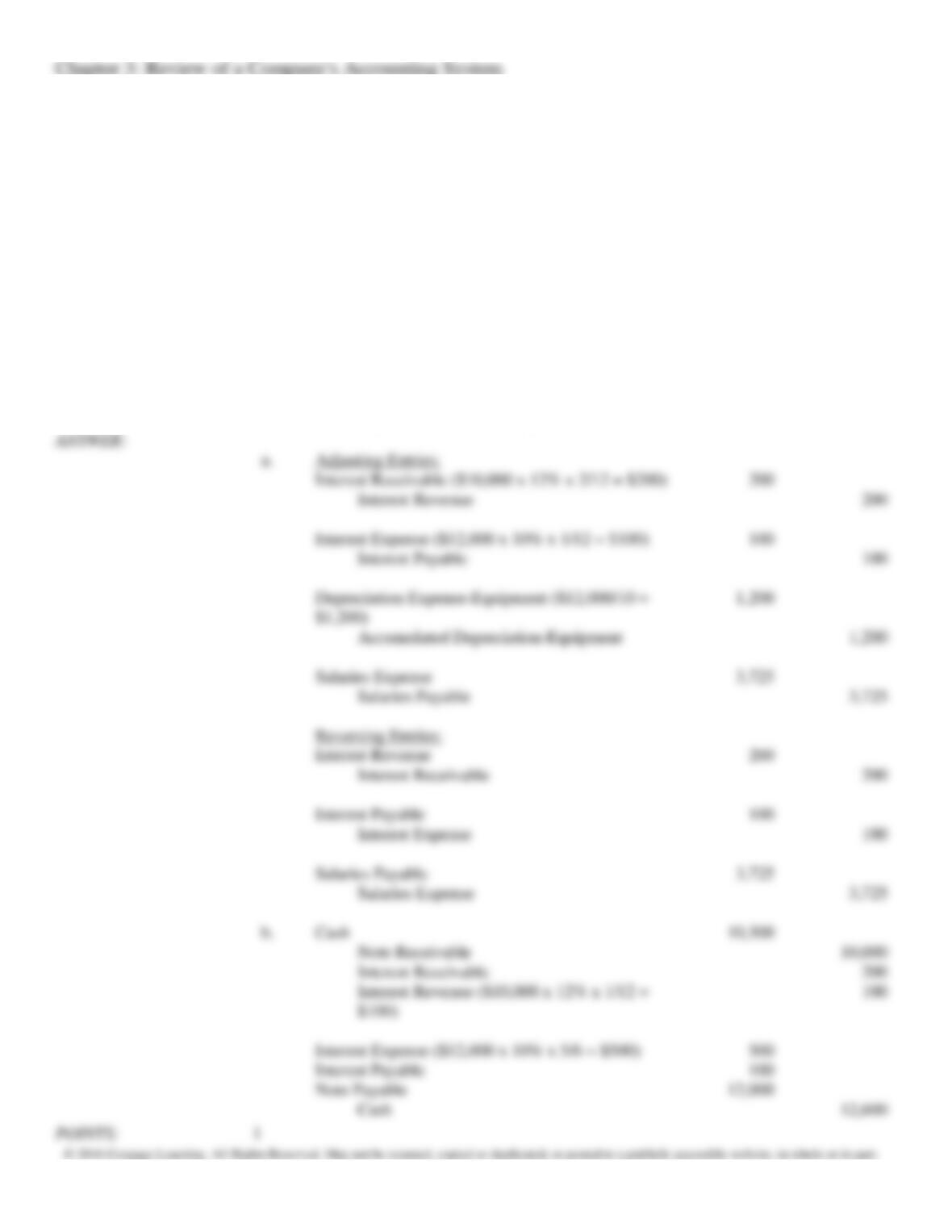
143. Information regarding the Rainey Company follows:
·
On November 1, 2014, Rainey accepted a $10,000, three-month note receivable from a
major customer. Interest on the note, computed at a 12% annual rate, will be collected with
the principal.
·
On December 1, 2014, Rainey borrowed $12,000 from its bank. The principal, plus interest
computed at a 10% annual rate, is due on June 1, 2015.
·
Rainey uses the straight-line method to record depreciation on its equipment. The equipment,
which cost $12,000, has an estimated life of 10 years and no expected residual value.
·
$3,725 of salaries had accrued as of December 31, 2014.
Required:
a.
Assuming that Rainey does use reversing entries, prepare December 31, 2014 adjusting
entries and 2015 reversing entries.
b.
Assuming that Rainey does not use reversing entries, prepare journal entries to record the
collection of the note receivable and the payment of the note payable in 2015.
1
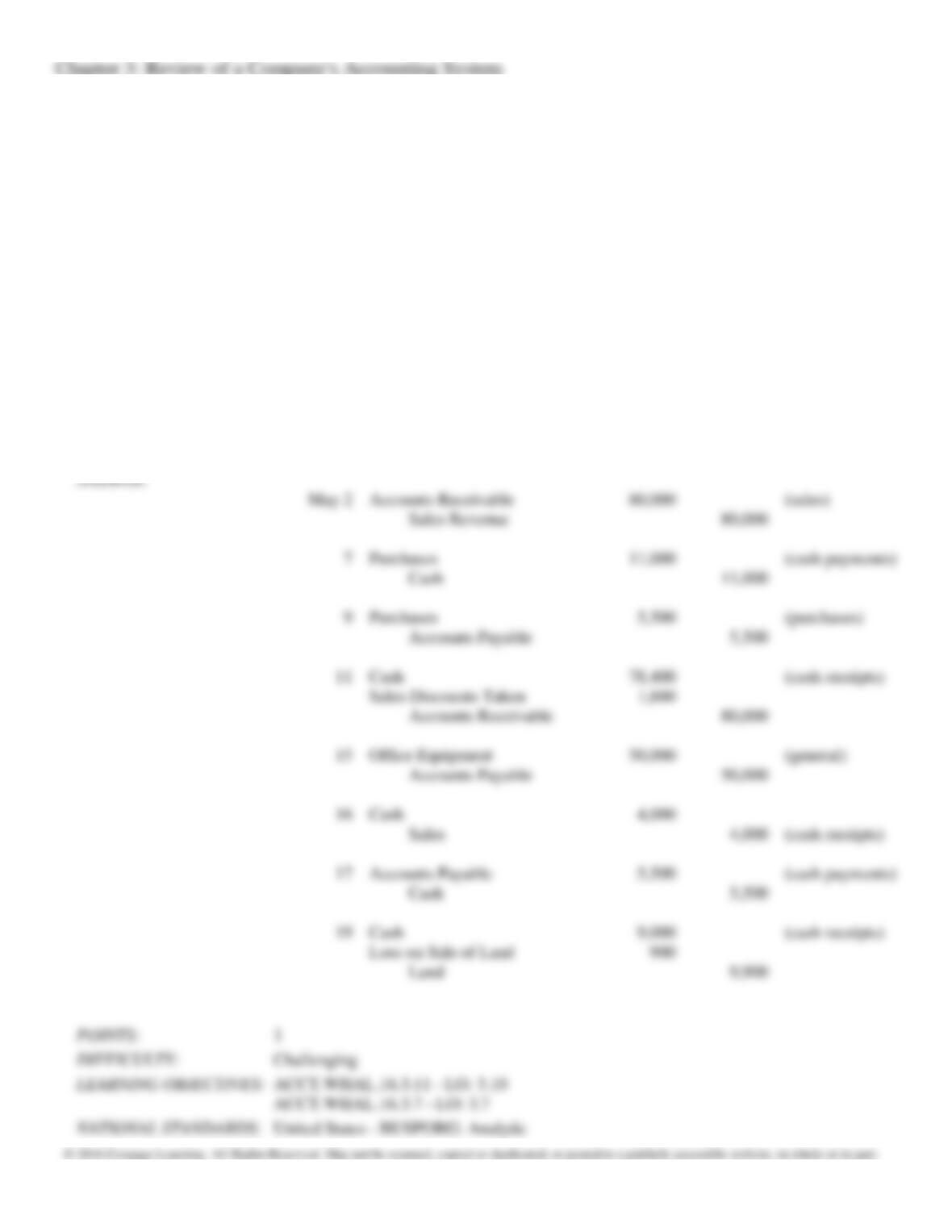
144. Manny Corporation has an accounting system that includes five journals: the sales, purchases, cash receipts, cash
payments, and general journals. The following transactions occurred during the month of May.
May 2
Sold merchandise to Tom Smith on account, $80,000, terms 2/10, n/30.
7
Purchased merchandise from the Karen Ruth Company for $11,000, paying cash.
9
Purchased merchandise from Joan Wholesalers on account for $5,500, terms n/30.
11
Received payment from Tom Smith for the $80,000 invoice amount, less the 2%
sales discount.
15
Purchased office equipment from Lew Supply Company for $50,000 on account.
16
Made a cash sale of $4,000 to Smithtown distributors.
17
Paid Joan Wholesalers for the $5,500 invoice.
19
Sold land for $9,000 cash. The original cost of the land was $9,900.
Required:
Prepare (in general journal form) the journal entries necessary to record the above transactions in the month of May,
and indicate in which (special) journal they would have been recorded. Assume that Manny Corporation uses the
periodic inventory system.
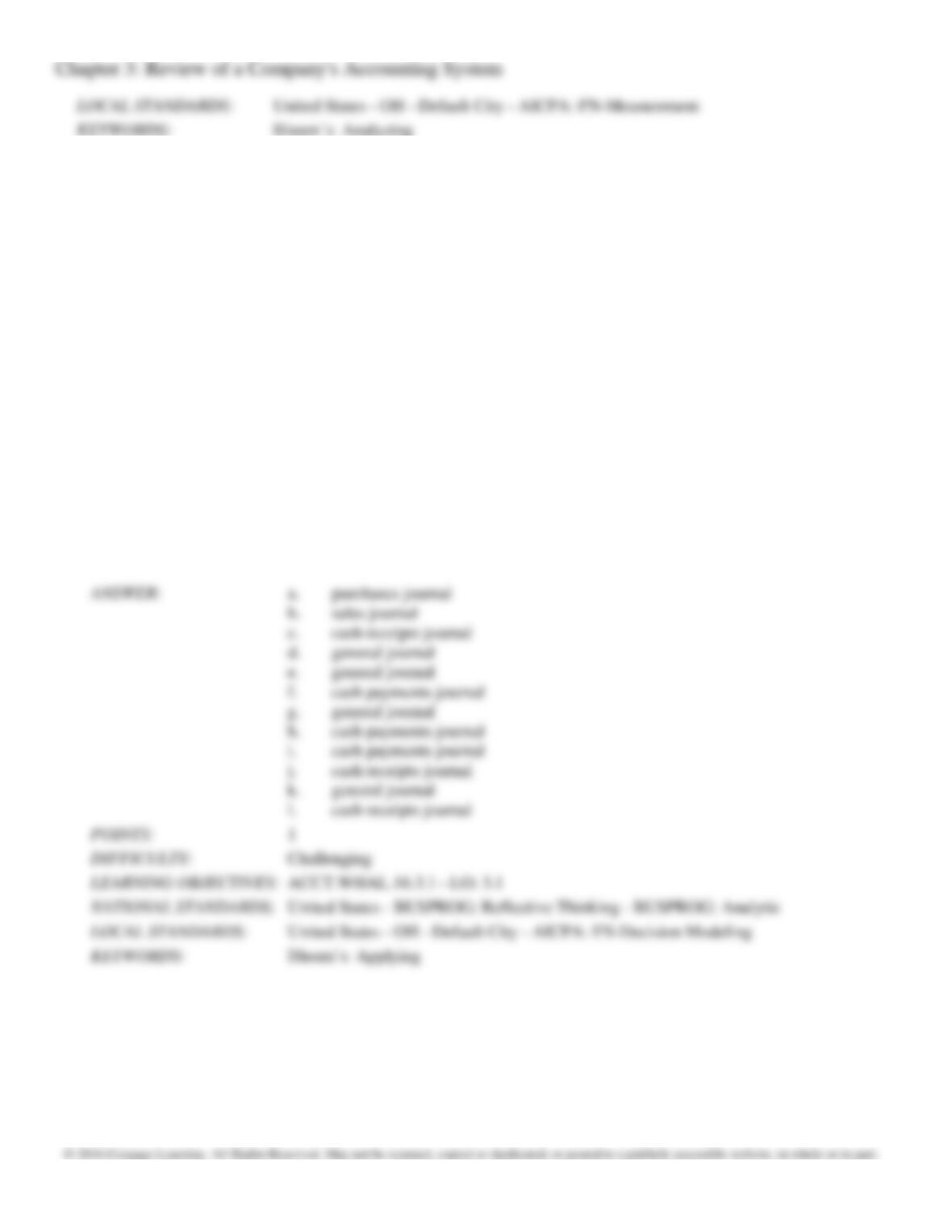
145. The Bell Corporation uses a general journal, a sales journal, a purchases journal, a cash receipts journal, and a cash
payments journal. Below are listed 12 of Bell Corporation’s transactions in for the current year.
a.
Purchased $3,000 of merchandise on credit.
b.
Sold $500 merchandise on account.
c.
Sold $1,500 merchandise for cash.
d.
Credited $300 in sales returns to customer accounts.
e.
Prepared adjusting and closing entries.
f.
Paid $200 office salaries.
g.
Returned $250 of defective merchandise to supplier for credit on account.
h.
Purchased building site for $7,500 cash.
i.
Purchased $1,000 merchandise for cash.
j.
Collected $750 from customers on account.
k.
Purchased building by issuing $10,000 note payable.
l.
Received a $600 income tax refund.
a.
b.
c.
d.
f.
g.
h.
i.
j.
k.
l.
Required:
List the letters (a) through (l) to reference the transactions shown above, and next to each letter write the name
of the journal in which Bell would record that transaction.
United States – OH – Default City – AICPA: FN-Measurement
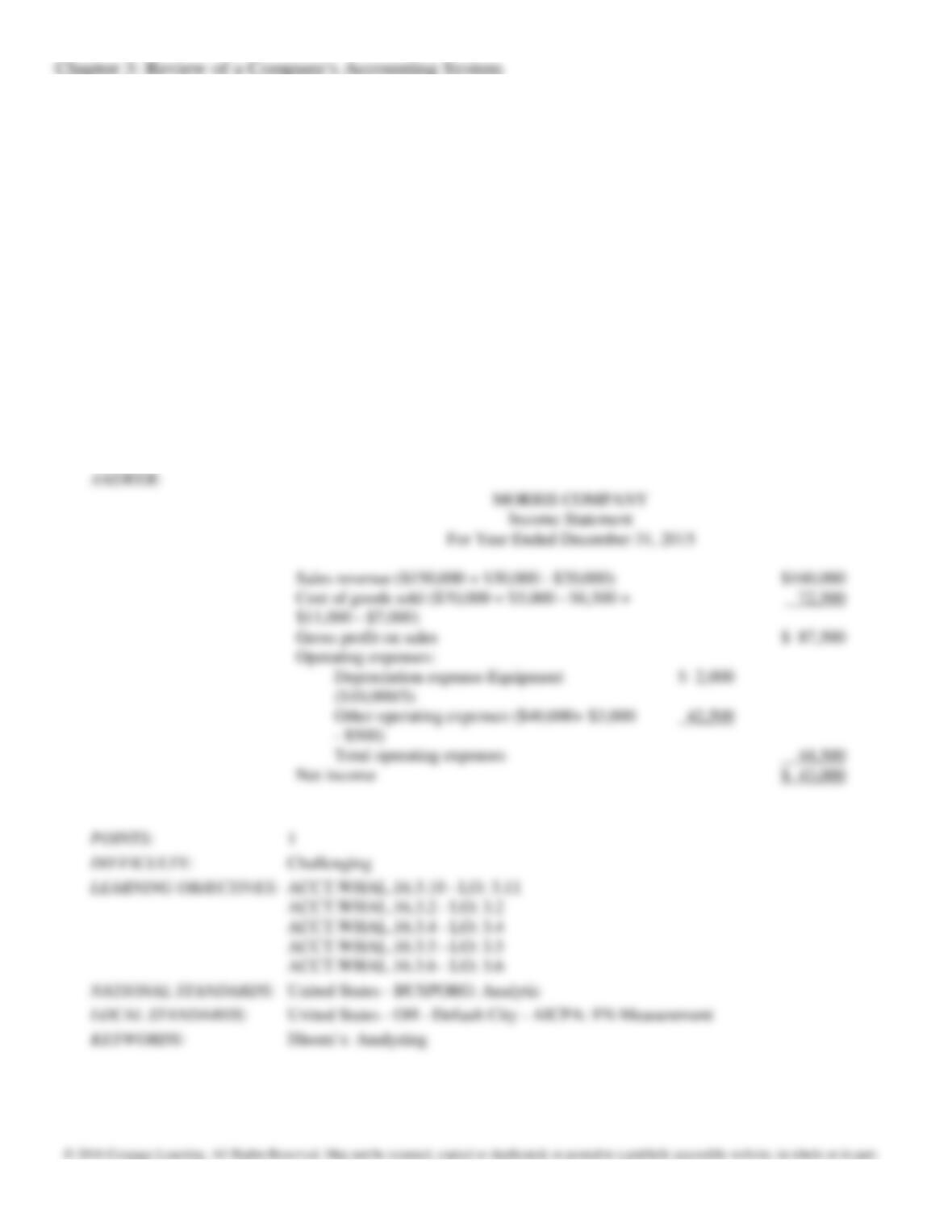
146. The Morris Company uses cash-basis accounting for its records. During 2015, Morris collected $150,000 from its
customers, made payments of $70,000 to its suppliers for merchandise inventory, and paid $40,000 for operating
costs. Morris wants to prepare its financial statements on an accrual basis. In gathering information for the accrual-
basis financial statements, Morris discovered the following:
·
At the beginning of 2015, customers owed Morris $20,000, and Morris owed suppliers
$7,000.
·
At the end of 2015, customers owed Morris $30,000, and Morris owed suppliers $11,000.
·
Two years ago, Morris purchased equipment for $10,000. The equipment has a useful life
of five years and no salvage value.
·
For the year 2015, Morris’s beginning inventory was $5,000, and its ending inventory was
$6,500.
·
At the beginning of 2015, Morris had prepaid rent of $3,000. At the end of the year, Morris
had prepaid rent of $500.
Required:
Using accrual accounting, prepare an income statement for 2015 for Morris Company.
1
ACCT.WHAL.16.3.5 – LO: 3.5
United States – BUSPORG: Analytic
United States – OH – Default City – AICPA: FN-Measurement
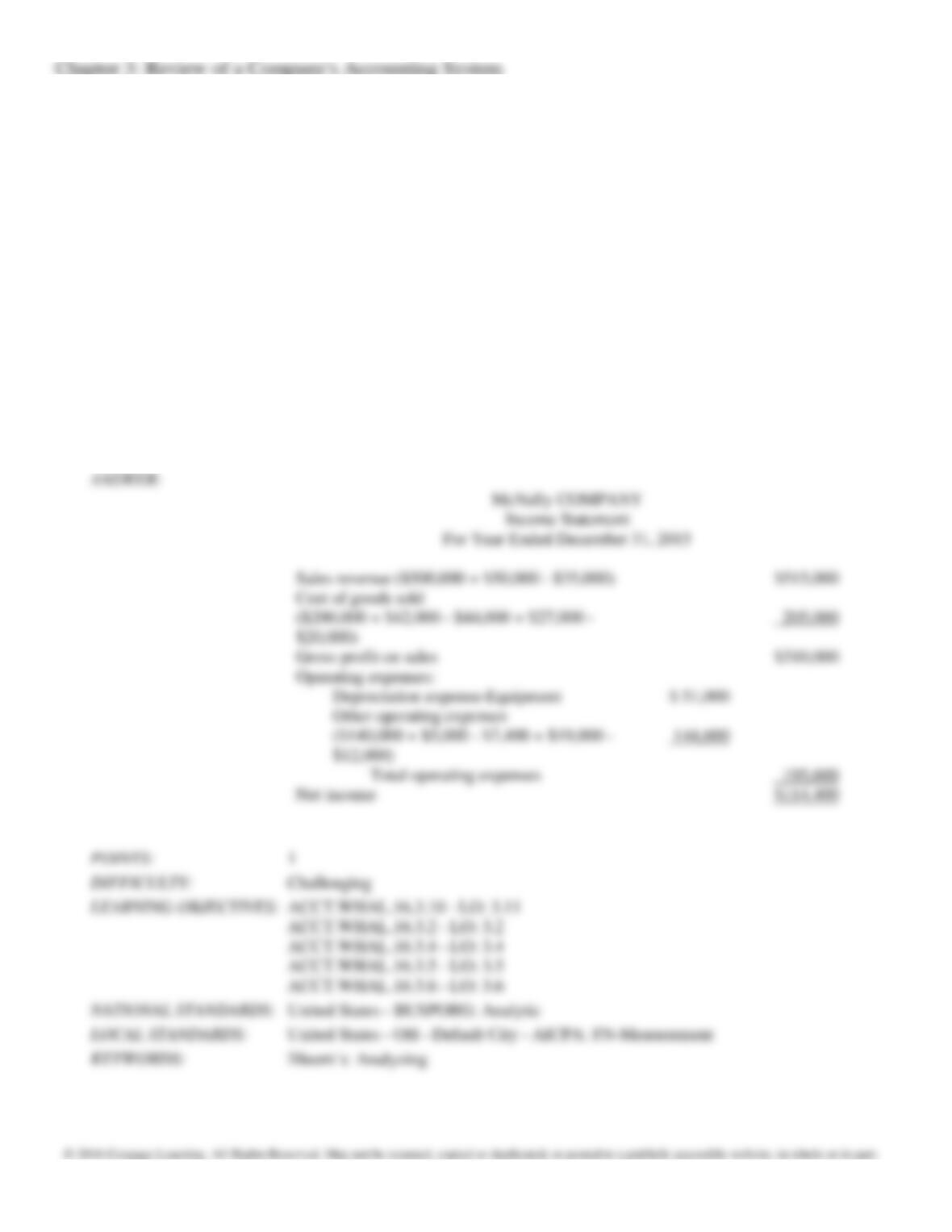
147. The McNally Company uses cash-basis accounting for its records. During 2015, McNally collected $500,000 from
its customers, made payments of $200,000 to its suppliers for inventory, and paid $140,000 for operating costs.
McNally wants to prepare accrual-basis financial statements. In gathering information for the accrual-basis financial
statements, McNally discovered the following:
·
Customers owed McNally $35,000 at the beginning of 2015 and $50,000 at the end of
2015.
·
McNally owed suppliers $20,000 at the beginning of 2014 and $27,000 at the end of 2015.
·
McNally’s beginning inventory was $42,000, and its ending inventory was $44,000.
·
McNally had prepaid expenses of $5,000 at the beginning of 2015 and $7,400 at the end of
2014.
·
McNally had accrued expenses of $12,000 at the beginning of 2015 and $19,000 at the end
of 2015.
·
Depreciation for 2015 was $51,000.
Required:
Prepare an accrual-basis income statement for 2015 for McNally Company.
1
Challenging
United States – BUSPORG: Analytic
United States – OH – Default City – AICPA: FN-Measurement
148. What is the primary purpose of a company’s accounting system?
149. List the major steps in the accounting cycle.
150. What are the advantages of using the general journal when recording journal entries?
151. What are adjusting entries and why are they necessary?
152. What is the order in which financial statements should be prepared?
153. What are closing entries and why are they necessary?
154. What is the purpose of the worksheet?
155. What is the purpose of a reversing entry?
156. What is the difference between a subsidiary ledger and a special journal?
157. What type of adjustments are necessary to convert cash basis to accrual based accounting?
158. A number of steps are typically completed during each accounting period to record, store, and report the accounting
information contained in the recorded transactions. These steps are referred to as the accounting cycle. List the steps
of the accounting cycle in the sequence in which they are performed.
159. Special journals, including the sales, purchases, cash receipts, cash payments, and general journals, were discussed in
the textbook. Indicate (a) the reasons why special journals may be used, and (b) which transactions would appear in
each of the five journals.
160. Please (a) define the cash-basis accounting method and state how net income is determined using this method, (b)
describe accrual accounting, and (c) indicate which of the two methods (i.e., cash or accrual) is recommended under
GAAP.
161. The accrual basis of accounting is a system that attempts to measure changes in the resources and obligations of the
entity, as those changes affect the accounting equation, regardless of the timing of actual cash flows.
Required:
First, describe the timing of revenue and expense recognition under the accrual basis versus the cash basis of
accounting. Then, give two examples of (1) a revenue-related transaction and (2) an expense-related transaction that
would be reported at significantly different points in time using the accrual basis versus the cash basis.