Chapter 03 – The Plasma Membrane and Membrane Potential
50. Gap junctions can be found in some non-muscle tissues, where they permit unrestricted passage of small nutrient
molecules between cells.
a.
True
b.
False
51. If a substance can cross a membrane, the membrane is impermeable to that substance.
a.
True
b.
False
False
52. Highly lipid-soluble particles of any size can dissolve in the lipid bilayer and pass through the membrane.
a.
True
b.
False
True
53. All molecules and ions are in continuous random motion at temperatures above absolute zero as a result of thermal
(heat) energy.
a.
True
b.
False
True
54. Solutions are homogeneous mixtures containing a relatively large amount of one substance called the solvent and
smaller amounts of one or more dissolved substances called solutes.
a.
True
b.
False
True
55. If a substance can permeate the membrane, its rate of simple diffusion is inversely proportional to its concentration
gradient.
a.
True
b.
False
False
56. The greater the lipid solubility of a substance, the slower the substance can diffuse through the membrane’s lipid
bilayer down its concentration gradient.
a.
True
b.
False
False
57. A more direct means of expressing solvent concentration is the osmolarity of a solution, which is a measure of its total
solvent concentration given in terms of the mass of particles.
a.
True
b.
False
False
58. Membrane channels can be open or closed, but carriers are always “open for business.”
a.
True
b.
False
True
59. Saturation of carriers is a critical rate-limiting factor in the transport of selected substances across the kidney
membranes during urine formation.
a.
True
b.
False
True
60. In secondary active transport, energy is used directly in the entire process.
a.
True
b.
False
False
61. Materials packaged for export by the endoplasmic reticulum and Golgi complex are externalized by exocytosis.
a.
True
b.
False
True
62. The term membrane potential refers to a separation of opposite charges across the membrane.
a.
True
b.
False
True
63. The balanced charges responsible for membrane potential accumulate in a thick layer along opposite surfaces of the
membrane.
a.
True
b.
False
False
64. An almost insignificant fraction of the total number of charged particles present in the body fluids is responsible for
the membrane potential.
a.
True
b.
False
True
65. The equilibrium potential for a given ion with differing concentrations across a membrane can be calculated by means
Chapter 03 – The Plasma Membrane and Membrane Potential
of Fick’s equation.
a.
True
b.
False
False
66. The difference in fluid composition inside and outside a cell is maintained by the ____________________.
67. Phospholipids have a(n) ____________________ head containing a negatively charged phosphate group and two
electrically neutral fatty acid chain tails.
polar
68. ____________________ proteins are polar molecules that do not penetrate the membrane.
Peripheral
69. The lipid bilayer is responsible for the ____________________ of the plasma membrane.
fluidity
70. Some trans-membrane proteins form water-filled pathways, or ____________________, through the lipid bilayer.
channels
71. ____________________ forms flexible but non-elastic fibers or sheets that provide tensile strength.
Collagen
72. ____________________ is a rubbery protein fiber most plentiful in tissues that must easily stretch and then recoil
after the stretching force is removed.
73. ____________________ promotes cell adhesion and holds cells in position.
74. ____________________ act like “spot rivets” that anchor together two adjacent but non-touching cells.
75. Transcellular transport across the cell is regulated by ____________________ and ____________________ proteins.
76. A(n) ____________________ is made up of six protein subunits arranged in a hollow, tube-like structure that extends
through the thickness of the plasma membrane.
77. If a substance can cross a membrane, the membrane is _____to that substance.
78. ____________________ forces require the cell to expend energy in transporting a substance across the membrane.
79. The net effect of simultaneous electrical and concentration gradients on an ion is called a(n) ____________________
gradient.
80. In many cell types, membrane proteins form ____________________, which are channels specific for the passage of
water.
81. Osmolarity is expressed in ____________________.
82. A(n) ____________________ solution has the same concentration of non-penetrating solutes as normal body cells.
83. If red blood cells are placed in a(n) ____________________ solution, water will enter the cells by osmosis.
84. Carrier-mediated transport systems display three important characteristics that determine the kind and amount of
material that’s transferred across the membrane: ____________________, ____________________ and
____________________.
85. In ____________________ active transport, energy is directly required to move a substance against its concentration
gradient.
86. The two types of secondary active transport are ____________________ and ____________________.
87. When a secretory cell is stimulated to secrete, it may temporarily insert up to ____________________ times its
surface membrane area through exocytosis.
88. The cells of excitable tissues mainly include ____________________ cells and ____________________ cells.
89. The greater the ____________________ of the plasma membrane for a given ion, the greater the tendency for that ion
to drive the membrane potential toward the ion’s ____________________ potential.
90. A(n) ____________________ exists when no net movement of any ions takes place because all passive leaks are
exactly balanced by active pumping.
Chapter 03 – The Plasma Membrane and Membrane Potential
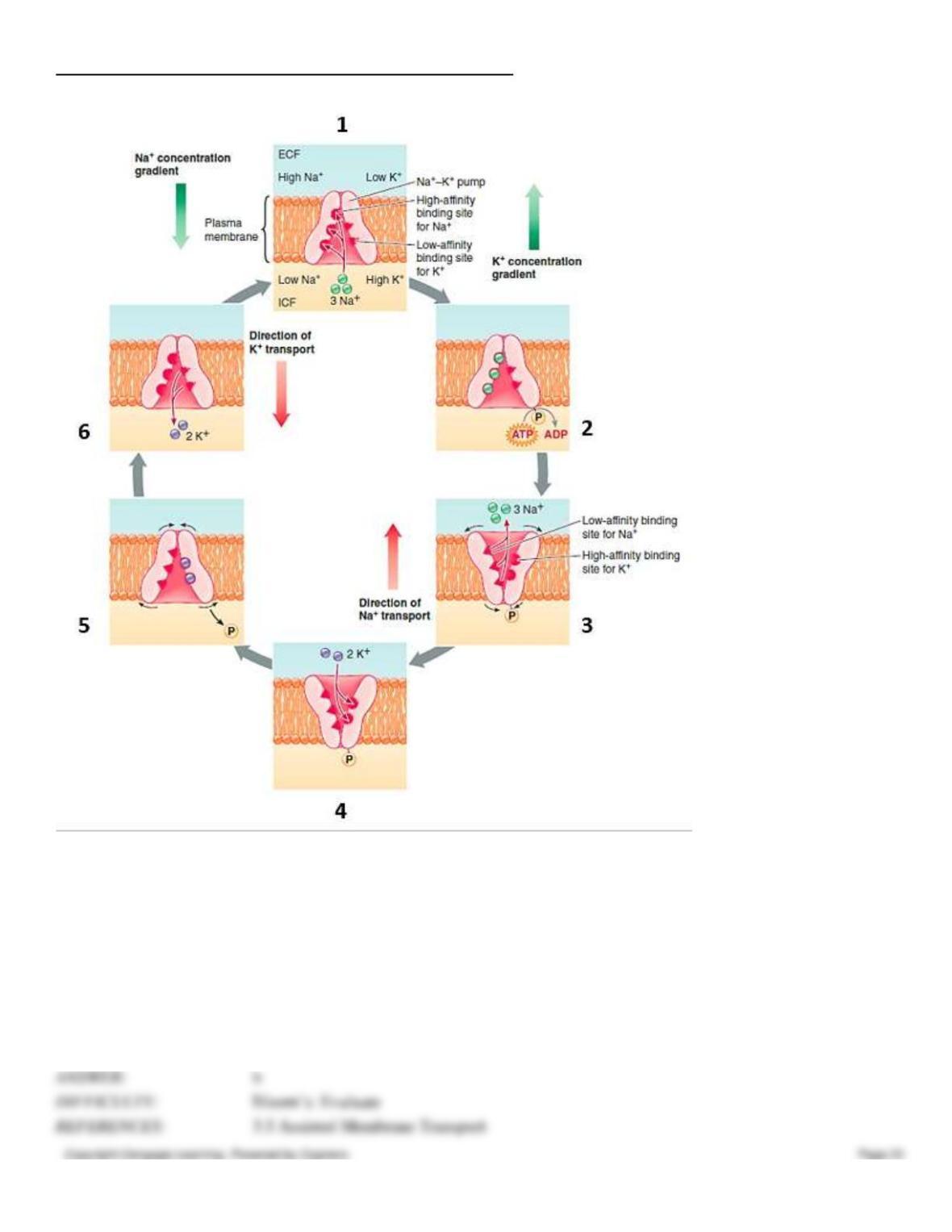
Figure 3-16
Answer the corresponding questions using the accompanying figure.
91. Which labeled diagram depicts phosphorylation?
a.
1
b.
2
c.
3
d.
4
e.
5
f.
6
92. Which labeled diagram depicts potassium being released into the ICF against its concentration gradient?
a.
1
b.
2
c.
3
d.
4
e.
5
f.
6
93. Which labeled diagram depicts the release of the phosphate group from the pump?
a.
1
b.
2
c.
3
d.
4
e.
5
f.
6
94. Which labeled diagram depicts the expenditure of energy?
a.
1
b.
2
c.
3
d.
4
e.
5
f.
6
b
95. Which labeled diagram depicts sodium ions in the ICF?
a.
1
Chapter 03 – The Plasma Membrane and Membrane Potential
b.
2
c.
3
d.
4
e.
5
f.
6
96. Describe the main functions of the plasma membrane.
97. Discuss how some cells are directly linked by specialized cell junctions.
98. Describe the structure and function of desmosomes.
99. Explain tonicity and how best to test it.
100. Describe the three roles of the sodium-potassium pump.