46. When a female softball player is given more applause for a home run hit than a male teammate, it would most likely
be due to:
a. first impression error.
b. projection.
c. selective perception.
d. contrast against a stereotype.
47. Attribution theory helps to behavior in organizations.
a. measure
b. explain causes of
c. specify correct or appropriate
d. observe
48. An achievement-oriented sales representative might attribute his failure to meet a monthly sales quota to:
a. changing economic conditions.
b. a short list of prospects provided by the company.
c. a lack of effort.
d. a cutback in product advertising.
49. Individuals who make external attributions will be more likely to:
a. achieve higher levels of performance.
b. quit because they do not feel responsible.
c. develop feelings of incompetence that may lead to depression.
d. provide a supporting environment for followers.
50. Achievement-oriented individuals attribute their success to .
a. good luck
b. ability
c. task difficulty
d. simplicity of the task
51. Achievement-oriented individuals attribute their failures to:
a. bad luck.
b. a combination of bad luck and a difficult task.
c. lack of effort.
d. lack of effort and a difficult task.
52. Research shows that successful candidates make:
a. less attributions than unsuccessful candidates.
b. more external attributions than unsuccessful candidates.
c. more internal attributions for negative events.
d. less internal attributions for negative events.
53. When a student attributes a high test grade to his or her diligent study habits and a low grade to the instructor’s
poorly worded questions, the student is displaying:
a. the fundamental attribution error.
b. the consensus error.
c. the acceptance error.
d. self-serving bias.
54. Attributional biases imply that managers must:
a. always be correct in their perceptions.
b. be wary of the cognitive process in decision making.
c. know as much as possible about individual differences and determine the causes of behavior.
d. not try to predict and control future behavior by understanding the causes of current behavior.
55. The tendency to make attributions to internal causes when focusing on someone else‘s behavior is:
a. remedied by the discounting principle.
b. known as the fundamental attribution error.
c. has been shown to not be related to cultural predispositions.
d. known as the self-serving bias.
56. When a manager makes the attribution that an employee’s lack of effort or ability is the basis for poor performance,
they are probably making an error called .
a. fundamental attribution
b. self-serving bias
c. discounting attribution
d. consistency attribution
57. A person from a fatalistic culture like India would be more likely than someone from China to:
a. make an internal attribution.
b. make a self-serving bias error.
c. make a fundamental attribution error.
d. make an external attribution.
58. GMA is considered a personality characteristic.
a. True
b. False
59. Personality is defined as a relatively stable set of characteristics that influence an individual’s behavior.
a. True
b. False
60. Heredity has been found to NOT be a determinant of personality.
a. True
b. False
61. The integrative approach to personality emphasizes individual growth and improvement.
a. True
b. False
62. Persons with high self-esteem and internal locus of control tend to be higher performers and are more satisfied with
their jobs.
a. True
b. False
63. High self-monitors can adjust their behavior to fit the situation.
a. True
b. False
64. A problem with self-report measure for assessing personality is that people often answer the questionnaires in
terms of how they want to be seen, rather than as they really are.
a. True
b. False
65. Mood is a state that has been found to be relatively stable and therefore contributes to the objective accuracy of
perception.
a. True
b. False
66. An example of a first impression error would be where speakers with higher vocal pitch are believed to be more
competent than those with lower voices.
a. True
b. False
67. CEO’s have been found to manage impressions by publicizing changes that seem to address financial analysts’
concerns without changing organizational policy.
a. True
b. False
68. High achievers are more likely to attribute their success to others and good luck.
a. True
b. False
69. The Pygmalion effect usually is associated with reduced output.
a. True
b. False
70. The basis for understanding individual differences stems from Lewin’s early contention that behavior is a function
of the person and the environment. This idea has been developed by the interactional psychology approach to
personality. Briefly explain the basic propositions of this approach.
71. Using the five personality characteristics identified as important for understanding organizational behavior, describe
an individual who would most likely be a strong performer.
72. Identify and explain barriers to social perception.
73. How would a manager use self-fulfilling prophecies to improve a work group?
74. Identify the most common errors that affect the attribution process, and briefly discuss the implications for
managers.
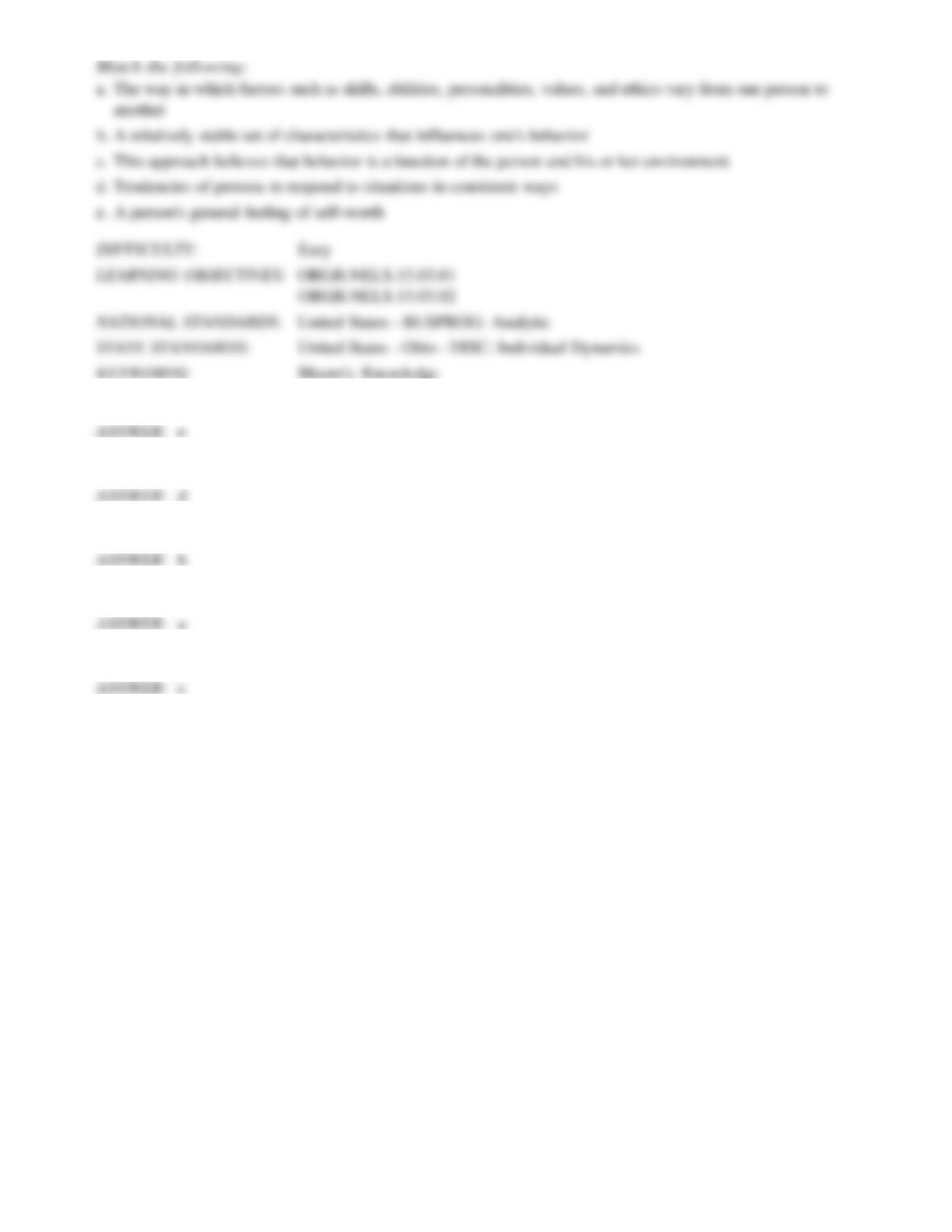
75. Self-esteem
76. Dispositions
77. Personality
78. Individual differences
79. Interactional psychology
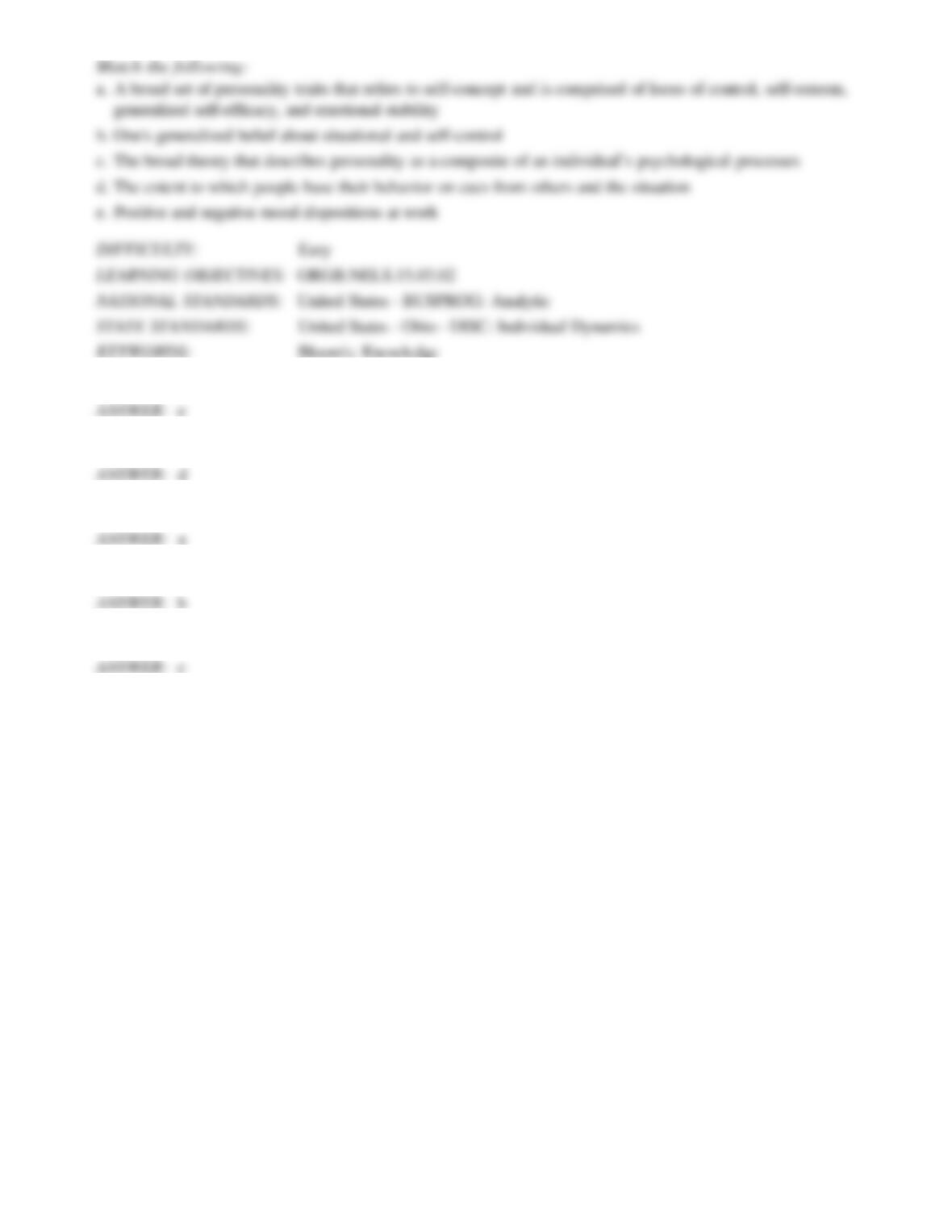
80. Affectivity
81. Self-monitoring
82. Core self-evaluation
83. Locus of control
84. Integrative approach
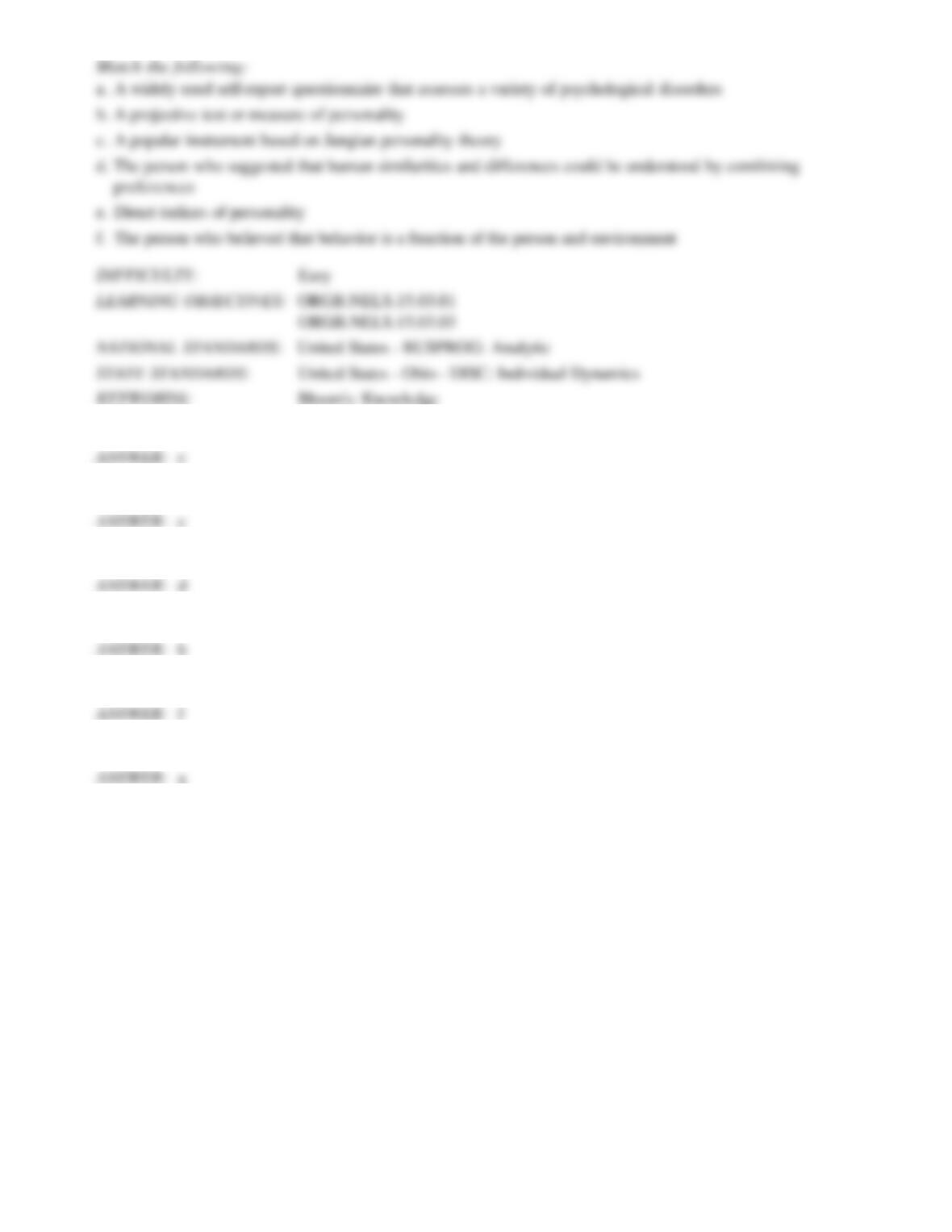
85. MBTI
86. Behavioral measures
87. Carl Jung
88. Rorschach ink blot test
89. Kurt Lewin
90. MMPI
91. Extrovert
92. Perceiver
93. Sensor
94. Judging preference
95. Thinker
96. Projection
97. Self-fulfilling prophecy
98. First impression
99. Nonverbal communication
100. Stereotype