
Chapter 3: Processing Accounting Information
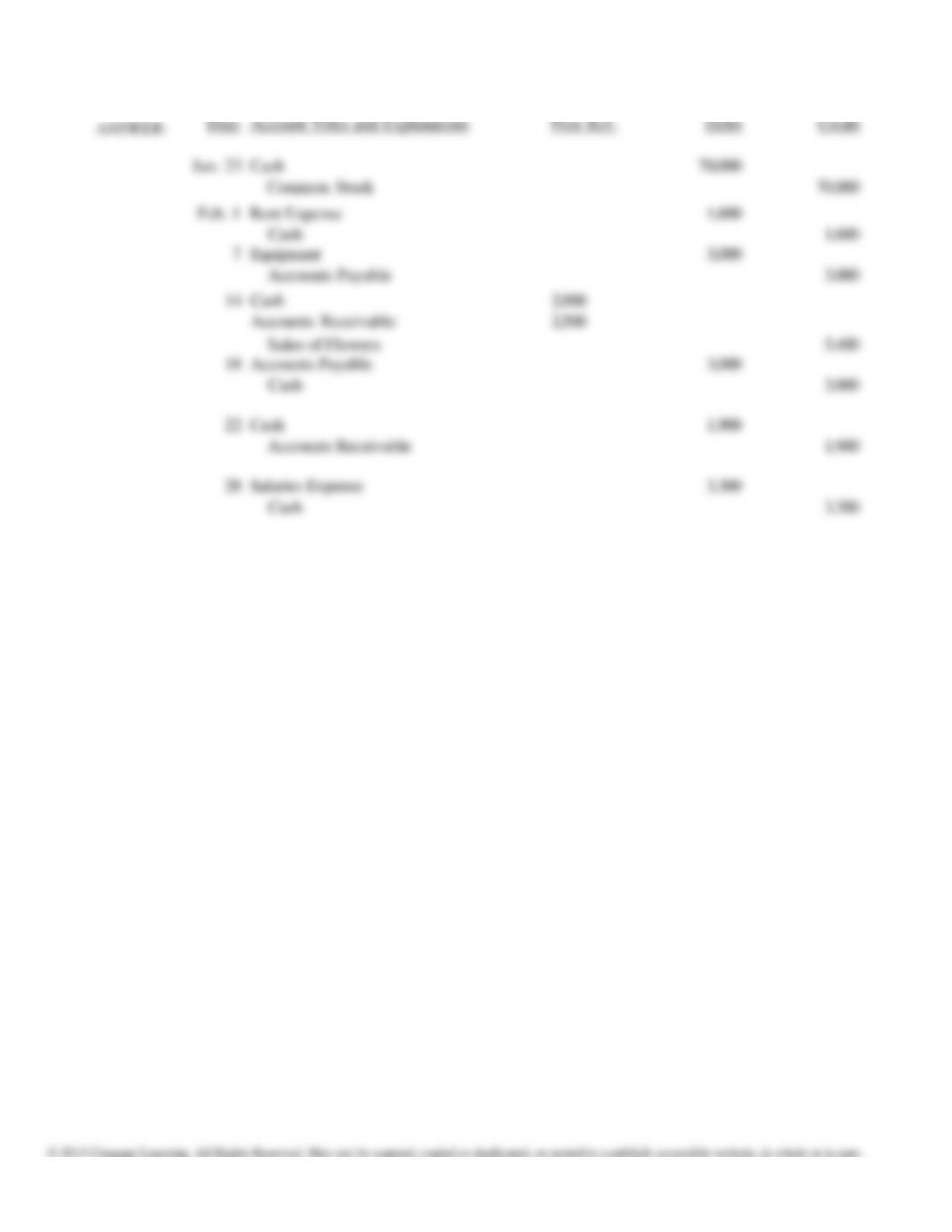
149. Karen’s Flower Shop began business as a corporation in 2015. Several transactions which occurred early in 2015 ar
below. Record each transaction in proper form, excluding written explanations, in the general journal provided.
A) January 23, 2015: Stockholders invested cash of $70,000 in the business and received 7,000
shares common stock as evidence of their ownership interest.
B) February 1, 2015: Rent of $1,600 was paid for the month of February.
C) February 7, 2015: Equipment with a cost of $3,000 was purchased on credit; payment is due
within 30 days.
D) February 14, 2015: Bills totaling $5,400 were presented to customers for flower
arrangements created and delivered; $2,900 was received in cash immediately; the balance
of $2,500 is due within 10 days.
E) February 18, 2015: Full payment was made for the equipment purchased on February 7.
F) February 22, 2015: Payment of $1,900 was received from customers with balances due from
February 14.
G) February 28, 2015: Employee salaries of $3,300 were paid.
General Journal
Date Account Titles and Explanations Post Ref. Debit
Chapter 3: Processing Accounting Information
Chapter 3: Processing Accounting Information
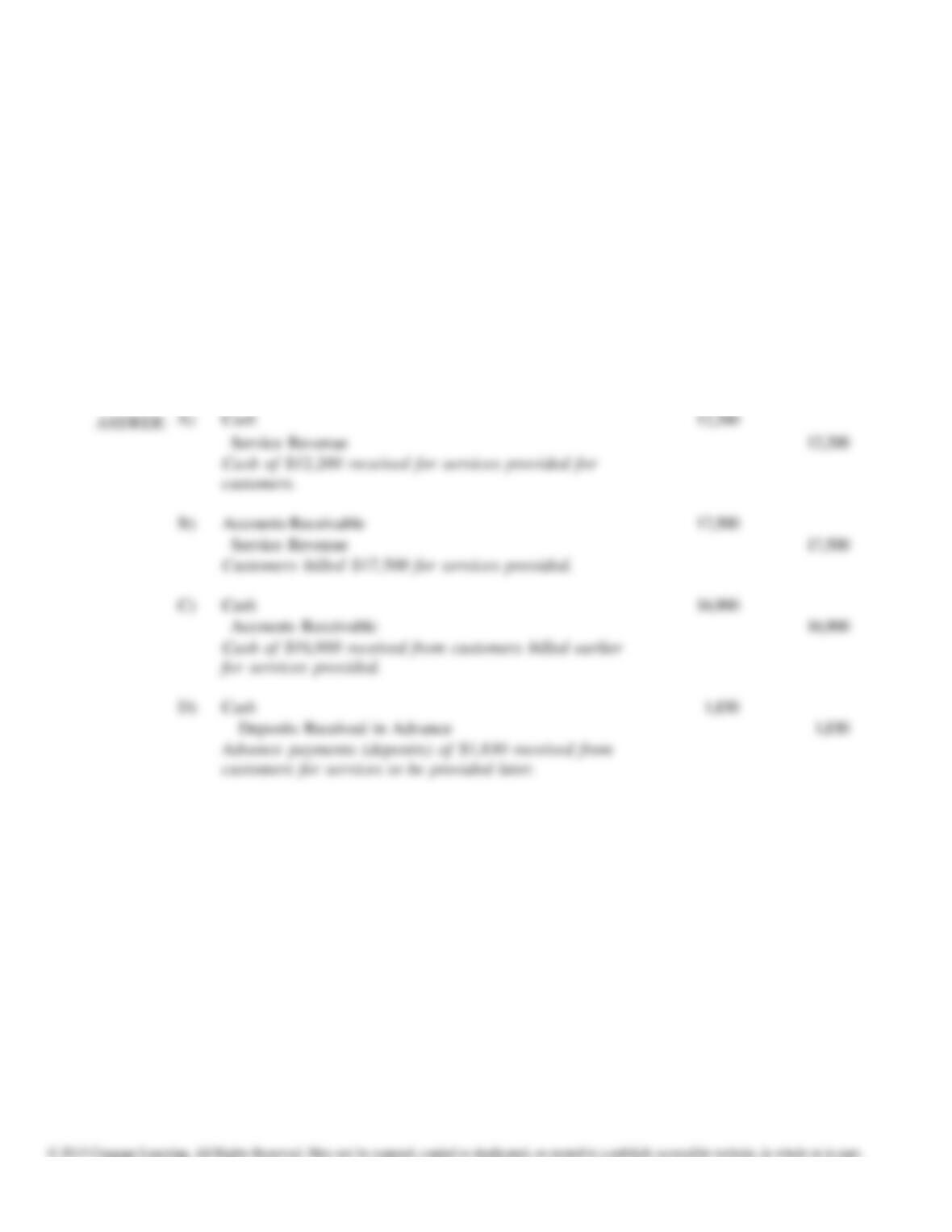
150. Four journal entries are presented below. Write an explanation for each entry in the space provided below the
entry.
A) Cash 12,200
Service Revenue 12,200
B) Accounts Receivable 17,500
Service Revenue 17,500
C) Cash 16,900
Accounts Receivable 16,900
D) Cash 1,830
Deposits Received in Advance 1,830
151. Described below are several transactions which an organization like the Rogers Symphony Orchestra might
record. Several accounts from the organization’s financial statements also are listed below. Using these
account titles, record each transaction in proper journal entry format in the general journal provided. A written
explanation for each journal entry is not required.
Accounts:
Cash Common Stock
Accounts Receivable Sales Revenue
Musical Instruments Selling Expenses
Accounts Payable General & Administrative
Expenses Deposits Received in Advance
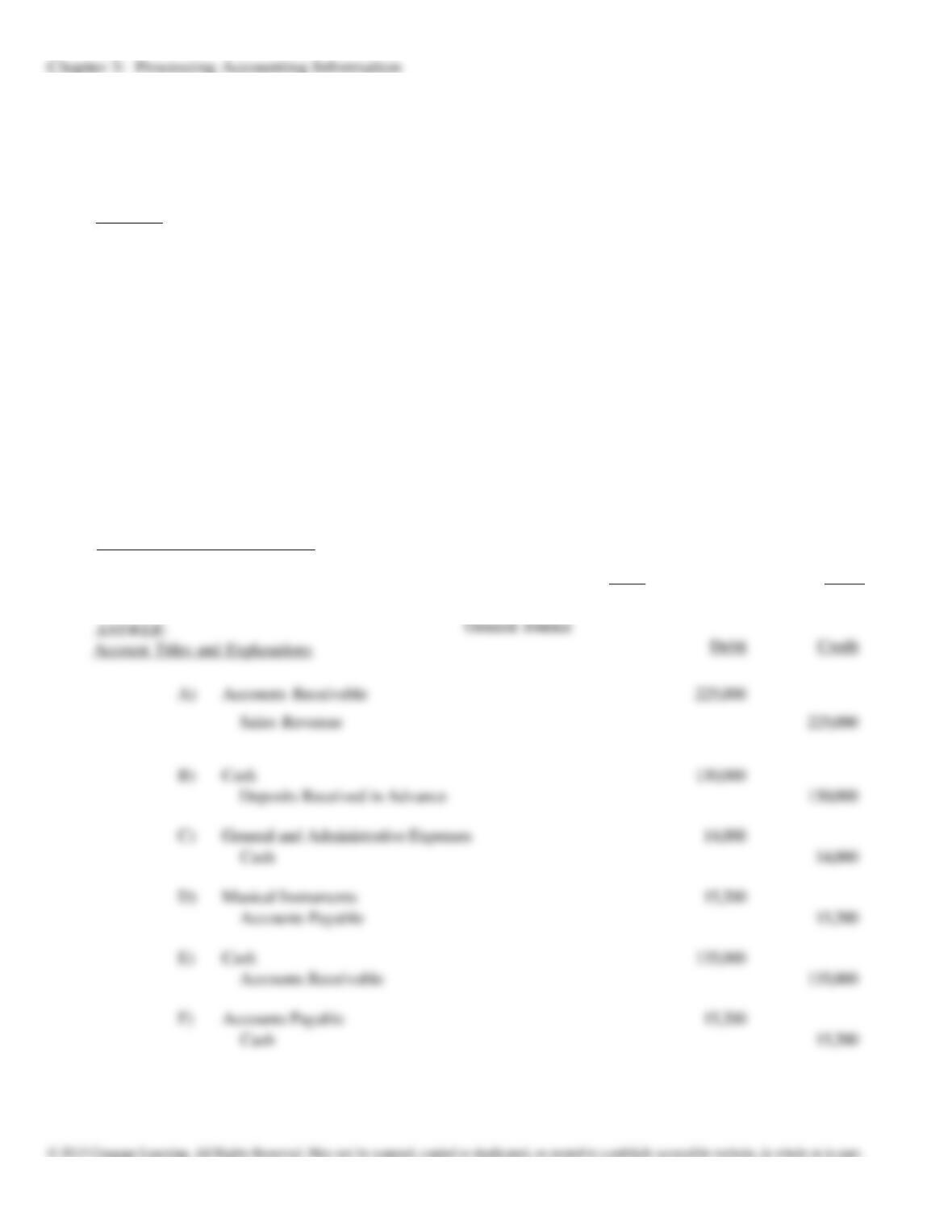
A) Customers are mailed bills for tickets, $225,000.
B) Customers pay for tickets in advance, $130,000.
C) Administrative employees are paid their monthly salaries, $14,000.
D) An invoice is received for new musical instruments, $15,200; payment is due in 30 days.
E) Payments received from customers for amounts billed in a previous transaction amount to
$135,000.
F) Payment is made for the instruments invoice received in a previous transaction.
General Journal
Account Titles and Explanations
Debit
Credit

Chapter 3: Processing Accounting Information
152. The bookkeeper for B. Sebastian & Company, Inc. prepared the following journal entries and posted the entries
to the general ledger as indicated in the T accounts presented. Assume that the dollar amounts and the
descriptions of the entries are correct.
Journal entries:
May 5 Accounts Receivable 1,600
Service Revenue 1,600
Customers were billed for services completed.
11 Cash 500
Service Revenue 500
Payment is received from a customer billed for services
on May 1.
15 Office Supplies 700
Accounts Payable 700
Purchased office furniture on credit; payment is due in
30 days.
25 Office Furniture 700
Cash 700
Payment is made for the office furniture bill received
on May 15.
ACCOUNTS RECEIVABLE SERVICE REVENUE
5/5
1,600
|
|
5/5
1,600
|
|
5/11
500
CASH
ACCOUNTS PAYABLE
5/11
500
|
5/25
700
| 5/15
700
OFFICE SUPPLIES
OFFICE FURNITURE
5/15
700 |
5/25
700 |
Chapter 3: Processing Accounting Information
See the journal entries and T accounts for B. Sebastian & Company.
REQUIRED: If you assume that all journal entries have been posted correctly, use the above information
to answer these questions:
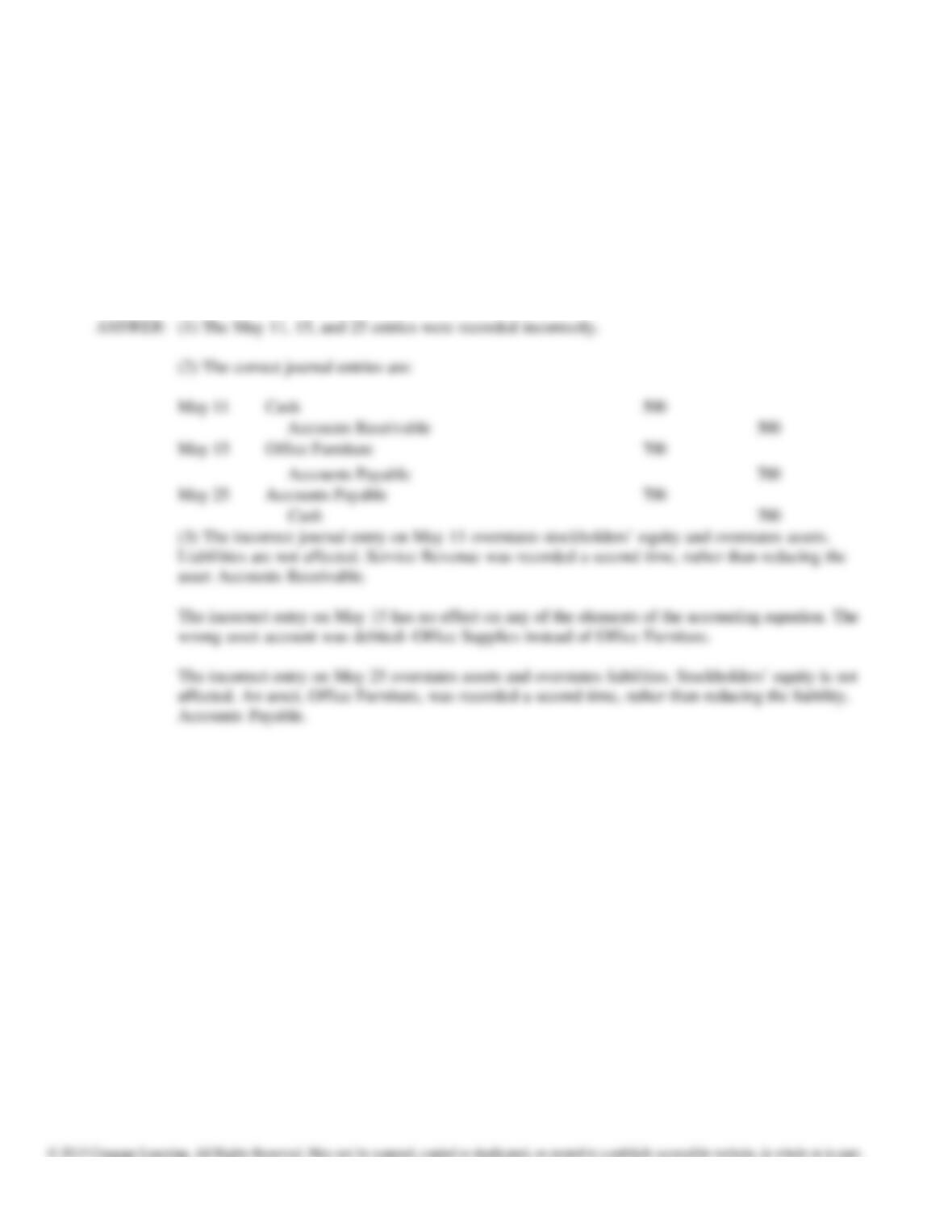
(1) Identify the transactions that the bookkeeper recorded incorrectly in the general journal.
(2) Prepare the journal entry that the bookkeeper should have made for each transaction that you have identified
as being made incorrectly.
(3) For each journal entry recorded incorrectly, indicate the impact of the error on the accounting equation.
For your answer, indicate whether each element of the accounting equation, Assets, Liabilities, and
Stockholders’ Equity, has been “Understated” or “Overstated” or there has been “No Effect.”
Chapter 3: Processing Accounting Information
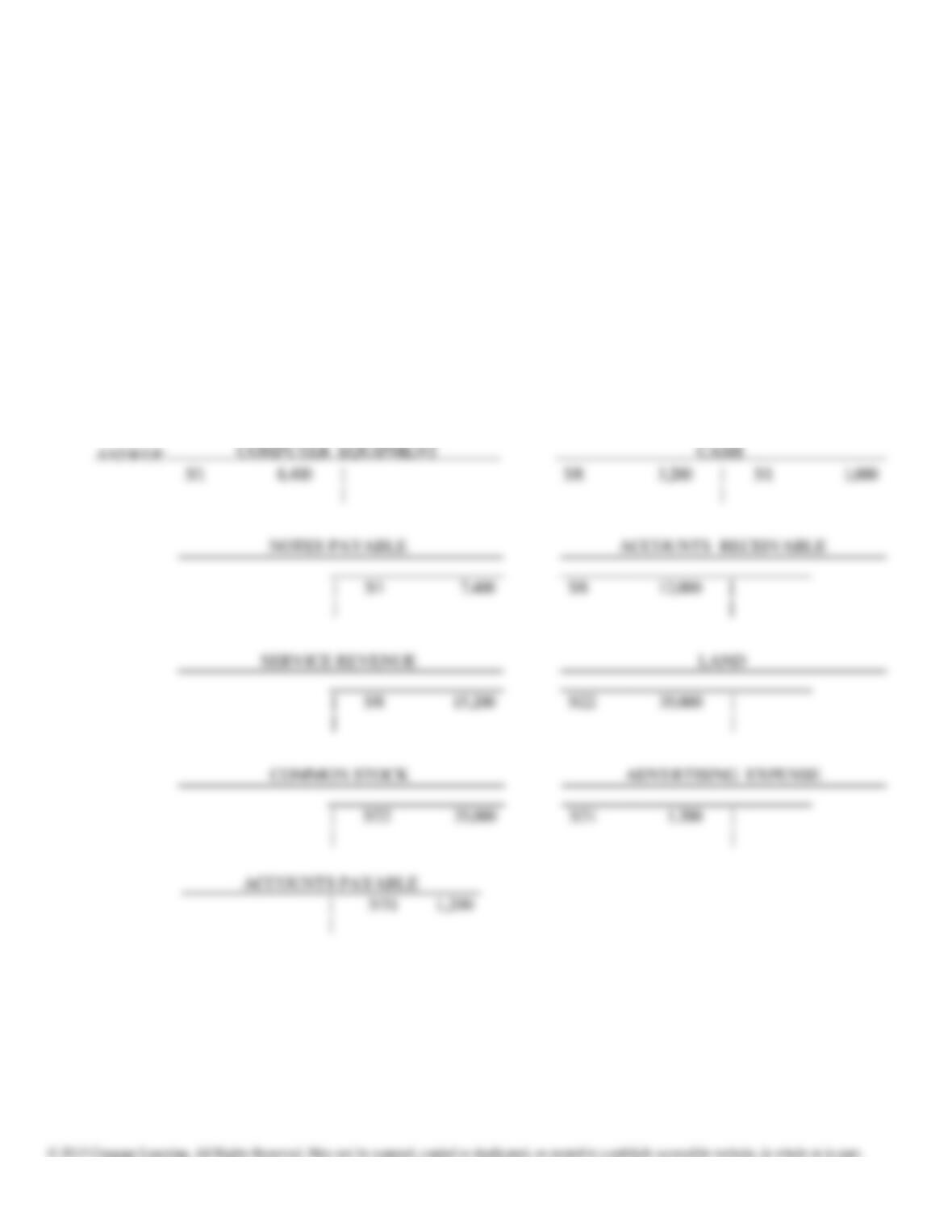
Terry Company
Transactions
May 1 Terry purchased computer equipment for $8,400, paying $1,000 now, and
issuing a promissory note for the balance; the note is due in monthly
installments of $500 plus interest at 10% on the unpaid balance.
8 Terry records service revenue earned: $3,200 from cash customers; $12,000
for customers billed for completed services.
22 Common stock is issued for land with a fair value of $35,000.
31 An invoice for $1,200 is received from the company‘s advertising agency for
ads which were run on radio and TV during May; the invoice is due in 30 days.
153. Refer to the transactions for Terry Company.
Use the transactions incurred by the Terry Corporation to set up T accounts and post each transaction to the T
accounts.
Chapter 3: Processing Accounting Information
154. Refer to the Terry Company transactions.
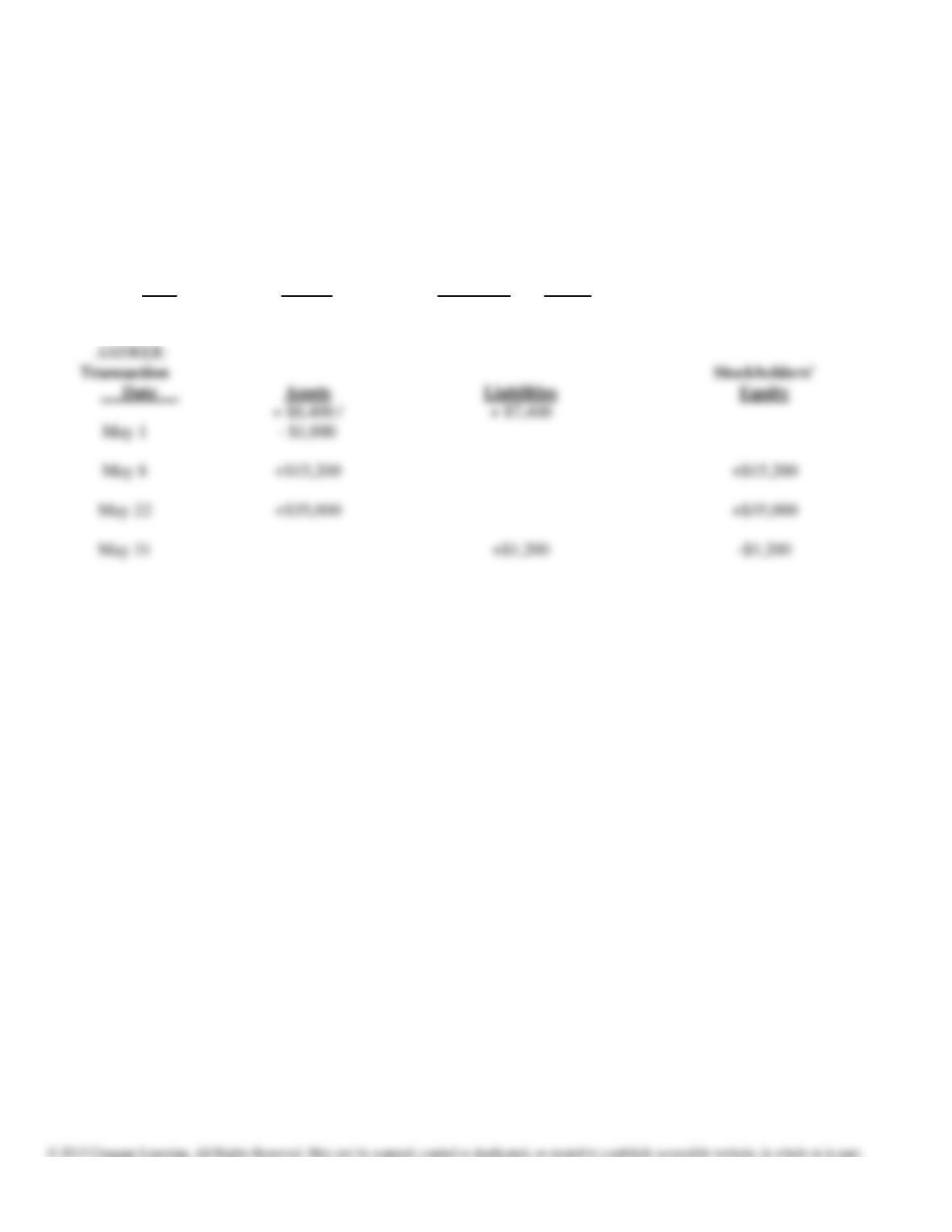
Required: Indicate the economic effects of each transaction above on the accounting equation. Use the following
format for your answers. Show the dollar amounts in the appropriate columns and use a “+” (plus) sign to indicate
an increase and a “-” (minus) sign to indicate a decrease.
Transaction
Date Assets Liabilities
Stockholders’
Equity
Chapter 3: Processing Accounting Information
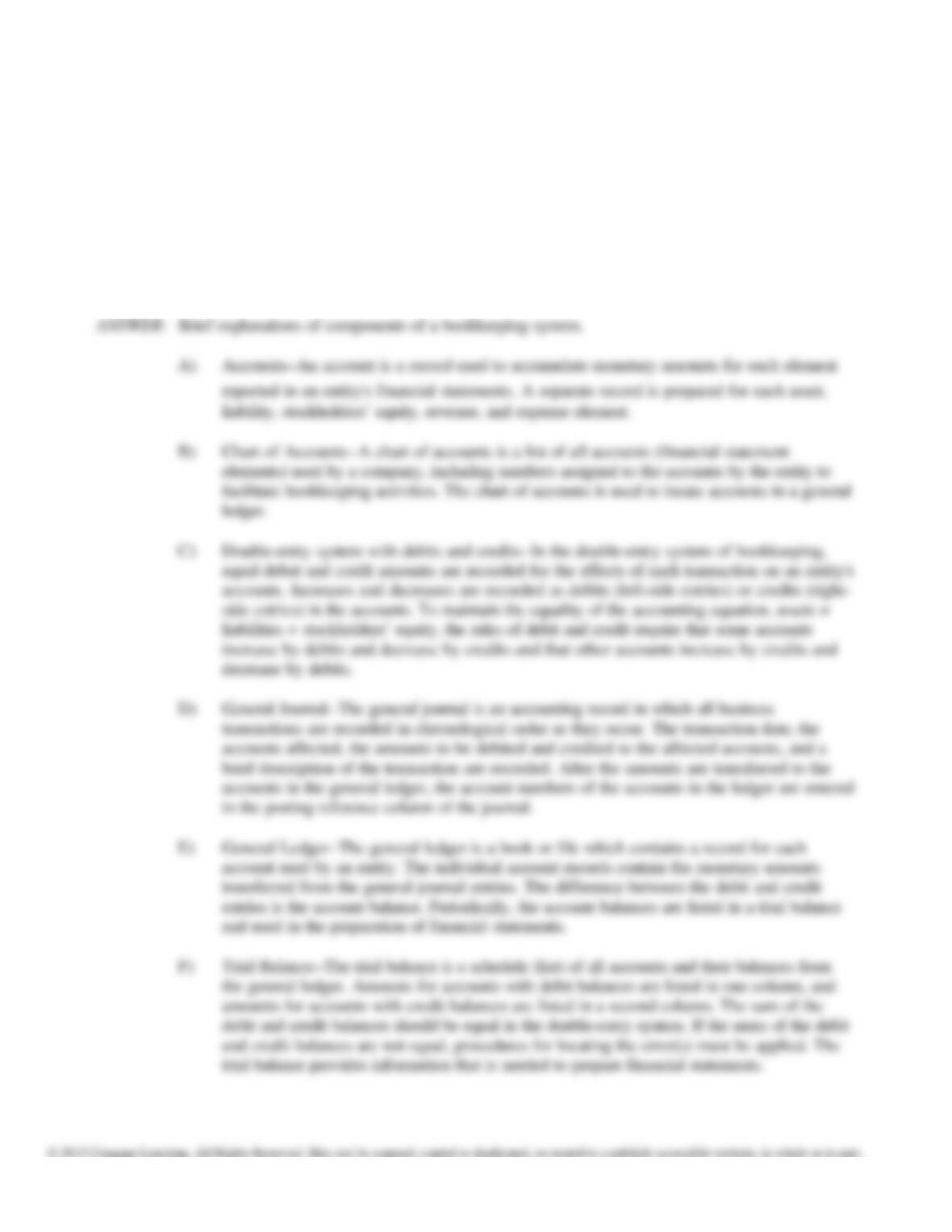
155. Several terms which represent components of a bookkeeping system are listed below. For each term, write a brief
explanation of how that component is used in a bookkeeping system. Space is provided for your answer
immediately below each term.
A) Accounts
B) Chart of Accounts
C) Double-entry system with debits and credits
D) General Journal
E) General Ledger
F) Trial Balance
Chapter 3: Processing Accounting Information
156. Would errors made by a bookkeeper in recording journal entries and in posting journal entries to the general ledger
be discovered by preparing a trial balance? Explain why or why not for both the journal entry errors and the posting
errors.
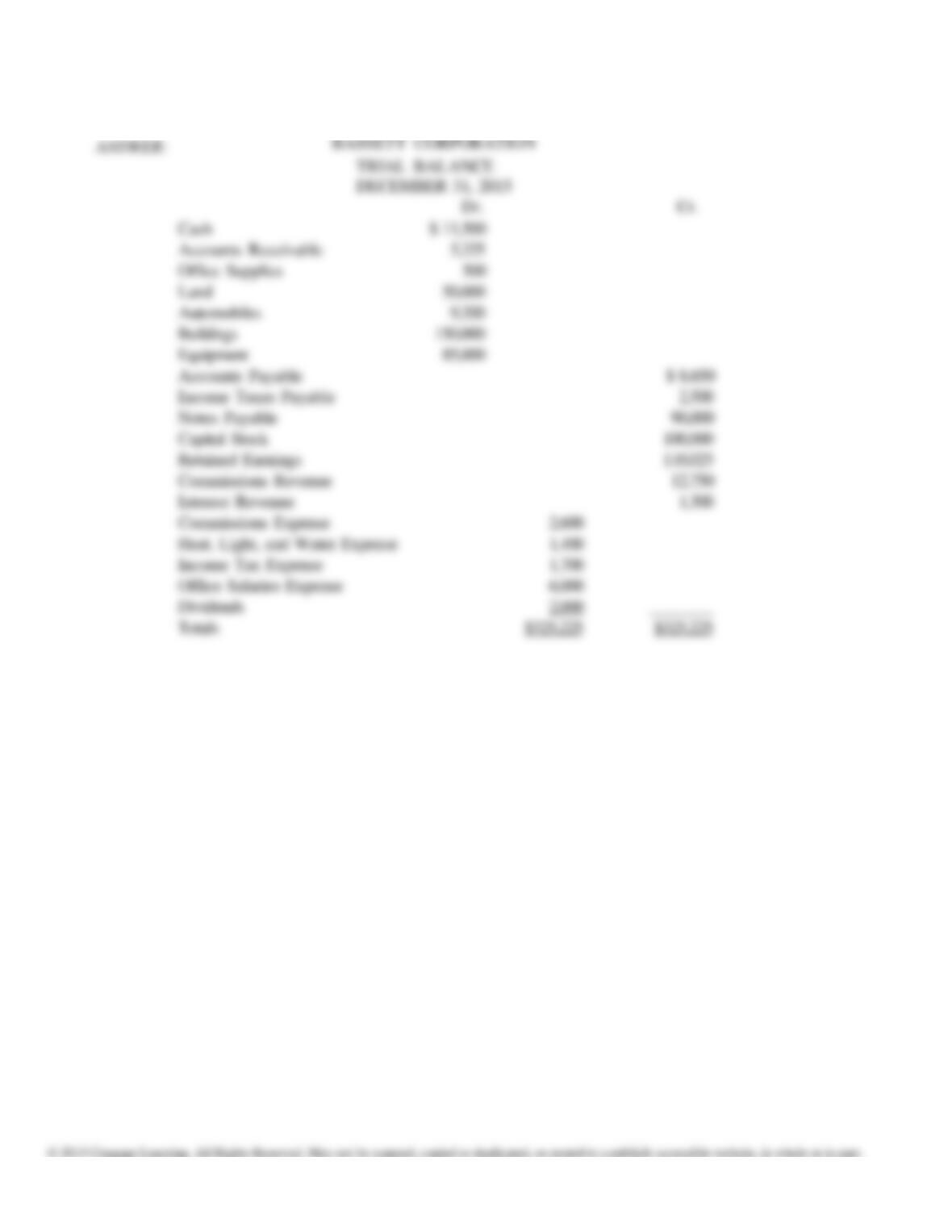
157. The following list of accounts was taken from the general ledger of Bassett Corporation on December 31, 2015.
The bookkeeper thought it would be helpful if the accounts were arranged in alphabetical order. Each account
contains the balance that is normal for that type of account; for example, Cash normally has a debit balance.
Prepare a trial balance as of this date with the accounts arranged in the following order: (1) assets, (2) liabilities, (3)
stockholders’ equity, (4) revenues, (5) expenses, and (6) dividends.
Accounts Payable
$ 8,650
Accounts Receivable
5,325
Automobiles
9,200
Buildings
150,000
Capital Stock
100,000
Cash
11,500
Commissions Expense
2,600
Commissions Revenue
12,750
Dividends
2,000
Equipment
85,000
Heat, Light, and Water Expense
1,400
Income Tax Expense
1,700
Income Taxes Payable
2,500
Interest Revenue
1,300
Land
50,000
Notes Payable
90,000
Office Salaries Expense
6,000
Office Supplies
500
Retained Earnings
110,025
Chapter 3: Processing Accounting Information
Totals
Chapter 3: Processing Accounting Information
158. From an accounting perspective, explain how an external event differs from an internal event and give an example
of each.
159. From an accounting perspective, what are source documents? Give examples of at least three source documents.
160. Provide at least three source documents and the related event for which each would provide the evidence to
record.
161. Briefly explain what accountants mean when they refer to the double-entry system of
accounting.