Cost Accounting: A Managerial Emphasis, 6e
Chapter 3 – Cost-Volume-Profit Analysis
38) Karen Hefner, a florist, operates retail stores in several shopping malls. The average selling price of an
arrangement is $30 and the average cost of each sale is $18. A new mall is opening where Karen wants to
locate a store, but the location manager is not sure about the rent method to accept. The mall operator
offers the following three options for its retail store rentals:
1. paying a fixed rent of $15,000 a month, or
2. paying a base rent of $9,000 plus 10% of revenue received, or
3. paying a base rent of $4,800 plus 20% of revenue received up to a maximum rent of $25,000.
Required:
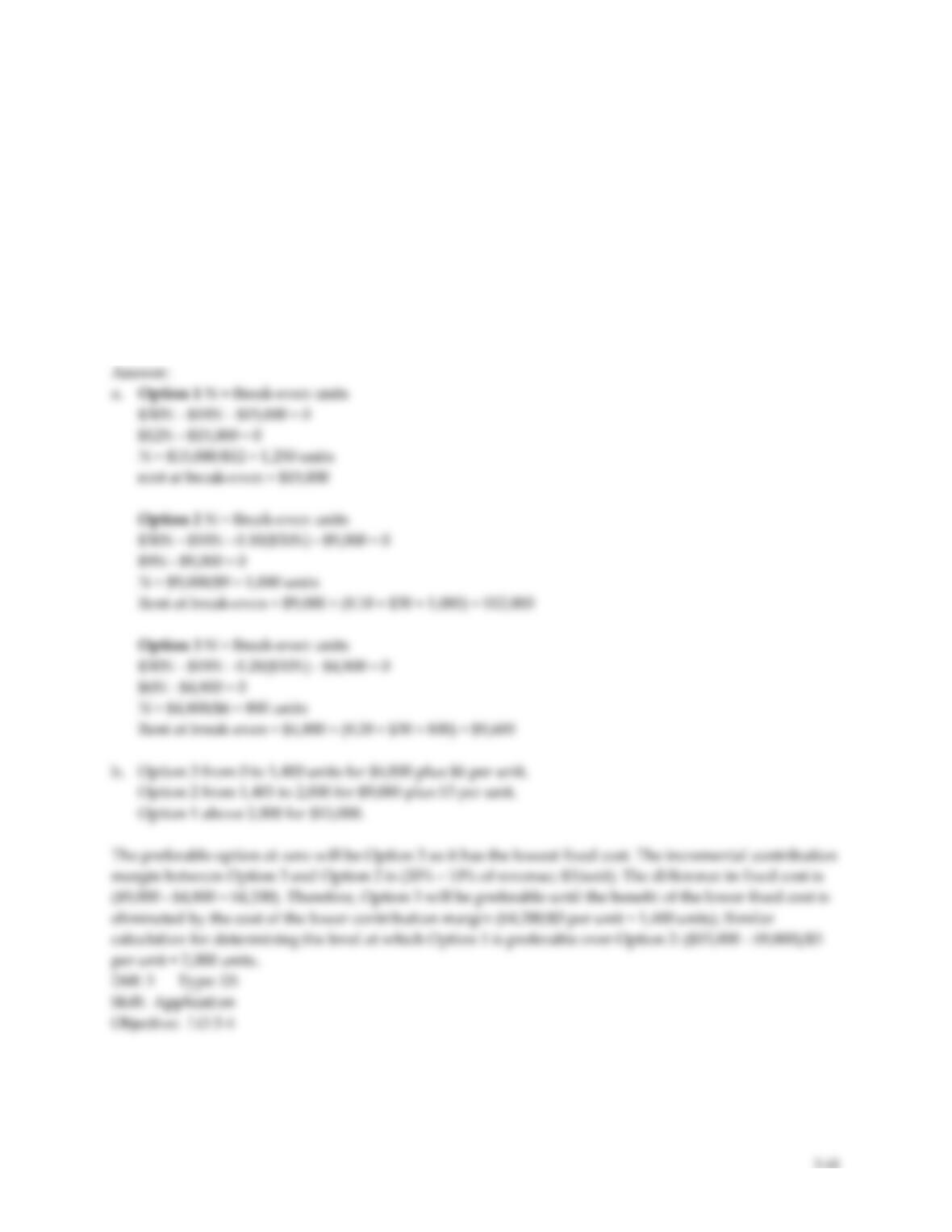
a. For each option, compute the break-even sales and the monthly rent paid at break-even.
b. Beginning at zero sales, show the sales levels at which each option is preferable up to 5,000 units.
Cost Accounting: A Managerial Emphasis, 6e
Chapter 3 – Cost-Volume-Profit Analysis
39) ABC Grocery needs to know the kilograms of bananas to have on hand each day. Each kilogram of
bananas costs $0.25 and can be sold for $0.40. Unsold bananas are worthless at the end of the day. The
following demands were found after studying the last six month’s sales:
200 kilograms of bananas one-fourth of the time
300 kilograms of bananas one-half of the time
400 kilograms of bananas one-fourth of the time
Required:
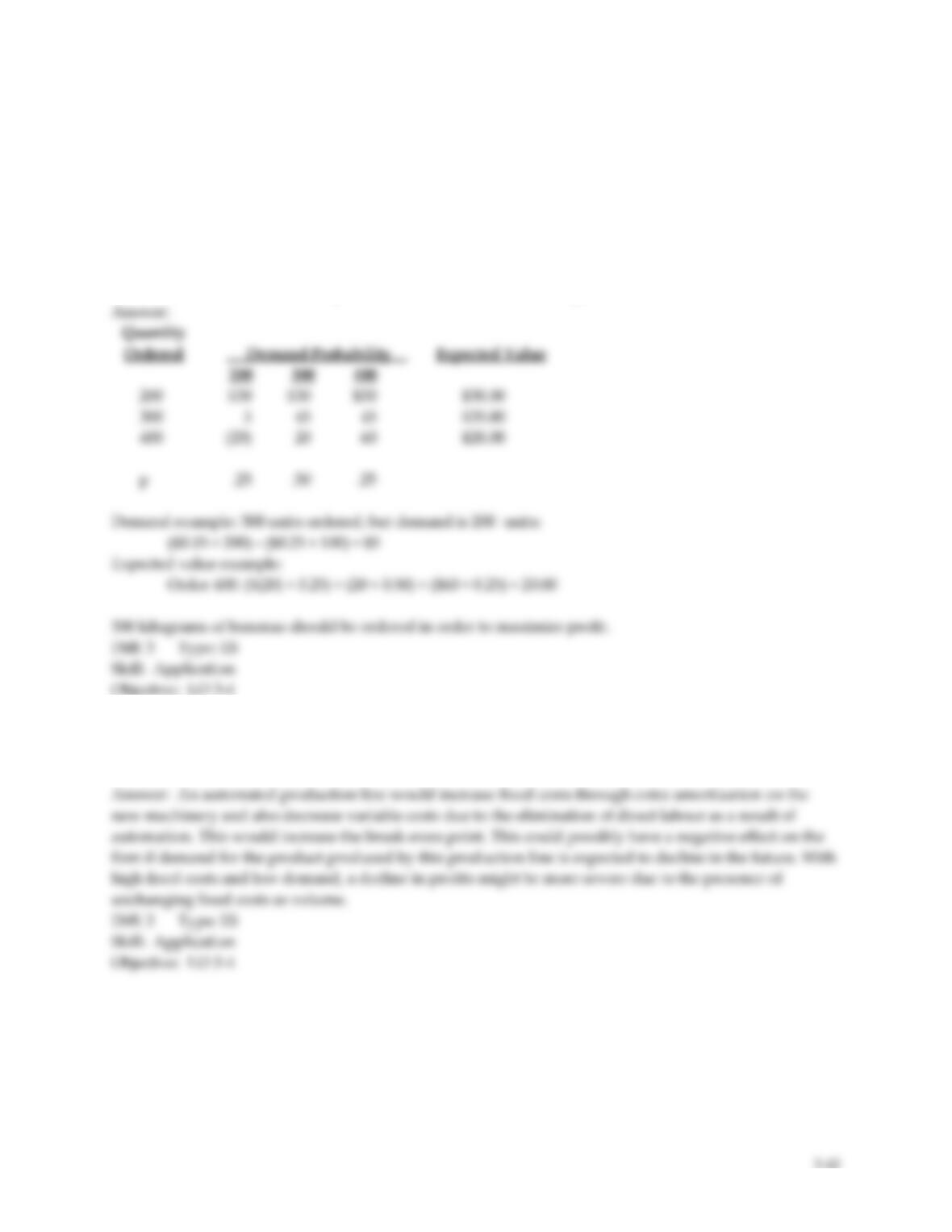
Determine whether ABC Grocery should order 200, 300, or 400 kilograms of bananas.
40) Suppose a company decided to automate a production line. Explain what effects this would have on a
company’s cost structure using CVP terminology. Could these changes have any possible negative effect
on the firm?
Cost Accounting: A Managerial Emphasis, 6e
Chapter 3 – Cost-Volume-Profit Analysis
41) Bonnie and Clyde started the BC Restaurant a few years ago. They rented a building, bought
equipment, and hired two employees to work full time at a fixed monthly salary. Utilities and other
operating charges remain fairly constant during each month.
During the past two years the business has grown with average sales increasing one percent a month.
This situation pleases both Bonnie and Clyde, but they do not understand how sales can grow by one
percent a month while profits are increasing at an even faster pace. They are afraid that one day they will
wake up to increasing sales but decreasing profits.
Required:
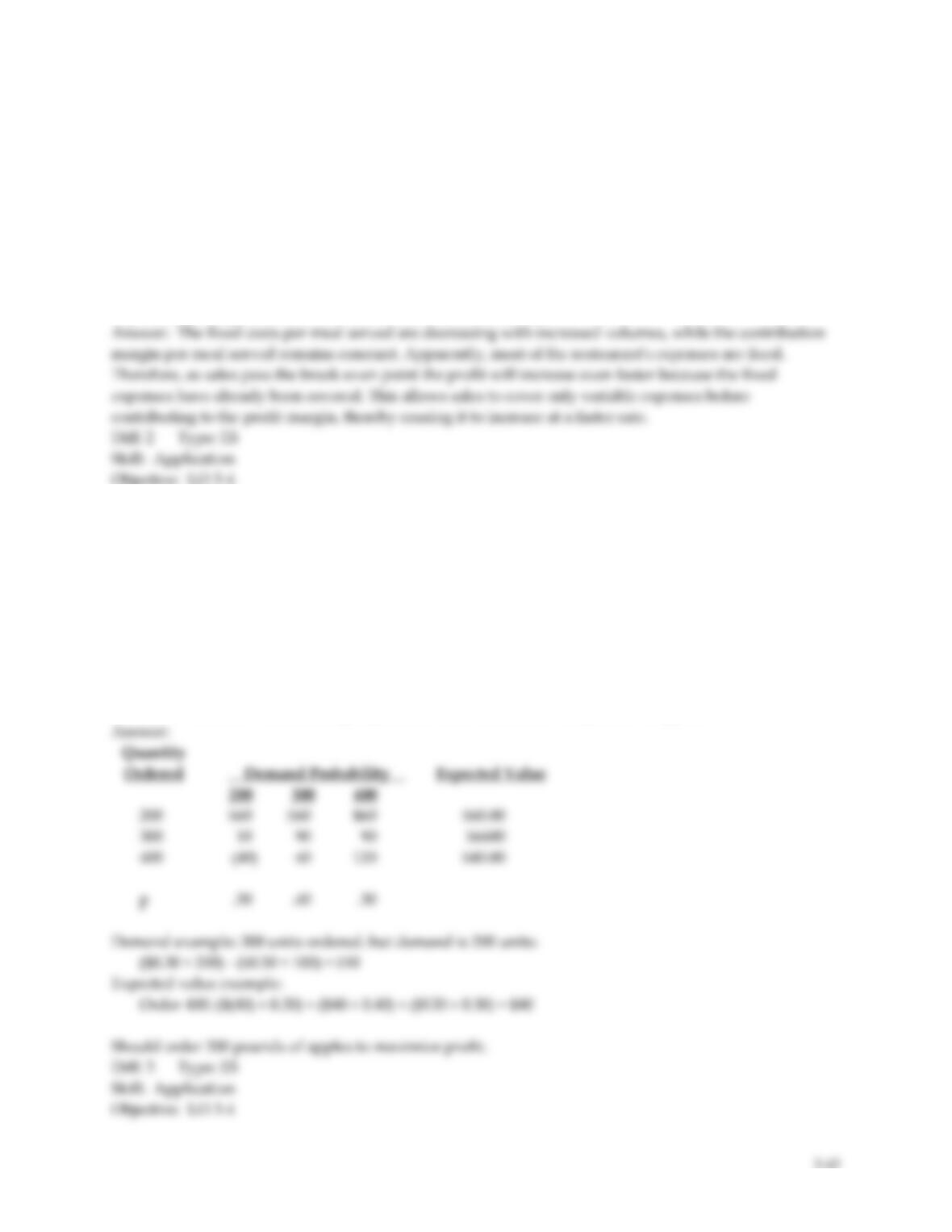
Explain why the profits have increased at a faster rate than sales.
42) Produce Company needs to know the pounds of apples to have on hand each day. Each pound of
apples costs $0.50 and can be sold for $0.80. Unsold apples are worthless at the end of the day. The
following demands were found after studying the last six months’ sales:
200 pounds of apples 30% of the time
300 pounds of apples 40% of the time
400 pounds of apples 30% of the time
Required:
Determine whether Produce Company should order 200, 300, or 400 pounds of apples.
Cost Accounting: A Managerial Emphasis, 6e
Chapter 3 – Cost-Volume-Profit Analysis
43) Snowmobile Inc. manufactures two colours of snowmobiles: White and Black. Marketing believes that
it can sell between 12,000 and 18,000 of either product during the upcoming year. Due to the overall
economic slowdown, the company is preparing to produce only one model for next year. The following
information has been provided by the accounting department:
White Black
Selling price $2,250 $2,550
Variable costs 1,350 1,350
For next year, fixed costs will total $9,450,000 if White is produced and $11,640,000 if Black is produced.
Plant capacity allows up to 107,800 direct manufacturing hours. White takes 9.8 hours to produce and
Black requires 11 hours. The company is subject to a 30 percent income tax rate.
Required:
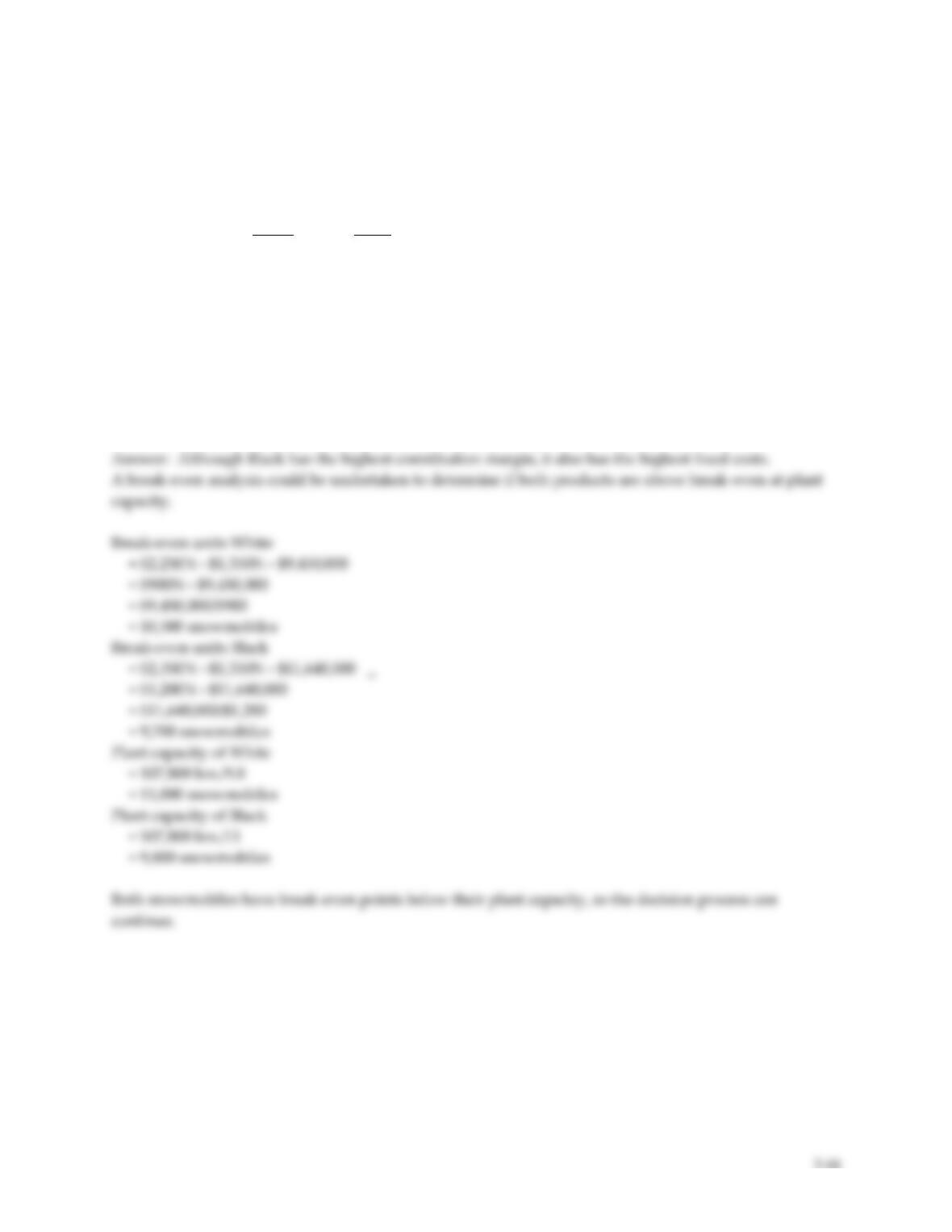
Which model should Snowmobile Inc. produce, assuming the marketing manager believes annual
demand of either model will exceed production capacity? Why?
Cost Accounting: A Managerial Emphasis, 6e
Chapter 3 – Cost-Volume-Profit Analysis
3.5 Interpret the results of CVP analysis in complex multi-product and multiple cost
driver situations.
1) The relative combination of quantities of products or services that constitute total revenues are called
the sales target.
2) The key to applying CVP analysis in non-profit and service organizations is to measure their output.
3) Changes in product quality could be considered an example of a revenue driver.
Cost Accounting: A Managerial Emphasis, 6e
Chapter 3 – Cost-Volume-Profit Analysis
4) There is no unique break-even point when there are multiple cost drivers.
5) In multi-product situations when sales mix shifts toward the product with the highest contribution
margin, operating income will be higher.
6) To calculate the break-even point in a multi-product situation, one must assume that the sales mix of
the various products remains constant.
Use the information below to answer the following question(s).
The following information is for Winnie Company:
Product A: Revenue
$4.00
Variable Cost
$1.00
Product B: Revenue
$6.00
Variable Cost
$2.00
Total fixed costs are
40,000
7) What is the break-even point assuming the sales mix consists of two units of Product A and one unit of
Product B?
A) 2,000 units of B and 4,000 units of A
B) 2,025 units of B and 4,050 units of A
C) 4,025 units of B and 8,050 units of A
D) 4,000 units of B and 4,000 units of A
E) 4,000 units of B and 8,000 units of A
Cost Accounting: A Managerial Emphasis, 6e
Chapter 3 – Cost-Volume-Profit Analysis
8) What is the operating income assuming actual sales are 300,000 units, and the sales mix is one unit of
Product A and two units of Product B?
A) $100,000
B) $1,040,000
C) $1,060,000
D) $1,100,000
E) $1,100,100
9) A hospital receives $1,000,000 monthly in funding from various sources. Annual fixed costs are
projected to be $5,000,000 and the variable cost per patient, across all departments is projected to be
$534.80. Last year they treated 11,500 patients. The hospital expects a 5% increase in patients this year. A
governing bylaw requires that the hospital be run as a non-profit organization.
What is the maximum number of patients the hospital can expect to be able to treat assuming the
operating income is zero?
A) 11,500
B) 12,079
C) 13,000
D) more than 13,000
E) CVP analysis is not relevant for non-profit organizations.
Cost Accounting: A Managerial Emphasis, 6e
Chapter 3 – Cost-Volume-Profit Analysis
10) A social agency receives a budget appropriation of $11,000 monthly from the municipality. Annual
fixed costs are projected to be $20,000 and the variable cost per client was $238.50 last year. Although the
agency projects its case load to increase by the usual 15% this year (as it has done historically), the
municipality appropriated funds based on last year’s case load.
Which of the following strategies would be ineffective in dealing with the expected shortfall in budget
appropriation for the agency?
A) reducing the number of clients served
B) reducing the variable cost of serving a client
C) reducing the total fixed costs
D) increasing funding from other sources
E) changing the measure of output used to calculate service
11) The agency supervisor of a non-profit organization wants to know how many individuals may receive
financial assistance during the year. The organization has fixed costs of $600,000. They aid the
unemployed by supplementing their incomes by $8,000 annually, while they seek new employment
skills. The budgeted appropriation for the year is $2,000,000.
A) 175 people
B) 130 people
C) 100 people
D) 75 people
E) 50 people
Cost Accounting: A Managerial Emphasis, 6e
Chapter 3 – Cost-Volume-Profit Analysis
12) Fan Inc. is a nonprofit organization that supplies fans during the summer for individuals in need.
Fixed costs are $500,000. The fans cost $40.00 each. The organization has a budgeted appropriation of
$1,200,000. How many people can receive a fan during the summer?
A) 15,000 people
B) 17,500 people
C) 30,000 people
D) 42,500 people
E) 80,000 people
13) A revenue driver is defined as
A) any factor that affects costs and revenues.
B) any factor which could cause a change in revenue.
C) any factor which could cause a change in the costs of a related revenue object.
D) any factor which does not affect costs associated with a revenue.
E) any factor that changes when revenue changes.
Cost Accounting: A Managerial Emphasis, 6e
Chapter 3 – Cost-Volume-Profit Analysis
14) Mount Carmel Company sells only two products, Product A and Product B.
Product A
Product B
Total
Selling price
$40
$50
Variable cost per unit
$24
$40
Total fixed costs
$840,000
Mount Carmel sells two units of Product A for each unit it sells of Product B. Mount Carmel faces a tax
rate of 30%. Mount Carmel desires a net after-tax income of $73,500. The number of units needed to be
sold to achieve the desired after-tax profit would be
A) 21,750 units of Product A and 43,500 units of Product B.
B) 22,500 units of Product A and 22,500 units of product B.
C) 43,500 units of Product A and 21,750 units of Product B.
D) 45,000 units of Product A and 22,500 units of Product B.
E) 64,616 units of Product A and 32,308 units of Product B.
Cost Accounting: A Managerial Emphasis, 6e
Chapter 3 – Cost-Volume-Profit Analysis
3-51
15) Assuming a constant mix of 3 units of Small for every 1 unit of Large.
Small
Large
Total
Sales
$20
$30
VC
14
18
Total fixed costs: $48,000
The break-even point in units would be
A) 4,800 units of Small and 1,600 units of Large.
B) 1,200 units of Small and 400 units of Large.
C) 1,600 units of Small and 4,800 units of Large.
D) 8,000 units of Small and 2,667 units of Large.
E) 1,600 units of Small and 1,600 units of Large.
Cost Accounting: A Managerial Emphasis, 6e
Chapter 3 – Cost-Volume-Profit Analysis
Answer the following question(s) using the information below.
The following information is for the Jeffries Corporation:
Product A:
Revenue
$16.00
Variable Cost
$12.00
Product B:
Revenue
$24.00
Variable Cost
$16.00
Total fixed costs
$75,000
16) What is the break-even point, assuming the sales mix consists of three units of Product A and one unit
of Product B?
A) 10,000 units of A and 5,000 units of B
B) 3,750 units of A and 3,750 units of B
C) 12,000 units of A and 4,000 units of B
D) 18,750 units of A and 6,250 units of B
E) 11,250 units of A and 3,750 units of B
Cost Accounting: A Managerial Emphasis, 6e
Chapter 3 – Cost-Volume-Profit Analysis
17) What is the operating income, assuming actual sales total 25,000 units, and the sales mix is three units
of Product A and one unit of Product B?
A) $300,000
B) $60,000
C) $225,000
D) $50,000
E) $75,000
18) If the sales mix shifts to four units of Product A and one unit of Product B, then the weighted-average
contribution margin will be
A) $30.
B) $16.
C) $20.
D) $12.
E) $24.
19) If the sales mix shifts to four units of Product A and one unit of Product B, then the break-even point
will
A) increase.
B) stay the same.
C) decrease.
D) decrease then increase.
E) increase then decrease.
Cost Accounting: A Managerial Emphasis, 6e
Chapter 3 – Cost-Volume-Profit Analysis
20) Karen’s Klothes sells blouses for women and girls. The average selling price and variable cost for each
product are as follows:
Women: Selling Price $18.00 Girls: Selling Price $15.00
Women: Variable Cost $12.75 Girls: Variable Cost $10.50
Fixed costs are $30,000 and cannot be separated evenly between the two products.
Required:
a. What is the break-even point in units for each type of blouse assuming the sales mix is 2:1 in favour
of women’s blouses? Total sales cannot exceed 7,000 units due to space constraints.
b. What is the operating income assuming the sales mix is 2:1 in favour of women’s blouses, and sales
total 9,900 blouses?
Cost Accounting: A Managerial Emphasis, 6e
Chapter 3 – Cost-Volume-Profit Analysis
21) Popcorn Inc. currently sells plain popcorn at the ballpark. During a typical month the stand reports a
profit of $18,000 with sales of $100,000 and fixed costs of $42,000 and variable costs of $0.64 per box.
Next year the company plans to start selling candy-coated popcorn for $3 a box. The candy-coated
popcorn will have a variable cost of $0.72. The new equipment and personnel to handle the popcorn will
increase monthly fixed costs by $17,616. Two boxes of candy-coated popcorn are expected to sell for
every box of plain popcorn.
Required:
a. Determine the monthly break-even sales in units before adding the candy-coated popcorn product.
b. Determine the monthly break-even sales in units of each product during the first year of candy–
coated popcorn sales assuming a constant sales mix.
22) Yurus Manufacturing Company produces two products, X and Y. The following information is
presented for both products:
X Y
Selling price per unit $36 $24
Variable cost per unit 28 12
Total fixed costs are $234,000.
Required:
a. Calculate the contribution margin for each product.
b. Calculate break-even point in units of both X and Y if the sales mix is 3 units of X for every unit of Y.
c. Calculate break-even volume in total dollars if the sales mix is 2 units of X for every 3 units of Y.
23) Pennsylvania Valve Company makes three types of valves: Speedy Flow, Sure Flow, and Fine Flow.
Each of the three products has a different contribution margin, and the proportions of the three products
sold have remained steady over the years. How could Pennsylvania valve compute a break-even point
given this situation?
Cost Accounting: A Managerial Emphasis, 6e
Chapter 3 – Cost-Volume-Profit Analysis
24) Atlanta Radio Supply sells only two products, Product X and Product Y.
Product X
Product Y
Total
Selling price
$25
$45
Variable cost per unit
$20
$35
Total fixed costs
$350,000
Atlanta Radio Supply sells three units of Product X for each two units it sells of Product Y; the tax rate is
25%.
Required:
a. What is the break-even point in units for each product, assuming the sales mix is 3 units of Product X
for each two units of Product Y?
b. How many units of each product would be sold if Atlanta Radio Supply desired an after-tax net
income of $210,000, using its tax rate of 25%?
Cost Accounting: A Managerial Emphasis, 6e
Chapter 3 – Cost-Volume-Profit Analysis
25) Ballpark Concessions currently sells hot dogs. During a typical month, the stand reports a profit of
$9,000 with sales of $50,000, fixed costs of $21,000, and variable costs of $0.64 per hot dog.
Next year, the company plans to start selling nachos for $3 per unit. Nachos will have a variable cost of
$0.72 and new equipment and personnel to produce nachos will increase monthly fixed costs by $8,808.
Initial sales of nachos should total 5,000 units. Most of the nacho sales are anticipated to come from
current hot dog purchasers, therefore, monthly sales of hot dogs are expected to decline to $20,000.
After the first year of nacho sales, the company president believes that hot dog sales will increase to
$33,750 a month and nacho sales will increase to 7,500 units a month.
Required:
a. Determine the monthly break-even sales in dollars before adding nachos.
b. Determine the monthly break-even sales during the first year of nachos sales, assuming a constant
sales mix of 1 hotdog and 2 units of nachos.
c. What is the expected monthly operating income for the second year that nachos are sold?
Cost Accounting: A Managerial Emphasis, 6e
Chapter 3 – Cost-Volume-Profit Analysis
3-59