
CHAPTER 3: REVIEW OF A COMPANY’S ACCOUNTING SYSTEM
1. The primary purpose of an accounting system is to record, organize. summarize, and report useful information to
external financial statement users and stakeholders, as well as to company management, who make operating, investing
and financing decisions.
a.
True
b.
True
1
Easy
ACCT.WHAL.16.3.1 – LO: 3.1
United States – BUSPROG: Reflective Thinking – BUSPROG: Analytic
United States – OH – Default City – AICPA: FN-Decision Modeling
False
2. The another interpretation of the accounting equation is Assets = Liabilities + Contributed Capital + Beginning
Retained Earnings + Net Income – Dividends + Beginning Accumulated Other Comprehensive Income + Other
Comprehensive Income.
a.
True
b.
True
1
Moderate
ACCT.WHAL.16.3.1 – LO: 3.1
United States – BUSPROG: Reflective Thinking – BUSPROG: Analytic
United States – OH – Default City – AICPA: FN-Decision Modeling
False
3. The accounting cycle followed each period by a company includes recording transactions, storing the data, organizing
the information, summarizing the events and arrangements, adjusting the accounts, reporting the accounting
information in financial statements, and then closing the books.
a.
True
b.
False
True
1
Easy
ACCT.WHAL.16.3.2 – LO: 3.2
United States – BUSPROG: Reflective Thinking – BUSPROG: Analytic
United States – OH – Default City – AICPA: FN-Decision Modeling

Chapter 3: Review of a Company’s Accounting System
4. The last step in the accounting cycle is to prepare the financial statements.
a.
True
b.
False
False
1
Easy
ACCT.WHAL.16.3.2 – LO: 3.2
United States – BUSPROG: Reflective Thinking – BUSPROG: Analytic
United States – OH – Default City – AICPA: FN-Decision Modeling
5. An advantage of using the general journal is to prevent errors.
a.
True
b.
False
True
1
Easy
ACCT.WHAL.16.3.3 – LO: 3.3
United States – BUSPROG: Reflective Thinking – BUSPROG: Analytic
United States – OH – Default City – AICPA: FN-Decision Modeling
6. The general journal has all journal entry transactions listed by account title.
a.
True
b.
False
False
1
Easy
ACCT.WHAL.16.3.3 – LO: 3.3
United States – BUSPROG: Reflective Thinking – BUSPROG: Analytic
United States – OH – Default City – AICPA: FN-Decision Modeling

Chapter 3: Review of a Company’s Accounting System
7. The trial balance does help find some errors but it will not identify errors resulting from transactions that have not been
posted or transactions that were posted twice.
a.
True
b.
False
True
1
Easy
ACCT.WHAL.16.3.4 – LO: 3.4
United States – BUSPROG: Reflective Thinking – BUSPROG: Analytic
United States – OH – Default City – AICPA: FN-Decision Modeling
8. If the trial balance does not balance, the preparer should check to see if the difference is evenly divisible by 9. If so
there may be a transposition.
a.
True
b.
False
True
1
Easy
ACCT.WHAL.16.3.4 – LO: 3.4
United States – BUSPROG: Reflective Thinking – BUSPROG: Analytic
United States – OH – Default City – AICPA: FN-Decision Modeling
9. Deferrals are transactions, events, or arrangements in which the cash flows occur after the related expenses are incurred
or revenues earned.
a.
True
b.
False
False
1
Easy
ACCT.WHAL.16.3.5 – LO: 3.5
United States – BUSPROG: Reflective Thinking – BUSPROG: Analytic
United States – OH – Default City – AICPA: FN-Decision Modeling

Chapter 3: Review of a Company’s Accounting System
10. In order to prepare the financial statements, the ending balance in each account in the ledger is recomputed to ensure
all effects of the adjusting entries have been captured.
a.
True
b.
False
True
1
Easy
ACCT.WHAL.16.3.6 – LO: 3.6
United States – BUSPROG: Reflective Thinking – BUSPROG: Analytic
United States – OH – Default City – AICPA: FN-Decision Modeling
11. When preparing the financial statements the adjusted trial balance is prepared listing all the accounts and associated
balances after the closing entries.
a.
True
b.
False
False
1
Easy
ACCT.WHAL.16.3.6 – LO: 3.6
United States – BUSPROG: Reflective Thinking – BUSPROG: Analytic
United States – OH – Default City – AICPA: FN-Decision Modeling
12. The purpose of closing entries is to reduce the balance in the temporary (periodic) accounts to zero and to update the
Retained Earnings account.
a.
True
b.
False
True
1
Easy
ACCT.WHAL.16.3.7 – LO: 3.7
United States – BUSPROG: Reflective Thinking – BUSPROG: Analytic
United States – OH – Default City – AICPA: FN-Decision Modeling

Chapter 3: Review of a Company’s Accounting System
13. Net sales are computed as sales minus sales returns and allowances and purchase discounts.
a.
True
b.
False
False
1
Easy
ACCT.WHAL.16.3.7 – LO: 3.7
United States – BUSPROG: Reflective Thinking – BUSPROG: Analytic
United States – OH – Default City – AICPA: FN-Decision Modeling
14. The worksheet is not a substitute for accounting records or financial statements but it is a helpful tool for external
users to use in order to see the detailed information behind the statements.
a.
True
b.
False
False
1
Easy
ACCT.WHAL.16.3.8 – LO: 3.8
United States – BUSPROG: Reflective Thinking – BUSPROG: Analytic
United States – OH – Default City – AICPA: FN-Decision Modeling
15. The worksheet is an internal tool that assists with the preparation of the adjusting entries and the financial statements.
a.
True
b.
False
True
1
Easy
ACCT.WHAL.16.3.8 – LO: 3.8
United States – BUSPROG: Reflective Thinking – BUSPROG: Analytic

Chapter 3: Review of a Company’s Accounting System
16. Reversing entries should be made for any adjusting entry that adjusts the ending balance of an existing balance sheet
account.
a.
True
b.
False
False
1
Easy
ACCT.WHAL.16.3.9 – LO: 3.9
United States – BUSPROG: Reflective Thinking – BUSPROG: Analytic
United States – OH – Default City – AICPA: FN-Decision Modeling
17. Although optional, a reversing entry is usually made for adjusting entries that accrue expenses to be paid in the next
accounting period.
a.
True
b.
False
True
1
Easy
ACCT.WHAL.16.3.9 – LO: 3.9
United States – BUSPROG: Reflective Thinking – BUSPROG: Analytic
United States – OH – Default City – AICPA: FN-Decision Modeling
18. Companies create subsidiary ledgers to divide accounting tasks and to reduce the size of the general ledger, while
keeping up-to-date records of customers and suppliers. This process is also used to minimize errors in recording
transactions.
a.
True
b.
False
True
1
Easy
ACCT.WHAL.16.3.1 – LO: 3.1
United States – BUSPROG: Reflective Thinking – BUSPROG: Analytic
United States – OH – Default City – AICPA: FN-Decision Modeling

Chapter 3: Review of a Company’s Accounting System
19. Special journals are used to divide accounting tasks, minimize errors, and to keep up-to-date records of customers and
suppliers.
a.
True
b.
False
False
1
Easy
ACCT.WHAL.16.3.1 – LO: 3.1
United States – BUSPROG: Reflective Thinking – BUSPROG: Analytic
United States – OH – Default City – AICPA: FN-Decision Modeling
20. The adjustment to convert cash-basis collections from customers to accrual-basis revenue earned requires adding the
ending balance in accounts receivable and subtracting the beginning balance in accounts receivable.
a.
True
b.
False
True
1
Easy
ACCT.WHAL.16.3.10 – LO: 3.11
United States – BUSPROG: Reflective Thinking – BUSPROG: Analytic
United States – OH – Default City – AICPA: FN-Decision Modeling
21. The adjustment necessary to convert cash-basis payments for other operating costs to accrual-basis operating expenses
requires the addition of ending prepaid expenses to the beginning prepaid expenses, subtracting the beginning accrued
expenses from this amount, and finally adding the ending accrued expenses.
a.
True
b.
False
False
1
Moderate
ACCT.WHAL.16.3.10 – LO: 3.11
United States – BUSPROG: Reflective Thinking – BUSPROG: Analytic
United States – OH – Default City – AICPA: FN-Decision Modeling
Chapter 3: Review of a Company’s Accounting System
22. The accounting equation can be expressed as
a.
Assets = Liabilities – Shareholders’ Equity
b.
Assets + Liabilities = Shareholders’ Equity
c.
Assets – Liabilities = Shareholders’ Equity
d.
Assets + Shareholders’ Equity = Liabilities
c
1
Easy
ACCT.WHAL.16.3.1 – LO: 3.1
United States – BUSPROG: Reflective Thinking – BUSPROG: Analytic
United States – OH – Default City – AICPA: FN-Decision Modeling
23. Which of the following rules is incorrect?
a.
The accounting equation must always remain in balance.
b.
Asset accounts are increased by debit entries and decreased by credit entries.
c.
Expense accounts normally have debit balances.
d.
Common stock accounts are increased by debit entries and decreased by credit entries.
d
1
Moderate
ACCT.WHAL.16.3.1 – LO: 3.1
United States – BUSPROG: Reflective Thinking – BUSPROG: Analytic
United States – OH – Default City – AICPA: FN-Decision Modeling
Chapter 3: Review of a Company’s Accounting System
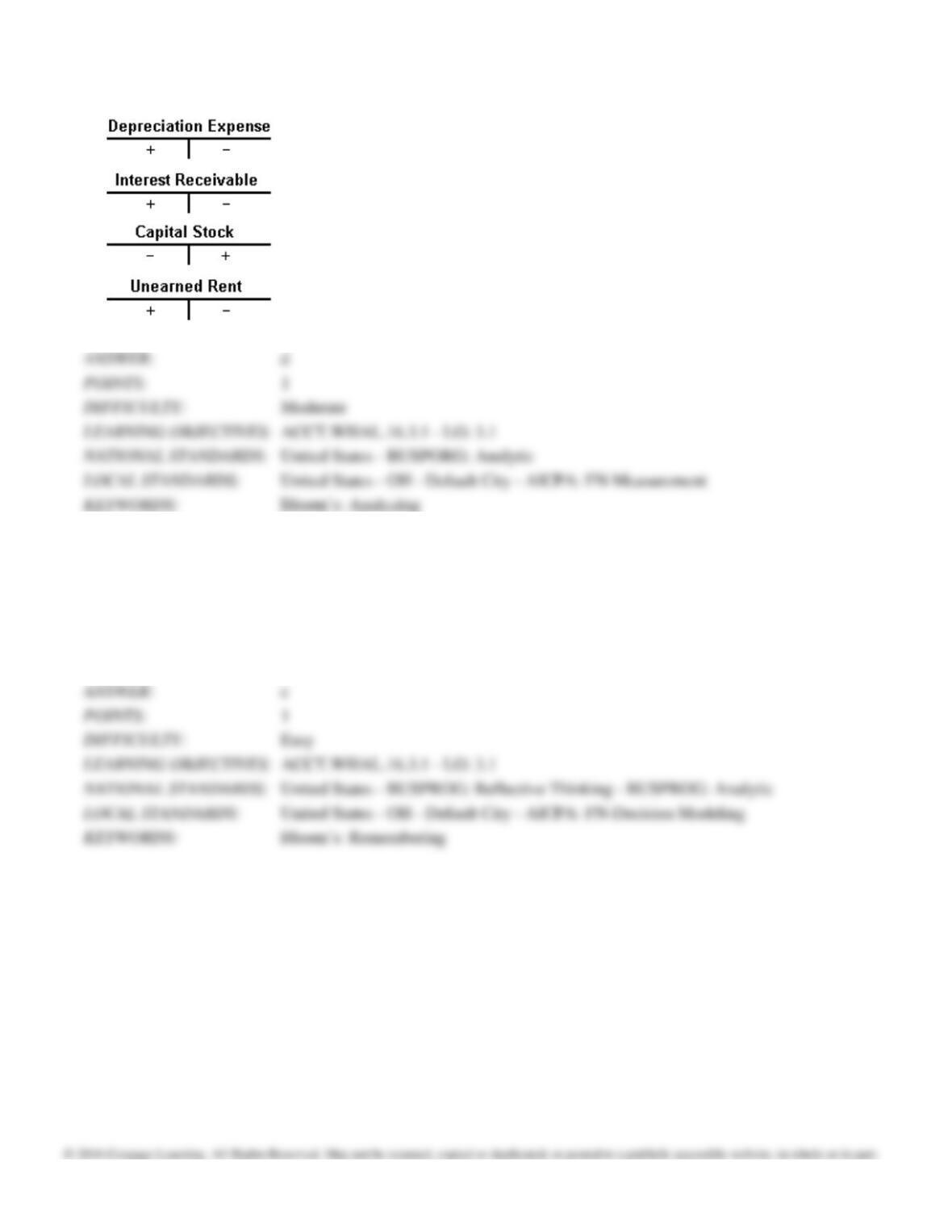
24. Which T-account is incorrect?
a.
b.
c.
d.
d
Moderate
ACCT.WHAL.16.3.1 – LO: 3.1
United States – BUSPORG: Analytic
United States – OH – Default City – AICPA: FN-Measurement
25. Which accounts are increased by using debits?
a.
Cost of Goods Sold, Common Stock, Assets
b.
Dividends, Revenue, Liabilities
c.
Assets, Cost of Goods Sold, Expenses
d.
Liabilities, Capital Stock, Revenue
c
1
Easy
ACCT.WHAL.16.3.1 – LO: 3.1
United States – BUSPROG: Reflective Thinking – BUSPROG: Analytic
United States – OH – Default City – AICPA: FN-Decision Modeling
Chapter 3: Review of a Company’s Accounting System
26. Which of the following is a permanent account?
a.
Dividend Revenue
b.
Allowance for Doubtful Accounts
c.
Interest Expense
d.
Sales Revenue
b
1
Easy
ACCT.WHAL.16.3.1 – LO: 3.1
United States – BUSPROG: Reflective Thinking – BUSPROG: Analytic
United States – OH – Default City – AICPA: FN-Decision Modeling
27. Which of the following is not a component of an accounting system?
a.
the input source documents
b.
the framework for operation of the system
c.
the output reports
d.
All of the answer choices are components of an accounting system.
d
1
Easy
ACCT.WHAL.16.3.1 – LO: 3.1
United States – BUSPROG: Reflective Thinking – BUSPROG: Analytic
United States – OH – Default City – AICPA: FN-Decision Modeling
28. Which of the following is a temporary account?
a.
Retained Earnings
b.
Accounts Receivable
c.
Purchases Returns and Allowances
d.
Accumulated Depreciation
c
1
Easy
ACCT.WHAL.16.3.1 – LO: 3.1
United States – BUSPROG: Reflective Thinking – BUSPROG: Analytic
United States – OH – Default City – AICPA: FN-Decision Modeling
Chapter 3: Review of a Company’s Accounting System
29. In terms of debits and credits, which types of accounts have the same (debit or credit) normal balances?
a.
dividends, expenses, assets
b.
assets, capital stock, revenues
c.
retained earnings, dividends, liabilities
d.
expenses, liabilities, capital stock
a
1
Moderate
ACCT.WHAL.16.3.1 – LO: 3.1
United States – BUSPROG: Reflective Thinking – BUSPROG: Analytic
United States – OH – Default City – AICPA: FN-Decision Modeling
30. Information related to the Berkley Company for the calendar year 2015 follows:
Liabilities, December 31, 2015
$400
Assets, December 31, 2015
700
Dividends distributed during 2015
90
Liabilities, December 31, 2014
250
Assets, December 31, 2014
350
Assuming no capital stock was issued during 2015, the net income earned by the Berkley Company during 2015 was
a.
$110
b.
$200
c.
$260
d.
$290
d
1
Moderate
ACCT.WHAL.16.3.1 – LO: 3.1
United States – BUSPORG: Analytic
United States – OH – Default City – AICPA: FN-Measurement
Chapter 3: Review of a Company’s Accounting System
31. Which of the following is the third major step in the accounting cycle?
a.
prepare the financial statements
b.
record the daily transactions in a journal
c.
prepare and post adjusting entries
d.
post the journal entries to the accounts in the ledger
c
1
Easy
ACCT.WHAL.16.3.2 – LO: 3.2
United States – BUSPROG: Reflective Thinking – BUSPROG: Analytic
United States – OH – Default City – AICPA: FN-Decision Modeling
32. Which of the following is not a major step necessary to complete the accounting cycle?
a.
Prepare and post-closing entries
b.
Prepare the adjusted trial balance
c.
Prepare adjusting entries
d.
Record the transactions, events, and arrangements
b
1
Moderate
ACCT.WHAL.16.3.2 – LO: 3.2
United States – BUSPROG: Reflective Thinking – BUSPROG: Analytic
United States – OH – Default City – AICPA: FN-Decision Modeling
33. Which of the following is a major step in completing the accounting cycle?
a.
Prepare financial statements
b.
Record transactions, events, and arrangements
c.
Prepare adjusting entries
d.
d
1
Easy
ACCT.WHAL.16.3.2 – LO: 3.2
United States – BUSPROG: Reflective Thinking – BUSPROG: Analytic
United States – OH – Default City – AICPA: FN-Decision Modeling
All of these answer choices are correct.
Chapter 3: Review of a Company’s Accounting System
34. The accounting cycle is a series of steps that process the accounting information contained in its transactions, events,
and arrangements. What are the steps involved in this task?
a.
Record, organize, close, report
b.
Organize, record, report, analyze
c.
Record, organize, summarize, report
d.
Analyze, prepare, record, report
c
1
Moderate
ACCT.WHAL.16.3.2 – LO: 3.2
United States – BUSPROG: Reflective Thinking – BUSPROG: Analytic
35. When you prepare a journal entry, the standard format is to list all
a.
asset accounts first.
b.
accounts to be debited first.
c.
liability accounts first.
d.
accounts to be credited first.
b
1
ACCT.WHAL.16.3.3 – LO: 3.3
United States – BUSPROG: Reflective Thinking – BUSPROG: Analytic
United States – OH – Default City – AICPA: FN-Decision Modeling
36. Which of the following is true regarding the general journal?
a.
It keeps up to date records of all customers and suppliers.
b.
It helps divide up accounting tasks.
c.
It helps prevent errors.
d.
It helps control the spending of the organization.
c
1
Easy
ACCT.WHAL.16.3.3 – LO: 3.3
United States – BUSPROG: Reflective Thinking – BUSPROG: Analytic
United States – OH – Default City – AICPA: FN-Decision Modeling
Chapter 3: Review of a Company’s Accounting System
37. Which of the following errors will be detected by a trial balance?
a.
posting a credit to Sales instead of to Accounts Payable
b.
incorrectly computing the balance of the cash account
c.
failure to journalize a sales transaction at all
d.
forgetting to post a purchase transaction at all
b
1
Moderate
ACCT.WHAL.16.3.4 – LO: 3.4
United States – BUSPROG: Reflective Thinking – BUSPROG: Analytic
United States – OH – Default City – AICPA: FN-Decision Modeling
38. The basic purpose of a trial balance is to
a.
list all of the accounts in the general ledger.
b.
list all of the accounts in the general ledger that have a balance.
c.
be sure that all journal entries have been recorded.
d.
verify that the total credits equal the total debits.
d
1
Moderate
ACCT.WHAL.16.3.4 – LO: 3.4
United States – BUSPROG: Reflective Thinking – BUSPROG: Analytic
United States – OH – Default City – AICPA: FN-Decision Modeling
39. What relationship exists between the general journal and the general ledger?
a.
The general ledger accounts contain the same information as those in the general journal, but it is just in a
different format.
b.
The balances in the general ledger will always equal those in the general journal.
c.
After all postings from the general journal are complete, the debit balances in the general ledger will rarely
equal the credit balances.
d.
a
1
Moderate
ACCT.WHAL.16.3.4 – LO: 3.4
United States – BUSPROG: Reflective Thinking – BUSPROG: Analytic
The number of accounts in the general journal will always be larger than the number of accounts in the general
ledger.
Chapter 3: Review of a Company’s Accounting System
40. The entire group of accounts for a company is referred to as the
a.
general ledger.
b.
worksheet.
c.
journal.
d.
document of original entry.
a
1
Easy
ACCT.WHAL.16.3.4 – LO: 3.4
United States – BUSPROG: Reflective Thinking – BUSPROG: Analytic
United States – OH – Default City – AICPA: FN-Decision Modeling
41. An example of a transposition is
a.
presenting the cash account at $1,500 instead of $15,000.
b.
presenting prepaid insurance at $920 instead of $290.
c.
incorrectly posting a credit amount as a debit amount in the general ledger.
d.
not journalizing a sales transaction at all.
b
1
Easy
ACCT.WHAL.16.3.4 – LO: 3.4
United States – BUSPROG: Reflective Thinking – BUSPROG: Analytic
United States – OH – Default City – AICPA: FN-Decision Modeling
42. If the trial balance does not balance and the difference between debits and credits is evenly divisible by 9, there is a
good chance that
a.
a transaction has not been recorded.
b.
a transaction has been journalized to the wrong account.
c.
a transposition or a slide has occurred.
d.
c
1
Moderate
ACCT.WHAL.16.3.4 – LO: 3.4
United States – BUSPROG: Reflective Thinking – BUSPROG: Analytic
United States – OH – Default City – AICPA: FN-Decision Modeling
only one side of the transaction has been recorded.
Chapter 3: Review of a Company’s Accounting System
43. A trial balance does not identify all types of errors. Which of the following are errors that are not identified using the
trial balance?
a.
incorrectly recording the transaction amount, but the debits still equal the credits
b.
incorrectly posting part of a journal entry to the wrong account
c.
not recording a transaction
d.
All of these answer choices represent errors that are not identified using the trial balance.
d
1
Easy
ACCT.WHAL.16.3.4 – LO: 3.4
United States – BUSPROG: Reflective Thinking – BUSPROG: Analytic
44. Posting is the procedure of transferring information from the
a.
journal to the ledger
b.
trial balance to the worksheet
c.
ledger to the journal
d.
worksheet to the financial statements
a
1
ACCT.WHAL.16.3.4 – LO: 3.4
United States – BUSPROG: Reflective Thinking – BUSPROG: Analytic
United States – OH – Default City – AICPA: FN-Decision Modeling
45. Which of the following errors is not identified by using the trial balance?
a.
an unposted transaction
b.
a transposition
c.
a slide
d.
recording a debit amount that differs from the credit amount recorded
a
1
Moderate
ACCT.WHAL.16.3.4 – LO: 3.4
United States – BUSPROG: Reflective Thinking – BUSPROG: Analytic
United States – OH – Default City – AICPA: FN-Decision Modeling
Chapter 3: Review of a Company’s Accounting System
46. A prepaid expense is
a.
a payment received by the company in advance for the future sale of inventory or performance of services
b.
an item of goods or services purchased by the company for use in its operations but not fully consumed by the
end of the accounting period
c.
an expense that has been incurred during the accounting period but has been neither paid nor recorded
d.
an item that has been earned by the company during the accounting period but has been neither received nor
recorded
b
1
Moderate
ACCT.WHAL.16.3.5 – LO: 3.5
United States – BUSPROG: Reflective Thinking – BUSPROG: Analytic
United States – OH – Default City – AICPA: FN-Decision Modeling
47. Which of the following is an economic resource that should be depreciated over the accounting periods estimated to
be benefited?
a.
salaries incurred but unpaid at year-end
b.
rent collected in advance for a three-year rental period
c.
equipment purchased for use in the business operations
d.
interest revenue accrued on investment in bonds
c
1
Moderate
ACCT.WHAL.16.3.5 – LO: 3.5
United States – BUSPROG: Reflective Thinking – BUSPROG: Analytic
United States – OH – Default City – AICPA: FN-Decision Modeling
48. Adjusting journal entries are made
a.
at the beginning of the accounting period
b.
at the end of the accounting period
c.
when revenue is realized (or realizable)
d.
b
1
Easy
ACCT.WHAL.16.3.5 – LO: 3.5
United States – BUSPROG: Reflective Thinking – BUSPROG: Analytic
anytime we need to adjust an account
Chapter 3: Review of a Company’s Accounting System
49. The Oliver Construction Company received $18,000 for six months rental income in advance on November 1, 2015,
and credited the Rental Revenue account. The required adjusting entry on December 31, 2015, would include a
a.
credit to Rental Revenue for $6,000
b.
debit to Rental Revenue for $12,000
c.
credit to Rental Receivable for $12,000
d.
debit to Rental Revenue for $6,000
b
1
Moderate
ACCT.WHAL.16.3.5 – LO: 3.5
United States – BUSPORG: Analytic
50. Which of the following adjusting entries involves the recognition of an accrued expense?
a.
recording depreciation on a long-lived asset
b.
writing off the portion of an insurance policy that has expired
c.
recognition of salaries owed to employees for work done during the current period that will be paid during the
next accounting period
d.
c
1
Challenging
ACCT.WHAL.16.3.5 – LO: 3.5
United States – BUSPROG: Reflective Thinking – BUSPROG: Analytic
United States – OH – Default City – AICPA: FN-Decision Modeling
recognition of bad debt losses that are expected to result from making sales on credit terms
Chapter 3: Review of a Company’s Accounting System
51. On March 31, 2015, the Turi Company purchased a two-year fire insurance policy. Turi recorded the purchase by
debiting Prepaid Insurance and crediting Cash for $10,000. Which of the following adjusting entries should Turi
prepare at the end of 2015?
a.
Prepaid Insurance 3,750
Insurance Expense 3,750
b.
Insurance Expense 3,750
Prepaid Insurance 3,750
c.
Prepaid Insurance 5,500
Insurance Expense 5,500
d.
Insurance Expense 5,000
Prepaid Insurance 5,000
b
1
Moderate
ACCT.WHAL.16.3.5 – LO: 3.5
United States – BUSPORG: Analytic
United States – OH – Default City – AICPA: FN-Measurement
52. Adjusting entries are made
a.
to match the consumption of prepaid assets against current revenues.
b.
to record accrued expenses.
c.
to record estimated items, such as depreciation.
d.
d
1
Easy
ACCT.WHAL.16.3.5 – LO: 3.5
United States – BUSPROG: Reflective Thinking – BUSPROG: Analytic
United States – OH – Default City – AICPA: FN-Decision Modeling
for all of these reasons.

Chapter 3: Review of a Company’s Accounting System
53. On April 1, 2015, Miller Company paid $6,280 for a two-year insurance policy. On that date, Miller recorded the
purchase by debiting Prepaid Insurance and crediting Cash. The correct December 31, 2015, adjusting entry would be
a.
Prepaid Insurance 3,140
Insurance Expense 3,140
b.
Insurance Expense 2,355
Prepaid Insurance 2,355
c.
Prepaid Insurance 2,355
Insurance Expense 2,355
d.
Insurance Expense 3,925
Prepaid Insurance 3,925
b
1
Moderate
ACCT.WHAL.16.3.5 – LO: 3.5
United States – BUSPORG: Analytic
United States – OH – Default City – AICPA: FN-Decision Modeling
54. On August 1, 2015, Yellow Company paid $6,320 for a three-year insurance policy. On that date, an expense account
was charged. In the adjusting entry on December 31, 2015, there would be a
a.
debit to Insurance Expense for $175.
b.
credit to Prepaid Insurance for $2,107.
c.
credit to Prepaid Insurance for $527.
d.
credit to Insurance Expense for $5,442.
d
1
Moderate
ACCT.WHAL.16.3.5 – LO: 3.5
United States – BUSPORG: Analytic
United States – OH – Default City – AICPA: FN-Measurement