Cost Accounting: A Managerial Emphasis, 6e
Chapter 3 – Cost-Volume-Profit Analysis
Chapter 3 Cost-Volume-Profit Analysis
3.1 Identify the essential elements of cost-volume-profit analysis and calculate the
break-even point (BEP).
1) The contribution margin is computed by deducting all costs which vary on the basis of an output–
related cost driver from revenues.
2) To perform cost-volume-profit analysis, a company must be able to separate costs into fixed and
variable components.
3) In CVP analysis, total costs can be separated into a fixed component that does not vary with output
and a component that is variable with output level.
4) Variable operating costs and fixed operating costs constitute total operating costs.
5) CVP analysis assumes that total costs can be separated into the fixed component and variable
component with respect to the level of output.
6) CVP analysis requires the time value of money to be factored into formula when comparing revenues
and costs.
Cost Accounting: A Managerial Emphasis, 6e
Chapter 3 – Cost-Volume-Profit Analysis
7) CVP analysis assumes that the behaviour of total costs is non-linear.
8) In CVP analysis, an assumption is made that the total revenues are linear with respect to output units,
but that total costs are non-linear with respect to output units.
9) Total revenues less total fixed costs equal the contribution margin.
10) In the graph method of CVP analysis, the break-even point is the (X-axis) quantity of units sold for
which the total revenues line crosses the total costs line.
11) A profit-volume graph shows the impact on operating income from changes in the output level.
12) The contribution margin method of CVP analysis uses the equation: break-even units = unit
contribution margin/fixed costs.
13) The contribution margin method can be used to verify a break-even calculation.
Cost Accounting: A Managerial Emphasis, 6e
Chapter 3 – Cost-Volume-Profit Analysis
14) The total costs line includes all variable costs and all fixed costs when using the graph method of CVP
analysis.
15) Cost-Volume-Profit analysis is useful for
A) helping managers to answer “what-if” questions.
B) implementing a differentiation strategy.
C) eliminating uncertainty about external factors, such as interest rates.
D) for long-range planning.
E) assigning costs to products.
16) Schuppener Company sells its only product for $18 per unit; variable production costs are $6 per unit,
and variable selling and administrative costs are $3 per unit; fixed costs for 10,000 units are $10,000. The
contribution margin is
A) $12 per unit.
B) $9 per unit.
C) $11 per unit.
D) $8 per unit.
E) $18 per unit.
17) Which of the following are necessary assumptions when using the contribution margin method of
determining the break-even point?
A) Average unit costs must be known.
B) There must be an input-related cost driver.
C) Fixed costs are irrelevant.
D) Total variable cost must be known.
E) Unit selling price and unit variable cost must be known.
Cost Accounting: A Managerial Emphasis, 6e
Chapter 3 – Cost-Volume-Profit Analysis
18) At the break-even point of 200 units, variable costs total $400 and fixed costs total $600. The 201st unit
sold will contribute ________ to profits.
A) $1
B) $2
C) $3
D) $5
E) $6
19) Sales total $200,000 when variable costs total $150,000 and fixed costs total $30,000. The break-even
point in sales dollars is
A) $200,000.
B) $120,000.
C) $40,000.
D) $30,000.
E) $180,000.
20) Cost-volume profit is used to analyze
A) the behaviour of some costs and revenues as changes occur in the output level.
B) the behaviour of total costs, total revenues, and operating income as changes occur in the output level.
C) a single revenue driver and multiple cost drivers in special case CVP.
D) multiple revenue drivers and a single cost driver in special case CVP.
E) the behaviour of variable costs at all levels of output.
21) Which of the following is an assumption of CVP analysis?
A) Costs must be separated into separate fixed and variable components.
B) Total revenues and total costs are curvilinear in relation to output units.
C) Given revenue mixed of products is dynamic.
D) There will be a change between beginning and ending levels of inventory.
E) The time value of money must be taken into account.
Cost Accounting: A Managerial Emphasis, 6e
Chapter 3 – Cost-Volume-Profit Analysis
22) Which of the following statements about contribution margin and gross margin in CVP analysis is
true?
A) Contribution margin equals total revenue minus cost of goods sold.
B) Contribution margin equals total revenue minus non-variable costs.
C) Gross margin equals total revenue minus cost of goods sold.
D) Service companies can compute a gross margin but not a contribution margin.
E) Gross margin equals total revenue minus non-variable costs.
23) The contribution income statement highlights
A) gross margin.
B) products costs and period costs.
C) different product lines.
D) variable and fixed costs.
E) gross margin and net operating income.
24) The break-even point in CVP analysis is defined as the point
A) where output units equal input units.
B) where total revenue equals fixed costs.
C) where revenues less variable costs equal operating income.
D) where the unit contribution margin equals the selling price less the unit variable cost.
E) where total revenue equals total costs.
25) If unit sales exceed the break-even point when using the graph method,
A) there is a loss because the total cost line exceeds the total revenue line.
B) total sales exceed total costs.
C) there is a profit because the total cost line exceeds the total revenue line.
D) expenses are extremely high relative to revenues.
E) operating income is negative (an operating loss).
Cost Accounting: A Managerial Emphasis, 6e
Chapter 3 – Cost-Volume-Profit Analysis
26) What is meant by the term break-even point? Why should a manager be concerned about the break–
even point?
27) Explain when a manager would use cost-volume-profit analysis and sensitivity analysis.
3.2 Apply the CVP model to calculate a target operating profit before interest and tax.
1) Operating margin is the same as operating revenues in CVP analysis.
2) Operating income is equal to net income plus income taxes.
3) Revenues less all costs that vary with respect to an output level is the gross margin.
Cost Accounting: A Managerial Emphasis, 6e
Chapter 3 – Cost-Volume-Profit Analysis
4) Operating costs include
A) interest costs.
B) income taxes.
C) only operating expenses.
D) operating expenses but not cost of goods sold.
E) operating expenses and cost of goods sold.
5) Comparing contribution margin [CM] to gross margin [GM], which of the following is true?
A) If Cost of goods sold includes fixed costs, then CM will exceed GM.
B) If Cost of goods sold does not include any fixed costs, then CM will equal GM.
C) In the merchandising sector, CM and GM are equivalent terms.
D) If CM and GM remain constant from one period to the next, operating income has to remain constant
as well.
E) CM is computed after all variable costs are deducted, but GM is computed by deducting only cost of
goods sold from revenues.
6) Which of the following statements about net income (NI) is true?
A) NI = operating income – income taxes
B) NI = operating income + operating costs
C) NI = operating income + non-operating revenues less non-operating costs
D) NI = operating income less Cost of Goods Sold
E) NI = operating revenue less Cost of Goods Sold
7) Gross margin in a merchandising organization is considered to be
A) the same as the contribution margin.
B) all revenues less costs which do not change with respect to an output–related driver.
C) all revenues less cost of goods sold.
D) all revenues plus costs which change with respect to an output-related driver.
E) all revenues.
Cost Accounting: A Managerial Emphasis, 6e
Chapter 3 – Cost-Volume-Profit Analysis
Answer the following question(s) using the information below.
Kaiser’s Kraft Korner sells a single product. 7,000 units were sold resulting in $70,000 of sales revenue,
$28,000 of variable costs, and $12,000 of fixed costs.
8) Contribution margin per unit is
A) $4.00
B) $4.29
C) $6.00
D) $10.00
E) $5.71
9) Break-even point in units is
A) 2,000 units.
B) 3,000 units.
C) 5,000 units.
D) 7,000 units.
E) 2,797 units.
10) The number of units that must be sold to achieve $60,000 of operating income is
A) 10,000 units.
B) 11,666 units.
C) 15,000 units.
D) 18,000 units.
E) 12,000 units.
Cost Accounting: A Managerial Emphasis, 6e
Chapter 3 – Cost-Volume-Profit Analysis
11) If sales increase by $25,000, operating income will increase by
A) $10,000.
B) $15,000.
C) $22,200.
D) $12,500.
E) $8,000.
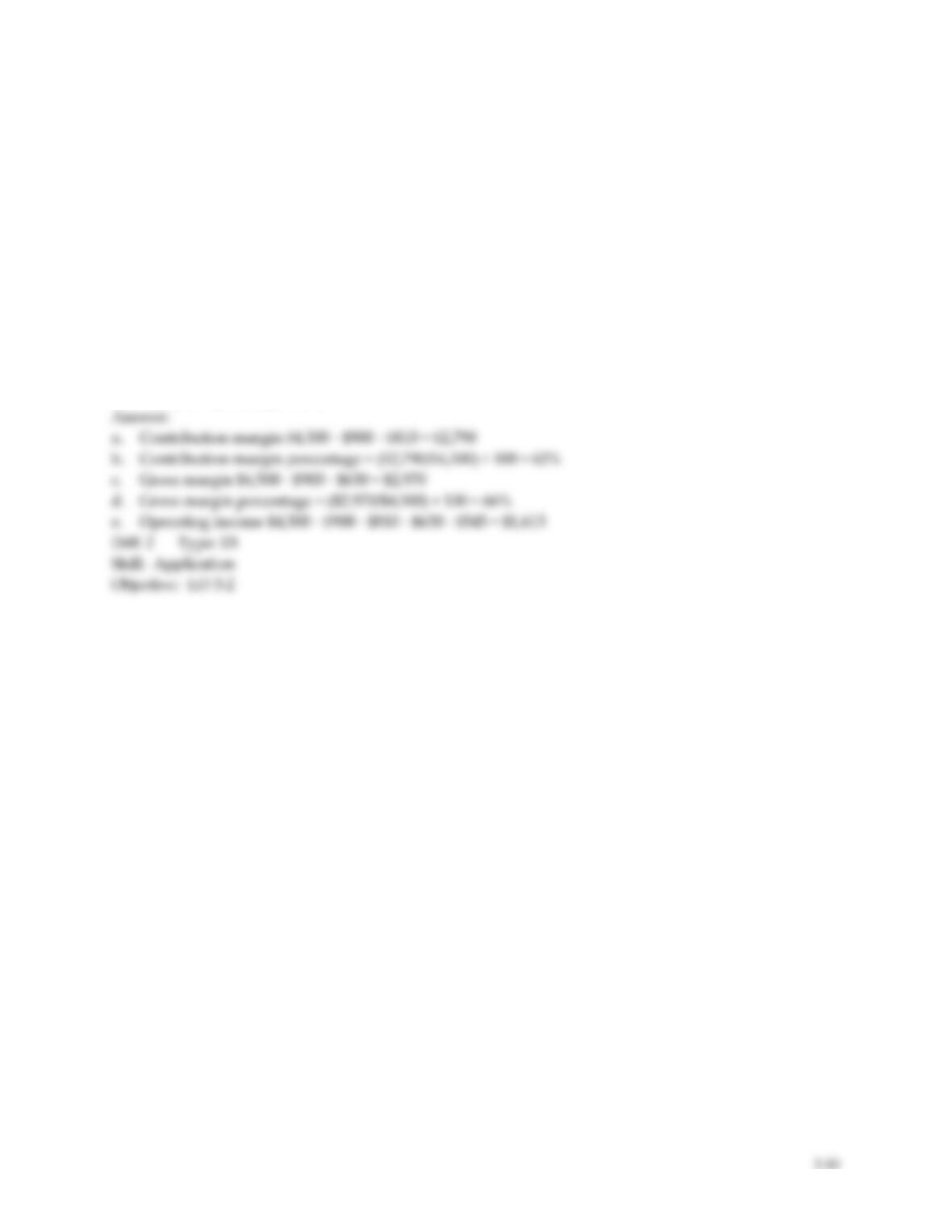
12) Stephanie’s Stuffed Animals reported the following:
Revenues $1,000
Variable manufacturing costs $200
Variable nonmanufacturing costs $230
Fixed manufacturing costs $150
Fixed nonmanufacturing costs $140
Required:
a. Compute contribution margin.
b. Compute gross margin.
c. Compute operating income.
Cost Accounting: A Managerial Emphasis, 6e
Chapter 3 – Cost-Volume-Profit Analysis
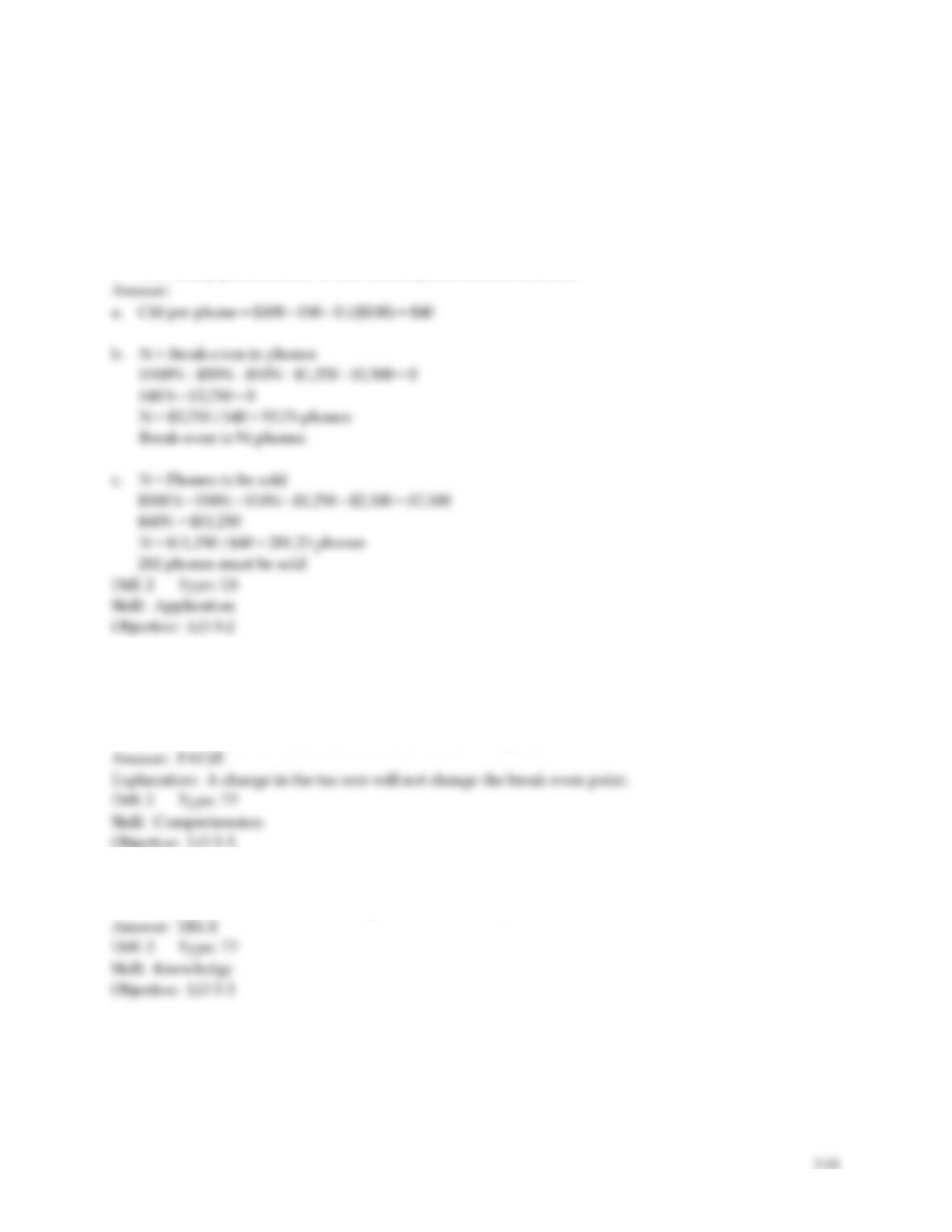
13) Arthur’s Plumbing reported the following:
Revenues $4,500
Variable manufacturing costs $900
Variable nonmanufacturing costs $810
Fixed manufacturing costs $630
Fixed nonmanufacturing costs $545
Required:
a. Compute contribution margin.
b. Compute contribution margin percentage.
c. Compute gross margin.
d. Compute gross margin percentage.
e. Compute operating income.
Cost Accounting: A Managerial Emphasis, 6e
Chapter 3 – Cost-Volume-Profit Analysis
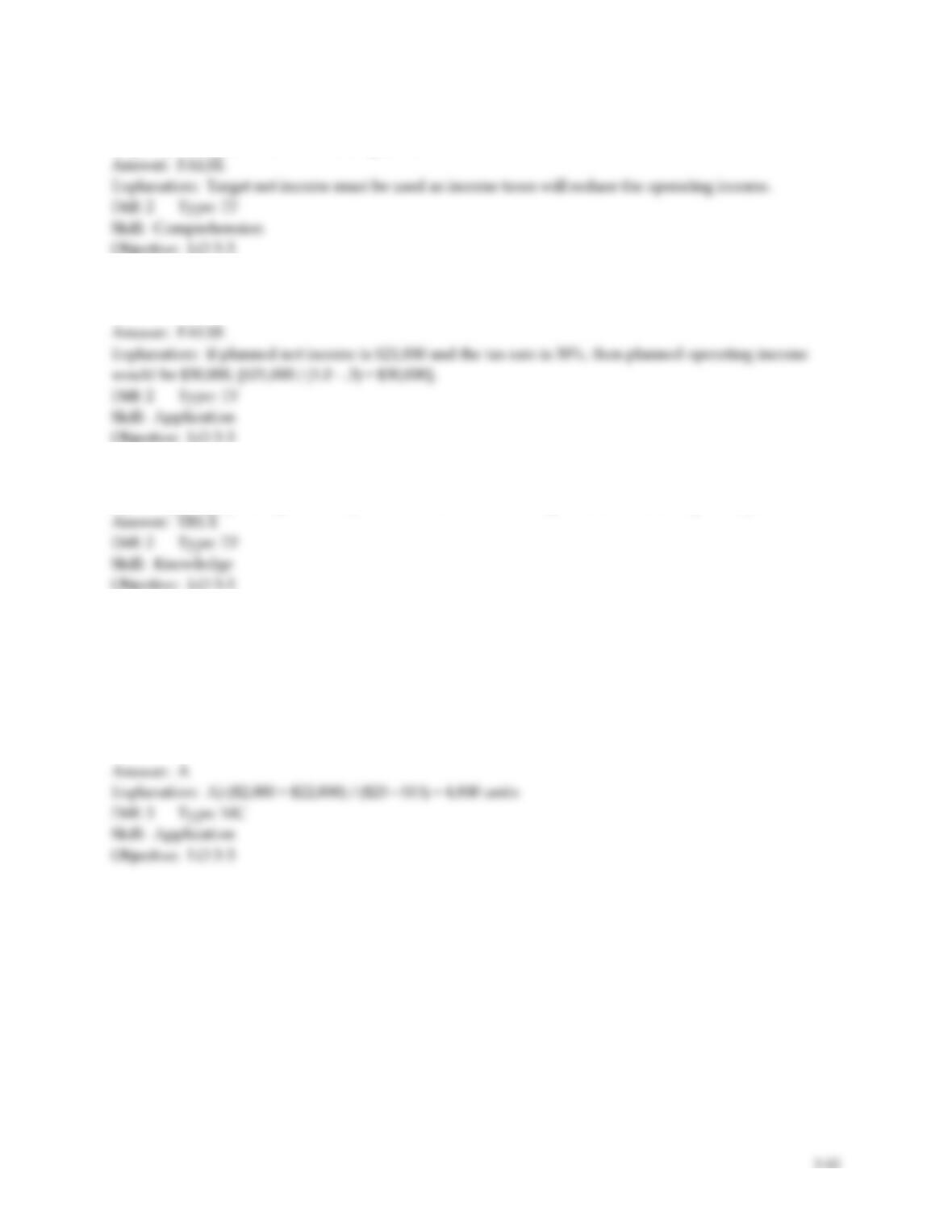
14) Berhannan’s Cellular sells phones for $100. The unit variable cost per phone is $50 plus a selling
commission of 10%. Fixed manufacturing costs total $1,250 per month, while fixed selling and
administrative costs total $2,500.
Required:
a. What is the contribution margin per phone?
b. What is the break-even point in phones?
c. How many phones must be sold to earn pretax income of $7,500?
3.3 Distinguish among contribution, gross, operating, and net income margins, and
apply the CVP model to calculate target net income.
1) An increase in the tax rate will increase the break-even point.
2) Determining the number of units that must be produced in order to generate enough profit to cover
total fixed costs is one reason for using a break-even analysis.
Cost Accounting: A Managerial Emphasis, 6e
Chapter 3 – Cost-Volume-Profit Analysis
3) When making net income evaluations, CVP calculations for target income must be stated in terms of
target operating income instead of target net income.
4) If planned net income is $21,000 and the tax rate is 30%, then planned operating income would be
$27,300.
5) Target net income is computed by multiplying operating income by one minus the entity’s tax rate, or
by multiplying operating income by the tax rate, and subtracting that amount from operating income.
6) How many units would have to be sold to yield a target operating income of $22,000, assuming
variable costs are $15 per unit, total fixed costs are $2,000, and the unit selling price is $20?
A) 4,800 units
B) 4,400 units
C) 4,000 units
D) 3,600 units
E) 1,600 units
Cost Accounting: A Managerial Emphasis, 6e
Chapter 3 – Cost-Volume-Profit Analysis
Use the information below to answer the following question(s).
Brian O’Neil intends to sell his customers a special round-trip airline ticket package. He is able to
purchase the package from the airline carrier for $400 each. The airline intends to reimburse Brian for any
unsold ticket packages. The round-trip tickets will be sold for $500 each.
7) How many units will he need to sell in order to break-even assuming Brian incurred $10,000 in
expenses to advertise the sale, and there are no other expenses?
A) 20 packages
B) 25 packages
C) 75 packages
D) 100 packages
E) 125 packages
8) What would his break-even point be assuming Brian incurred $31,200 in fixed expenses?
A) 312 packages
B) 232 packages
C) 125 packages
D) 110 packages
E) 100 packages
9) Which of the following statements about using the equation method to determine the break-even point
is true?
A) Operating income in the equation is set equal to the target income for the year.
B) Operating income in the equation assumes that fixed costs are nil.
C) Revenue in the equation includes only operating revenues plus fixed costs.
D) The number of units required to reach the break-even point tends to be higher (as it incorporates total
costs) using this method than when using the Contribution Margin method.
E) Operating income in the equation is set equal to nil.
Cost Accounting: A Managerial Emphasis, 6e
Chapter 3 – Cost-Volume-Profit Analysis
10) Which of the following formulae is correct when using the contribution margin method to determine
the break-even point?
A) Revenues less operating income equal variable costs plus fixed costs.
B) Unit contribution margin times unit variable cost equals the break-even number of units.
C) Unit contribution margin times the break-even number of units equals total variable costs.
D) Selling price less unit contribution margin equals unit fixed cost for all values below or at the break–
even number of units.
E) Unit contribution margin times the break-even number of units equals fixed costs.
Use the information below to answer the following question(s).
Jill Bishop makes homemade soap. She sells it for $100 a case. Her variable costs are $40 per case. She has
fixed costs of $600.
11) What is the break-even point in cases?
A) 6 cases
B) 10 cases
C) 15 cases
D) 20 cases
E) 100 cases
12) What is the contribution margin per case?
A) $100.00
B) $60.00
C) $40.00
D) $15.00
E) $10.00
Cost Accounting: A Managerial Emphasis, 6e
Chapter 3 – Cost-Volume-Profit Analysis
13) What is the break-even point in units for a product line, assuming a unit selling price of $200, total
fixed costs are $4,000, unit variable costs are $40, and target operating income is $16,000,000?
A) 25 units
B) 75 units
C) 100 units
D) 125 units
E) 100,000 units
14) What is the break-even point in units, assuming a product’s selling price is $100, fixed costs are $8,000,
unit variable costs are $20, and operating income is $32,000?
A) 100 units
B) 300 units
C) 400 units
D) 500 units
E) 600 units
15) What would target operating income be when fixed costs equal $6,000, unit contribution margin
equals $40.00, and the number of units equals 400?
A) $6,000
B) $10,000
C) $16,000
D) $20,000
E) $60,000
16) How many units would have to be sold to yield a target income of $11,000 assuming variable costs are
$30 per unit, total fixed costs are $1,000, and the unit selling price is $40?
A) 1,200 units
B) 1,100 units
C) 1,000 units
D) 900 units
E) 300 units
Answer the following question(s) using the information below.
Stephanie’s Bridal Shoppe sells wedding dresses. The average selling price of each dress is $1,000,
variable costs are $400, and fixed costs are $90,000.
17) What is the Bridal Shoppe’s operating income when 200 dresses are sold?
A) $120,000
B) $80,000
C) $200,000
D) $100,000
E) $30,000
18) How many dresses are sold when operating income is zero?
A) 225 dresses
B) 150 dresses
C) 100 dresses
D) 90 dresses
E) 60 dresses
Cost Accounting: A Managerial Emphasis, 6e
Chapter 3 – Cost-Volume-Profit Analysis
19) How many dresses must the Bridal Shoppe sell to yield after–tax net income of $18,000, assuming the
tax rate is 40%?
A) 180 dresses
B) 170 dresses
C) 150 dresses
D) 200 dresses
E) 270 dresses
20) To determine the effect of income tax on a decision, managers should evaluate
A) target operating income.
B) contribution margin.
C) tax as a variable expense in determining contribution margin.
D) selling price.
E) target net income.
21) If the tax rate is t, it is possible to calculate planned operating income by
A) dividing net operating income by t.
B) dividing net operating income by 1 – t.
C) multiplying net operating income by t.
D) multiplying net operating income by 1 – t.
E) dividing net operating income by t – 1.
22) Information Inc., sells accounting software. Each unit’s cost may be separated as follows: selling price
of $100 and variable costs of $30. Fixed costs are $10,000.
What is Information Inc.’s operating income assuming 1,000 units are sold?
A) $100,000
B) $90,000
C) $60,000
D) $40,000
E) $20,000
Cost Accounting: A Managerial Emphasis, 6e
Chapter 3 – Cost-Volume-Profit Analysis
23) Ben’s Custom Golf sells special clubs. Ben is able to purchase equipment from a manufacturing
company for $100 each. The equipment is sold for $150 each.
Required:
a. What is the break-even in units assuming Ben incurred $2,500 in selling expenses, and there were no
other expenses?
b. What would be the break-even in units assuming Ben incurred $2,500 in selling expenses and had
$10,000 in other fixed expenses?
Cost Accounting: A Managerial Emphasis, 6e
Chapter 3 – Cost-Volume-Profit Analysis
24) Gates Rubber Company sells cases of hydraulic hoses for $80. The unit variable costs per case are $40
plus a selling commission of 10 percent of sales. Fixed manufacturing costs total $1,000 per month, while
fixed selling and administrative costs total $2,000.
Required:
a. What is the contribution margin per case?
b. What is the break-even point in cases?
c. How many cases must be sold to earn pretax income of $6,000?
Cost Accounting: A Managerial Emphasis, 6e
Chapter 3 – Cost-Volume-Profit Analysis
25) Gilley Inc., sells a single product. The company‘s most recent income statement is given below.
Sales (4,000 units) $120,000
Less variable expenses (68,000)
Contribution margin 52,000
Less fixed expenses (40,000)
Net income $12,000
Required:
a. Contribution margin per unit is $ ________
b. If sales are doubled to $240,000,
total variable costs will equal $ ________
c. If sales are doubled to $240,000,
total fixed costs will equal $ ________
d. If 10 more units are sold, profits will increase by $ ________
e. Compute how many units must be sold to break-even. # ________
f. Compute how many units must be sold
to achieve profits of $20,000. # ________
26) Widget Company sells widgets for $20.00 each. The manufacturing costs, all variable, are $6 each. The
company is planning on renting an exhibition booth ,for both display and selling purposes, at the annual
candy convention. The company’s sales manager will earn a vacation bonus if she can earn a target net
income of $150,000, for the sales operation at the convention. The convention organizers provide the
advertising and guarantee a certain level of traffic, in exchange for 15% of the net income. The 15%
surcharge operates like a tax on net income. The company absorbs all of the fixed costs of production for
the sales made at the convention.
How many widgets does the sales manager have to sell to earn the vacation bonus?