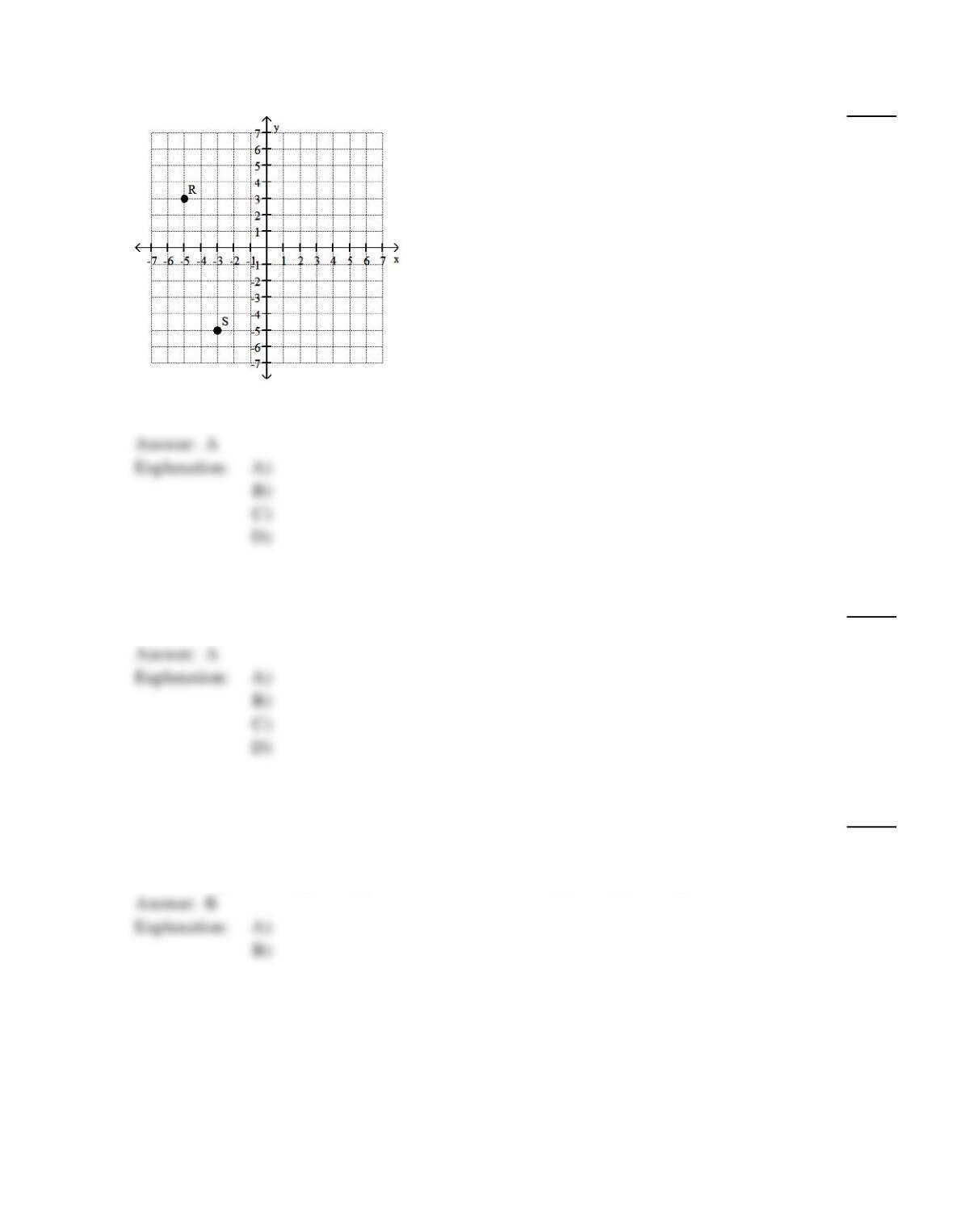
Give the ordered pairs that correspond to the points labeled in the figure.
43)
43)
A)
R = (–5, 3), S = (–3, –5)
B)
R = (–5, 3), S = (–5, –3)
C)
R = (3, 6), S = (–5, –3)
D)
R = (–5, –5), S = (3, –5)
Find the slope of the line passing through the pair of points or state that the slope is undefined.
44)
44)
(1, 3) and (1, –9)
A)
undefined
B)
– 3
C)
0
D)
6
Provide an appropriate answer.
45)
45)
Determine whether the points whose coordinates are (2, –1), (3, –4), (4, –3), and (5, –6) are the
vertices of a four–sided figure whose opposite sides are parallel. (Such a figure is called a
parallelogram.)
A)
The figure is not a parallelogram.
B)
The figure is a parallelogram.
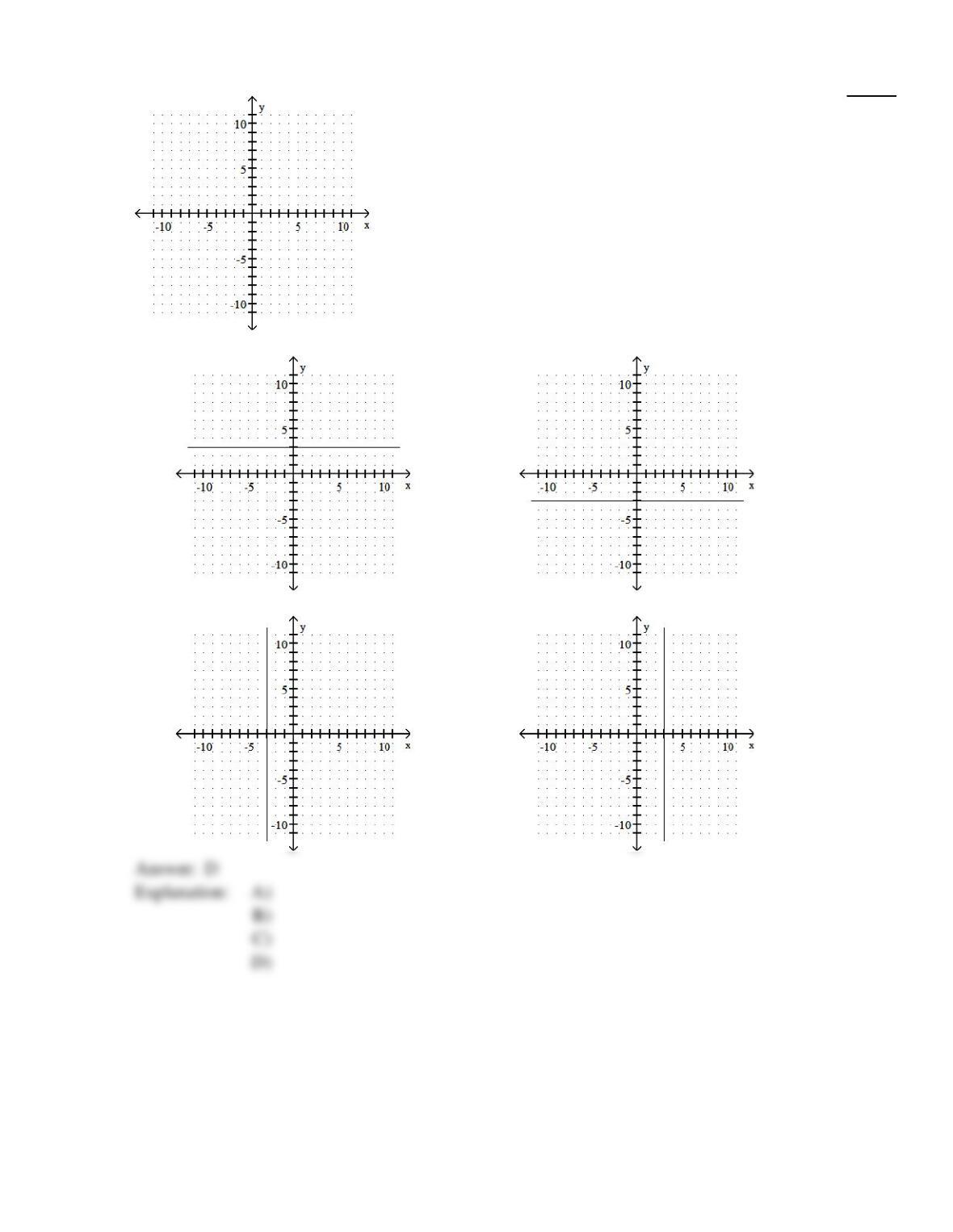
Graph the equation.
21
46)
46)
30 –10x = 0
A)
B)
C)
D)
22
Determine whether the ordered pair is a solution of the given equation.
47)
47)
(6, 1)
x – y =5
A)
Yes
B)
No
Determine whether the lines through each pair of points are parallel.
48)
48)
(–7, 2) and (–11, –14); (6, 1) and (8, –7)
A)
parallel
B)
not parallel
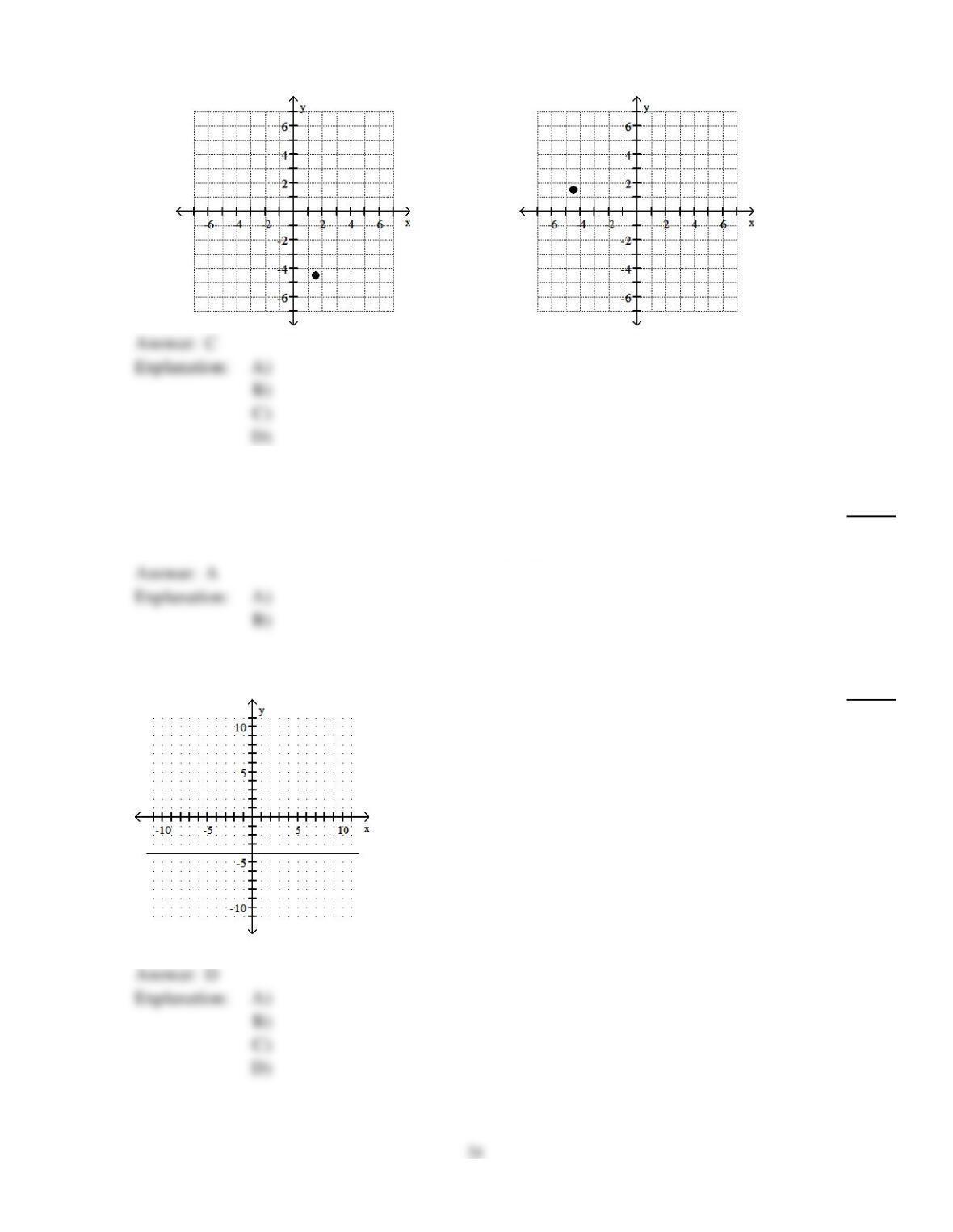
Plot the given point in a rectangular coordinate system.
49)
3
2, –9
2
49)
A)
B)
23
C)
D)
Determine whether the ordered pair is a solution of the given equation.
50)
50)
(3, 6)
y = x – 9
A)
No
B)
Yes
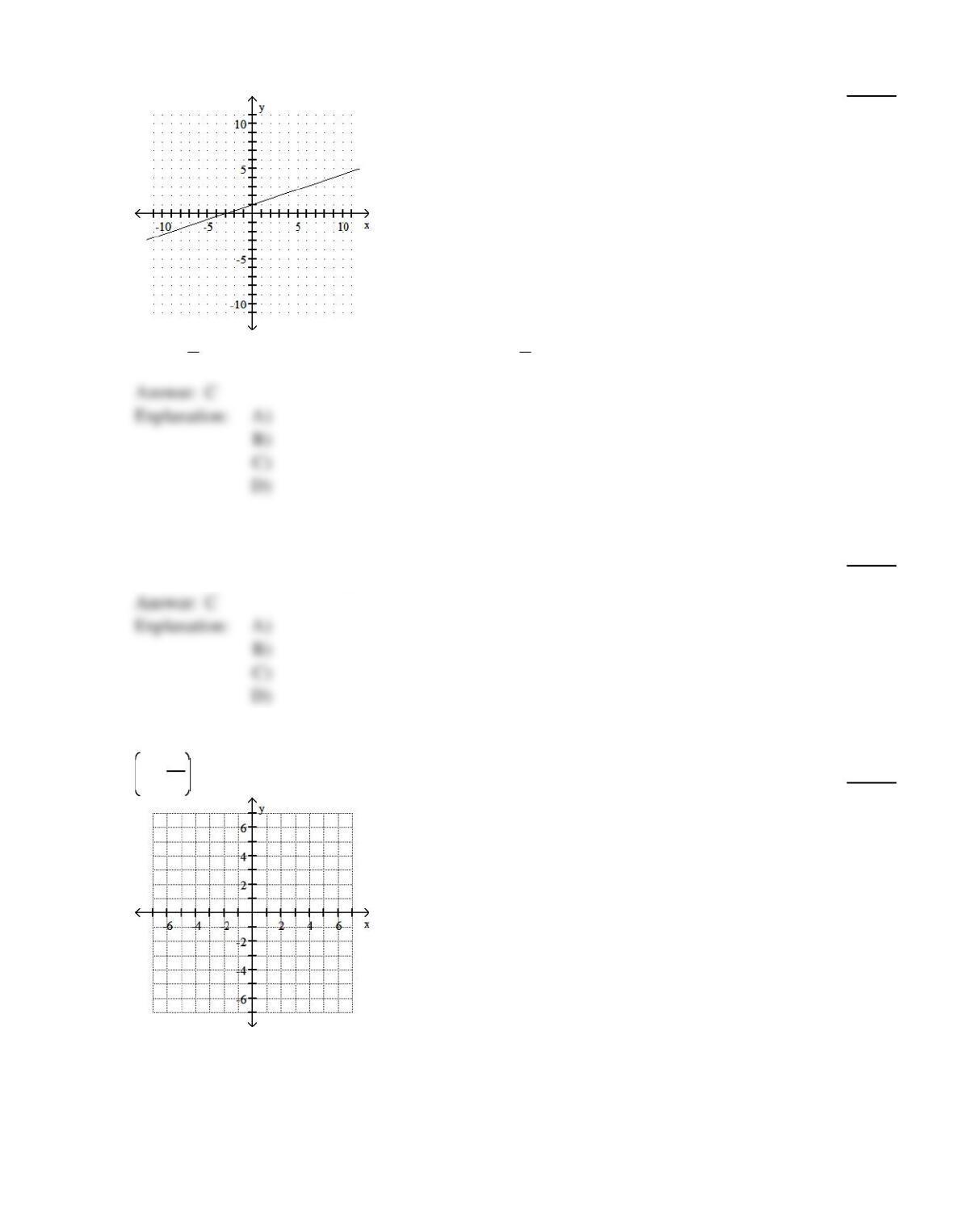
Find the slope of the line, or state that the slope is undefined.
51)
51)
A)
2
B)
Undefined
C)
–4
D)
0
52)
52)
A)
–1
3
B)
–3
C)
1
3
D)
3
Write an equation in slope–intercept form of the line satisfying the given conditions.
53)
53)
Parallel to the line x = – 2; containing the point (9, 6)
A)
y =6
B)
y = – 2
C)
x =9
D)
x =6
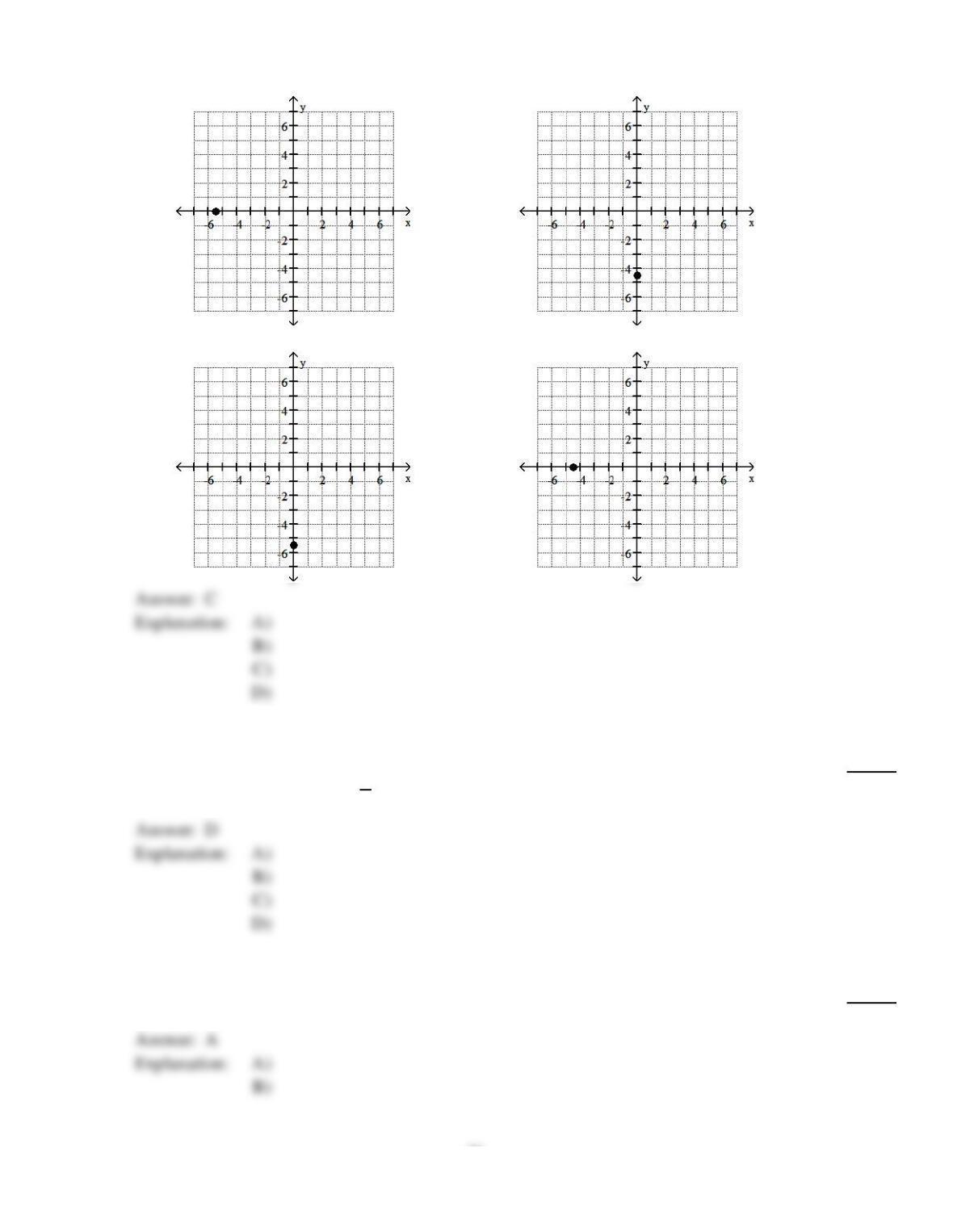
Plot the given point in a rectangular coordinate system.
54)
0, –11
2
54)
25
A)
B)
C)
D)
Find the y–intercept.
55)
55)
y =2x
A)
2
B)
–1
2
C)
1
D)
0
Determine whether the ordered pair is a solution of the given equation.
56)
56)
3x + 4y = – 36; (–4, –6)
A)
Yes
B)
No
26
Find the x–intercept and the y–intercept of the graph of the equation. Do not graph the equation.
57)
57)
4x +5y =20
A)
x–intercept =4; y–intercept =5
B)
x–intercept =5; y–intercept = – 4
C)
x–intercept =5; y–intercept =4
D)
x–intercept = – 5; y–intercept = – 4
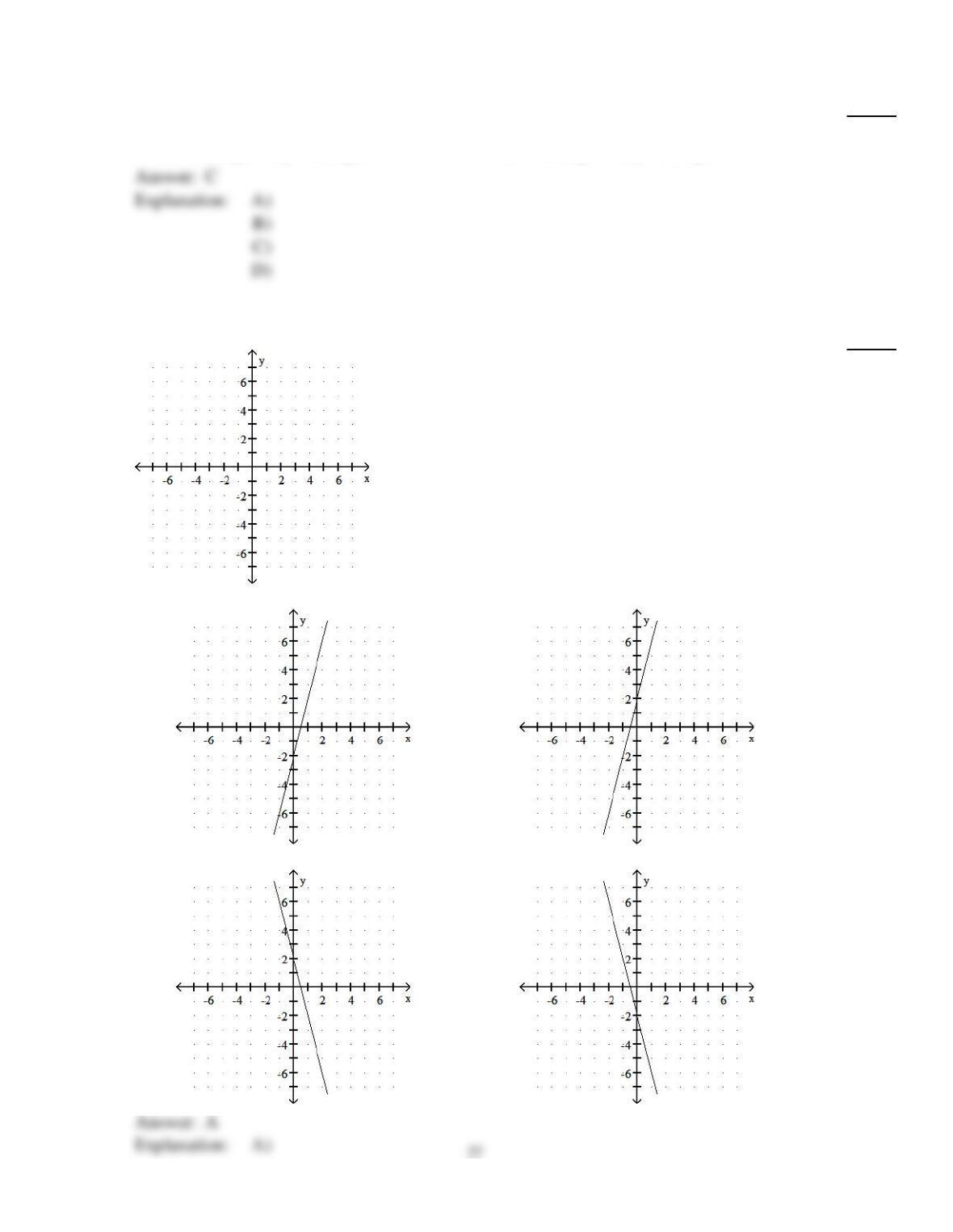
Graph the linear equation in two variables.
58)
58)
y =4x – 2
A)
B)
C)
D)
Find the slope.
59)
59)
Find the slope of a line perpendicular to the line y = – 5.
A)
–1
5
B)
–5
C)
0
D)
undefined
Solve.
60)
60)
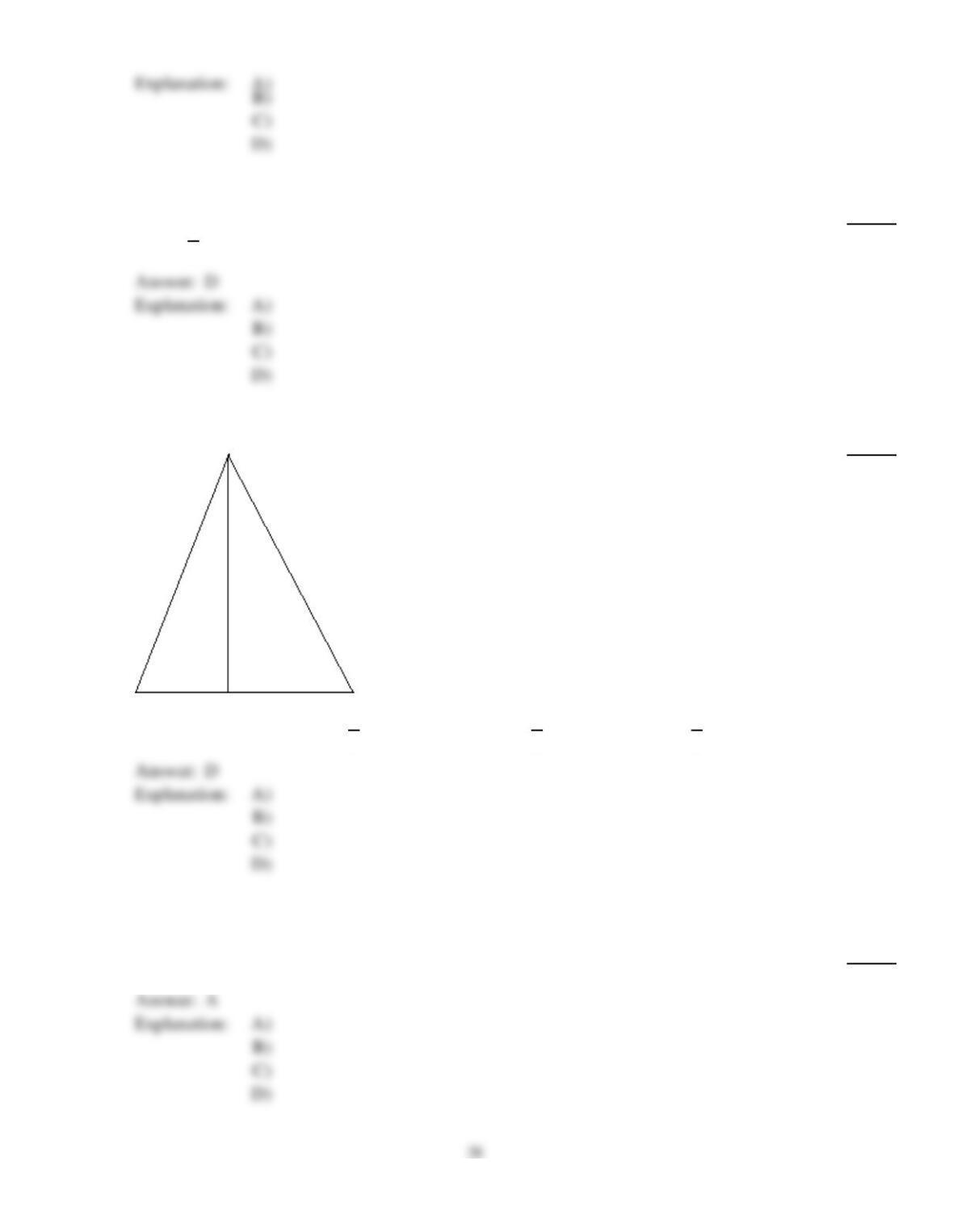
A tent has the dimensions shown in feet. Find the pitch (slope) of the left side of the roof.
5
3
A)
2
B)
3
5
C)
–5
3
D)
5
3
Find the point–slope form of the equation of the line satisfying the given conditions and use this to write the
slope–intercept form of the equation.
61)
61)
Passing through (0, 2) and (1, 3)
A)
y = x + 2
B)
y = x – 2
C)
y = – x – 2
D)
y = – x + 2
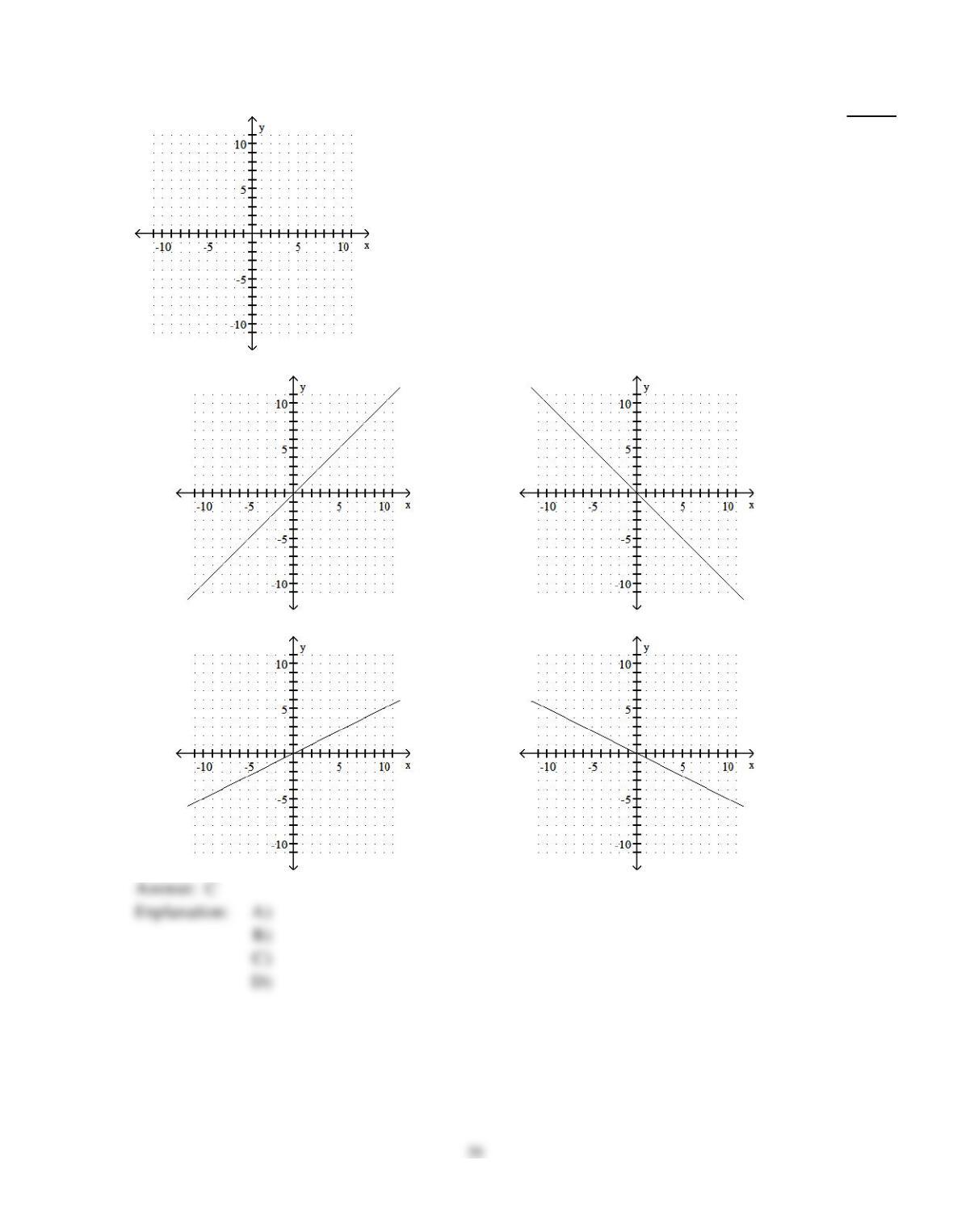
Find the y– and x–intercepts for the equation. Then graph the equation.
62)
62)
4x – 8y =0
A)
(0, 0); (0, 0)
B)
(0, 0); (0, 0)
C)
(0, 0); (0, 0)
D)
(0, 0); (0, 0)
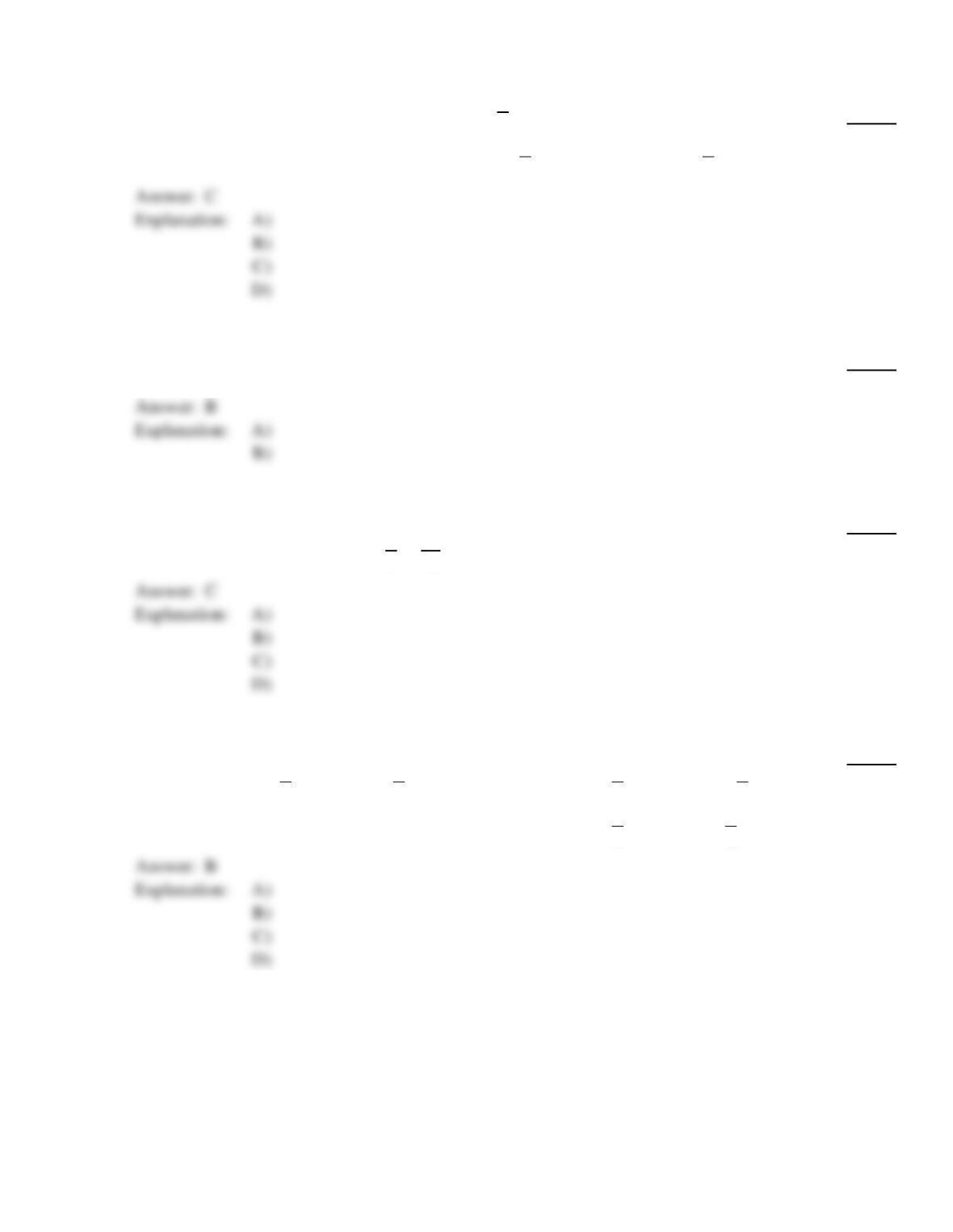
Find the slope.
63)
Find the slope of a line perpendicular to the line y = – 3
5x.
63)
A)
undefined
B)
0
C)
5
3
D)
–3
5
Determine whether the lines through each pair of points are parallel.
64)
64)
(–8, –4) and (–6, –4); (10, 2) and (11, 2)
A)
not parallel
B)
parallel
Use the given conditions to write an equation for the line in slope–intercept form.
65)
65)
Passing through (5, –3) and parallel to the line whose equation is y = – 4x +6.
A)
y = – 4x – 17
B)
y = – 1
4x –17
4
C)
y = – 4x + 17
D)
y =4x – 17
Find the x–intercept and the y–intercept of the graph of the equation. Do not graph the equation.
66)
66)
2x –4y =5
A)
x–intercept = – 5
4; y–intercept =5
2
B)
x–intercept =5
2; y–intercept = – 5
4
C)
x–intercept =3; y–intercept =9
D)
x–intercept =5
2; y–intercept =5
4
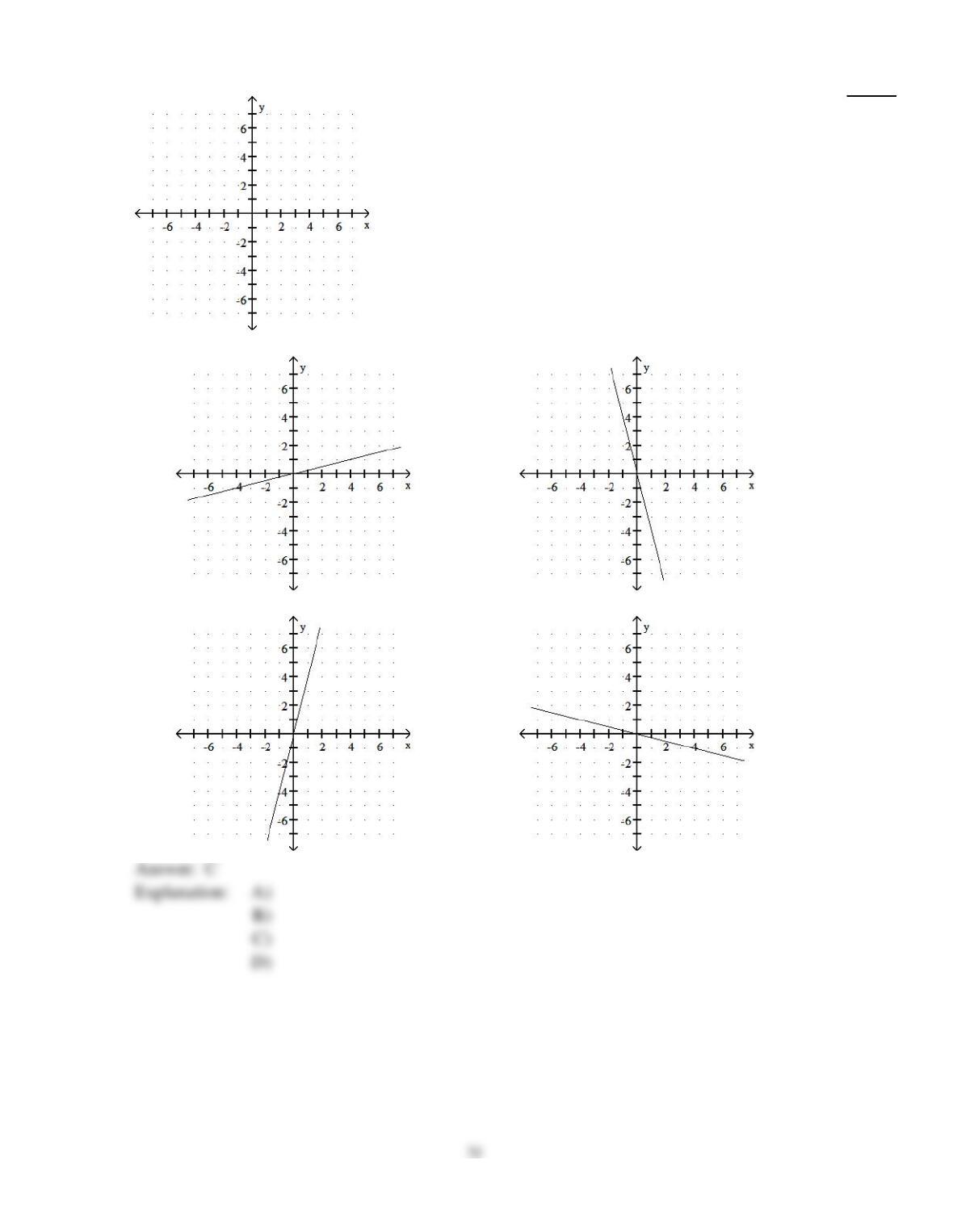
Graph the linear equation in two variables.
30
67)
67)
y =4x
A)
B)
C)
D)
Find the y–intercept.
68)
68)
–7x + y =8
A)
0
B)
–7
C)
7
D)
8
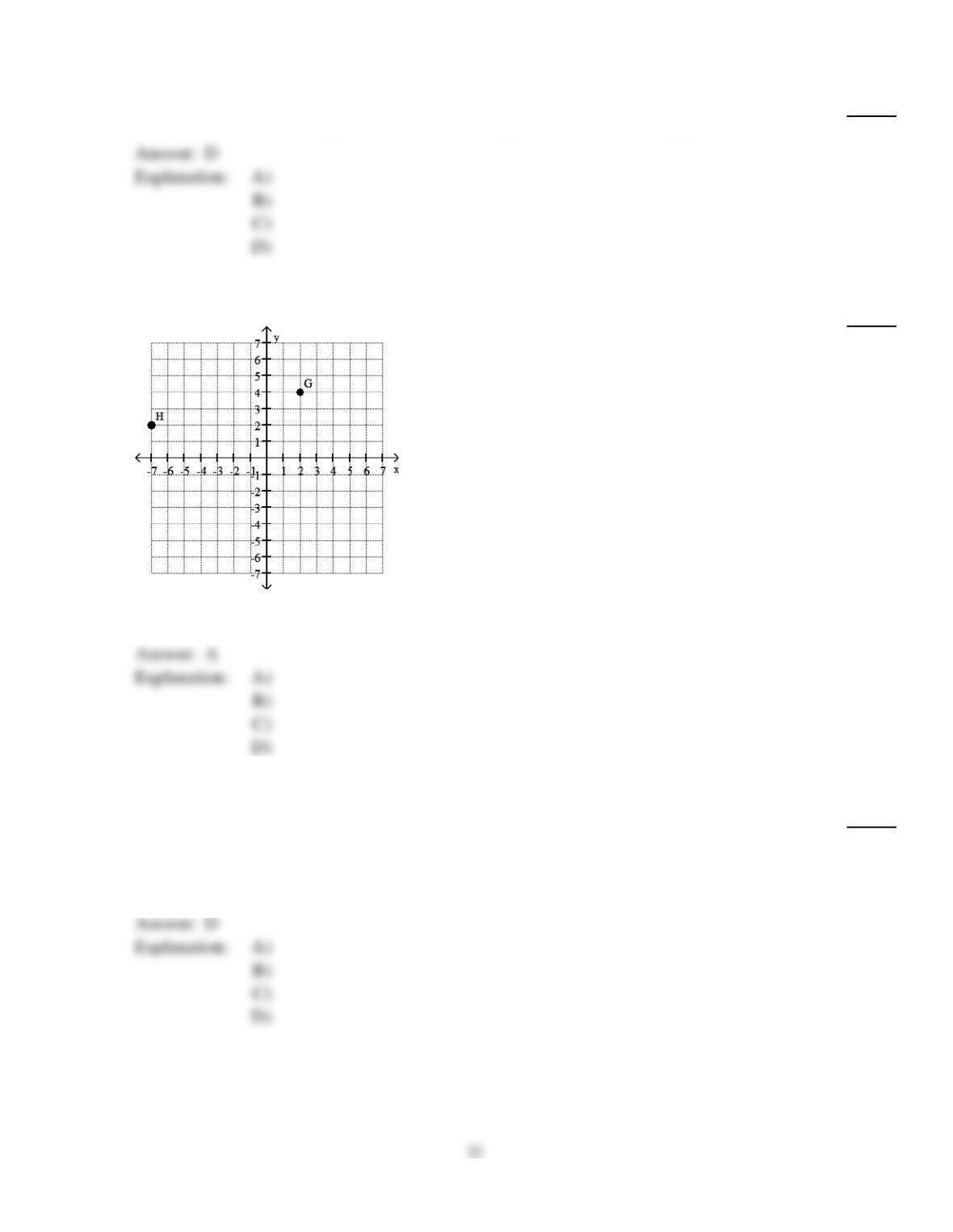
Give the ordered pairs that correspond to the points labeled in the figure.
69)
69)
A)
G = (2, 4), H = (–7, 2)
B)
G = (2, 4), H = (2, –7)
C)
G = (4, 20), H = (2, –7)
D)
G = (2, 2), H = (4, 2)
Solve the problem.
70)
70)
The linear equation in two variables y =124 –2x models the amount of water, y, in ounces,
remaining in a leaky bucket x minutes after the bucket was filled. The equation indicates that the
bucket initially contains 124 ounces of water and loses 2 ounces each minute. Find a solution of y
=124 –2x using 4 for x.
A)
(4, 122)
B)
(4, 132)
C)
(4, 8)
D)
(4, 116)
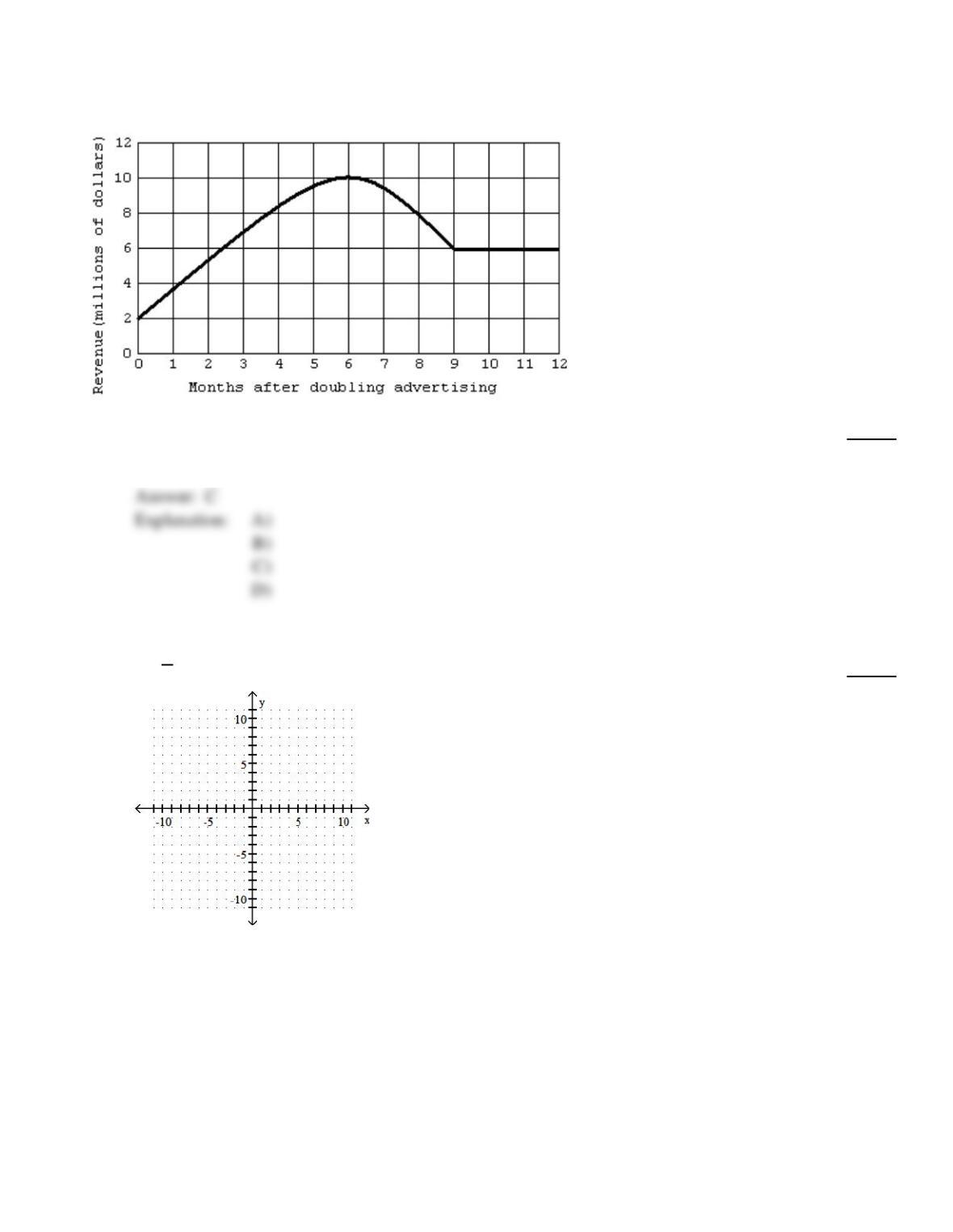
The graph shows the monthly revenue in millions of dollars of a growing company after the company doubled its
advertising. Use the graph to solve the problem.
71)
71)
How many months after the company doubled its advertising did the maximum monthly
revenue occur.
A)
12 months
B)
9 months
C)
6 months
D)
0 months
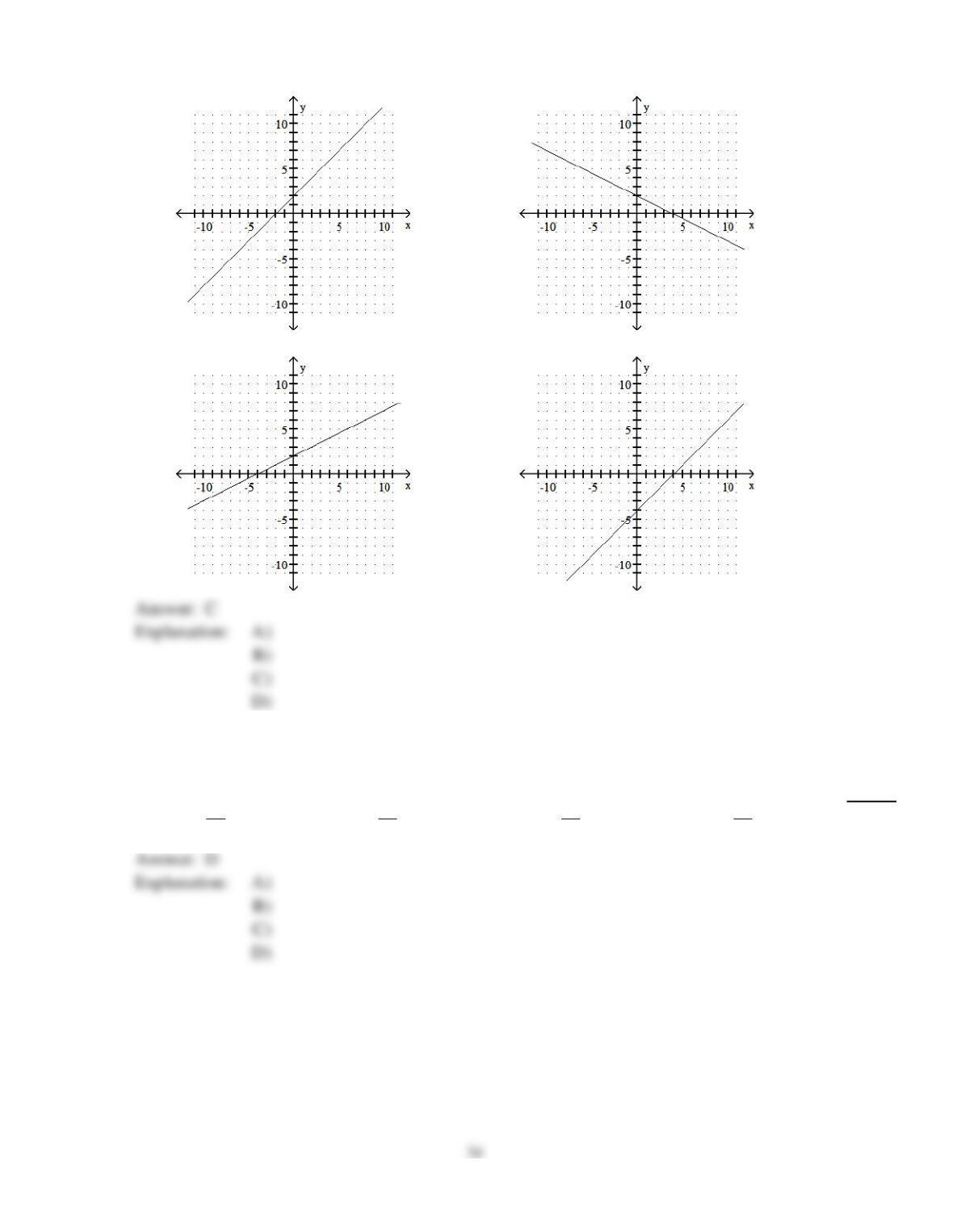
Graph the linear equation using the slope and y–intercept.
72)
y =1
2x +2
72)
33
A)
B)
C)
D)
Calculate the slope of the line passing through the given points. If the slope is undefined, so state. Then indicate
whether the line rises, falls, is horizontal, or is vertical.
73)
73)
(8, –5) and (–2, 6)
A)
m =11
10 ; rises
B)
m =10
11 ; rises
C)
m = – 10
11 ; falls
D)
m = – 11
10 ; falls
Find the point–slope form of the equation of the line satisfying the given conditions and use this to write the
slope–intercept form of the equation.
74)
74)
Passing through (–5, –14) and (–3, –12)
A)
y = – x – 9
B)
y = x – 9
C)
y = – x + 9
D)
y = x + 9
Find the slope.
75)
75)
Find the slope of a line perpendicular to the line y = – 9x + 6.
A)
1
9
B)
undefined
C)
– 9
D)
6
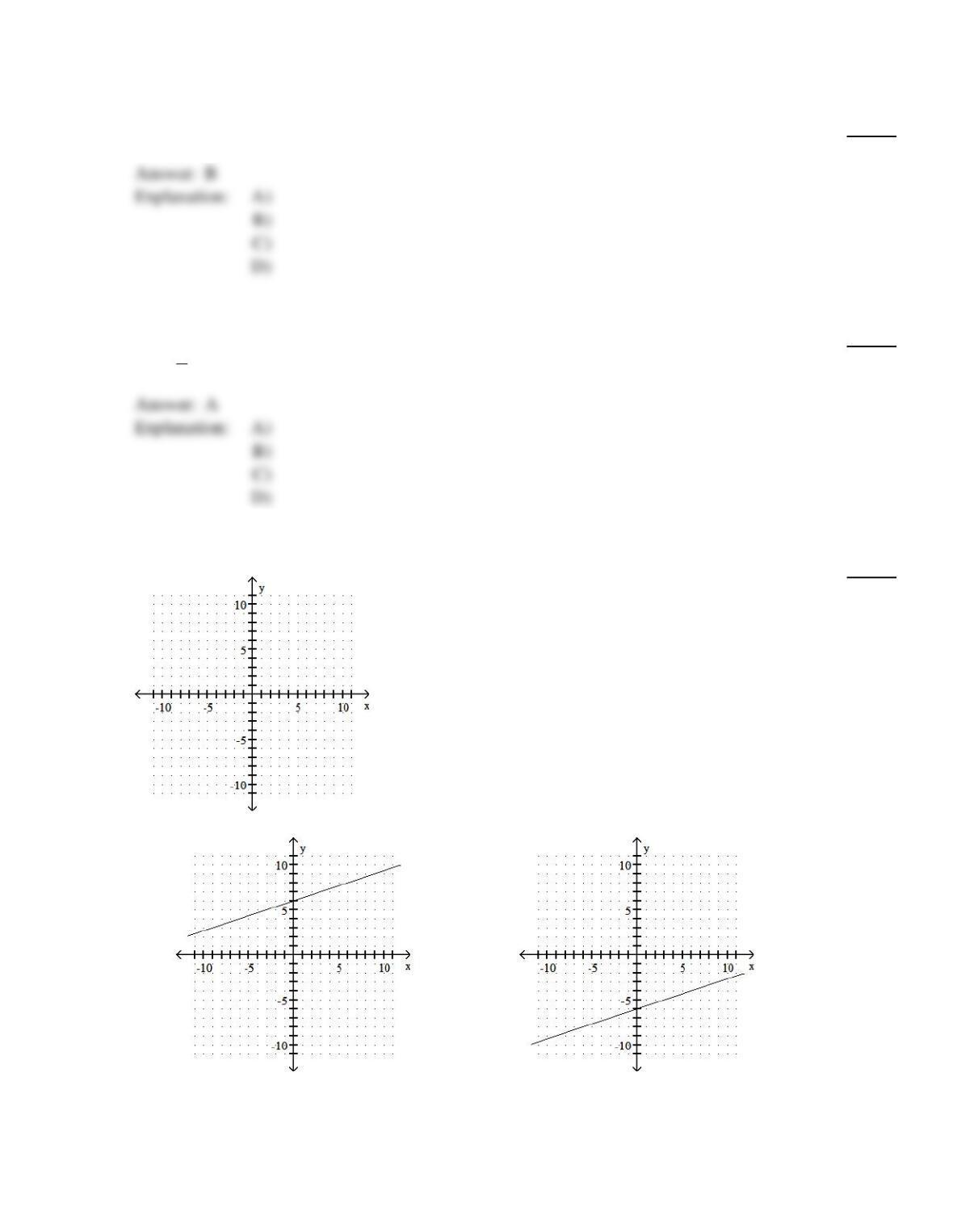
Put the equation in slope–intercept form by solving for y. Use the slope and y–intercept to graph the equation.
76)
76)
3x + y =6
A)
B)
35