Chapter 3—Changes in Chromosome Number
MULTIPLE CHOICE
1. Nondisjunction refers to
a.
the failure of cells to separate properly during mitosis.
b.
the failure of chromosomes to separate properly during meiosis.
c.
a chromosomal mutation.
d.
the failure of chromosomes to replicate.
e.
the inability to produce sperm.
2. Under what circumstances might a couple consult with a genetic counselor?
a.
If the woman will be over 35 years of age at the time of birth
b.
Couples who are first cousins or other blood relatives
c.
Couples who come from ethnic groups in which certain types of genetic defects are more
common
d.
Couples who have already had a child with a genetic disorder
e.
All of these are possible reasons to consult with a genetic counselor.
3. The end result of meiosis is
a.
four haploid cells.
b.
two diploid cells.
c.
two haploid cells and two diploid cells.
d.
four diploid cells.
e.
two haploid cells.
4. Which of the following chromosomes is the smallest in size?
a.
chromosome 22
b.
chromosome 1
c.
X chromosome
d.
chromosome 12
e.
chromosome 2
5. An individual with only one X chromosome and no other sex chromosome
a.
is female.
b.
is male.
c.
is never born.
d.
never develops completely.
e.
has Jacobs syndrome.

Chapter 3 – Changes in Chromosome Number
6. What is considered the main risk factor for having a child with Down syndrome?
a.
maternal age
b.
paternal age
c.
exposure to radiation
d.
exposure to cancer-causing chemicals
e.
the combined age of the parents
7. What kinds of chromosomal defects invariably result in miscarriage in early pregnancy?
a.
all trisomies involving autosomes
b.
all monosomies involving autosomes
c.
all monosomies involving the sex chromosomes
d.
all trisomies involving chromosome 21
e.
all trisomies involving the sex chromosomes
8. The most common cause of both trisomy and monosomy is
a.
exposure to radiation.
b.
carcinogenic agents.
c.
smoking.
d.
nondisjunction.
e.
None of these are the most common cause of trisomy and monosomy.
9. All of the following trisomies can still lead to live births EXCEPT
a.
Trisomy 1
b.
Trisomy 13
c.
Trisomy 18
d.
Trisomy 21
e.
Trisomy 8
10. What chromosomal change(s) can lead to birth defects?
a.
additional copies of chromosomes
b.
aneuploidy
c.
duplications of segments of chromosomes
d.
deletions of segments of chromosomes
e.
All of these can lead to birth defects.
11. This test requires growing the isolated cells for about a week and can indicate prenatal chromosomal
abnormalities.
a.
amniocentesis
b.
chorionic villus sampling (CVS)
c.
pregnancy testing that detects hormone levels
d.
analysis of free fetal DNA.
e.
analysis of the father’s DNA.
12. Under what circumstance(s) is it recommended that a woman undergo amniocentesis?
a.
The woman will be 25 years of age or older at the time of birth.
b.
The woman has not had a previous child with a chromosomal aberration.
c.
Either parent has a known structurally abnormal chromosome.
d.
The father will be 35 years of age or older at the time of the birth.
e.
The parents want to have a karyotype of their child.
13. Amniocentesis
a.
involves removal of fluid and cells from around the fetus.
b.
is usually used to determine if a female is pregnant.
c.
is performed at or around the 12th week of pregnancy
d.
involves a risk of about 1% for miscarriage
e.
has a high risk for the mother’s health.
14. At the end of meiosis, the number of chromosomes in each daughter cell is _____ the number of
chromosomes that were present in the original parent cell.
a.
the same as
b.
double
c.
half
d.
triple
e.
four times
15. Individuals with Jacobs syndrome are
a.
47, XYY.
b.
45, X.
c.
47, XXY.
d.
47, +13
e.
47, +21
16. Meiosis in females
a.
leads to the production of sperm.
b.
only produces polar bodies.
c.
has already completed by the time of her birth.
d.
only completes if an oocyte is fertilized.
e.
never completes.
17. If a normal diploid cell from a certain animal species contains 36 chromosomes, an oocyte from a
female of this species contains ____ chromosomes.
a.
9
b.
12
c.
18
d.
36
e.
72
18. Sperm and oocytes are
a.
triploid.
b.
aneuploid.
c.
haploid.
d.
diploid.
e.
polyploid.
19. A human cell that is polyploid might have _____ chromosomes.
a.
45
b.
46
c.
47
d.
92
e.
23
20. What is the advantage of performing CVS over amniocentesis?
a.
CVS can be done earlier in the pregnancy.
b.
With CVS, there is no risk of miscarriage.
c.
CVS allows chromosomal analysis; amniocentesis does not.
d.
There is no advantage to performing CVS over amniocentesis.
e.
CVS can be performed on the father; amniocentesis must be performed on the mother.
21. The condition in which there is only a single copy of an autosome in a diploid cell is known as
a.
monosomy.
b.
trisomy.
c.
diploidy.
d.
polyploidy.
e.
haploidy.
22. Autosomal trisomies
a.
usually do not cause any abnormalities.
b.
cannot occur.
c.
never lead to live births.
d.
usually lead to miscarriages.
e.
are usually due to chromosomal duplications.
23. Uniparental disomy
a.
describes a condition in which an individual has an abnormal number of chromosomes.
b.
never causes any genetic problems.
c.
has been determined to be involved in Angelman syndrome.
d.
can be the cause of Turner syndrome.
e.
can lead to autosomal monosomy.
24. To produce an individual with Jacobs syndrome (47, XYY),
a.
a nondisjunction event must have occurred during spermatogenesis.
b.
more than one sperm must have been involved in fertilization.
c.
a nondisjunction event must have occurred during oogenesis.
d.
this must have been caused by uniparental disomy.
e.
a nondisjunction event could have occurred during spermatogenesis or oogenesis.
25. To produce an individual with Turner syndrome (45, X),
a.
a nondisjunction event must have occurred during spermatogenesis.
b.
more than one sperm must have been involved in fertilization.
c.
a nondisjunction event must have occurred during oogenesis.
d.
this must have been caused by uniparental disomy.
e.
a nondisjunction event could have occurred during spermatogenesis or oogenesis.
26. To produce an individual with Kleinfelter syndrome (47, XXY),
a.
a nondisjunction event must have occurred during spermatogenesis.
b.
more than one sperm must have been involved in fertilization.
c.
a nondisjunction event must have occurred during oogenesis.
d.
this must have been caused by uniparental disomy.
e.
a nondisjunction event could have occurred during spermatogenesis or oogenesis.
27. To produce an individual with Down syndrome (47, +21),
a.
a nondisjunction event must have occurred during spermatogenesis.
b.
more than one sperm must have been involved in fertilization.
c.
a nondisjunction event must have occurred during oogenesis.
d.
this must have been caused by uniparental disomy.
e.
a nondisjunction event could have occurred during spermatogenesis or oogenesis.
28. Different versions of genes are called
a.
homologues.
b.
alleles.
c.
autosomes.
d.
sister chromatids.
e.
centromeres.
29. Homologous chromosomes
a.
carry different genes at different positions.
b.
carry the same genes at different positions.
c.
carry some of the same genes but also some different genes.
d.
are both inherited from the same parent.
e.
carry the same genes at the same positions.
30. A karyotype
a.
will change during the course of an individual’s lifetime.
b.
does not provide any information on the sex of a fetus.
c.
is a microscope slide containing a spread of chromosomes from a single cell.
d.
shows the chromosomes from the mother separated from those from the father.
e.
can be used to determine whether an individual is aneuploid or not.
31. Polar bodies form
a.
only if fertilization occurs.
b.
due to unequal cytoplasmic division during oogenesis.
c.
only when a nondisjunction event has occurred.
d.
due to unequal cytoplasmic division during spermatogenesis.
e.
after a woman has reached menopause.
TRUE/FALSE
1. One type of aneuploidy is Down syndrome.
2. Monosomy involving an autosomal chromosome is never fatal.
3. Mothers who are over the age of 35 have a higher likelihood of having a child with genetic defects
than do younger mothers.
4. Meiosis involves a reduction in the number of chromosomes.
5. Telomeres may play a role in aging.
32
6. Nondisjunction events can lead to aneuploidy.
7. Structural changes in chromosomes never lead to genetic defects.
8. Aneuploidy is a major cause of early miscarriages.
9. Individuals with Klinefelter syndrome have XXY sex chromosomes.
10. Turner syndrome involves monosomy of the Y chromosome.
MATCHING
Match the correct syndromes with the genetic abnormality.
a.
Trisomy 21
b.
XXY
c.
XO
d.
47, +13
e.
Trisomy 18
f.
47, XYY
1. Turner syndrome
2. Klinefelter syndrome
3. Down syndrome
4. Edwards syndrome
5. Patau syndrome
6. Jacobs syndrome
Match the appropriate term with the description or term.
a.
Zygote
b.
Involves gain or loss of a chromosome
c.
Sperm cell
d.
Extra copies of all the chromosomes
Chapter 3 – Changes in Chromosome Number
33
7. Diploid
8. Haploid
9. Aneuploid
10. Polyploid
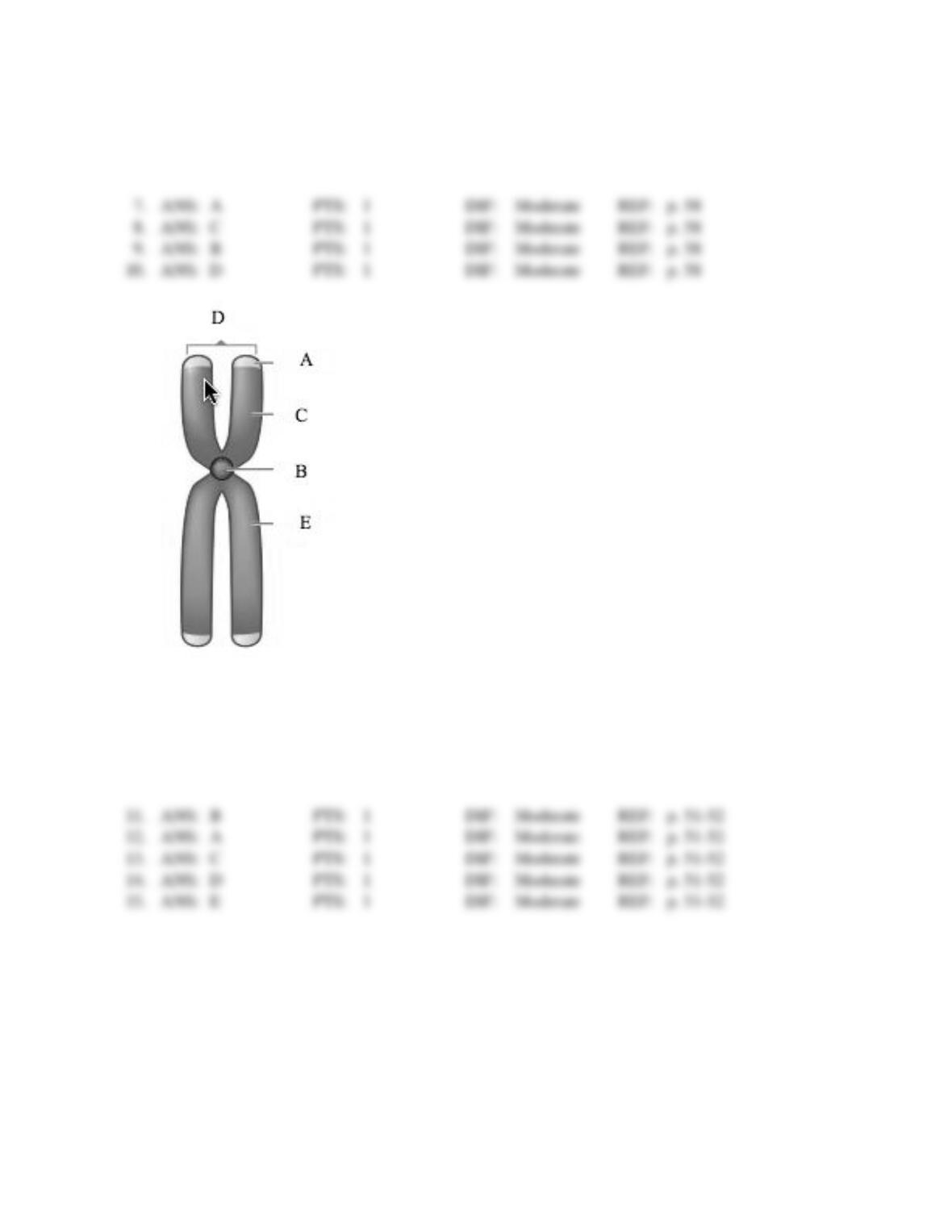
11. The location of this can vary depending on the chromosome.
12. These shorten after each cell division.
13. The p arm.
14. Sister chromatids.
15. The q arm.
Chapter 3 – Changes in Chromosome Number
ESSAY
1. What is the purpose of genetic counseling? What kinds of information must a genetic counselor take
into account in order to assess patient risk for genetic disorders?
2. Maternal age is the only known risk factor for aneuploidy. What are possible reasons for the increased
risk associated with increase maternal age?
SHORT ANSWER
1. Identify and describe two medical tests that can be used to detect chromosomal abnormalities in a
fetus. What are advantages and disadvantages of each?
2. Describe chromosomal nondisjunction? What are the consequences of nondisjunction in meiosis?
3. In most cases of Down syndrome, there is no family inheritance pattern. Individuals with Down
syndrome are born to mothers even when there has been no family history of Down syndrome.
However, in rare cases, there is a family inheritance pattern. Describe the cause of this rare form of
Down syndrome and explain why this form shows a family inheritance pattern.
4. Describe three major structural changes in chromosomes that can lead to genetic abnormalities?