Chapter 03 – The Chemical Building Blocks of Life
38. Enzymes function to:
39. The types of bonds found in nucleic acids are:

Chapter 03 – The Chemical Building Blocks of Life
40. Which of the following reactions is a dehydration reaction?
Chapter 03 – The Chemical Building Blocks of Life
Clarify Question
•
What is the key concept addressed by the question?
•
What type of thinking is required?
•
What key words does the question contain and what do they mean?
Gather Content
•
What do you know about dehydration reactions? How does it relate to the question?
Consider Possibilities
•
What other information is related to the question? Which information is most useful?
Choose Answer
•
Given what you now know, what information and/or problem solving approach is most
likely to produce the correct answer?
Reflect on Process
•
Did your problem-solving process lead you to the correct answer? If not, where did the
process break down or lead you astray? How can you revise your approach to produce a
more desirable result?

Chapter 03 – The Chemical Building Blocks of Life

Chapter 03 – The Chemical Building Blocks of Life
41. Which of the following reactions is a hydrolysis reaction?
Chapter 03 – The Chemical Building Blocks of Life
Clarify Question
•
What is the key concept addressed by the question?
o The question asks about hydrolysis reactions.
•
What type of thinking is required?
o You are being asked to apply your knowledge of hydrolysis reactions to identify one.
•
What key words does the question contain and what do they mean?
Gather Content
•
What do you know about hydrolysis reactions? How does it relate to the question?
Consider Possibilities
•
What other information is related to the question? Which information is most useful?
Choose Answer
•
Given what you now know, what information and/or problem solving approach is most
likely to produce the correct answer?
Reflect on Process
•
Did your problem-solving process lead you to the correct answer? If not, where did the
process break down or lead you astray? How can you revise your approach to produce a
more desirable result?
Chapter 03 – The Chemical Building Blocks of Life
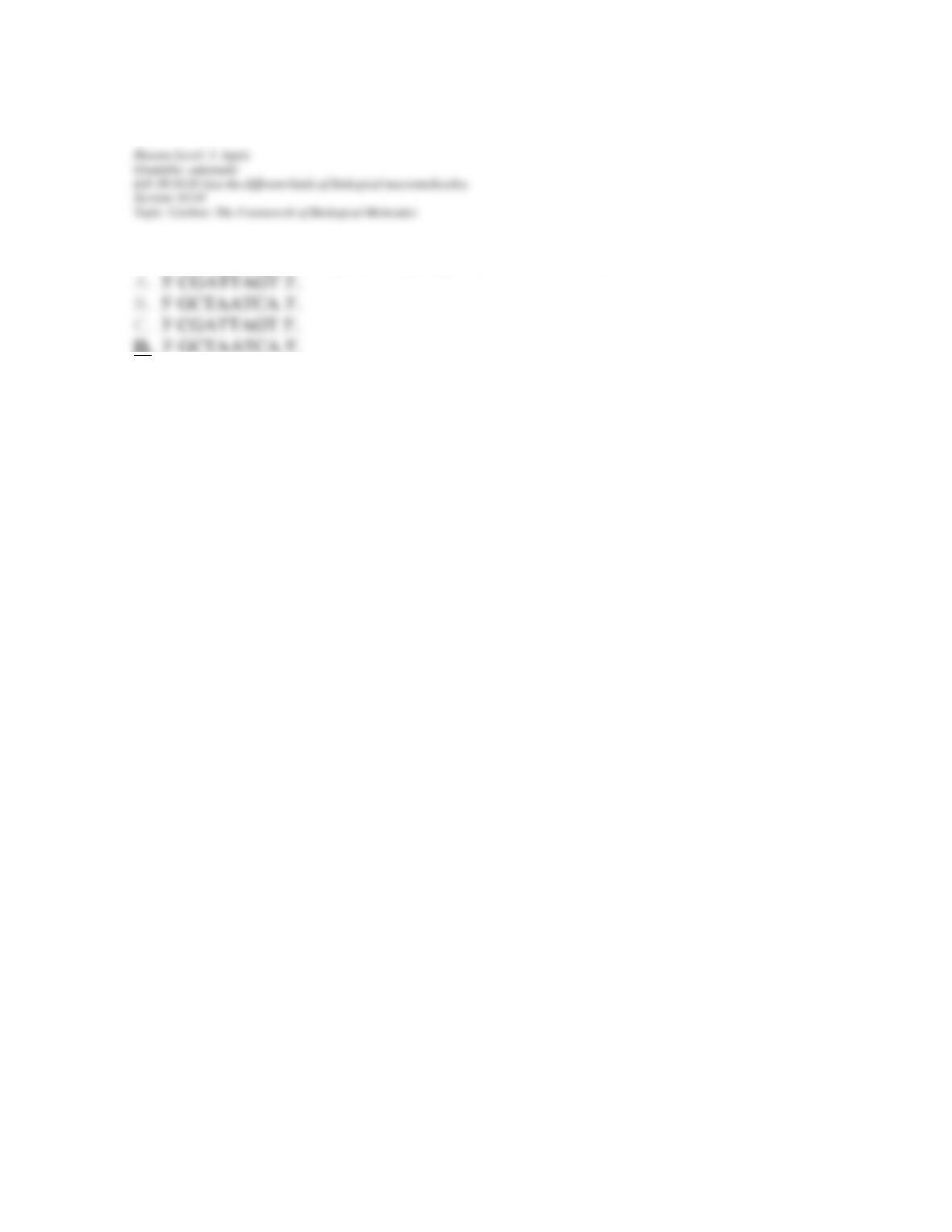
42. The DNA sequence capable of pairing with 5′ CGATTAGT 3′ is:
Chapter 03 – The Chemical Building Blocks of Life
Clarify Question
•
What is the key concept addressed by the question?
•
What type of thinking is required?
•
What key words does the question contain and what do they mean?
Gather Content
•
What do you know about base pairing? How does it relate to the question?
Consider Possibilities
•
What other information is related to the question? Which information is most useful?
Choose Answer
•
Given what you now know, what information and/or problem solving approach is most
likely to produce the correct answer?
Reflect on Process
•
Did your problem-solving process lead you to the correct answer? If not, where did the
process break down or lead you astray? How can you revise your approach to produce a
more desirable result?

Chapter 03 – The Chemical Building Blocks of Life
43. You recently identified a novel protein that contains several membrane-spanning
domains. You would predict that the amino acids embedded in the membrane would have
____ side groups.
Chapter 03 – The Chemical Building Blocks of Life
Clarify Question
•
What is the key concept addressed by the question?
•
What type of thinking is required?
•
What key words does the question contain and what do they mean?
Gather Content
•
What do you know about amino acid side groups? How does it relate to the question?
Consider Possibilities
•
What other information is related to the question? Which information is most useful?
Choose Answer
•
Given what you now know, what information and/or problem solving approach is most
likely to produce the correct answer?
Reflect on Process
•
Did your problem-solving process lead you to the correct answer? If not, where did the
process break down or lead you astray? How can you revise your approach to produce a
more desirable result?
Chapter 03 – The Chemical Building Blocks of Life
44. L-lysine is an essential amino acid and must be supplied in the diet. By comparison, the
stereoisomer D-lysine is not biologically active. Why can your body only utilize one form?
Chapter 03 – The Chemical Building Blocks of Life
45. People who are lactose intolerant can often consume some products made from milk such
as cheese and yogurt because microorganisms in their digestive system consume the lactose.
By comparison, people with a true milk allergy, which involves an immune response to milk
protein, cannot consume milk or products made from milk. Given this information, what can
you conclude about milk?
Chapter 03 – The Chemical Building Blocks of Life
Clarify Question
•
What is the key concept addressed by the question?
•
What type of thinking is required?
role of lactose and proteins in each.
•
What key words does the question contain and what do they mean?
Gather Content
•
What do you know about milk proteins and lactose? How does it relate to the question?
Consider Possibilities
•
What other information is related to the question? Which information is most useful?
yogurt make by active cultures of bacteria.
Choose Answer
•
Given what you now know, what information and/or problem solving approach is most
likely to produce the correct answer?
Reflect on Process
•
Did your problem-solving process lead you to the correct answer? If not, where did the
process break down or lead you astray? How can you revise your approach to produce a
more desirable result?
Chapter 03 – The Chemical Building Blocks of Life
46. Egg whites consist primarily of water and the protein albumin. When you fry an egg, why
does the egg white turn from clear to white?

Chapter 03 – The Chemical Building Blocks of Life
47. Margarine is made by hydrogenating vegetable oils so that they take on the consistency of
butter. Propose a chemical basis for this change from a liquid to a solid.
Chapter 03 – The Chemical Building Blocks of Life
Clarify Question
•
What is the key concept addressed by the question?
•
What type of thinking is required?
on consistency.
•
What key words does the question contain and what do they mean?
Gather Content
•
What do you know about the effect of saturation on the consistency of a fat? How does it
relate to the question?
Consider Possibilities
•
What other information is related to the question? Which information is most useful?
Choose Answer
•
Given what you now know, what information and/or problem solving approach is most
likely to produce the correct answer?
Reflect on Process
•
Did your problem-solving process lead you to the correct answer? If not, where did the
process break down or lead you astray? How can you revise your approach to produce a
more desirable result?
Chapter 03 – The Chemical Building Blocks of Life
48. Vitamin D can be synthesized by the body from a derivative of cholesterol. Given this
information, predict vitamin D’s solubility.
Chapter 03 – The Chemical Building Blocks of Life
Clarify Question
•
What is the key concept addressed by the question?
•
What type of thinking is required?
•
What key words does the question contain and what do they mean?
Gather Content
•
What do you know about the solubility of cholesterol? How does it relate to the question?
Consider Possibilities
•
What other information is related to the question? Which information is most useful?
Choose Answer
•
Given what you now know, what information and/or problem solving approach is most
likely to produce the correct answer?
Reflect on Process
•
Did your problem-solving process lead you to the correct answer? If not, where did the
process break down or lead you astray? How can you revise your approach to produce a
more desirable result?
Chapter 03 – The Chemical Building Blocks of Life
49. You arrive late to a biological seminar. However, just as you enter the room, you hear the
speaker referring to the “amino end” and the “carboxyl end” of a macromolecule.
Immediately, you know that they are talking about a:
50. You arrive late to a biological seminar. However, just as you enter the room, you hear the
speaker referring to the “five-prime end” and the “three-prime end” of a macromolecule.
Immediately, you know that they are talking about a:
51. What type of monomer does ATP represent?

Chapter 03 – The Chemical Building Blocks of Life
52. The digestive enzyme pepsin works in the acidic environment of the stomach to
hydrolyze peptide bonds. As a result, pepsin affects which macromolecule?