150 Chapter 3: Applications of Differentiation
3.2 Rolle’s Theorem and the Mean Value Theorem
Multiple Choice
Identify the choice that best completes the statement or answers the question.
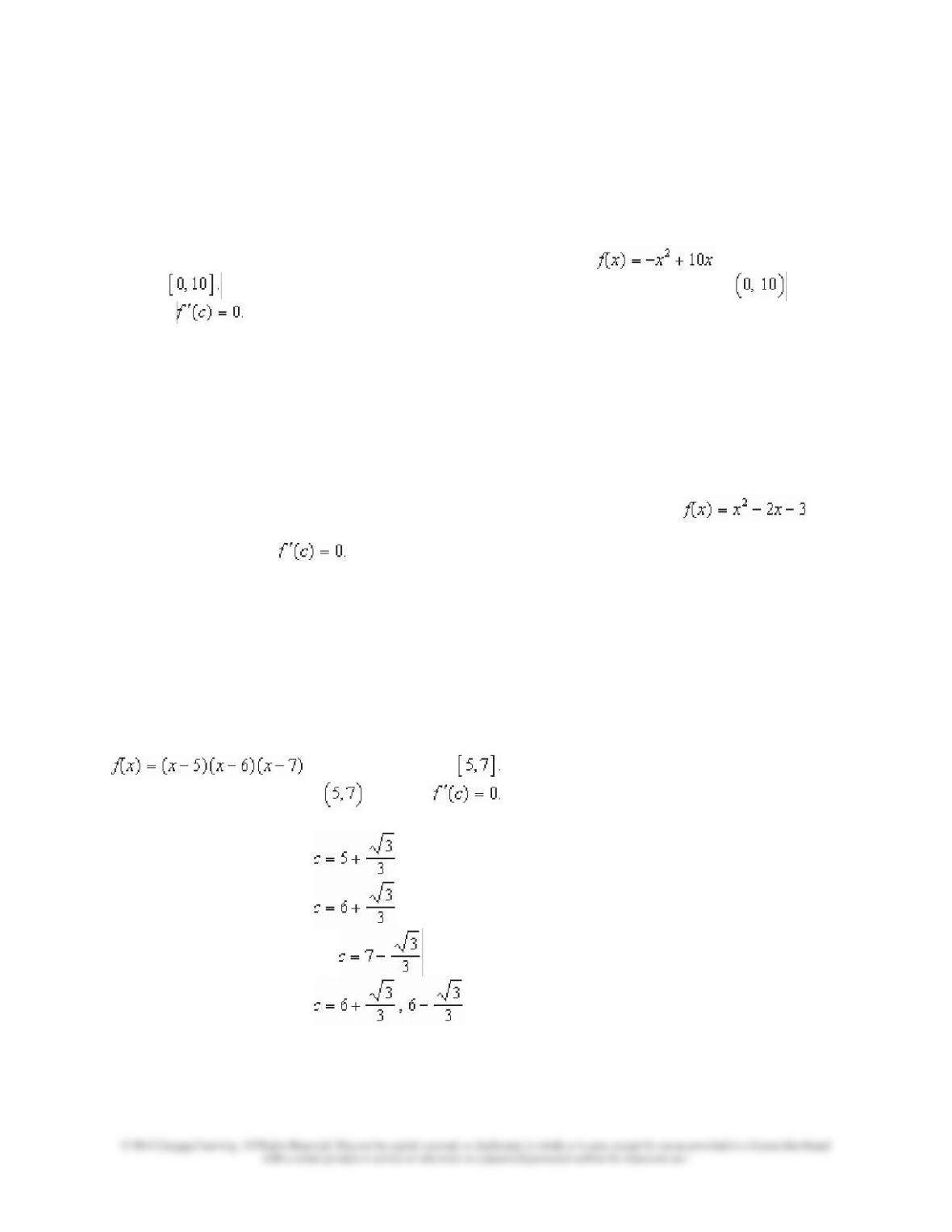
____ 1. Determine whether Rolle’s Theorem can be applied to on the closed
interval If Rolle’s Theorem can be applied, find all values of c in the open interval
such that
a. Rolle’s Theorem applies; c = 6, c = 5
b. Rolle’s Theorem applies; c = 4, c = 6
c. Rolle’s Theorem applies; c = 5
d. Rolle’s Theorem applies; c = 4
e. Rolle’s Theorem does not apply
____ 2. Determine whether Rolle’s Theorem can be applied to the function
on the closed interval [–1,3]. If Rolle’s Theorem can be applied, find all values of c in the open
interval (–1,3) such that
a. Rolle’s Theorem applies; c = 1
b. Rolle’s Theorem applies; c = 2
c. Rolle’s Theorem applies; c = 0
d. Rolle’s Theorem applies; c = –1
e. Rolle’s Theorem does not apply
____ 3. Determine whether Rolle’s Theorem can be applied to the function
on the closed interval If Rolle’s Theorem can be applied, find all
numbers c in the open interval such that
a.
Rolle’s Theorem applies;
b.
Rolle’s Theorem applies;
c.
Rolle’s Theorem does apply;
d.
Rolle’s Theorem applies;
e. Rolle’s Theorem does not apply
3.2 Rolle’s Theorem and the Mean Value Theorem 151
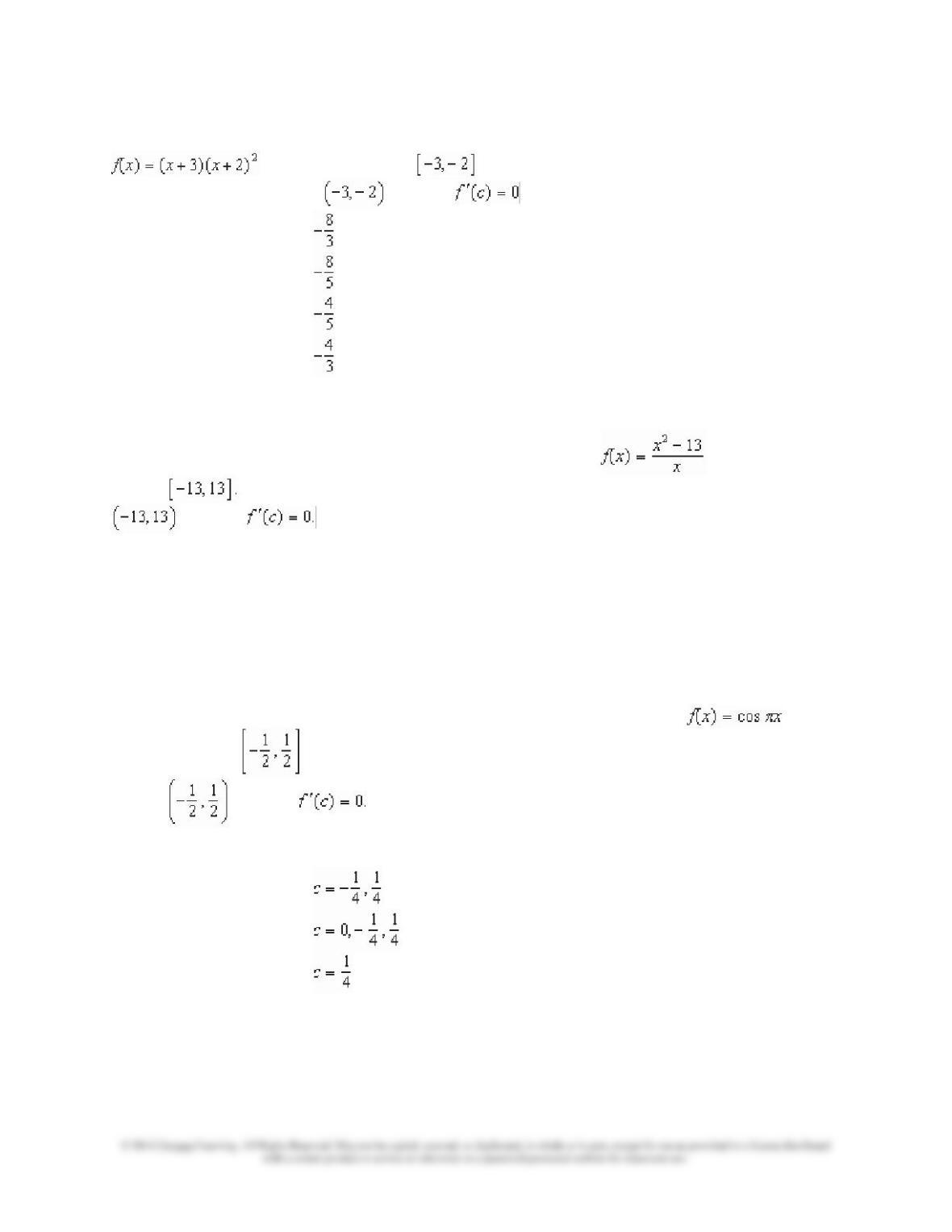
____ 4. Determine whether Rolle’s Theorem can be applied to the function
on the closed interval . If Rolle’s Theorem can be applied, find all
numbers c in the open interval such that .
a. Rolle’s Theorem applies;
b. Rolle’s Theorem applies;
c. Rolle’s Theorem applies;
d. Rolle’s Theorem applies;
e. Rolle’s Theorem does not apply
____ 5. Determine whether Rolle’s Theorem can be applied to on the closed
interval If Rolle’s Theorem can be applied, find all values of c in the open interval
such that
a. c = 8
b. c = 12, c = 11
c. c = 11, c = 8
d. c = 12
e. Rolle’s Theorem does not apply
____ 6. Determine whether Rolle’s Theorem can be applied to the function on
the closed interval . If Rolle’s Theorem can be applied, find all numbers c in the open
interval such that
a. Rolle’s Theorem applies; c = 0
b. Rolle’s Theorem applies;
c. Rolle’s Theorem applies;
d. Rolle’s Theorem applies;
e. Rolle’s Theorem does not apply.
152 Chapter 3: Applications of Differentiation
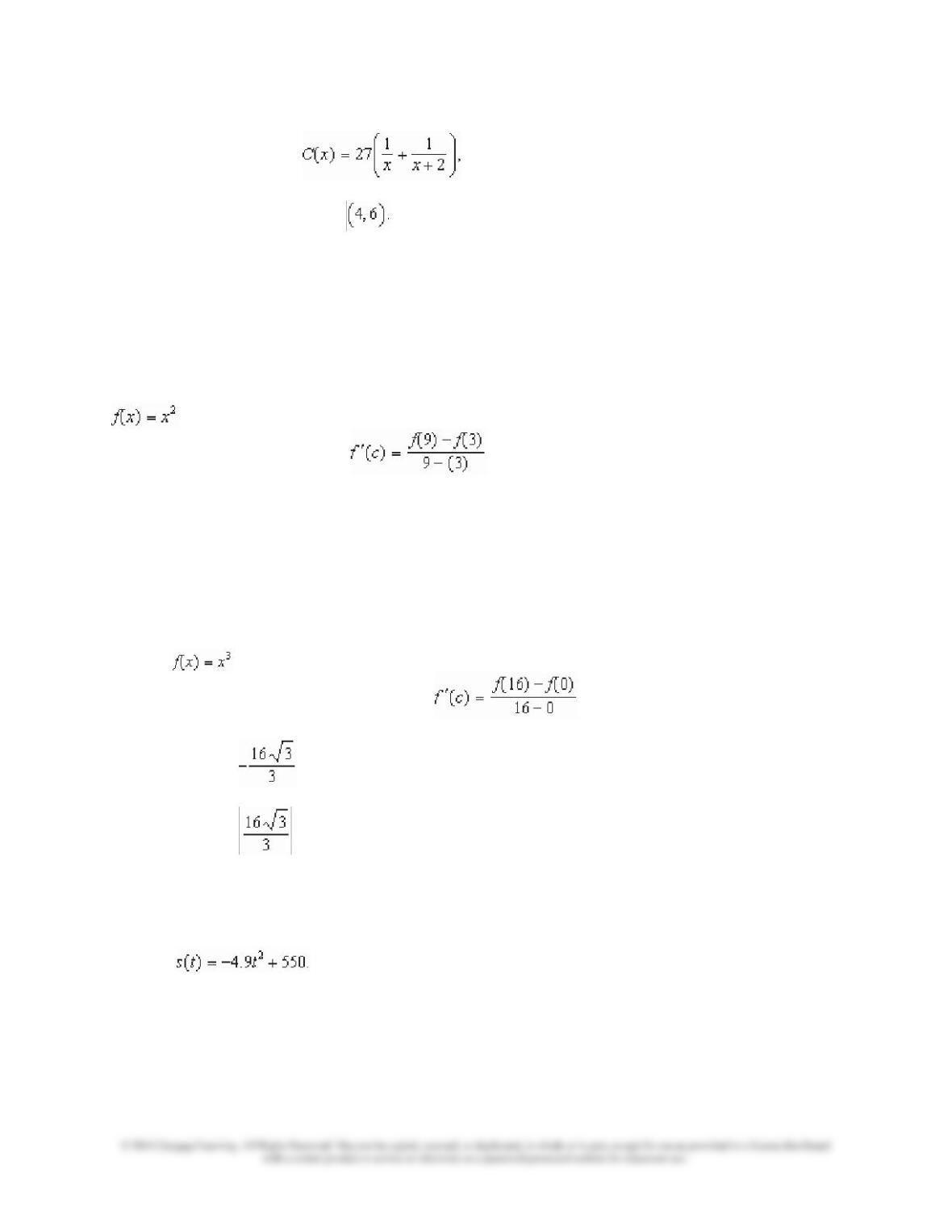
____ 7. The ordering and transportation cost C for components used in a manufacturing
process is approximated by where C is measured in thousands of dollars and x
is the order size in hundreds. According to Rolle’s Theorem, the rate of change of the cost must be 0
for some order size in the interval Find this order size. Round your answer to three decimal
places.
a. 9.657 components
b. 6.828 components
c. 8.000 components
d. 6.000 components
e. 4.828 components
____ 8. Determine whether the Mean Value Theorem can be applied to the function
on the closed interval [3,9]. If the Mean Value Theorem can be applied, find all numbers c
in the open interval (3,9) such that .
a. MVT applies; c = 6
b. MVT applies; c = 7
c. MVT applies; c = 4
d. MVT applies; c = 5
e. MVT applies; c = 8
____ 9. Determine whether the Mean Value Theorem can be applied to the
function on the closed interval [0,16]. If the Mean Value Theorem can be applied, find all
numbers c in the open interval (0,16) such that .
a.
MVT applies;
b. MVT applies; 4
c.
MVT applies;
d. MVT applies; 8
e. MVT does not apply
____ 10. The height of an object t seconds after it is dropped from a height of 550
meters is Find the average velocity of the object during the first 7 seconds.
a. 34.30 m/sec
b. –34.30 m/sec
c. –49.00 m/sec
d. 49 m/sec
e. –16.00 m/sec
3.2 Rolle’s Theorem and the Mean Value Theorem 153
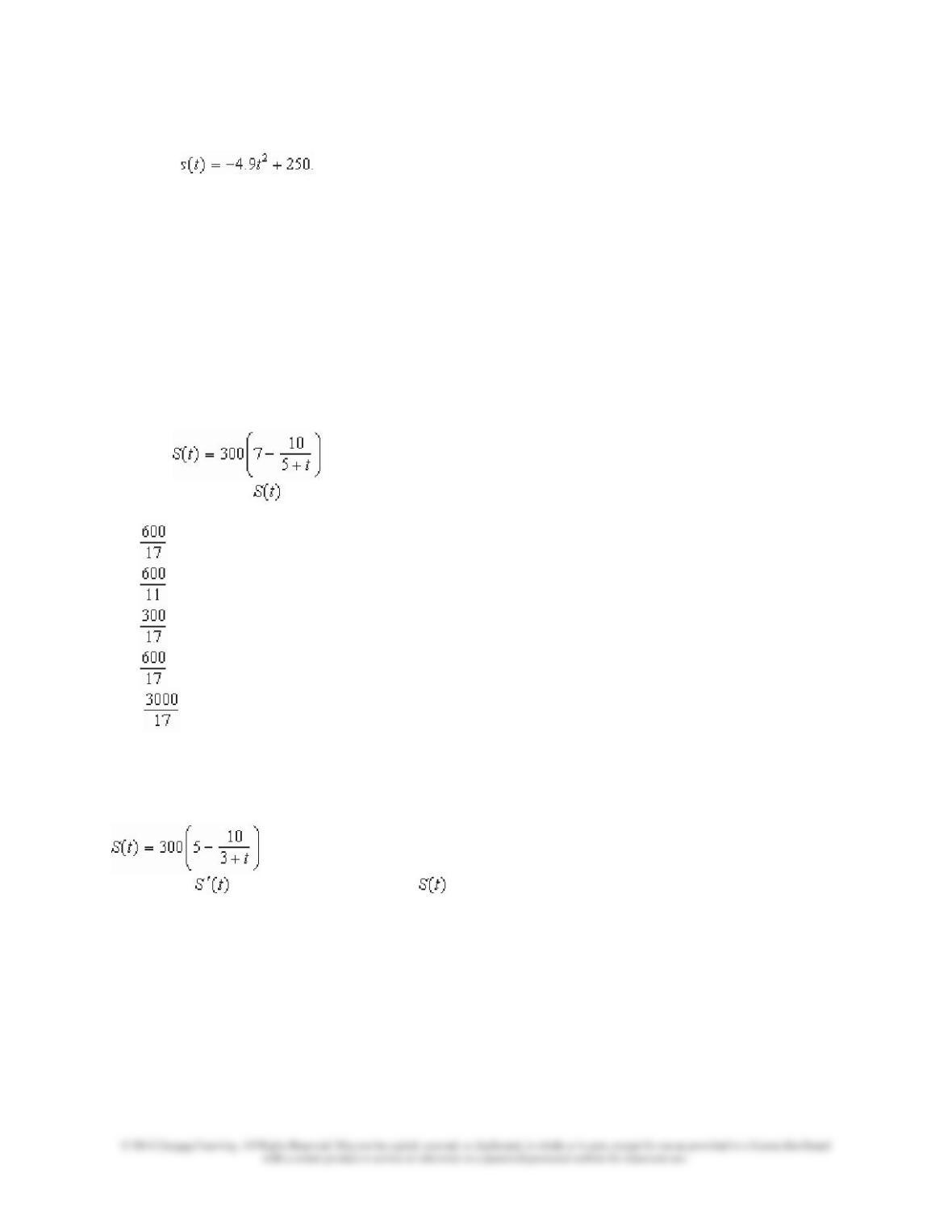
____ 11. The height of an object t seconds after it is dropped from a height of 250
meters is Find the time during the first 8 seconds of fall at which the
instantaneous velocity equals the average velocity.
a. 32 seconds
b. 19.6 seconds
c. 6.38 seconds
d. 4 seconds
e. 2.45 seconds
____ 12. A company introduces a new product for which the number of units
sold S is where t is the time in months since the product was introduced. Find
the average value of during the first year.
a.
b.
c.
d.
e.
____ 13. A company introduces a new product for which the number of units sold S is
where t is the time in months since the product was introduced. During what
month does equal the average value of during the first year?
a. October
b. July
c. December
d. April
e. March
154 Chapter 3: Applications of Differentiation
____ 14. A plane begins its takeoff at 2:00 P.M. on a 2200-mile flight. After 12.5 hours, the
plane arrives at its destination. Explain why there are at least two times during the flight when the
speed of the plane is 100 miles per hour.
a. By the Mean Value Theorem, there is a time when the speed of the plane must equal the
average speed of 303 mi/hr. The speed was 100 mi/hr when the plane was accelerating to
303 mi/hr and decelerating from 303 mi/hr.
b. By the Mean Value Theorem, there is a time when the speed of the plane must equal the
average speed of 152 mi/hr. The speed was 100 mi/hr when the plane was accelerating to
152 mi/hr and decelerating from 152 mi/hr.
c. By the Mean Value Theorem, there is a time when the speed of the plane must equal the
average speed of 88 mi/hr. The speed was 100 mi/hr when the plane was accelerating to 88
mi/hr and decelerating from 88 mi/hr.
d. By the Mean Value Theorem, there is a time when the speed of the plane must equal the
average speed of 117 mi/hr. The speed was 100 mi/hr when the plane was accelerating to
117 mi/hr and decelerating from 117 mi/hr.
e. By the Mean Value Theorem, there is a time when the speed of the plane must equal the
average speed of 176 mi/hr. The speed was 100 mi/hr when the plane was accelerating to
176 mi/hr and decelerating from 176 mi/hr.
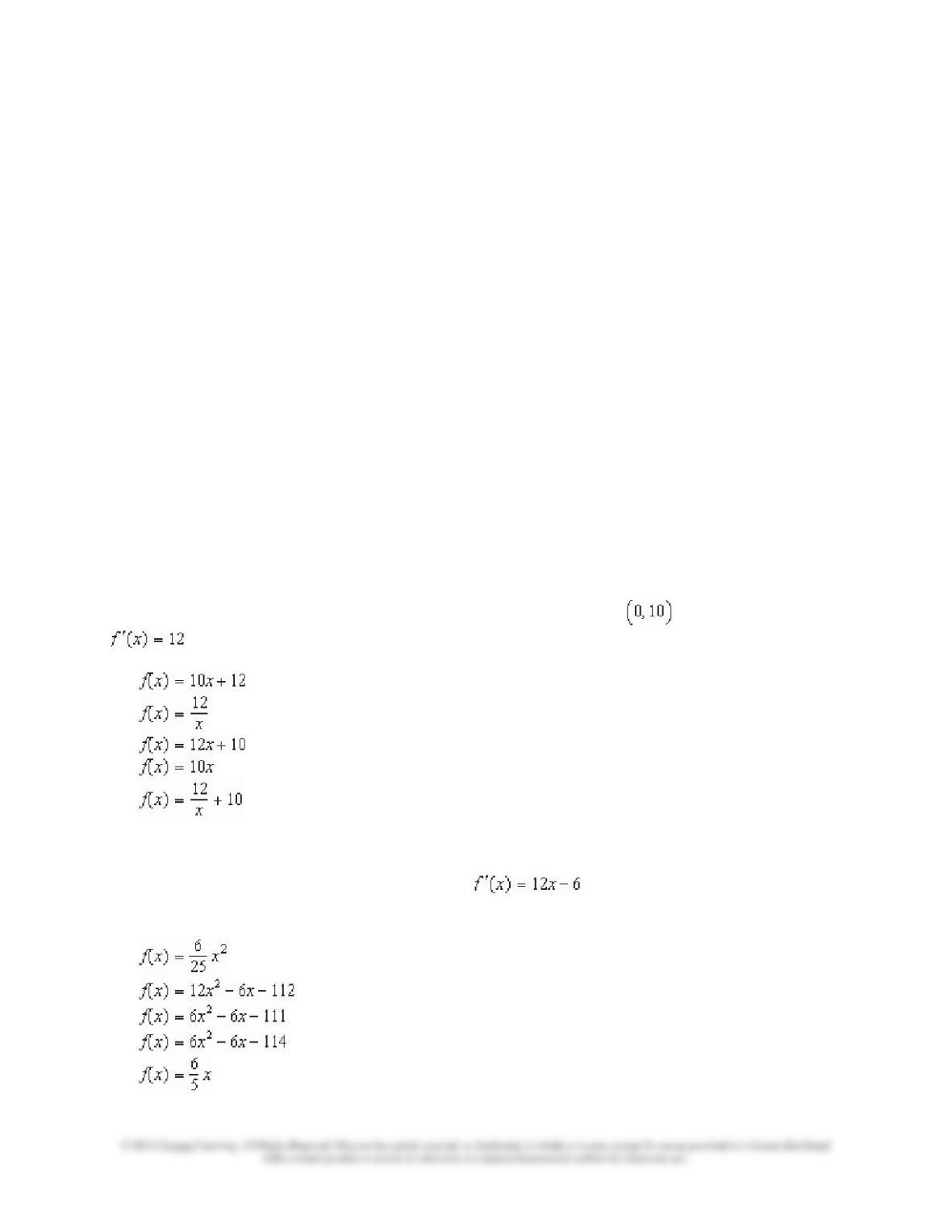
____ 15. Which of the following functions passes through the point and satisfies
?
a.
b.
c.
d.
e.
____ 16. Find a function f that has derivative and with graph passing through
the point (5,6).
a.
b.
c.
d.
e.
3.2 Rolle’s Theorem and the Mean Value Theorem 155
3.2 Rolle’s Theorem and the Mean Value Theorem
Answer Section