Chapter 3 Multicultural and Bilingual Aspects of Special
Education
3.1 Multiple-Choice Questions
1) Each of the following is a misconception about multicultural and bilingual aspects of
special education EXCEPT
A) It addresses the concerns of ethnic minorities who want their children to learn
more about their history.
B) Everyone agrees that it is critical to our nation’s future.
C) Educators must make sure that students understand the language of school, not
just informal conversation.
D) Disproportionate representation of minorities in special education is no longer
a problem.
Praxis: III.E.
CEC: ICC7K1
2) Which one of the following best describes the purpose of multicultural education?
A) It teaches children of ethnic minorities about their ancestors.
B) It provides bilingual education for non-English speakers.
C) It provides equal educational opportunities to all students.
D) It involves parents in their child’s education.
Praxis: III.A.
CEC: ICC7K1
3) Taking pride in the fact that one person a group with which you identify yourself has
accomplished something notable is referred to as
A) collective pride.
B) ethnic pride.
C) personal pride.
D) community pride.
Praxis: I.B.
CEC: ICC1K1
4) Critics of multicultural education claim that it
A) seeks to socialize students to a multicultural norm of acceptance and respect
for people with different cultures.
B) undermines the central purpose of school, which is to ensure academic
competence.
C) focuses too much on rebuilding the moral foundation of society.
D) is undemocratic.
Praxis: II.B.
CEC: ICC1K9
5) Progress in constructing multicultural education has been slow, for all of the following
reasons EXCEPT
A) Cultural groups have not found common satisfaction in specific curriculum.
B) Cultural groups tend to agree on a standard against which all should be judged.
C) Some argue it is more important to identify a common American culture.
D) There is disagreement over whether we should achieve the “melting
pot” metaphor or recognize each identifiable group.
Praxis: II.B.
CEC: ICC1K9
6) Cultural diversity presents challenges for special educators in which three areas?
A) instruction, assessment, and law
B) law, socialization, and curriculum
C) assessment, instruction, and socialization
D) curriculum, instruction, and socialization
Praxis: III.C.
CEC: ICC3K5
7) In the personal perspective “Desegregation and Degeneration,” the author states the
new euphemism for “white flight” is
A) vouchers.
B) No Child Left Behind.
C) choice.
D) charters.
Praxis: II.B.
CEC: ICC3K3
8) Each of the following is a major component or element of culture EXCEPT
A) skin color.
B) values and typical behavior.
C) nonverbal communication.
D) world views or general perspectives.
Praxis: II.B.
CEC: ICC3K3
9) A culture that is associated with or part of a larger culture, but which is not necessarily
small, is a
A) subculture.
B) macroculture.
C) microculture.
D) substandard.
Praxis: II.B.
CEC: ICC1K1
10) Each of the following is a general purpose of multicultural education EXCEPT
A) to promote pride in positive aspects of one’s own cultural heritage.
B) to foster positive attitudes toward cultural diversity.
C) to satisfy a large, tax-paying constituency.
D) to ensure equal educational opportunities for all students.
Praxis: II.B.
CEC: ICC1K1
11) Which two issues particularly complicate teaching about cultures and engendering an
acceptance of cultural diversity?
A) the money and time we have for curriculum changes
B) deciding which cultures should be represented and the predominate religious
beliefs within a school system
C) deciding which cultures best illustrate the concepts of universality of cultural
pride and shame
D) deciding which cultures should be included and how to teach about them
Praxis: II.B.
CEC: ICC7K1
12) Assuming that a cultural identity is sufficient to explain academic achievement or
economic success is a form of
A) racism.
B) ethnicity.
C) cultural relativism.
D) stereotyping.
Praxis: II.B.
CEC: ICC5K9
13) The use of language is a controversial aspect of multicultural education because of all
of the following EXCEPT
A) It may not be appropriate to refer to a group as a “minority” if it constitutes
half or more of the population in an area.
B) It is difficult to determine labels and terms that are acceptable for designating
various groups.
C) It is generally agreed among professionals that English should be the only
language of instruction.
D) It is difficult to decide what language(s) or dialect(s) should be used for
instruction.
Praxis: III.E.
CEC: ICC6S2
14) A group that shares an historic origin, culture, heritage, and traditions, and that has its
own political and economic interests is called a/an
A) microcultural group.
B) ethnic group.
C) exceptionality group.
D) macrocultural group.
Praxis: II.B.
CEC: ICC3K3
15) A group sharing a set of specific abilities or disabilities that are especially valued or
that require special accommodation within a given subculture is called a/an
A) microcultural group.
B) ethnic group.
C) exceptionality group.
D) macrocultural group.
Praxis: II.B.
CEC: ICC3K3
16) Each of the following is TRUE about teachers and teacher training in multicultural
and bilingual education EXCEPT
A) We know a great deal about how best to train teachers to be aware of their own
cultural histories and biases.
B) Many people see better teacher education as critically important for improving
performance of many students of color.
C) No Child Left Behind (NCLB) act’s concept of a “highly qualified” teacher is
open to question.
D) Better training of teachers includes helping them to be more knowledgeable
about their own cultures.
Praxis: III.B.
CEC: ICC9K1
17) The two primary objectives of multicultural special education are
A) promoting understanding of exceptionality as a microculture and ensuring that
exceptionality is included in the multicultural curriculum.
B) ensuring that ethnicity is not mistaken for exceptionality and increasing
understanding of disability as a microculture.
C) increasing visibility of people with disabilities in the macroculture and
promoting acceptance of people with disabilities by the majority culture.
D) enabling students from culturally diverse backgrounds to succeed in the
mainstream and lobbying for services in multicultural educational programs.
Praxis: II.B.
CEC: ICC2K3
18) An example of a culturally linked behavior that might be confused with
exceptionality is
A) handedness.
B) eye contact.
C) skin color.
D) killing.
Praxis: II.B.
CEC: ICC6K3
19) The disproportionate representation of ethnic minority students in special education
points to the need for all of the following EXCEPT to
A) make available strong academic programs that foster success for all students
regardless of their achievement.
B) implement effective procedures for referral, assessment, eligibility,
classification, placement, and reevaluation.
C) decrease the level of home/community involvement.
D) use diverse community resources.
Praxis: III.E.
CEC: ICC7S8
20) An example of a disability with a highly organized subculture is
A) mental retardation.
B) autism.
C) deafness.
D) blindness.
Praxis: II.B.
CEC: ICC2K3
21) Quick measurements to determine who may need further assessment are
A) outcome measures.
B) progress monitors.
C) diagnoses.
D) screening measures.
Praxis: III.C.
CEC: ICC8K1
22) All of the following are common criticisms of standardized tests EXCEPT
A) failing to take cultural diversity into account.
B) focusing on deficits of the individual.
C) underestimating abilities of students from the majority culture.
D) failing to provide information useful in teaching.
Praxis: III.C.
CEC: ICC8K4
23) Response to intervention, authorized to use to identify students with learning
disabilities relies
A) on the IQ-achievement discrepancy formula.
B) more on curriculum-based measurement.
C) on the prereferral strategies technique.
D) more on standardized tests.
Praxis: III.C.
CEC: ICC8S8
24) Although the response to intervention has not been validated for non-English
speaking or bilingual students, the method has positive implications for culturally
diverse students because
A) it relies on quality instruction prior to identification and may prevent some of
these students from being identified for special education services.
B) it is part of NCLB, which stipulated that the student’s first language must be
used for assessment.
C) it requires that students who are bilingual remain in regular classrooms for all
instruction.
D) it uses standardized assessment procedures to enable teachers to understand
the students’ strengths and weaknesses.
Praxis: III.C.
CEC: ICC8S8
25) The increase in the use of informal measures to assess student progress is beneficial
to students from diverse populations because
A) they are part of NCLB, so teachers can use ready-made assessment tests.
B) informal measures are easy to develop and are more reliable than formal
measures.
C) progress monitoring assessments may be less biased than traditional
standardized tests.
D) such assessments cost more, so schools get more federal money for each
bilingual student.
Praxis: III.C.
CEC: ICC8S2
26) Which one of the following provides the best description of curriculum-based
measurement?
A) evaluation of experimental educational programs
B) testing that uses actual instructional content and materials
C) examination of the effectiveness of a program’s scope and sequence
D) evaluation of student performance on achievement tests
Praxis: III.C.
CEC: ICC8S2
27) Standardized tests may be biased for all of the following reasons EXCEPT
A) Most test items draw on specific experiences that students from some
subcultures may not have had.
B) Language used may be unfamiliar to members of some subcultures.
C) Tests may be administered in ways that penalize students with impaired ability
to answer in a standardized way.
D) Minority group members are inherently more likely to score lower on any
achievement test.
Praxis: III.C.
CEC: ICC8K4
28) Each of the following is TRUE about testing accommodations for students with
limited English proficiency and/or disabilities EXCEPT
A) They should give an advantage to students by providing superior opportunities
to demonstrate knowledge and skills.
B) They should reduce the language barriers that may interfere with assessment
results.
C) They should include administration accommodations and the use of bilingual
dictionaries.
D) They may include translation of tests to the student’s native language or
provision of a bilingual version of the test.
Praxis: III.C.
CEC: ICC8S4
29) There is a dilemma in choosing either to ignore or recognize differences because
A) either choice can perpetuate inequality for members of a subculture.
B) all cultural differences have both advantages and disadvantages, making it
difficult to predict how those differences will affect the individual.
C) in striving to assert their identity, members of subcultures serve only to
perpetuate stereotypes and inequality.
D) in order to fit in at school, students must forfeit the values and beliefs that they
learned at home.
Praxis: II.B.
CEC: ICC7K1
30) Most authorities agree that in accepting and fostering cultural diversity, schools
should
A) also provide instruction in skills needed to survive and prosper in the larger
context of American culture.
B) not require students to learn English if they live in a community that is
predominantly non-English speaking.
C) identify multiple sets of performance standards so that all students can
succeed.
D) act as “gatekeepers,” requiring that students graduating from high school meet
standards of both the dominant culture and the subculture.
Praxis: III.E.
CEC: ICC5K7
31) Cultural sensitivity requires
A) choosing activities that “fit” a student’s culture.
B) utilizing empirically validated instructional strategies.
C) adding materials that include examples of contributions by members of all
cultural groups.
D) being “blind” to differences in the classroom.
Praxis: III.E.
CEC: ICC7S8
32) In the pursuit of equality and fairness, educational reformers are working toward all
of the following EXCEPT
A) teaching tolerance and appreciation of difference.
B) finding ways to work without involving families who seem reluctant to help.
C) improving instruction of language-minority students.
D) adopting effective teaching practices.
Praxis: III.E.
CEC: ICC7S8
33) Tolerance is best described as
A) an appreciation and valuing of difference.
B) putting up with a necessary evil.
C) enduring others even if they are seen as undesirable.
D) acknowledging our legacy of racism and prejudice.
Praxis: II.B.
CEC: ICC9S6
34) Parents have different views of exceptionality and disability and different ways of
accommodating these differences in their children because of
A) different education levels.
B) different beliefs about punishment.
C) different cultural traditions.
D) different income levels.
Praxis: II.B.
CEC: ICC3K3
35) An approach to teaching language-minority students in which students are taught for
most of the day in their native languages and later make the transition to English is
A) native-language emphasis.
B) sheltered-English approach.
C) ESL.
D) sheltered-native language approach.
Praxis: III.E.
CEC: ICC6S2
36) A technique in which the teacher assists the student in learning a task and then phases
out help as the student learns to use the strategy independently is called
A) scaffolded instruction.
B) hand-over-hand instruction.
C) supported instruction.
D) mnemonic instruction.
Praxis: III.E.
CEC: ICC4S4
37) Tactics that aid memory, such as rhymes or images, are called
A) scaffolds.
B) mnemonics.
C) visual organizers.
D) reminders.
Praxis: III.E.
CEC: ICC4S4
38) When a student sees a teacher use a learning strategy and then tries it out, the
technique is called
A) team teaching.
B) reciprocal teaching.
C) scaffolded instruction.
D) copy teaching.
Praxis: III.E.
CEC: ICC4S1
39) Which of the following statements is true?
A) Most of education is appropriately challenging for students.
B) Students from cultural minorities, who are at risk for failure or who have
disabilities, should not be given challenging tasks.
C) Appropriately challenging tasks are those that a given student finds just
manageable.
D) Teachers tend to overestimate the capabilities of minority and exceptional
children.
Praxis: III.E.
CEC: ICC4S3
40) Each of the following statements is true EXCEPT
A) Students need to engage in extended conversations with simple linguistic
structures.
B) Too often students are asked for rote responses.
C) The content of instruction must be related to students’ experiences.
D) The issue of cultural diversity should be included routinely in all curriculum
areas.
Praxis: III.B.
CEC: ICC5K8
41) Of all the academic skills, which is described as “critically” important?
A) math
B) listening
C) writing
D) reading
Praxis: III.E.
CEC: ICC7K1
42) Teachers can create classroom environments that support academic success for
English language learners by each of the following EXCEPT
A) segregate English language learning students, except for special area classes
(P.E., art, music) and math.
B) select materials relevant to student’s experiences.
C) establish classroom interactions that are comfortable to the students.
D) engage in effective instructional strategies that promote vocabulary and
development.
Praxis: III.E.
CEC: ICC7K1
43) Instructional tools that promote learning through the use of visual representation or
related topics are
A) graphic organizers.
B) visual cues.
C) concept maps.
D) tactile maps.
Praxis: III.E.
CEC: ICC7S8
44) A viable multicultural curriculum cannot be created and handed out to teachers
because
A) they must be involved in the process because their values, perspectives, and
teaching styles affect what is taught and how it is taught.
B) most want to exercise their right to select their own curriculum based on their
own beliefs and are resistant to being told what to teach.
C) the government has passed legislation banning the teaching of multicultural
issues within an integrated curriculum.
D) there is not enough money to create such a curriculum nationwide.
Praxis: II.B.
CEC: ICC9K1
45) Academic instruction is one of two primary purpose of education. The other is
A) socialization.
B) physical development.
C) functional skills.
D) artistic/musical development.
Praxis: III.E.
CEC: ICC7K1
46) In the Focus on Concepts feature, the author suggests that a “common sense of
urgency” should exist toward
A) helping children maximize potential with enrichment activities.
B) helping each child master grade-level curriculum.
C) exposing poor students to community cultural events.
D) exposing children to advanced concepts to raise interest levels.
Praxis: III.E.
CEC: ICC7K1
47) A recommended technique of breaking down prejudice and encouraging positive
interactions among students with different characteristics is
A) Afrocentrism.
B) cooperative learning.
C) immersion.
D) direct instruction.
Praxis: III.E.
CEC: ICC5K8
48) Each of the following as true regarding the use of response cards EXCEPT
A) The teacher should create a streamlined procedure for distribution.
B) The teacher must maintain a brisk but reasonable presentation rate.
C) The teacher should allow the students to become comfortable with the
procedure before using it intensively.
D) The teacher should allow the students to share their responses with each other
before showing them to her or him.
Praxis: III.E.
CEC: ICC5K8
49) Educators are often ethnocentric with respect to discipline. This means they
A) do not share the same beliefs about discipline as parents do.
B) believe that their views are correct and others’ are inferior.
C) adopt different approaches to discipline, depending on the cultural values of
the student that they teach.
D) use whatever strategy makes classroom management easier for them, with
little regard for the effect on their students.
Praxis: III.B.
CEC: ICC9K1
3.2 True/False Questions
1) Some disabilities are genetically linked to ethnicity.
Praxis: I.B.
CEC: ICC2K1
2) The primary purpose of multicultural education is to teach children of ethnic
minorities about their history and the intellectual, social, and artistic contributions of
their ancestors.
Praxis: III.E.
CEC: ICC7S8
3) An individual can be a member of many subcultures.
Praxis: I.B.
CEC: ICC2K3
4) Most professionals agree that multicultural education should consider only
subcultures identified by ethnicity, not those identified by gender, sexual preference,
or disability.
Praxis: III.E.
CEC: ICC7S8
5) Some ethnic minorities are underrepresented in special education.
Praxis: III.C.
CEC: ICC8S6
6) The preferred method of identifying students with learning disabilities is to use an IQ–
achievement discrepancy formula.
Praxis: III.C.
CEC: ICC8K4
7) Curriculum-based measurement is thought to decrease the likelihood of cultural bias.
Praxis: III.C.
CEC: ICC8K4
8) Adolescents of color are more likely to be identified with disruptive behavior disorders
than their Caucasian peers.
Praxis: III.E.
CEC: ICC8K4
9) Professionals generally agree that bilingual students should be taught using the
sheltered-English approach.
Praxis: III.E.
CEC: ICC7S8
10) In reciprocal teaching, the teacher provides assistance in learning a task and then
phases out the help as the student learns to use the strategy independently.
Praxis: III.E.
CEC: ICC4S1
3.3 Short Answer Questions
1) Discuss the authors’ view that multicultural education gives us the opportunity to
“engender acceptance, if not love, of all differences that are not destructive of the
human experience.”
Praxis: II.B.
CEC: ICC9S6
2) Identify the three general purposes of multicultural education.
Praxis: III.E.
CEC: ICC5K8
3) Describe three reasons why cultural diversity is a concern for special educators.
Praxis: III.C.
CEC: ICC7K1
4) List four types of assessment and describe their purposes.
Praxis: III.C.
CEC: ICC8K4
5) Why are testing accommodations provided to students with disabilities and students
with limited English proficiency? Describe three testing accommodations that might
be used.
Praxis: III.C.
CEC: ICC8K4
6) Discuss the dilemma associated with the choice to either ignore or recognize student’s
differences and provide two recommendations for practices (describe them) that could
help to resolve the dilemma.
Praxis: I.B.
CEC: ICC2K3
7) Compare and contrast the native language emphasis and the sheltered-English
approach to teaching English as a second language.
Praxis: III.E.
CEC: ICC6S2
8) Describe components of effective teaching and discuss how they relate to effective
multicultural education.
Praxis: III.E.
CEC: ICC7K1
9) Explain why socialization is described as “one of two primary purposes [along with
academic instruction] of education.” In what ways do cultural and linguistic
differences pose challenges for teachers?
Praxis: III.F.
CEC: ICC5K7
10) Describe the research-validated instructional strategies, “concept mapping” and “use
of response cards,” and explain why they are particularly appropriate for students
with cultural or linguistic differences.
Praxis:
CEC: ICC4K1
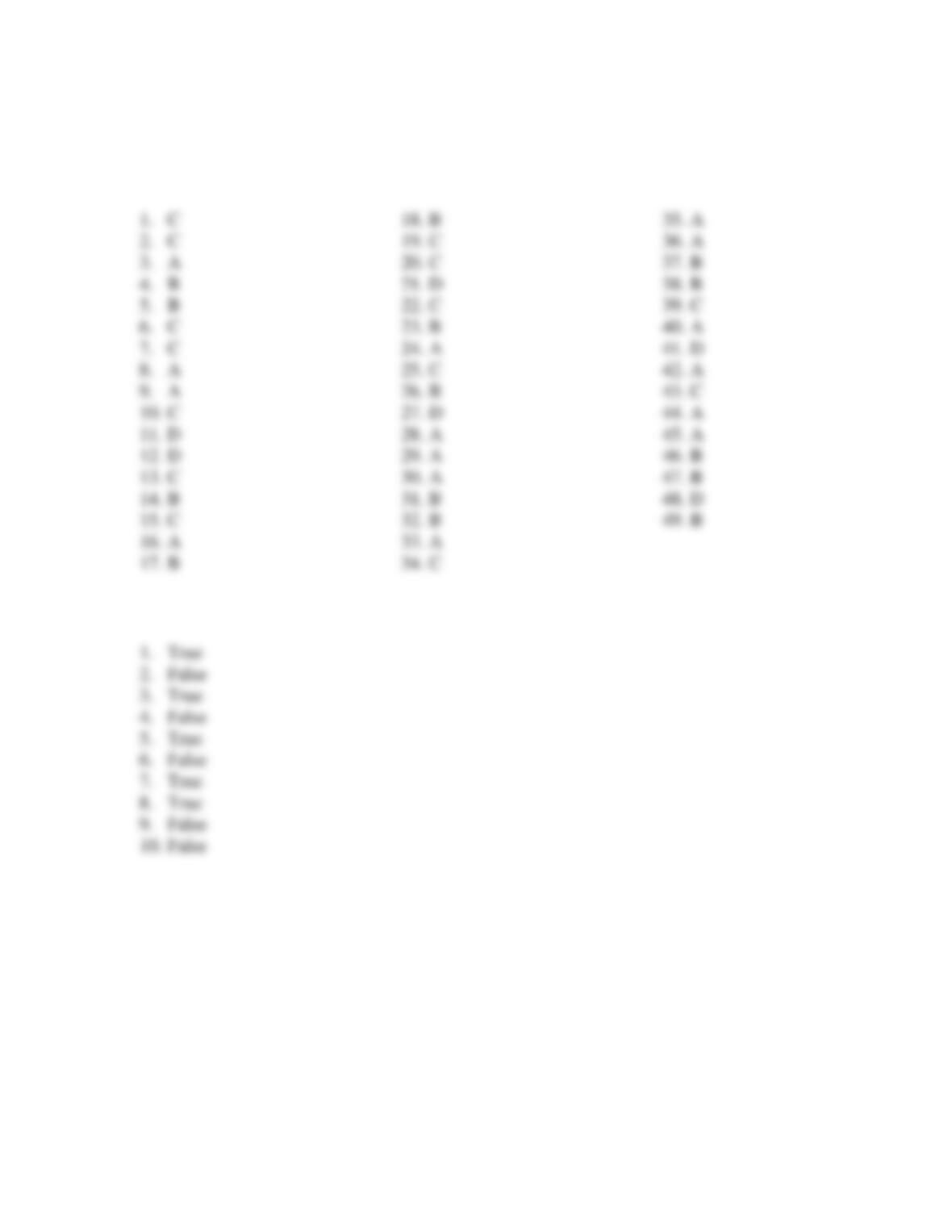
Chapter 3 Multicultural and Bilingual Aspects of Special Education
3.1 Multiple Choice Questions
3.2 True/False Questions
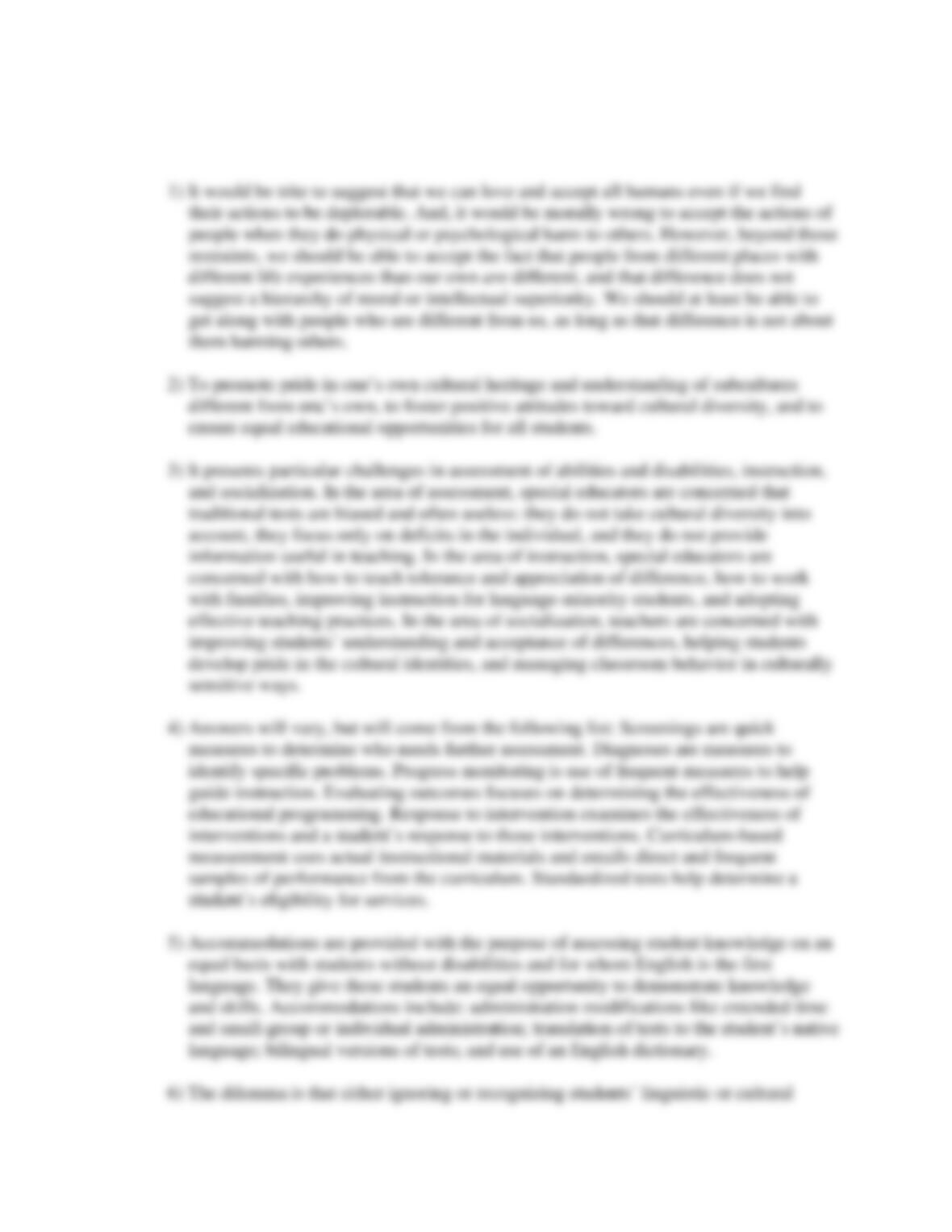
3.3 Short Answer Questions