Granof Test Bank Chapter 3 Page 1
Chapter 3
Issues of Budgeting and Control
TRUE/FALSE (CHAPTER 3)
1. Capital budgets focus on plans for the acquisition and construction of fixed assets.
2. The accounting cycle for most governments is two to three years, consistent with the terms of elected
officials.
3. Most budgets are prepared on a cash or modified cash basis.
4. Neither the GASB nor the FASB sets standards for budgetary accounting.
5. State and local governments must prepare their GAAP budgetary comparisons on the modified
accrual basis of accounting.
6. When budgets are integrated into a government’s accounting system, estimated revenues are debited.
7. Encumbrances and expenditures both reduce total fund balances of state and local governments.
8. Not-for-profit budgets focus first on revenues and secondarily on expenditures.
9. State and local governments’ budget–to-actual comparisons present both original and final budget
amounts.
10. Cash-basis budgets help governments focus on interperiod equity.
11. Reserve for encumbrances accounts should be closed at year-end.
12. Capital budgets concentrate on long-lived assets.
Granof Test Bank Chapter 3 Page 2
MULTIPLE CHOICE (CHAPTER 3)
1. Which of the following is NOT a function of a budget in the governmental environment?
a) Planning.
b) Organizing.
c) Controlling.
d) Evaluating.
2. For which of the following funds would flexible budgeting be most valuable?
a) Special revenue fund.
b) Capital projects fund.
c) Agency fund.
d) Enterprise fund.
3. Property taxes levied on the citizens of the Hill County would most appropriately be budgeted in
which of the following budgets?
a) Operating budget.
b) Capital budget.
c) Flexible budget.
d) All of the above.
4. Expenditures should be budgeted by “character.” An example of a character classification would be
a) Current expenditures.
b) Salaries.
c) Public Safety.
d) Police Department.
5. Which of the following is a primary benefit of a performance budget?
a) It facilitates control by establishing rigid spending mandates.
b) It encourages accomplishment of objectives by associating expenditures with outcomes.
c) It encourages planning by requiring management to anticipate every type of expenditure.
d) It provides decision-makers with detailed information.
6. Which branch of local (city and county) government most commonly prepares the budget?
a) Executive branch.
b) Legislative branch.
c) Judicial branch.
d) None of the above.
7. An officially adopted budget is generally called
a) An appropriation bill.
b) An operating budget.
c) A capital budget.
d) None of the above.
8. Periodic allocations of funds to departments or agencies are generally called
a) Appropriations.
b) Allotments.
c) Allocations.
d) None of the above.
Granof Test Bank Chapter 3 Page 3
9. Which of the following bases of accounting has been established by GASB for use in the preparation
of the general fund budget?
a) Cash basis.
b) Modified accrual basis.
c) Accrual basis.
d) None of the above.
10. Which of the following is the best reason for preparing budgets for government entities on the cash
basis?
a) Cash basis budgeting helps to achieve interperiod equity.
b) Cash basis budgeting helps to ensure that the government will receive no more in revenues than
itis required to disburse.
c) Cash basis budgeting helps a government plan to have cash on hand to pay bills
d) Cash basis budgeting more accurately reflects the economic impact of fiscal activities.
11. Which of the following is NOT true about cash basis budgeting?
a) Cash basis budgeting permits a government to balance its budget by delaying cash disbursements.
b) Cash basis budgeting permits a government to balance its budget by advancing the recognition of
revenue.
c) Cash basis budgeting encourages interperiod equity.
d) Cash basis budgeting complicates financial accounting and reporting.
12. GASB requires that government entities present their budget-to-actual comparison data on which of
the following bases of accounting?
a) Budgetary basis.
b) Cash basis.
c) Modified accrual basis.
d) Accrual basis.
13. Which of the following is NOT a reason that legally adopted budgets may not be readily comparable
to amounts reported in the GAAP-based financial statements?
a) Differences in basis of accounting.
b) Differences in timing.
c) Differences in reporting entity.
d) Differences in recognition.
14. The City of Lakeview adopts its budget on a basis of accounting that permits outstanding purchase
commitments to be charged against the budget in the year that the goods are ordered instead of in the
year they are received. During the year the city ordered and received $4,000 of supplies (of which
$3,000 had been paid and $1,000 was unpaid) and had $500 of outstanding purchase commitments
for supplies at year-end. In the budget-to-actual comparison, the expenditures for supplies would be:
a) $3,000.
b) $3,500.
c) $4,000.
d) $4,500.
Granof Test Bank Chapter 3 Page 4
15. A governmental entity has formally integrated the budget into its accounting records. At year-end the
ledger account “Revenues from property taxes” has a debit balance. Which of the following is the
best explanation for the debit balance?
a) The entity overestimated property tax revenue when preparing its budget.
b) The entity underestimated property tax revenue when preparing its budget.
c) The entity collected more in property taxes than it anticipated.
d) There is no logical explanation; revenue accounts usually do not have debit balances.
16. A governmental entity has formally integrated the budget into its accounting records and uses
encumbrance accounting. During the year the government ordered but had not yet received a new
police car. What effect will this event have on the unencumbered balance in the account
“Expenditures—capital outlay, police department”?
a) The balance in the account will not be affected until the police car is received.
b) The balance in the account will be increased.
c) The balance in the account will be decreased.
d) Purchase orders never affect any budgetary account balances.
17. A governmental entity has formally integrated the budget into its accounting records. At the end of
the third quarter the ledger account “Expenditures—salaries” has a $100,000 debit balance. Which of
the following is a true statement?
a) The entity has $100,000 available to spend on salaries.
b) The entity has incurred salaries in the amount of $100,000.
c) The entity had paid salaries in the amount of $100,000.
d) The entity has overspent its budget for salaries by $100,000.
18. A public school district formally adopted a budget with estimated revenues of $800 and approved
expenditures of $780. Which of the following is the appropriate entry to record the budget?
a) Debit Estimated revenues $800; credit Appropriations $780; credit Fund balance $20.
b) Debit Appropriations $780; Debit Fund balance $20; credit Estimated revenues $800.
c) Debit Encumbrances $780; Debit Fund balance $20; credit Estimated revenues $800.
d) Memorandum entry only.
19. A city formally adopted a budget at the beginning of the current year. Budgeted revenues were $500
and budgeted expenditures were $490. During the year actual revenues were $520 and actual
expenditures were $480. Which of the following statements is true?Fund balance at the end of the
current year in comparison to fund balance at the end of the preceding year will be
a) $10 greater.
b) $30 greater.
c) $40 greater.
d) $50 greater.
20. A county general fund budget includes budgeted revenues of $900 and budgeted expenditures of
$890. Actual revenues for the year were $915. To close the estimated revenues account at the end
of the year
a) Debit Estimated revenues $15
b) Credit Estimated revenue $15
c) Debit Estimated revenues $900
d) Credit Estimated revenues $900
Granof Test Bank Chapter 3 Page 5
21. A university that formally integrates the budget in the accounting system and uses encumbrance
accounting orders some new computers that will cost approximately $20,000. To recognize this
event the university should make which of the following entries?
a) Debit Expenditures $20,000; credit Encumbrances $20,000
b) Debit Encumbrances $20,000; credit Reserve for encumbrances $20,000
c) Debit Encumbrances $20,000; credit Accounts payable $20,000
d) No entry required when the order is placed.
22. A county previously encumbered $15,000 for the acquisition of supplies. The supplies were received
at a total cost of $14,700. To recognize this event the county should make which of the following
entries?
a) Debit Reserve for encumbrances $15,000; credit Encumbrances $15,000.
b) Debit Reserve for encumbrances $14,700; credit Encumbrances $14,700.
c) Debit Encumbrances $15,000; credit Reserve for encumbrances $15,000.
d) Debit Encumbrances $14,700; credit Reserve for encumbrances $14,700.
23. A city received supplies that had been previously encumbered. The supplies were encumbered for
$5,000 and had an actual cost of $4,900. To recognize this event the county should make which of
the following entries?
a) Debit Reserve for encumbrances $5,000 and Supplies $4,900; credit Encumbrances $5,000 and
Vouchers payable $4,900.
b) Debit Encumbrances $5,000 and Supplies $4,900; credit Reserve for encumbrances $5,000 and
Vouchers payable $4,900.
c) Debit Reserve for encumbrances $4,900 and Supplies $4,900; credit Encumbrances $4,900 and
Vouchers payable $4,900.
d) Debit Encumbrances $4,900 and Supplies $4,900; credit Reserve for encumbrances $4,900 and
Vouchers payable $4,900.
24. To close Encumbrances at the end of the year which of the following entries should be made?
a) Debit Encumbrances; credit Fund balance.
b) Debit Reserve for encumbrances; credit Encumbrances.
c) Debit Fund balance; credit Encumbrances.
d) No closing entry needed.
25. To close Reserve for encumbrances at the end of the year which of the following entries should be
made?
a) Debit Reserve for encumbrances; credit Fund balance.
b) Debit Reserve for encumbrances; credit Encumbrances.
c) Debit Fund balance; credit Reserve for encumbrances.
d) No closing entry needed.
26. During the previous year, Bane County closed its Encumbrances account. At the end of the previous
year there was $5,000 of outstanding purchase commitments. To restore these commitments to the
accounts, which of the following entries would be required?
a) Debit Reserve for encumbrances $5,000; credit Encumbrances $5,000.
b) Debit Encumbrances $5,000; credit Reserve for encumbrances $5,000.
c) Debit Encumbrances $5,000; credit Fund balance $5,000
d) Debit Fund balance $5,000; credit Reserve for encumbrances $5,000.
Granof Test Bank Chapter 3 Page 6
27. When Spruce City receives goods at a cost of $9,700 that were encumbered in the prior year for
$10,000, which of the following entries are required (assume that encumbrances lapse at year end)?
a) Debit Expenditures $9,700; credit Accounts payable $9,700; no entry for Encumbrances.
b) Debit Expenditures $9,700 and Reserve for encumbrances $10,000; credit Accounts payable
$9,700 and Encumbrances $10,000.
c) Debit Expenditures $10,000 and Reserve for encumbrances $10,000; credit Accounts payable
$10,000 and Encumbrances $10,000.
d) Debit Reserve for encumbrances $10,000; credit Encumbrances $10,000; no entry for
Expenditures.
28. At year-end Oakland County had $3,000 of outstanding purchase commitments on the books. After
the appropriate closing entries are made, what is the effect on the total fund balance of Oakland
County?
a) It is $3,000 greater than it would have been if the purchase commitments had been fulfilled by
year-end.
b) It is $3,000 less than it would have been if the purchase commitments had been fulfilled by year-
end.
c) It is the same as it would have been if the purchase commitments had been fulfilled by year-end;
it will be reduced by $3,000 next year.
d) It is the same as it would have been if the purchase commitments had been fulfilled by year-end;
it will not change next year.
29. Hill City uses encumbrance accounting to control expenditures. However, it charges the cost of
outstanding purchase commitments to expenditures in the year they are received, not in the year they
are ordered. If Hill City had $10,000 of purchase commitments outstanding at the end of Year 1 and
received those goods during Year 2 at a cost of $9,800, what would be the impact on total fund
balance for Year 2?
a) Total fund balance at the end of Year 2 would be $9,800 less than at the end of Year 1.
b) Total fund balance at the end of Year 2 would be $200 less than at the end of Year 1.
c) Total fund balance at the end of Year 2 would be $200 greater than at the end of Year 1.
d) Total fund balance at the end of Year 2 would be same as it was at the end of Year 1.
30. The City of Denton uses encumbrance accounting to control expenditures. It charges the cost of
outstanding purchase commitments to expenditures in the year they are received, not in the year they
are ordered. If the city had $11,000 of purchase commitments outstanding at the end of Year 1 and
received those goods during Year 2 at a cost of $11,700, what would be the impact on total fund
balance for Year 2?
a) Total fund balance at the end of Year 2 would be $11,700 less than at the end of Year 1.
b) Total fund balance at the end of Year 2 would be $700 less than at the end of Year 1.
c) Total fund balance at the end of Year 2 would be $700 greater than at the end of Year 1.
d) Total fund balance at the end of Year 2 would be same as it was at the end of Year 1.

Granof Test Bank Chapter 3 Page 7
31. Lincoln County uses encumbrance accounting to control expenditures. It charges the cost of
outstanding purchase commitments to expenditures in the year they are ordered, not in the year they
are received. If the county had $7,000 of purchase commitments outstanding at the end of Year 1
and received those goods during Year 2 at a cost of $7,800, what would be the impact on total fund
balance for Year 2?
a) Total fund balance at the end of Year 2 would be $7,800 less than at the end of Year 1.
b) Total fund balance at the end of Year 2 would be $800 less than at the end of Year 1.
c) Total fund balance at the end of Year 2 would be $800 greater than at the end of Year 1.
d) Total fund balance at the end of Year 2 would be the same as it was at the end of Year 1
32. Why would a government be more likely than a not-for-profit organization to integrate its budget into
its accounting system?
a) Because the amount of expenditures is likely to be greater.
b) Because the penalties for exceeding budgeted expenditures are more severe.
c) Because governments have more sophisticated accounting systems than not-for-profit
organizations.
d) Governments are NOT more likely than not-for-profits to formally integrate their budget into
their accounting system.
33. Which of the following is the primary reason why governments formally integrate their legally
adopted budget into their accounting systems?
a) It is required by GASB.
b) It enables the government to better control its expenditures.
c) It keeps the government from overspending its budget.
d) It helps a government by letting it know when it is in danger of overspending its budget.
34. Washington County received goods that had been approved for purchase but for which payment had
not yet been made. Should the following accounts be increased?
Expenditures Encumbrances
a) No No
b) Yes Yes
c) Yes No
d) No Yes
35. In which of the following cases would the reserve for encumbrances account be decreased?
a) Budget revisions are made, decreasing appropriations
b) Payment is made for goods received
c) Goods, related to purchase orders, are received
d) Purchase orders are issued
36. A review of Park City’s books shows the following information:
I. $2,500 of outstanding vouchers payable
II. $3,000 of outstanding purchase order amounts
Which of these amounts would you expect to see in the general fund’s encumbrances account?
a) $2,500
b) $3,000
c) $5,500
d) $500
Granof Test Bank Chapter 3 Page 8
37. Per GASB standards, a budget-to-actual comparison must include columns for the actual results and
a) The original budget only.
b) The final budget only.
c) Both the original and the final budget.
d) Both the amended and the final budget.
38. Carolina City places an order for a specific item of equipment and encumbers $6,000 for that item.
The equipment arrives with an invoice for $5,700. Which of the following entries should the city
make upon receipt of the equipment?
a) A debit to expenditures for $5,700, a debit to accounts payable for $300, and a credit to
encumbrances for $6,000.
b) A debit to expenditures for $5,700, a debit to reserve for encumbrances for $6,000, a credit to
accounts payable for $5,700, and a credit to encumbrances for $6,000.
c) A debit to expenditures for $5,700, a debit to reserve for encumbrances for $300, and a credit
to accounts payable for $6,000.
d) A debit to expenditures for $300, a debit to reserve for encumbrances for $5,700, and a credit
to encumbrances for $6,000.
Granof Test Bank Chapter 3 Page 9
PROBLEMS (CHAPTER 3)
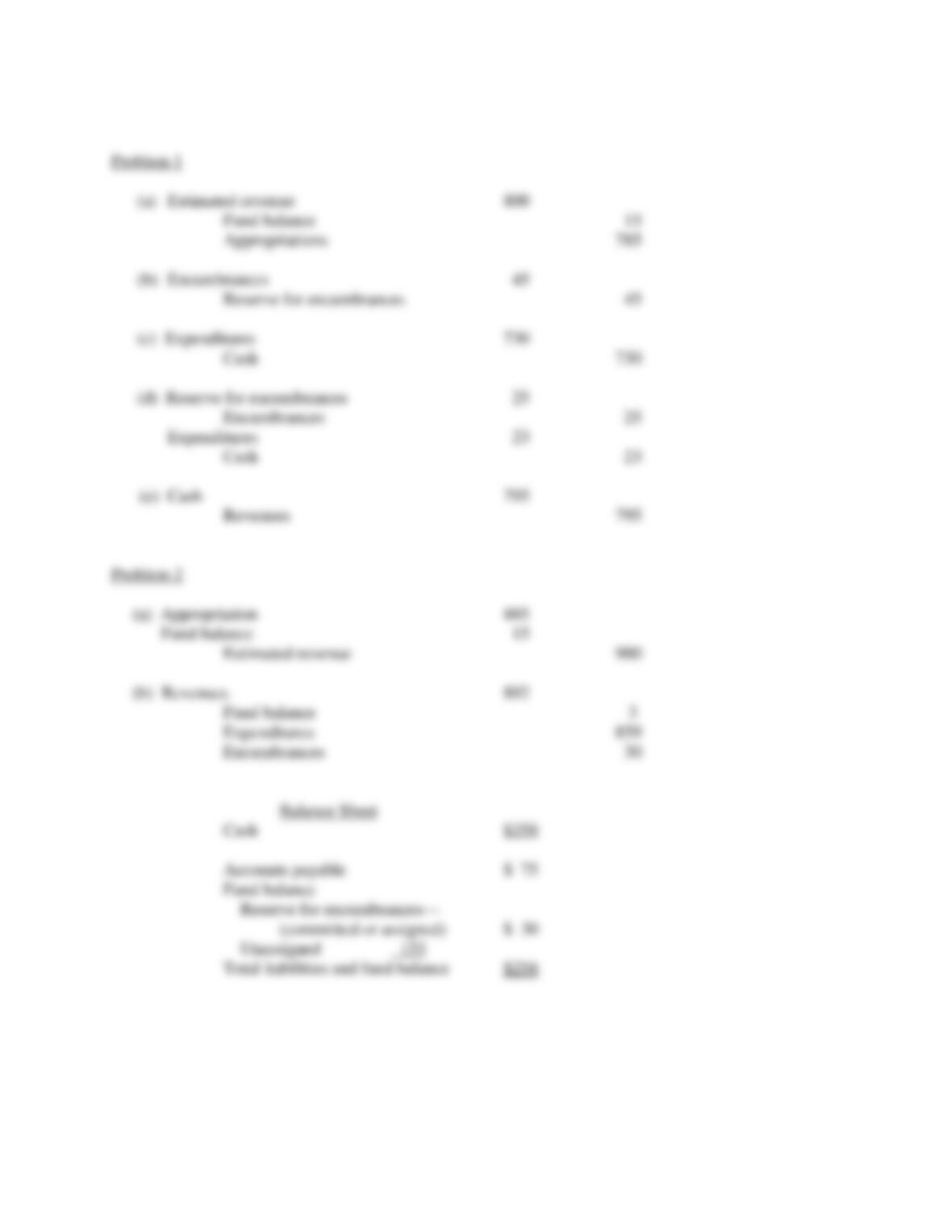
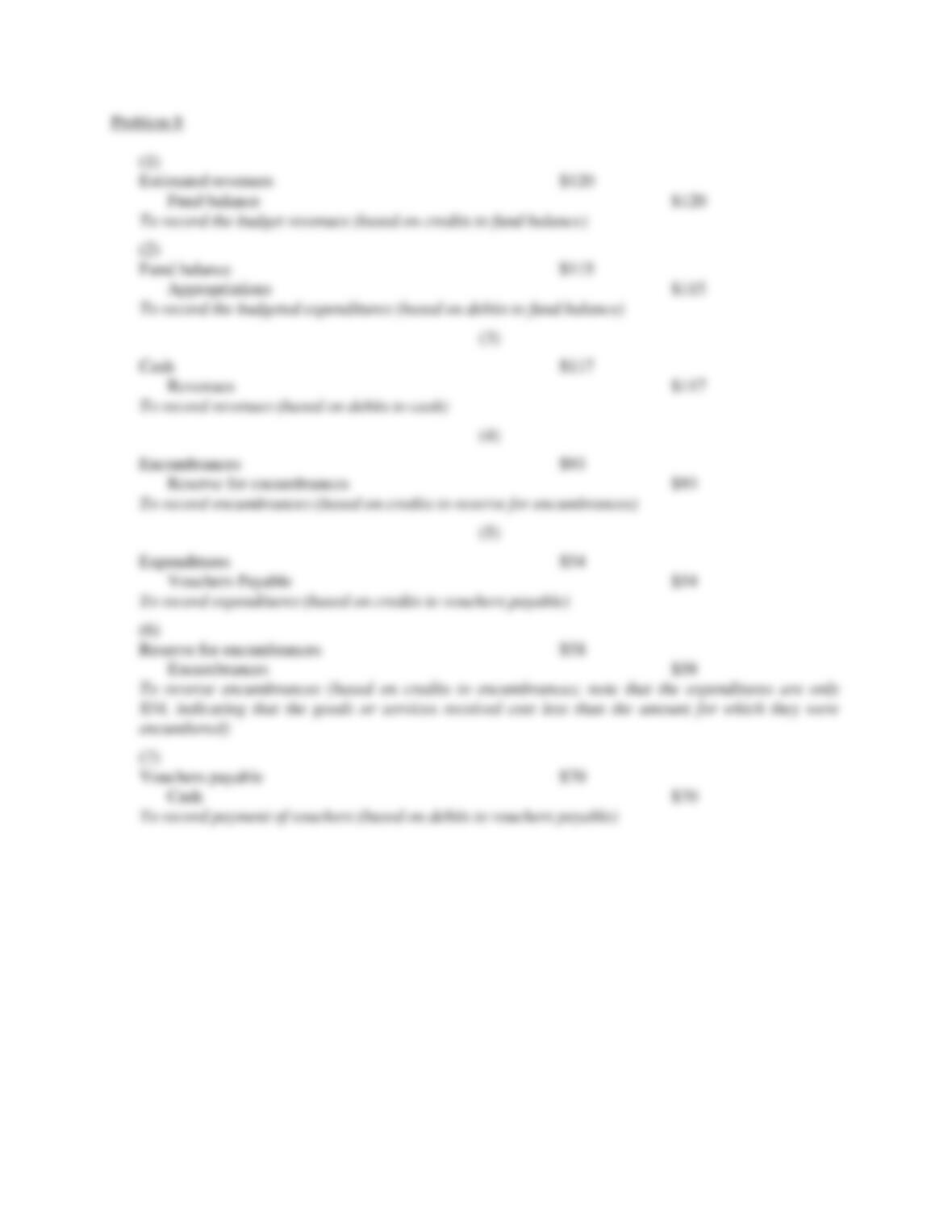
1. Assume that the City of Pasco maintains its books and records in a manner that facilitates preparation
of the fund financial statements. The city engaged in the following transactions related to its general
fund during the current fiscal year. The city formally integrates the budget into the accounting
records. The city does not maintain an inventory of supplies. All amounts are in thousands.
REQUIRED: Prepare, in summary form, the appropriate journal entries.
(a) The city council approved a budget with revenues estimated to be $800 and expenditures of $785.
(b) The city ordered supplies at an estimated cost of $25 and equipment at an estimated cost of $20.
(c) The city incurred salaries and other operating expenses during the year totaling $730. The city
paid for these items in cash.
(d) The city received the supplies at an actual cost of $23.
(e) The city collected revenues of $795.
2. School District #25 formally integrates the budget into the accounting system and uses the
encumbrance system. All appropriations lapse at year-end. At year-end, before closing entries, the
district had the following balances in its accounts. All accounts had normal balances.
REQUIRED: (a) Prepare the necessary closing entries.
(b) Prepare a balance sheet after closing.
Accounts Payable $ 75
Appropriations 885
Cash 258
Encumbrances 30
Estimated revenues 900
Expenditures 859
Fund balance 165
Reserve for encumbrances 30
Revenues 892
Granof Test Bank Chapter 3 Page 10
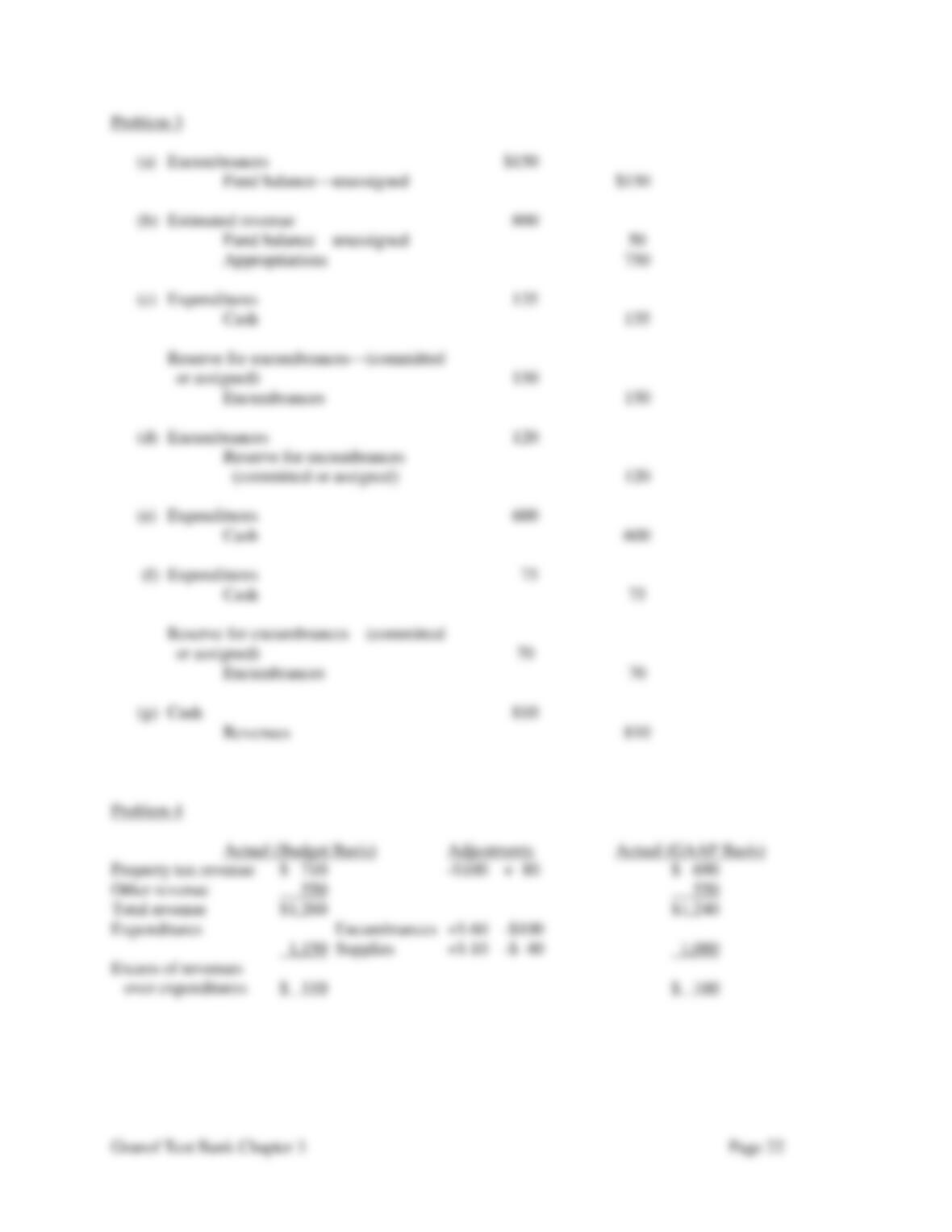
3. Assume that the County of Katerah maintains its books and records in a manner that facilitates
preparation of the fund financial statements. The county formally integrates the budget into the
accounting system and uses the encumbrance system. All appropriations lapse at year-end. At the
beginning of the fiscal year, the county had the following balances in its accounts. All amounts are in
thousands.
REQUIRED: Prepare the necessary entries for the current fiscal year.
Cash $200
Fund balanceunassigned50
Reserve for encumbrances
(committed or assigned) 150
(a) The county made the appropriate entry to restore the prior-year purchase commitments.
(b) The county board approved a budget with revenues estimated to be $800 and expenditures of
$750.
(c) The county received the items that had been ordered in the prior year at an actual cost of $135.
(d) The county ordered supplies at an estimated cost of $50 and equipment at an estimated cost of
$70.
(e) The county incurred salaries and other operating expenses during the year totaling $600. The
county paid these items in cash.
(f) The county received the equipment at an actual cost of $75.
(g) The county earned and collected, in cash, revenues of $810.

Granof Test Bank Chapter 3 Page 11
4. Kayla County prepares its general fund financial reports in accordance with generally accepted
accounting principles (GAAP) but its budgetary basis for the general fund differs from GAAP. The
budget-to-actual comparison for the general fund is presented below. All numbers are in thousands.
REQUIRED: Prepare the GAAP-basis operating statement for the general fund.
(a) For budgetary purposes, the county recognizes encumbrances as expenditures in the year of the
purchase commitment; it recognizes supplies as expenditures when acquired. For budgetary
purposes the county recognizes all revenues in the fiscal year collected.
For GAAP-basis financial reporting, the county recognizes supplies as expenditures as consumed.
It recognizes property taxes as revenue if they are collected within 60 days of fiscal year-end. All
other revenues are recognized on the cash basis for GAAP.
(b) The following additional information is available.
Beginning of Year End of Year
Encumbrances $ 60 $ 100
Supplies inventory on hand $ 10 $ 40
Property taxes expected to be collected
within 60 days of year-end$ 100 $ 80
Amended Actual
Budget (on Budget Basis)
Property tax revenue $ 700 $ 710
Other revenue 500 550
Total revenue $1,200 $1,260
Expenditures 1,190 1,150
Excess of revenues over expenditures $ 10 $ 110
Granof Test Bank Chapter 3 Page 12
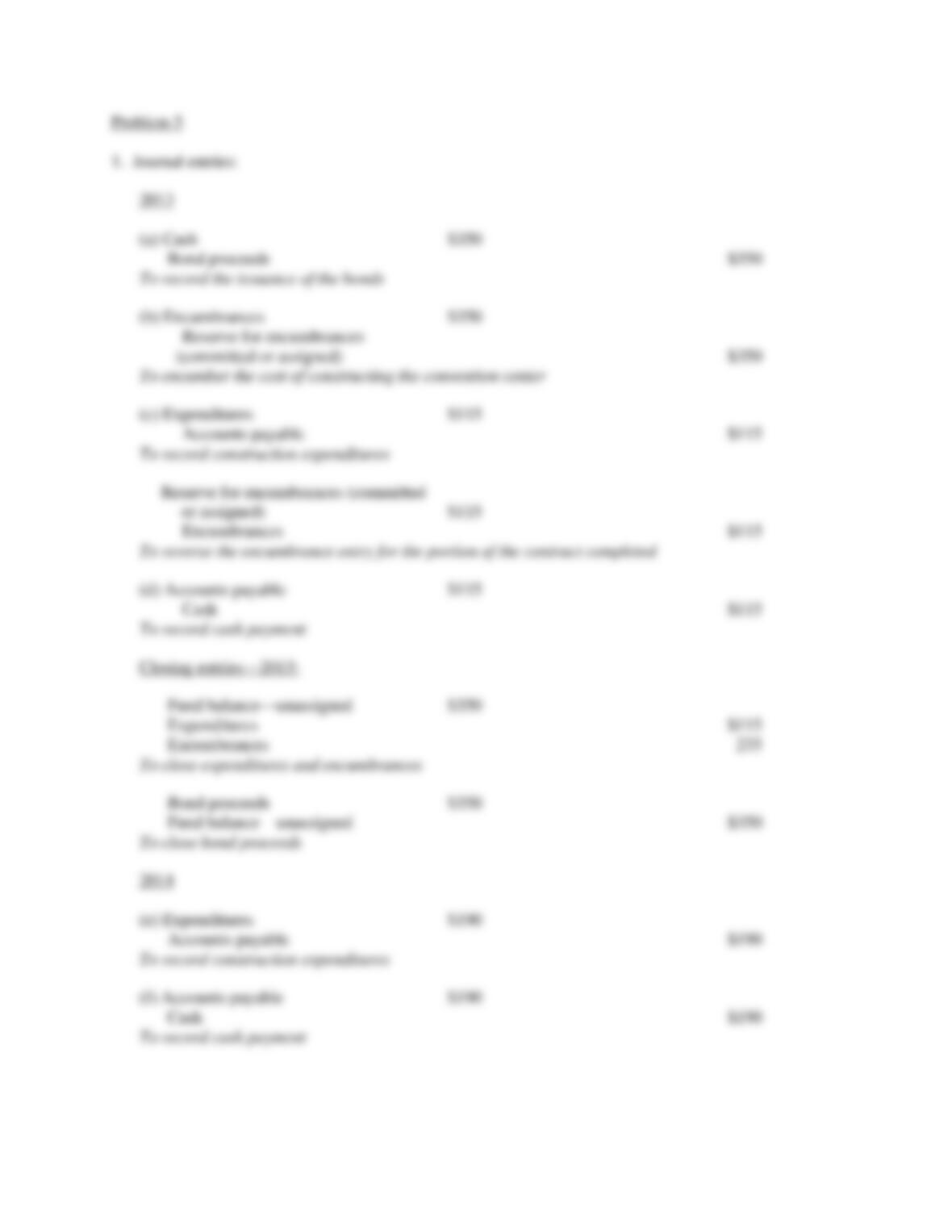
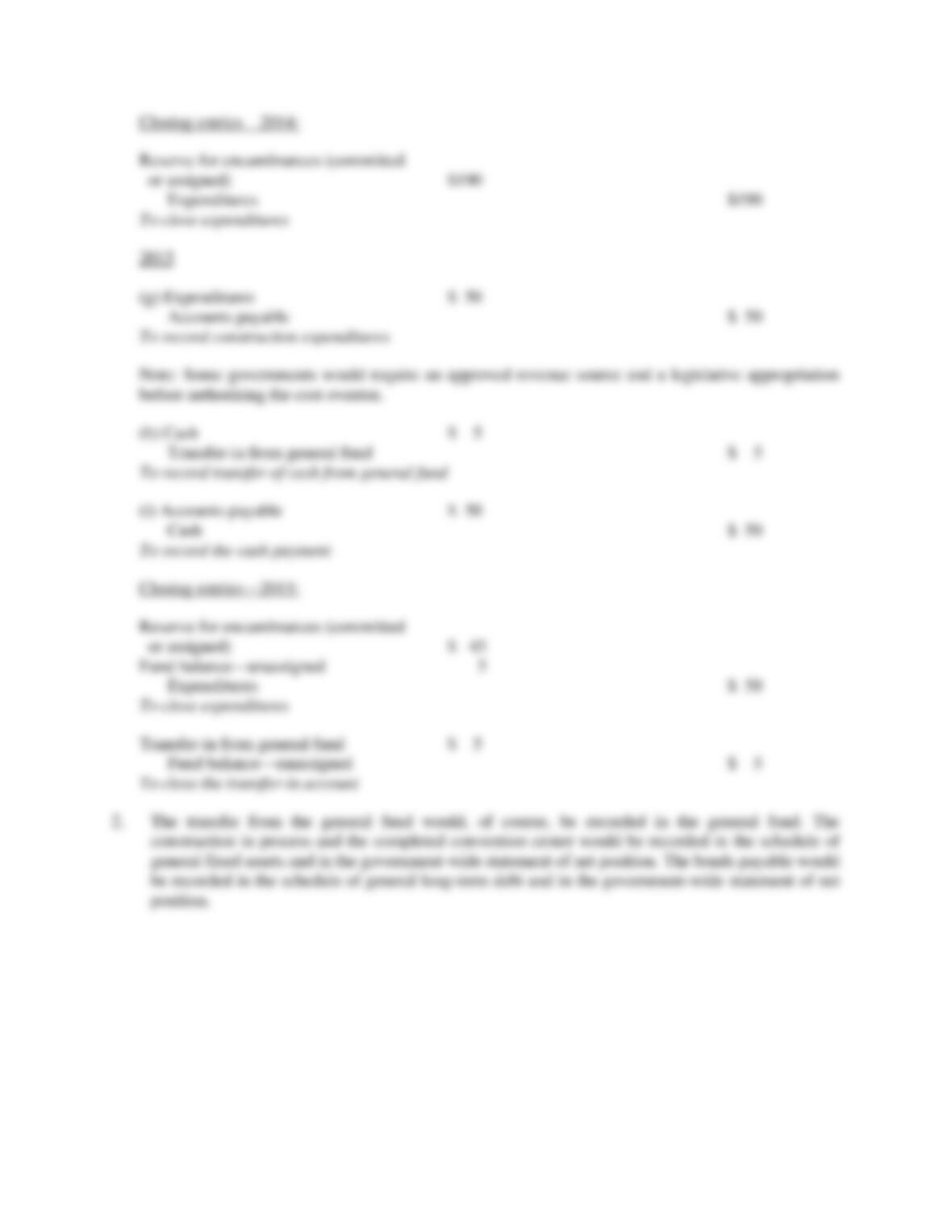
5. Geneva County authorized the issuance of bonds and contracted with the Chessie Construction
Company (CCC) to build a new convention center. During 2013, 2014, and 2015, the county
engaged in the transactions that follow. All were recorded in the county’s capital projects fund.
a. In 2013, the county issued $350 million in bonds (and recorded them as bond proceeds, an
account comparable to revenues.)
b. The county approved the contract proposal from CCC for $350 million and encumbered the
entire amount.
c. CCC billed the county for $115 for construction to date.
d. The county paid CCC the amount due in full.
e. In 2014, CCC billed the county for additional construction to date of $190 million.
f. The county paid the amount due in full.
g. In 2015, CCC completed construction of the convention center and billed the county an
additional $50 million. The county approved the additional costs, even though the total cost
of the center was now $355 million, $5 million more than the contract initially provided for.
h. The county transferred $5 million from its general fund to the capital projects fund.
i. The county paid the $50 million in full.
REQUIRED:
1. Prepare the journal entries to record these transactions in the capital projects fund, including
closing entries. Assume that amounts originally encumbered are reappropriated each year. Hence the
county need not reestablish encumbrances in each year after the first year. Instead, it can close the
expenditures of the second and third years to reserve for encumbrances rather than to fund balance.
2. What other funds or schedules would be affected by the transactions listed?
Granof Test Bank Chapter 3 Page 13
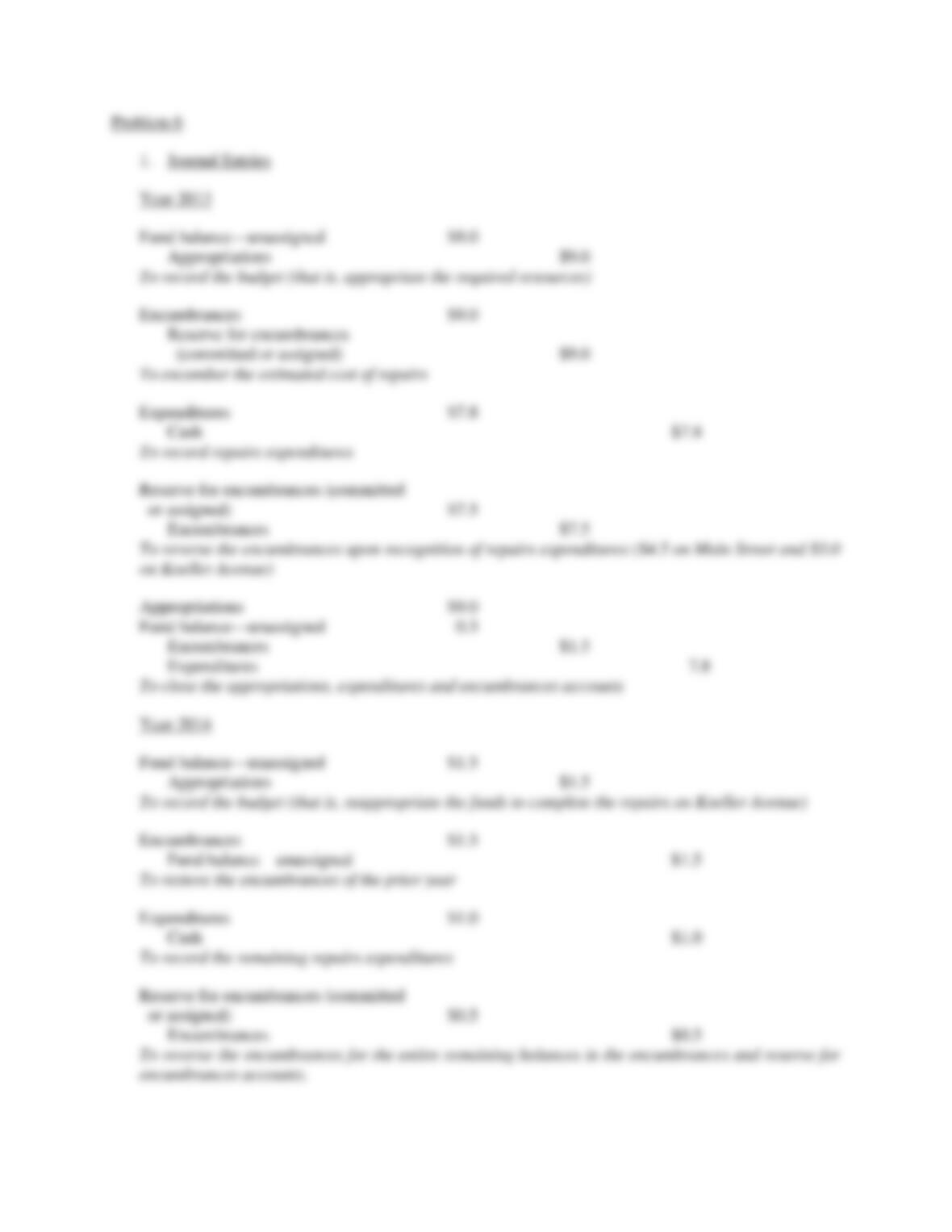
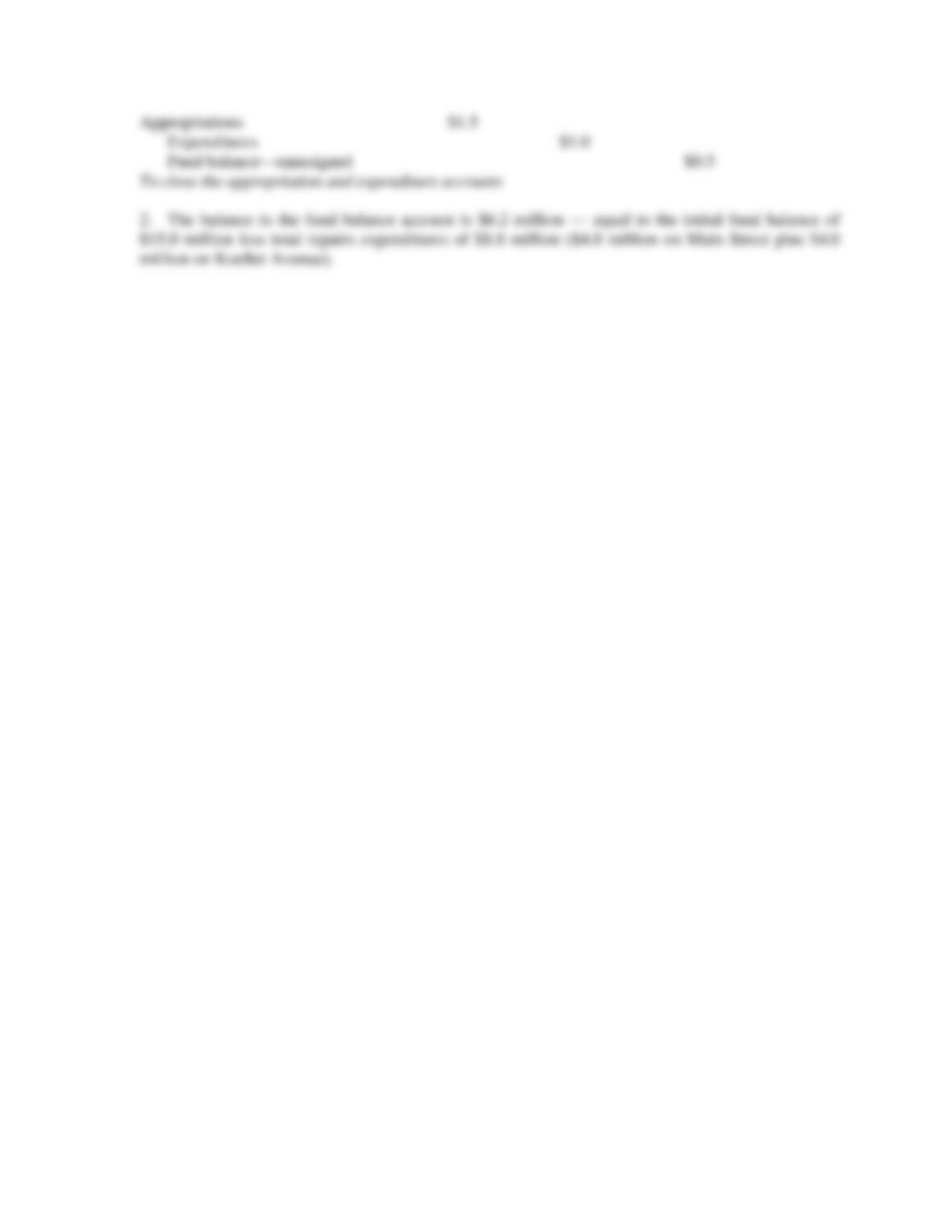
6. The town of Terry began 2013 with an unreserved balance of $15 million in its street repair fund, a
capital projects fund. At the start of the year, the city council appropriated $9 million to reconstruct
portions of the roadbed for two of its major roads—Main Street and Koeller Avenue. Shortly after,
the town signed contracts with two construction companies to perform the repairs for a total of $9
million. During the year, the town received bills from the construction companies as follows:
a. $4.8 million for the entire cost of repairs to Main Street. This amount is $0.3 higher than expected
due to design changes approved by the town. The town did not encumber the additional $0.3
million.
b. $3.0 million, representing a progress billing for repairs to Koeller Avenue, which were not
completed at the end of 2013.
At the beginning of 2014, the town reappropriated the remaining $1.5 million for the Koeller Avenue
repairs. During the year, the town received this bill:
c. $0.1 million, representing the final billing for the Koeller Avenue repairs. The final cost was $0.5
million less than anticipated.
REQUIRED:
Prepare journal entries to record the events and transactions over the two-year period. Include entries
to appropriate, reappropriate, encumber, and re-encumber the required resources, to record the
payment of the bills, and to close the accounts at the end of each year.
Determine the reserve for encumbrances (committed or assigned) and fund balance—unassigned for
the capital projects fund at the end of the second year.
Granof Test Bank Chapter 3 Page 14
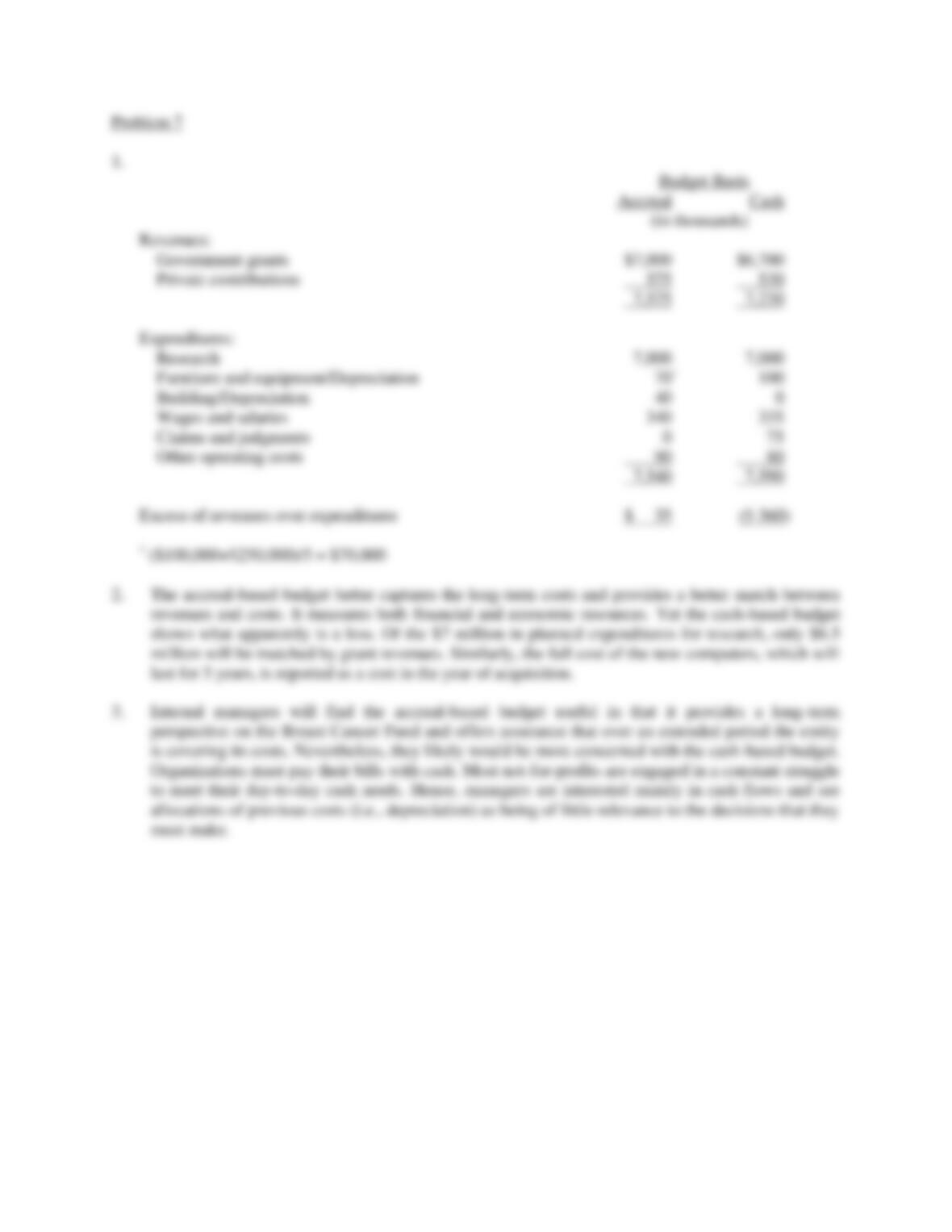
7. The Breast Cancer Fund, a not-for-profit organization, receives its funding primarily from
government grants and private contributions. In turn, the Fund provides resources to other
organizations and individuals for breast cancer research. Many of the government grants it receives
are reimbursement-type. That is, the Fund must incur specific costs to be eligible for grants that
reimburse those costs. The Fund makes the following estimates as to its next fiscal year:
It will be awarded $7 million in government grants; all but $0.5 million will be received during
the fiscal year. The balance will be reimbursed in the first six months after year-end. The Fund
will also receive $0.2 million in reimbursement grants related to the previous year.
It will receive $600,000 in pledges from private donors. It expects to collect $450,000 during the
year and $125,000 in the following year. It estimates that $25,000 will never be received. It also
expects to collect $80,000 in pledges made the prior year.
It will pay $7 million for outside research.
It will purchase new computer equipment costing $100,000. The Fund currently owns its own
building, which it had purchased for $800,000, and additional furniture and equipment that it
acquired for $250,000. The building has a useful life of twenty years; the furniture and equipment
have useful lives of 5 years. It is the Fund’s policy to record a full year of depreciation expense
in the year that assets are placed in service.
Employees will earn wages and salaries of $340,000, of which they will be paid $320,000 during
the year and the balance in the next year. The Fund will also pay another $15,000 in payroll costs
incurred in the prior year.
It will pay the $75,000 insurance deductible on an employee-related lawsuit settled the previous
year.
It will incur operating costs of $90,000, of which it will pay $70,000 during the year and $20,000
in the following year. It will also pay another $10,000 in costs incurred in the previous year.
EQUIRED:
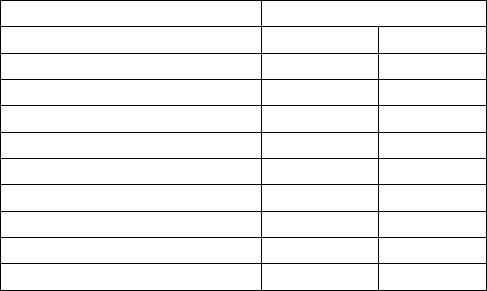
1. Prepare two budgets, one on the cash basis, the other on the full accrual basis. Show both on
the same schedule—the full accrual basis in the first column and the cash basis in the second column.
2. Comment on which budget better shows whether the Breast Cancer Fund is covering the
economic cost of the services it provides.
3. Which budget is likely to be more useful to Breast Cancer Fund managers?
Granof Test Bank Chapter 3 Page 15
8. The following schedule shows the amounts related to supplies that the City of Pascal debited and
credited to the indicated accounts during the year (not necessarily year-end balances), before closing
entries. The Ccity records its budget, encumbers all of its expenditures, and initially vouchers all
payments. All revenue was collected in cash.
REQUIRED:
Some information is missing in the schedule below. Determine the missing data by reconstructing (in
summary) the journal entries the city must have made during the year.
(in thousands)
Debits
Credits
Cash
$ 117
$ ?
Estimated revenues
?
0
Revenues
0
?
Vouchers payable
70
54
Appropriations
0
?
Encumbrances
?
58
Expenditures
?
0
Reserve for encumbrances
?
93
Fund balance
115
120

Granof Test Bank Chapter 3 Page 16
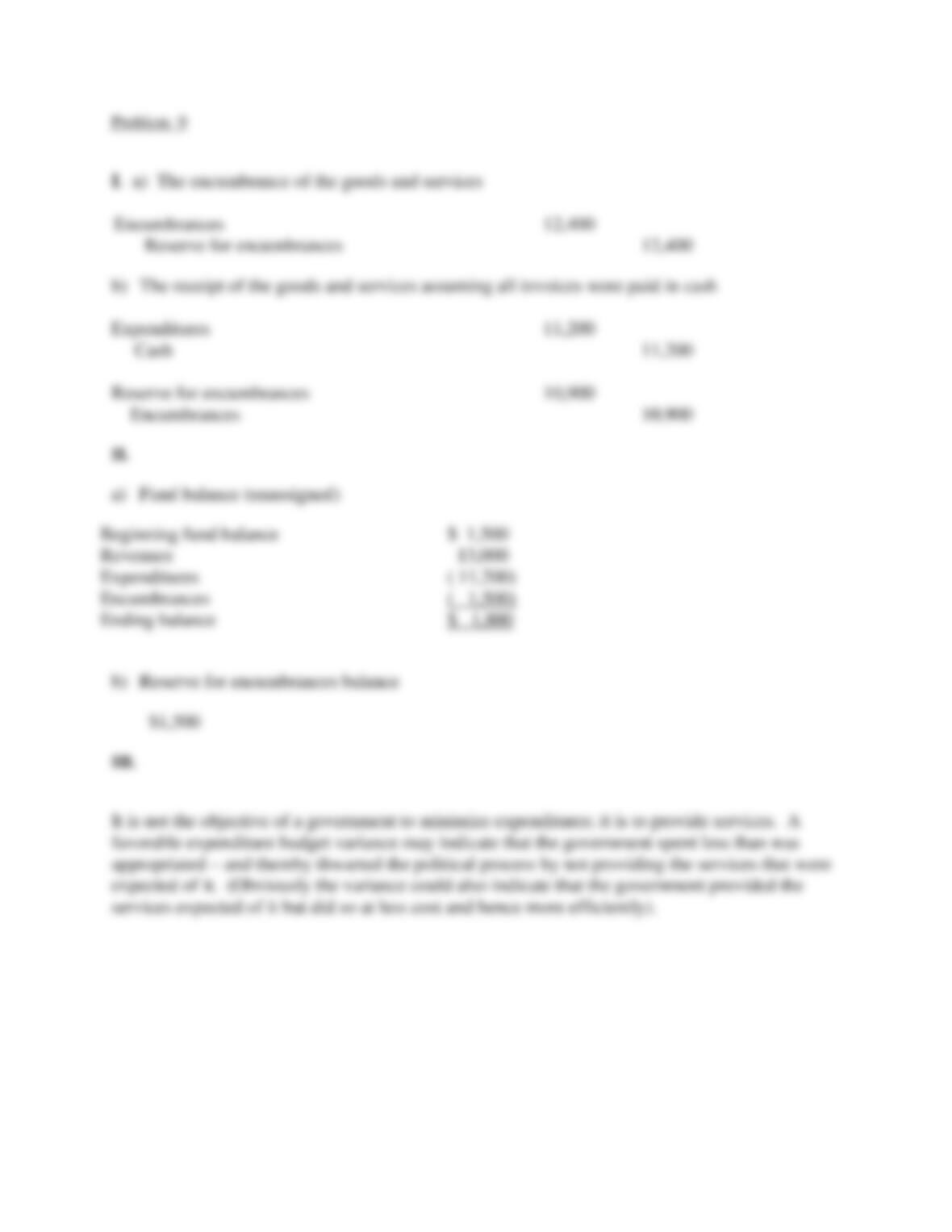
9. The data presented below were taken from the books and records of the village of Denaville. All
amounts are in millions. The village encumbers all outlays. As is evident from the data, some goods
or services that were ordered and encumbered have not yet been received. City regulations require that
all appropriations lapse at year-end.
Amounts Received
Estimated/
Amounts
Estimated
Actual
Actual
Appropriated
Encumbered
Cost
Cost
Revenues
Revenues
Property taxes
$8,900
$8,800
Sales taxes
3,900
3,600
Licenses
300
200
Other
700
400
$13,800
$13,000
=====
Expenditures/Appropriations
General government
$3,500
$3,100
$2,900
$3,300
Public safety
6,000
5,900
5,000
4,900
Recreation
1,200
1,200
800
900
Health and sanitation
2,300
2,200
2,200
2,100
$13,000
$12,400
$10,900
$11,200
Excess of estimated revenues
====
====
over appropriations
$800
Beginning fund balance
1,500
Estimated ending fund balance
$2,300
I. Prepare summary entries to record: a) the encumbrance of the goods and services and
b) the receipt of the goods and services assuming all invoices were paid in cash.
II. What would be the year-end: a) fund balance (unassigned)
b) reserve for encumbrances balance
III. Suppose a city accountant prepared a schedule comparing budgeted to actual revenues and
expenditures. The city’s mayor notes (correctly) that the very favorable variance between
budgeted and actual expenditures was not merely a matter of luck – e.g., attributable to factors
beyond the control of the city, such as less than usual snowfall and hence lower than usual snow
removal costs. Rather, he boasts, it was due to a concerted effort on the part of his
administration to “hold the line” on expenditures. Why, in governments and not-for-profit
organizations might favorable expenditure variances be an indication of inept rather than
competent management?

Granof Test Bank Chapter 3 Page 17
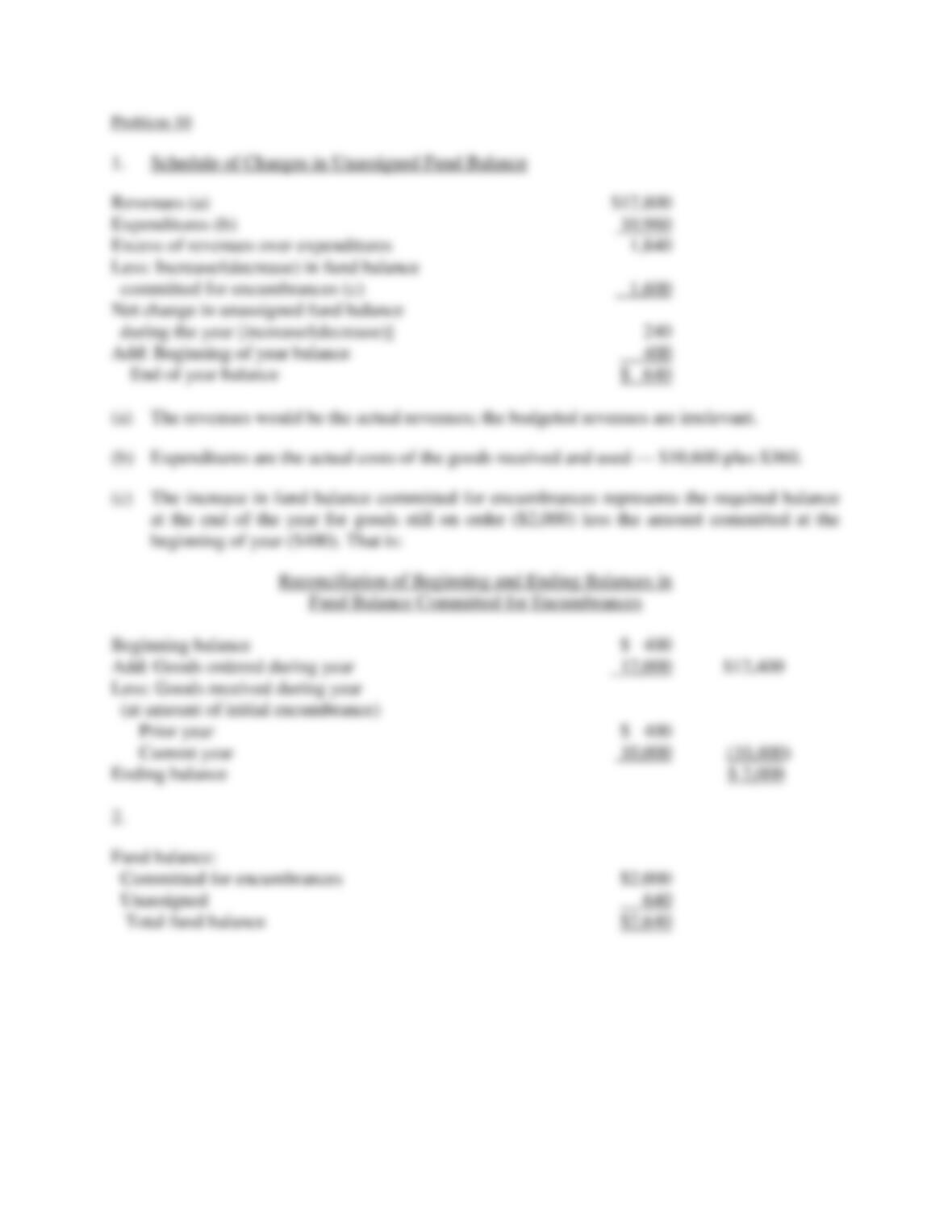
10. On July 1, the start of its fiscal year, Daze County reported the following balances ($ in thousands):
Fund balance:
Committed for encumbrances $400
Unassigned 800
Total fund balance $1,200
During the year, the county ($ in thousands):
• Estimated that revenues for the year would be $12,600.
• Appropriated $13,000 for operations.
• Ordered supplies estimated to cost $12,000. Of these, the county received (and used) supplies that
it had estimated would cost $10,000. Actual cost, however, was $10,600.
• Received (and used) all goods that it had ordered in the previous year. Actual cost was only $360.
• Recognized actual revenues of $12,800.
REQUIRED
1. Prepare a schedule of changes in unassigned fund balance for the year.
2. Show how the total fund balance (including the unassigned and committed portions) would be
displayed at year-end.
Granof Test Bank Chapter 3 Page 18
ESSAYS (CHAPTER 3)
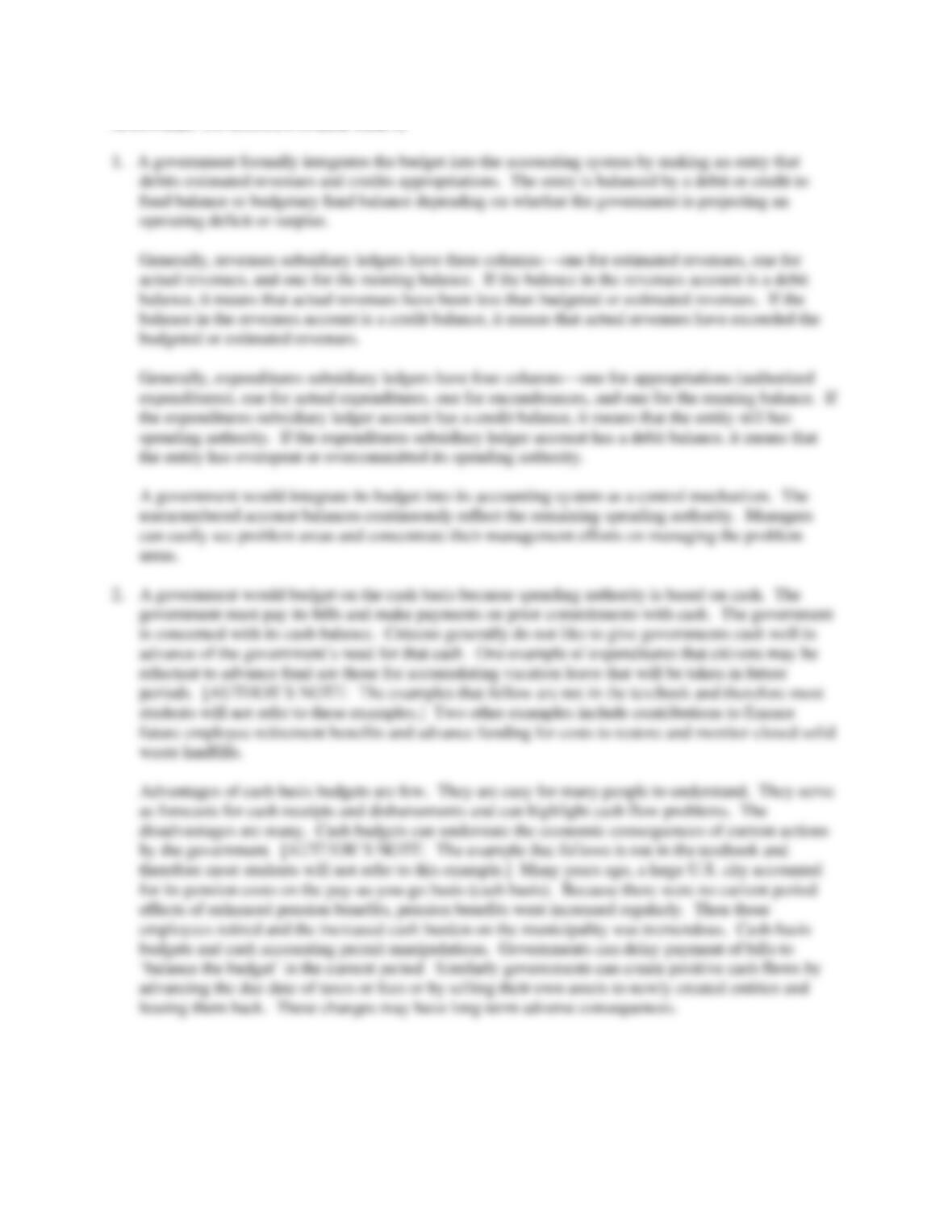
1. Many governments formally integrate the budget into the accounting system. Explain how this is
accomplished. Also, explain why a government would formally integrate the budget into the
accounting system.
2. Many governments budget on the cash basis. Explain why a government would budget on a cash
basis rather than on a GAAP-basis. Discuss the advantages and disadvantages of cash-basis budgets.
3. GAAP require state and local governments to include in their annual financial reports a budget–to–
actual comparison showing actual results and original and final appropriated budgets. What are the
advantages of requiring both the original and final appropriated budget amounts?
4. Why do many governments not consider it necessary to prepare appropriation budgets for, and
incorporate budgetary entries into the accounts of, their capital projects funds?
5. Why may flexible budgets be more appropriate for a government’s business-type activities than for
its governmental activities?
6. The mayor of the City of Geneva boasts that the budgeted year-end excess of revenues over
expenditures for the year just ended was significantly greater than expected. Why is this “favorable”
result not necessarily a good thing?
7. In what way will budgetary entries and encumbrances affect amounts reported in year-end GAAP
balance sheets and operating statements of state and local governments?
8. What are the possible differences that may occur between a state or local government’s budgetary
practices and GAAP?
9. A government’s unassigned general fund balance at year-end may not be indicative of the amount
that the government has available for appropriation in future years. Explain and provide an example
to support your answer.
10. For most governments, the “variance” column on general fund budget–to-actual statements is likely
to report relatively small amounts. Do you agree? Explain.
11. Some governments and most not-for-profit entities do not integrate their budgets into their
accounting systems or encumber the cost of goods or services for which they are committed. Are
such practices justifiable? Explain.

Granof Test Bank Chapter 3 Page 19
ANSWERS TO TRUE/FALSE (CHAPTER 3)
12. T
ANSWERS TO MULTIPLE CHOICE (CHAPTER 3)

Granof Test Bank Chapter 3 Page 20
Granof Test Bank Chapter 3 Page 21
ANSWERS TO PROBLEMS (CHAPTER 3)
Granof Test Bank Chapter 3 Page 23
Granof Test Bank Chapter 3 Page 24
Granof Test Bank Chapter 3 Page 25
Granof Test Bank Chapter 3 Page 26
Granof Test Bank Chapter 3 Page 27
Granof Test Bank Chapter 3 Page 28
Granof Test Bank Chapter 3 Page 29
Granof Test Bank Chapter 3 Page 30
Granof Test Bank Chapter 3 Page 31
ANSWERS TO ESSAYS (CHAPTER 3)
Granof Test Bank Chapter 3 Page 32
Granof Test Bank Chapter 3 Page 33