Chapter 03 – Transmission of Genes from Generation to Generation
True / False
1. Recessive traits are expressed only in the homozygous state.
a.
True
b.
False
True
2. Gregor Mendel was a completely self-trained scientist and never attended university.
a.
True
b.
False
False
3. Pedigree construction can be a difficult task.
a.
True
b.
False
True
4. Chi-square tests are used to determine whether a cross has been correctly constructed and analyzed.
a.
True
b.
False
False
5. People with albinism carry two copies of the dominant allele (AA) and cannot make a pigment called melanin.
a.
True
b.
False
False
6. If a dihybrid cross is begun with a P1 generation of a true-breeding plant that produces smooth and yellow peas
(smooth and yellow are both dominant traits), crossed with a plant that produces wrinkled green peas (wrinkled and green
are both recessive traits), the F1 plants will all be smooth and yellow.
a.
True
b.
False
True
7. Methylmalonic acidemia (MMA) is caused by the inability to metabolize amino acids and fats.
a.
True
b.
False
True
disorders.
8. Mendel chose to study pea plants because they have a long life cycle that offers ample time for analysis.
a.
True
b.
False
False
9. When analyzing a cross involving two traits, each trait is analyzed separately, and then the frequencies of each are
combined to yield the observed phenotypic ratios.
a.
True
b.
False
True
10. Incomplete dominance is the expression of a phenotype that is intermediate to those of the parents.
a.
True
b.
False
True
Chapter 03 – Transmission of Genes from Generation to Generation
Multiple Choice
11. In his monohybrid crosses, Mendel deduced that one trait was recessive because that trait was ____.
a.
not present in the F1 and did not reappear in the F2
b.
present in the F1 and in the F2
c.
not present in the F1 and reappeared in the F2
d.
present only in the parents
e.
present only in the F2
c
Bloom’s: Understand
3-4 Crossing Pea Plants: Mendel’s Study of Single Traits
using pea plant seed shape and describe his results and conclusions
12. In a monohybrid cross with complete dominance, the F2 offspring should contain ____.
a.
two different phenotypes and two different genotypes
b.
two different phenotypes and three different genotypes
c.
three different phenotypes and two different genotypes
d.
three different phenotypes and three different genotypes
e.
two different phenotypes and one genotype
b
Bloom’s: Understand
3-4 Crossing Pea Plants: Mendel’s Study of Single Traits
the outcomes.
13. Alternate forms of a gene are called ____.
a.
homologues
b.
loci
c.
alleles
d.
homozygous
e.
heterozygous
c
Bloom’s: Remember
3-4 Crossing Pea Plants: Mendel’s Study of Single Traits
using pea plant seed shape and describe his results and conclusions
Bloom’s: Understand
3-8 Variations on a Theme by Mendel
phenotype in heterozygotes.
14. Independent assortment means that the ____.
a.
phenotypes are often a blending of two independent genotypes
b.
segregation of one gene pair depends on the segregation of another gene pair
c.
gametes produced must be heterozygous in all cases
d.
segregation of one gene pair occurs as if no other gene pair was present
e.
phenotypic ratio in F2 will be the same for dihybrid and monohybrid crosses
ANSWER:
d
DIFFICULTY:
Bloom’s: Understand
REFERENCES:
3-5 More Crosses with Pea Plants: The Principle of Independent Assortment
assortment) and apply it to the inheritance of two traits.
15. In a cross between a true-breeding plant bearing the dominant traits of smooth, yellow seeds and a true-breeding plant
bearing the recessive traits of wrinkled, green seeds, the offspring (F1) are all smooth and yellow and their genotype is
____.
a.
SSYY
b.
ssyy
c.
SsYy
d.
ssYY
e.
SSyy
ANSWER:
DIFFICULTY:
Bloom’s: Analyze
REFERENCES:
3-5 More Crosses with Pea Plants: The Principle of Independent Assortment
predict the outcomes.
16. In a P1 cross involving incomplete dominance, ____.
a.
the dominant phenotype is expressed in the F1
b.
the recessive phenotype is expressed in the F1
c.
Mendelian inheritance does not apply
d.
the phenotypic ratio and genotypic ratio in the F1 are identical
e.
heterozygotes will express the parental phenotype
ANSWER:
d
DIFFICULTY:
Bloom’s: Analyze
REFERENCES:
3-8 Variations on a Theme by Mendel
scientists to question the validity of segregation and independent assortment.
17. Phenotype is ____.
a.
only expressed in a heterozygous organism
b.
an observable property or expression of a trait in an organism
c.
the specific genetic constitution of an organism
Chapter 03 – Transmission of Genes from Generation to Generation
d.
the variation of genes
e.
cannot be determined by knowing genotype
b
Bloom’s: Understand
3-4 Crossing Pea Plants: Mendel’s Study of Single Traits
using pea plant seed shape and describe his results and conclusions
18. In codominant inheritance, ____.
a.
there is partial phenotypic expression of one member of a gene pair in the homozygous condition
b.
there is full phenotypic expression of both members of a gene pair in the heterozygous condition
c.
the interaction of two or more non-allelic genes controls a single phenotype
d.
two recessive alleles interact and express themselves as a single dominant trait
e.
the phenotype of a heterozygote is intermediate to those of the parents
b
Bloom’s: Understand
3-8 Variations on a Theme by Mendel
HUHE.CUMM.16.3-8-3 – Define codominance in a heterozygote.
19. A locus is ____.
a.
an alternate form of a gene
b.
the chromosome location of the centromere
c.
the location of a gene on a chromosome
d.
a mutation of a gene to an alternate state
e.
the site of crossing over
Bloom’s: Remember
3-6 Meiosis Explains Mendel’s Results: Genes Are on Chromosomes
how its conclusions were confirmed.
20. Pedigrees ____.
a.
are usually constructed using the phenotypic information of one generation
b.
cannot determine whether a trait has a dominant or recessive pattern
c.
use squares to represent females and circles to represent males on their diagrams
d.
are not useful in deducing the genotypes of parents
e.
provide information on the patterns of inheritance of a trait
Bloom’s: Understand
3-7 Mendelian Inheritance in Humans
HUHE.CUMM.16.3-7-2 – Construct a pedigree and interpret the results.
21. In genetics, a chi-square test can be used to determine ____.
a.
whether an organism with a dominant phenotype is homozygous or heterozygous
b.
whether an allele exhibits complete or incomplete dominance
Chapter 03 – Transmission of Genes from Generation to Generation
c.
what the predicted outcome of a dihybrid cross will be
d.
how closely actual results of a cross match the expected results
e.
whether a trait is determined by one gene or many genes
d
Bloom’s: Understand
3-6 Meiosis Explains Mendel’s Results: Genes Are on Chromosomes
the results of Mendel’s pea plant experiments.
22. In a pedigree, a person whose symbol is filled in and who is associated with the Roman numeral II is ____.
a.
affected by the trait and in the second generation
b.
not affected by the trait and in the second generation
c.
affected by the trait and is the second-oldest child in the family
d.
not affected by the trait and is the second-oldest child in the family
e.
affected by the trait and has an identical twin
a
Bloom’s: Understand
3-7 Mendelian Inheritance in Humans
HUHE.CUMM.16.3-7-2 – Construct a pedigree and interpret the results.
23. The offspring (F1) resulting from the cross between two red flowered plants are 3/4 red and 1/4 white. The most likely
genotype of both red flowered parental plants (P1) is ____.
a.
codominant recessive
b.
incomplete dominant
c.
incomplete recessive
d.
heterozygous
e.
homozygous recessive
d
Bloom’s: Understand
3-4 Crossing Pea Plants: Mendel’s Study of Single Traits
the outcomes.
24. In humans, hair texture is an incompletely dominant trait. Curly is the dominant genotype, wavy is heterozygous, and
straight hair is recessive. What is the probable phenotypic ratio for a cross between a man with wavy hair and a woman
with curly hair?
a.
All wavy hair
b.
3/4 wavy hair; 1/4 straight hair
c.
1/2 wavy hair; 1/2 curly hair
d.
All curly hair
e.
1/4 curly hair; 1/2 wavy hair; 1/4 straight hair
c
Bloom’s: Understand
25. Some forms of methylmalonic acidemia can be ____.
a.
caused by ethylene glycol exposure
b.
caused by tainted baby formula
c.
caused by type O blood transfusions
d.
cured if the condition is detected early in life
e.
treated successfully if the condition is detected early in life
e
Bloom’s: Remember
3-1 Mom, Murder, and MMA
disorders.
26. The topic of ____, the idea of the fundamental unit of living organisms, raised several questions in Mendel’s mind
about inheritance.
a.
evolution
b.
cosmology
c.
cell theory
d.
DNA
e.
blood typing
c
Bloom’s: Remember
3-2 Heredity: How Are Traits Inherited?
point for a discussion of human genetics.
27. Mendel selected pea plants for his experiments because ____.
a.
the offspring are infertile
b.
others were also using pea plants for their experiments and this would allow data sharing
c.
male and female flowers are on separate plants
d.
they can be self-fertilized or artificially fertilized by hand
e.
he was told by his superior that only pea plants were suitable for experimentation
d
Bloom’s: Remember
3-3 Mendel’s Experimental Design Resolved Many Unanswered Questions
plant species
28. Mendel analyzed his pea plant data using the principles of ____.
a.
nomenclature
b.
physics
c.
Aristotle
3-4 Crossing Pea Plants: Mendel’s Study of Single Traits
the outcomes.
Chapter 03 – Transmission of Genes from Generation to Generation
d.
cellular dynamics
e.
probability
e
Bloom’s: Understand
3-3 Mendel’s Experimental Design Resolved Many Unanswered Questions
success of his experiments.
29. Ockham’s razor could also be called the principle of ____.
a.
parsimony
b.
selectivity
c.
identity
d.
homogeneity
e.
exceptionalism
a
Bloom’s: Remember
3-4 Crossing Pea Plants: Mendel’s Study of Single Traits
single trait inheritance.
30. The first genetic trait described in humans was ____.
a.
albinism
b.
dwarfism
c.
Marfan syndrome
d.
multiple sclerosis
e.
brachydactyly
e
Bloom’s: Remember
3-7 Mendelian Inheritance in Humans
concepts when studying human genetics.
Completion
31. When members of the gene pair carried by an individual are not alike, the individual is said to be
____________________.
heterozygous
Bloom’s: Understand
3-4 Crossing Pea Plants: Mendel’s Study of Single Traits
establish its significance in the study of inheritance.
32. The offspring of a parental cross (P1) are called the F1, or ____________________.
first filial
Bloom’s: Remember
3-4 Crossing Pea Plants: Mendel’s Study of Single Traits
33. Mendel called crosses involving two traits ____________________ crosses.
34. Pure-breeding individuals always have the ____________________ genotype.
35. In crosses involving complete dominance, the F2 genotypic ratio is 1:2:1 and is expressed as a phenotypic
____________________ ratio (express as x:x).
36. The inheritance of human traits is predictable because the genes controlling them exhibit the principles of both
____________________ and ____________________ during meiosis.
37. When two traits are analyzed separately, then the frequencies of each are combined to yield the observed phenotypic
ratios, this confirms the principle of ____________________.
38. Although phenotypes may not follow predicted ratios, genotypes do obey the principles of ____________________.
39. Symptoms of methylmalonic acidemia are similar to those seen in ____________________ poisoning.
40. In spite of the benefits offered by genetic screening for newborns, critics charge that patients’
____________________ rights are violated because the programs are mandatory.
41. Before Mendel began his pea plant experiments he wondered if traits in offspring result from blending of parental
traits or it they are inherited as ____________________ units.
42. In Mendel’s pea plant experiment, the trait of pea shape was represented by the two variations
____________________ and ____________________.
43. The separation of members of a gene pair from each other during gamete formation is called ____________________.
44. The genotypes of two F1 plants are SsYy, with S and Y alleles dominant to s and y. If fertilization occurs at random
____________________ (number) genotypes and ____________________ (number) phenotypes will result in the F2
generation.
45. The fusion of gametes during fertilization restores the ____________________ number of chromosomes.
46. People with albinism carry two copies of the ____________________ allele (aa) and cannot make a pigment called
____________________ which is the principal pigment in skin, hair and eye color.
47. The first affected family member who seeks medical attention for a genetic disorder is called the
____________________.
48. Easily observable examples of incomplete dominance in human are rare, but ____________________ is one example.
49. In humans, the gene for blood type has ____________________ (number) alleles and the A and B alleles are
____________________.
50. An example of ____________________ occurs in a rare condition called the Bombay phenotype, where a mutation in
an unrelated gene prevents expression of the A and B blood phenotypes, making those with this condition phenotypically
Chapter 03 – Transmission of Genes from Generation to Generation
blood type ____________________
51. Should states have mandatory screening programs that test every newborn for genetic disorders? Explain your
reasoning.
52. Why is it unethical to use humans in experimental genetics? Explain your reasoning.
53. Explain why Mendel choose seven different varieties of pea plants for his experiments.
54. Explain Mendel’s conclusion that traits passed from parents to offspring are not blended, but are instead inherited as if
they are separate units.
55. Define Ockham’s razor and provide an example.
56. Explain how the resulting phenotypic ratios from Mendel’s dihybrid cross assisted him in framing his Second Law.
57. Identify the contribution of Walter Sutton and Theodore Boveri to the science of genetics and explain its importance.
58. Explain how Mendel compensated for the fact that he was unable to analyze mathematically how well the observed
outcome of his cross fulfilled his predictions.
59. Explain the circumstances that led to a debate about whether all inheritance cases could be explained by Mendelian
inheritance or whether there might be another, separate mechanism of inheritance that did not follow the laws of
segregation and independent assortment. Summarize the outcome of that debate.
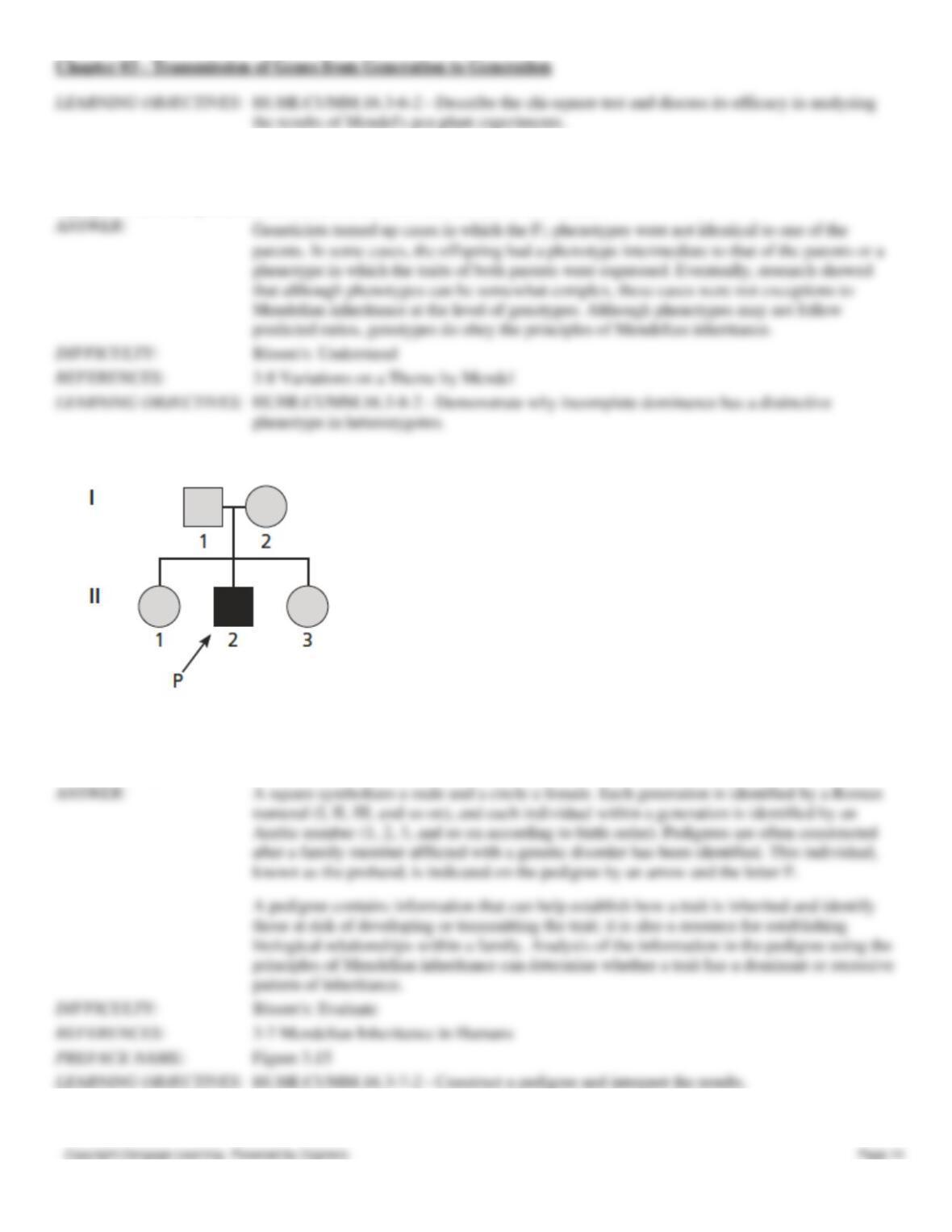
Figure 3.15
60. Interpret the pedigree in the accompanying figure by describing each symbol and number. How might the information
from this pedigree be used by clinicians and researchers?