59)
Although it is a popular product, Apple makes little profit from each song downloaded through
iTunes. Why does Apple charge only $0.99 to download a song?
59)
A)
Apple cannot raise the price above $0.99 per song because consumers can download songs at
even lower prices from Apple’s competitors.
B)
Apple plans to increase the price of downloading songs after it sells a large enough number of
iPods.
C)
Although Apple makes a small amount of profit per song, total profit is large because the
quantity sold is large.
D)
The low price makes it more likely that consumers will buy iPods, which are relatively
expensive.
60)
Starting in the 1960s researchers predicted that flat–screen televisions produced with liquid crystal
displays (LCD) would be sold to the public. But technical problems delayed the manufacture and
sale of LCD televisions until the late 1990s. What was this technical problem?
60)
A)
It was not until the 1990s that satellite television signals enabled consumers to watch
programming from many countries. This led to a large increase in demand and made the sale
of LCD televisions profitable.
B)
Until the 1990s relatively few channels were available for consumers to watch. After cable
and satellite television became popular consumers were able to watch many more stations;
this led to an increase in the demand for LCD televisions.
C)
Until the 1990s only very small screens could be economically produced. These screens were
not popular with consumers. New technology resulted in larger screens.
D)
There was no way to make very thin, clean television screens until 1999 when Corning, Inc.
finally developed a process to do this.
61)
Prices of California Merlot wine (assume that this is a normal good) have risen steadily in recent
years. Over this same period, prices for French oak barrels used for wine storage have dropped and
consumer incomes have risen. Which of the following best explains the rising prices of California
Merlots?
61)
A)
The demand curve for Merlot has shifted to the right faster than the supply curve has shifted
to the right.
B)
The demand curve and the supply curve for Merlot have both shifted to the left.
C)
The supply curve for Merlot has shifted to the right faster than the demand curve has shifted
to the right.
D)
The supply curve for Merlot has shifted to the right while the demand curve for Merlot has
shifted to the left.
62)
If a decrease in income leads to an increase in the demand for macaroni, then macaroni is
62)
A)
a necessity.
B)
an inferior good.
C)
a neutral good.
D)
a normal good.
63)
A decrease in the demand for eggs due to changes in consumer tastes, accompanied by a decrease
in the supply of eggs as a result of an outbreak of Avian flu, will result in
63)
A)
a decrease in the equilibrium quantity of eggs and no change in the equilibrium price.
B)
a decrease in the equilibrium quantity of eggs; the equilibrium price may increase or decrease.
C)
a decrease in the equilibrium price of eggs and no change in the equilibrium quantity.
D)
a decrease in the equilibrium price of egg; the equilibrium quantity may increase or decrease.
64)
A movement along the demand curve for toothpaste would be caused by
64)
A)
a change in population.
B)
a change in the price of toothpaste.
C)
a change in consumer income.
D)
a change in the price of toothbrushes.
65)
Even when the demand for one good is high, the price of the good is also affected by supply. The
textbook illustrates this by comparing the price of two items that were auctioned on the same day.
Which of the following describes the results of the auction?
65)
A)
A letter written by John Wilkes Booth sold for a higher price than a letter written by Lee
Harvey Oswald.
B)
A letter written by Abraham Lincoln was sold for a higher price than a letter written by Adam
Smith.
C)
A letter written by John Wilkes Booth sold for a higher price than a letter written by Abraham
Lincoln.
D)
A letter written by Abraham Lincoln sold for a higher price than a letter written by John
Wilkes Booth.
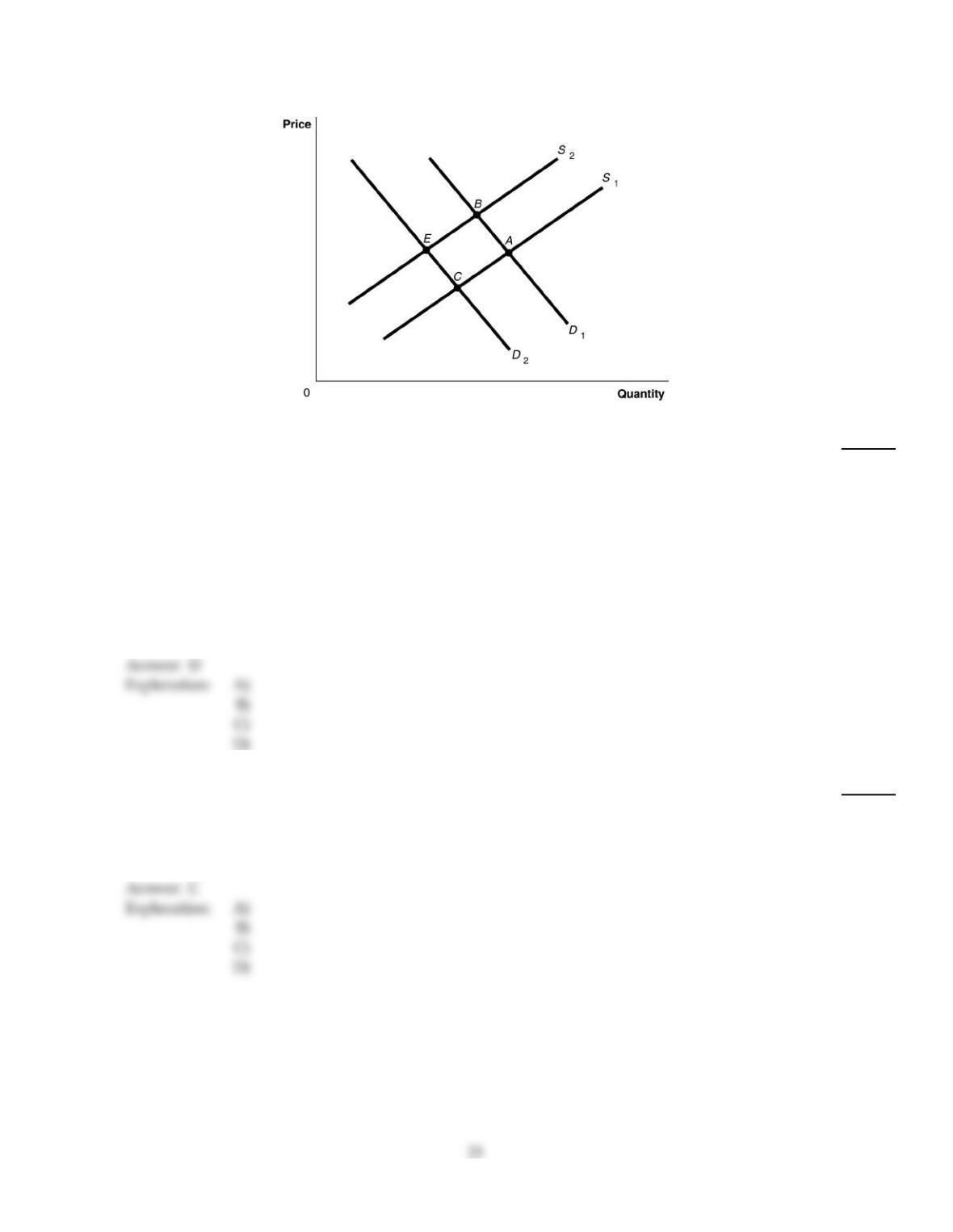
Figure 3–6
66)
Refer to Figure 3–6. The graph in this figure illustrates an initial competitive equilibrium in the
market for apples at the intersection of D2 and S2 (point E). Which of the following changes would
cause the equilibrium to change to point A?
66)
A)
an increase in the wages of apple workers and a decrease in the price of oranges, a substitute
for apples
B)
a positive change in the technology used to produce apples and decrease in the price of
oranges, a substitute for apples
C)
an increase in the number of apple producers and a decrease in the number of apple trees as a
result of disease
D)
a decrease in the wages of apple workers and an increase in the price of oranges, a substitute
for apples
67)
The law of demand implies, holding everything else constant, that
67)
A)
as the price of bagels increases, the quantity of bagels demanded will increase.
B)
as the price of bagels increases, the demand for bagels will decrease.
C)
as the price of bagels increases, the quantity of bagels demanded will decrease.
D)
as the price for bagels increases, the demand for bagels will increase.
68)
Hurricane Katrina damaged a large portion of oil refining and pipeline capacity in the Gulf coast
states. In the market for gasoline,
68)
A)
the demand curve shifted to the right resulting in an increase in the equilibrium price
B)
the demand curve shifted to the left resulting in a decrease in the equilibrium price.
C)
the supply curve shifted to the left resulting in an increase in the equilibrium price.
D)
the supply curve shifted to the right resulting in an increase in the equilibrium price.
69)
The Internet has created a new category in the book selling market, namely, the “barely used” book.
How does the availability of barely used books affect the market for new books?
69)
A)
the supply curve for new books shifts to the left
B)
the supply curve for new books shifts to the right
C)
the demand curve for new books shifts to the left
D)
the demand curve for new books shifts to the right
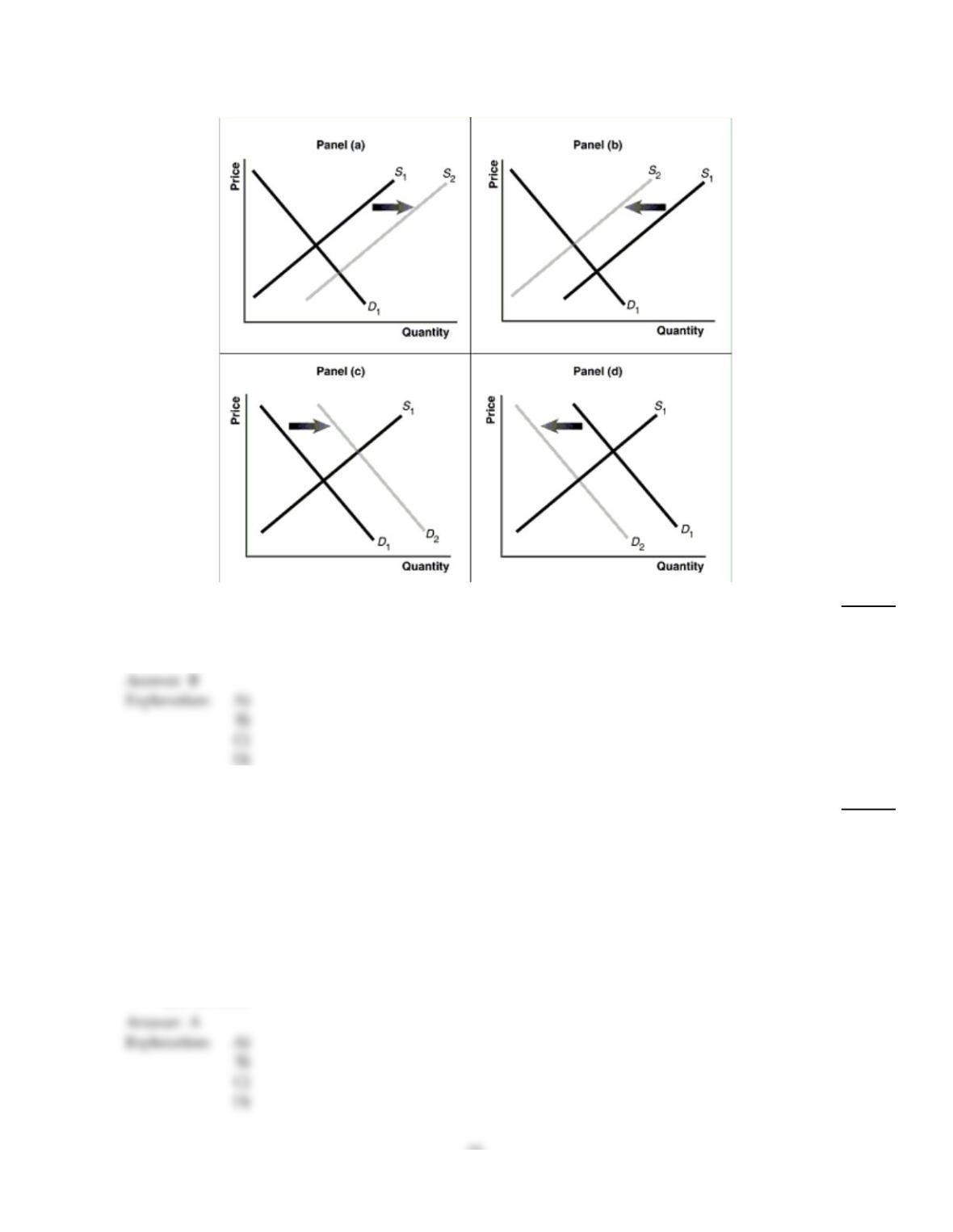
Figure 3-5
70)
Refer to Figure 3–5. Assume that the graphs in this figure represent the demand and supply curves
for women’s clothing. Which panel best describes what happens in this market when the wages of
seamstresses rise?
70)
A)
Panel (a)
B)
Panel (b)
C)
Panel (c)
D)
Panel (d)
71)
To compete with the iPod from Apple, Microsoft began marketing its own digital music player
called Zune. The textbook mentioned one strategy Microsoft could use to overcome the advantages
Apple has from selling the most popular brand of music player. What was this strategy?
71)
A)
Microsoft could try to sell Zune or downloaded songs at prices lower than those charged by
Apple.
B)
Microsoft is considering suing Apple for copyright infringement; Microsoft was the first
company to develop the technology used to produce digital music players.
C)
Microsoft could advertise Zune by sending emails to the many consumers who use the
company’s software.
D)
Microsoft could spend some of its large advertising budget to run television and magazine
ads for Zune.
25
72)
What is the difference between an “increase in supply” and an “increase in quantity supplied“?
72)
A)
An “increase in supply” means the supply curve has shifted to the right while an “increase in
quantity supplied” refers to a movement along a given supply curve in response to an
increase in price.
B)
There is no difference between the two terms; they both refer to a movement along a given
supply curve.
C)
An “increase in supply” means the supply curve has shifted to the right while an “increase in
quantity supplied” means at any given price supply has increased.
D)
There is no difference between the two terms; they both refer to a shift of the supply curve.
73)
If an increase in income leads to in an increase in the demand for peanut butter, then peanut butter
is
73)
A)
a neutral good.
B)
a normal good.
C)
a complement.
D)
a necessity.
B
74)
Which of the following would cause a decrease in the supply of milk?
74)
A)
an increase in the price of cookies (assuming that milk and cookies are complements)
B)
an increase the price of a product that producers sell instead of milk
C)
an increase in the number of firms that produce milk
D)
a decrease in the price of milk
B
75)
Which of the following would shift the supply curve for MP3 players to the right?
75)
A)
a decrease in the number of firms that produce MP3 players
B)
an increase in the price of a substitute in production
C)
an increase in consumer income (assuming that all MP3 players are normal goods)
D)
a decrease in the price of an input used to produce MP3 players
D
A

76)
“Because apples and oranges are substitutes, an increase in the price of oranges will cause the
demand for apples to increase. This initial shift in demand for apples results in a higher price for
apples; this higher price will cause the demand curve for apples to shift to the right.” Which of the
following correctly comments on this statement?
76)
A)
The statement is false because one cannot assume that apples and oranges are substitutes for
all consumers.
B)
The statement is false because oranges are inferior goods; apples are normal goods.
C)
The statement will be true, if consumer tastes for apples and oranges do not change.
D)
The statement is false because a change in the price of apples would not change the demand
for apples.
77)
Several studies have shown promising links between green tea consumption and cancer
prevention. How does this affect the market for green tea?
77)
A)
The green tea demand curve shifts to the left because this new information will increase the
price of green tea.
B)
The green tea supply curve shifts to the left because this new information will increase the
price of green tea.
C)
The green tea demand curve shifts to the right because of a change in tastes in favor of green
tea.
D)
The green tea supply curve shifts to the right because of a change in tastes in favor of green
tea.
C
78)
Farmers can plant either corn or soybeans in their fields. Which of the following would cause the
supply of soybeans to increase?
78)
A)
a decrease in the price of corn
B)
an increase in the demand for corn
C)
an increase in the price of soybeans
D)
an increase in the price of soybean seeds
A
79)
At a product’s equilibrium price
79)
A)
not all sellers who are willing to accept the price will find buyers for their products.
B)
anyone who needs the product will be able to buy the product, regardless of ability to pay.
C)
any buyer who is willing and able to pay the price will find a seller for the product.
D)
the federal government will provide the product to anyone who cannot afford it.
C
D
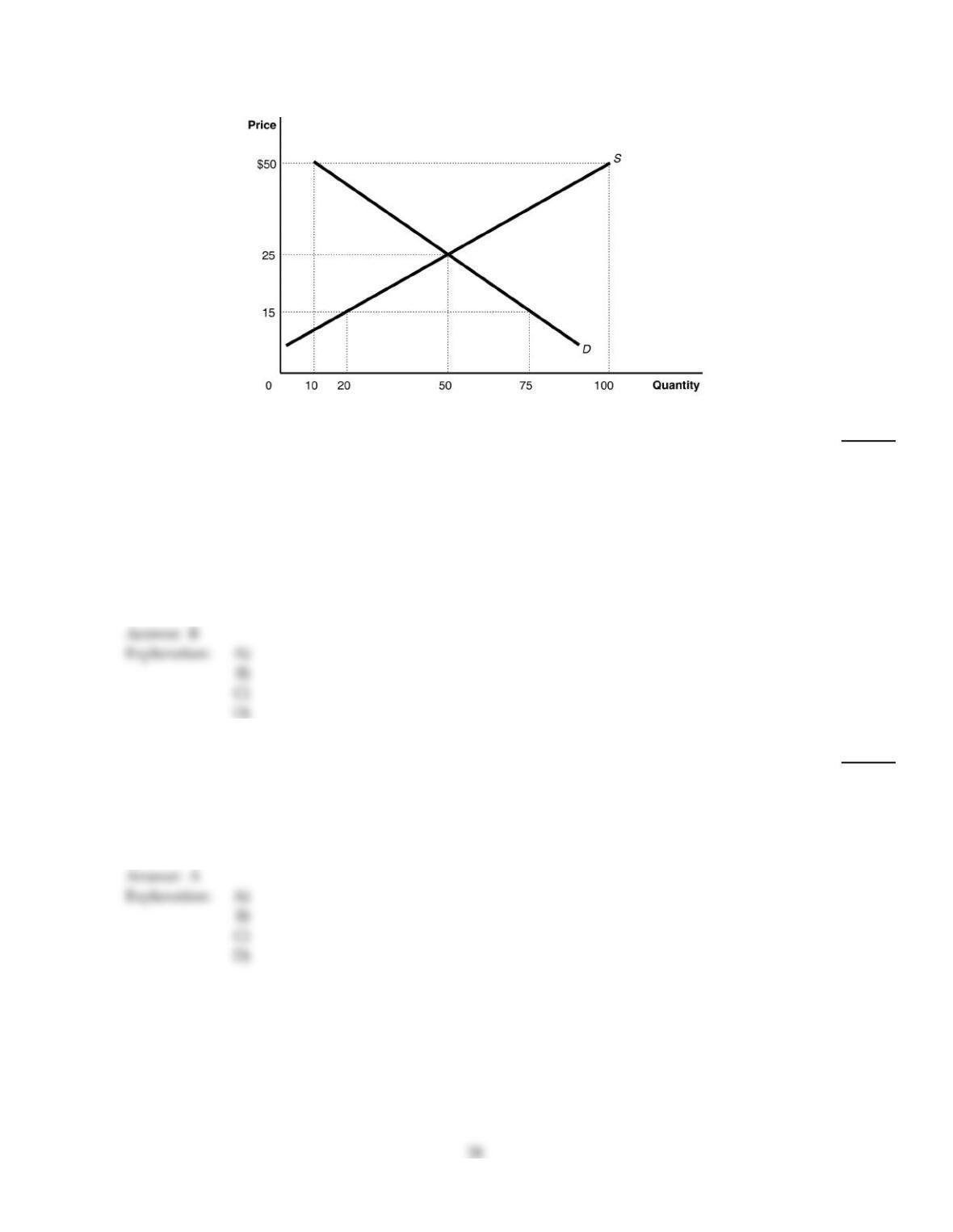
Figure 3–4
80)
Refer to Figure 3–4. The figure represents the market for canvas tote bags. Assume that the market
price is $35. Which of the following statement is true?
80)
A)
There is a surplus that will cause the price to increase; quantity demanded will then decrease
and quantity supplied will increase until the price equals $25.
B)
There is a surplus that will cause the price to decrease; quantity demanded will then increase
and quantity supplied will decrease until the price equals $25.
C)
There will be a surplus that will cause the price to decrease; demand will then increase and
supply will decrease until the price equals $25.
D)
There is a surplus that will cause the price to decrease; quantity supplied will then increase
and quantity demanded will decrease until the price equals $25.
81)
The demand for lobster is lower in the spring than in the summer. If the price of lobster is higher in
spring than in summer then
81)
A)
the supply of lobster is greater in summer than in spring.
B)
there are more substitutes for lobster in summer than there are in spring.
C)
there is a shortage of lobster in spring and a surplus of lobster in summer.
D)
consumers’ tastes for lobster are greater in spring than in summer.
82)
What is the difference between an “increase in demand” and an “increase in quantity demanded”?
82)
A)
An “increase in demand” is represented by a rightward shift of the demand curve while an
“increase in quantity demanded” is represented by a movement along a given demand curve.
B)
There is no difference between the two terms; they both refer to a shift of the demand curve.
C)
An “increase in demand” is represented by a movement along a given demand curve, while
an “increase in quantity demanded” is represented by a rightward shift of the demand curve.
D)
There is no difference between the two terms; they both refer to a movement downward
along a given demand curve.
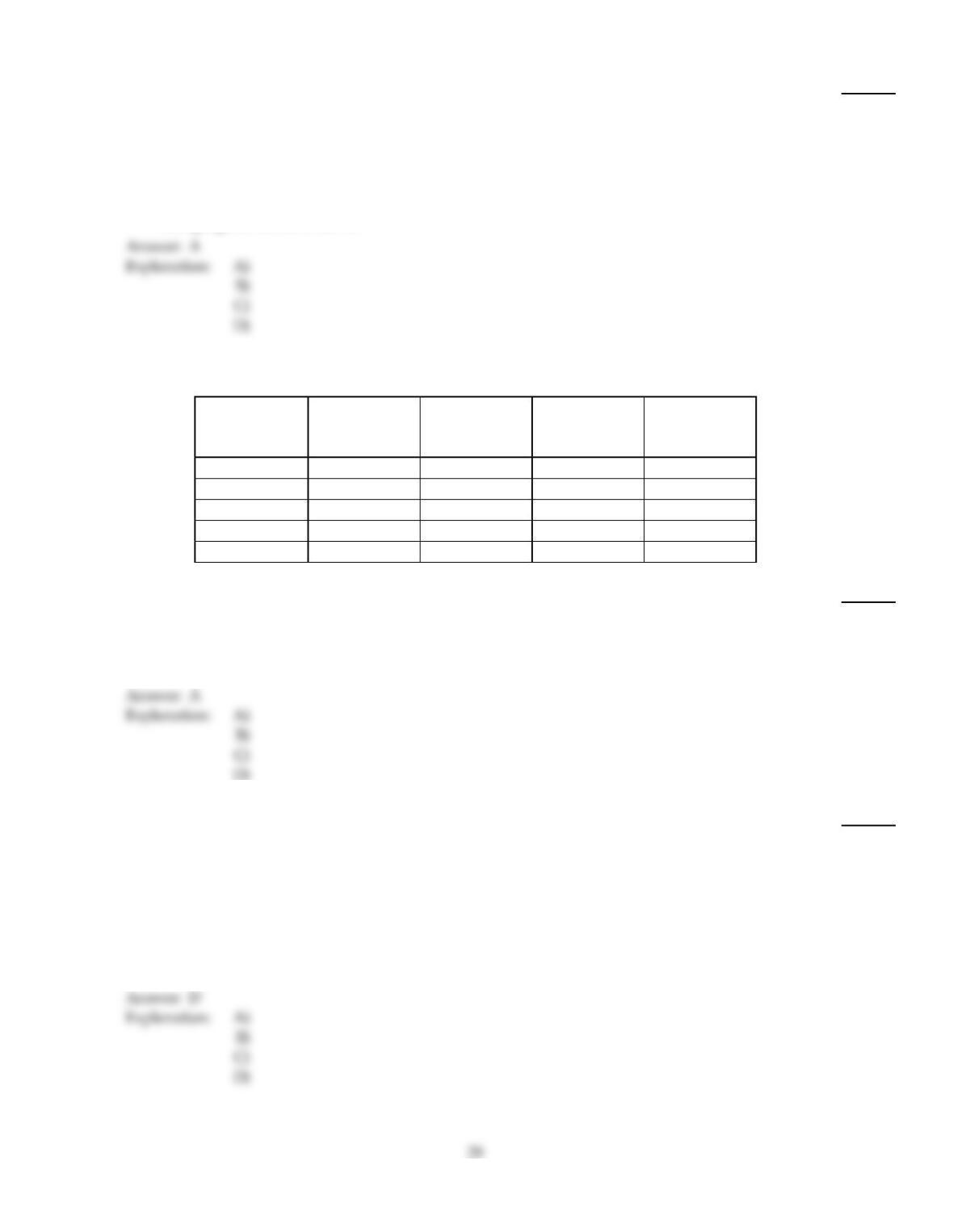
Table 3–1
Loose leaf Tea
Price per lb.
(dollars)
Sunil’s
Quantity
Demanded (lbs)
Mia’s
Quantity
Demanded (lbs)
Rest of Market
Quantity
Demanded (lbs)
Market
Quantity
demanded (lbs)
$8 4 0 30
6 7 2 40
5 9 3 51
412 564
315 890
83)
Refer to Table 3–1. The table above shows the demand schedules for loose–leaf tee of two
individuals (Sunil and Mia) and the rest of the market. If the price of loose–leaf tea rises from $3 to
$4 the market quantity demanded would
83)
A)
decrease by 32 pounds.
B)
increase by 32 pounds.
C)
decrease by 64 pounds.
D)
increase by 64 pounds.
84)
Select the phrase that correctly completed the following statement. “A positive change in
technology caused an increase in the supply of flat–screen televisions. As a result
84)
A)
the price of flat–screen televisions decreased. The lower price caused the supply of
flat–screen televisions to decrease.”
B)
the equilibrium quantity of flat–screen televisions decreased.”
C)
the price of flat–screen televisions decreased and the demand for flat–screen televisions
increased.”
D)
the price of flat–screen televisions decreased and the quantity demanded of flat–screen
televisions increased.“

85)
If in the market for oranges the supply has increased then
85)
A)
the supply curve for oranges has shifted to the right.
B)
there has been a movement downwards along the supply curve for oranges.
C)
there has been a movement upwards along the supply curve for oranges.
D)
the supply curve for oranges has shifted to the left.
86)
Buyers scrambled to secure stocks of Australian wool following a forecast of an 11 percent decline
in wool production. What happens in the Australian wool market as a result of this announcement?
86)
A)
The demand curve for Australian wool shifts to the right in anticipation of higher prices in the
future.
B)
The supply curve for Australian wool shifts to the right in anticipation of higher prices in the
future.
C)
The supply curve for Australian wool shifts to the left in anticipation of lower quantities in
the future.
D)
The demand curve for Australian wool shifts to the left in anticipation of higher prices in the
future.
A
A
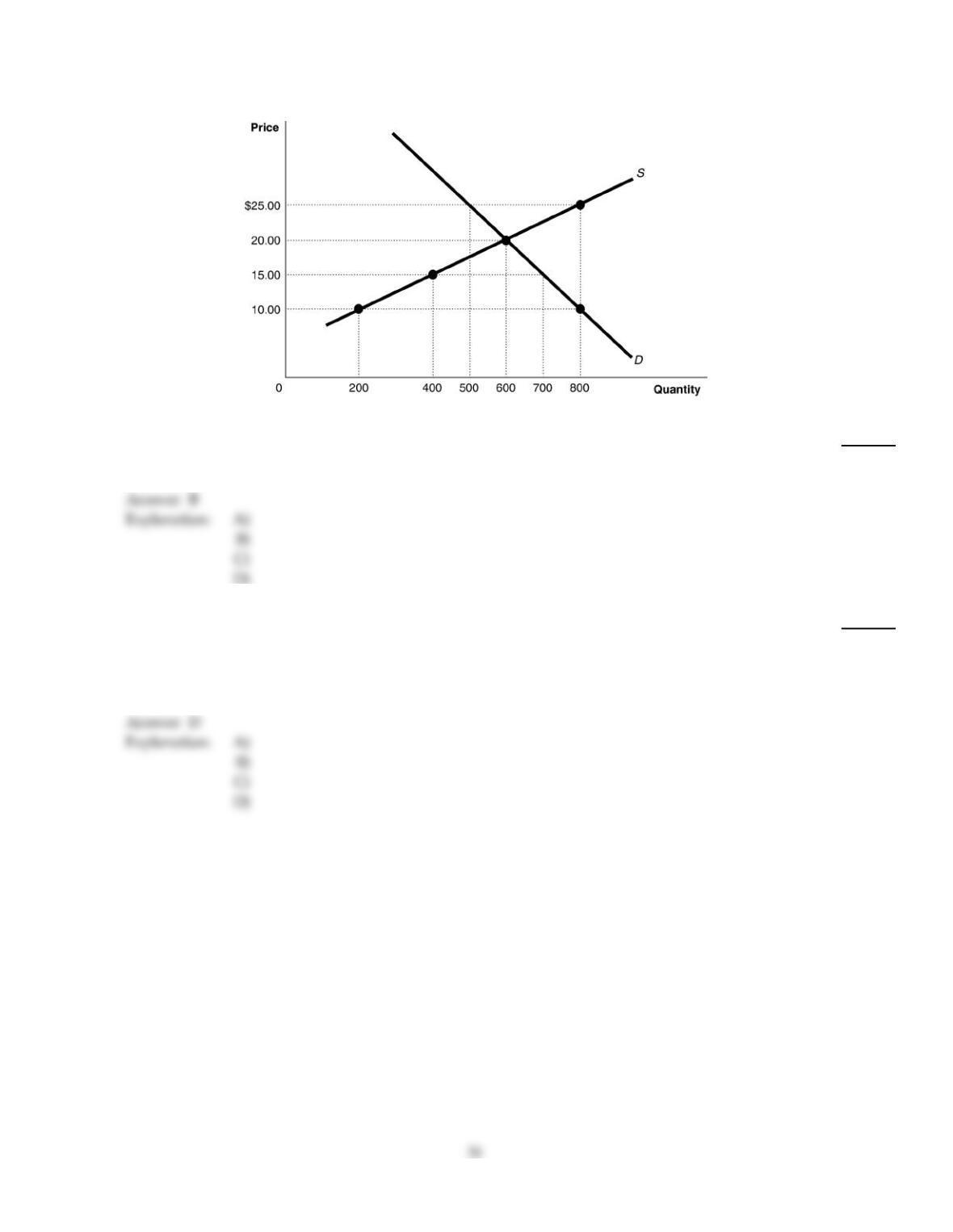
Figure 3-2
87)
Refer to Figure 3–2. If the price is $25,
87)
A)
there would be a shortage of 300 units
B)
there would be a surplus of 300 units.
C)
there would be a surplus of 200 units.
D)
there would be a shortage of 200 units.
88)
How does the increasing use of digital cameras affect the market for traditional camera film?
88)
A)
The supply curve for traditional camera film shifts to the left.
B)
The demand curve for traditional camera film shifts to the right.
C)
The supply curve for traditional camera film shifts to the right.
D)
The demand curve for traditional camera film shifts to the left.
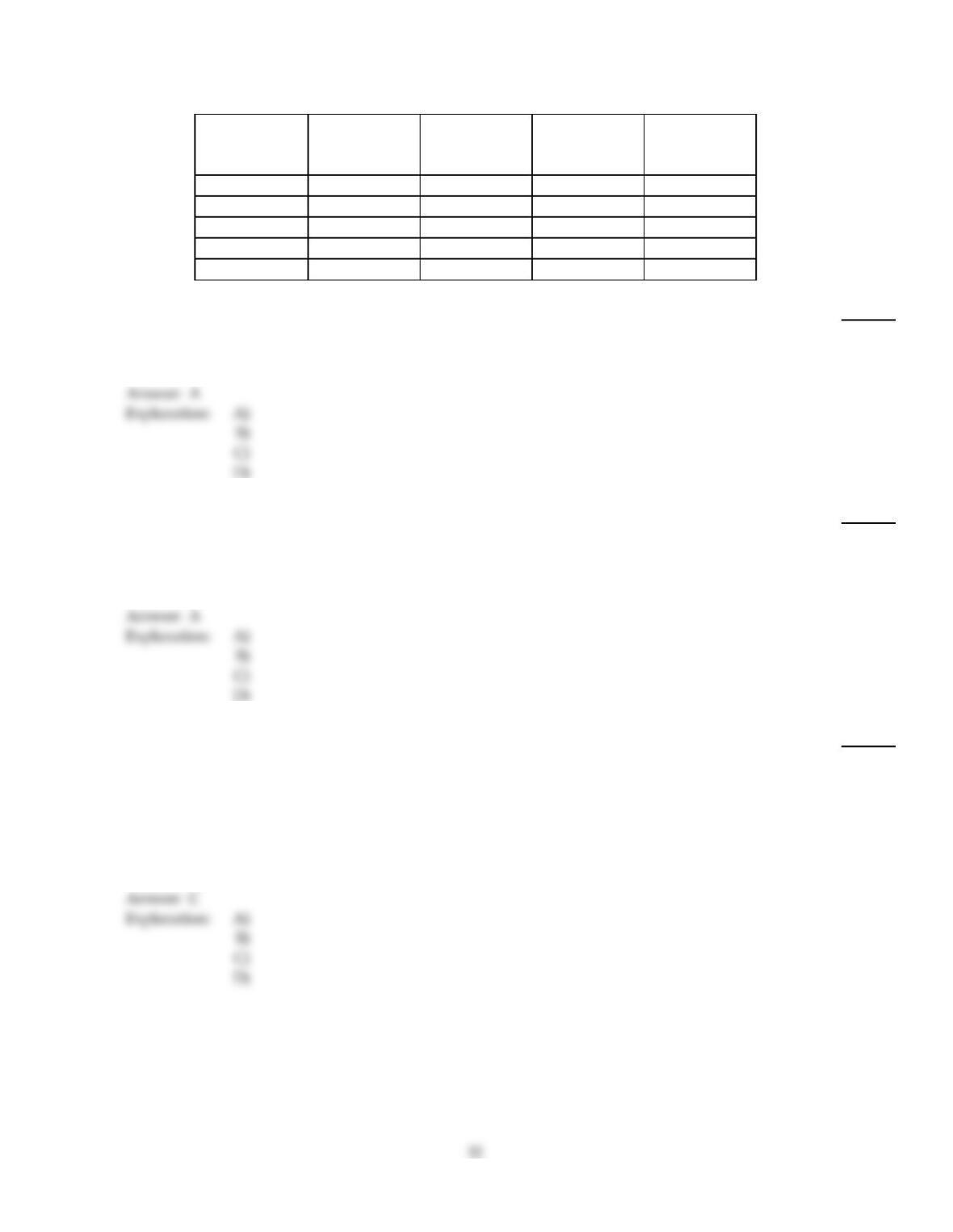
Table 3–1
Loose leaf Tea
Price per lb.
(dollars)
Sunil’s
Quantity
Demanded (lbs)
Mia’s
Quantity
Demanded (lbs)
Rest of Market
Quantity
Demanded (lbs)
Market
Quantity
demanded (lbs)
$8 4 0 30
6 7 2 40
5 9 3 51
412 564
315 890
89)
Refer to Table 3–1. The table above shows the demand schedules for loose–leaf tea of two
individuals (Sunil and Mia) and the rest of the market. At a price of $5, the quantity demanded in
the market would be
89)
A)
63 lbs.
B)
146 lbs.
C)
51 lbs.
D)
76 lbs.
90)
If the price of automobiles were to increase, then
90)
A)
the demand for gasoline would decrease.
B)
the supply of gasoline would increase.
C)
the demand for gasoline would increase.
D)
the quantity demanded of gasoline would decrease.
91)
Auctions in recent years have resulted in higher prices paid for letters written by John Wilkes Booth
than those written by Abraham Lincoln. What is a reason for this difference in price?
91)
A)
Many people are more fascinated by villains and anti–heroes than by heroic figures.
B)
Booth was a well–known actor; the demand for his letters rose as wealthy actors attempted to
buy them.
C)
There are more letters written by Lincoln available for collectors to buy than there are letters
written by Booth.
D)
There is a surplus of letters written by Booth and a shortage of letters written by Lincoln.