
Chapter 3 — Consolidated Statements: Subsequent to Acquisition
MULTIPLE CHOICE
1. Pedro purchased 100% of the common stock of the Sanburn Company on
January 1, 20X1, for $500,000. On that date, the stockholders’ equity
of Sanburn Company was $380,000. On the purchase date, inventory of
Sanburn Company, which was sold during 20X1, was understated by
$20,000. Any remaining excess of cost over book value is attributable
to patent with a 20-year life. The reported income and dividends paid
by Sanburn Company were as follows:
20X1 20X2
Net income…………………….. $80,000 $90,000
Dividends paid…………………. 10,000 10,000
Using the simple equity method, which of the following amounts are
correct?
Investment Income Investment Account Balance
20X1 December 31, 20X1
a.
$80,000 $570,000
b.
$70,000 $570,000
c.
$70,000 $550,000
d.
$80,000 $550,000
2. Pedro purchased 100% of the common stock of the Sanburn Company on
January 1, 20X1, for $500,000. On that date, the stockholders’ equity
of Sanburn Company was $380,000. On the purchase date, inventory of
Sanburn Company, which was sold during 20X1, was understated by
$20,000. Any remaining excess of cost over book value is attributable
to patent with a 20-year life. The reported income and dividends paid
by Sanburn Company were as follows:
20X1 20X2
Net income…………………….. $80,000 $90,000
Dividends paid…………………. 10,000 10,000
Using the sophisticated (full) equity method, which of the following
amounts are correct?
Investment Income Investment Account Balance
20X1 December 31, 20X1
a.
$55,000 $555,000
b.
$55,000 $545,000
c.
$75,000 $565,000
d.
$80,000 $570,000

3. Pedro purchased 100% of the common stock of the Sanburn Company on
January 1, 20X1, for $500,000. On that date, the stockholders’ equity
of Sanburn Company was $380,000. On the purchase date, inventory of
Sanburn Company, which was sold during 20X1, was understated by
$20,000. Any remaining excess of cost over book value is attributable
to patent with a 20-year life. The reported income and dividends paid
by Sanburn Company were as follows:
20X1 20X2
Net income…………………….. $80,000 $90,000
Dividends paid…………………. 10,000 10,000
Using the cost method, which of the following amounts are correct?
Investment Income Investment Account Balance
20X1 December 31, 20X1
a.
$10,000 $500,000
b.
$10,000 $570,000
c.
$0 $570,000
d.
$80,000 $500,000
4. What is the effect if an unconsolidated subsidiary is accounted for by
the equity method but consolidated statements are being prepared for
the parent company and other subsidiaries?
a.
All of the unconsolidated subsidiary’s accounts will be included
individually in the consolidated statements.
b.
The consolidated retained earnings will not reflect the earnings
of the unconsolidated subsidiary.
c.
The consolidated retained earnings will be the same as if the
subsidiary had been included in the consolidation.
d.
Dividend revenue from the unconsolidated subsidiary will be
reflected in consolidated net income.

Chapter 3
5. On January 1, 20X1, Promo, Inc. purchased 70% of Set Corporation for
$469,000. On that date the book value of the net assets of Set totaled
$500,000. Based on the appraisal done at the time of the purchase, all
assets and liabilities had book values equal to their fair values
except as follows:
Book Value Fair Value
Inventory……………………… $100,000 $120,000
Land …………………………. 75,000 85,000
Equipment (useful life 4 years)….. 125,000 165,000
The $70,000 of excess of cost over book value was allocated to a patent
with a 10-year useful life.
During 20X1 Promo reported net income of $200,000 and Set had net
income of $100,000.
What is consolidated net income if Promo includes in its net income,
income from Set using the sophisticated equity method?
a.
$42,000
b.
$70,000
c.
$200,000
d.
$270,000
6. On January 1, 20X1, Promo, Inc. purchased 70% of Set Corporation for
$469,000. On that date the book value of the net assets of Set totaled
$500,000. Based on the appraisal done at the time of the purchase, all
assets and liabilities had book values equal to their fair values
except as follows:
Book Value Fair Value
Inventory……………………… $100,000 $120,000
Land …………………………. 75,000 85,000
Equipment (useful life 4 years)….. 125,000 165,000
The $70,000 of excess of cost over book value was allocated to a patent
with a 10-year useful life.
During 20X1 Promo reported net income of $200,000 and Set had net
income of $100,000.
What income from subsidiary did Promo include in its net income if
Promo uses the simple equity method?
a.
$33,000
b.
$42,000
c.
$70,000
d.
$100,000

Chapter 3
7. On January 1, 20X1, Promo, Inc. purchased 70% of Set Corporation for
$469,000. On that date the book value of the net assets of Set totaled
$500,000. Based on the appraisal done at the time of the purchase, all
assets and liabilities had book values equal to their fair values
except as follows:
Book Value Fair Value
Inventory……………………… $100,000 $120,000
Land …………………………. 75,000 85,000
Equipment (useful life 4 years)….. 125,000 165,000
The $70,000 of excess of cost over book value was allocated to a patent
with a 10-year useful life.
During 20X1 Promo reported net income of $200,000 and Set had net
income of $100,000.
What income from subsidiary did Promo include in its net income if
Promo uses the sophisticated equity method?
a.
$33,000
b.
$42,000
c.
$70,000
d.
$100,000
8. On January 1, 20X1, Rabb Corp. purchased 80% of Sunny Corp.’s $10 par
common stock for $975,000. On this date, the carrying amount of Sunny’s
net assets was $1,000,000. The fair values of Sunny’s identifiable
assets and liabilities were the same as their carrying amounts except
for plant assets (net), which were $100,000 in excess of the carrying
amount.
In the January 1, 20X1, consolidated balance sheet, goodwill should be
reported at _______.
a.
$0
b.
$75,000
c.
$95,000
d.
$175,000
9. Which of the following statements applying to the use of the equity
method versus the cost method is true?
a.
The equity method is required when one firm owns 20% or more of
the common stock of another firm.
b.
If no dividends were paid by the subsidiary, the investment
account would have the same balance under both methods.
c.
The method used has no significance to consolidated statements.
d.
An advantage of the equity method is that no amortization of
excess adjustments needs to be made on the consolidated work
sheet.

Chapter 3
10. In consolidated financial statements it is expected that:
a.
Dividends declared equals the sum of the total parent company’s
declared dividends and the total subsidiary’s declared dividends.
b.
Retained Earnings equals the sum of the controlling interest’s
separate retained earnings and the noncontrolling interest’s
separate retained earnings.
c.
Common Stock equals the sum of the parent company’s outstanding
shares and the subsidiary’s outstanding shares.
d.
Net Income equals the sum of the income distributed to the
controlling interest and the income distributed to the
noncontrolling interest.
11. How is the portion of consolidated earnings to be assigned to
noncontrolling interest in consolidated financial statements
determined?
a.
The net income of the parent is subtracted from the subsidiary’s
net income to determine the noncontrolling interest.
b.
The subsidiary’s net income is extended to the noncontrolling
interest.
c.
The amount of the subsidiary’s earnings recognized for
consolidation purposes is multiplied by the noncontrolling’s
percentage ownership.
d.
The amount of consolidated earnings determined on the consolidated
working papers is multiplied by the noncontrolling interest
percentage at the balance-sheet date.
12. Patti Corp. has several subsidiaries (Aeta, Beta, and Gaeta) that are
included in its consolidated financial statements. In its 12/31/X1
separate balance sheet, Patti had the following intercompany balances
before eliminations:
Debit Credit
Current Receivable due from Aeta….. $ 40,000
Noncurrent Receivable due from Beta… 100,000
Cash Advance to Beta……………… 26,000
Cash Advance from Gaeta…………… 75,000
Intercompany Payable to Gaeta……… 40,000
In its 12/31/X1 consolidated balance sheet, what amount should Patti
report as intercompany receivables?
a.
$166,000
b.
$51,000
c.
$26,000
d.
$0

Chapter 3
3-6
________________________________________________________________
Pawnee Company Scenario
Balance sheet information for Pawnee Company and its 90% owned
subsidiary, Sioux Corporation, at December 31, 20X1 is summarized as
follows:
Pawnee Sioux
Current assets-net……………… $ 200,000 $ 50,000
Property, plant, and equipment-net.. 1,000,000 600,000
Investment in Sioux…………….. 558,000
$1,758,000 $650,000
========== ========
Current liabilities…………….. $ 100,000 $ 30,000
Capital stock………………….. 800,000 400,000
Retained earnings………………. 858,000 220,000
$1,758,000 $650,000
========== ========
Pawnee acquired its interest in Sioux for cash at book value several
years ago when Sioux’s assets and liabilities were equal to their fair
values.
13. Refer to the Pawnee Company Scenario. Consolidated total assets of
Pawnee and Sioux at December 31, 20X1 will be _______.
a.
$1,785,000
b.
$1,850,000
c.
$2,343,000
d.
$2,408,000
14. Refer to the Pawnee Company Scenario. The consolidated balance sheet of
Pawnee and Sioux at December 31, 20X1 will show
a.
Investment in Sioux, $558,000.
b.
Capital stock, $800,000.
c.
Retained earnings, $1,078,000.
d.
Noncontrolling interest, $65,000.
15. Pahl Corporation owns a 60% interest in Sauer Corporation, acquired at
book value equal to fair value at the beginning of 20X1. On December
20, 20X1 Sauer declares dividends of $80,000, and the dividends remain
unpaid at year end. Pahl has not recorded the dividends receivable at
December 31. A consolidated working paper entry is necessary to
a.
Enter the $80,000 dividends receivable in the consolidated balance
sheet.
b.
Enter $48,000 dividends receivable in the consolidated balance
sheet.
c.
Reduce the dividend payable account to $32,000 in the consolidated
balance sheet.
d.
Eliminate the dividend payable account in the consolidated balance

Chapter 3
3-7
sheet.
16. If the investment in subsidiary account is increased or decreased by
the amount determined by the following calculation:
Parent ownership percentage x (current balance in the subsidiary’s
retained earnings minus the subsidiary’s retained earnings balance on
the date of acquisition) the investment account is being converted from
a.
cost to simple equity.
b.
cost to sophisticated equity.
c.
simple equity to sophisticated equity.
d.
simple equity to cost.
17. On January 1, 20X1, Payne Corp. purchased 70% of Shayne Corp.’s $10 par
common stock for $900,000. On this date, the carrying amount of
Shayne’s net assets was $1,000,000. The fair values of Shayne’s
identifiable assets and liabilities were the same as their carrying
amounts except for plant assets (net), which were $200,000 in excess of
the carrying amount. For the year ended December 31, 20X1, Shayne had
net income of $150,000 and paid cash dividends totaling $90,000. Excess
attributable to plant assets is amortized over 10 years.
In the December 31, 20X1, consolidated balance sheet, noncontrolling
interest should be reported at _______.
a.
$282,500
b.
$300,500
c.
$318,000
d.
$345,000
18. Alpha purchased an 80% interest in Beta on June 30, 20X1. Both Alpha’s
and Beta’s reporting periods end December 31. Which of the following
represents the controlling interest in consolidated net income for
20X1?
a.
100% of Alpha’s July 1-December 31 income plus 80% of Beta’s
July 1-December 31 income
b.
100% of Alpha’s July 1-December 31 income plus 100% of Beta’s
July 1-December 31 income
c.
100% of Alpha’s January 1-December 31 income plus 80% of Beta’s
July 1-December 31 income
d.
100% of Alpha’s January 1-December 31 income plus 80% of Beta’s
January 1-December 31 income
19. In a mid-year purchase when the subsidiary’s books are not closed until
the end of the year, the purchased income account contains the parent’s
share of the

Chapter 3
3-8
a.
subsidiary’s income earned for the entire year.
b.
subsidiary’s income earned from the beginning of the year to the
date of acquisition.
c.
subsidiary’s income earned from the date of acquisition to the end
of the year.
d.
Consolidated Net Income.
20. On January 1, 20X1, Piston, Inc. acquired Spur Corp. While recording
the acquisition Piston established a deferred tax liability. It is most
likely that this account was created because
a.
the transaction was a tax-free
exchange to Piston.
c.
the transaction was a tax-free
exchange to Spur.
b.
Piston had not paid all of the
income taxes due the government
when acquiring Spur.
d.
Spur had not paid all of the
income taxes due the government
prior to the acquisition by
Piston.
PROBLEM
1. On January 1, 20X1, Parent Company purchased 80% of the common stock of
Subsidiary Company for $316,000. On this date, Subsidiary had common
stock, other paid–in capital, and retained earnings of $40,000,
$120,000, and $190,000, respectively. Net income and dividends for 2
years for Subsidiary Company were as follows:
20X1 20X2
Net income…………………………… $50,000 $90,000
Dividends……………………………. 10,000 20,000
On January 1, 20X1, the only tangible assets of Subsidiary which were
undervalued were inventory and building. Inventory, for which FIFO is
used, was worth $5,000 more than cost. The inventory was sold in 20X1.
Building, which was worth $15,000 more than book value, has a remaining
life of 8 years, and straight-line depreciation is used. Patent, if
any, is to be amortized over 10 years.
Required:
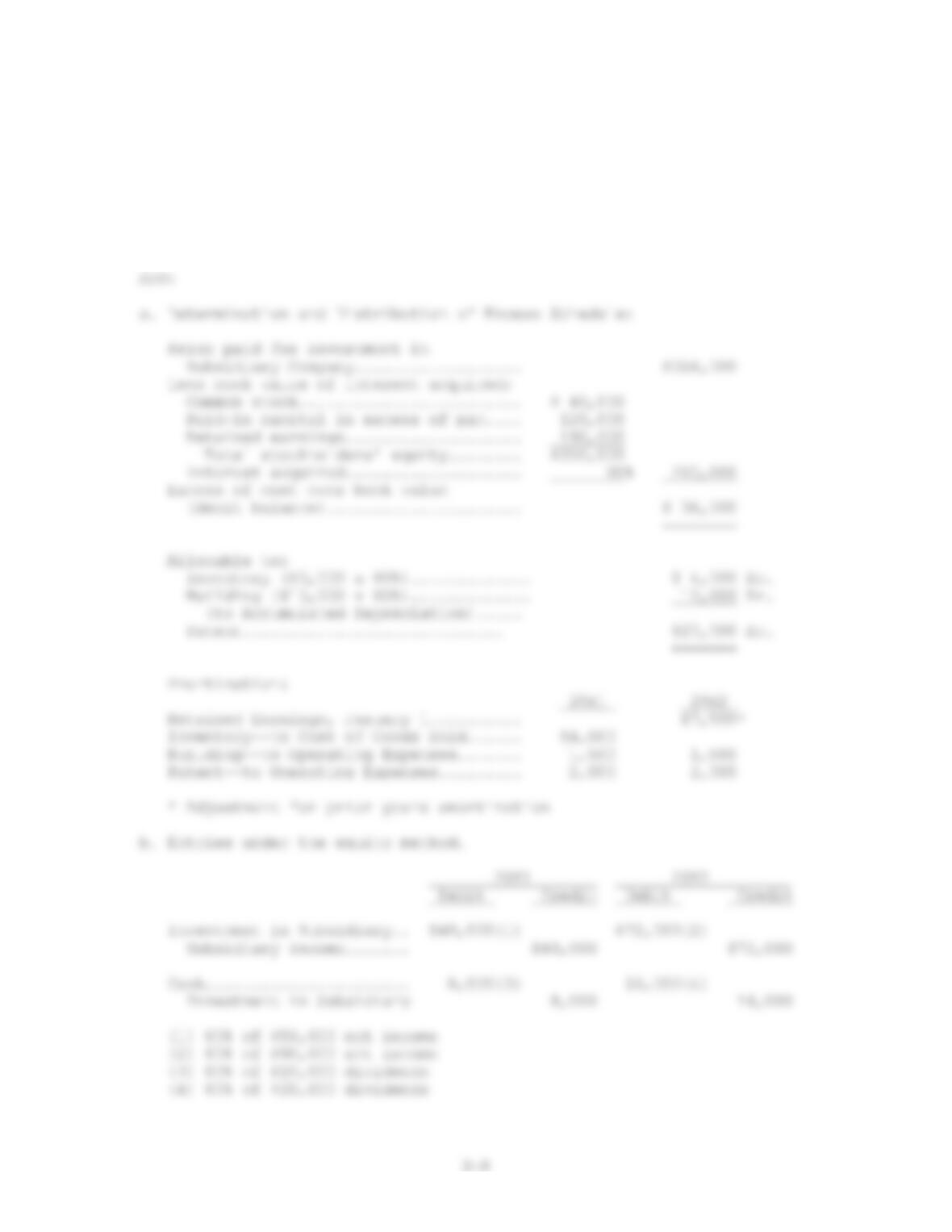
a.
Using the information above or on the separate worksheet,
prepare a determination and distribution of excess schedule.
Use the parent company concept (pro–rata fair value approach)
in any write-up of assets.
b.
Parent Company carries the Investment in Subsidiary Company
under the simple equity method. In general journal form,
record the entries that would be made to apply the equity
method in 20X1 and 20X2.
Chapter 3
c.
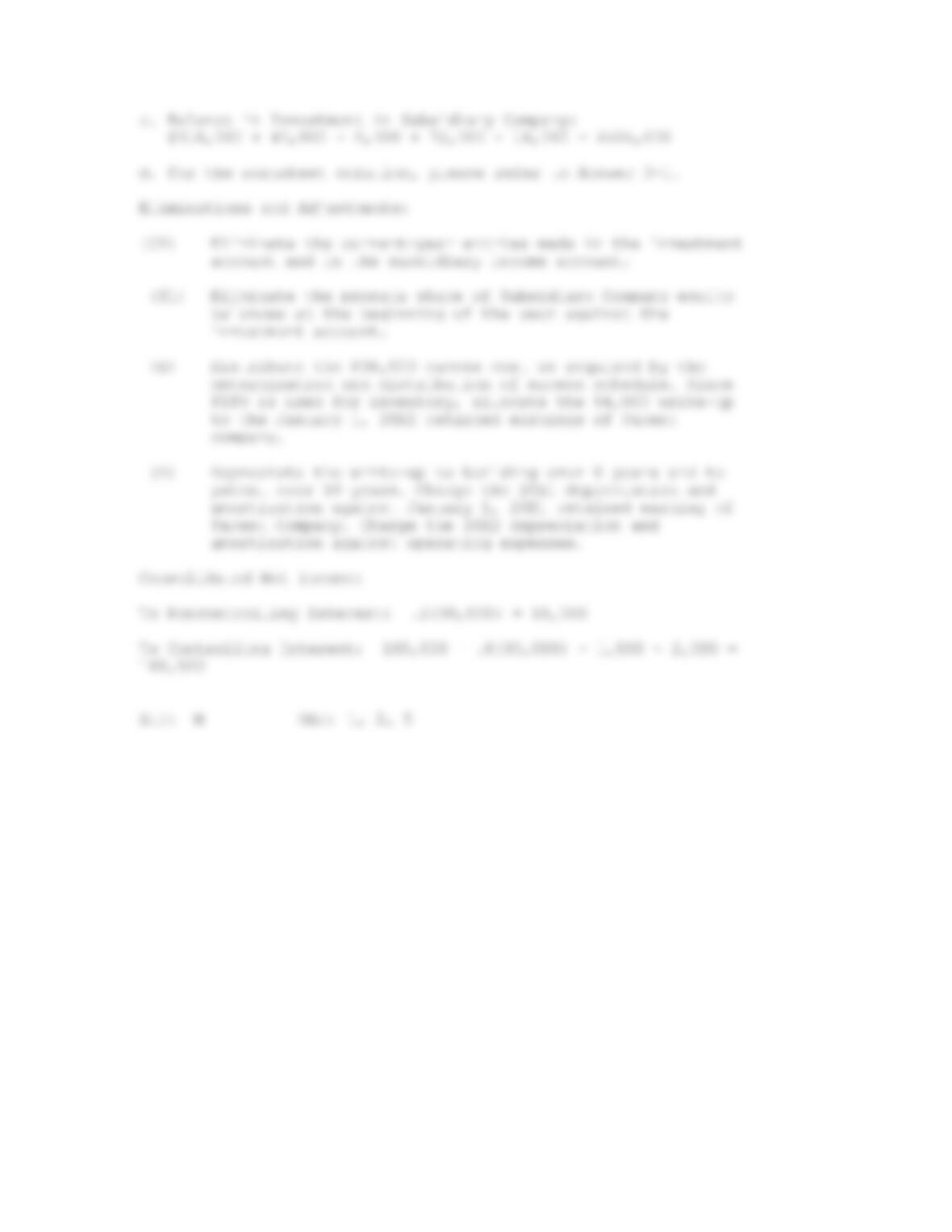
Compute the balance which should appear in Investment in
Subsidiary Company and in Subsidiary Income on December 31,
20X2 (the second year). Fill in these amounts on Parent
Company’s trial balance for 20X2.
d.
Complete the Figure 3-1 worksheet for consolidated financial
statements for 20X2.
Chapter 3
3-10
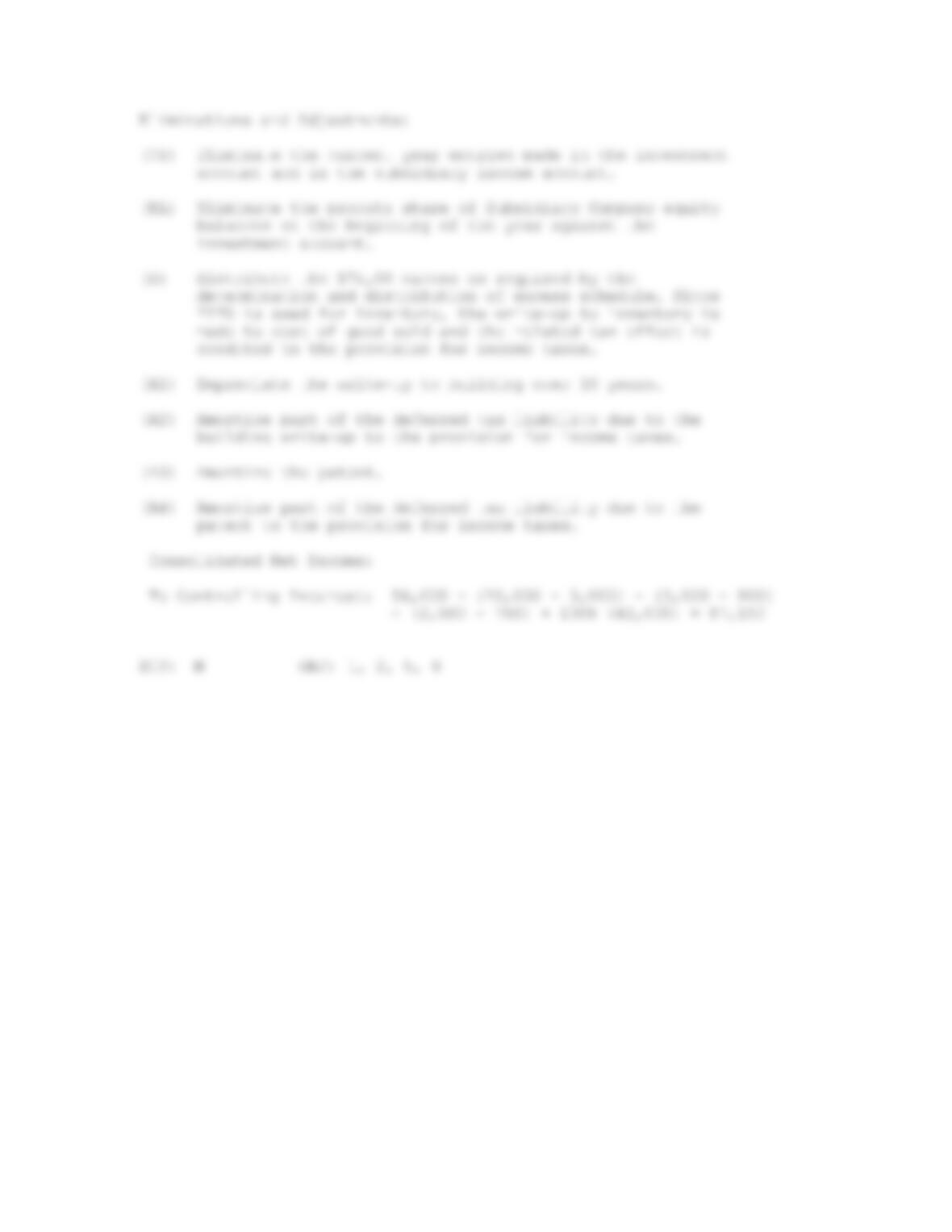
2. On January 1, 20X1, Pepper Company purchased 100% of the common stock
of Salt Company for $360,000. On this date, Salt had common stock,
other paid-in capital, and retained earnings of $50,000, $100,000 and
$150,000 respectively. Net income and dividends for two years for Salt
Company were:
20X1 20X2
Net income……………………………. $60,000 $90,000
Dividends…………………………….. 20,000 30,000
On January 1, 20X1, the only tangible assets of Salt which were
undervalued were inventory and building. Inventory, for which FIFO is
used, was worth $10,000 more than cost. The inventory was sold in 20X1.
Buildings had a fair value of $320,000, a remaining life of 10 years
and straight-line depreciation is used. The book value of the land and
building are $50,000 and $260,000 respectively. Patent, if any, is to
be amortized over 10 years.
Pepper uses the simple equity method in accounting for its Investment
in Salt Company.
Chapter 3
Required:
a.
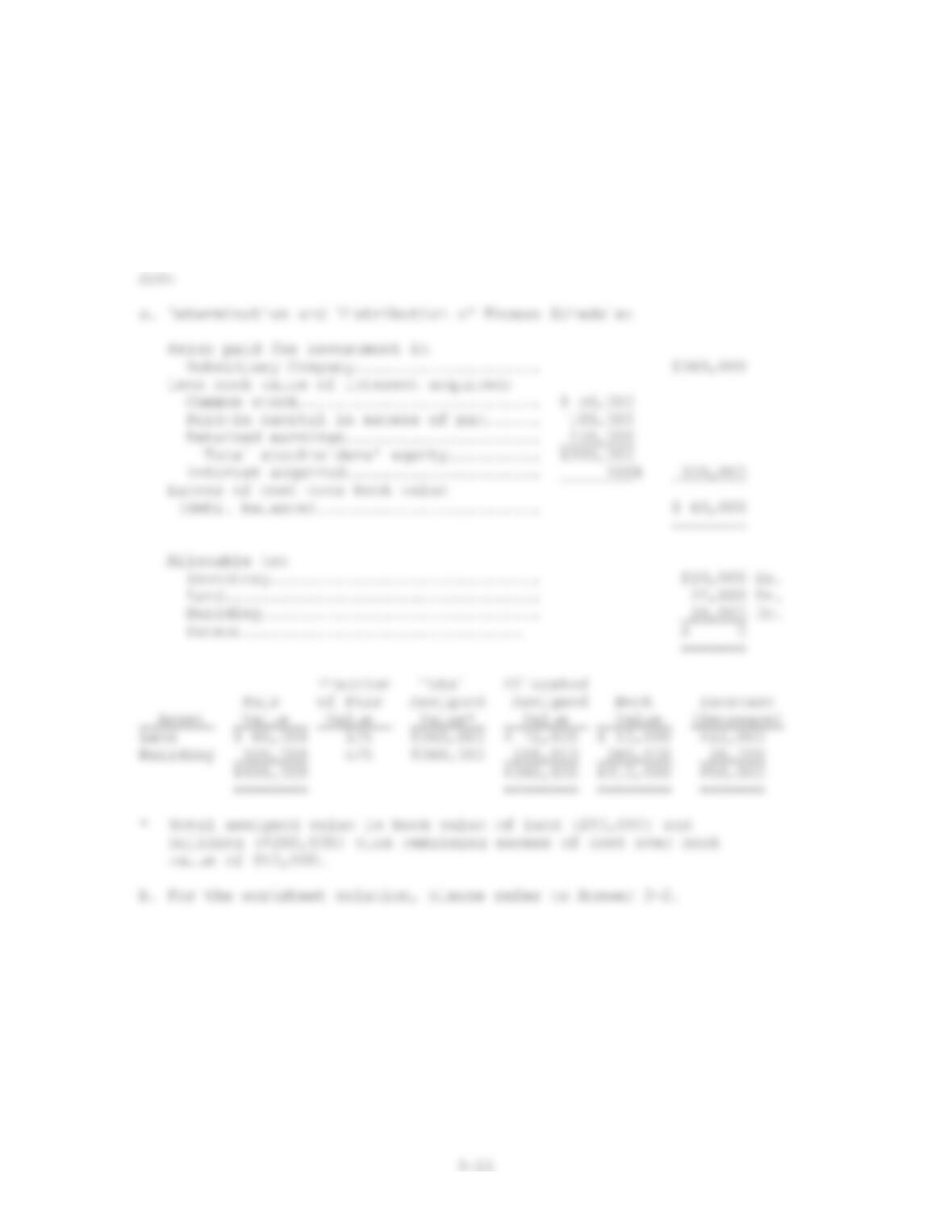
Using the information above or on the separate worksheet,
prepare a determination and distribution of excess schedule.
b.
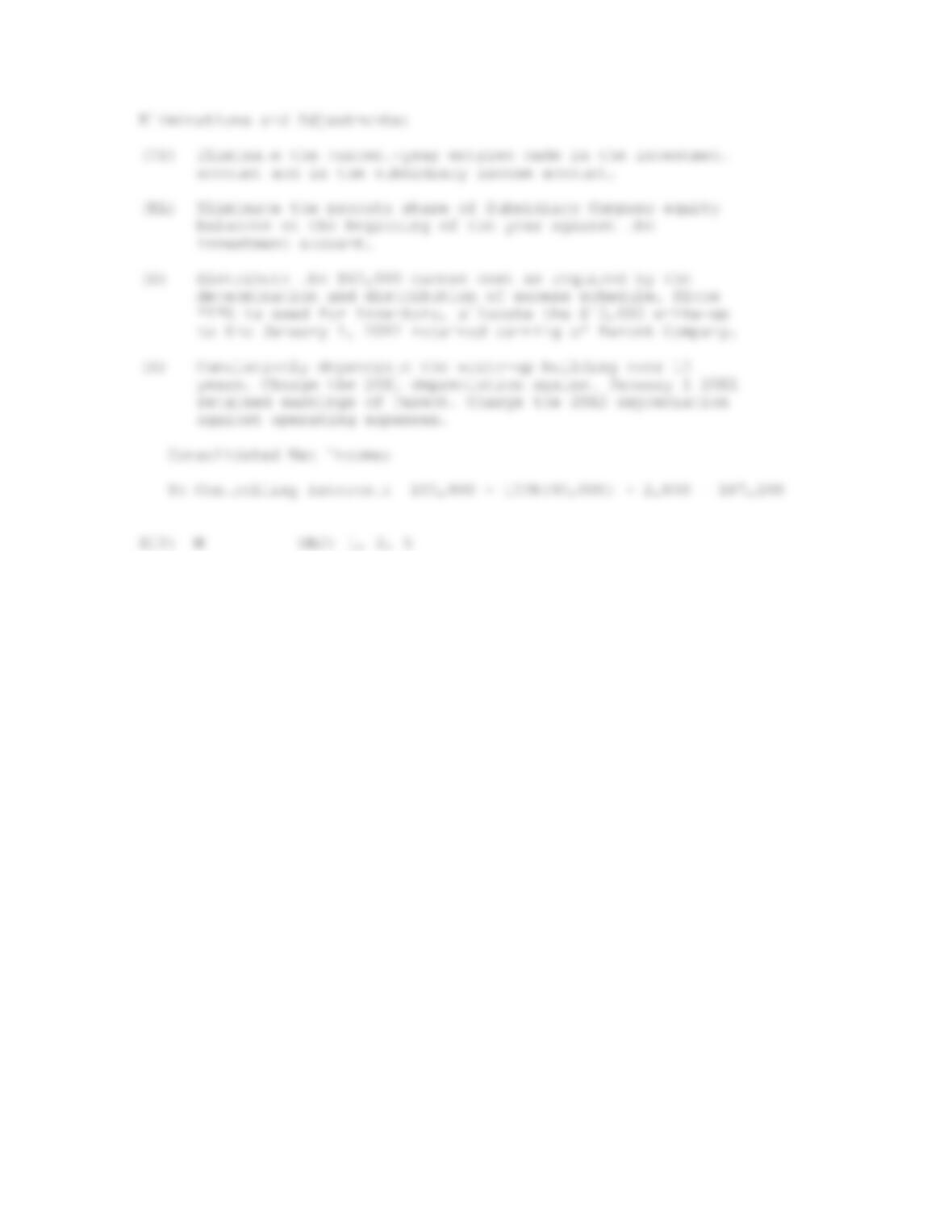
Complete the Figure 3-2 worksheet for consolidated financial
statements for 20X2.
Chapter 3
3-12
3. On January 1, 20X1, Parent Company acquired 100% of the common stock of
Subsidiary Company for a cost of $294,000 in a tax-free combination. On
this date, Subsidiary had total owner’s equity of $220,000. The excess
of cost over book value is due to the undervaluation of inventory,
other long-term investments, equipment, and patent.
The inventory is worth $10,000 more than book value and FIFO is used.
The inventory was sold during 20X1. The other long-term investments of
Subsidiary are worth $20,000 more than book value and are carried under
the cost method. The equipment is worth $30,000 more than book value,
has a remaining useful life of 10 years, with no salvage value, and
straight-line depreciation is used. The patent is to be amortized over
20 years. The corporate tax rate is 30%.
During 20X1, Subsidiary had net income after taxes of $42,000 and in
December, paid dividends of $20,000. As a result, the appropriate
entries were made on Parent’s books under the equity method.
Required:
a.
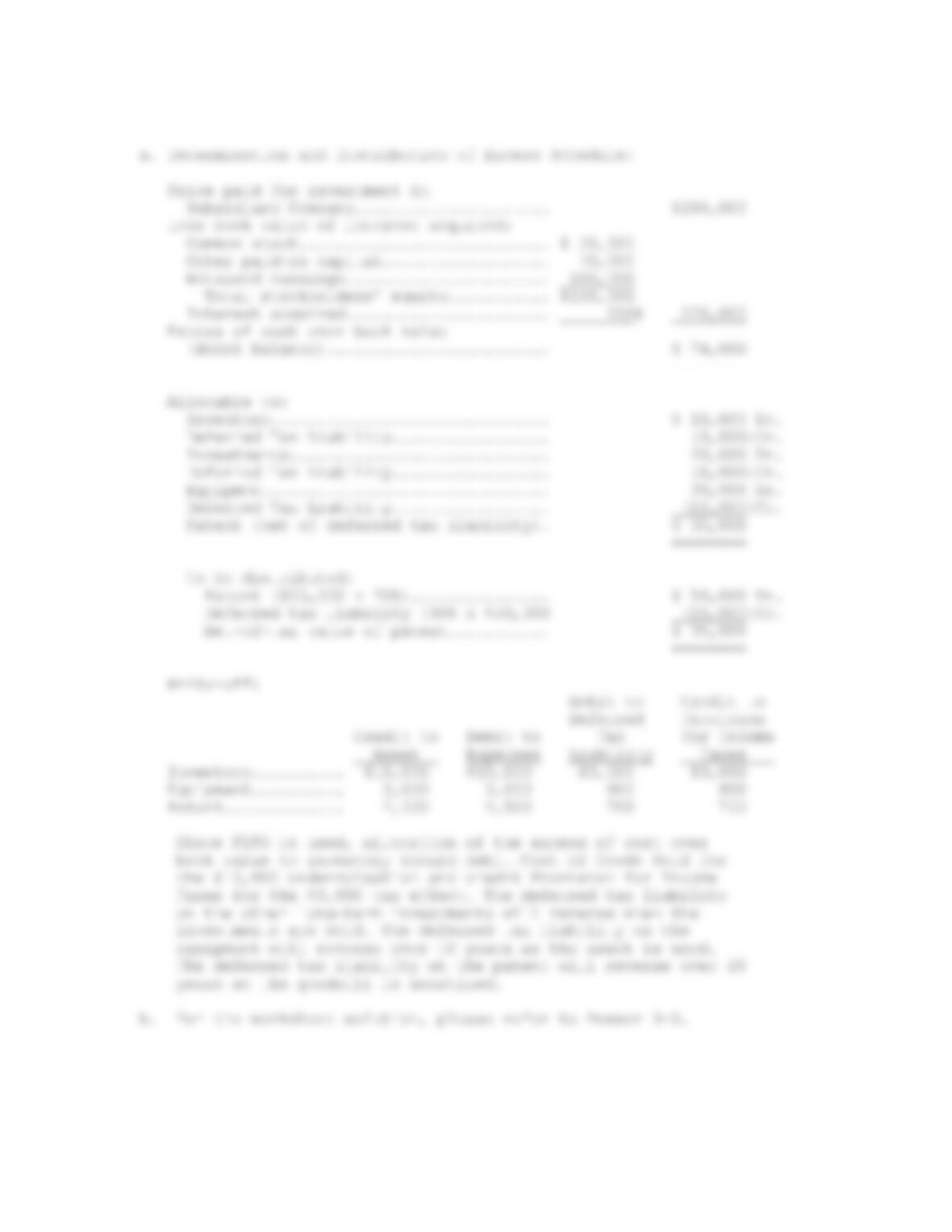
Prepare a schedule to determine and distribute the excess of
cost over book value to assets and to related deferred taxes.
Include computations for the write off of the asset increases
and the related tax effect.
b.
Complete the worksheet in Figure 3-3 for consolidated
financial statements for 20X1.
Chapter 3
3-13
ANS:
Chapter 3
3-14
4. On January 1, 20X1, Port Company purchased 80% of the common stock of
Star Company for $400,000. On this date, Star had common stock, other
paid-in capital, and retained earnings of $10,000, $140,000 and
$200,000 respectively. Net income and dividends for two years for Star
Company were:
20X1 20X2
Net income…………………………… $50,000 $90,000
Dividends……………………………. 10,000 30,000
On January 1, 20X1, the only tangible assets of Star which were
undervalued were inventory and building. Inventory, for which FIFO is
used, was worth $10,000 more than cost. The inventory was sold in 20X1.
Building, which was worth $27,500 more than book value, has a remaining
life of 10 years, and straight-line depreciation is used. Patent, if
any, is to be amortized over 10 years.
Chapter 3
Required:
a.
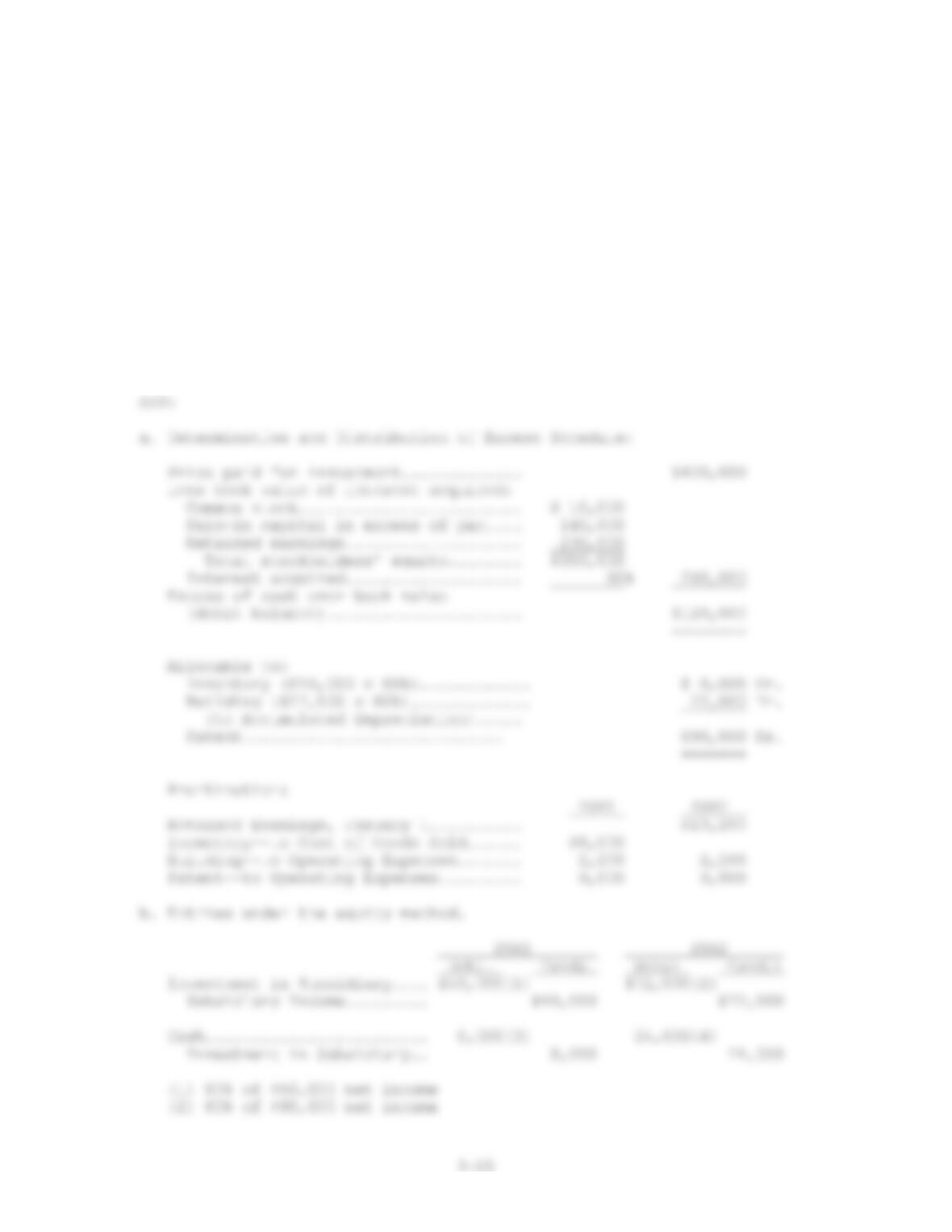
From the information above or on the separate vertical-form
worksheet, prepare a determination and distribution of excess
schedule. Use the parent company concept (pro rata fair value
approach) in any write-up of assets.
b.
Port Company carries the Investment in Star Company under the
simple equity method. In general journal form, record the
entries that would be made to apply the equity method in 20X1
and 20X2.
c.
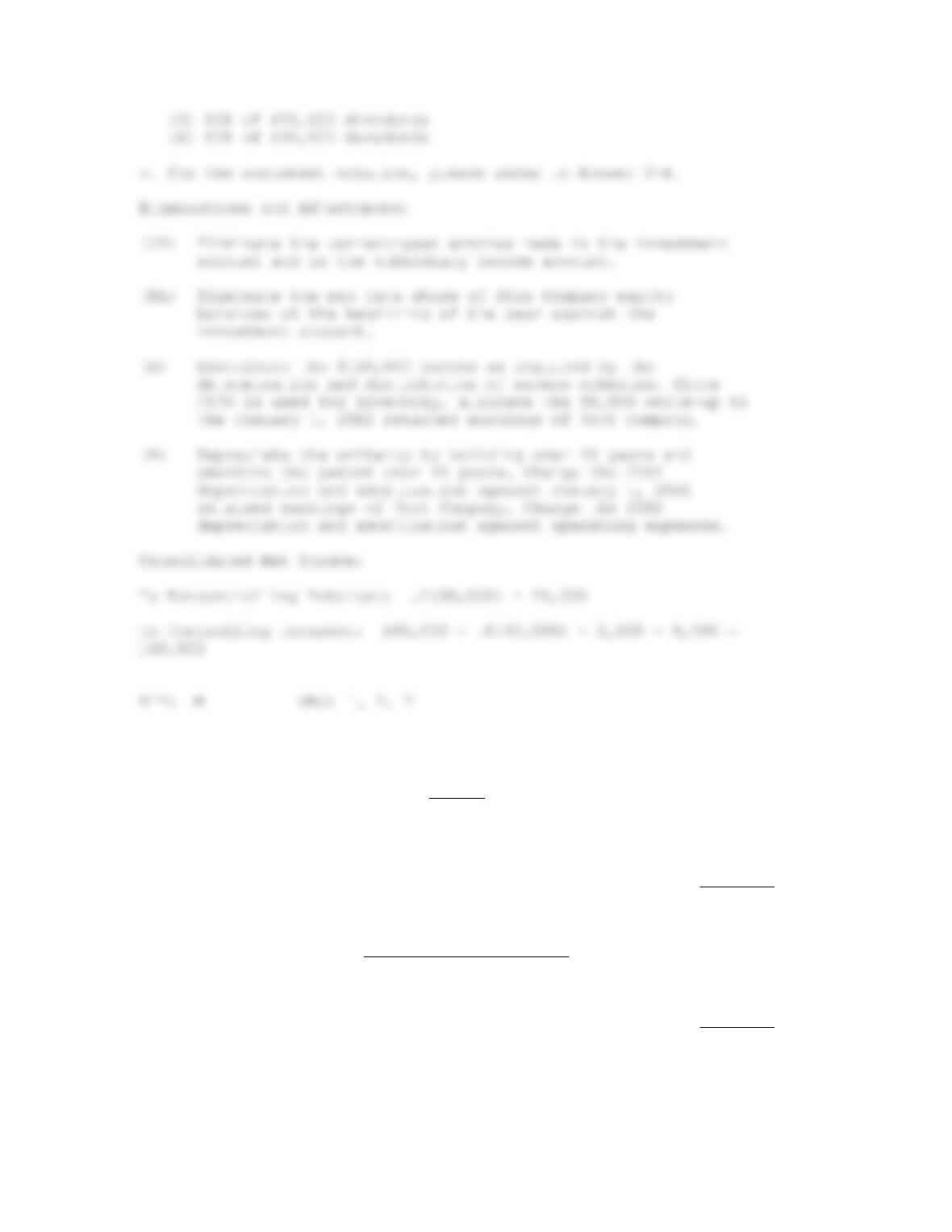
Complete the Figure 3-4 worksheet for consolidated financial
statements for 20X2.
Chapter 3
3-16
5. The Paris Company purchased an 80% interest in Seine, Inc. for $600,000
on July 1, 20X1, when Seine had the following balance sheet:
Assets
Accounts receivable……………………………… $ 50,000
Inventory………………………………………. 120,000
Land…………………………………………… 80,000
Building……………………………………….. 270,000
Equipment………………………………………. 80,000
Total………………………………………… $600,000
========
Liabilities and Equity
Current liabilities……………………………… $100,000
Common stock, $5 par…………………………….. 50,000
Paid-in capital in excess of par………………….. 150,000
Retained earnings – 7/1………………………….. 300,000
Total………………………………………… $600,000
========
Chapter 3
The inventory is understated by $20,000 and is sold in the third
quarter of 20X1. The building has a fair value of $320,000 and a 10–
year remaining life. The equipment has a fair value of $120,000 and a
remaining life of 5 years. Any remaining excess is attributed to patent
with a 20-year life.
On December 31, 20X4, Seine has the following stockholders’ equity:
Common Stock, $5 par…………………………….. $ 50,000
Paid-in capital in excess of par………………….. 150,000
Retained earnings……………………………….. 600,000
During 20X1, Seine had a net income of $100,000 and paid $10,000 in
dividends.
Assume that Paris uses the cost method to record its investment in
Seine.
Required:
a.
Prepare a determination and distribution of excess schedule as
of July 1, 20X1.
b.
Prepare the cost to equity conversion adjustment that would be
made on the December 31, 20X1, consolidated trial balance
worksheet.
c.
Prepare the eliminations and adjustments that would be made on
the December 31, 20X1, consolidated worksheet to eliminate the
investment in Seine. Distribute and amortize any excess.
Chapter 3
3-18
6. On January 1, 20X1, Parent Company purchased 100% of the common stock
of Subsidiary Company for $360,000. On this date, Subsidiary had common
stock, other paid–in capital, and retained earnings of $50,000,
$100,000 and $150,000 respectively. Net income and dividends for two
years for Subsidiary Company were:
20X1 20X2
Net income…………………………… $60,000 $90,000
Dividends……………………………. 20,000 30,000
On January 1, 20X1, the only tangible assets of Subsidiary which were
undervalued were inventory and building. Inventory, for which FIFO is
used, was worth $10,000 more than cost. The inventory was sold in 20X1.
Land had a fair value of $80,000. Buildings had a fair value of
$320,00, a remaining life of 10 years and straight-line depreciation is
used. The book value of the land and building are $50,000 and $260,000
respectively. Patent, if any, is to be amortized over 10 years.
Parent uses the simple equity method in accounting for its Investment
in Subsidiary Company.
Chapter 3
Required:
a.
Using the information above or on the separate worksheet,
prepare a determination and distribution of excess schedule.
b.
Complete the Figure 3-5 worksheet for consolidated financial
statements for 20X2.
Chapter 3
3-20
7. The Paris Company purchased an 80% interest in Seine, Inc. for $600,000
on July 1, 20X1, when Seine had the following balance sheet:
Assets
Accounts receivable……………………………… $ 50,000
Inventory………………………………………. 120,000
Land…………………………………………… 80,000
Building……………………………………….. 270,000
Equipment………………………………………. 80,000
Total………………………………………… $600,000
========
Liabilities and Equity
Current liabilities……………………………… $100,000
Common stock, $5 par…………………………….. 50,000
Paid-in capital in excess of par………………….. 150,000
Retained earnings – 7/1………………………….. 300,000
Total………………………………………… $600,000
========
The inventory is understated by $20,000 and is sold in the third
quarter of 20X1. The building has a fair value of $320,000 and a 10–
year remaining life. The equipment has a fair value of $120,000 and a
remaining life of 5 years. Any remaining excess is attributed to patent
with a 20-year life.
On December 31, 20X4, Seine has the following stockholders’ equity:
Chapter 3
Common stock, $5 par…………………………….. $ 50,000
Paid-in capital in excess of par………………….. 150,000
Retained earnings……………………………….. 600,000
During 20X1, Seine had a net income of $100,000 and paid $10,000 in
dividends.
Assume that Paris uses the sophisticated equity method to record its
investment in Seine.
Required:
a.
Prepare a determination and distribution of excess schedule as
of July 1, 20X1.
b.
Prepare the eliminations and adjustments that would be made on
the December 31, 20X1, consolidated worksheet to eliminate the
investment in Seine. Distribute and amortize any excess.
Chapter 3
3-22
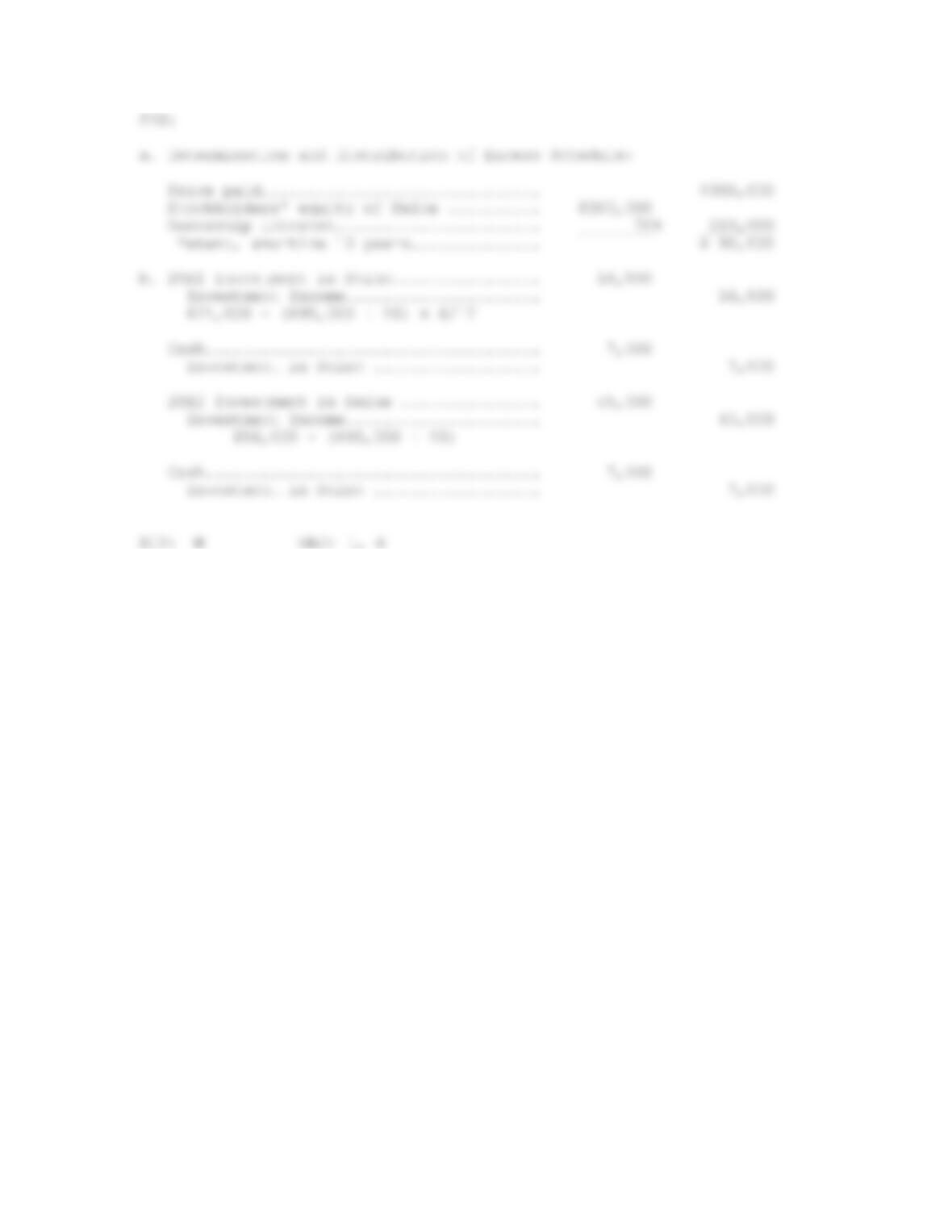
8. On January 1, 20X1, Parent Company purchased 80% of the common stock of
Subsidiary Company for $316,000. On this date, Subsidiary had common
stock, other paid–in capital, and retained earnings of $40,000,
$120,000, and $190,000, respectively. Net income and dividends for 2
years for Subsidiary Company were as follows:
20X1 20X2
Net income…………………………… $50,000 $90,000
Dividends……………………………. 10,000 20,000
On January 1, 20X1, the only tangible assets of Subsidiary which were
undervalued were inventory and building. Inventory, for which FIFO is
used, was worth $5,000 more than cost. The inventory was sold in 20X1.
Building, which was worth $15,000 more than book value, has a remaining
life of 8 years, and straight-line depreciation is used. Patent, if
any, is to be amortized over 10 years.
Required:
a.
Using the information above or on the separate worksheet,
prepare a determination and distribution of excess schedule.
Use the parent company concept (prorata fair value approach)
in any write-up of assets.
b.
Parent Company carries the Investment in Subsidiary Company
under the sophisticated equity method. In general journal
form, record the entries that would be made to apply the
equity method in 20X1 and 20X2.
c.
Compute the balance which should appear in Investment in
Subsidiary Company and in Subsidiary Income on December 31,
20X2 (the second year. Fill in these amounts on Parent
Company’s trial balance for 20X2.
d.
Complete the Figure 3-6 worksheet for consolidated financial
statements for 20X2.
Chapter 3
Chapter 3
3-24
9. Puddle Corporation acquired 90% of Suds Company’s common stock on
January 1, 20X1 for $32,000 cash when Sud’s stockholders’ equity
consisted of:
Common Stock $20,000
Retained Earnings $ 4,000
A determination and distribution schedule was prepared for the
difference between the price paid by Puddles and the underlying equity
acquired in Suds with the excess of cost over book value being
allocated as:
Inventory (undervalued) $ 400
Building & Equipment (undervalued) 2,000
Patent 8,000
Allocated excess cost over book value $10,400
=======
The inventory was sold during 20X1, and the building and equipment are
being depreciated for 5 years using the straight-line method. The
Patent is expected to have a 10-year useful life.
Chapter 3
Required:
The separate December 31, 20X1 financial statements for Puddle and Suds
is provided on worksheet 3-7. Based upon this information answer the
following questions.
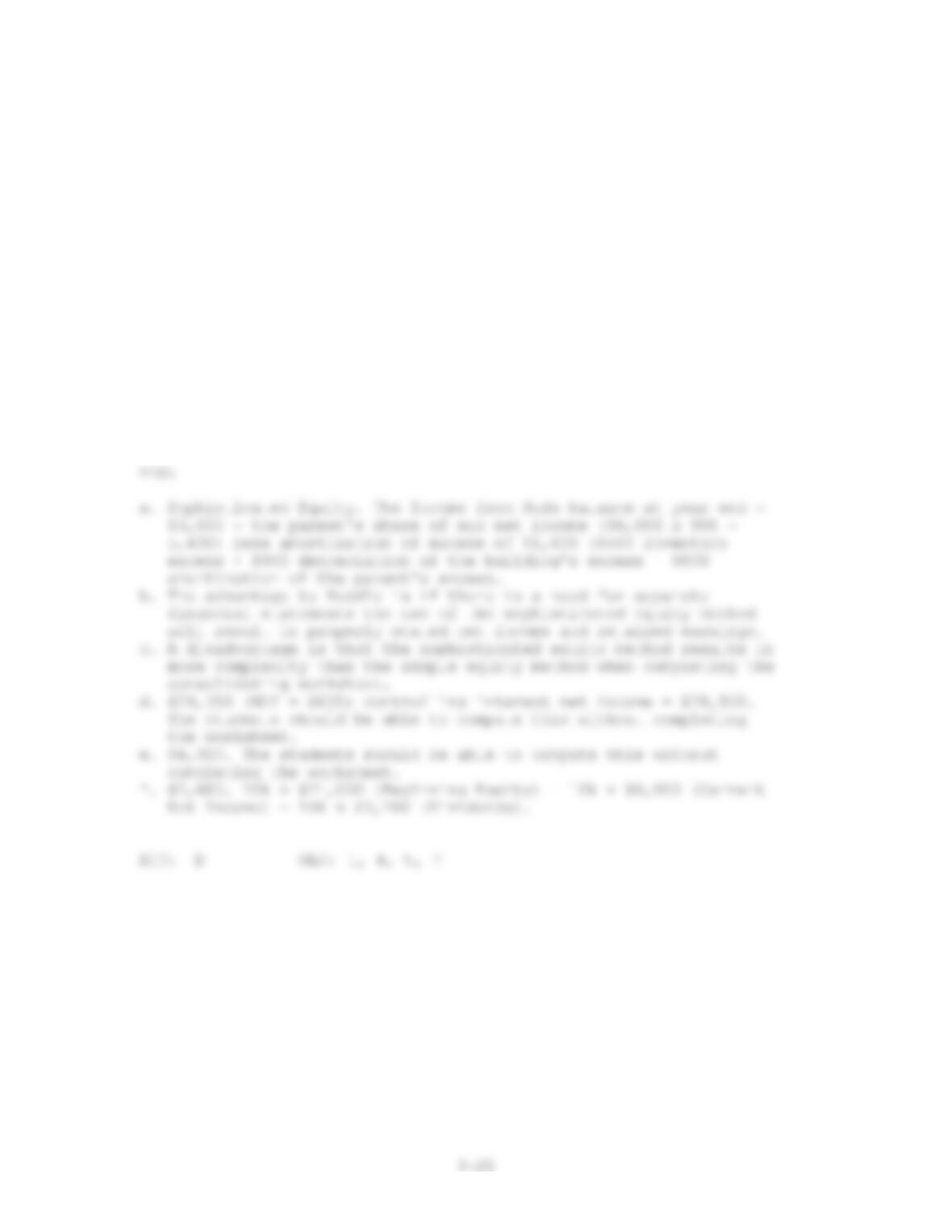
a. Which method to account for its investment in Suds is Puddle
using? Provide supporting computations?
b. What advantage does Puddle have in using this method?
c. What is a disadvantage for Puddle in using this method?
d. What amount is reported for Consolidated Net Income?
e. What amount is reported for Dividends Declared on the
Consolidated Statement of Retained Earnings?
f. What amount is reported on the December 31, 20X1 consolidated
financial statements for Noncontrolling Interest?
You do not have to complete the worksheet but it may be helpful to
answer the questions.
amortization of the patent’s excess.
will result in properly stated net income and retained earnings.
e. $4,000. The students should be able to compute this without
Net Income) – 10% x $3,200 (Dividends).

Chapter 3
3-26
10. The Paris Company purchased an 80% interest in Seine, Inc. for $550,000
on July 1, 20X1, when Seine had the following balance sheet:
Assets
Accounts receivable……………………………… $ 50,000
Inventory………………………………………. 120,000
Land…………………………………………… 80,000
Building……………………………………….. 270,000
Equipment………………………………………. 80,000
Total………………………………………… $600,000
========
Liabilities and Equity
Current liabilities……………………………… $100,000
Common stock, $5 par…………………………….. 50,000
Paid-in capital in excess of par………………….. 150,000
Retained earnings – 7/1………………………….. 300,000
Total………………………………………… $600,000
========
The inventory is understated by $20,000 and is sold in the third
quarter of 20X1. The building has a fair value of $320,000 and a 10–
year remaining life. The equipment has a fair value of $120,000 and a
remaining life of 5 years. Any remaining excess is attributed to patent
with a 20-year life.
On December 31, 20X4, Seine has the following stockholders’ equity:
Common stock, $5 par…………………………….. $ 50,000
Paid-in capital-in excess of par………………….. 150,000
Retained earnings……………………………….. 600,000
During 20X1, Seine had a net income of $100,000 and paid $10,000 in
dividends.
Assume that Paris uses the simple equity method to record its
investment in Seine.
Required:
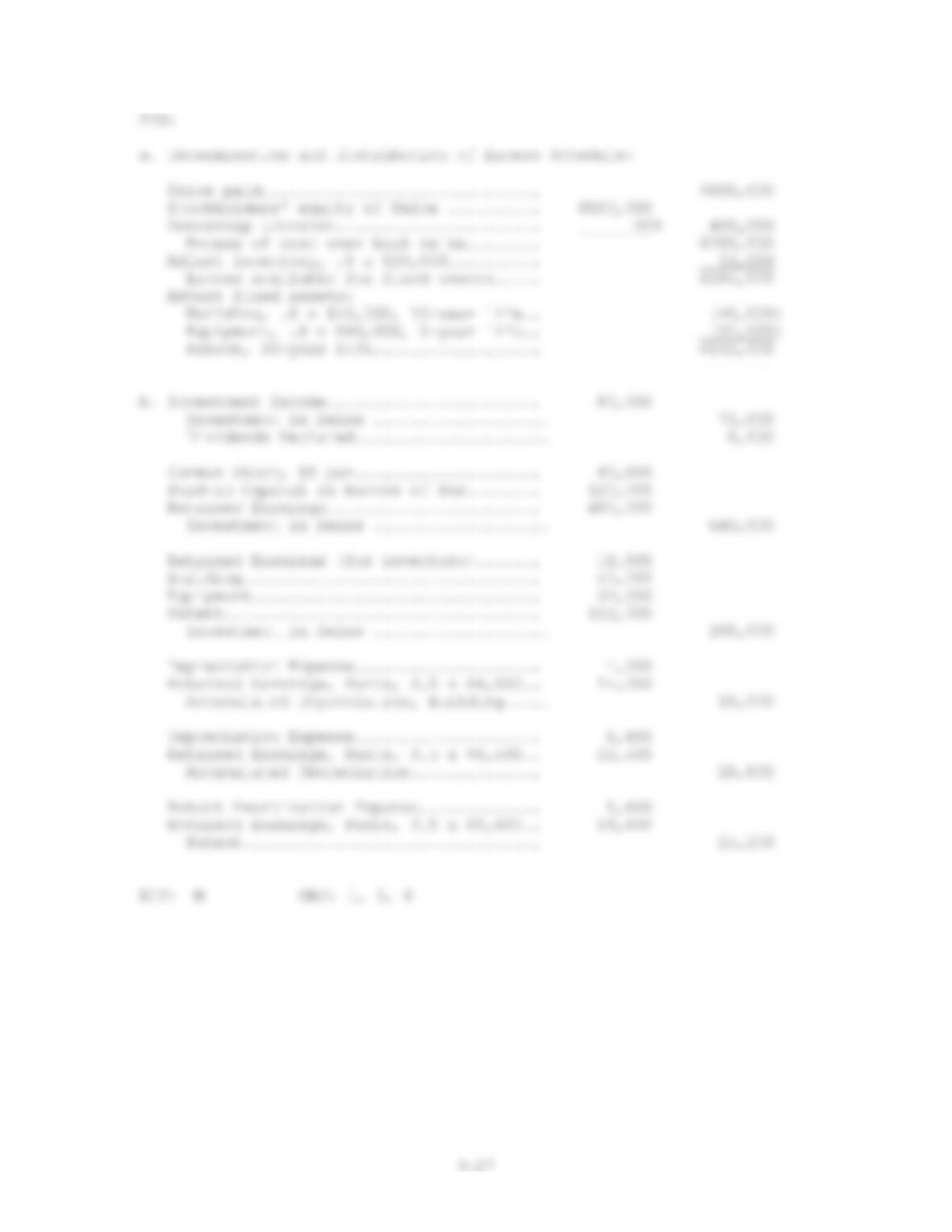
a.
Prepare a determination and distribution of excess schedule as
of July 1, 20X1.
b.
Prepare the eliminations and adjustments that would be made on
the December 31, 20X1, consolidated worksheet to eliminate the
investment in Seine. Distribute and amortize any excess.
Chapter 3

Chapter 3
3-28
11. The Paris Company purchased a 70% interest in Seine, Inc. for $278,000
on July 1, 20X1, when Seine had the following balance sheet:
Assets
Accounts receivable……………………………… $ 50,000
Inventory………………………………………. 110,000
Land…………………………………………… 80,000
Building and Equipment…………………………… 160,000
Total………………………………………… $400,000
========
Liabilities and Equity
Current liabilities……………………………… $160,000
Common stock, $5 par…………………………….. 50,000
Paid-in capital in excess of par………………….. 150,000
Retained earnings – 7/1………………………….. 100,000
Total………………………………………… $400,000
========
The inventory is understated by $50,000 and is sold in the third
quarter of 20X1. The land has a fair value of $100,000. The equipment
has a fair value of $130,000 and a remaining life of 3 years. Any
remaining excess is attributed to a patent with a 10-year life.
The following net incomes (earned evenly throughout the year) and
dividends paid (on 12/1 each year) are reported by Seine:
20X1 20X2
Net income…………………………… $150,000 $100,000
Dividends paid……………………….. 10,000 10,000
Required:
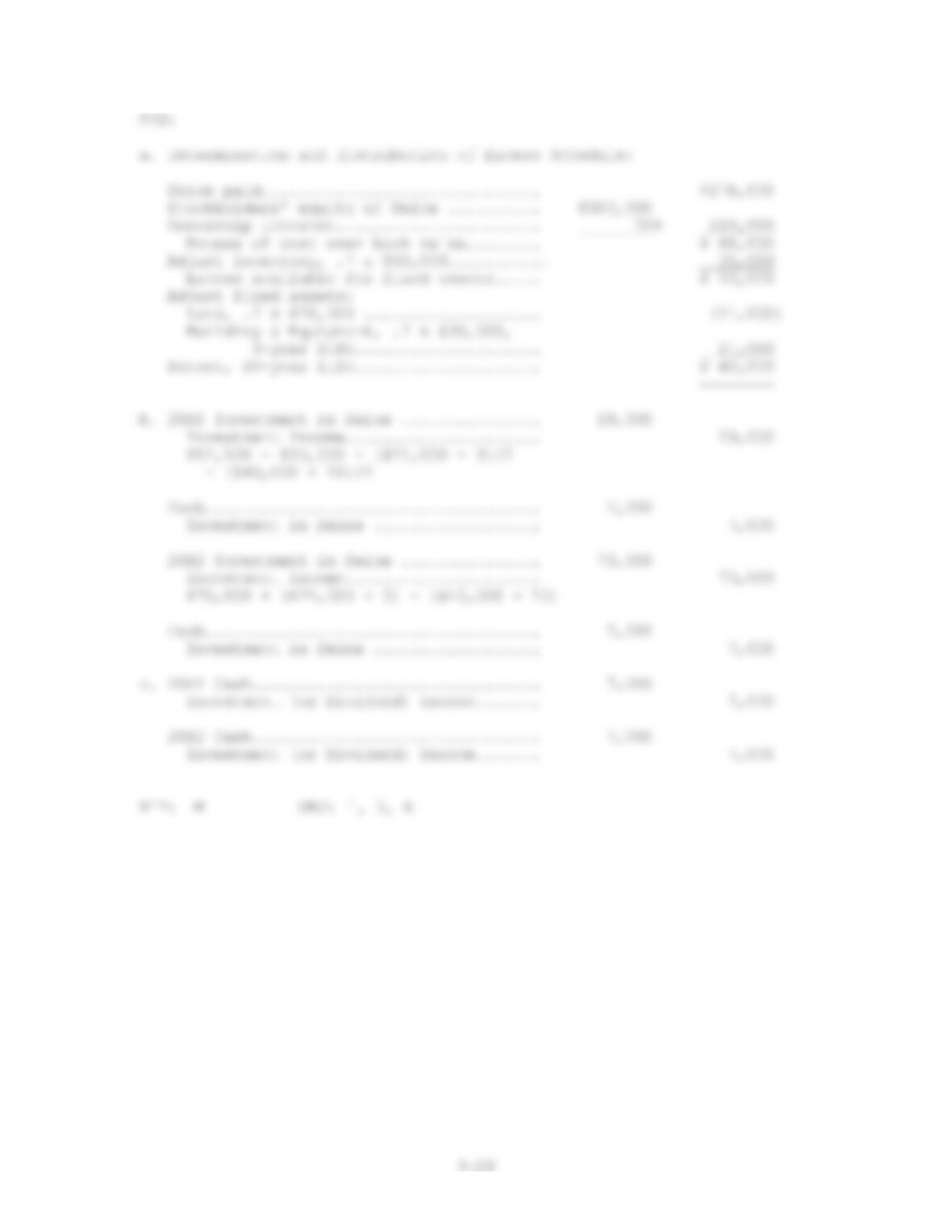
a.
Prepare a determination and distribution of excess schedule as
of July 1, 20X1.
b.
Prepare the 20X1 and 20X2 entries made by Paris to record the
net income and dividends paid information on its books under
the sophisticated equity method.
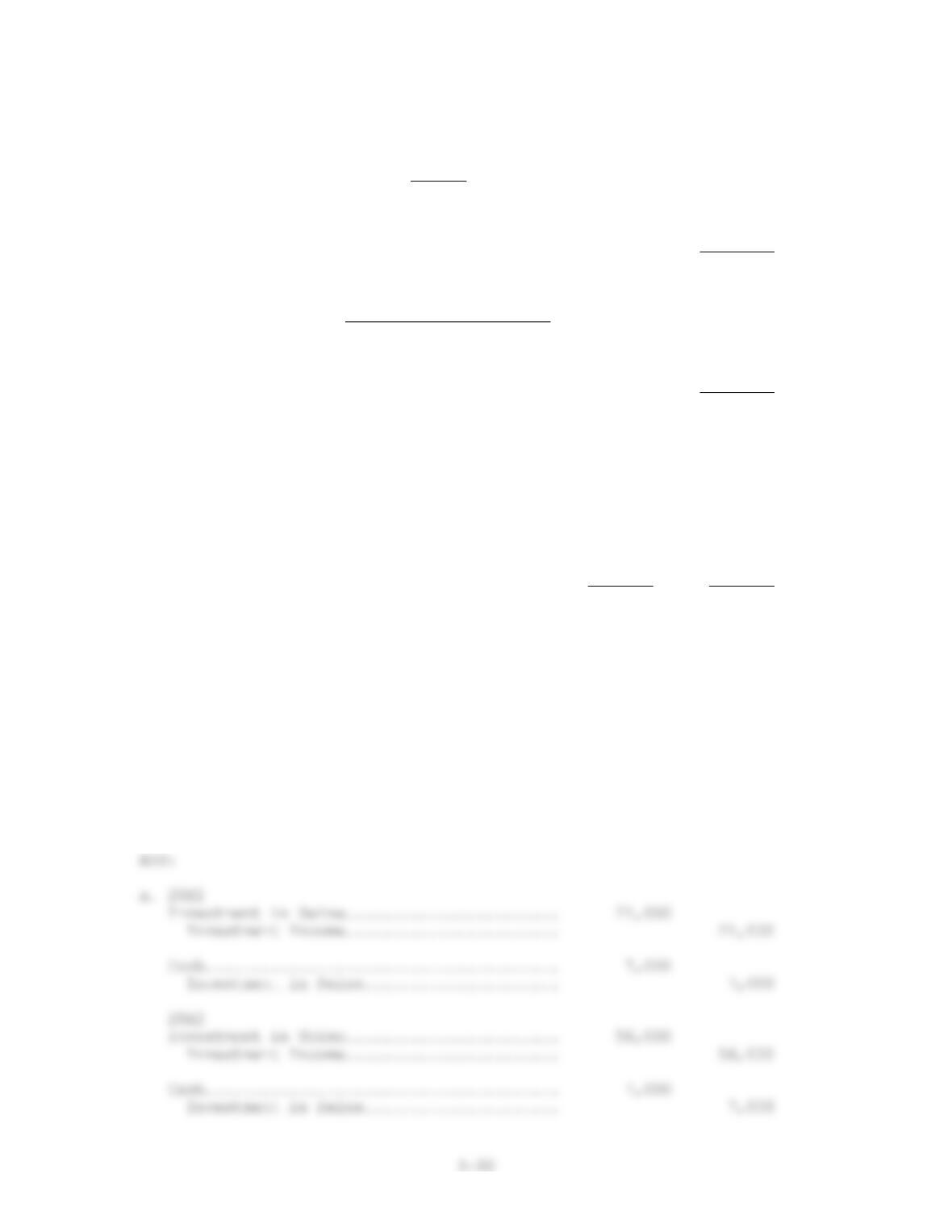
c.
Prepare the 20X1 and 20X2 entries made by Paris to record the
net income and dividends paid information on its books under
the cost method.
Chapter 3
Chapter 3
12. The Paris Company purchased an 70% interest in Seine, Inc. for $300,000
on July 1, 20X1, when Seine had the following balance sheet:
Assets
Accounts receivable……………………………… $ 50,000
Inventory………………………………………. 110,000
Land…………………………………………… 80,000
Building and Equipment…………………………… 160,000
Total………………………………………… $400,000
========
Liabilities and Equity
Current liabilities……………………………… $160,000
Common stock, $5 par…………………………….. 50,000
Paid-in capital in excess of par………………….. 150,000
Retained earnings – 7/1………………………….. 100,000
Total………………………………………… $400,000
========
Assume that all assets and liabilities have fair values equal to their
book values. Any excess cost is attributed to patent with a 10-year
life.
The following net incomes (earned evenly throughout the year) and
dividends paid (on 12/1 each year) are reported by Seine:
20X1 20X2
Net income…………………………… $60,000 $80,000
Dividends paid……………………….. 10,000 10,000
Required:
a.
Prepare the 20X1 & 20X2 entries made by Paris to record the
net income and dividends paid information on its books under
the simple equity method.
b.
Prepare the 20X1 & 20X2 entries made by Paris to record the
net income and dividends paid information on its books under
the cost method.

Chapter 3
3-31
13. The Paris Company purchased a 70% interest in Seine, Inc. for $300,000
on July 1, 20X1, when Seine had the following balance sheet:
Assets
Accounts receivable……………………………… $ 50,000
Inventory………………………………………. 110,000
Land…………………………………………… 80,000
Building and Equipment…………………………… 160,000
Total………………………………………… $400,000
========
Liabilities and Equity
Current liabilities……………………………… $160,000
Common stock, $5 par…………………………….. 50,000
Paid-in capital in excess of par………………….. 150,000
Retained earnings – 7/1………………………….. 100,000
Total………………………………………… $400,000
========
Assume that all assets and liabilities have fair values equal to their
book values. Any excess cost is attributed to patent with a 10-year
life.
The following net incomes (earned evenly throughout the year) and
dividends paid (on 12/1 each year) are reported by Seine:
20X1 20X2
Net income…………………………… $60,000 $80,000
Dividends paid……………………….. 10,000 10,000
Required:
a.
Prepare a determination and distribution of excess schedule as
of July 1, 20X1.
b.
Prepare the 20X1 and 20X2 entries made by Paris to record the
net income and dividends paid information on its books under
the sophisticated equity method.
Chapter 3
3-32
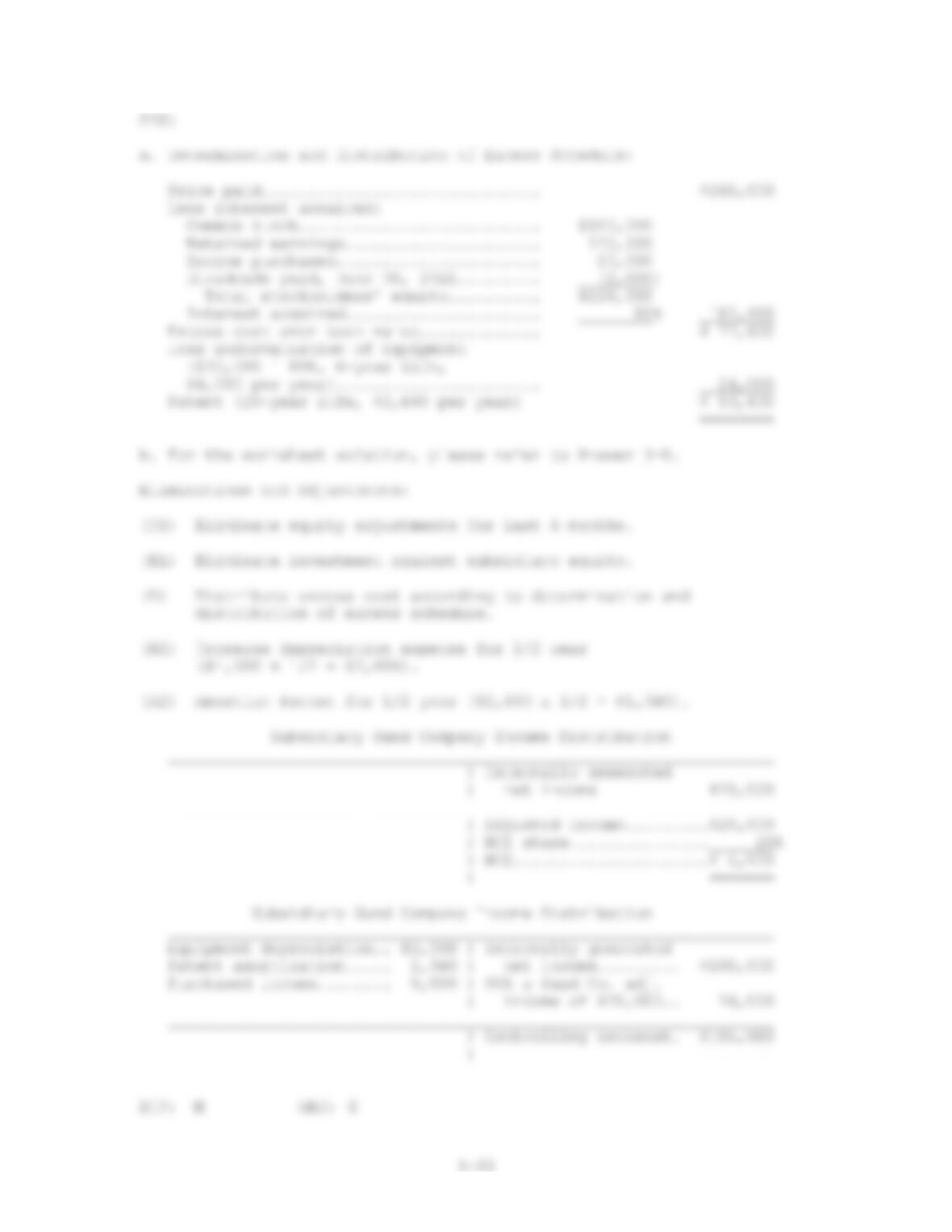
14. Pablo Company purchased an 80% interest in Sand Company on July 1,
20X1, for $260,000. On July 1, 20X1, Sand Company had the following
information available:
Common stock outstanding ($10 par)………………… $100,000
Retained earnings, January 1, 20X1………………… 120,000
Net income, January 1-June 30, 20X1……………….. 10,000
Dividends paid, June 30, 20X1…………………….. 2,000
Equipment is undervalued by $30,000 and has a 6-year remaining life.
Any remaining excess is attributable to patent with a 20-year life.
Required:
a.
Prepare a determination and distribution of excess schedule.
b.
Complete the Figure 3-8 partial worksheet for the year ended
December 31, 20X1. Subsidiary books were not closed on the
purchase date. Provide keyed explanations for all worksheet
entries and key each amortization of excess separately.
Include income distribution schedules.
Chapter 3
Chapter 3
15. Puddle Corporation acquired 90% of Suds Company’s common stock on
January 1, 20X1 for $32,000 cash when Sud’s stockholders’ equity
consisted of:
Common Stock $20,000
Retained Earnings $ 4,000
A determination and distribution schedule was prepared for the
difference between the price paid by Puddles and the underlying equity
acquired in Suds with the excess of cost over book value being
allocated as:
Inventory (undervalued) $ 400
Building & Equipment (undervalued) 2,000
Patent 8,000
Allocated excess cost over book value $10,400
=======
The inventory was sold during 20X1, and the building and equipment are
being depreciated for 5 years using the straight-line method. The
Patent is expected to have a 10-year useful life.
Required:
The separate December 31, 20X1 financial statements for Puddle and Suds
is provided in Figure 3-7. Complete the worksheet and provide
supporting calculations as needed and an explanation of the elimination
and adjustment entries.