Biology: A Guide to the Natural World, 5e (Krogh)
Chapter 3 Life’s Components: Biological Molecules
1) Sugar is an organic molecule because it contains:
A) carbon and nitrogen.
B) carbon.
C) water.
D) carbon dioxide.
E) carbon and oxygen.
2) In some vintage science fiction movies, space travelers find themselves on a planet orbiting a
distant star in which there are curious forms of life based on silicon instead of carbon. Although
the story clearly is sci-fi, there is an aura of plausibility in the choice of silicon, an atom with 14
protons, in place of carbon as this alien life-form’s central atom. The reason is that silicon:
A) has four electrons in its outermost shell.
B) has one more proton than carbon, so is very similar to it.
C) is an isotope of carbon.
D) is lighter than carbon.
E) is heavier than carbon.
3) Carbon is such an important element for life because it:
A) forms strong ionic bonds.
B) can form chemical bonds with a maximum of four other atoms.
C) can hydrogen bond to many different molecules.
D) is part of the water molecule.
E) does not form isomers.
4) Butane and isobutane are isomers. This means they have the same:
A) arrangement of atoms but a different chemical formula.
B) number of carbon atoms but different numbers of hydrogen atoms.
C) chemical formula but a different arrangement of atoms.
D) chemical formula but can only exist as ring structures.
2
5) A functional group added to a hydrocarbon usually makes the hydrocarbon:
A) nonpolar.
B) hydrophobic.
C) polar.
D) acidic.
E) an isomer.
6) Unique chemical groups that confer special properties to an organic molecule are called:
A) monomers.
B) amino acids.
C) functional groups.
D) lipids.
7) Hydroxyl groups are commonly found in:
A) amino acids.
B) DNA.
C) carbohydrates.
D) fatty acids.
8) Which of the following contains both a carboxyl group and an amino group?
A) carbohydrates
B) nucleotides
C) amino acids
D) lipids
9) All of the following are monosaccharides except:
A) fructose.
B) cellulose.
C) glucose.
D) deoxyribose.
10) In many cases, carbohydrates have the following ratio of elements:
A) carbon, hydrogen, and oxygen in a ratio of 1:2:1.
B) carbon and hydrogen in a ratio of 1:2.
C) carbon, hydrogen, and nitrogen in a ratio of 1:2:1.
D) carbon, oxygen, and hydrogen in a ratio of 1:2:1.
E) carbon, hydrogen, and oxygen in a ratio of 2:1:2.
11) In the following chemical reaction, which molecule is the disaccharide?
glucose + fructose → sucrose + water
A) sucrose
B) glucose
C) water
D) fructose
12) Glycogen is a polysaccharide used for energy storage by:
A) plants.
B) animals.
C) monera.
D) fungi.
13) The monomers of polysaccharides are:
A) amino acids.
B) nucleotides.
C) steroids.
D) lipids.
E) sugars.
14) What do polysaccharides, such as cellulose; nucleic acids, such as DNA; and proteins, such
as keratin, have in common?
A) They are all built of chemically linked monomers.
B) They are all amino acids.
C) They are all lipids.
D) They are all carbohydrates.
E) They are all nonpolar.
15) The monomers of polysaccharides are:
A) nucleotides.
B) simple sugars.
C) amino acids.
D) fatty acids.
16) Which of the following are polysaccharides?
A) sucrose and glucose
B) fructose and deoxyribose
C) DNA and RNA
D) starch and glycogen
17) Chitin and cellulose are examples of:
A) structural polysaccharides.
B) storage polysaccharides.
C) monosaccharides.
D) disacchrides.
18) Which of the following is true of cellulose?
A) Plants store glucose as cellulose.
B) Animals store glucose as cellulose.
C) Plants store amino acids as cellulose.
D) Plants’ cell walls are made up of cellulose.
19) Which of the following is the indigestible (at least for humans) glucose polysaccharide that is
found in plants?
A) starch
B) glycogen
C) cellulose
D) chitin
20) Glycogen is used to store ________ in the ________.
A) protein; muscle
B) protein; liver
C) nucleic acids; liver
D) glucose; spleen
E) glucose; liver
21) Butter, which is made from milk fat, tends to be harder at room temperature than most
margarines. If you wanted to make a butter that is softer at room temperature, you should
consider:
A) making the fatty acid chains longer.
B) making fatty acid chains with fewer kinks.
C) creating more double bonds in the fatty acid chains.
D) saturating the fatty acid chains.
E) adding more than three fatty acid chains to the triglycerides.
22) What is a triglyceride?
A) a lipid made of one glycerol and two fatty acids
B) a lipid made of two glycerols, a fatty acid, and a phosphate group
C) a lipid made of one glycerol and three fatty acids
D) a carbohydrate made of three sugars
E) a polypeptide made of three amino acids
23) You notice that water is running off the feathers of a bird in the rain. The reason is probably
that the bird has coated the feathers with ________, which keeps the water out of them.
A) proteins
B) polysaccharides
C) lipids
D) nucleic acids
24) What do wax and testosterone have in common?
A) They are both hormones.
B) They are both proteins.
C) They are both steroids.
D) They are both lipids.
25) Which of the following lipids is the primary component in cell membranes?
A) triglycerides
B) steroids
C) phospholipids
D) glycerol
26) Which of the following is true of steroids?
A) Steroids exist naturally in humans as hormones.
B) Some amino acids are steroids.
C) If people inject male steroid hormones, they can build muscle mass with no side effects.
D) Steroids contain a central, single-ring carbon structure.
E) Steroids are polymers.
27) Which of the following is an example of a lipid?
A) cholesterol
B) cellulose
C) keratin
D) chitin
28) If you removed the cuticle from the skin of an apple, the:
A) apple would absorb moisture and get soggy.
B) apple would lose water and dehydrate.
C) seeds of the apple would die.
D) apple would be inedible.
29) Unsaturated fatty acids:
A) have one or more double bonds between the carbons.
B) are usually found in animal fats.
C) have long been linked with heart disease.
D) contain the maximum number of hydrogen atoms possible.
30) The hydrogenation of vegetable oil results in:
A) an increase in the number of double bonds between the carbon atoms.
B) the oil becoming more liquid at room temperature.
C) a decrease in the number of double bonds between the carbon atoms.
D) the conversion of monounsaturated fatty acids into polyunsaturated fatty acids.
E) a decrease in the number of hydrogen atoms in the oil molecule.
31) Which of the following is a polymer?
A) fat
B) steroid
C) nucleic acid
D) wax
32) A triglyceride contains ________ fatty acid chains, whereas a phospholipid contains
________ fatty acid chains.
A) two; three
B) four; two
C) two; four
D) three; two
33) Saturated fats are usually found in:
A) coconut oil.
B) canola oil.
C) safflower oil.
D) a beef steak.
E) both coconut oil and a beef steak.
34) Every protein has a unique shape and function because:
A) each protein has a unique sequence of nucleotides.
B) each protein has a unique sequence of amino acids.
C) the bonds between the amino acids vary from protein to protein.
D) the number of nitrogen atoms in each amino acid differs.
35) Proteins that are composed of more than one polypeptide chain are said to have ________
structure.
A) secondary
B) tertiary
C) primary
D) quaternary
36) The difference between one amino acid and another is the:
A) number of amino and carboxyl groups each contains.
B) number of R groups each contains.
C) type of R group each contains.
D) way their amino groups bond with carboxyl groups.
E) difference in the chemical properties of their amino and carboxyl groups.
37) An example of an important biological molecule that may contain the –NH2 group is:
A) a triglyceride.
B) a starch.
C) a glucose molecule.
D) an enzyme.
E) steroids.
38) All of the following are functions of proteins except:
A) hormone activity.
B) enzyme activity.
C) serving as structural building materials.
D) serving as transport molecules.
E) storing genetic information.
39) Many features of a protein change when it is moved into an environment with a different pH.
Which of the following features would stay the same?
A) function of the protein
B) shape of the protein
C) binding properties of the protein
D) amino acid sequence of the protein
E) tertiary structure of the protein
40) Alpha helices and beta pleated sheets are examples of:
A) primary structure.
B) secondary structure.
C) tertiary structure.
D) quaternary structure.
41) Amino acids are monomers used to build:
A) nucleic acids.
B) triglycerides.
C) polysaccharides.
D) proteins.
42) Before DNA was established as the genetic material, proteins were considered the most
likely molecules to serve this role. In part this belief was based on the fact that there are 20
building blocks (20 different kinds of amino acids) for proteins versus 4 building blocks (4
different nucleotides) for DNA. If proteins stored a code, there would be a far greater number of
code words possible for a protein of a given number of amino acids than for a DNA molecule of
the same number of nucleotides. For example, there are 16 different sequences (42) possible for
a DNA two nucleotides long and 400 (202) different sequences possible for a protein two amino
acids long. For a sequence three nucleotides or three amino acids in length, the number of
distinct DNA sequences is ________, and the number of distinct protein sequences is ________.
A) 64; 8,000
B) 800; 8,000
C) 30; 800
D) 64; 800
E) 20; 420
43) The two chains of nucleotides in a DNA molecule are held together by:
A) covalent bonds.
B) ionic bonds.
C) hydrogen bonds.
D) peptide bonds.
E) hydrophobic interactions.
44) Nucleotides are the building blocks for:
A) disaccharides.
B) ATP, DNA, and RNA.
C) proteins.
D) lipids.
E) steroids.
45) Which of the following is the correct order for the flow of information in the cell?
A) Proteins code for DNA, which codes for RNA.
B) RNA codes for DNA, which codes for protein.
C) DNA codes for protein, which codes for RNA.
D) DNA codes for RNA, which codes for protein.
46) Water is an organic molecule.
47) Hydroxyl groups are functional groups found on amino acids.
48) Amino acids contain both amino and carboxyl functional groups.
49) The chitin that makes up the exoskeleton of insects is a polymer of amino acids.
50) Glycogen is the carbohydrate found in plant cell walls.
51) Cholesterol is used to make other steroids in the body.
52) Both men and women make testosterone.
53) Wax is a lipid.
54) Lipids with carbon-carbon double bonds tend to be more solid at room temperature.
55) All hormones are steroids.
56) Most enzymes are proteins, but not all proteins are enzymes.
57) Your muscles contract using contractile proteins to produce movement.
58) All other levels of protein structure are dictated by the primary structure.
59) A nucleotide is a polymer of nucleic acids.
Match the following.
A) DNA
B) lipoproteins
C) glycoproteins
D) polysaccharide
E) structural proteins
60) A carbohydrate polymer
Topic: Section 3.3
Skill: Knowledge/Comprehension
61) Serve as cell surface receptors
Topic: Section 3.5
Skill: Knowledge/Comprehension
62) Transport fats throughout the body
Topic: Section 3.5
Skill: Knowledge/Comprehension
63) Found in hair and cartilage
Topic: Section 3.5
Skill: Knowledge/Comprehension
64) The primary information-bearing molecule of life
Topic: Section 3.6
Skill: Knowledge/Comprehension
65) ________ is a branch of chemistry that studies carbon compounds.
66) The precursor from which steroid hormones are made is ________.
67) A series of amino acids linked in linear fashion is called a ________.
68) Keratin is an example of a ________ protein.
69) Polypeptides differ in their ________ and ________ of amino acids.
70) The active site of an enzyme is a product of its ________.
71) If you boil an egg for lunch, the egg white becomes hard, white, and opaque because the
protein molecules have unfolded, causing them to stick together. This is an example of how heat
________ a protein.
72) ATP (adenosine triphosphate) is an energy-carrying, modified ________.
73) You have a genetic defect that prevents your cells from making the amino acid tryptophan
from indole and serine. Your cells might be lacking the proper information in their ________,
which would direct the synthesis of the ________ that catalyzes tryptophan synthesis.
74) Ribosomes are made up of protein and ________.
75) Name the four most important groups of biological molecules necessary for life. List one
polymer and one monomer of each.
76) Why are proteins, polysaccharides, and nucleic acids considered polymers, but lipids are not?
77) You go the store to buy some lard for cooking. You notice when you get home that the lard
is solid at room temperature. What does this tell you about the fat in lard, and how does this
explain it being solid at room temperature? What type of fat would not be solid at room
temperature, and why?
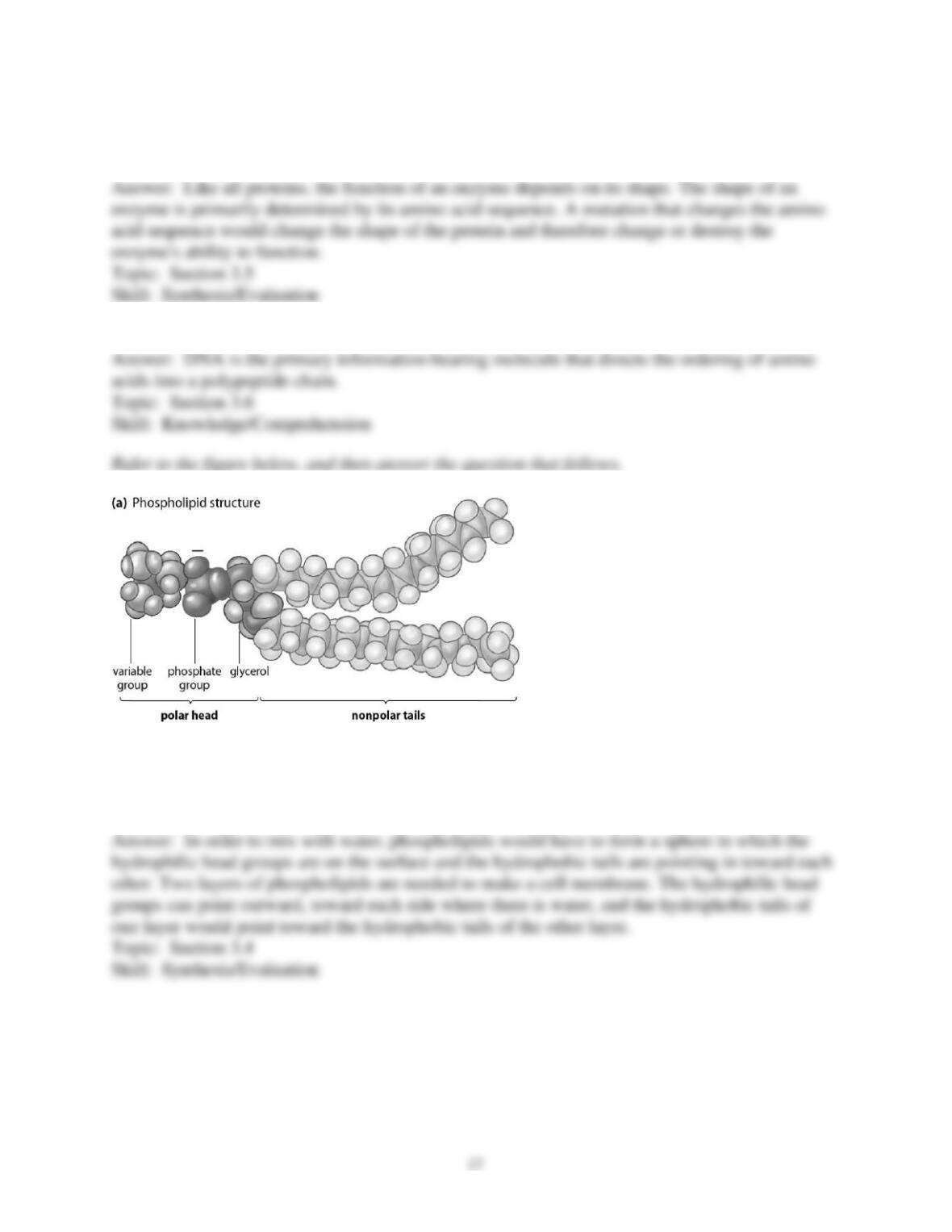
78) Describe the structure of phospholipids, and state where they are found in cells.
79) Explain how a protein ends up with its final shape.
80) Mutations are changes to the information in DNA. What would happen to an enzyme’s
ability to function if a mutation changed the order of some of the amino acids in its polypeptide
chain?
81) Explain the relationship between DNA and proteins.
82) Phospholipids can be made to mix with water if mixed vigorously enough. Predict what kind
of structure would be produced based on the chemical characteristics of phospholipids if they are
mixed vigorously with water. If water exists outside a cell and water exists inside a cell, propose
a way that phospholipids can be used to create a cell membrane.
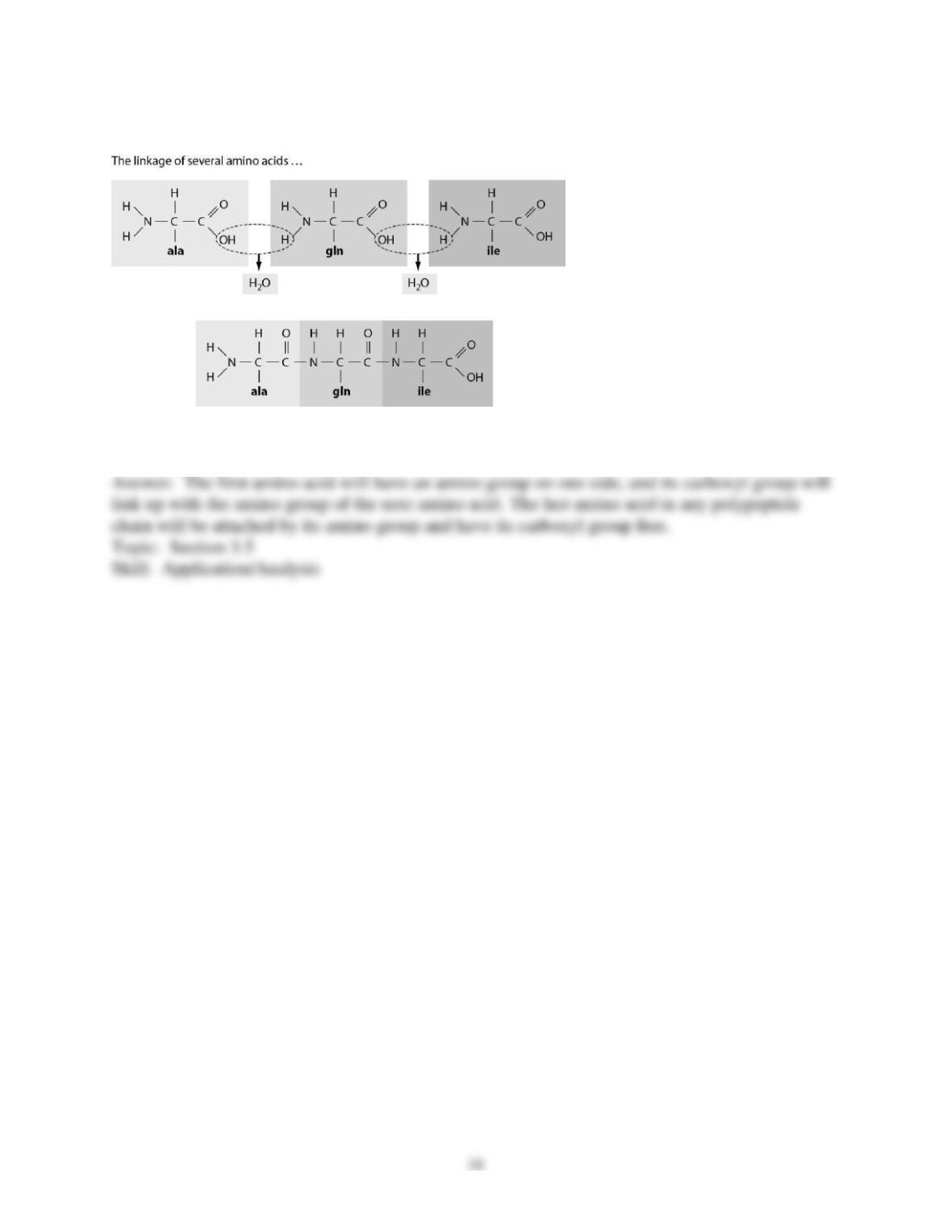
Refer to the figure below, and then answer the question that follows.
83) Explain why you will always find an amino group at one end of a polypeptide chain and a
carboxyl group at the other end.