
Name:
Class:
Date:
chapter 3
Indicate whether the statement is true or false.
1. The federal government has imposed strict regulations on food advertising for children based on their
nutritional standards.
a.
True
b.
False
2. Six firms – GM, Ford, Chrysler, Toyota, Honda, and Nissan – share 90 percent of all U.S. auto sales. Hence
the U.S. auto market can be regarded as a monopoly.
a.
True
b.
False
3. People develop standards of ethical behavior based on their own systems of values.
a.
True
b.
False
4. Demarketing is a reaction to a surplus of production materials that results in product supply exceeding
demand.
a.
True
b.
False
5. Sentencing guidelines act as an incentive for corporations to implement effective ethics compliance
programs—if they are hauled into court, the existence of such a program can help reduce penalties.
a.
True
b.
False
6. Ensuring ethical practices means promising customers and business partners to sacrifice quality and fairness
for profit.
a.
True
b.
False
7. A large pharmaceutical company invents a very small device that can be implanted in people with diabetes to
provide time-released amounts of insulin. A patent for this invention will set up a temporary oligopoly for the
company.
a.
True
b.
False
8. Technological innovations create not just new goods and services but also entirely new industries.
a.
True
b.
False
9. Acquisitions and mergers help firms with limited resources to gain access to new markets or new expertise.
a.
True
b.
False

Name:
Class:
Date:
chapter 3
10. A major constraint on consumer spending is deflation, which devalues money by reducing the products it
can buy through persistent price increases.
a.
True
b.
False
11. In addition to planning for change, marketers must set goals to meet the concerns of customers, employees,
shareholders, and members of the general public.
a.
True
b.
False
12. The governmental regulations that affect marketing practices are mainly for advertising and distribution, and
do not place any restrictions and prohibitions on the design and packaging of products.
a.
True
b.
False
13. The government’s Do Not Call Registry exempts callers representing not-for-profit organizations and
political candidates.
a.
True
b.
False
14. The gross domestic product (GDP) of a nation does not take into consideration the goods and services that
are exported to foreign markets.
a.
True
b.
False
15. Fresh Meadows, an organic yogurt manufacturer, organizes camps to assist and encourage farmers in
adopting organic farming practices. Fresh Meadows is engaging in socially responsible marketing.
a.
True
b.
False
16. The first phase of federal regulation of business was aimed at protecting competitors and included the
Robinson-Patman Act, passed in the 1930s.
a.
True
b.
False
17. Electric power companies often give advice on how consumers can use less electricity during the summer
and save money on their electric bills. This is an example of demarketing.
a.
True
b.
False
18. Public and private consumer interest groups and self-regulatory organizations are part of the legal
environment.
a.
True
b.
False

Name:
Class:
Date:
chapter 3
19. The firm that provides regional expertise in a strategic alliance does not share the risks associated with the
business.
a.
True
b.
False
20. The most direct form of competition occurs among marketers of dissimilar products.
a.
True
b.
False
21. The FTC and U.S. Department of Justice can stop mergers if they believe the proposed acquisition will
reduce competition by making it harder for new companies to enter the field.
a.
True
b.
False
22. The extent of consumer spending is directly related to the rate of unemployment.
a.
True
b.
False
23. Foreign currency fluctuations, labor costs, and political stability are part of an international economic
environment that affects U.S. marketers.
a.
True
b.
False
24. Consumer spending sinks to its lowest level during an economic depression.
a.
True
b.
False
25. A clothing manufacturer sells to 300 retail chains and boutiques within the United States. Since West Coast
retailers have a more affluent clientele, they can command higher retail prices. This is likely to be considered
illegal under the Clayton Act.
a.
True
b.
False
26. The competition between Amtrak, Hertz, and Delta Airlines for the travelers’ dollar is considered indirect
competition because these services can be substituted for one another.
a.
True
b.
False
27. Major oil companies, such as ExxonMobil and Chevron, often donate large amounts of money toward
political campaigns in an attempt to influence government policy in their favor. This is an example of
environmental management.
a.
True
b.
False
28. Discretionary income is the amount of money people have to spend on buying necessities such as food,

Name:
Class:
Date:
chapter 3
clothing, and housing.
a.
True
b.
False
29. Sears offers discount coupons and lowers prices on 1,000 items in the store in order to generate sales. This is
most likely to occur during an economic recession.
a.
True
b.
False
30. The existing U.S. legal framework was constructed in a logical, systematic manner, resulting in a coherent
and easily understood body of laws.
a.
True
b.
False
31. The antitrust laws in the United States were designed to protect the interests of organizations having
monopoly positions.
a.
True
b.
False
32. Despite its many advantages, technology can seldom address social concerns.
a.
True
b.
False
33. The decision of whether or not to compete should be based on a firm’s resources, objectives, and expected
profit potential.
a.
True
b.
False
34. The local government in Colorado has made it mandatory for firms to publish information on labels,
regarding the environmental impact of their products. The government is trying to protect the consumers’ right
to be safe.
a.
True
b.
False
35. The industry deregulation phase has focused on increasing the competition in industries such as utilities and
financial services.
a.
True
b.
False
36. Maros, an agricultural biotechnology company, is the sole supplier of genetically engineered seeds and
controls 84 percent of the market share for genetically modified crops. This is an example of a monopoly.
a.
True
b.
False
37. Creative applications of technology can benefit society, but rarely give firms a definite competitive edge

Name:
Class:
Date:
chapter 3
since other firms can simply copy the technology.
a.
True
b.
False
38. Colleges and universities, and other not-for-profit institutions play major roles in the development of new
technology.
a.
True
b.
False
39. Production, promotion, and reclamation of environmentally sensitive products is the basic premise of ethical
marketing.
a.
True
b.
False
40. Improved product quality and superlative customer service can help a company gain a competitive
advantage in the marketplace.
a.
True
b.
False
41. The Federal Trade Commission was established to facilitate trade by removing tariffs and other trade
barriers among Canada, Mexico, and the United States.
a.
True
b.
False
42. The Sherman Antitrust Act, Clayton Act, and Federal Trade Commission Act are evidence of federal
commitment to maintaining a competitive business environment in the United States.
a.
True
b.
False
43. Paying universities for the use of their logo, team name, and mascot in advertising products and services to
their students is considered ethical.
a.
True
b.
False
44. The cultural diversity of the United States results in various submarkets, each with unique values, cultural
characteristics, purchasing behaviors, and consumer preferences.
a.
True
b.
False
45. The Direct Marketing Association helps consumers to get their names removed from marketers’ targeted
lists.
a.
True
b.
False
46. The main purpose of the community development financial institutions certified by the U.S. Treasury

Name:
Class:
Date:
chapter 3
Department is to educate low-income borrowers.
a.
True
b.
False
47. During an eighteen-month period, sales of Mercedes automobiles, Carnival Cruise vacations, and Florida
real estate increased by at least 20 percent. A marketer might deduce that the business cycle is in the late stages
of recovery or experiencing a period of economic prosperity.
a.
True
b.
False
48. A pharmaceutical company that owns a patent for a new drug obtains exclusive rights to produce and market
that drug for an entire lifetime.
a.
True
b.
False
49. The Federal Food and Drug Act was designed to maintain a competitive environment in the food and drug
industries.
a.
True
b.
False
50. The
strategy
of time-based competition can be advantageous to companies most
affected
by technology.
a.
True
b.
False
51. The newest regulatory frontier in the United States is cyberspace, where state and federal regulators are
investigating ways to police the Internet and online services.
a.
True
b.
False
52. Marketers are usually more concerned with the amount of discretionary income in households.
a.
True
b.
False
53. A stay-at-home mother, a high school senior, and a retired government employee are considered
unemployed if they do not have a job and don’t want one.
a.
True
b.
False
54. Marketing strategies that work for a particular cultural group in the United States will always work when
applied to the same cultural group abroad.

Name:
Class:
Date:
chapter 3
a.
True
b.
False
55. The deregulation movement has ended total monopoly protection for most utilities.
a.
True
b.
False
56. As economic recovery begins after a period of recession, consumption patterns would reveal a sharp spike.
a.
True
b.
False
57. Managers of firms have traditionally focused on improving their relationship with the government and the
general public as part of their social responsibility.
a.
True
b.
False
58. Deflation is necessarily better for the economy than inflation as inflation devalues money and reduces the
purchasing power of consumers.
a.
True
b.
False
59. Long deflationary periods can cause a freefall in business profits, lower returns on most investments, and
widespread job layoffs.
a.
True
b.
False
60. During an economic recession, marketers look to emphasize value in their offerings by reducing prices in
order to help consumers stretch their budget dollars.
a.
True
b.
False
61. Strategic alliances are necessary in countries where local laws require foreign companies to work with local
businesses.
a.
True
b.
False
62. Laura decided to quit her job and travel for a year. She can be considered a part of the population that is
unemployed.
a.
True
b.
False
63. Marketing theory would define Starbucks, Caribou Coffee, and Dunkin’ Donuts as indirect competitors
because some coffee drinkers are particular about the brands they purchase.
a.
True
b.
False

Name:
Class:
Date:
chapter 3
64. Environmental management rarely works because marketers cannot hope to influence the external
environment, they can only respond to changes in it.
a.
True
b.
False
65. Technological advancement helps reduce prices and offers superior, cost-efficient distribution methods.
a.
True
b.
False
66. The success or failure of a product is independent of the competitive environment.
a.
True
b.
False
67. Time-based competition is a strategy of developing and distributing goods and services after a competitor to
observe the customers’ response to a particular product.
a.
True
b.
False
68. One way the Federal Trade Commission can enforce laws is by issuing a consent order in which a firm
accused of violations can agree to voluntary compliance without admitting guilt.
a.
True
b.
False
69. The U.S. military has historically been a source of product innovation and many of its technologies have
been adapted for the consumer markets.
a.
True
b.
False
70. A customer of All World Bank receives telemarketing calls and emails from the bank’s business partners,
Specialty Insurance and Global Investments. Since the customer has signed into the Do Not Call Registry, these
companies are in violation of the federal regulation.
a.
True
b.
False
71. The choice between pleasing all consumers and remaining profitable—thus surviving—defines one of the
most difficult dilemmas facing business.
a.
True
b.
False
72. Environmental scanning is the process of collecting external data, analyzing it, and determining whether the
trends identified are opportunities or threats to the company.
a.
True
b.
False

Name:
Class:
Date:
chapter 3
73. The demand for green products is increasing as consumers have responded by purchasing more and more
green goods, providing profits and opportunities for growth to the companies that make and sell them.
a.
True
b.
False
74. Not-for-profit organizations are not impacted by the rate of discretionary spending.
a.
True
b.
False
75. The United States is becoming culturally more diverse and subculture populations are rising.
a.
True
b.
False
76. Changes in an environment are most often the result of sudden crises.
a.
True
b.
False
77. The environmental scanning process helps firms to determine the best response to a particular environment
change.
a.
True
b.
False
78. Economic recovery can be described as a period when consumer spending begins to cautiously increase,
while companies try to hold down rising costs.
a.
True
b.
False
79. The basic consumer rights expounded by President Kennedy include “the right to be safe,” referring to the
idea that the goods and services people buy should not be injurious in normal use.
a.
True
b.
False
80. During the recession stage of the business cycle, consumers have enough money to spend, but caution often
restraints their willingness to buy.
a.
True
b.
False
Indicate the answer choice that best completes the statement or answers the question.
81. The airline industry in a particular country has only four dominant players. Large capital investments and
government regulations often prevent new players from entering the market. Based on this information, the
structure of the airline industry in this country is _____.
a.
a duopoly
b.
perfectly competitive
c.
an oligopoly

Name:
Class:
Date:
chapter 3
d.
a monopoly
82. Which of the following phases in the history of U.S. government regulation sought to increase competition
among industries by permitting them to expand their services into the new markets?
a.
The consumer protection phase
b.
The antimonopoly period
c.
The industry deregulation phase
d.
The phase aimed at protecting competitors
83. Pharmaceutical companies often get patents granting them the exclusive right to produce and market drug
formulations they have developed. These patents are:
a.
the result of non-compete agreements signed by pharmaceutical firms.
b.
in violation of ethical principles on which business is based.
c.
probably of little use because what one firm can patent, another can duplicate.
d.
rewards for the millions that firms have invested in the research and development process.
84. _____ leads to new goods and services for consumers, improves existing products, offers better customer
service, and often reduces prices through new, cost-efficient production and distribution methods.
a.
Reintermediation
b.
Consumerism
c.
Disintermediation
d.
Technology
85. Jen’s Dairy markets milk and other milk products that are purely organic and grown using sustainable
farming methods. They also have a program under which they recycle used cans of their products. These
marketing strategies employed by Jen’s Dairy show that they are involved in _____.
a.
demarketing
b.
green marketing
c.
socially responsible investing
d.
competitive marketing
86. Marketers are increasingly emphasizing to consumers that their products are not only high-quality, but they
also have no health risks and they do not damage the environment. This emphasis is consistent with which of
the following concepts?
a.
Socially conscious promotion
b.
Ethical marketing
c.
Green marketing
d.
Environmental management
e.
Customer relationship management
87. As suggested by President John. F. Kennedy, the consumers’ right to be _____ states that consumers should
be assured that the goods and services they purchase are not injurious with normal use.
a.
able to choose

Name:
Class:
Date:
chapter 3
b.
informed
c.
safe
d.
heard
88. Which of the following acts gives the FTC jurisdiction over false and misleading advertising?
a.
The Wheeler-Lea Act
b.
The Clayton Act
c.
The Robinson-Patman Act
d.
The Consumer Product Safety Act
89. The four basic consumer rights are: the right to be informed, the right to be heard, the right to be safe, and:
a.
the right to feedback.
b.
the right to choose freely.
c.
the right to sue.
d.
the right to demand.
90. The interactive exchange between firms and their customers creates the competitive environment. There are
multiple types of competitive environments, and each has its own characteristics. Your company operates in a
competitive environment where there are only a limited number of competitors. Moreover, it is hard for new
competitors to enter the industry because of the high startup costs involved.
Which one of the following competitive environments best describes the industry your company is in?
a.
Monopolistic competition
b.
Monopoly
c.
Oligopoly
d.
Perfect competition
e.
Socialism
91. A food lobbying group funded by Coca Cola worked to counter proposed legislation about school lunches
and the availability of soda in vending machines at schools across the country. Coca Cola supports lobbyists in
an effort to engage in _________.
a.
environmental management
b.
environmental scanning
c.
environmental screening
d.
competitive intelligence
92. The history of U.S. government regulation can be divided into four phases: the antimonopoly period, _____,
consumer protection, and industry deregulation.
a.
protecting trade
b.
protecting competitors
c.
protecting cyberspace
d.
protecting privacy

Name:
Class:
Date:
chapter 3
93. Which act prohibits price discrimination in sales to wholesalers, retailers, or other producers?
a.
The Wheeler-Lea Act
b.
The Robinson-Patman Act
c.
The North American Free Trade Agreement
d.
The Federal Trade Commission Act
94. Indirect competition occurs among marketers of:
a.
similar products.
b.
products that satisfy different needs.
c.
products that can be easily substituted.
d.
products that belong to different categories.
95. Technological changes and the increased use of wi–fi has enabled companies such as Netflix to create a large
consumer following and changed consumer’s viewing habits. Netflix has emerged as an entertainment company
offering original content that’s not available on cable or satellite networks. Netflix is a _____ competitor to
cable and satellite companies.
a.
direct
b.
indirect
c.
insignificant
d.
substitute
96. Consumers who are part of the Millennial generation rely on social media and the influence of peers when
making decisions about purchasing products and brands compared to Baby Boom generation consumers who
might prefer to read reviews by sources such as Consumer Reports. This distinction is important to marketers
and part of the ______ environment.
a.
social-cultural
b.
economic
c.
technological
d.
demographic
97. Zara and H&M are market leaders in the world of “fast fashion” where they’re able to design and
manufacture clothing based on the latest fashion trends in a quick and affordable manner. Due to their ability to
partner with manufacturing firms in developing countries and their use of supply chain strategies, Zara and
H&M can reduce the time between design and availability in the retail store which is a significant competitive
advantage. These companies make use of _______ competition.
a.
time-based
b.
direct
c.
indirect
d.
fashion
98. Your company is the market leader in your industry. You consistently beat your competition by developing
and distributing your goods and services more quickly than they are able to do. Which of the following best
describes what you are doing to beat your competition?

Name:
Class:
Date:
chapter 3
a.
Promotion superiority
b.
Environmental scanning
c.
Just-in-time inventory management
d.
Time-based competition
e.
Supply chain management
99. Which technology creates a common interface for data to be carried across networks between different
devices?
a.
IMS
b.
Wi–Fi
c.
VoIP
d.
RFID
100. Monitoring local newspapers and television news shows for general information relating to a firm’s
business would be an example of:
a.
environmental scanning.
b.
economic analysis.
c.
socio-political manipulation.
d.
technological development.
101. A(n) _____ is a structure that refers to a limited number of sellers in an industry in which high start-up
costs form barriers to keep out new competitors while ensuring that corporations remain innovative.
a.
duopoly
b.
monopoly
c.
oligopoly
d.
monopsony
102. In Australia, consumer spending in the past few months has seen an upward trend, and buyers are willing to
spend more on premium brands. From this pattern, we can say that Australia is in the _____ stage of the
business cycle.
a.
recovery
b.
prosperity
c.
recession
d.
depression
103. The business cycle refers to the pattern of stages in the level of economic activity: prosperity, recession,
depression, and recovery. During periods of prosperity, consumers are willing to spend ___________, and
during periods of recession, consumers are willing to spend _____________.
a.
Less, more
b.
More, less
c.
More, more
d.
Less, less

Name:
Class:
Date:
chapter 3
e.
The same, less
104. Marketers are keenly aware that good marketing alone is not enough to win the hearts and minds of
consumers anymore. Now, marketers must market in a socially responsible manner or risk alienating consumers
in ways that can be irreparable. Which one of the following statements is trueregarding social responsibility?
a.
Government legislation can mandate socially responsible actions.
b.
Consumer activism cannot promote social responsibility.
c.
There are five dimensions of social responsibility.
d.
Consumers demand that marketers give more weight to profits than to social well-being.
e.
The traditional concept of social responsibility only extended to employees.
105. The Council of Better Business Bureaus is a national organization devoted to consumer
service and _____.
a.
business self-regulation
b.
deregulation
c.
corporate lobbying
d.
socially responsible investing
106. The government’s Do Not Call Registry that helps consumers to avoid telemarketing calls exempts callers
who represent:
a.
financial institutions.
b.
not-for-profit organizations.
c.
service companies.
d.
insurance companies.
107. Manufacturers of vitamins and nutrition supplements have greater freedom in the manufacture and
marketing of their products since many of their products are not regulated by the _______ in the same way that
drugs are since double-blind efficacy studies are not required.
a.
FDA
b.
FTC
c.
EPA
d.
EEOC
108. Kia Motors has gained consumer confidence and increased sales through its warranty program which
includes a 10-year and 100,000 mile limited warranty. Kia Motors notes that all warranties are “limited” and
consumers are encouraged to read the fine print to fully understand what the warranty covers. Which element
of the marketing mix is the warranty linked when considering a company’s ethical behavior?
a.
product
b.
price
c.
promotion
d.
distribution
109. _____ are used by the federal government to control extreme fluctuations in the business cycle that can

Name:
Class:
Date:
chapter 3
lead to a depression.
a.
Deregulation
b.
Monetary and fiscal policies
c.
Stringent environmental policies
d.
Mergers and acquisitions
110. Which of the following protects the consumer by exerting legal, moral, and economic pressures on business
and government?
a.
Consumerism
b.
Corporate branding
c.
Socialism
d.
Capitalism
111. The social-cultural environment a firm operates in is constantly changing, and having a significant impact
on marketing strategies. The change is so rapid and immense that some firms have created a new position in the
organization to handle this change. Which title best describes the new position described in the scenario?
a.
Manager of Customer Relationships
b.
Manager of public policy research
c.
Manager of social media
d.
Vice President of diversity marketing
e.
Vice President of consumer advocacy
112. Which of the following agencies supports consumer rights through its initiative of informing consumers of
their right to modify or discontinue receiving solicitations?
a.
The Federal Trade Commission
b.
The Direct Marketing Association
c.
The Council of Better Business Bureaus
d.
The Consumer Product Safety Commission
113. Jonathan Nash, aged 60, feels young at heart and spends most of his leisure time networking with family
and friends online or surfing the Web. He can be characterized as:
a.
a social animal
b.
a generation Xer
c.
a baby boomer
d.
a Web addict
114. You own a high-end restaurant competing for the business of well-heeled diners. Now you’re worried, because a
gourmet takeout store just opened across the street. The new store will mean increased _____ competition.
a.
direct
b.
indirect
c.
generic
d.
mealtime

Name:
Class:
Date:
chapter 3
e.
price
115. The Federal Trade Commission Act is a law that:
a.
prohibits copying or downloading of digital files.
b.
facilitates trade by removing tariffs and other trade barriers.
c.
prohibits unfair methods of competition.
d.
restricts practices such as exclusive dealing, tying contracts, and interlocking boards of directors.
116. Since the latter part of the 19th century, the U.S. government has played an activist role in the financial
markets and the market for goods and services. The emphasis of their role has varied over this time as different
issues and dynamics were at the forefront of business and economic trends. The first phase of the U.S.
government’s active regulatory role, in the early part of the 20th century, can be best described as which of the
following?
a.
The cyberspace phase
b.
The consumer protection phase
c.
The protecting consumers phase
d.
The antimonopoly phase
e.
The industry deregulation phase
117. Last summer, the Thomas family had to decide whether to buy a new car, go to Disney World, or remodel
their basement. They chose the vacation. This illustrates:
a.
that competition can be defined in terms of dissimilar products vying for a limited supply of
discretionary buying power.
b.
how the most direct form of competition plays a role in a consumer’s decision making.
c.
how competition for essential items leaves unlimited discretionary funds for non-essentials.
d.
that there can be no competition among dissimilar products.
118. Which of the following bans the purchase of domain names that are identical or confusingly similar to
existing registered trademarks?
a.
The Anticybersquatting Consumer Protection Act
b.
The Identity Theft and Assumption Deterrence Act
c.
The Antitrust Act
d.
The Privacy Protection Act
119. It has been seen that periods of major innovations often lead to:
a.
reduced personal consumption.
b.
higher standards of living.
c.
decreased annual spending.
d.
reduced discretionary income.
120. An industry with only a few large competing firms is called a(n):
a.
regulated monopoly.

Name:
Class:
Date:
chapter 3
b.
pure monopoly.
c.
perfect market.
d.
oligopoly.
121. Marketers are constantly challenged by the dynamic forces operating in the marketing environment.
However, with the right approach this dynamic environment can be tamed enough to make it possible to
implement effective marketing strategies. The marketer who successfully achieves organizational objectives by
predicting and influencing the five components of the marketing environment is doing which of the following:
a.
Environmental scanning
b.
Risk management
c.
Porter’s Five Forces modelling
d.
SWOT Analysis
e.
Environmental management
122. JP Video Rentals is offering a “Rent 2 get 1 free” video rental coupon. They have been accused of
deceptive advertising throughout the U.S. Which division of the Council of Better Business Bureaus is
designated to handle such cases?
a.
The National Advertising Division
b.
The Advertising Standards Authority
c.
The Direct Marketing Association
d.
The Institute of Sales Promotion
123. The process of reducing consumer demand for a product to a level that a firm can reasonably supply is
called __________.
a.
indirect marketing
b.
economic marketing
c.
direct marketing
d.
demarketing
124. Marketers use _______________ to collect information about the external marketing environment to
identify and interpret potential trends.
a.
CRM software
b.
Promotional giveaways
c.
Target marketing
d.
Environmental scanning
e.
Test marketing
125. The Coffee Cup, a popular coffee chain in Switzerland, is trying to expand its business into Canada. It
decides to enter into a partnership with a Canadian bookstore chain to set up coffee shops inside bookstores, an
arrangement which will benefit both firms. This type of partnership that helps to create a competitive advantage
in a new market is known as a _____.
a.
strategic alliance
b.
franchising agreement

Name:
Class:
Date:
chapter 3
c.
joint venture
d.
buy out
126. The production, promotion, and reclamation of environmentally sensitive products is called _____.
a.
social media marketing
b.
green washing
c.
demarketing
d.
green marketing
127. Which of the following usually indicates a strong economy?
a.
Growth in services such as banking and restaurants
b.
Cautious spending by businesses and consumers
c.
A focus on basic, functional products with lower price tags
d.
Increase in purchasing power coupled with uncertain consumer demand
128. The amount of money available with people after buying necessities such as food, clothing, and housing is
referred to as _____.
a.
basic income
b.
gross income
c.
discretionary income
d.
personal income
129. When Kevin analyzes recent data from the U.S. Census Bureau to uncover new markets for his firm’s
product, he is engaging in:
a.
demarketing.
b.
time-based competition.
c.
environmental scanning.
d.
marketing management.
130. The Telecommunications Act of 1996 was passed to:
a.
set annual fees for telemarketers to access the Do Not Call Registry.
b.
create the national Do Not Call Registry prohibiting telemarketing calls to registered numbers.
c.
deregulate the telecommunication industry by removing barriers to competition.
d.
prohibit the sale of cell phone records.
131. Which of the following stages in the business cycle forces businesses to hold down costs, trim payrolls, and
cut down travel costs in order to earn profits and cope with uncertain consumer demand?
a.
Recovery
b.
Growth
c.
Prosperity
d.
Maturity

Name:
Class:
Date:
chapter 3
132. In the context of cybercrime, luring consumers to provide personal information is called _____.
a.
piracy
b.
viral marketing
c.
logging
d.
phishing
133. Which of the following has ended total monopoly protection for most utilities like natural gas, electricity,
water, and cable TV service?
a.
Deregulation movement
b.
Disinvestment
c.
Temporary monopoly
d.
Perfect competition
134. Which of the following was the prime reason behind the formation of regulations aimed at protecting
competitors?
a.
To provide legal protection to independent merchants against competition from larger chain stores
b.
To reduce the concentration of industry power in the hands of a small number of competitors
c.
To increase competition in industries like telecommunications, utilities, transportation, and financial
services by discontinuing many regulations
d.
To permit firms to expand their service offerings to new markets by discontinuing many regulations
135. Air travel today is not very glamorous and takes a lot of patience but many changes have occurred to
enhance convenience for travelers. First, consumers can book their own travel via the Web rather than use a
travel agent. Before their flight, they can check-in remotely via their smart phone or other mobile device and
print their boarding pass. Alternately, they can use their smart phone to display their boarding pass to the gate
agent who scans the digital image. Once on-board and safely cruising, some airlines offer in-flight wifi to
enable travelers to check their e-mail, send documents, surf the web or catch up on a Netflix series or movie.
These conveniences are most related to the ________ environmental factor.
a.
technological
b.
social-cultural
c.
political-legal
d.
economic
136. Given the rapid pace of technological innovation over the last few decades, the technological forces a firm
must contend with are arguably the most dynamic of all the forces impacting the marketing environment. These
technological forces can have either negative or positive implications for the firm. Which of the following
statements is true about technology in a marketing context?
a.
Technology can lead to new products and services for a firm, but seldom has any impact on existing
products and services.
b.
Technological changes can be expensive, and always lead to higher production and distribution costs.
c.
Technological innovations only come from the private sector of the economy.
d.
Many technological innovations, such as the Internet, come from the government sector.
e.
Not-for-profit companies do not produce technological innovations.

Name:
Class:
Date:
chapter 3
137. When marketers offer new products, increase their promotional efforts, and expand their distributional
limits, it is a sign of:
a.
low inflation and low unemployment.
b.
low inflation and high unemployment.
c.
high inflation and high unemployment.
d.
high inflation and low unemployment.
138. Caterpillar and First Solar, Inc. launched a ______ where First Solar will design and manufacture a pre-
engineered turnkey package for use in remote microgrid applications, such as small communities and mine
sites. The package will feature Cat-branded solar panels manufactured by First Solar and will include a balance
of system components. The products will be sold exclusively through Caterpillar’s extensive worldwide dealer
network.
a.
strategic alliance
b.
global partnership
c.
competitive agreement
d.
licensing agreement
139. Cabi, a women’s clothing company based in Los Angeles, CA partners with Opportunity International to
make small business loans to female entrepreneurs in developing countries through its “Make a Change
Program” where customers can round-up their purchase to the nearest dollar amount and contribute “change”
for a change. This program is part of the _______ dimension of social responsibility.
a.
philanthropic
b.
economic
c.
legal
d.
ethical
140. In the United States, four major music companies receive 80 percent of recording revenues. Such a market
structure is termed as a(n) _____.
a.
monopsony
b.
oligopoly
c.
monopoly
d.
duopoly
141. The overall health of the economy has a significant impact on consumers’ ability and willingness to
purchase goods and services. The most reliable measure of the economy’s health is the sum of all final goods
and services produced in the country in a given period. This measure is called____________.
a.
National income
b.
Gross national product
c.
Consumer expenditures
d.
Gross domestic product
e.
Corporate profits

Name:
Class:
Date:
chapter 3
142. The Robinson family recently bought a car as they were offered a no-interest financing option. The
family’s annual vacation was also booked through a discount travel firm. The family has purchasing power, but
they prefer to spend their money cautiously like most other families in the country. The above stated instances
indicate which stage of the business cycle?
a.
Depression
b.
Prosperity
c.
Recession
d.
Recovery
143. A local furniture store was recently penalized for continuously using a “going out of business” message in
its marketing communications to influence shoppers to visit the store and assume that prices would be very
low. This ethical issue is linked to the _____ variable of the marketing mix.
a.
promotion
b.
product
c.
distribution
d.
price
144. Which of the following components of the marketing environment consists of factors that influence
consumer buying power and marketing strategies?
a.
Competitive environment
b.
Cultural environment
c.
Economic environment
d.
Regulatory environment
145. Achieving organizational objectives by predicting and influencing the competitive, political-legal,
economic, technological, and social-cultural environment is referred to as _____.
a.
research and development
b.
marketing research
c.
environmental management
d.
SWOT analysis
146. A pharmaceutical company that works with the Food and Drug Administration to create new regulations is
practicing:
a.
strategic planning.
b.
environmental scanning.
c.
marketing research.
d.
environmental management.
147. Which of the following is an example of indirect competition?
a.
A Sony home entertainment system competing with a Jacuzzi hot tub
b.
An ExxonMobil station opening across the street from a Shell retail outlet
c.
Competition among Verizon, AT&T, and T-Mobile

Name:
Class:
Date:
chapter 3
d.
The purchase of a Honda Accord competing with a Toyota Camry
148. Artisanal Brands, Inc. markets and distributes a line of specialty, artisanal, and farmstead cheese products
in the United States. The company gives bulk discounts to their wholesalers. The result is that smaller stores are
getting the products at a higher rate as compared to supermarkets and large shopping chains. These stores will
be protected under the _____.
a.
Sherman Antitrust Act
b.
Robinson-Patman Act
c.
Wheeler-Lea Act
d.
Celler–Kefauver Act
149. The regulatory agency which can require advertisers to provide additional information about products in
their advertisements is the _____.
a.
Federal Trade Commission (FTC)
b.
Environmental Protection Agency (EPA)
c.
Food and Drug Administration (FDA)
d.
Federal Advertising Commission (FAC)
150. Which of the following is a trend usually observed during an economic depression?
a.
Consumers are willing to spend more for premium versions of well-known brands.
b.
Consumers have money to spend, but caution often restrains their willingness to buy.
c.
Consumers focus on more basic, functional products that carry lower price tags.
d.
Businesses offer new products, expand distribution, and raise prices to widen profit margins.
151. Friums & You, a Canadian firm, together with its subsidiaries, manufactures and markets snacks,
confectionery, and quick meal products worldwide. The firm has been trying to expand its business into China.
As Chinese laws require foreign firms to do business with local companies, Friums & You will have to be
involved in a _____ to start operations in China.
a.
limited liability partnership
b.
buyout
c.
strategic alliance
d.
hostile takeover
152. The Robinson-Patman Act was passed to:
a.
provide legal protection to individual merchants against competition from larger chain stores.
b.
increase competition in the telecommunications and utilities industry by deregulation.
c.
protect consumers by specifying safety standards for products.
d.
maintain a competitive environment by prohibiting monopolization.
153. Consumerism is defined as a social force within the marketing environment that aids and protects the
consumer by exerting legal, moral, and economic pressures on business and government. The conceptual
framework for consumer rights include all of the following except:
a.
The right to be safe

Name:
Class:
Date:
chapter 3
b.
The right to choose freely
c.
The right to be informed
d.
The right to fair pricing
e.
The right to be heard
154. Widespread adoption of wireless networks and in-home Internet use has led to an increased availability of
“smart” products for the home such as thermostats, lighting, security, systems and smoke detectors. Which
environmental factor is most related to the new smart home products?
a.
technological
b.
social-cultural
c.
economic
d.
political-legal
155. The aerospace industry has been shaken up by SpaceX, a small company building innovative passenger spacecraft.
However, because of extremely high startup costs, the industry remains dominated by a small number of large
corporations. Its market structure may be described as a(n) __________.
a.
Monopoly
b.
Oligopoly
c.
Temporary monopoly
d.
Transitional monopoly
e.
None of the above.
156. A leading e-Learning company is expanding its operations in Japan. To ensure smooth communication
between branches, it needs a communication technology which provides facilities such as call plans, call
waiting, and three way calling. Additionally it would like to keep costs low. Which technology should it adopt?
a.
IMS
b.
VoIP
c.
JIT
d.
RFID
157. Marketers must constantly monitor their competitors’ products, prices, distribution, and promotional efforts
because:
a.
competitors may be violating truth-in-advertising laws.
b.
it can lower a firm’s command over the market price.
c.
it will help prevent indirect competition.
d.
firms may need to adjust their marketing mix based on new competing products.
158. News reports from Zimbabwe indicate that a small pack of locally produced coffee beans costs
approximately 1 billion Zimbabwean dollars, an amount that would have bought 60 new cars less than ten years
ago in the same country. It can be surmised that Zimbabwe is experiencing extremely high levels of _____
which has spiraled out of control in the past ten years.
a.
growth
b.
stagflation

Name:
Class:
Date:
chapter 3
c.
deflation
d.
inflation
159. MedicaPlus, a pharmaceutical company, is finding it difficult to track and locate slow moving medicines.
Pharmaceutical distributors have been complaining about the time it takes for their orders to arrive. One
technology that can be used effectively to shorten this waiting period, locate, and track items easily is:
a.
VoIP.
b.
Logistics.
c.
RFID.
d.
GPS.
160. Baier Oil Co. encourages consumers to reduce oil consumption by engaging in environmentally friendly
commuting through its promotional campaigns. It also provides tips for people to employ green commuting.
These measures employed by the company to reduce the demand for oil shows that they are engaging in:
a.
socially responsible investing.
b.
demarketing.
c.
product redesigning.
d.
green marketing.
161. Which of the following devalues money and reduces its purchasing power through persistent increase in
prices?
a.
Disinflation
b.
Stagflation
c.
Inflation
d.
Deflation
162. Tim was on his way to work one morning and he noticed smoke coming from under the hood of his truck.
He pulled over to the side of the road, turned off the ignition, and had his vehicle taken to the dealership. The
dealership found a faulty wire and wanted to charge him for the service. However, since the vehicle was still
under warranty, Tim contacted the manufacturer as well as the National Highway Traffic Safety Administration
(NHTSA) to report the incident. Tim’s “right” to contact the manufacturer and NHTSA is related to the right to
_______, one of the consumer rights mentioned in a speech by President John F. Kennedy.
a.
be heard
b.
be safe
c.
be informed
d.
choose freely
163. Which of the following statements is true regarding a monopoly?
a.
It is enjoyed by an organization who is the sole suppliers of a good or service.
b.
It is common in the telecommunications industry.
c.
It cannot be achieved temporarily, even through the use of patents and similar legal devices.
d.
It is the most common type of competition in the U.S. market.

Name:
Class:
Date:
chapter 3
164. During which phase in the business cycle do marketers consider lowering prices and increasing promotions
that include special offers to stimulate demand?
a.
Prosperity
b.
Recession
c.
Growth
d.
Maturity
165. Bank of Norasmus is one of the few banks that provides credit to disadvantaged communities. These loans
are used for housing, small business creation, and education or personal development. Such an organization is
said to be involved in _____.
a.
credit based investing
b.
socially responsible investing
c.
sustainability
d.
environmental management
166. If a business refuses to comply with a request by the _____, the agency can issue a cease-and-desist order,
which gives a final demand to stop an illegal practice.
a.
Environmental Protection Agency
b.
Consumer Product Safety Commission
c.
U.S. Department of Justice
d.
Federal Trade Commission
167. A market structure in which a single seller dominates trade in a good or service for which buyers can find
no close substitutes is called a(n) _____.
a.
oligopoly
b.
monopoly
c.
monopsony
d.
perfect market
168. Which law protects intellectual property rights by prohibiting the copying or downloading of digital files?
a.
The Real ID Act
b.
The Electronic Signature Act
c.
The Digital Millennium Copyright Act
d.
The Identity Theft and Assumption Deterrence Act
169. You are creating an ethics compliance program for your corporation. Which of the following issues is it unnecessary
for you to address?
a.
Exclusive territories
b.
Product warranties
c.
Price fixing
d.
Cannibalization
e.
Promotional allowances

Name:
Class:
Date:
chapter 3
170. Marketing raises a number of ethical questions about the how, when, what, where, and who of marketing
implications on individuals and society at large. Ethics are of concern in every aspect of marketing.
Your company offers cash rewards to consumers in return for them giving you information that you could use in
your own marketing or that you could sell to direct marketers. Which category of ethics does this scenario
represent?
a.
Ethics in product strategy
b.
Ethics in promotion
c.
Ethics in marketing research
d.
Ethics in pricing
e.
Ethics in customer relationship management
171. Which of the following is the newest regulatory frontier for federal and state regulators in the United
States?
a.
Protecting competitors
b.
Industry deregulation
c.
Antimonopoly
d.
Cyberspace
172. To acquire regional expertise and comply with the local laws of a country, international firms often find it
desirable to:
a.
form political action committees.
b.
export goods and services to that country.
c.
form strategic alliances with domestic companies in that country.
d.
relocate manufacturing facilities to that market.
173. When Jonathan was contacted by his insurance firm regarding certain medical claims he had made recently,
he realized that someone else had used his name and insurance information without his consent to make false
claims for medical services and goods. Which of the following acts will enable Jonathan to take action against
the person who stole his personal information?
a.
The Clayton Act
b.
The Identity Theft Enforcement and Restitution Act
c.
The Sherman Antitrust Act
d.
The Digital Millennium Copyright Act
174. In times of prosperity, marketers respond to consumer buying behavior by:
a.
launching special value-priced products that are likely to appeal to cost-conscious buyers.
b.
holding down costs and offering superior services at lower prices.
c.
lowering prices and increasing promotions that include special offers to stimulate demand.
d.
offering new products, increasing their promotional efforts, and expanding distribution.
175. The technological environment that a company operates in represents all the discoveries made via science,
inventions and innovation that impacts the firm’s marketing strategy. Which one of the following statements is
false regarding the impact of technology on the firm’s marketing endeavors?

Name:
Class:
Date:
chapter 3
a.
Technology can lead to new goods and services
b.
Technology can improve existing products and customer service
c.
Technology can reduce prices through new production and distribution methods
d.
Since it is equally accessible by all competitors, it offers limited competitive advantages
e.
It can help address social concerns
176. Which act prohibits restraint of trade and monopolization and identifies a competitive marketing system as
a national policy goal?
a.
The Wheeler-Lea Act
b.
The Sherman Antitrust Act
c.
The Federal Trade Commission Act
d.
The Clayton Act
177. Lockheed Martin won the largest military contract ever by proving it could be the first company to develop
and fly a new model plane. This illustrates the importance of _____.
a.
rapid prototyping of new products
b.
demarketing
c.
time-based competition
d.
the legal environment
178. The Sherman Act, FTC Act, and the Food and Drug Act were all laws passed by Congress in an effort to
regulate certain activities and practices in the economy. These laws were passed during the ___________ phase
of government regulation.
a.
Industry deregulation
b.
Antimonopoly
c.
Cyberspace
d.
Consumer protection
e.
Protecting competitors
179. Before accepting a job offer from a restaurant chain, you want to be sure your future employer is in tune with the
social-cultural environment of the United States. You get worried when your interviewer makes a comment on this topic
which is clearly inaccurate. What does she say?
a.
We need to cater to retirees, because consumers are getting older.
b.
We may be able to raise prices in the future, because consumers are getting more affluent.
c.
We need to be welcoming to all ethnic groups, because consumers are becoming more culturally diverse.
d.
We need to cater to large families, because the birthrate is rising.
e.
We should buy eco-friendly products, because consumers are concerned about the natural world.
180. The _____ component of the marketing environment consists of laws that require firms to operate under
competitive conditions and to protect consumer rights.
a.
economic
b.
competitive
c.
social-cultural

Name:
Class:
Date:
chapter 3
d.
political-legal
181. Which of the following ethical issues is associated with firms’ product strategies?
a.
Exclusive territories
b.
False and deceptive advertising
c.
Planned obsolescence
d.
Bait-and-switch advertising
182. Marketers’ standards of conduct and moral values is termed as _____.
a.
social marketing
b.
corporate identity
c.
green marketing
d.
marketing ethics
183. In which phase of U.S. government regulation were major laws such as the Sherman Antitrust Act, the
Clayton Act, and the Federal Trade Commission Act passed to maintain a competitive environment?
a.
The phase aimed at protecting competitors
b.
The industry deregulation phase
c.
The antimonopoly period
d.
The consumer protection phase
184. In marketing, _____ involves accepting an obligation to give equal weight to profits, consumer satisfaction,
and social well-being in evaluating a firm’s performance.
a.
green washing
b.
consumerism
c.
social responsibility
d.
demarketing
185. The process of collecting information about the external marketing environment to identify and interpret
potential trends is called _____.
a.
market profiling
b.
target marketing
c.
marketing management
d.
environmental scanning
186. HandyBrands Inc., a consumer goods company, engages in the design, manufacture, sourcing, and sale of
apparel essentials in the United States and abroad. They have a very good e-tailing portal. Online shopping
constitutes 40 percent of their sales. Recently, they have faced complaints by customers that orders are not
getting processed. The reason was the existence of a website with similar content and an identical domain name.
HandyBrands Inc. should take the help of the _____.
a.
Electronic Signature Act
b.
Anticybersquatting Consumer Protection Act

Name:
Class:
Date:
chapter 3
c.
Identity Theft and Assumption Deterrence Act
d.
Credit Card Accountability, Responsibility and Disclosure Act
187. Corea Inc., a pharmaceutical company, is involved in the research, development, manufacture, and
marketing of prescription medicines. A new drug developed by Corea has been awarded patent rights by the
U.S. Food and Drug Administration. The patent grants them exclusive rights to manufacture and market the
drug for 3 years. Based on this information, which of the following statements will be true?
a.
Corea Inc. will operate in a market with monopolistic competition.
b.
Corea Inc. will have exclusive rights to produce and market the product forever.
c.
Corea Inc. will operate in a perfectly competitive market.
d.
Corea Inc. will have a temporary monopoly in the market for this drug.
188. Because of competitive pressures, some firms have used packaging and labelling practices that are
questionable, misleading, deceptive and unethical. This is an example of issues related to __________.
a.
Ethics in customer relationships
b.
Ethics in pricing
c.
Ethics in product strategy
d.
Ethics in promotion
e.
Ethics in marketing research
189. Recently, a top economist to the Federal Reserve bank predicted that market conditions would be favorable
with low levels of inflation and low unemployment rates. Which of the following might be a response by
marketers to this economic forecast?
a.
increasing promotional efforts
b.
limiting new product offerings
c.
reducing distribution
d.
lower prices
190. Brock recently graduated from college and began his job as a media analyst earning $50,000 per year. He
wants to start saving for retirement and use a weekly budget to keep him from spending too much money. He
determines that his _______ income is $120 per week for entertainment, dining out, clothes, and other non-
essential items.
a.
discretionary
b.
net
c.
gross
d.
frivolous
191. Which of the following helps time-based competitors to improve product quality, reduce costs, and expand
product offerings to satisfy new market segments and enhance customer satisfaction?
a.
Validity and reliability
b.
Flexibility and responsiveness
c.
Rigidity and vision
d.
Profitability and coverage

Name:
Class:
Date:
chapter 3
192. _____ can lead to a damaging downward spiral, causing a freefall in business profits, lower returns on most
investments, and widespread job layoffs.
a.
Deflation
b.
Lower interest rates
c.
Inflation
d.
A federal budget surplus
193. It is believed that marketers need to reevaluate their strategies and concentrate on their most promising
products during the _____ stage of the business cycle.
a.
recession
b.
recovery
c.
maturity
d.
prosperity
194. In the recovery period, which type of firms have the best possible chance to create loyal customers by
providing exceptional service?
a.
Brands
b.
Sick units
c.
Providers of superior services at lower prices
d.
Price skimmers
195. Which of the following is a critical issue facing governmental agencies regarding ethics in marketing
research?
a.
Personal selling
b.
Truth in advertising
c.
Planned obsolescence
d.
Invasion of personal privacy
196. Companies often reorganize their operations which might include lay-offs, divestiture of business units, or
other decisions linked to their ability to maximize profitability. Which dimension of social responsibility is
related to a firm’s desire to maximize profits?
a.
economic
b.
legal
c.
ethical
d.
philanthropic
197. Alliances are considered essential in countries where:
a.
markets are monopolistic in nature.
b.
laws require foreign firms doing business there to work with local companies.
c.
partners combine resources and capital to create competitive advantages in an established market.
d.
efforts are required to achieve organizational objectives by predicting and influencing the

Name:
Class:
Date:
chapter 3
technological environments.
198. The goal of _____ is to analyze information and decide whether the identified trends represent significant
opportunities or pose major threats to the company.
a.
environmental scanning
b.
green marketing
c.
benchmarking
d.
social marketing
Indicate one or more answer choices that best complete the statement or answer the question.
199. You just had a job interview at a firm that develops housing complexes around the country. The interviewer seemed
impressed by your knowledge of the complex political-legal environment affecting the industry. Which level(s) of
government impose(s) regulations on real estate developers — as well as on many other industries?
a.
Federal
b.
State
c.
Local
d.
Civic
e.
Administrative
200. It’s not only the government that regulates what toys your store can sell to children. Non-governmental regulatory
forces include:
a.
Public consumer interest groups focused on protecting kids
b.
Private consumer interest groups focused on protecting kids
c.
Self-regulatory organizations
d.
Better Business Bureau
e.
Consumer Product Safety Commission
201. You aspire to a career developing new biomedical technologies. Choose the type(s) of institutions that might play a
role in your future endeavors.
a.
Government
b.
Industry
c.
Universities
d.
Not-for-profit organizations
e.
Technology analysts
202. You feel strongly about working for a socially responsible company, so you are pleased when a prospective
employer brings this up. He shows you a set of statements that are posted in all the firm’s offices to remind people of the
basic steps in the social responsibility pyramid. Choose the statements that appear in this set.
a.
Be profitable.
b.
Obey the law.
c.
Be ethical.
d.
Be a good corporate citizen.
e.
Put efficiency first.

Name:
Class:
Date:
chapter 3
203. You are thinking about starting a new business, now that the economy is emerging from recession and consumer
purchasing power is increasing. Which of the following statements accurately describes this stage in the business cycle?
a.
This is the recovery stage.
b.
This is the prosperity stage.
c.
While consumers have money to spend, they may still be cautious about spending it.
d.
Consumer demand is uncertain.
e.
Consumer demand is stable.
204. A consultant has given you a list of questions to help determine a competitive strategy for your online editing
business. Which of the following questions were most likely included on the list?
a.
Should we compete in the editing business?
b.
Should we compete in the student market, or in the professional writing market?
c.
How should we compete in the editing business?
d.
Why should we compete in the editing business?
Match each definition to the corresponding term.
a.
environmental scanning
b.
environmental management
c.
competitive environment
d.
time-based competition
e.
economic environment
f.
demarketing
g.
consumerism
h.
marketing ethics
i.
social responsibility
j.
green marketing
k.
oligopoly
l.
gross domestic product
m.
planned obsolescence
n.
inflation
o.
socially responsible marketing
p.
political-legal environment
q.
VoIP
r.
discretionary income
s.
antitrust
t.
strategic alliance
205. _____ is the process of collecting information about the external marketing environment to identify and
interpret potential trends.

Name:
Class:
Date:
chapter 3
206. Attainment of organizational objectives by predicting and influencing the competitive, political-legal,
economic, technological and socio-cultural environments is called _____.
207. A partnership in which two or more companies combine resources and capital to create competitive
advantages in a new market is called a(n) _____.
208. The _____ is an interactive process that occurs in the marketplace among marketers of directly competitive
products, marketers of products that can be substituted for one another, and marketers competing for the
consumer’s purchasing power.
209. _____ laws are designed to prevent restraints on trade such as business monopolies.
210. A market condition where relatively few producers compete because of barriers like high start-up costs that
restrict entry is called a(n) _____.
211. _____ is a strategy of developing and distributing goods and services more quickly than other firms.
212. The component of the marketing environment that consists of laws that require firms to protect consumer
rights is referred to as the _____.
213. The factors that influence consumer buying power and marketing strategies are part of the _____ of a
market.
214. _____ is the sum of all goods and services produced by a nation in a year.
215. Rising prices caused by excess demand and increases in the costs of raw materials, component parts,
human resources, or other factors of production is referred to as _____.
216. _____ is the amount of money people have to spend after buying necessities such as food, clothing, and
housing.
217. _____ is the process of reducing consumer demand for a good or service to a level that a firm can supply.
218. _____ is a telecommunication service that helps in connecting a personal computer with any type of
broadband Internet connection.
219. _____ is a social force within the marketing environment that aids and protects the consumer by exerting
pressures on the business and government.
220. The marketers’ standards of conduct and moral values are called _____.
221. _____ consists of marketing philosophies, policies, procedures, and actions that have the enhancement of
society’s welfare as a primary objective.
222. Marketers intentionally offering products with limited durability are engaging in _____.
223. Toyota’s promotion of cars using hybrid technology is an example of _____.

Name:
Class:
Date:
chapter 3
224. _____ involves campaigns that encourage people to adopt beneficial behaviors such as safe driving, eating
more nutritious food, or improving the working conditions of people half a world away.
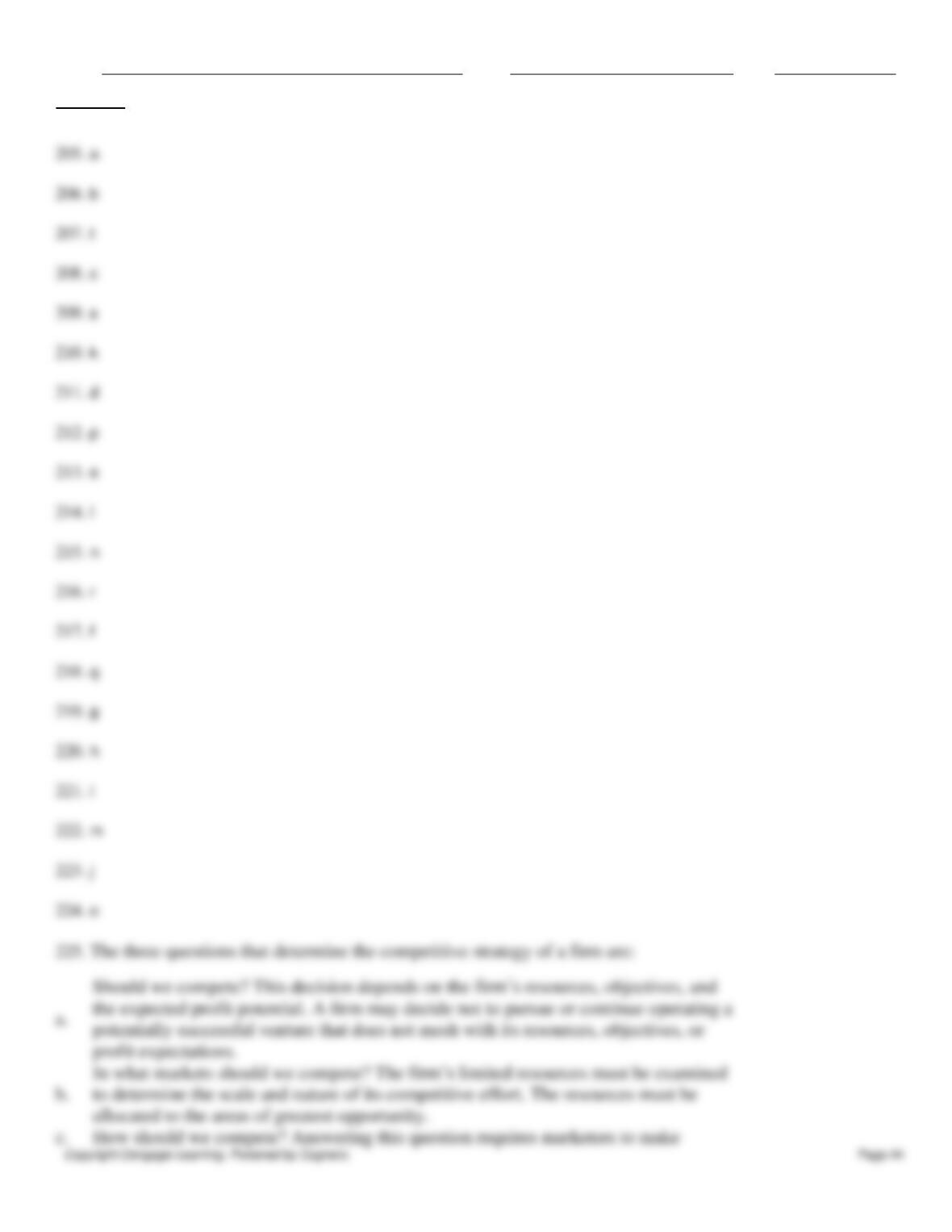
225. What are the questions that can help a company to determine a competitive strategy? Discuss.
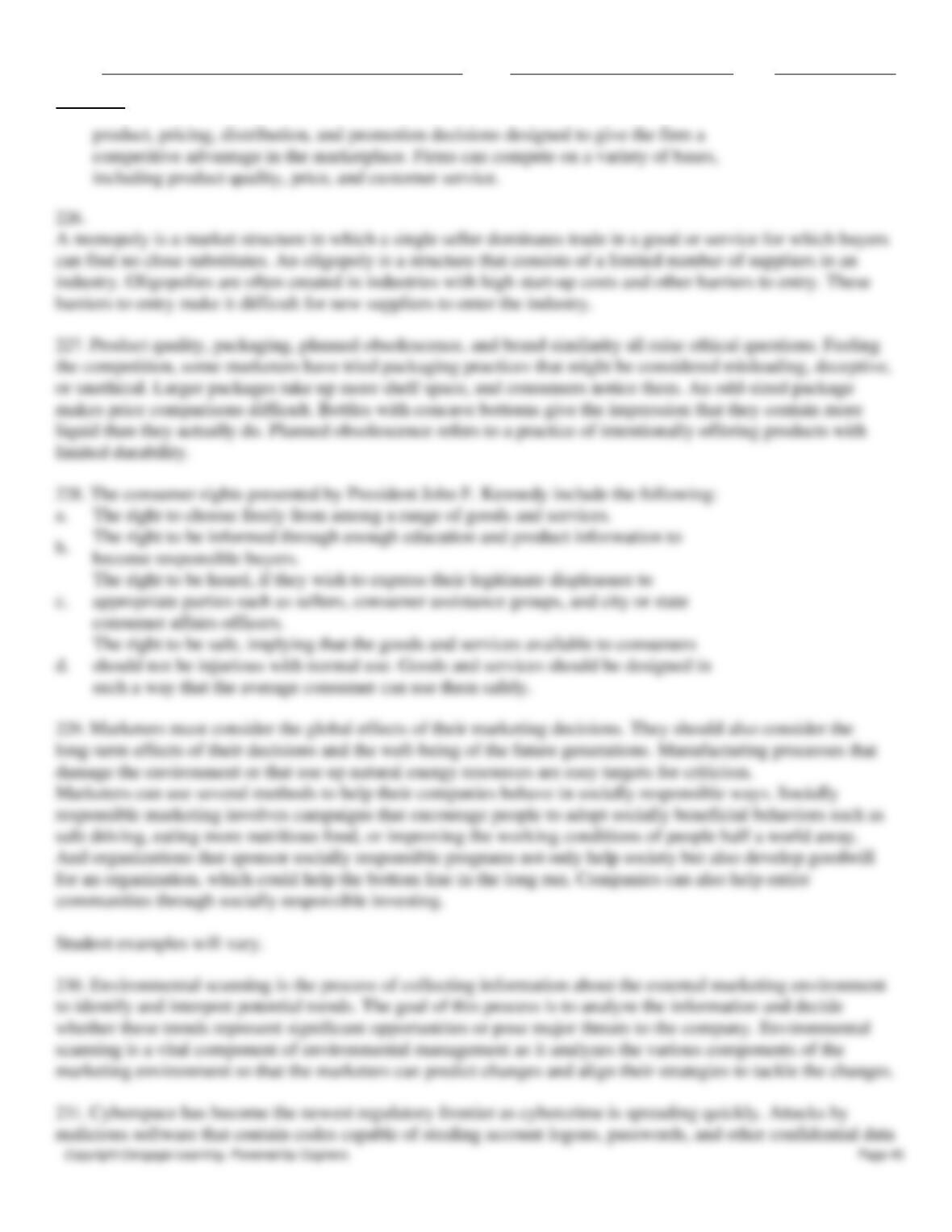
226. Explain the difference between a monopoly and an oligopoly. What creates oligopolies?
227. What ethical issues might arise when developing a product strategy?
228. Discuss each of the consumer rights presented by President John F. Kennedy.
229. How can marketers help companies to meet their social responsibility? What impact does social
responsibility have on the public’s perception of an organization? Give examples of companies that have
undertaken socially responsible initiatives.
230. Define environmental scanning. How does it contribute to environmental management?
231. Why has cyberspace become an important regulatory frontier for government regulators? What are the
measures being taken by the government to police the Internet and other online services? Governments in
certain countries are attempting to censor the Internet. Do you think this is ethical? Justify your answer.
232. Differentiate between direct and indirect competition with examples.
233. What is consumerism? What can marketers do to protect the consumer’s right to be informed?
234. Define the terms inflation and deflation. Discuss their effects on the economy with the help of real-life
examples.
235. Why is ethics regarded as a critical issue in marketing research? What are the steps taken by the
government to ensure consumer safety and privacy?
236. Summarize the economic factors that influence marketing decision making and consumer buying behavior.
237. Explain the importance of the technological environment on marketing.
238. What is a strategic alliance? Why do firms engage in strategic alliances?
239. What is the role of the Federal Trade Commission (FTC) in the regulation of marketing activities?
240. List out the four phases in the history of U.S. government regulations. Why were these regulations passed?
241. What is green marketing? Explain the influence of ecology on marketing.
242. What is demarketing? Give examples of methods used by businesses to compensate for limited resources.
243. Describe the role of ethics in the promotion of products and services.

Name:
Class:
Date:
chapter 3
244. Which particular challenge does the telecommunications industry face because of the fast pace of product
innovation? What steps are being taken to correct these barriers?
Name:
Class:
Date:
chapter 3
Answer Key

Name:
Class:
Date:
chapter 3

Name:
Class:
Date:
chapter 3
Name:
Class:
Date:
chapter 3
Name:
Class:
Date:
chapter 3
Name:
Class:
Date:
chapter 3
Name:
Class:
Date:
chapter 3
Name:
Class:
Date:
chapter 3
Name:
Class:
Date:
chapter 3
Name:
Class:
Date:
chapter 3
Name:
Class:
Date:
chapter 3
Name:
Class:
Date:
chapter 3
Name:
Class:
Date:
chapter 3