
FOR INSTRUCTOR USE ONLY
CHAPTER 3
THE ACCOUNTING INFORMATION SYSTEM
SUMMARY OF QUESTIONS BY LEARNING OBJECTIVE AND BLOOM’S TAXONOMY
Item
LO
BT
Item
LO
BT
Item
LO
BT
Item
LO
BT
Item
LO
BT
True-False Statements
1.
1
K
12.
3
K
23.
3
K
34.
4
K
45.
6
K
2.
1
C
13.
3
K
24.
3
K
35.
5
K
46.
6
K
3.
1
C
14.
3
K
25.
3
K
36.
5
K
47.
7
K
4.
1
C
15.
3
K
26.
3
K
37.
5
K
48.
7
K
5.
1
C
16.
3
K
27.
3
K
38.
5
K
49.
8
K
6.
2
K
17.
3
K
28.
3
K
39.
5
K
50.
8
C
7.
2
K
18.
3
K
29.
3
K
40.
6
K
51.
8
K
8.
2
K
19.
3
K
30.
4
K
41.
6
K
52.
8
C
9.
2
K
20.
3
K
31.
4
K
42.
6
K
53.
9
K
10.
2
K
21.
3
K
32.
4
K
43.
6
K
54.
9
K
11.
3
K
22.
3
K
33.
4
K
44.
6
K
Multiple Choice Questions
55.
1
C
89.
2
K
123.
3
C
157.
4
K
191.
6
K
56.
1
C
90.
2
K
124.
3
C
158.
4
K
192.
5
K
57.
1
C
91.
2
K
125.
3
C
159.
4
K
193.
6
K
58.
1
C
92.
2
K
126.
3
K
160.
4
K
194.
6
K
59.
1
C
93.
2
K
127.
3
C
161.
4
K
195.
6
K
60.
1
C
94.
2
K
128.
3
C
162.
4
K
196.
6
C
61.
1
C
95.
3
K
129.
3
K
163.
4
K
197.
7
K
62.
1
C
96.
3
K
130.
3
C
164.
4
K
198.
6
K
63.
1
C
97.
3
K
131.
3
K
165.
4
K
199.
7
K
64.
1
C
98.
3
K
132.
3
K
166.
4
K
200.
7
K
65.
1
C
99.
3
K
133.
3
K
167.
4
C
201.
7
K
66.
1
C
100.
3
K
134.
3
K
168.
5
C
202.
7
K
67.
1
C
101.
3
K
135.
3
C
169.
5
K
203.
7
K
68.
1
C
102.
3
K
136.
3
C
170.
5
K
204.
8
K
69.
1
C
103.
3
K
137.
3
C
171.
5
K
205.
7
AP
70.
1
C
104.
3
K
138.
3
K
172.
5
K
206.
7
AP
71.
1
C
105.
3
K
139.
3
K
173.
5
K
207.
8
K
72.
1
C
106.
3
K
140.
3
C
174.
5
K
208.
8
C
73.
1
C
107.
3
K
141.
3
AP
175.
5
K
209.
8
C
74.
1
C
108.
3
K
142.
3
AP
176.
5
C
210.
8
K
75.
1
C
109.
3
C
143.
3
AP
177.
5
AP
211.
8
K
76.
1
C
110.
3
K
144.
3
AP
178.
5
AP
212.
8
C
77.
1
C
111.
3
C
145.
3
AP
179.
5
AP
213.
8
K
78.
1
C
112.
3
C
146.
3
C
180.
5
C
214.
8
K
79.
1
C
113.
3
C
147.
3
C
181.
5
AP
215.
8
C
80.
1
C
114.
3
K
148.
3
C
182.
5
AP
216.
8
AN
81.
1
C
115.
3
K
149.
3
C
183.
8
K
217.
9
K
82.
1
C
116.
3
C
150.
3
K
184.
6
K
218.
9
K
83.
1
C
117.
3
C
151.
3
K
185.
6
K
84.
1
AP
118.
3
K
152.
3
C
186.
6
K
85.
1
AP
119.
3
K
153.
3
C
187.
6
K
86.
1
C
120.
3
K
154.
3
C
188.
6
K
87.
2
K
121.
3
K
155.
3
C
189.
6
K
88.
2
K
122.
3
C
156.
3
C
190.
6
K
Test Bank for Financial Accounting: Tools for Business Decision Making, Seventh Edition
FOR INSTRUCTOR USE ONLY
3-2
Brief Exercises
219.
1
C
221.
3
K
223.
5
AP
225.
5
C
227.
7
AP
220.
2
C
222.
3
K
224.
8
AP
226.
1
C
228.
8
AP
Exercises
229.
1
C
235.
1
AP
241.
3
K
247.
5
AP
253.
8
AP
230.
3
K
236.
1
AP
242.
3
K
248.
5
AP
254.
8
AN
231.
1
C
237.
1,5,7
AP
243.
3
K
249.
5,7
AP
255.
8
AN
232.
1
AP
238.
3
K
244.
3
C
250.
5,8
AP
256.
8
AN
233.
1
AP
239.
3
K
245.
3
K
251.
7,8
AP
257
8
AP
234.
1
AP
240.
3
C
246.
5
AP
252.
7,8
AP
258.
8
AP
Completion Statements
259.
2
K
261.
3
K
263.
4
K
265.
5
K
267.
6
K
260.
3
K
262.
3
K
264.
5
K
266.
7
K
268.
8
K
Matching
269.
1-8
K
Short Answer Essay
270.
1,4
K
272.
4, 5
C
274.
3
C
276.
5
C
278.
2
E
271.
3
K
273.
2, 3
C
275.
3
K
277.
8
C
279.
8
AN
SUMMARY OF LEARNING OBJECTIVES BY QUESTION TYPE
Learning Objective 1
Item
Type
Item
Type
Item
Type
Item
Type
Item
Type
Item
Type
1.
TF
58.
MC
66.
MC
74.
MC
82.
MC
231.
Ex
2.
TF
59.
MC
67.
MC
75.
MC
83.
MC
232.
Ex
3.
TF
60.
MC
68.
MC
76.
MC
84.
MC
233.
Ex
4.
TF
61.
MC
69.
MC
77.
MC
85.
MC
234.
Ex
5.
TF
62.
MC
70.
MC
78.
MC
86.
MC
235.
Ex
55.
MC
63.
MC
71.
MC
79.
MC
219.
BE
236.
Ex
56.
MC
64.
MC
72.
MC
80.
MC
226.
BE
237.
Ex
57.
MC
65.
MC
73.
MC
81.
MC
229.
Ex
269.
Ma
Learning Objective 2
Item
Type
Item
Type
Item
Type
Item
Type
Item
Type
Item
Type
6.
TF
9.
TF
88.
MC
91.
MC
94.
MC
269.
Ma
7.
TF
10.
TF
89.
MC
92.
MC
220.
BE
273.
SA
8.
TF
87.
MC
90.
MC
93.
MC
259.
CS
278.
SA

The Accounting Information System
FOR INSTRUCTOR USE ONLY
3-3
Learning Objective 3
Item
Type
Item
Type
Item
Type
Item
Type
Item
Type
Item
Type
11.
TF
28.
TF
110.
MC
127.
MC
144.
MC
239.
Ex
12.
TF
29.
TF
111.
MC
128.
MC
145.
MC
240.
Ex
13.
TF
95.
MC
112.
MC
129.
MC
146.
MC
241.
Ex
14.
TF
96.
MC
113.
MC
130.
MC
147.
MC
242.
Ex
15.
TF
97.
MC
114.
MC
131.
MC
148.
MC
243.
Ex
16.
TF
98.
MC
115.
MC
132.
MC
149.
MC
244.
Ex
17.
TF
99.
MC
116.
MC
133.
MC
150.
MC
245.
Ex
18.
TF
100.
MC
117.
MC
134.
MC
151.
MC
260.
CS
19.
TF
101.
MC
118.
MC
135.
MC
152.
MC
261.
CS
20.
TF
102.
MC
119.
MC
136.
MC
153.
MC
262.
CS
21.
TF
103.
MC
120.
MC
137.
MC
154.
MC
269.
Ma
22.
TF
104.
MC
121.
MC
138.
MC
155.
MC
271.
SA
23.
TF
105.
MC
122.
MC
139.
MC
156.
MC
273.
SA
24.
TF
106.
MC
123.
MC
140.
MC
221.
BE
274.
SA
25.
TF
107.
MC
124.
MC
141.
MC
222.
BE
275.
SA
26.
TF
108.
MC
125.
MC
142.
MC
230.
Ex
27.
TF
109.
MC
126.
MC
143.
MC
238.
Ex
Learning Objective 4
Item
Type
Item
Type
Item
Type
Item
Type
Item
Type
Item
Type
30.
TF
34.
TF
160.
MC
164.
MC
263.
CS
31.
TF
157.
MC
161.
MC
165.
MC
269.
Ma
32.
TF
158.
MC
162.
MC
166.
MC
270.
SA
33.
TF
159.
MC
163.
MC
167.
MC
272.
SA
Learning Objective 5
Item
Type
Item
Type
Item
Type
Item
Type
Item
Type
Item
Type
35.
TF
169.
MC
175.
MC
181.
MC
246.
Ex
265.
CS
36.
TF
170.
MC
176.
MC
182.
MC
247.
Ex
269.
Ma
37.
TF
171.
MC
177.
MC
192.
MC
248.
Ex
272.
SA
38.
TF
172.
MC
178.
MC
223.
BE
249.
Ex
276.
SA
39.
TF
173.
MC
179.
MC
225.
BE
250.
Ex
168.
MC
174.
MC
180.
MC
237.
Ex
264.
CS
Learning Objective 6
Item
Type
Item
Type
Item
Type
Item
Type
Item
Type
Item
Type
40.
TF
44.
TF
185.
MC
189.
MC
194.
MC
267.
CS
41.
TF
45.
TF
186.
MC
190.
MC
195.
MC
269.
Ma
42.
TF
46.
TF
187.
MC
191.
MC
196.
MC
43.
TF
184.
MC
188.
MC
193.
MC
198.
MC
Learning Objective 7
Item
Type
Item
Type
Item
Type
Item
Type
Item
Type
Item
Type
47.
TF
199.
MC
202.
MC
206.
MC
249.
Ex
266.
CS
48.
TF
200.
MC
203.
MC
227.
BE
251.
Ex
269.
Ma
197.
MC
201.
MC
205.
MC
237.
Ex
252.
Ex
Test Bank for Financial Accounting: Tools for Business Decision Making, Seventh Edition
FOR INSTRUCTOR USE ONLY
3-4
Learning Objective 8
Item
Type
Item
Type
Item
Type
Item
Type
Item
Type
Item
Type
49.
TF
204.
MC
211.
MC
216.
MC
253.
Ex
258.
Ex
50.
TF
207.
MC
212.
MC
224.
BE
254.
Ex
268.
CS
51.
TF
208.
MC
213.
MC
228.
BE
255.
Ex
269.
Ma
52.
TF
209.
MC
214.
MC
250.
Ex
256.
Ex
277.
SA
183.
MC
210.
MC
215.
MC
252.
Ex
257.
Ex
279.
SA
Learning Objective 9
Item
Type
Item
Type
Item
Type
Item
Type
Item
Type
Item
Type
53.
TF
54.
TF
217.
MC
218.
MC
Note: TF = True-False C = Completion
MC = Multiple Choice Ex = Exercise
Ma = Matching SA = Short Answer Essay
CHAPTER LEARNING OBJECTIVES
1. Analyze the effect of business transactions on the basic accounting equation. Each
business transaction must have a dual effect on the accounting equation. For example, if an
individual asset is increased, there must be a corresponding (a) decrease in another asset, or
(b) increase in a specific liability, or (c) increase in stockholders’ equity.
2. Explain what an account is and how it helps in the recording process. An account is an
individual accounting record of increases and decreases in specific asset, liability, and
stockholders’ equity items.
3. Define debits and credits and explain how they are used to record business
transactions. The terms debit and credit are synonymous with left and right. Assets,
dividends, and expenses are increased by debits and decreased by credits. Liabilities,
common stock, retained earnings, and revenues are increased by credits and decreased by
debits.
4. Identify the basic steps in the recording process. The basic steps in the recording process
are (a) analyze each transaction in terms of its effect on the accounts, (b) enter the
transaction information in a journal, and (c) transfer the journal information to the appropriate
accounts in the ledger.
5. Explain what a journal is and how it helps in the recording process. The initial
accounting record of a transaction is entered in a journal before the data are entered in the
accounts. A journal (a) discloses in one place the complete effect of a transaction, (b)
provides a chronological record of transactions, and (c) prevents or locates errors because
the debit and credit amounts for each entry can be readily compared.
6. Explain what a ledger is and how it helps in the recording process. The entire group of
accounts maintained by a company is referred to collectively as a ledger. The ledger provides
the balance in each of the accounts as well as keeps track of changes in these balances.
7. Explain what posting is and how it helps in the recording process. Posting is the
procedure of transferring journal entries to the ledger accounts. This phase of the recording
process accumulates the effects of journalized transactions in the individual accounts.
The Accounting Information System
3-5
8. Explain the purposes of a trial balance. A trial balance is a list of accounts and their
balances at a given time. The primary purpose of the trial balance is to prove the
mathematical equality of debits and credits after posting. A trial balance also uncovers errors
in journalizing and posting and is useful in preparing financial statements.
9. Classify cash activities as operating, investing, or financing. Operating activities are the
types of activities the company performs to generate profits. Investing activities relate to the
purchase or sale of long-lived assets used in operating the business, or to the purchase or
sale of investment securities (stock and bonds of other companies). Financing activities are
borrowing money, issuing shares of stock, and paying dividends.
TRUE-FALSE STATEMENTS
1. Economic events that require recording in the financial statements are called accounting
transactions.
2. Revenue increases stockholders’ equity and should be recorded whenever cash is
received from customers.
3. Collection on an account receivable will increase both cash and accounts receivable.
4. The payment of a liability decreases both cash and accounts payable.
5. If total assets are increased, there must be a corresponding increase in liabilities or a
decrease in stockholders’ equity.
6. A new account is opened for each transaction entered into by a business firm.
7. The recording process becomes more efficient and informative if all transactions are
recorded in one account.
8. An account consists of two parts: (1) a left or debit side and (2) a right or credit side.
9. For a T account, an account balance is the difference in total dollars between total debit
amounts and total credit amounts.
Test Bank for Financial Accounting: Tools for Business Decision Making, Seventh Edition
FOR INSTRUCTOR USE ONLY
3-6
10. An account is often referred to as a T-account because of the way it is constructed.
11. A debit to an account always indicates an increase in that account.
12. If a revenue account is credited, the revenue account is increased.
13. The normal balance of all accounts is a debit.
14. Debit and credit can be interpreted to mean “bad” and “good”, respectively.
15. A credit means that an account has been increased.
16. A decrease in a liability account is recorded by a debit.
17. An increase in an asset is recorded by a debit.
18. The double-entry system of accounting refers to the placement of a double line at the end
of a column of figures.
19. A credit balance in a liability account indicates that an error in recording has occurred.
20. The normal balance of an asset is a credit.
21. The normal balance of the dividend account is a credit.
22. Assets are decreased with a credit.
23. A debit means that an account has been decreased.
24. A decrease in a liability is recorded by a debit.
The Accounting Information System
FOR INSTRUCTOR USE ONLY
3-7
25. An increase in an asset is recorded by a debit.
26. Liabilities are increased with debits and decreased with credits.
27. The dividends account is a subdivision of the retained earnings account and appears as
an expense on the income statement.
28. Revenues are a subdivision of stockholders’ equity.
29. Under the double-entry system, revenues must always equal expenses.
30. Transactions are entered in the ledger first and then they are analyzed in terms of their
effect on the accounts.
31. Source documents can provide evidence that a transaction has occurred.
32. Each transaction must be analyzed in terms of its effect on the accounts before it can be
recorded in a journal.
33. Transactions are entered in the ledger accounts and then transferred to journals.
34. All business transactions must be entered first in the general ledger.
35. Transactions are recorded in alphabetical order in a journal.
36. The journal is a chronological record of all transactions.
37. A journal is an accounting record in which transactions are initially recorded.
38. The complete effect of a transaction on the accounts is disclosed in the journal.
Test Bank for Financial Accounting: Tools for Business Decision Making, Seventh Edition
3-8
39. The account titles used in journalizing transactions need not be identical to the account
titles in the ledger.
40. The chart of accounts is a special ledger used in accounting systems.
41. A general ledger should be arranged in financial statement order beginning with the
balance sheet accounts.
42. The entire group of accounts maintained by a company is referred to collectively as the
journal.
43. Prepaid expenses are assets.
44. Salaries and wages payable is a type of expense.
45. Dividends are classified as an expense.
46. Unearned Service Revenue is classified as a liability on the balance sheet.
47. Posting is the process of proving the equality of debits and credits in the trial balance.
48. Entering transactions into the journal is called posting.
49. A trial balance is prepared at the beginning of an accounting period.
50. A trial balance does not prove that all transactions have been recorded or that the ledger
is correct.
51. In a trial balance, all debits are listed before all credits.
52. When the columns of the trial balance equal each other, it means that no errors have
occurred in the recording and posting the transactions.
53. Operating activities are the types of activities the company performs to generate profits.
54. Financing activities include the purchase or sale of long-lived assets or the purchase or
sale of investment securities.
Answers to True-False Statements
MULTIPLE CHOICE QUESTIONS
55. If total liabilities decreased by $4,000, then
a. stockholders’ equity must have decreased by $4,000.
b. assets must have decreased by $4,000, or stockholders’ equity must have increased
by $4,000.
c. assets and stockholders’ equity each increased by $2,000.
d. assets must have increased by $4,000.
56. Collection of a $600 Accounts Receivable
a. increases an asset $600; decreases an asset $600.
b. increases an asset $600; decreases a liability $600.
c. decreases a liability $600; increases stockholders’ equity $600.
d. decreases an asset $600; decreases a liability $600.
Test Bank for Financial Accounting: Tools for Business Decision Making, Seventh Edition
3-10
57. If an individual asset is increased, then
a. there could be an equal decrease in a specific liability.
b. there could be an equal decrease in stockholders’ equity.
c. there could be an equal decrease in another asset.
d. None of these answer choices are correct.
58. If services are rendered on account, then
a. assets will decrease.
b. liabilities will increase.
c. stockholders’ equity will increase.
d. liabilities will decrease.
59. If services are rendered for cash, then
a. assets will increase.
b. liabilities will increase.
c. stockholders’ equity will decrease.
d. liabilities will decrease.
60. If expenses are paid in cash, then
a. assets will increase.
b. liabilities will decrease.
c. stockholders’ equity will increase.
d. assets will decrease.
61. An investment by the stockholders in a business increases
a. assets and stockholders’ equity.
b. assets and liabilities.
c. liabilities and stockholders’ equity.
d. assets only.
62. The purchase of an asset for cash
a. increases assets and stockholders’ equity.
b. increases assets and liabilities.
c. decreases assets and increases liabilities.
d. leaves total assets unchanged.
63. The purchase of an asset on credit
a. increases assets and stockholders’ equity.
b. increases assets and liabilities.
c. decreases assets and increases liabilities.
d. leaves total assets unchanged.
The Accounting Information System
3-11
64. The payment of a liability
a. decreases assets and stockholders’ equity.
b. increases assets and decreases liabilities.
c. decreases assets and increases liabilities.
d. decreases assets and liabilities.
65. The sale of an asset on credit for what it cost
a. increases assets and liabilities.
b. decreases assets and liabilities.
c. leaves total assets unchanged.
d. decreases assets and increases liabilities.
66. When collection is made on Accounts Receivable,
a. total assets will remain the same.
b. stockholders equity will increase.
c. total assets will increase.
d. total assets will decrease.
67. A revenue generally
a. increases assets and liabilities.
b. increases assets and stockholders’ equity.
c. increases assets and decreases stockholders’ equity.
d. leaves total assets unchanged.
68. A paid dividend
a. decreases assets and stockholders’ equity.
b. increases assets and stockholders’ equity.
c. increases assets and decreases stockholders’ equity.
d. decreases assets and increases stockholders’ equity.
69. Receiving payment of a portion of an accounts receivable will
a. not affect total assets.
b. increase liabilities.
c. increase stockholders’ equity.
d. decrease net income.
70. An expense
a. decreases assets and liabilities.
b. decreases stockholders’ equity.
c. leaves stockholders’ equity unchanged.
d. is basically the same as a liability.
Test Bank for Financial Accounting: Tools for Business Decision Making, Seventh Edition
3-12
71. Which of the following items has no effect on retained earnings?
a. Expense
b. Dividends
c. Land purchase
d. Revenue
72. If a company buys a $700 machine on credit, this transaction will affect the
a. income statement and retained earnings statement only.
b. income statement only.
c. income statement, retained earnings statement, and balance sheet.
d. balance sheet only.
73. A payment of a portion of an accounts payable will
a. not affect total assets.
b. increase liabilities.
c. not affect stockholders’ equity.
d. decrease net income.
74. Powers Corporation received a cash advance of $500 from a customer. As a result of this
event,
a. assets increased by $500.
b. equity increased by $500.
c. liabilities decreased by $500.
d. Both assets and equity increased by $500.
75. Courtney Company purchased equipment for $1,800 cash. As a result of this event,
a. equity decreased by $1,800.
b. assets increased by $1,800.
c. total assets remained unchanged.
d. Both assets and equity decreased by $1,800.
76. Comstock Company provided consulting services and billed the client $2,500. As a result
of this event
a. assets remained unchanged.
b. assets increased by $2,500.
c. equity increased by $2,500
d. Both assets and equity increased by $2,500.
The Accounting Information System
3-13
77. Budke Corporation paid dividends of $5,000. As a result of this event, the
a. Dividends account was increased by $5,000.
b. Dividends account was decreased by $5,000.
c. Cash account was increased by $5,000.
d. Cash was increased and the Dividends account was decreased by $5,000.
78. If a company pays dividends of $10,000,
a. stockholders’ equity will be reduced by $10,000.
b. net income will be reduced by $10,000.
c. retained earnings will be reduced by $10,000.
d. Both retained earnings and stockholders’ equity will be reduced by $10,000.
79. If a company issues common stock for $40,000 and uses $30,000 of the cash to purchase
a truck,
a. assets will be increased by $10,000.
b. equity will be reduced by $40,000.
c. assets will be increased by $40,000.
d. assets will be unchanged.
80. Are advanced receipts from customers treated as revenue at the time of receipt? Why or
why not?
a. Yes, they are treated as revenue at the time of receipt because the company has
access to the cash.
b. No, the amount of revenue cannot be adequately determined until the company
completes the work.
c. Yes, The intent of the company is to perform the work and the customer is confident
that the services will be completed.
d. No, revenue cannot be recognized until the work is performed.
81. The receipt of cash in advance from a customer
a. increases assets and stockholders’ equity.
b. increases assets and decreases stockholders’ equity.
c. increases assets and liabilities.
d. none of these answer choices are correct.
Test Bank for Financial Accounting: Tools for Business Decision Making, Seventh Edition
3-14
82. On March 1, 2014, Freeze Company hires a new employee who will start to work on
March 6. The employee will be paid on the last day of each month. Should a journal entry
be made on March 6? Why or why not?
a. Yes, the company is now obligated to pay the employee, thus that event must be
recorded.
b. No, hiring an employee is an important event; however it is not an economic event that
should be recorded.
c. Yes, failure to record the event would cause the financial statements to be misleading.
d. No, the financial position of the company has been changed, however, the dollar
amount of the transaction is not yet known.
83. Howard Company had a transaction that caused a $5,000 increase in both assets and
total liabilities. This transaction could have been a(n)
a. purchase of office equipment for $12,000, paying $7,000 cash and issuing a note
payable for the balance.
b. investment of $5,000 cash in the business by the stockholders.
c. purchase of office equipment for $5,000 cash.
d. repayment of a $5,000 bank loan.
84. Jamal Company began the year with $84,000 in its Common Stock account and a debit
balance in Retained Earnings of $36,000. During the year, the company earned net
income of $18,000 and declared and paid $6,000 of dividends. In addition, the company
sold additional common stock amounting to $22,000. Based on this information, what
should the transaction analysis show for the ending total of all stockholders’ equity
accounts?
a. $154,000
b. $166,000
c. $82,000
d. $110,000
85. Crawford Company started the year with $30,000 in its Common Stock account and a
credit balance in Retained Earnings of $22,000. During the year, the company earned net
income of $24,000 and declared and paid $10,000 of dividends. In addition, the company
sold additional common stock amounting to $14,000. As a result, the amount of its
retained earnings at the end of the year would be
a. $80,000.
b. $36,000.
c. $66,000.
d. $50,000.
The Accounting Information System
3-15
86. All of the following are characteristics of every accounting information system except it is
a system
a. that collects transaction data.
b. that processes transaction data.
c. that communicates financial information to decision makers.
d. of data storage hardware for the chart of accounts.
87. The left side of an account is
a. blank.
b. a description of the account.
c. the debit side.
d. the balance of the account.
88. Which one of the following is not a part of an account?
a. Credit side
b. Trial balance
c. Debit side
d. Title
89. An account is a part of the financial information system and is described by each one of
the following except
a. an account has a debit and credit side.
b. an account is a source document.
c. an account consists of three parts.
d. an account has a title.
90. The right side of an account
a. is the correct side.
b. reflects all transactions for the accounting period.
c. shows all the balances of the accounts in the system.
d. is the credit side.
91. An account consists of
a. a title, a debit balance, and a credit balance.
b. a title, a left side, and a debit balance.
c. a title, a debit side, and a credit side.
d. a title, a right side, and a debit balance.
Test Bank for Financial Accounting: Tools for Business Decision Making, Seventh Edition
3-16
92. A T-account is
a. a way of depicting the basic form of an account.
b. a special account used instead of a journal.
c. a special account used instead of a trial balance.
d. used for accounts that have both a debit and credit balance.
93. Which statement about an account is true?
a. In its simplest form, an account consists of two parts.
b. An account is an individual accounting record of increases and decreases in specific
asset, liability, and stockholders’ equity items.
c. There are separate account for specific assets and liabilities but only one account for
stockholders’ equity items.
d. The left side of an account is the credit or decrease side.
94. In its simplest form, an account consists of all of the following except
a. right (credit) side.
b. account title.
c. left side.
d. explanation column.
95. A debit to an asset account indicates a(n)
a. error.
b. credit was made to a liability account.
c. decrease in the asset.
d. increase in the asset.
96. Debits
a. increase both assets and liabilities.
b. decrease both assets and liabilities.
c. increase assets and decrease liabilities.
d. decrease assets and increase liabilities.
97. The normal balance of any account is the
a. left side.
b. right side.
c. side which increases that account.
d. side which decreases that account.
The Accounting Information System
3-17
98. The double-entry system requires that each transaction must be recorded
a. in at least two different accounts.
b. in two sets of books.
c. in a journal and in a ledger.
d. first as a revenue and then as an expense.
99. A credit is not the normal balance for which account listed below?
a. Common Stock account
b. Revenue account
c. Liability account
d. Dividends account
100. The classification and normal balance of the Dividends account is
a. revenue with a credit balance.
b. an expense with a debit balance.
c. a liability with a credit balance.
d. stockholders’ equity with a debit balance.
101. Which of the following describes the classification and normal balance of the Retained
Earnings account?
a. Asset, debit
b. Stockholders’ equity, credit
c. Revenues, credit
d. Expense, debit
102. Which of the following describes the classification and normal balance of the Unearned
Rent Revenue account?
a. Asset, debit
b. Liability, credit
c. Revenues, credit
d. Expense, debit
103. A revenue account
a. is increased by debits.
b. is decreased by credits.
c. has a normal balance of a debit.
d. is increased by credits.
Test Bank for Financial Accounting: Tools for Business Decision Making, Seventh Edition
3-18
104. Which one of the following represents the expanded basic accounting equation?
a. Assets = Liabilities + Common Stock + Dividends – Revenue – Expenses
b. Assets + Dividends + Expenses = Liabilities + Common Stock + Revenues
c. Assets – Liabilities – Dividends = Common Stock + Revenues – Expenses
d. Assets = Revenues + Expenses – Liabilities
105. Which of the following correctly identifies normal balances of accounts?
a. Assets Debit
Liabilities Credit
Common Stock Credit
Revenues Debit
Expenses Credit
b. Assets Debit
Liabilities Credit
Common Stock Credit
Revenues Credit
Expenses Credit
c. Assets Credit
Liabilities Debit
Common Stock Debit
Revenues Credit
Expenses Debit
d. Assets Debit
Liabilities Credit
Common Stock Credit
Revenues Credit
Expenses Debit
106. Which accounts normally have debit balances?
a. Assets, expenses, and revenues
b. Assets, expense, and retained earnings
c. Assets, liabilities, and dividends
d. Assets, expenses, and dividends
107. Which accounts normally have credit balances?
a. Revenues, liabilities, and dividends
b. Revenues, liabilities, and assets
c. Revenues, liabilities, and retained earnings
d. Revenues, liabilities, and expenses
The Accounting Information System
3-19
108. The best interpretation of the word “credit” is the
a. offset side of an account.
b. increase side of an account.
c. right side of an account.
d. decrease side of an account.
109. In recording an accounting transaction in a double-entry system
a. the number of debit accounts must equal the number of credit accounts.
b. there must always be entries made on both sides of the accounting equation.
c. the amount of the debits must equal the amount of the credits.
d. there must only be two accounts affected by any transaction.
110. A debit is not the normal balance for which account listed below?
a. Dividends
b. Cash
c. Accounts Receivable
d. Service Revenue
111. An accountant has debited an asset account for $1,000 and credited a liability account for
$500. What can be done to complete the recording of the transaction?
a. Nothing further must be done.
b. Debit a stockholders’ equity account for $500.
c. Debit another asset account for $500.
d. Credit a different asset account for $500.
112. An accountant has debited an asset account for $800 and credited a liability account for
$700. Which of the following would be an incorrect way to complete the recording of the
transaction?
a. Credit an asset account for $100.
b. Credit another liability account for $100.
c. Credit a stockholders’ equity account for $100.
d. Debit a stockholders’ equity account for $100.
113. An accountant has debited an asset account for $900 and credited a liability account for
$600. What can be done to complete the recording of the transaction?
a Debit a stockholders’ equity account for $300.
b. Debit another asset account for $300.
c. Credit a different asset account for $300.
d. Nothing further must be done.
Test Bank for Financial Accounting: Tools for Business Decision Making, Seventh Edition
3-20
114. Which of the following accounts is increased with a debit?
a. Dividends
b. Service Revenue
c. Interest Payable
d. Common Stock
115. Which of the following accounts is increased with a credit?
a. Supplies Expense
b. Supplies
c. Sales Revenue
d. Dividends
116. Which pair of accounts follows the rules of debit and credit in relation to increases and
decreases in the same manner?
a. Dividends Payable and Rent Expense
b. Utilities Expense and Notes Payable
c. Prepaid Insurance and Advertising Expense
d. Service Revenue and Equipment
117. Which of the following accounts follows the rules of debit and credit in relation to
increases and decreases in the opposite manner?
a. Prepaid Insurance and Dividends
b. Dividends and Interest Revenue
c. Interest Payable and Common Stock
d. Advertising Expense and Land
118. Which of the following is not true of the terms debit and credit?
a. They can be abbreviated as Dr. and Cr.
b. They can be interpreted to mean increase and decrease.
c. They can be used to describe the balance of an account.
d. They can be interpreted to mean left and right.
119. An account will have a credit balance if the
a. credits exceed the debits.
b. first transaction entered was a credit.
c. debits exceed the credits.
d. last transaction entered was a credit.
The Accounting Information System
3-21
120. For the basic accounting equation to stay in balance, each transaction recorded must
a. affect two or less accounts.
b. affect two or more accounts.
c. always affect exactly two accounts.
d. affect the same number of asset and liability accounts.
121. Which of the following statements is true?
a. Debits increase assets and increase liabilities.
b. Credits decrease assets and decrease liabilities.
c. Credits decrease assets and increase liabilities.
d. Debits increase liabilities and decrease assets.
122. Which pair of the listed accounts follows the rules of debits and credits in relation to
increases and decreases in the same manner?
a. Salaries and Wages Expense and Notes Payable
b. Common Stock and Rent Expense
c. Prepaid Rent and Advertising Expense
d. Service Revenue and Equipment
123. Which pair of the listed accounts follows the rules of debits and credits in relation to
increases and decreases in the opposite manner?
a. Salaries and Wages Expense and Notes Payable
b. Common Stock and Unearned Rent Revenue
c. Prepaid Rent and Advertising Expense
d. Service Revenue and Notes Payable
124. A company that receives money in advance of performing a service
a. debits Cash and credits Unearned Service Revenue.
b. debits Unearned Service Revenue and credits Accounts Payable
c. debits Cash and credits Prepaid Insurance.
d. debits Cash and credits Accounts Receivable.
125. When a company performs a service but has not yet received payment, it
a. debits Service Revenue and credits Accounts Receivable.
b. debits Accounts Receivable and credits Service Revenue.
c. debits Service Revenue and credits Accounts Payable.
d. makes no entry until cash is received.
Test Bank for Financial Accounting: Tools for Business Decision Making, Seventh Edition
3-22
126. Assets normally show
a. credit balances.
b. debit balances.
c. debit and credit balances.
d. debit or credit balances.
127. An awareness of the normal balances of accounts would help you spot which of the
following as an error in recording?
a. A debit balance in the Dividends account
b. A credit balance in an expense account
c. A credit balance in a liabilities account
d. A credit balance in a revenue account
128. If a company has overdrawn its bank balance, then
a. its Cash account will show a debit balance.
b. its Cash account will show a credit balance.
c. the Cash account debits will exceed the cash account credits.
d. it cannot be detected by observing the balance of the Cash account.
129. Which account below is not a subdivision of stockholders’ equity?
a. Dividends
b. Revenues
c. Expenses
d. Liabilities
130. When a corporation distributes a dividend the
a. most common form of distribution is a cash dividend.
b. Dividends account will be increased with a credit.
c. Retained Earnings account will be directly increased with a debit.
d. Dividends account will be decreased with a debit.
131. The Dividends account
a. appears on the income statement along with the expenses of the business.
b. must show transactions every accounting period.
c. is increased with debits and decreased with credits.
d. is not a proper subdivision of stockholders’ equity.
The Accounting Information System
3-23
132. A revenue account
a. is increased with a debit.
b. is decreased with a credit.
c. is increased with a credit.
d. has a normal balance of a debit.
133. Which of the following statements is not true?
a. Expenses increase stockholders’ equity.
b. Expenses have normal debit balances.
c. Expenses decrease stockholders’ equity.
d. Expenses are a negative factor in the computation of net income.
134. A credit to a liability account
a. indicates an increase in the amount owed to creditors.
b. indicates a decrease in the amount owed to creditors.
c. is an error.
d. must be accompanied by a debit to an asset account.
135. In the first month of operations, the total of the debit entries to the Cash account
amounted to $1,400 and the total of the credit entries to the Cash account amounted to
$800. The Cash account has a
a. $800 credit balance.
b. $1,400 debit balance.
c. $600 debit balance.
d. $600 credit balance.
136. In the first month of operations, the total of the debit entries to the Cash account
amounted to $1,200 and the total of the credit entries to the Cash account amounted to
$900. The Cash account has a
a. $900 credit balance.
b. $300 debit balance.
c. $1,200 debit balance.
d. $300 credit balance.
Test Bank for Financial Accounting: Tools for Business Decision Making, Seventh Edition
FOR INSTRUCTOR USE ONLY
3-24
137. In the first month of operations, the total of the debit entries to the Cash account
amounted to $1,000 and the total of the credit entries to the Cash account amounted to
$600. The Cash account has a
a. $600 credit balance.
b. $1,000 debit balance.
c. $400 debit balance.
d. $600 credit balance.
138. The Cash account has a credit balance. Which statement is true?
a. This is the normal balance for cash.
b. An error has occurred and must be corrected before financial statements can be
prepared.
c. The account needs to be analyzed to determine the reason for the credit balance.
d. Debit postings exceed the credit postings for the accounting period.
139. Which statement is incorrect?
a. Dividends represent a distribution by a corporation to its stockholders.
b. Dividends are shown on the income statement.
c. Dividends reduce stockholders’ equity, thus the Dividends account increases on the
left side.
d. The Dividends account has a normal debit balance.
140. Why are expenses increased with a debit?
a. They are always paid by cash, which is credited. Thus expenses are debited.
b. They decrease stockholders’ equity thus they increase with a debit.
c. They have the same rules of debits and credits as the retained earnings account.
d. None of the statements are correct.
141. Barnes Company showed the following balances at the end of its first year:
Cash $14,000
Prepaid insurance 700
Accounts receivable 3,500
Accounts payable 2,800
Notes payable 4,200
Common stock 5,400
Dividends 700
Revenues 24,000
Expenses 17,500
The Accounting Information System
3-25
Mc. 141 (count)
What did Barnes Company show as total credits on its trial balance?
a. $37,100
b. $36,400
c. $35,700
d. $37,800
142. Winrow Company showed the following balances at the end of its first year:
Cash $11,000
Prepaid insurance 500
Accounts receivable 2,500
Accounts payable 2,000
Notes payable 3,000
Common stock 5,000
Dividends 500
Revenues 17,000
Expenses 12,500
What did Winrow Company show as total credits on its trial balance?
a. $27,500
b. $27,000
c. $26,500
d. $28,000
143. During January 2014, its first month of operation, Osborn Enterprises earned net income
of $1,700 and paid dividends to the owners of $500. At January 31, the balance in
Retained Earnings will be
a. $0.
b. $1,700 credit.
c. $1,200 credit.
d. $500 debit.
144. On June 1, 2014, England Inc. reported a cash balance of $21,000. During June, England
made deposits of $8,000 and made disbursements totaling $24,000. What is the cash
balance at the end of June?
a. $5,000 credit balance
b. $29,000 debit balance
c. $5,000 debit balance
d. $3,000 credit balance
Test Bank for Financial Accounting: Tools for Business Decision Making, Seventh Edition
3-26
145. At January 1, 2014, Troyer Industries reported Retained Earnings of $280,000. During
2014, Troyer had a net loss of $60,000 and paid dividends to the stockholders of $40,000.
At December 31, 2014, the balance in Retained Earnings is
a. $280,000 debit.
b. $240,000 credit.
c. $220,000 debit.
d. $180,000 credit.
146. During January 2014, Carey Services Inc. paid a cash dividends of $2,000. This
transaction
a. reduces stockholders’ equity by $2,000.
b. increases stockholders’ equity by $2,000.
c. reduces net income by $2,000.
d. increases expenses by $2,000.
147. During February 2014, its first month of operations, the owner of Schwenn Enterprises
invested cash of $40,000. Schwenn had cash sales of $8,000 and paid expenses of
$14,000. Assuming no other transactions impacted the cash account, what is the balance
in Cash at February 28?
a. $6,000 credit
b. $34,000 debit
c. $48,000 debit
d. $26,000 credit
148. At September 1, 2014, Kern Enterprises reported a cash balance of $70,000. During the
month, Kern collected cash of $30,000 and made disbursements of $50,000. At
September 30, 2014, the cash balance is
a. $20,000 credit.
b. $50,000 credit.
c. $100,000 debit.
d. $50,000 debit.
149. All of the following statements regarding the double-entry system are true except
a. a two-sided effect of each transaction is recorded in appropriate accounts when using
the double-entry system.
b. the double-entry system provides a logical method for recording transactions.
c. both sides of the accounting equation must be affected when recording a transaction
using the double-entry system.
d. when using the double-entry system, the sum of all debits to the accounts must equal
the sum of all credits.
The Accounting Information System
3-27
150. Which of the following accounts has a normal debit balance?
a. Accounts Payable
b. Prepaid Rent
c. Retained Earnings
d. Common Stock
151. Which of the following accounts has a normal credit balance?
a. Prepaid Rent
b. Notes Receivable
c. Rent Revenue
d. Rent Expense
152. During 2014, its first year of operations, Jane’s Bakery had revenues of $65,000 and
expenses of $33,000. The business paid cash dividends of $18,000. What is the balance
in Retained Earnings at December 31, 2014?
a. $0
b. $18,000 debit
c. $14,000 credit
d. $32,000 credit
153. At January 31, 2014, the balance in Goebel Inc.’s supplies account was $700. During
February. Goebel purchased supplies of $600 and used supplies of $800. At the end of
February, the balance in the Supplies account should be
a. $700 debit.
b. $900 credit.
c. $2,100 debit.
d. $500 debit.
154. At December 1, 2014, Orear Company’s Accounts Receivable balance was $5,600.
During December, Orear had credit sales of $15,000 and collected accounts receivable of
$12,000. At December 31, 2014, the Accounts Receivable balance is
a. $5,600 debit
b. $8,600 debit
c. $20,600 debit
d. $8,600 credit
Test Bank for Financial Accounting: Tools for Business Decision Making, Seventh Edition
3-28
155. At October 1, 2014, Metz Industries had an Accounts Payable balance of $70,000. During
the month, the company made purchases on account of $50,000 and made payments on
account of $80,000. At October 31, 2014, the Accounts Payable balance is
a. $70,000 debit
b. $10,000 credit
c. $40,000 credit
d. $80,000 credit
156. At September 1, 2014, Baxter Inc. reported Retained Earnings of $282,000. During the
month, Baxter generated revenues of $40,000, incurred expenses of $24,000, purchased
equipment for $10,000 and paid dividends of $4,000. What is the balance in Retained
Earnings at September 30, 2014?
a. $282,000 debit
b. $16,000 credit
c. $284,000 credit
d. $294,000 credit
157. The usual sequence of steps in the transaction recording process is
a. journalize, analyze, post to the ledger.
b. analyze, journalize, post to the ledger.
c. journalize, post to the ledger, analyze.
d. post to the ledger, journalize, analyze.
158. In recording accounting transactions, evidence that a transaction has taken place is
obtained from
a. source documents.
b. the Internal Revenue Service.
c. the public relations department.
d. the Securities and Exchange Commission.
159. After a business transaction has been analyzed and entered in the book of original entry,
the next step in the recording process is to transfer the information to
a. the company’s bank.
b. stockholders’ equity.
c. ledger accounts.
d. financial statements.
The Accounting Information System
3-29
160. The first step in the recording process is to
a. prepare financial statements.
b. analyze the transaction in terms of its effect on the accounts.
c. post to a journal.
d. prepare a trial balance.
161. Which of the following is not part of the recording process?
a. Analyzing transactions
b. Preparing a trial balance
c. Entering transactions in a journal
d. Posting journal entries
162. Evidence that would not help with determining the effects of a transaction on the accounts
would be a(n)
a. cash register sales tape.
b. bill.
c. advertising brochure.
d. check.
163. After transaction information has been recorded in the journal, it is transferred to the
a. trial balance.
b. income statement.
c. general journal.
d. ledger.
164. The usual sequence of steps in the recording process is to
a. analyze each transaction, enter the transaction in the journal, and transfer the
information to the ledger accounts.
b. analyze each transaction, enter the transaction in the ledger, and transfer the
information to the journal.
c. analyze each transaction, enter the transaction in the book of accounts, and transfer
the information to the journal.
d. analyze each transaction, enter the transaction in the book of original entry, and
transfer the information to the journal.
165. The final step in the recording process is to transfer the journal information to the
a. trial balance.
b. financial statements.
c. ledger.
d. file cabinets.
Test Bank for Financial Accounting: Tools for Business Decision Making, Seventh Edition
3-30
166. The recording process occurs
a. once a year.
b. once a month.
c. repeatedly during the accounting period.
d. infrequently in a manual accounting system.
167. Which of the following is not an example of a source document that provides evidence of
a transaction?
a. A cancelled check
b. A sales slip
c. A trial balance
d. A cash register tape
168. All of the following are significant contributions that the journal makes to the recording
process except the journal
a. discloses the complete effect of a transaction in one place.
b. helps prevent or locate errors because debits and credits can be readily compared.
c. keeps complete information about changes in a specific account balance in one place.
d. provides a chronological record of transactions.
169. A journal provides
a. the balances for each account.
b. information about a transaction in several different places.
c. a list of all accounts used in the business.
d. a chronological record of transactions.
170. The basic format of a journal would not include a(n)
a. brief explanation.
b. account title column.
c. T-account.
d. date column.
171. Transactions in a journal are initially recorded in
a. account number order.
b. dollar amount order.
c. alphabetical order.
d. chronological order.
The Accounting Information System
3-31
172. A journal is not useful for
a. disclosing in one place the complete effect of a transaction.
b. preparing financial statements.
c. providing a record of transactions.
d. locating and preventing errors.
173. A complete journal entry does not show
a. the date of the transaction.
b. the new balance in the accounts affected by the transaction.
c. a brief explanation of the transaction.
d. the accounts and amounts to be debited and credited.
174. The name given to entering transaction data in the journal is
a. chronicling.
b. listing.
c. posting.
d. journalizing.
175. The basic form of a journal entry has the
a. debit account entered first and indented.
b. credit account entered first and indented.
c. debit account entered first at the extreme left margin.
d. credit account entered first at the extreme left margin.
176. Which of the following journal entries is recorded correctly and in the basic format?
a. Salaries and Wages Expense 550
Cash 1,500
Advertising Expense 950
b. Salaries and Wages Expense 550
Advertising Expense 950
Cash 1,600
c. Cash 1,500
Salaries and Wages Expense 550
Advertising Expense 950
d. Salaries and Wages Expense 550
Advertising Expense 950
Cash 1,500
Test Bank for Financial Accounting: Tools for Business Decision Making, Seventh Edition
3-32
177. When a company has performed a service but has not yet received payment, it
a. debits accounts receivable and credits service revenue.
b. debits revenue from services and credits accounts receivable.
c. debits revenue from services and credits accounts payable.
d. makes no entry until the cash is received.
178. A company that receives money in advance of performing a service
a. debits cash and credits prepaid services.
b. debits unearned fees and credits accounts payable.
c. debits cash and credits unearned service revenue.
d. debits cash and credits accounts receivable.
179. When a company receives a utility bill but will not pay it right away, it should
a. debit Utilities Expense and credit Accounts Receivable.
b. debit Utilities Expense and credit Accounts Payable.
c. debit Accounts Payable and credit Utilities Expense.
d. make no entry until the bill is paid.
180. When a service has been performed, but no cash has been received, which of the
following statements is true?
a. No journal entry is made.
b. The entry includes a debit to accounts payable.
c. The entry includes a credit to unearned revenue.
d. The entry includes a debit to accounts receivable.
181. Equipment costing $20,000 machine is purchased by paying $5,000 cash and signing a
note payable for the remainder. The journal entry should include a
a. credit to Notes Payable.
b. debit to Cash.
c. credit to Notes Receivable.
d. credit to Equipment.
182. Equipment costing $20,000 is purchased by paying $5,000 cash and signing a note
payable for the remainder. The journal entry should include a
a. debit to Notes Payable.
b. credit to Cash.
c. credit to Notes Receivable.
d. credit to Equipment.
The Accounting Information System
3-33
183. An accounting record that includes a list of accounts and their balances at a given time is
called a
a. trial balance.
b. general journal.
c. general ledger.
d. chart of accounts.
184. Typically the chart of accounts begins with
a. asset accounts.
b. liability accounts.
c. revenue accounts.
d. expense accounts.
185. The purpose of the ledger is to
a. record chronologically the day’s transactions.
b. keep a record of documentation to support each transaction.
c. keep in one place all information about changes in specific account balances.
d. make sure that all assets, liabilities, etc., have normal balances at all times.
186. Which of the following accounts probably would be listed before the others in a chart of
accounts?
a. Accumulated Depreciation—Buildings
b. Insurance Expense
c. Dividends
d. Notes Payable
187. Which of the following accounts probably would be listed after the others in a chart of
accounts?
a. Accumulated Depreciation—Buildings
b. Insurance Expense
c. Dividends
d. Notes Payable
188. The Unearned Service Revenue account is classified as a(n)
a. asset.
b. revenue.
c. expense.
d. liability.
Test Bank for Financial Accounting: Tools for Business Decision Making, Seventh Edition
3-34
189. A ledger
a. contains only asset and liability accounts.
b. is a collection of the entire group of accounts maintained by a company.
c. provides a chronological record of transactions.
d. should show accounts in alphabetical order.
190. Which of the following is an asset?
a. Service Revenue
b. Notes Payable
c. Supplies Expense
d. Prepaid Rent
191. A person who wants to determine the balance of a particular account should refer to the
a. ledger.
b. source document.
c. chart of accounts.
d. journal.
192. A journal
a. contains only asset and liability accounts.
b. is a collection of the entire group of accounts maintained by a company.
c. provides a chronological record of transactions.
d. should show accounts in alphabetical order.
193. The usual ordering of accounts in the general ledger is
a. assets, liabilities, stockholders’ equity, revenues, and expenses.
b. assets, liabilities, stockholders’ equity, expenses, and revenues.
c. liabilities, assets, stockholders’ equity, revenues, and expenses.
d. stockholders’ equity, assets, liabilities, expenses, and revenues.
194. Management could determine the amounts due from customers by examining which
ledger account?
a. Service Revenue
b. Accounts Payable
c. Accounts Receivable
d. Supplies
The Accounting Information System
3-35
195. The ledger accounts are typically arranged in
a. chronological order.
b. alphabetical order.
c. financial statement order.
d. order of appearance in the journal.
196. Which statement is incorrect?
a. A chart of accounts is a listing of accounts used by a business.
b. New accounts can be added to the chart of accounts.
c. Stockholders’ Equity is an account that is included in the chart of accounts.
d. Account titles for the chart of accounts are used in general journal entries.
197. The procedure of transferring journal entries to the ledger accounts is called
a. journalizing.
b. analyzing.
c. reporting.
d. posting.
198. A chart of accounts for a business firm
a. is a graph.
b. indicates the amount of profit or loss for the period.
c. lists the accounts in the ledger.
d. shows the balance of each account in the general ledger.
199. Posting
a. should be performed in account number order.
b. accumulates the effects of journalized transactions in the individual accounts.
c. involves transferring all debits and credits on a journal page to the trial balance.
d. is accomplished by examining ledger accounts and seeing which ones need updating.
200. The principal purpose of posting is to
a. help identify errors made in the journal.
b. accumulate the effects of journalized transactions in the individual accounts.
c. enter transactions directly into the ledger.
d. help determine if the financial statements are ready to be prepared.
201. Posting is performed by transferring information from the
a. source documents to the journal.
b. ledger to the journal.
c. source documents to the ledger.
d. journal to the ledger.
Test Bank for Financial Accounting: Tools for Business Decision Making, Seventh Edition
3-36
202. Posting
a. transfers journal entries to ledger accounts.
b. transfers ledger transaction data to the journal.
c. involves transferring all debits and credits on a journal page to the trial balance.
d. provides a chronological record of transactions.
203. Posting
a. transfers ledger transaction data to the journal.
b. normally occurs before journalizing.
c. accumulates the effects of journalized transactions in the individual accounts.
d. enters transaction data in the journal.
204. A list of accounts and their balances at a given time is called a(n)
a. journal.
b. posting.
c. trial balance.
d. income statement.
205. On January 14, Decker industries purchased supplies of $500 on account. The entry to
record the purchase will include
a. a debit to Supplies and a credit to Accounts Payable.
b. a debit to Supplies Expense and a credit to Accounts Receivable.
c. a debit to Supplies and a credit to Cash.
d. a debit to Accounts Receivable and a credit to Supplies.
206. On July 7, 2014, Shireman Enterprises received cash $1,400 for services rendered. The
entry to record this transaction will include
a. a debit to Service Revenue of $1,400.
b. a credit to Accounts Receivable of $1,400.
c. a debit to Cash of $1,400.
d. a credit to Accounts Payable of $1,400.
207. The primary purpose of the trial balance is to
a. disclose the complete effect of a transaction in one place.
b. make sure a journal entry is not posted twice.
c. transfer journal entries to the ledger accounts.
d. prove the equality of the debit and credit amounts after posting.
The Accounting Information System
3-37
208. The accountant for Mega Stores, Inc. should have recorded the following correct entry:
Jan. 15 Notes Receivable 243
Equipment 243
Instead, he misunderstood the transaction and recorded an incorrect entry. Which of the
following wrong entries pertaining to this transaction could have been detected as
erroneous when using a trial balance?
a. Jan 15 Notes Payable 243
Cash 243
b. Jan 15 Notes Receivable 234
Equipment 234
c. Jan 15 Equipment 243
Notes Receivable 243
d. Jan 15 Notes Receivable 243
Equipment 234
209. If the sum of the debit column equals the sum of the credit column in a trial balance, it
indicates
a. no errors have been made.
b. no errors can be discovered.
c. that all accounts reflect correct balances.
d. the mathematical equality of the accounting equation.
210. A trial balance is a listing of
a. transactions in a journal.
b. the chart of accounts.
c. general ledger accounts and balances.
d. the totals from the journal pages.
211. Customarily, a trial balance is prepared
a. at the end of each day.
b. after each journal entry is posted.
c. at the end of an accounting period.
d. only at the inception of the business.
212. A trial balance would only help in detecting which one of the following errors?
a. A transaction that is not journalized
b. A journal entry that is posted twice
c. Offsetting errors made in recording the transaction
d. A transposition error when transferring the debit side of journal entry to the ledger
Test Bank for Financial Accounting: Tools for Business Decision Making, Seventh Edition
3-38
213. A trial balance proves
a. the mathematical equality of debits and credits after the posting process.
b. the ledger is posted correctly.
c. that all transactions have been recorded correctly.
d. that all transactions have been posted.
214. A trial balance
a. is a list of accounts with their balances at a given point in time.
b. will not balance if a correct journal entry is posted twice.
c. will tell you if a transaction is not posted at all.
d. proves the factual accuracy of journalized transactions.
215. A trial balance will not balance if
a. a correcting journal entry is posted twice.
b. a $50 cash dividend is debited to dividends for $500 and credit to cash for $50.
c. a $300 payment on accounts payable is debited to accounts payable for $30 and
credited to cash for $30.
d. a transaction is not posted at all.
216. Which of the following errors, each considered individually, would cause the trial balance
to be out of balance?
a. A payment of $148 to a creditor was posted as a debit to Accounts Payable and a
debit of $148 to Cash.
b. Cash of $530 received from a customer on account was posted as a debit of $350 to
Cash and as a credit of $350 to Accounts Payable.
c. A payment of $59 for supplies was posted as a debit of $95 to Supplies and a credit of
$95 to Cash.
d. A transaction was not posted.
217. Borrowing money and issuing shares of stock are
a. operating activities.
b. investing activities.
c. financing activities.
d. None of these answer choices are correct.
218. The purchase or sale of long-lived assets used in operating the business is
a. an operating activity.
b. an investing activity.
c. a financing activity.
d. None of these answer choices are correct.
The Accounting Information System
3-39
Answers to Multiple Choice Questions
BRIEF EXERCISES
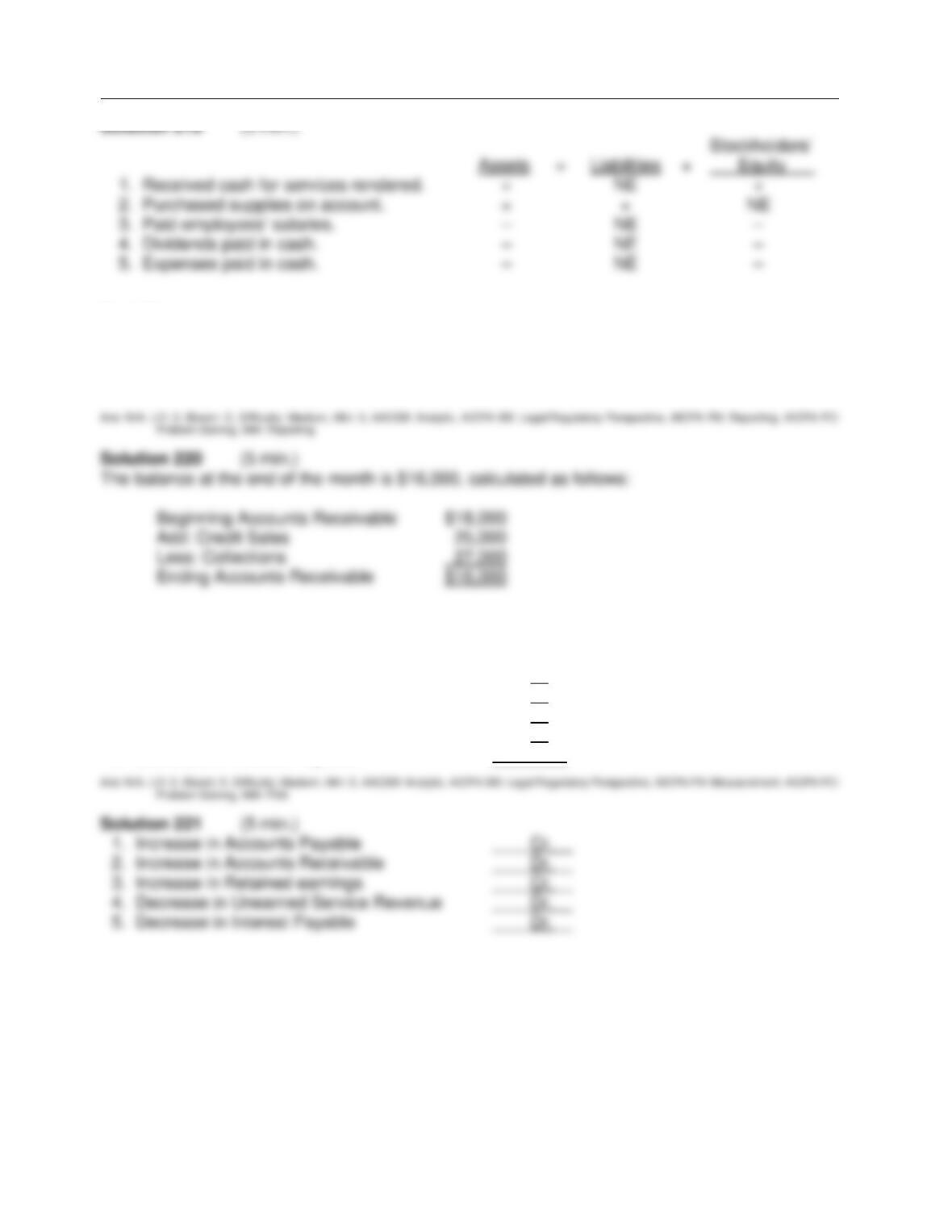
Be. 219
Presented here are five economic events. For each item, indicate whether the event increased
(+), decreased (–), or had no effect (NE) on assets, liabilities, and stockholders’ equity.
Stockholders’
Assets = Liabilities + Equity
1. Received cash for services rendered. _______ ______ _______
2. Purchased supplies on account. _______ ______ _______
3. Paid employees’ salaries. _______ ______ _______
4. Dividends paid in cash. _______ ______ _______
5. Expenses paid in cash. _______ ______ _______
Test Bank for Financial Accounting: Tools for Business Decision Making, Seventh Edition
FOR INSTRUCTOR USE ONLY
3-40
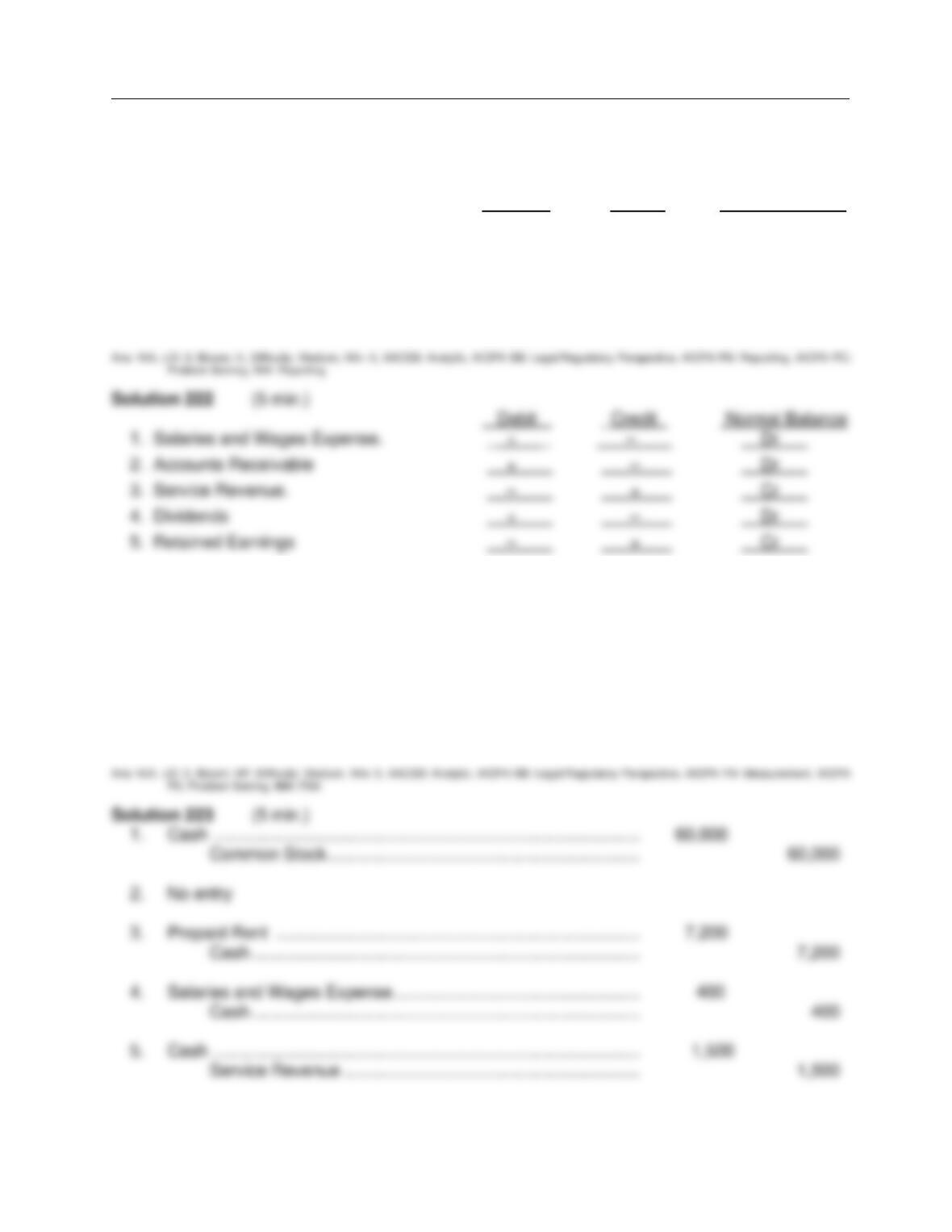
Be. 220
At June 1, 2014, Massoth Industries had an Accounts Receivable balance of $18,000. During the
month, the company had credit sales of $25,000 and collected Accounts Receivable of $27,000.
What is the balance in Accounts Receivable at June 30, 2014?
Be. 221
For each item below, indicate whether a debit or credit applies.
1. Increase in Accounts Payable ____ __
2. Increase in Accounts Receivable ____ __
3. Increase in Retained Earnings ____ __
4. Decrease in Unearned Service Revenue ____ __
5. Decrease in Interest Payable ____ __
The Accounting Information System
FOR INSTRUCTOR USE ONLY
3-41
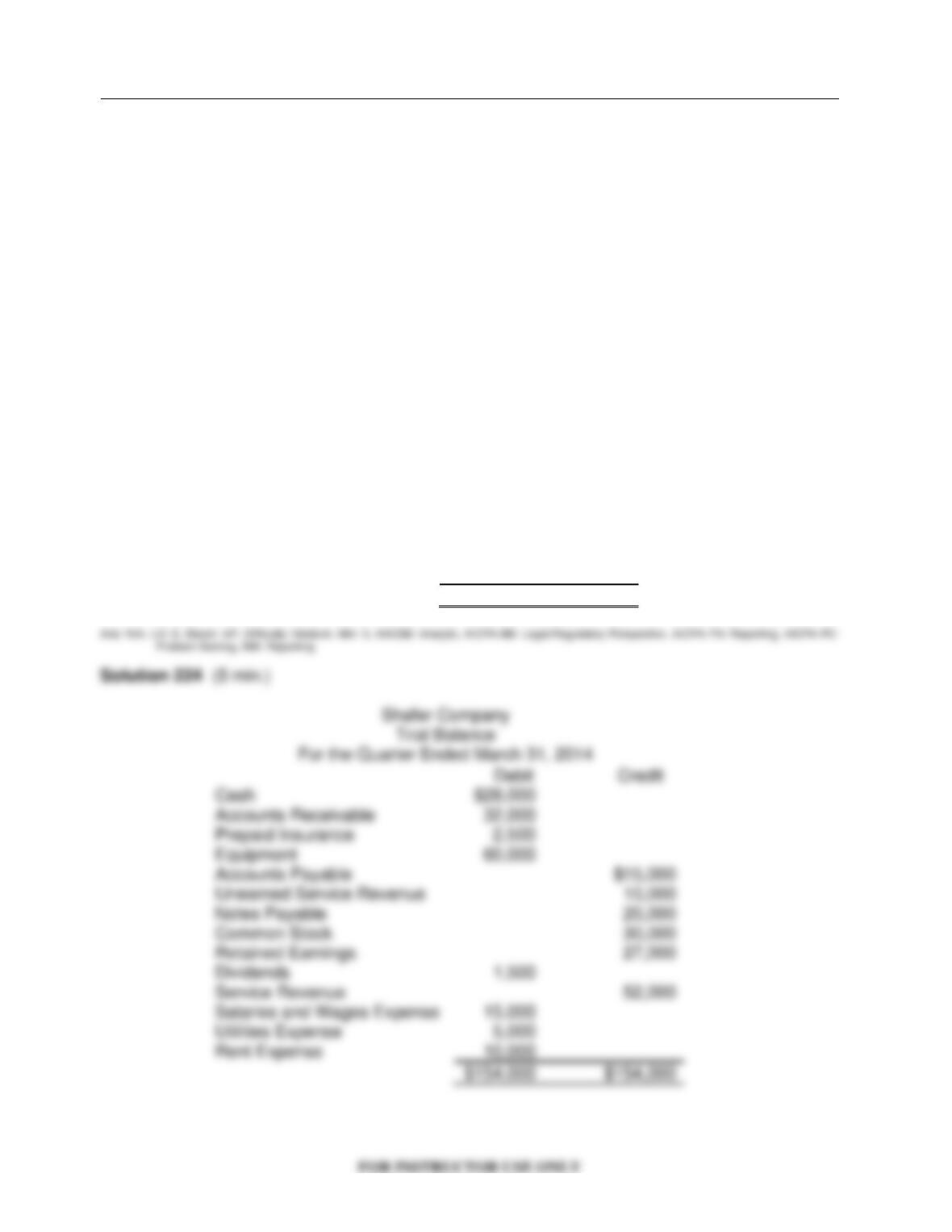
Be. 222
For each of the following accounts indicate the effect of a debit or a credit on the account and the
normal balance. Increase (+), Decrease (–).
Debit _Credit_ Normal Balance
1. Salaries and Wages Expense. _______ ______ _______
2. Accounts Receivable. _______ ______ _______
3. Service Revenue. _______ ______ _______
4. Dividends _______ ______ _______
5. Retained Earnings. _______ ______ _______
Be. 223
Journalize the following business transactions in general journal form. Identify each transaction
by number. You may omit explanations of the transaction.
1. Owner invested $60,000 in exchange for common stock of the corporation.
2. Hired an employee to be paid $400 per week, starting tomorrow.
3. Paid two years’ rent in advance, $7,200.
4. Paid the worker’s weekly wage.
5. Recorded service revenue earned and received for the week, $1,500.
Test Bank for Financial Accounting: Tools for Business Decision Making, Seventh Edition
3-42
Be 224
Prepare a corrected trial balance for Shafer Company. All accounts should have a normal
balance
Shafer Company
Trial Balance
For the Quarter Ended March 31, 2014
Debit
Credit
Cash
$28,000
Accounts Receivable
$32,000
Prepaid Insurance
2,500
Equipment
60,000
Accounts Payable
15,000
Unearned Service Revenue
10,000
Notes Payable
20,000
Common Stock
30,000
Retained Earnings
27,000
Dividends
1,500
Service Revenue
52,000
Salaries and Wages Expense
15,000
Utilities Expense
5,000
Rent Expense
10,000
$157,500
$150,500
Cash
Accounts Receivable
Prepaid Insurance
Equipment
Accounts Payable
Unearned Service Revenue
Notes Payable
Common Stock
Retained Earnings
Dividends
Service Revenue
Salaries and Wages Expense
Utilities Expense
Rent Expense
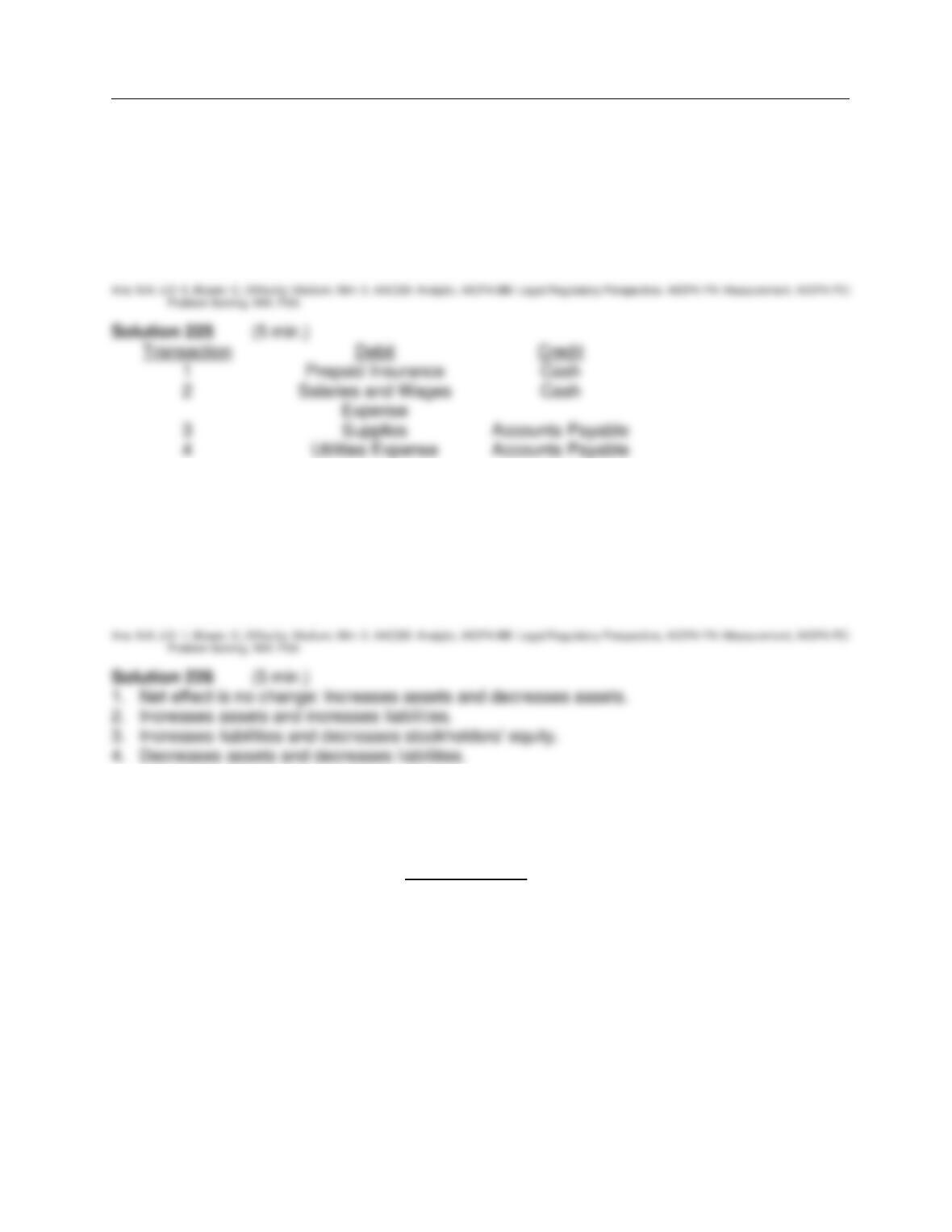
The Accounting Information System
FOR INSTRUCTOR USE ONLY
3-43
Be. 225
For each of the following transactions of Woods Inc., identify the account to be debited and the
account to be credited.
1. Purchased 18-month insurance policy for cash.
2. Paid weekly payroll.
3. Purchased supplies on account.
4. Received utility bill to be paid at later date.
Be. 226
Identify the impact on the accounting equation of the following transactions.
1. Purchased 24-month insurance policy for cash.
2. Purchased supplies on account.
3. Received utility bill to be paid at later date.
4. Paid utility bill previously accrued.
Be. 227
The transactions of the Stormont Store are recorded in the general journal below. You are to post
the journal entries to T-accounts and compute the August 31, 2014 balances.
General Journal
____________________________________________________________________________
Date Account Titles and Explanation Debit Credit
____________________________________________________________________________
2014
Aug. 5 Accounts Receivable 2,500
Service Revenue 2,500
10 Cash 3,000
Service Revenue 3,000
19 Rent Expense 1,000
Cash 1,000
25 Cash 1,400
Accounts Receivable 1,400
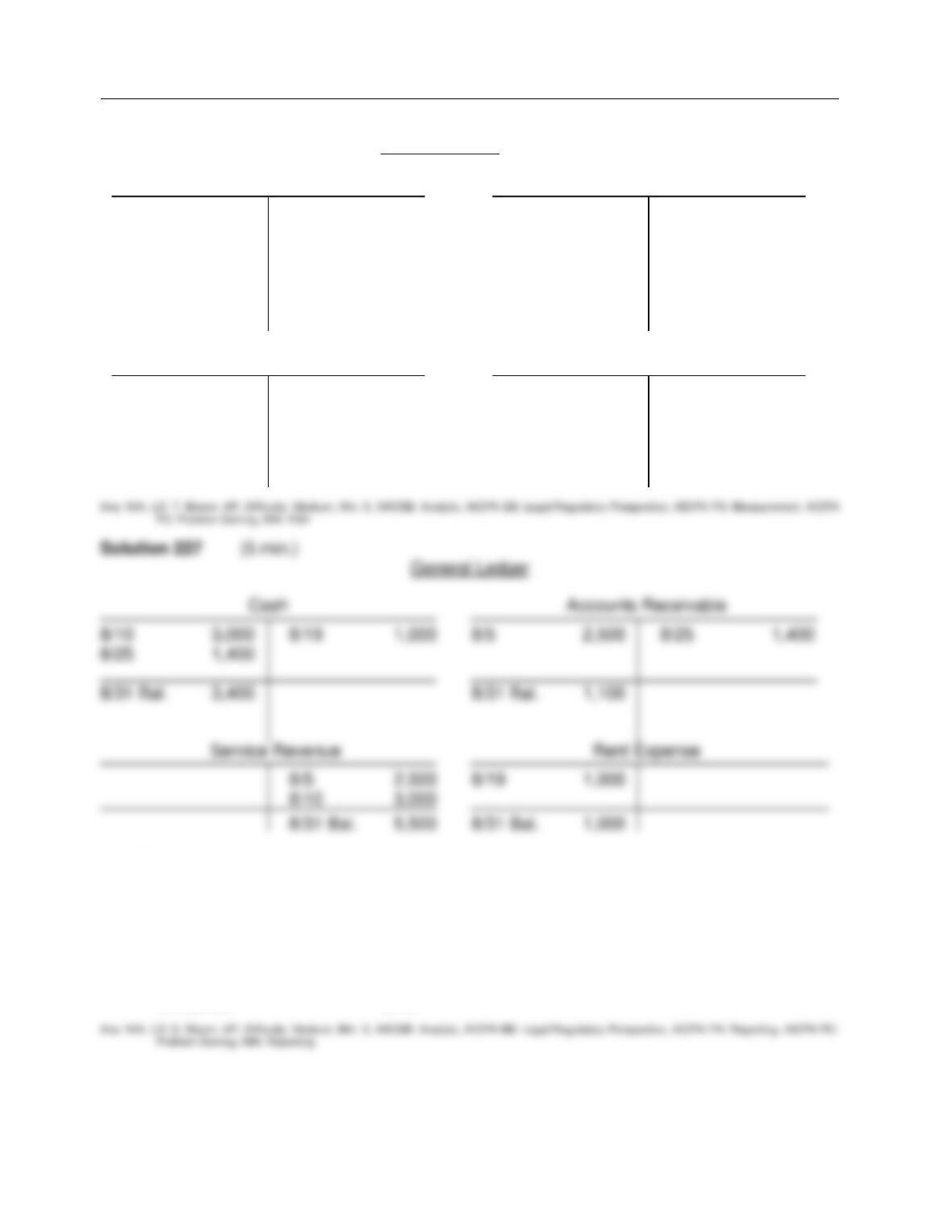
Test Bank for Financial Accounting: Tools for Business Decision Making, Seventh Edition
FOR INSTRUCTOR USE ONLY
3-44
Be. 227 (Cont.)
General Ledger
Cash Accounts Receivable
Service Revenue Rent Expense
Be. 228
Prepare a trial balance from the ledger accounts of Swisher Company as of January 31, 2014.
Accounts Payable
1,500
Rent Expense
$ 500
Accounts Receivable
2,500
Service Revenue
3,500
Cash
1,600
Supplies
200
Common Stock
2,200
Salaries and Wages Expense
1,000
Dividends
1,400
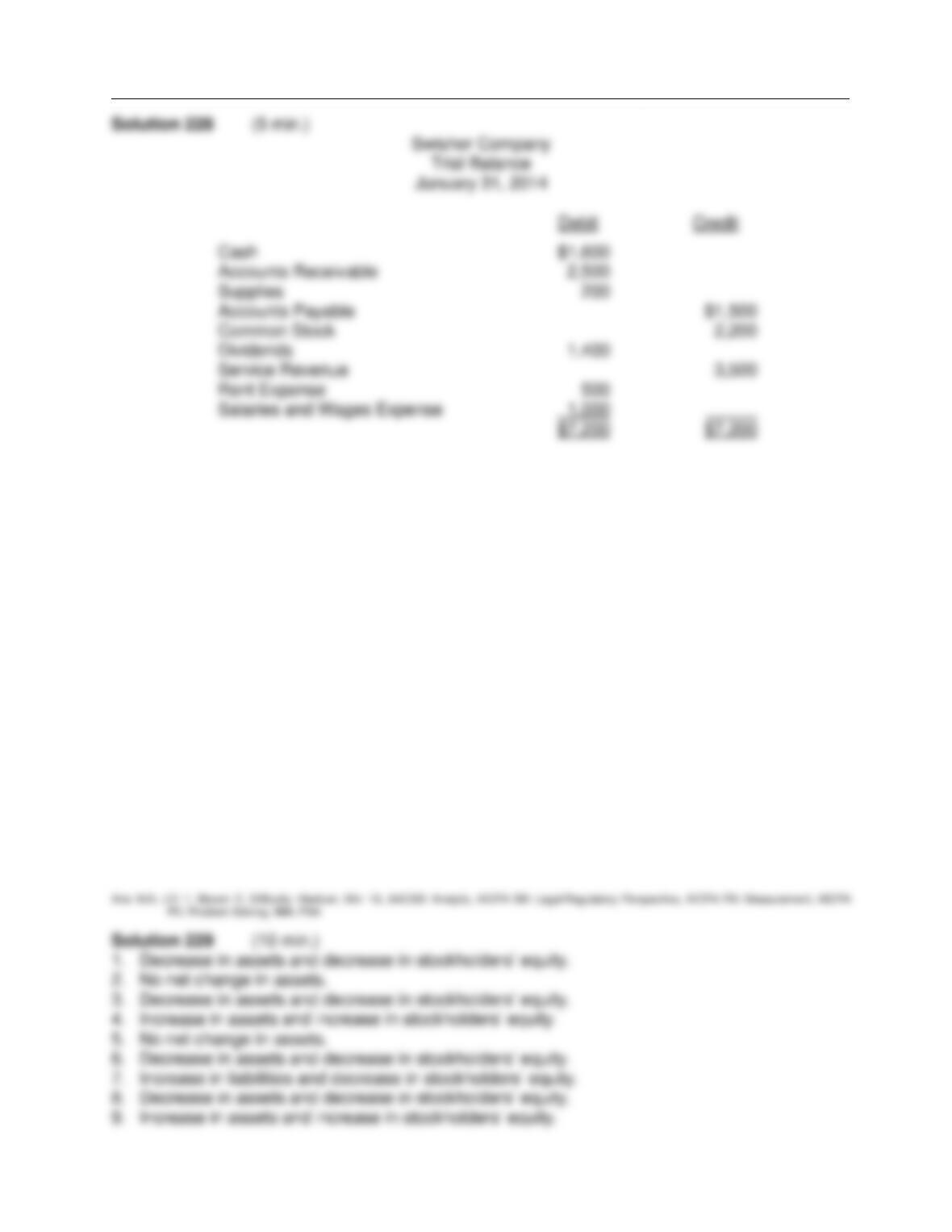
The Accounting Information System
FOR INSTRUCTOR USE ONLY
3-45
Exercises
Ex. 229
Selected transactions for the Sleezer Company are listed below. List the number of the
transaction and then describe the effect of each transaction on assets, liabilities, and
stockholders’ equity.
Sample: Made initial cash investment in the business.
The answer would be—Increase in assets and increase in stockholders’ equity.
1. Paid monthly utility bill.
2. Purchased new display case for cash.
3. Paid cash for repair work on security system.
4. Billed customers for services performed.
5. Received cash from customers billed in transaction 4.
6. Dividends paid to owners.
7. Incurred advertising expenses on account.
8. Paid monthly rent.
9. Received cash from customers when service was rendered.
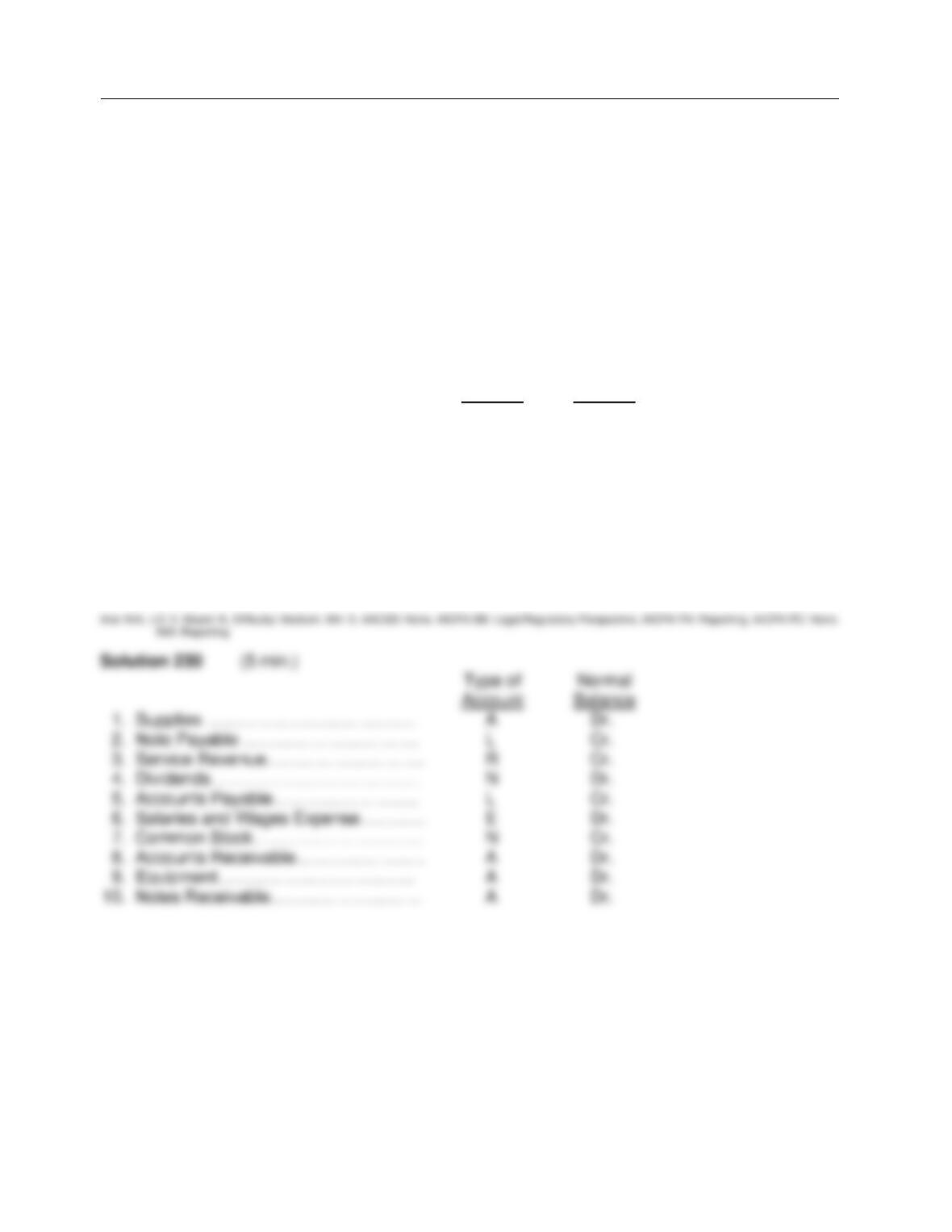
Test Bank for Financial Accounting: Tools for Business Decision Making, Seventh Edition
FOR INSTRUCTOR USE ONLY
3-46
Ex. 230
Selected accounts from the ledger of McDaniel Corporation appear below. For each account,
indicate the following:
(a) In the first column at the right, indicate the nature of each account, using the following
abbreviations:
Asset – A Liability – L None of the above – N
Expense – E Revenues – R
(b) In the second column, indicate the normal balance by inserting Dr. or Cr.
Type of Normal
Account Balance
1. Supplies ………………………………..
2. Notes Payable ………………………….
3. Service Revenue……………………….
4. Dividends……………………………….
5. Accounts Payable……………………..
6. Salaries and Wages Expense…………
7. Common Stock…………………………
8. Accounts Receivable…………………..
9. Equipment……………………………..
10. Notes Receivable………………………
The Accounting Information System
FOR INSTRUCTOR USE ONLY
3-47
Ex. 231
Analyze the transactions of a business organized as a corporation described below and indicate
their effect on the basic accounting equation. Use a plus sign (+) to indicate an increase and a
minus sign (–) to indicate a decrease.
Stockholders’
Assets = Liabilities + Equity
1. Received cash for services rendered. _______ ______ _______
2. Purchased office equipment on credit. _______ ______ _______
3. Paid employees’ salaries. _______ ______ _______
4. Received cash from customer in payment
on account. _______ ______ _______
5. Paid telephone bill for the month. _______ ______ _______
6. Paid for office equipment purchased in
transaction 2. _______ ______ _______
7. Purchased office supplies on credit. _______ ______ _______
8. Dividends were paid. _______ ______ _______
9. Obtained a loan from the bank. _______ ______ _______
10. Billed customers for services rendered. _______ ______ _______

Test Bank for Financial Accounting: Tools for Business Decision Making, Seventh Edition
3-48
Ex. 232
Sara Obermeyer decides to open a pizza parlor near the local college campus that will operate as
a corporation. Analyze the following transactions for the month of June in terms of their effect on
the basic accounting equation. Record each transaction by increasing (+) or decreasing (–) the
dollar amount of each item affected. Indicate the new balance of each item after a transaction is
recorded. It is not necessary to identify the cause of changes in stockholders’ equity.
Transactions
(1) Sara Obermeyer invests $25,000 cash in exchange for common stock to start a pizza
parlor business on June 1.
(2) Purchased equipment for $4,000 paying $2,000 in cash and the remainder due in 30
days.
(3) Purchased supplies for $1,200 cash.
(4) Received a bill from Campus News for $200 for advertising in the campus newspaper.
(5) Cash receipts from customers for pizza sales amounted to $1,500.
(6) Paid salaries of $200 to student workers.
(7) Billed the Tiger Football Team $300 for pizzas ordered.
(8) Paid $200 to Campus News for advertising that was previously billed in Transaction 4.
(9) Sara Obermeyer was paid dividends of $1,200.
(10) Incurred utility expenses for month on account, $100.
Trans- Accounts Accounts Common Retained
action Cash + Receivable + Supplies + Equipment = Payable + Stock + Earnings
(1)
___________________________________________________________________________________
Balance
(2)
___________________________________________________________________________________
Balance
(3)
___________________________________________________________________________________
Balance
(4)
___________________________________________________________________________________
Balance
(5)
___________________________________________________________________________________
Balance
(6)
___________________________________________________________________________________
Balance
(7)
___________________________________________________________________________________
Balance
(8)
___________________________________________________________________________________
Balance
(9)
___________________________________________________________________________________
Balance
(10)
___________________________________________________________________________________
Totals
The Accounting Information System
FOR INSTRUCTOR USE ONLY
3-49
Solution 232 (20 min.)

Test Bank for Financial Accounting: Tools for Business Decision Making, Seventh Edition
FOR INSTRUCTOR USE ONLY
3-50
Ex. 233
Analyze the following transactions in terms of their effect on the basic accounting equation.
Record each transaction by increasing (+) or decreasing (–) the dollar amount of each item
affected. Indicate the new balance of each item after a transaction is recorded.
(1) Issued stock to investors for $20,000 in cash.
(2) Purchased supplies on credit for $700.
(3) Billed customers $1,000 for services provided.
(4) Paid for supplies purchased in transaction 2.
(5) Paid dividends of $300 cash to stockholders.
(6) Received half from customers billed in transaction 3.
(7) Received and paid utility bill for $100.
Trans- Accounts Accounts Common Retained
action Cash + Receivable + Supplies = Payable + Stock + Earnings
(1)
_________________________________________________________________________
Balance
(2)
_________________________________________________________________________
Balance
(3)
_________________________________________________________________________
Balance
(4)
_________________________________________________________________________
Balance
(5)
_________________________________________________________________________
Balance
(6)
_________________________________________________________________________
Balance
(7)
_________________________________________________________________________
Totals
Ans: N/A, LO: 1, Bloom: AP, Difficulty: Medium, Min: 15, AACSB: Analytic, AICPA BB: Legal/Regulatory Perspective, AICPA FN: Measurement, AICPA
PC: Problem Solving, IMA: FSA
The Accounting Information System
3-51
Solution 233 (15 minutes)
Ex. 234
A tabular analysis of the transactions made during August 2014 by Baxter Company during its
first month of operations is shown below. Each increase and decrease in stockholders’ equity is
explained.
Assets
= Liab.+
Stockholders’ Equity
Retained Earnings
Cash
+ A/R
+ Supp.
+ Equip
= Accts Pay
Com. Stock
+ Rev.
– Exp.
– Div.
1. +$30,000
+$30,000
Com.
Stock
2. –1,000
+$5,000
+$4,000
3. –750
+$750
4. +2,400
+$5,900
+8,300
Serv. Rev.
5. –1,500
– 1,500
6. –1,000
–1,000
Div.
7. –800
–800
Rent Exp.
8. +450
–450
9. –4,000
–4,000
Sal. Exp.
10.
+500
–500
Util. Exp.
Instructions
(a) Determine how much stockholders’ equity increased for the month.
(b) Compute the net income for the month.
Test Bank for Financial Accounting: Tools for Business Decision Making, Seventh Edition
3-52
Ex. 235
The tabular analysis of transactions for Baxter Company is presented below.
Assets
= Liab. +
Stockholders’ Equity
Retained Earnings
Accts
Cash
+ A/R
+ Supp.
+ Equip.
= Payable
+ C/S
+ Rev.
– Exp.
– Div.
1. +$30,000
+$30,000
Com. Stock
2. –1,000
+$11,000
+$10,000
3. –950
+$950
4. +2,400
+$5,900
+8,300
Serv. Rev.
5. –1,500
–1,500
6. –1,000
–1,000
Div.
7. –800
–800
Rent Exp.
8. +450
–450
9. –4,000
–4,000
Sal. Exp.
10.
+500
–500
Util. Exp.
Instructions
Prepare a retained earnings statement for August and a classified balance sheet at August 31,
2014.
The Accounting Information System
FOR INSTRUCTOR USE ONLY
3-53
Solution 235 (Cont.)
Ex. 236
The accounts in the ledger of Dependable Delivery Service contain the following balances on July
31, 2014.
Accounts Receivable
$11,400
Prepaid Insurance
$ 1,800
Accounts Payable
7,400
Maintenance and Repairs Expense
1,200
Cash
15,940
Service Revenue
15,500
Equipment
59,360
Dividends
800
Utilities Expense
950
Common Stock
40,000
Insurance Expense
600
Salaries and Wages Expense
8,400
Notes Payable, due 2017
31,450
Salaries and Wages Payable
900
Retained Earnings
5,200
(July 1, 2014)
Instructions
Prepare an income statement and a retained earnings statement for the month of July 2014, and
a classified balance sheet for July 31.
Test Bank for Financial Accounting: Tools for Business Decision Making, Seventh Edition
FOR INSTRUCTOR USE ONLY
3-54
Solution 236 (10 min.) DEPENDABLE DELIVERY SERVICE
The Accounting Information System
FOR INSTRUCTOR USE ONLY
3-55
Ex. 237
Selected transactions for Stockton Corporation during its first month in business are presented
below:
Sept. 1 Issued common stock in exchange for $30,000 cash received from investors.
5 Purchased equipment for $20,000, paying $2,000 in cash and the balance on account.
25 Paid $6,000 cash on balance owed for equipment.
30 Paid $1,000 cash dividend.
Stockton’s chart of accounts shows: Cash, Equipment, Accounts Payable, Common Stock, and
Dividends.
Instructions
(a) Prepare a tabular analysis of the September transactions. The column headings should be:
Cash + Equipment = Accounts Payable + Stockholders’ Equity. For transactions affecting
stockholders’ equity, provide explanations in the right margin.
(b) Journalize the transactions. Do not provide explanations.
(c) Post the transactions to T-accounts.
Test Bank for Financial Accounting: Tools for Business Decision Making, Seventh Edition
FOR INSTRUCTOR USE ONLY
3-56
Ex. 238
For each item below, indicate whether a debit or credit applies.
1. Decrease in Notes Payable ____ __
2. Increase in Dividends ____ __
3. Increase in Common Stock ____ __
4. Increase in Unearned Rent Revenue ____ __
5. Decrease in Interest Payable ____ __
6. Increase in Prepaid Insurance ____ __
7. Decrease in Salaries and Wages Expense ____ __
8. Decrease in Supplies ____ __
9. Increase in Revenues ____ __
10. Decrease in Accounts Receivable ____ __
The Accounting Information System
FOR INSTRUCTOR USE ONLY
3-57
Ex. 239
For each item below, indicate whether a debit or credit applies.
1. Decrease in Prepaid Rent ____ __
2. Increase in Service Revenue ____ __
3. Decrease in Unearned Rent Revenue ____ __
4. Increase in Dividends ____ __
5. Decrease in Interest Receivable ____ __
6. Increase in Depreciation Expense ____ __
7. Decrease in Accounts Payable ____ __
8. Increase in Supplies ____ __
9. Increase in Salaries and Wages Expense ____ __
10. Decrease in Accounts Receivable ____ __

Test Bank for Financial Accounting: Tools for Business Decision Making, Seventh Edition
3-58
Ex. 240
The chart of accounts used by Norton Printing Company is listed below. You are to indicate the
proper accounts to be debited and credited for the following transactions by writing the account
number(s) in the appropriate boxes.
CHART OF ACCOUNTS
1 Cash 8 Common Stock
2 Accounts Receivable 9 Retained Earnings
3 Supplies 10 Dividends
4 Equipment 11 Service Revenue
5 Accounts Payable 12 Advertising Expense
6 Notes Payable 13 Rent Expense
7 Unearned Service Revenue
__________________________________________________________________________
Number(s) Number(s)
of account(s) of account(s)
debited credited
1. Stockholders invest $90,000 cash to start the
business.
_______________________________________________________________________________________________________
2. Purchased three digital copy machines for
$400,000, paying $100,000 cash and signing a
5-year, 6% note for the remainder.
_______________________________________________________________________________________________________
3. Purchased $5,000 paper supplies on credit.
_______________________________________________________________________________________________________
4. Cash received for photocopy services amounted
to $7,000.
_______________________________________________________________________________________________________
5. Paid $500 cash for radio advertising.
_______________________________________________________________________________________________________
6. Paid $800 on account for paper supplies
purchased in transaction 3.
_______________________________________________________________________________________________________
7. Dividends of $1,500 were paid to stockholders.
_______________________________________________________________________________________________________
8. Paid $1,200 cash for rent for the current month.
_______________________________________________________________________________________________________
9. Received $2,000 cash advance from a customer
for future copying.
_______________________________________________________________________________________________________
10. Billed a customer for $450 for photocopy
services completed.
_______________________________________________________________________________________________________
The Accounting Information System
FOR INSTRUCTOR USE ONLY
3-59
Solution 240 (15 min.)
Test Bank for Financial Accounting: Tools for Business Decision Making, Seventh Edition
FOR INSTRUCTOR USE ONLY
3-60
Ex. 241
Under a double-entry system, show how the entry in each statement is entered in the ledger by
using debit or credit to indicate the increase or decrease in the affected account.
Debit or Credit
1. An increase in Salaries and Wages Expense. _________________
2. An increase in Accounts Payable. _________________
3. An increase in Prepaid Insurance. _________________
4. An increase in Common Stock. _________________
5. A increase in Supplies. _________________
6. An increase in Dividends. _________________
7. An increase in Service Revenue. _________________
8. A decrease in Accounts Receivable. _________________
9. An increase in Rent Expense. _________________
10. A decrease in Equipment. _________________
The Accounting Information System
3-61
Ex. 242
For the accounts listed below, indicate if the normal balance of the account is a debit or credit.
Normal Balance
Accounts Debit or Credit
1. Service Revenue _________________
2. Rent Expense _________________
3. Accounts Receivable _________________
4. Accounts Payable _________________
5. Common Stock _________________
6. Supplies _________________
7. Insurance Expense _________________
8. Dividends _________________
9. Buildings _________________
10. Notes Payable _________________
Ex. 243
During an accounting period, a business has numerous transactions affecting each of the
following accounts. State for each account whether it is likely to have (a) debit entries only, (b)
credit entries only, or (c) both debit and credit entries.
(1) Advertising Expense (6) Dividends
(2) Service Revenue (7) Cash
(3) Accounts Payable (8) Salaries and wages Expense
(4) Accounts Receivable (9) Notes Payable
(5) Common Stock (10) Insurance Expense
Test Bank for Financial Accounting: Tools for Business Decision Making, Seventh Edition
FOR INSTRUCTOR USE ONLY
3-62
Ex. 244
Eight transactions are recorded in the following T-accounts:
Cash
Accounts Receivable
(1)
35,000
(2)
3,500
(5)
27,500
(7)
22,500
(7)
22,500
(3)
1,950
(4)
2,225
(6)
8,000
(8)
4,500
Supplies
Equipment
(3)
1,950
(2)
13,500
Common Stock
Service Revenue
(1)
35,000
(5)
27,500
Accounts Payable
Dividends
(6)
8,000
(2)
10,000
(8)
4,500
Salaries and Wages Expense
(4)
2,225
Indicate for each debit and each credit: (a) whether an asset, liability, common stock, dividends,
revenue, or expense account was affected and (b) whether the account was increased (+) or (–)
decreased. Answers should be presented in the following chart form:
Transaction Account Debited Account Credited
No. Type Effect Type Effect
__________________________________________________________________________
(1) (Example) Asset + Common Stock +
__________________________________________________________________________
(2)
__________________________________________________________________________
(3)
__________________________________________________________________________
(4)
__________________________________________________________________________
(5)
__________________________________________________________________________
(6)
__________________________________________________________________________
(7)
__________________________________________________________________________
(8)
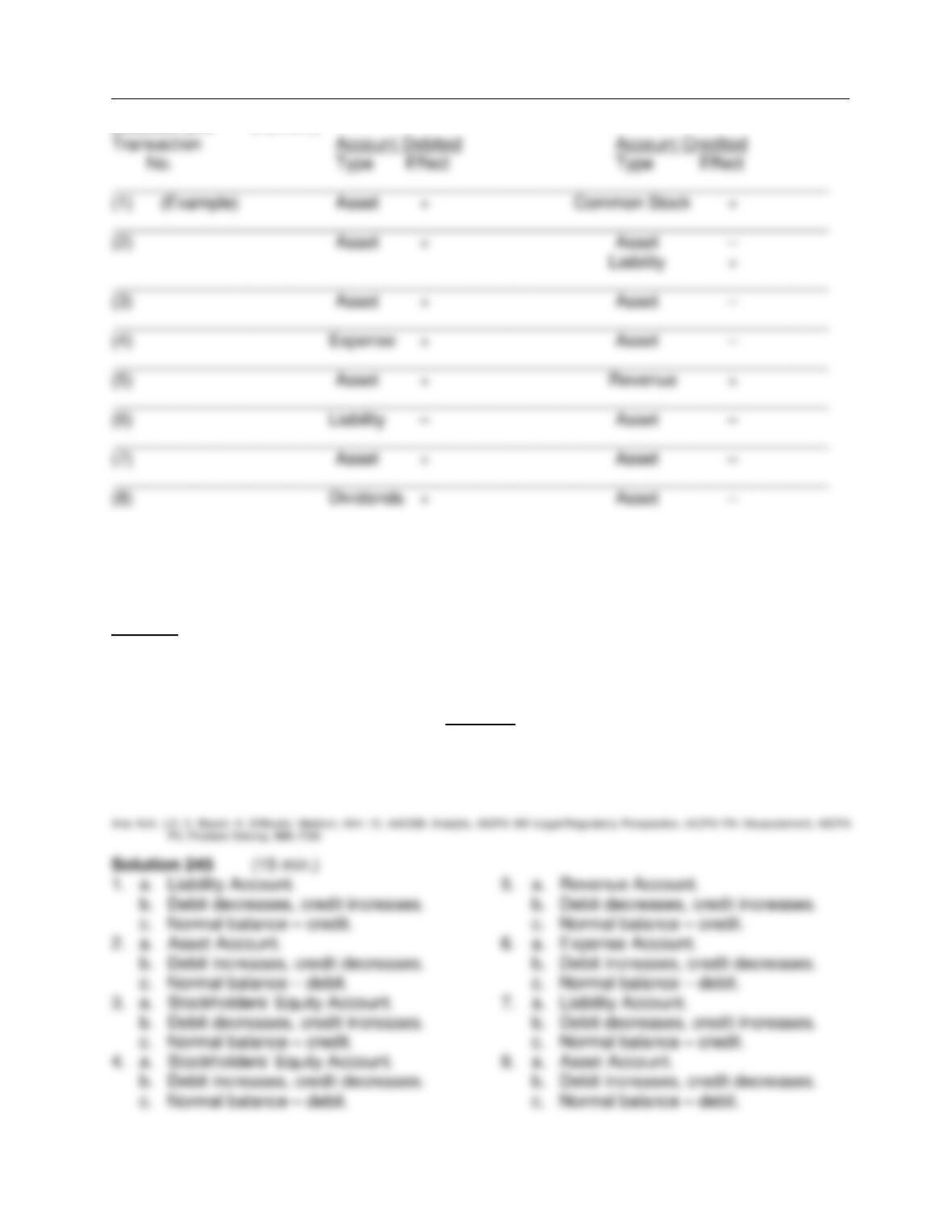
The Accounting Information System
FOR INSTRUCTOR USE ONLY
3-63
Solution 244 (15 min.)
Ex. 245
For each of the following accounts indicate (a) the type of account (Asset, Liability, Stockholders’
Equity, Revenue, and Expense), (b) the debit and credit effects, and (c) the normal account
balance.
Example
0. Cash a. Asset account
b. Debit increases, credit decreases
c. Normal balance – debit
Accounts
1. Accounts Payable 5. Service Revenue
2. Accounts Receivable 6. Insurance Expense
3. Common Stock 7. Notes Payable
4. Dividends 8. Equipment
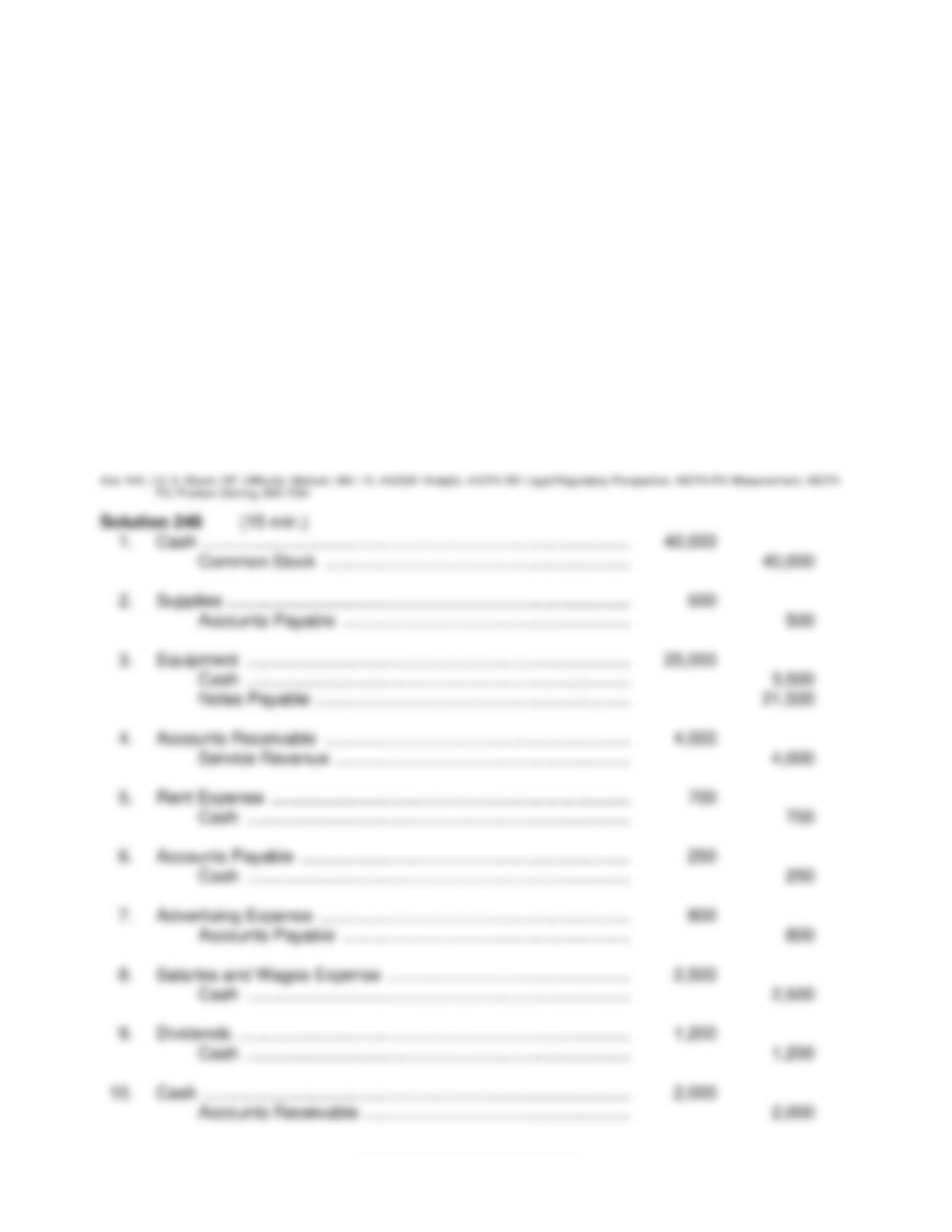
Test Bank for Financial Accounting: Tools for Business Decision Making, Seventh Edition
FOR INSTRUCTOR USE ONLY
3-64
Ex. 246
Journalize the following business transactions in general journal form. Identify each transaction
by number. You may omit explanations of the transactions.
1. Stockholders invest $40,000 in cash in starting a real estate office operating as a
corporation.
2. Purchased $500 of supplies on credit.
3. Purchased equipment for $25,000, paying $3,500 in cash and signed a 30-day, $21,500,
note payable.
4. Real estate commissions billed to clients amount to $4,000.
5. Paid $700 in cash for the current month’s rent.
6. Paid $250 cash on account for office supplies purchased in transaction 2.
7. Received a bill for $800 for advertising for the current month.
8. Paid $2,500 cash for office salaries.
9. Paid $1,200 cash dividends to stockholders.
10. Received a check for $2,000 from a client in payment on account for commissions billed in
transaction 4.
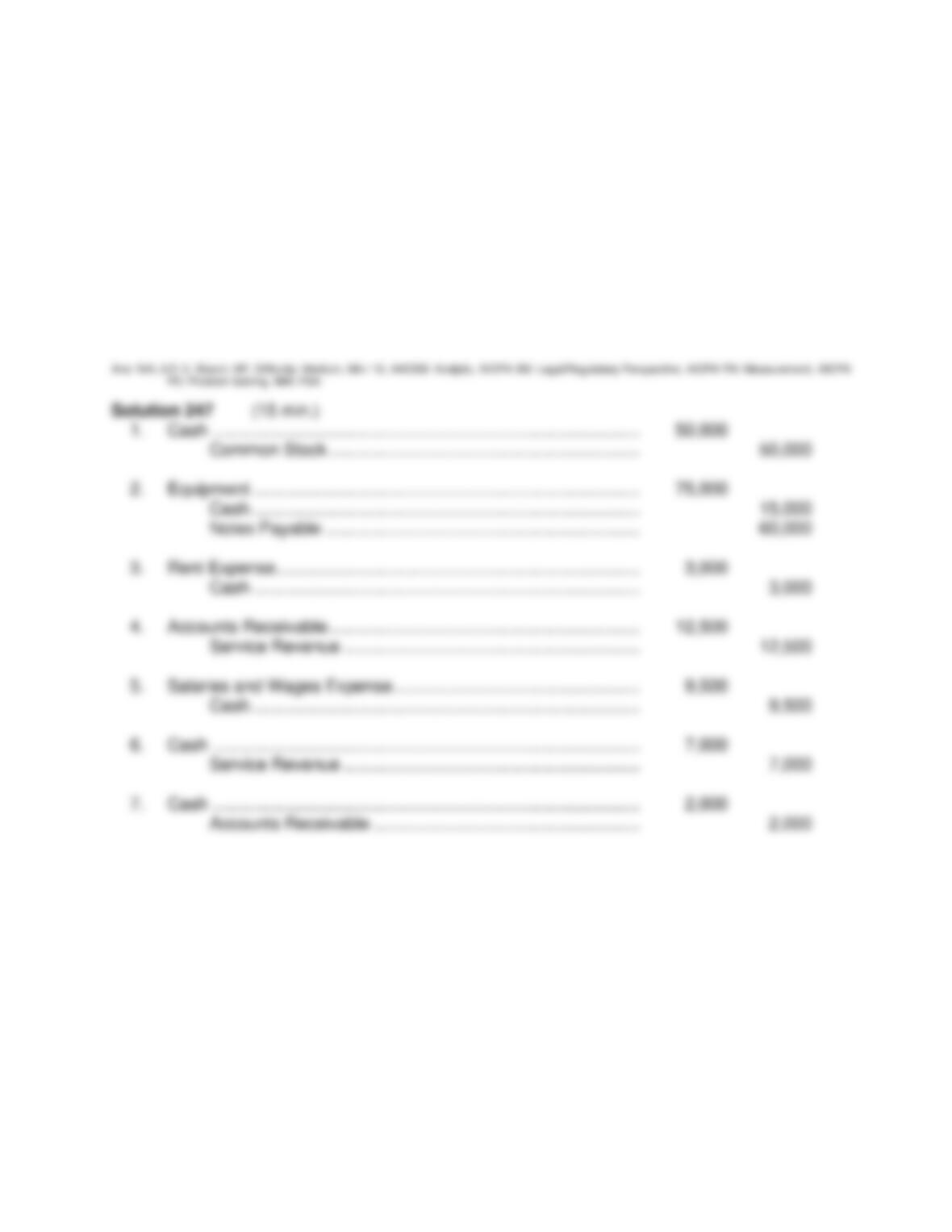
The Accounting Information System
FOR INSTRUCTOR USE ONLY
3-65
Ex. 247
Journalize the following business transactions in general journal form. Identify each transaction
by number. You may omit explanations of the transactions.
1. Received $50,000 from stockholders.
2. Purchased equipment for $75,000, paying $15,000 in cash and giving a note payable for
the remainder.
3. Paid $3,000 rent for the month.
4. Recorded $12,500 of services provided on account.
5. Paid wages of $9,500.
6. Received $7,000 in cash for services provided.
7. Collected $2,000 from customers on account.
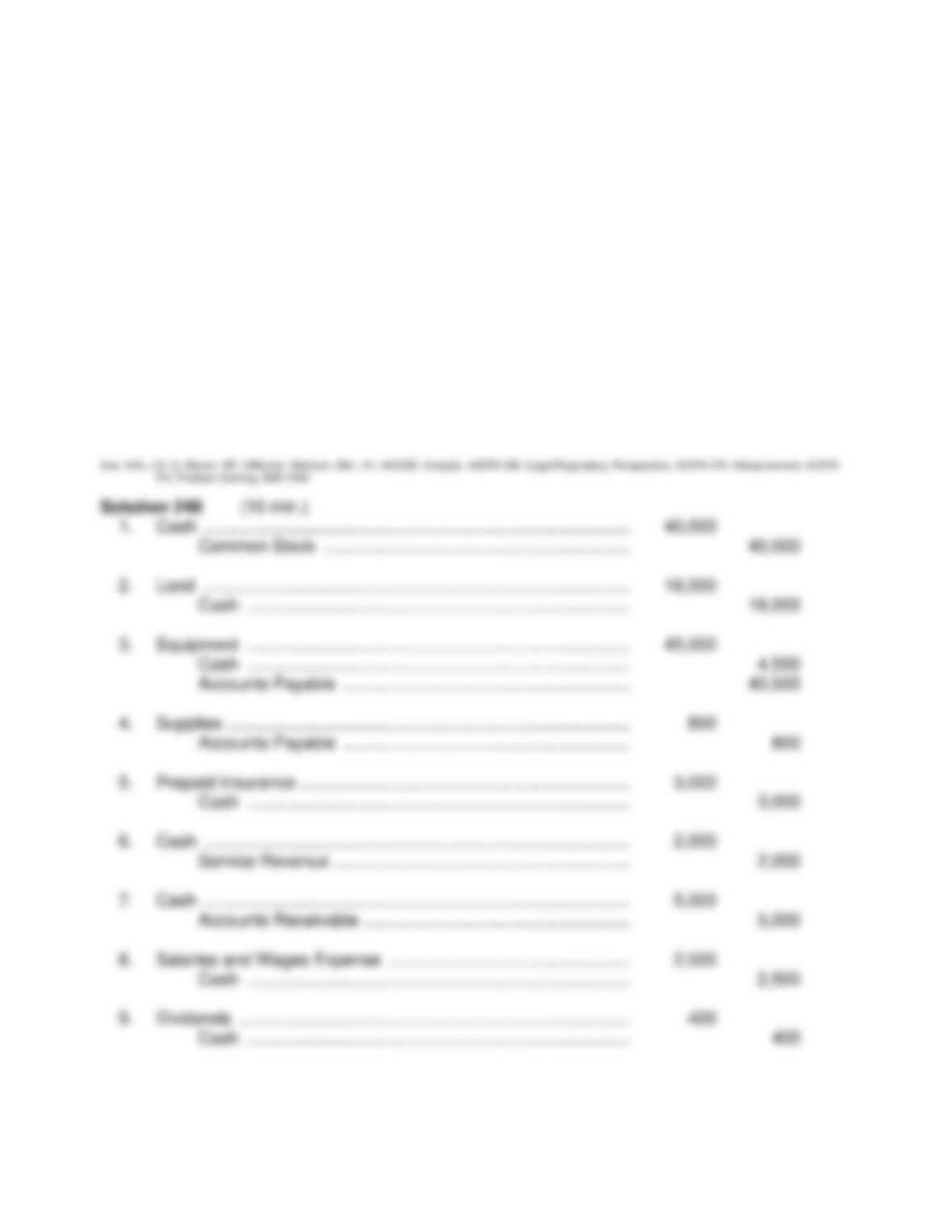
Test Bank for Financial Accounting: Tools for Business Decision Making, Seventh Edition
FOR INSTRUCTOR USE ONLY
3-66
Ex. 248
Transactions for the Hartman Company for the month of November are presented below.
Journalize each transaction and identify each transaction by number. You may omit journal
explanations.
1. Stockholders invested an additional $40,000 cash in the business.
2. Purchased land costing $18,000 for cash.
3. Purchased equipment costing $45,000 for $4,500 cash and the remainder on credit.
4. Purchased supplies on account for $800.
5. Paid $3,000 for a one-year insurance policy.
6. Received $2,000 cash for services performed.
7. Received $5,000 for services previously performed on account.
8. Paid wages to employees for $2,500.
9. Paid dividends to stockholders of $400.
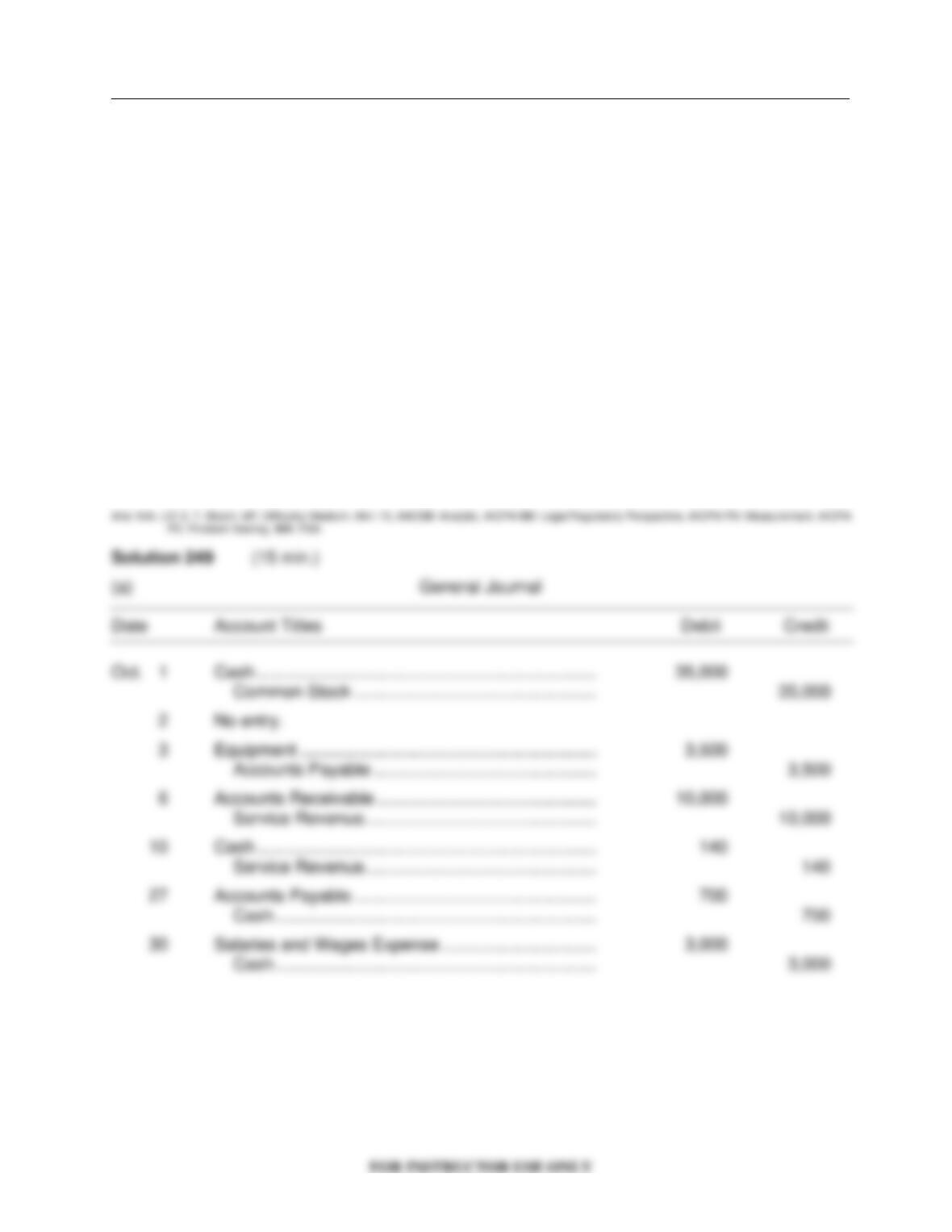
The Accounting Information System
3-67
Ex. 249
This information relates to Hanshew Real Estate Agency.
Oct. 1 Stockholders invested $35,000 in exchange for common stock of the corporation.
2 Hires an administrative assistant at an annual salary of $36,000.
3 Buys equipment for $3,500 on account.
6 Sells a house and lot for M Springer; commissions due from Springer, $10,000 (not
paid by Springer at this time).
10 Receives cash of $140 as commission for acting as rental agent renting an
apartment.
27 Pays $700 on account for the equipment purchased on October 3.
30 Pays the administrative assistant $3,000 in salary for October.
Instructions
(a) Journalize the transactions. Do not provide explanations.
(b) Post the transactions to T accounts.
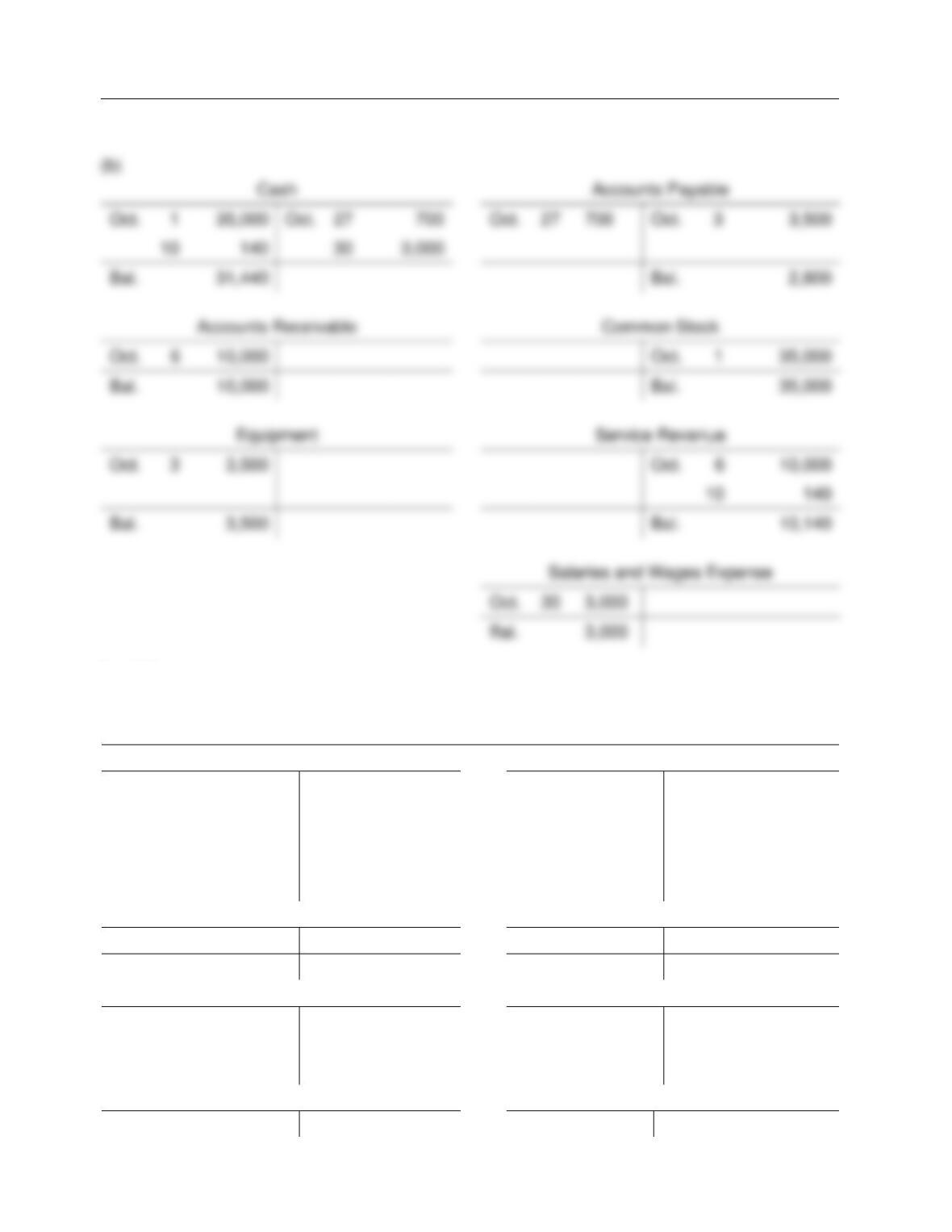
Test Bank for Financial Accounting: Tools for Business Decision Making, Seventh Edition
FOR INSTRUCTOR USE ONLY
3-68
Solution 249 (Cont.)
Ex. 250
These T accounts summarize the ledger of Garner Gardening Company Inc. at the end of the first
month of operations, April 2014.
Cash
Unearned Service Revenue
Apr.
1
20,000
Apr.
15
1,200
Apr.
30
900
12
700
25
3,500
29
800
30
900
Accounts Receivable
Common Stock
Apr.
7
3,400
Apr.
29
800
Apr.
1
20,000
Supplies
Service Revenue
Apr.
4
5,700
Apr.
7
3,400
12
700
Account Payable
Salaries and Wages Expense
Apr.
25
3,500
Apr.
4
5,700
Apr.
15
1,200
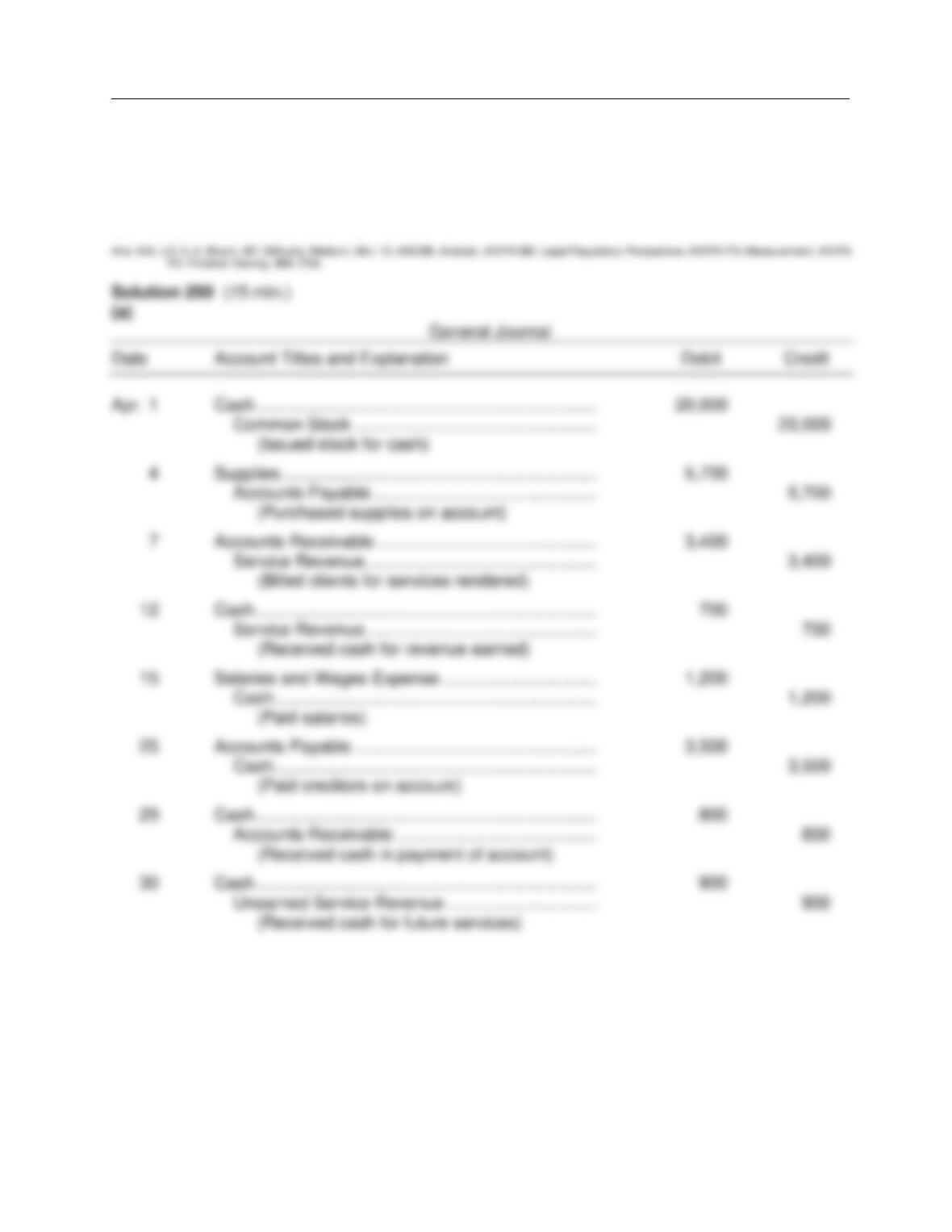
The Accounting Information System
FOR INSTRUCTOR USE ONLY
3-69
Ex. 250 (Cont.)
Instructions
(a) Prepare in the order they occurred the journal entries (including explanations) that resulted
in the amounts posted to the accounts.
(b) Prepare a trial balance at April 30, 2014.
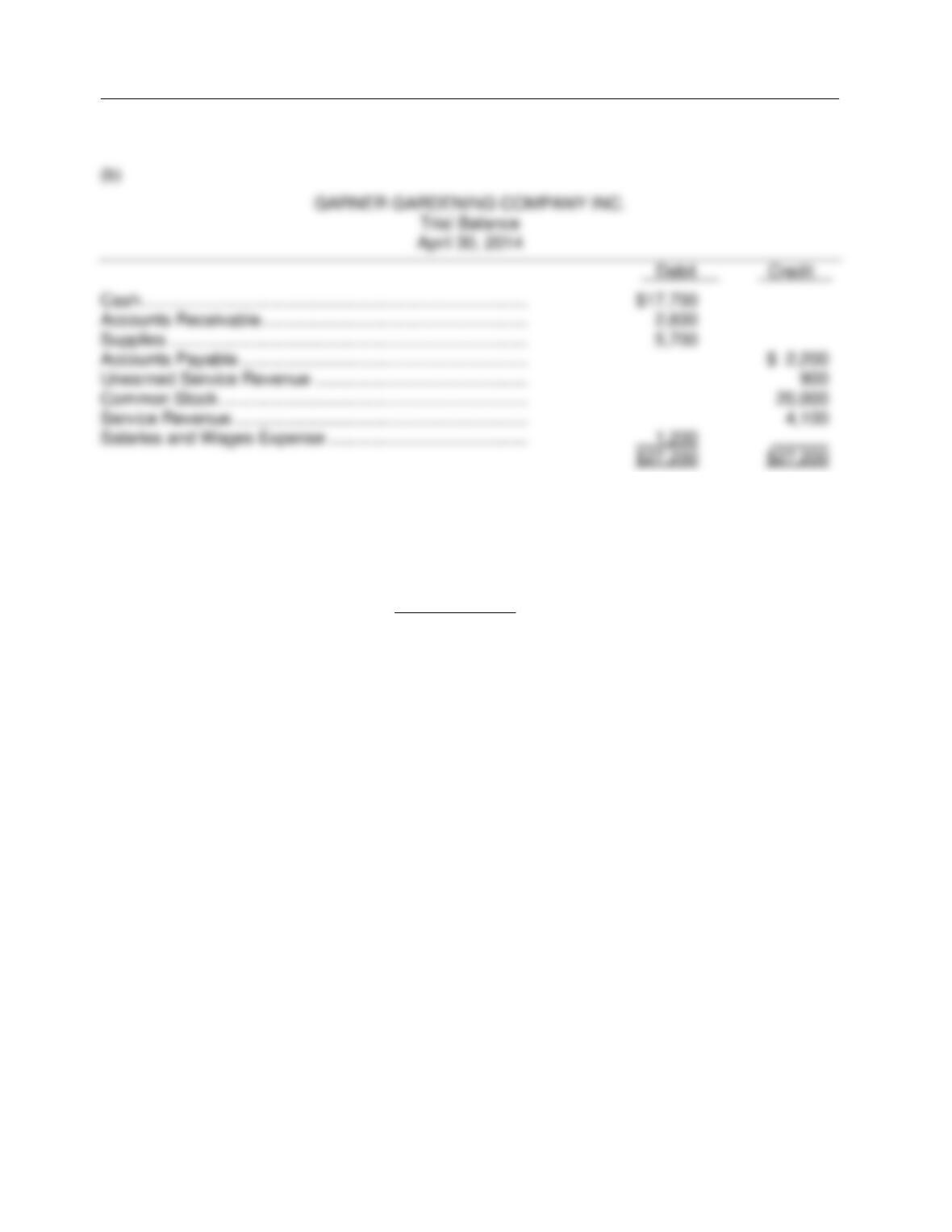
Test Bank for Financial Accounting: Tools for Business Decision Making, Seventh Edition
FOR INSTRUCTOR USE ONLY
3-70
Solution 250 (Cont.)
Ex. 251
The transactions of the Speedy Delivery Service are recorded in the general journal below. You
are to post the journal entries to the accounts in the general ledger. After all entries have been
posted, you are to prepare a trial balance on the form provided.
General Journal
____________________________________________________________________________
Date Account Titles and Explanation Debit Credit
____________________________________________________________________________
2014
Sept. 1 Cash 25,000
Common Stock 25,000
(Stockholders invested cash in business)
4 Equipment 60,000
Cash 10,000
Notes Payable 50,000
(Paid cash and issued 2-year, 6%, note for
delivery trucks)
8 Rent Expense 1,000
Cash 1,000
(Paid September rent)
15 Prepaid Insurance 1,400
Cash 1,400
(Paid one-year liability insurance)
18 Cash 4,500
Service Revenue 4,500
(Received cash for delivery services)
The Accounting Information System
FOR INSTRUCTOR USE ONLY
3-71
Ex. 251 (Cont.)
20 Salaries and Wages Expense 500
Cash 500
(Paid salaries for current period)
25 Utilities Expense 100
Accounts Payable 100
(Received a bill for September utilities)
30 Dividends 750
Cash 750
(Paid dividends)
30 Accounts Receivable 1,000
Service Revenue 1,000
(Billed customer for delivery service)
General Ledger
Cash
Accounts Receivable
Prepaid Insurance
Equipment
Accounts Payable
Notes Payable
Test Bank for Financial Accounting: Tools for Business Decision Making, Seventh Edition
FOR INSTRUCTOR USE ONLY
3-72
Ex. 251 (Cont.)
Common Stock
Dividends
Service Revenue
Rent Expense
Salaries and Wages Expense
Utilities Expense
SPEEDY DELIVERY SERVICE
Trial Balance
September 30, 2014
Accounts
Credit
Debit
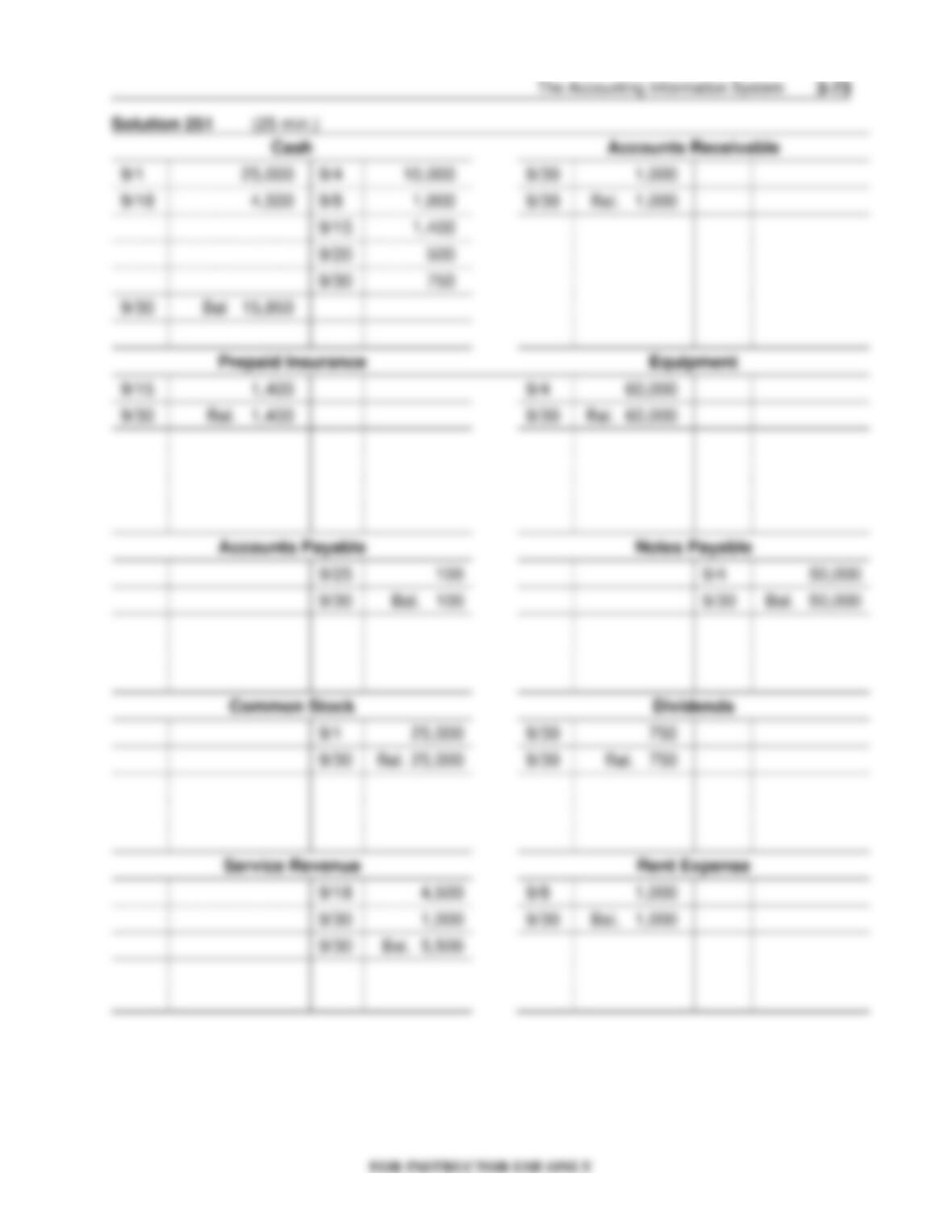
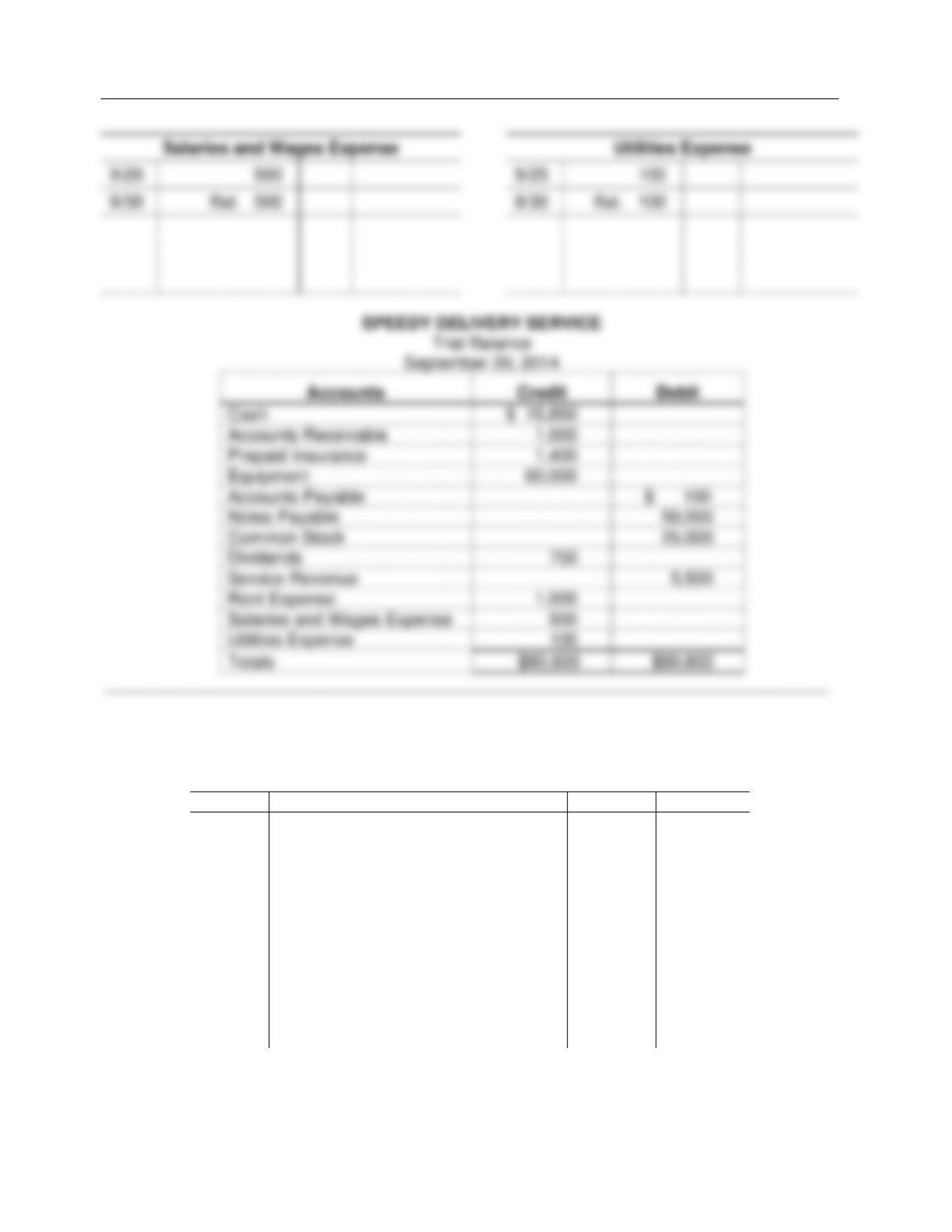
Test Bank for Financial Accounting: Tools for Business Decision Making, Seventh Edition
FOR INSTRUCTOR USE ONLY
3-74
Ex. 252
Selected transactions from the journal of Giambi Inc. during its first month of operations are
presented here.
Date
Account Titles
Debit
Credit
Aug. 1
Cash
10,000
Common Stock
10,000
10
Cash
1,700
Service Revenue
1,700
12
Equipment
12,200
Cash
1,200
Notes Payable
11,000
25
Accounts Receivable
2,500
Service Revenue
2,500
31
Cash
600
Accounts Receivable
600
Cash
Accounts Receivable
Prepaid Insurance
Equipment
Accounts Payable
Notes Payable
Common Stock
Dividends
Service Revenue
Rent Expense
Salaries and Wages Expense
Utilities Expense
Totals
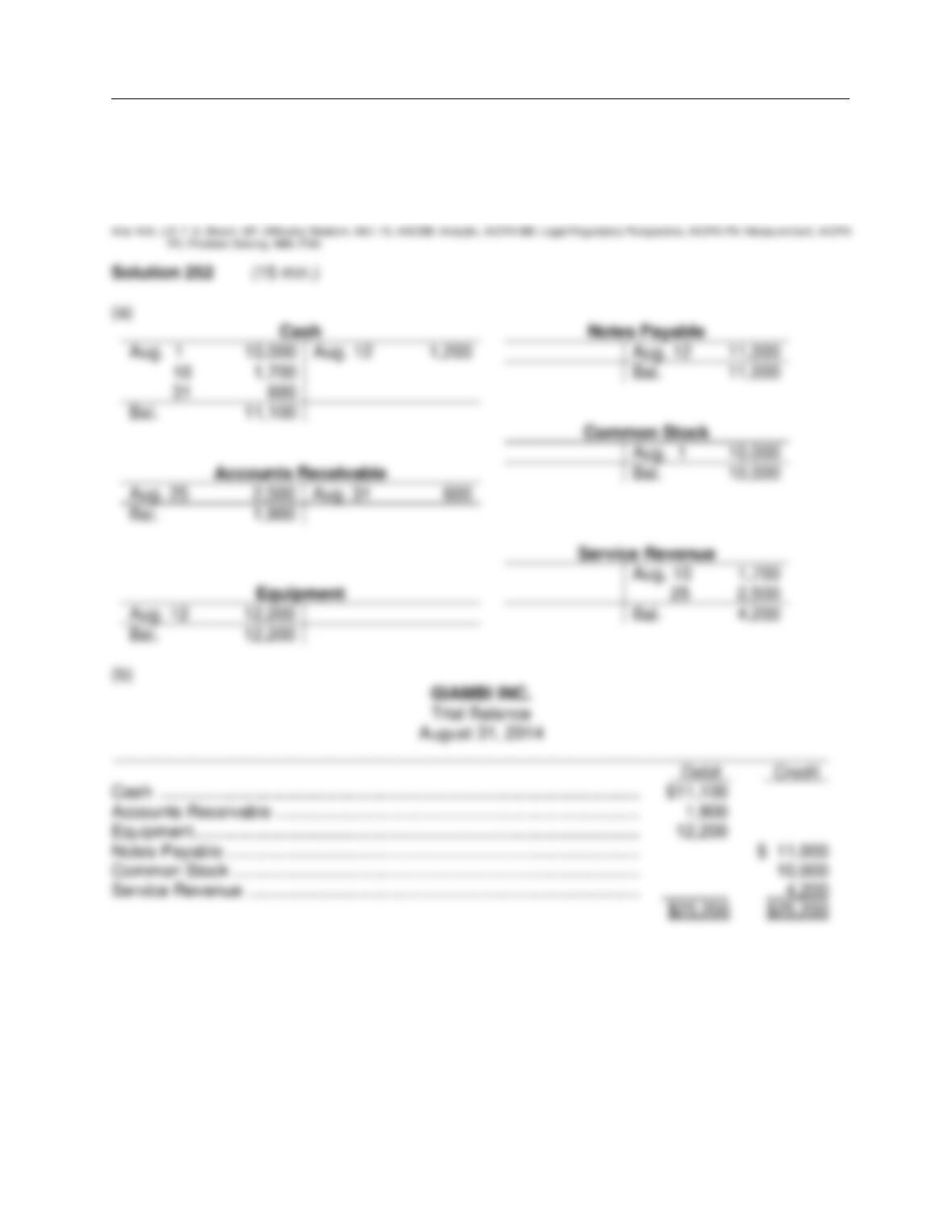
The Accounting Information System
FOR INSTRUCTOR USE ONLY
3-75
Ex. 252 (Cont.)
Instructions
(a) Post the transactions to T-accounts.
(b) Prepare a trial balance at August 31, 2014.
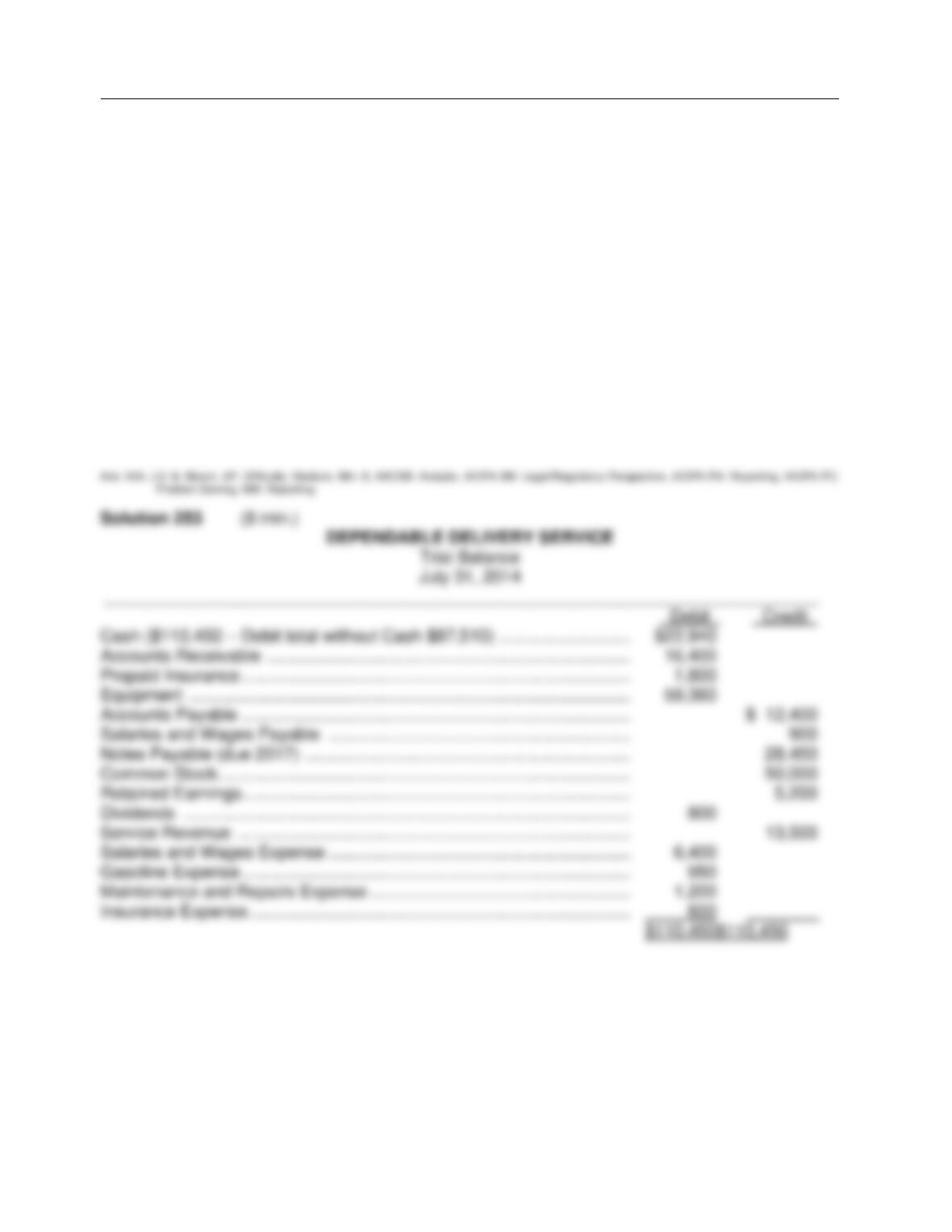
Test Bank for Financial Accounting: Tools for Business Decision Making, Seventh Edition
FOR INSTRUCTOR USE ONLY
3-76
Ex. 253
The accounts in the ledger of Dependable Delivery Service contain the following balances on July
31, 2014.
Accounts Receivable
$16,400
Prepaid Insurance
$ 1,800
Accounts Payable
12,400
Maintenance and Repairs Expense
1,200
Cash
?
Service Revenue
13,500
Equipment
59,360
Dividends
800
Gasoline Expense
950
Common Stock
50,000
Insurance Expense
600
Salaries and Wages Expense
6,400
Notes Payable, due 2017
28,450
Salaries and Wages Payable
900
Retained Earnings
5,200
(July 1, 2014)
Instructions
Prepare a trial balance with the accounts arranged as illustrated in the chapter, and fill in the
missing amount for Cash.
The Accounting Information System
3-77
Ex. 254
The trial balance of the Gavin Company shown below does not balance.
GAVIN COMPANY
Trial Balance
June 30, 2014
____________________________________________________________________________
Debit Credit
Cash ………………………………………………………………………………… $ 5,600
Accounts Receivable …………………………………………………………… 7,600
Supplies ……………………………………………………………………………. 600
Equipment …………………………………………………………………………. 8,300
Accounts Payable ………………………………………………………………. $ 12,766
Common Stock ………………………………………………………………….. 1,941
Dividends ………………………………………………………………………….. 1,500
Service Revenue ………………………………………………………………… 15,200
Salaries and Wages Expense ………………………………………………. 3,800
Maintenance and Repairs Expense ……………………………………….. 1,600
Totals ……………………………………………………………………….. $29,000 $29,907
An examination of the ledger and journal reveals the following errors:
1. Each of the above listed accounts has a normal balance per the general ledger.
2. Cash of $350 received from a customer on account was debited to Cash $530 and credited to
Accounts Receivable $530.
3. Dividends of $300 paid to stockholders were posted as a credit to Dividends, $300, and a
credit to Cash $300.
4. Salaries and Wages Expense of $300 was omitted from the trial balance.
5. The purchase of equipment on account for $700 was recorded as a debit to Maintenance and
Repairs Expense and a credit to Accounts Payable for $700.
6. Services were performed on account for a customer, $510, for which Accounts Receivable
was debited $510 and Service Revenue was credited $51.
7. A payment on account for $215 was credited to Cash for $215 and credited to Accounts
Payable for $251.
Instructions
Prepare a correct trial balance.
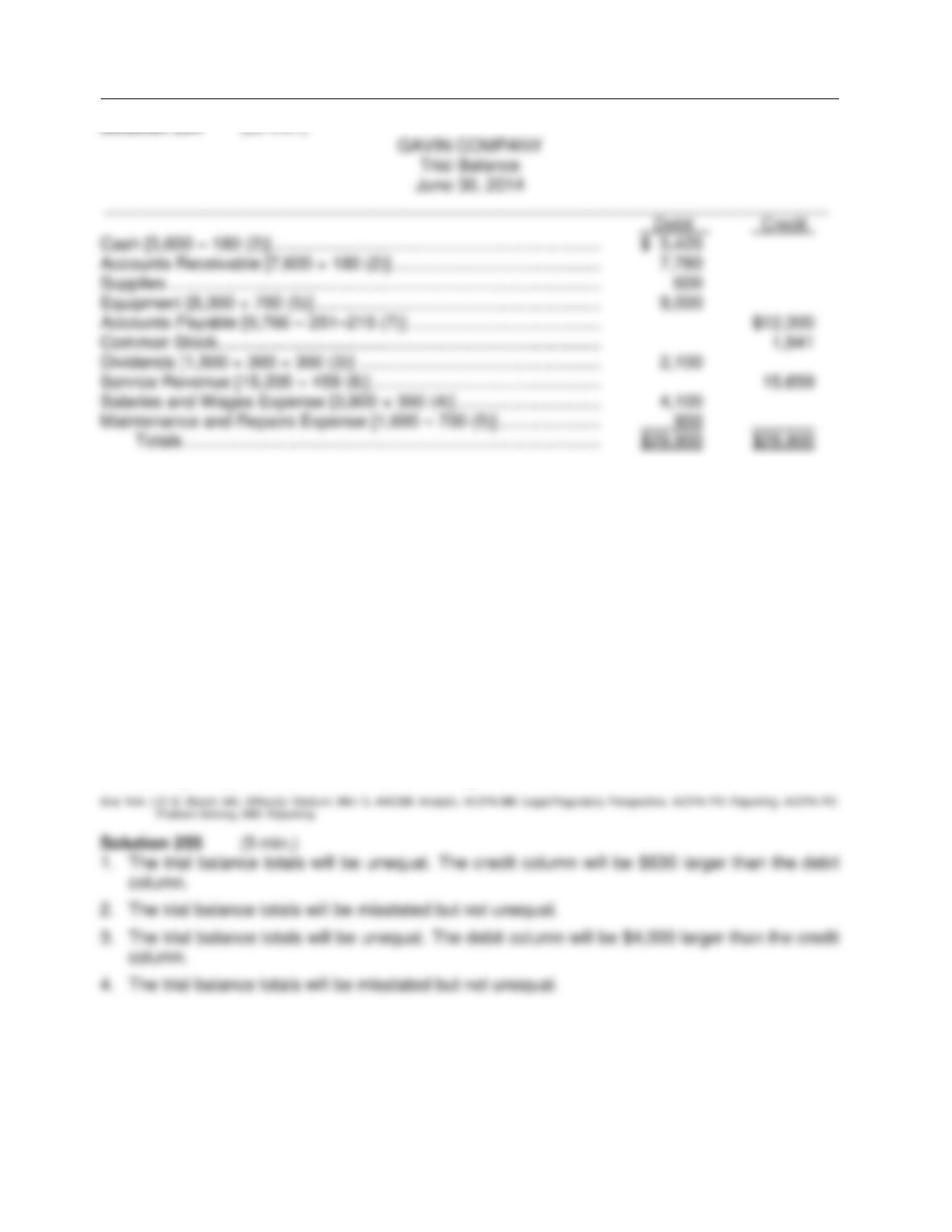
Test Bank for Financial Accounting: Tools for Business Decision Making, Seventh Edition
FOR INSTRUCTOR USE ONLY
3-78
Solution 254 (25 min.) GAVIN COMPANY
Ex. 255
Some of the following errors would cause the debit and credit columns of the trial balance to have
unequal totals. For each of the four cases, state whether the error would cause unequal totals in
the trial balance. If the error causes unequal totals, indicate the amount of difference between the
columns and state whether the debit or credit is larger. Each case is to be considered
independently of the others.
1. A payment of $700 to a creditor was recorded by a debit to Accounts Payable of $70 and a
credit to Cash of $700.
2. A $340 payment for a printer was recorded by a debit to Equipment of $34 and a credit to
Cash for $34.
3. An account receivable in the amount of $2,000 was collected in full. The collection was
recorded by a debit to Cash for $2,000 and a debit to Accounts Payable for $2,000.
4. An account payable was paid by issuing a check for $800. The payment was recorded by
debiting Accounts Payable $800 and crediting Accounts Receivable $800.
The Accounting Information System
3-79
Ex. 256
Some of the following errors would cause the debit and credit columns of the trial balance to have
unequal totals. For each of the four cases, state whether the error would cause unequal totals in
the trial balance. If the error causes unequal totals, indicate the amount of difference between the
columns and state whether the debit or credit is larger. Each case is to be considered
independently of the others.
1. A collection on account of $400 was journalized and posted as a debit to Cash $400 and a
credit to Service Revenue $400.
2. A $950 purchase of supplies on account was recorded as a debit of $950 to Equipment and a
credit of $950 to Accounts Payable.
3. A purchase of equipment for $3,500 on account was not recorded.
4. A $270 receipt on account was recorded as a $720 debit to Cash and a $270 credit to
Accounts Receivable.
Ex. 257
Sue Sloan and Associates is a financial planning service. The account balances at December 31,
2014 are shown by the following alphabetical list:
Accounts Payable $34,000
Accounts Receivable 16,000
Buildings 120,000
Cash 24,500
Common Stock 167,700
Equipment 79,300
Land 47,000
Notes Payable 95,000
Notes Receivable 9,100
Supplies 800
Instructions
Prepare a trial balance with the accounts arranged in financial statement order.
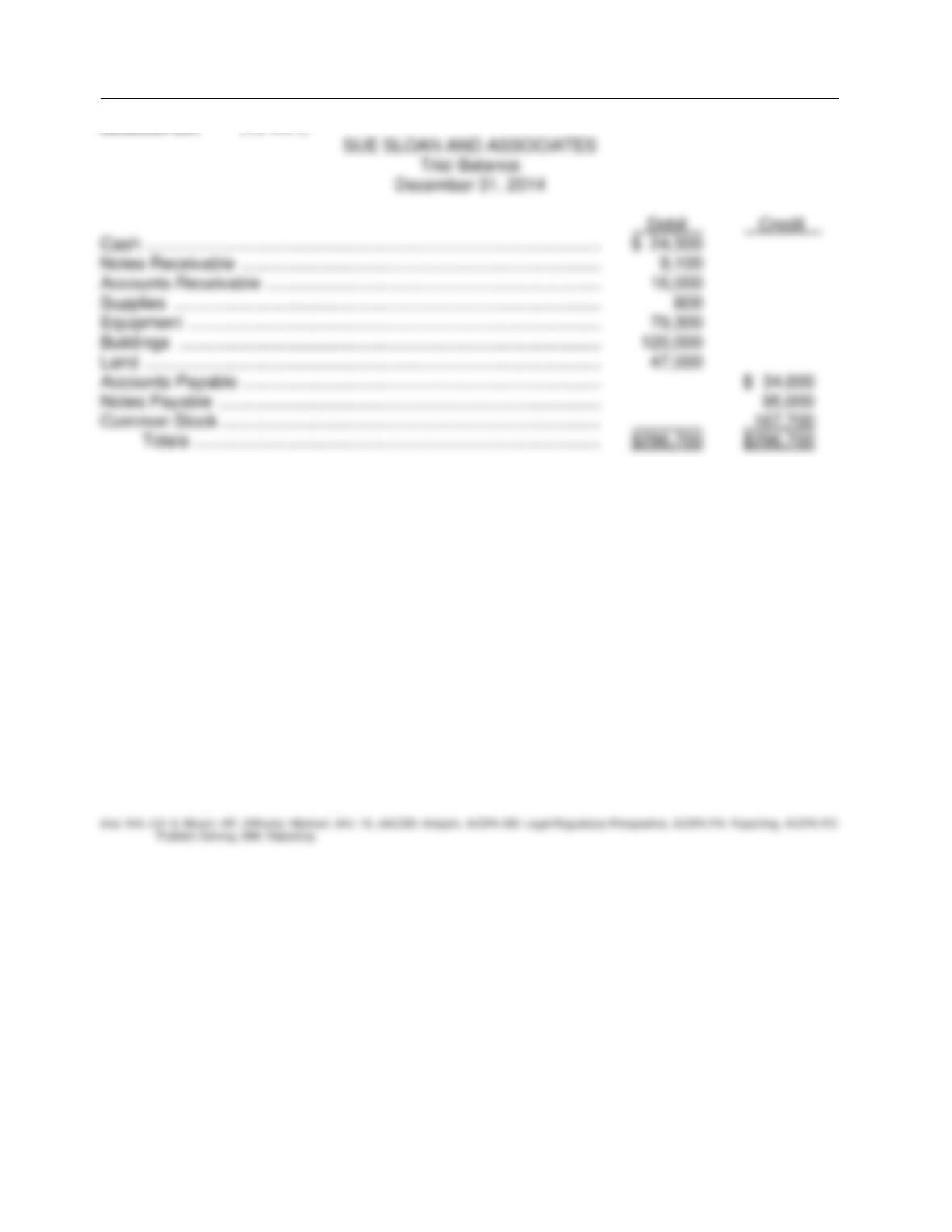
Test Bank for Financial Accounting: Tools for Business Decision Making, Seventh Edition
FOR INSTRUCTOR USE ONLY
3-80
Solution 257 (10 min.) SUE SLOAN AND ASSOCIATES
Ex. 258
The ledger accounts of the Get Fit Gym at July 31, 2014 are shown below:
Accounts Payable $ 12,100
Accounts Receivable 1,050
Buildings 55,400
Common Stock 65,100
Cash 9,000
Equipment 45,900
Notes Payable 45,000
Supplies 350
Dividends 10,500
Instructions
Prepare a trial balance with the ledger accounts arranged in the proper financial statement order.
Include the appropriate heading.
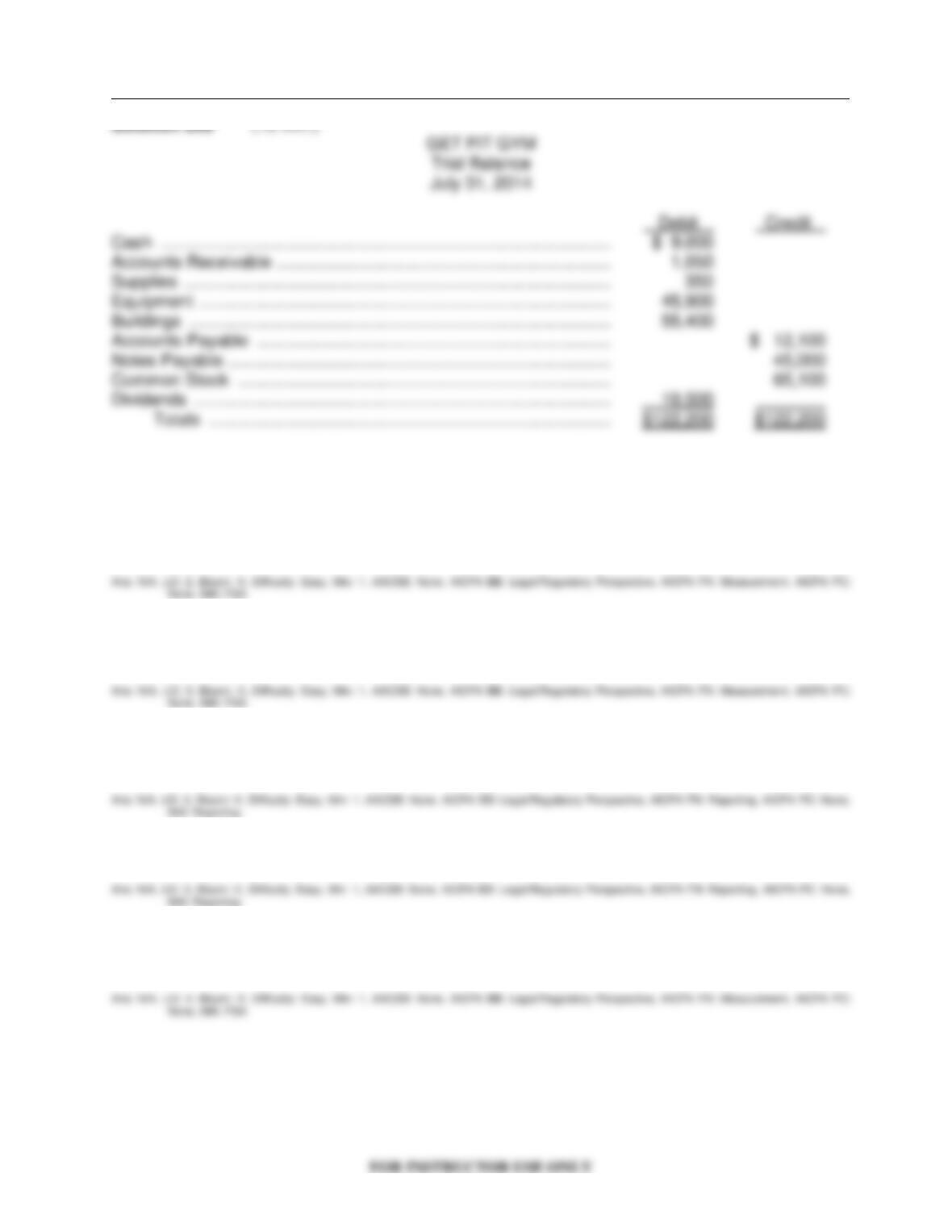
The Accounting Information System
3-81
COMPLETION STATEMENTS
259. An _______________ is an individual accounting record of increases and decreases in
specific assets, liabilities, and stockholders’ equity items.
260. The act of entering an amount on the left side of an account is called _______________
the account, and making an entry on the right side is called _________________ the
account.
261. _____________, ______________, and _______________ have debit normal account
balances whereas _______________, ______________, ______________, and
________________ have credit normal account balances.
262. The five subdivisions of stockholders’ equity are ______________, _______________,
_________________, __________________, and _________________.
263. The basic steps in the recording process are: _______________ each transaction, enter
the transaction in a ______________, and transfer the _______________ information to
appropriate accounts in the ________________.
Test Bank for Financial Accounting: Tools for Business Decision Making, Seventh Edition
FOR INSTRUCTOR USE ONLY
3-82
264. A sales slip, a check, and a cash register tape are examples of ________________ used
as evidence that a transaction has taken place.
265. An accounting record where transactions are initially recorded in chronological order is
called a ________________.
266. Posting is the procedure of transferring journal entries to ________________.
267. The entire group of accounts and their balances maintained by a company is called the
________________.
268. A two column list of all accounts and their balances at a given time is a ______________.
Answers to Completion Statements
The Accounting Information System
FOR INSTRUCTOR USE ONLY
3-83
MATCHING
269. Match the items below by entering the appropriate code letter in the space provided.
A. Account F. Journal
B. Normal account balance G. Posting
C. Debit H. Chart of accounts
D. Revenue account I. Trial balance
E. Ledger J. Source document
____ 1. The entire group of accounts maintained by a company.
____ 2. Transferring journal entries to ledger accounts.
____ 3. The side which increases an account.
____ 4. A list of all the accounts used by a company.
____ 5. An accounting record of increases and decreases in specific assets, liabilities, and
stockholders’ equity items.
____ 6. Left side of an account.
____ 7. Evidence that a transaction has taken place.
____ 8. Shows the debit and credit effects of specific transactions.
____ 9. A list of accounts and their balances at a given time.
____ 10. Has a credit normal balance
IMA: Reporting
Answers to Matching
Test Bank for Financial Accounting: Tools for Business Decision Making, Seventh Edition
FOR INSTRUCTOR USE ONLY
3-84
SHORT-ANSWER ESSAY QUESTIONS
S-A E 270
Describe the accounting information system and the steps in the recording process.
S-A E 271
A student is considering dropping his accounting class because he cannot understand the rules
of debits and credits.
Can the student be successful in the course without an understanding of the rules of debits and
credits? Explain the rules of debits and credits in a way that will help him understand them.
The Accounting Information System
FOR INSTRUCTOR USE ONLY
3-85
S-A E 272
During a study session, a classmate states that it is not necessary to make journal entries and
then post them to the ledger. She states that it is sufficient to analyze the transaction and simply
record the information in T-accounts.
What is your response to this statement? Be brief, yet concise.
S-A E 273
An account is an important accounting record where financial information is stored until needed.
Briefly explain (1) the nature of an account, (2) the different types of accounts, and (3) the
manner in which an account is increased and decreased and its normal balance.
Test Bank for Financial Accounting: Tools for Business Decision Making, Seventh Edition
FOR INSTRUCTOR USE ONLY
3-86
S-A E 274
Why is the Dividends account increased by a debit? Explain in terms of its relationship to
stockholders’ equity.
S-A E 275
Steve Rondelli, a fellow student, contends that the double-entry system means each transaction
must be recorded twice. Is Steve correct? Explain.
S-A E 276
(a) Can accounting transaction debits and credits be recorded directly in the ledger accounts?
(b) What are the advantages of first recording transactions in the journal and then posting to the
ledger?
S-A E 277
Describe the process of preparing a trial balance. What is the purpose of preparing a trial
balance? If a trial balance does not balance, identify what might be the reasons why it does not
balance. If the trial balance does balance, does that insure that the ledger accounts are correct?
Explain.
The Accounting Information System
FOR INSTRUCTOR USE ONLY
3-87
S-A E 278 (Ethics)
Robert Harder, Jr. was appointed the manager of Westbrook Properties, a recently formed
company that manages residential rental properties. Maria Valdez is the accountant. She
prepared a chart of accounts based on an analysis of the expenditures of the company. One of
the largest expense categories is Travel and Entertainment. Mr. Harder believes that it is
important to maintain a presence in the social life of the city. In this, he sharply differs from his
father, Robert Harder, Sr. the elder Mr. Harder has set up Westbrook Properties in order to test
his son’s management skills before allowing him to manage a more lucrative commercial property
business. Mr. Harder, Sr. provided the capital for Westbrook, and maintains close contact with the
company. He allowed his son, however, to hire his own employees.
Mr. Harder has asked Ms. Valdez to name the Travel and Entertainment account Property
Development. He hopes to deflect his father’s attention away from the amount he has spent on
travel and entertainment until he has proven that his methods work. When Ms. Valdez resisted,
he reminded her that he, not his father, hired her. He also reminded her that she had been
enthusiastic about his business plans when she was hired.
Required:
1. Who are the stakeholders in this situation?
2. Should Ms. Valdez agree to the change in the Travel and Entertainment account to Property
Development? Explain.
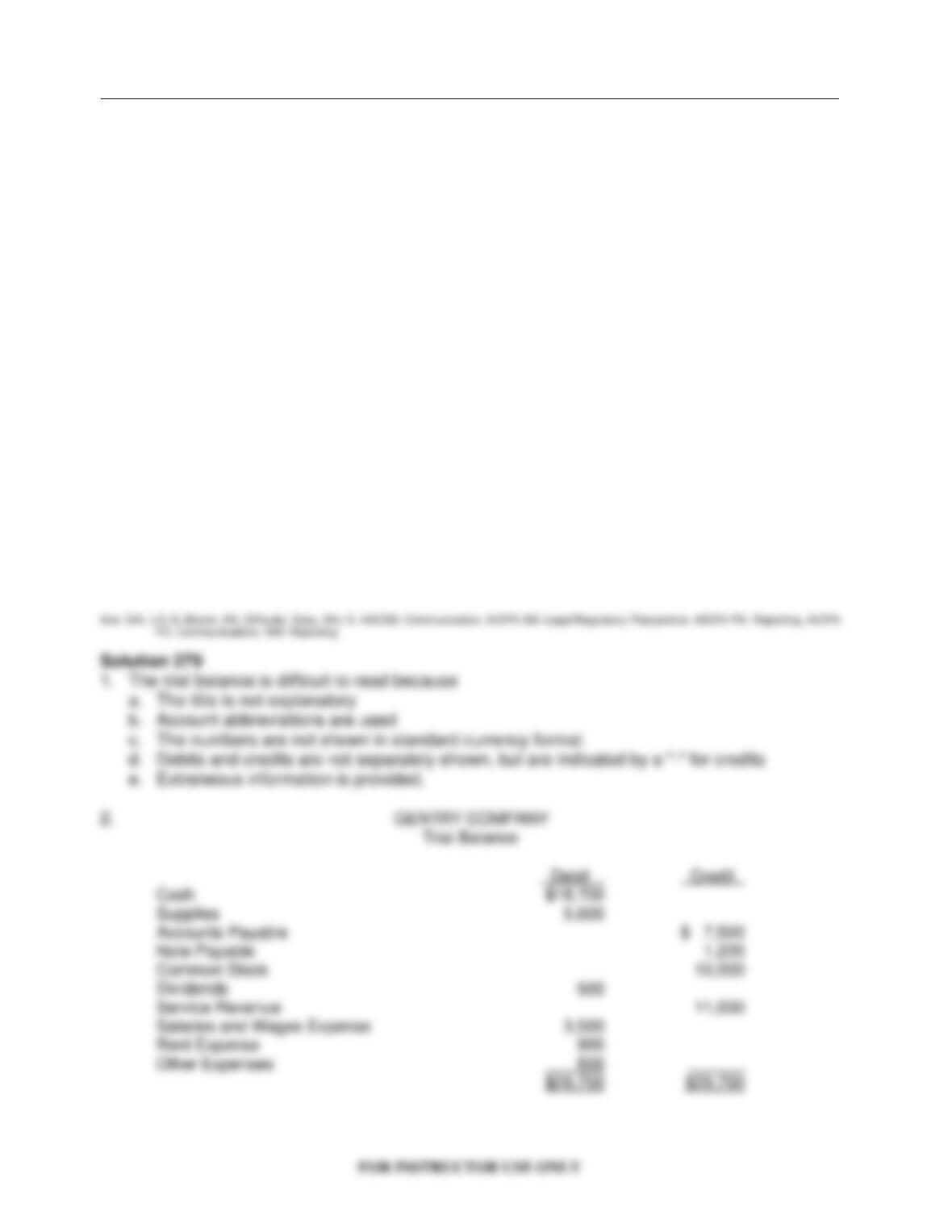
Test Bank for Financial Accounting: Tools for Business Decision Making, Seventh Edition
3-88
S-A E 279 (Communication)
The following trial balance was obtained from Gentry Company‘s computer system.
RPT TR BAL
DPT ACC MGR
PRIORITY 2
RUN BY R.HAMES
SEQUENCE 997411
ACCOUNT BAL
CASH 18700
SUPPLIES 5600
ACC PAY 7500–
NOTE PAY 1200–
COMMON STOCK 10000-
DIVIDENDS 500
SERVICE REVENUE 11000-
SAL AND WAG EXP 3500
RENT EXP 900
OTHER EXP 500
BAL 0
***TRIAL BALANCE IS IN BALANCE***
Required:
1. What features make this trial balance difficult to read?
2. Prepare an improved trial balance.
The Accounting Information System
3-89
IFRS QUESTIONS
1. Which of the following are the same under both GAAP and IFRS?
a. The account.
b. Debit and credit rules.
c. Steps in the recording process.
d. All of these answer choices are correct.
2. Which of the following are the same under both GAAP and IFRS?
a. The journal.
b. The ledger.
c. The chart of accounts.
d. All of these answer choices are correct.
3. Which of the following is true?
a. Transaction analysis is completely different under IFRS and GAAP.
b. Most transaction are recorded differently under IFRS and GAAP.
c. Transaction analysis is the same under IFRS and GAAP, but some transactions are
recorded differently.
d. All transaction are recorded the same under IFRS and GAAP.
4. European companies rely
a. less on historical cost and more on fair values than U.S companies.
b. less on fair values and more on historical cost than U.S companies.
c. completely on fair values for financial reporting.
d. completely on historical cost for financial reporting.
5. The double-entry accounting system is the basis of accounting systems
a. worldwide.
b. worldwide, except for the U.S.
c. in the U.S. only
d. neither internationally nor in the U.S.
6. Under IFRS, the trial balance
a. follow the same format as under GAAP.
b. shows credits on the left and debits on the right.
c. include less accounts than under GAAP.
d. include more accounts than under GAAP.
7. In deciding whether the U.S. should adopt IFRS, the issue the SEC said should be
considered is
a. whether IFRS is sufficiently developed and consistent in application.
b. whether the IFRS is established for the benefit of investors.
c. the impact of a switch to IFRS on U.S. laws and regulation.
d. all of these answer choices are correct.
Test Bank for Financial Accounting: Tools for Business Decision Making, Seventh Edition
3-90
8. Which of the following statements is true regarding the recording process?
a. Because IFRS (International Financial Reporting Standards) rely more on fair value
and less on historical cost than U.S. GAAP, the double-entry accounting system is not
widely used by companies who use IFRS.
b. Both IFRS (International Financial Reporting Standards) and U.S. GAAP use the
same general rules of debits and credits and the steps in the recording process.
c. A trial balance using IFRS (International Financial Reporting Standards) is organized
by first showing the accounts from the statement of financial position followed by
accounts from the income statement; a trial balance using U.S. GAAP is organized
using the opposite order.
d. All of these answer choices are correct.
9. Under U.S. GAAP
a. currency signs are generally used in the journal, ledger, trial balance, and financial
statements.
b. share Capital – Ordinary is referred to as Retained Earnings.
c. the statement of financial position is often called the statement of changes in financial
position.
d. the rules of debits and credits, and the steps in the recording process are the same as
under IFRS (International Financial Reporting Standards).