
Chapter 3: Processing Accounting Information
92. The accounting equation must balance after each transaction.
a. True
b. False
93. Dividends are a determinant of net income.
a. True
b. False
94. If a company purchases equipment by issuing a note payable, its total assets will not change.
a. True
b. False
95. A company‘s chart of accounts will reflect the nature of its business.
a. True
b. False
96. The origins of single-entry accounting were documented in a book written by Pacioli over 500 years ago. It includes
the concepts of bookkeeping that are still applied today.
a. True
b. False
97. There is a universal chart of accounts that is applicable to all businesses.
a. True
b. False
98. A T account for Cash cannot contain any credits.
a. True
b. False
99. A debit entry increases assets, decreases liabilities, or decreases stockholders’ equity.
a. True
b. False

Chapter 3: Processing Accounting Information
100. The normal balance of the Dividends account is a credit.
a. True
b. False
101. Under the double–entry system of accounting, every transaction is entered in at least two accounts on opposite
sides of T accounts.
a. True
b. False
102. A debit is a negative entry.
a. True
b. False
103. With few exceptions, the balance of all accounts should be on the side of the T account that causes the increase.
a. True
b. False
104. The credit side of an account is the right side while the debit side is the left side.
a. True
b. False
105. When making a general journal entry, there can only be one debit and one credit.
a. True
b. False
106. Every business transaction is recorded by a debit to a balance sheet account and a credit to an income statement
account.
a. True
b. False
107. Only events that can be measured will be reflected in the journal entries.
a. True
b. False

Chapter 3: Processing Accounting Information
108. The ledgers are an example of an accounting book of original entry.
a. True
b. False
109. The general journal is often used to record repetitive transactions.
a. True
b. False
110. The general ledger is sometimes called the book of original entry because it is the accounting
record where transactions are first recorded.
a. True
b. False
111. Every transaction affects equal numbers of ledger accounts and is recorded by equal dollar amounts of
debits and credits.
a. True
b. False
112. A trial balance is the listing of each account and its balance at a specific point in time.
a. True
b. False
113. The equality of debits and credits in a trial balance means that all entries were correctly posted to the
accounts.
a. True
b. False
114. A trial balance can be distributed to stockholders in place of the balance sheet.
a. True
b. False

Chapter 3: Processing Accounting Information
115. A trial balance that balances provides proof that all transactions were correctly journalized and posted to
the ledger.
a. True
b. False
116. A purchase of raw materials from a supplier is a(n) event.
117. An internal or external event must be to be recognized.
118. provide the evidence needed in an accounting system to record a
transaction.
119. The issuance of common stock increases both and stockholders’ equity.
120. The acquisition of a computer for $1,200, with a down payment of $200 cash and the signing of a
$1,000 note payable for the balance increases both assets and .
121. If an accounting firm provides services on account, both and stockholders’
equity increase.
122. The payment of salaries and wages decreases cash and increases a(n) .
123. Dividends are not a(n) but a direct reduction of retained earnings.
124. The principle says that, with a few exceptions, assets are not carried at
market values, but at their original cost.

Chapter 3: Processing Accounting Information
125. Various transactions may change the amount and composition of the assets and liabilities, but the
____________________________ must balance after each transaction.
126. are a distribution of net income for the period, not a determinant of net
income as are expenses.
127. A(n) is a numerical list of all of the accounts used by an
entity.
128. The is the file or book that contains all of a company’s accounts.
129. The totaling of each side of a T account is known as .
130. The left or debit side of a liability account is used to record .
131. Assets and expenses are ____________________ by credits.
132. Liabilities and stockholders’ equity are by debits.
133. Credits are always on the side of the T account.
134. The normal balance of revenue is a(n) .
135. A(n) is a chronological record of all transactions entered into by a business.
136. A(n) is a list of each account and its balance at a specific point in time.
Chapter 3: Processing Accounting Information
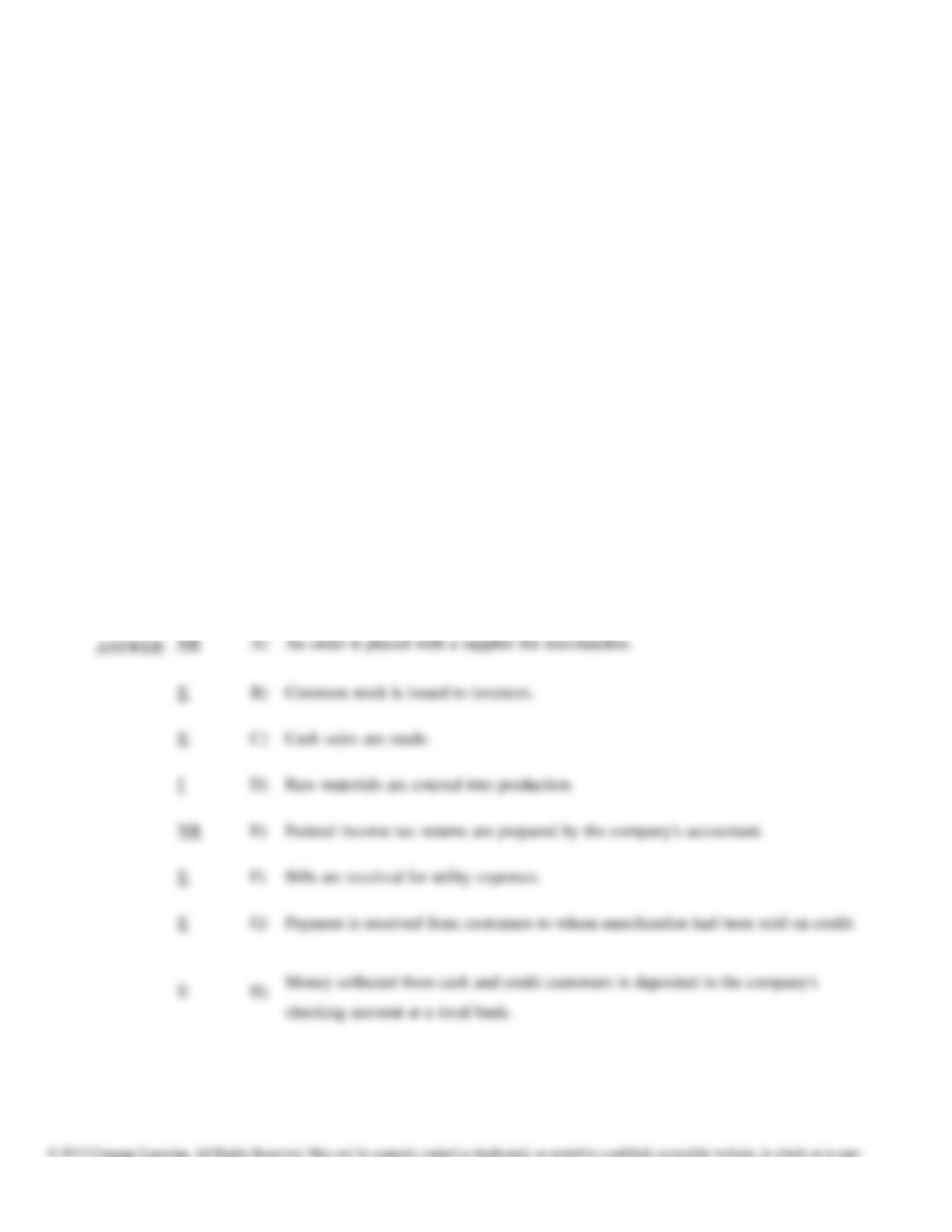
137. Several events are listed below. Indicate whether each event is an external event that should be recorded as a
transaction, an internal event which should be recorded as a transaction, or an event which should not be recorded.
Use the following identification codes for your answers:
E – External event to be recorded as a transaction
I – Internal event to be recorded as a transaction
NR – An event which should NOT be recorded
_____ A) An order is placed with a supplier for merchandise.
_____ B) Common stock is issued to investors.
_____ C) Cash sales are made.
_____ D) Raw materials are entered into production.
_____ E) Federal income tax returns are prepared by the company’s accountant.
_____ F) Bills are received for utility expenses.
_____ G) Payment is received from customers to whom merchandise had been sold on credit.
_____ H) Money collected from cash and credit customers is deposited in the company’s
checking account at a local bank.
Chapter 3: Processing Accounting Information
_____
(3)
_____
(4)
_____
(5)
_____
(6)
_____
(7)
_____
(8)
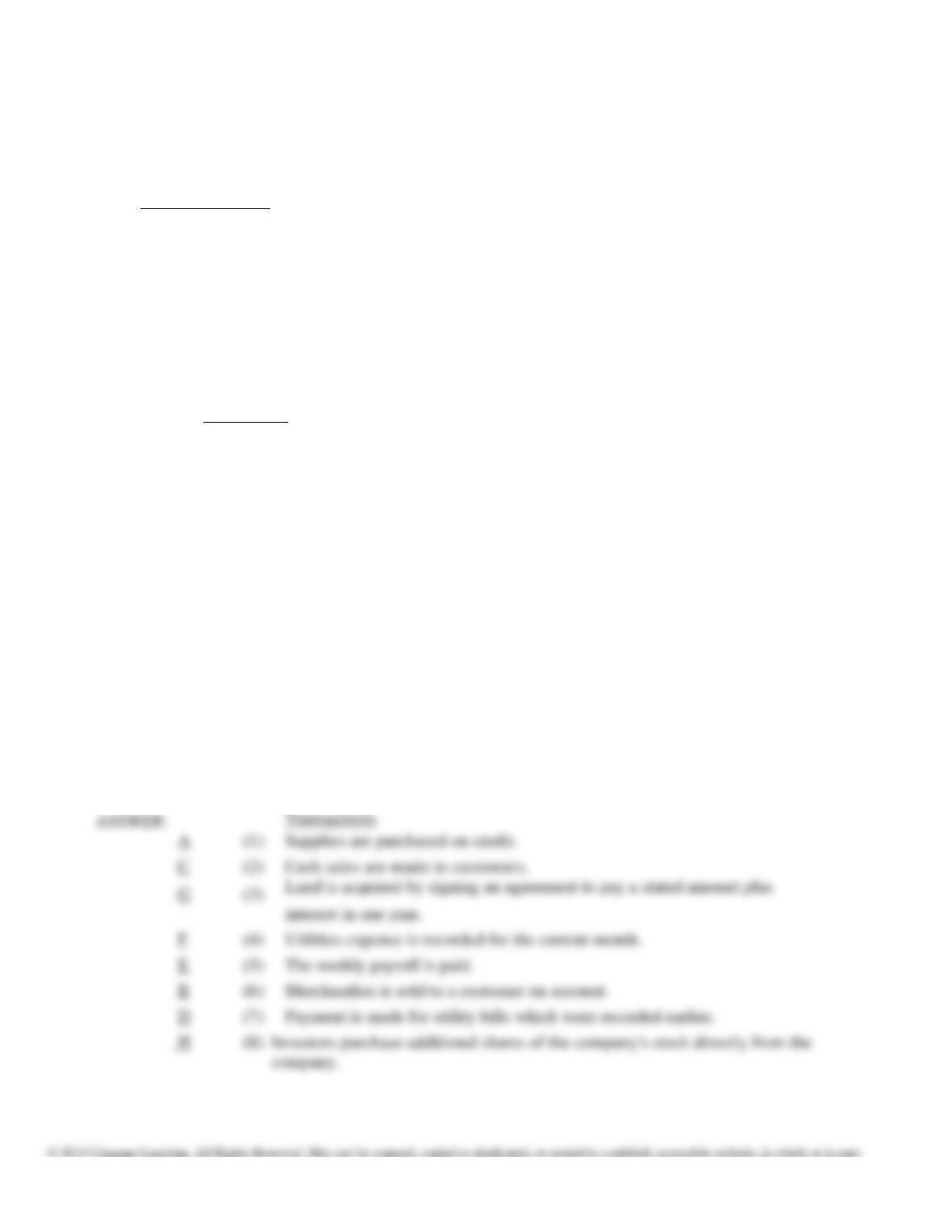
138. Presented below are a list of source documents and a list of transactions. Using the identification letters
before each source document, indicate next to each transaction which source document serves as evidence
for the recording of the transaction.
Source Documents
A) Purchase invoice
B) Sales invoice
C) Cash register tape
D) Check
E) Time card
F) Monthly statement
G) Promissory note
H) Stock certificate
Transactions
_____ (1) Supplies are purchased on credit.
_____ (2) Cash sales are made to customers.
Land is acquired by signing an agreement to pay a stated amount plus interest
in one year.
Utilities expense is recorded for the current month.
The weekly payroll is paid.
Merchandise is sold to a customer on account.
Payment is made for utility bills which were recorded earlier.
Investors purchase additional shares of the company’s stock directly from
the company.

Chapter 3: Processing Accounting Information
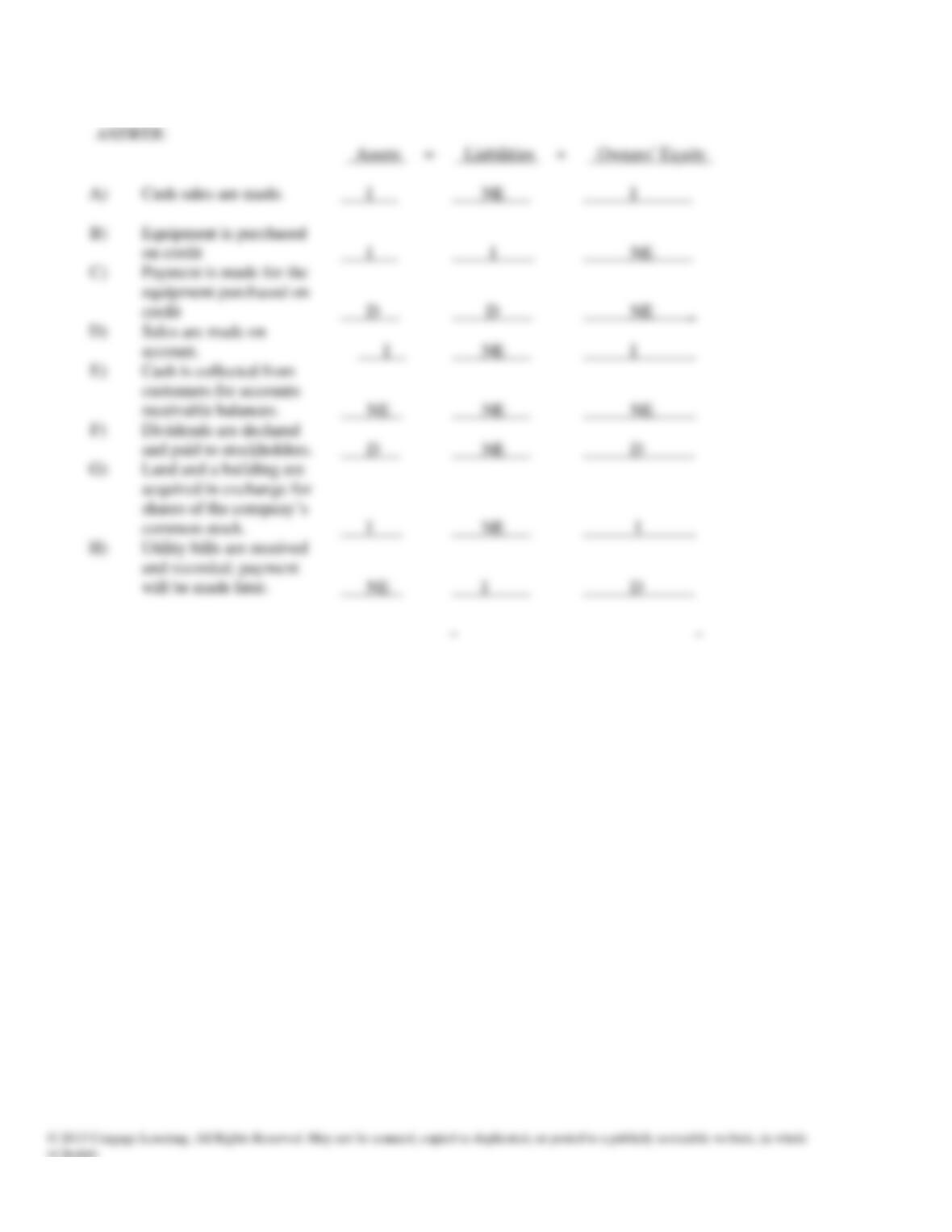
139. Several transactions are listed below, with the accounting equation stated to the right side of each. Use the
following identification codes to indicate the effects of each transaction on the accounting equation. Write your
answers in the space provided under the accounting equation. You need an identification code for each element of
the accounting equation. An example is given before the first transaction.
I-Increase D-Decrease NE–No Effect
Example Common stock is issued to
investors in the company
Assets = Liabilities + Owners’ Equity
I NE I
A) Cash sales are made. ______ _______ ______
B) Equipment is purchased on
credit. ______ _______ ______
C) Payment is made for the
equipment purchased on credit. ______ _______ ______
D) Sales are made on account. _______ _______ ______
E) Cash is collected from
customers for accounts
receivable balances.. _______ _______ ______
F) Dividends are declared and paid
to stockholders. _______ _______ ______
G) Land and a building are
acquired in exchange for shares
of the company’s common
stock.
_______ _______ ______
H) Utility bills are received and
recorded; payment will be made
later.
_______ _______ ______
Chapter 3: Processing Accounting Information

Chapter 3: Processing Accounting Information
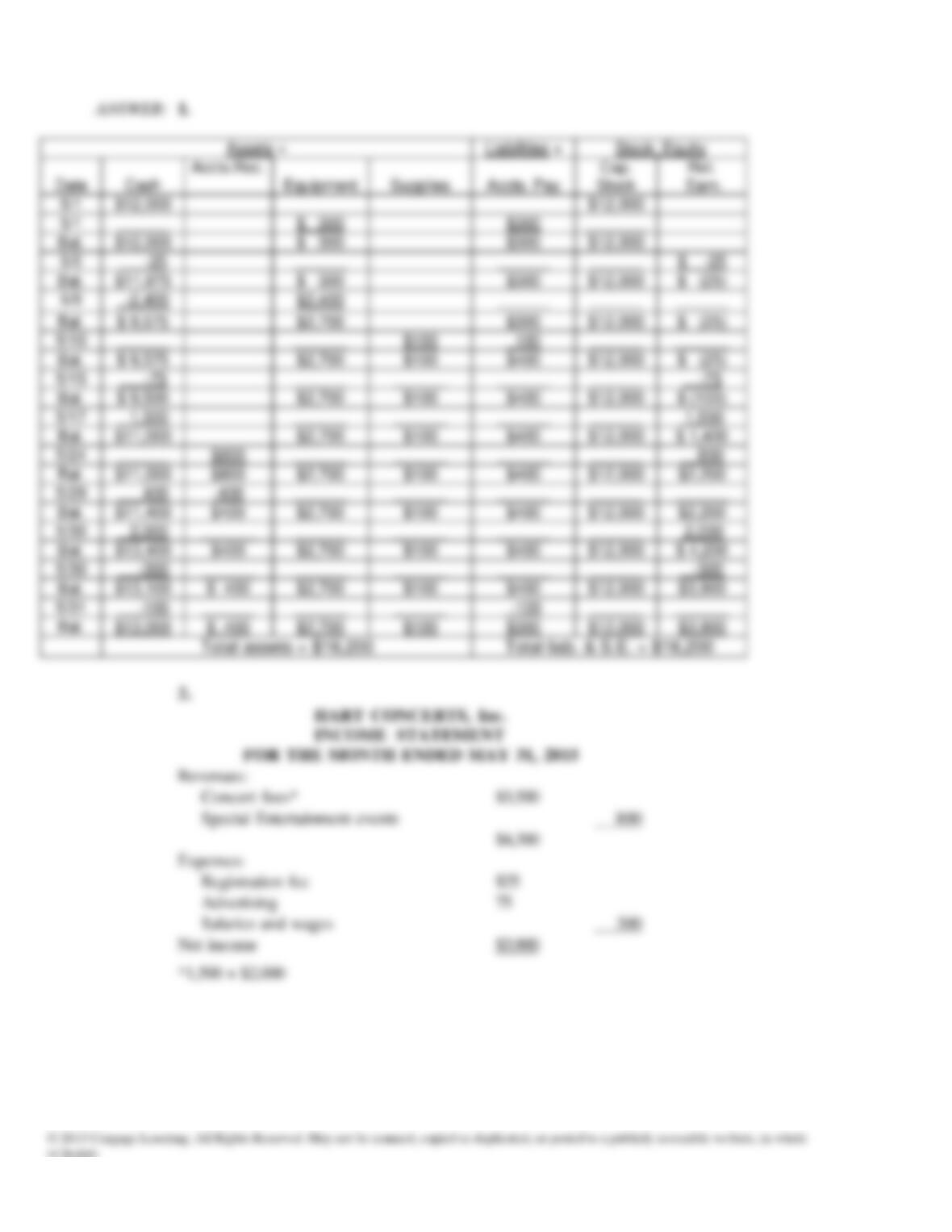
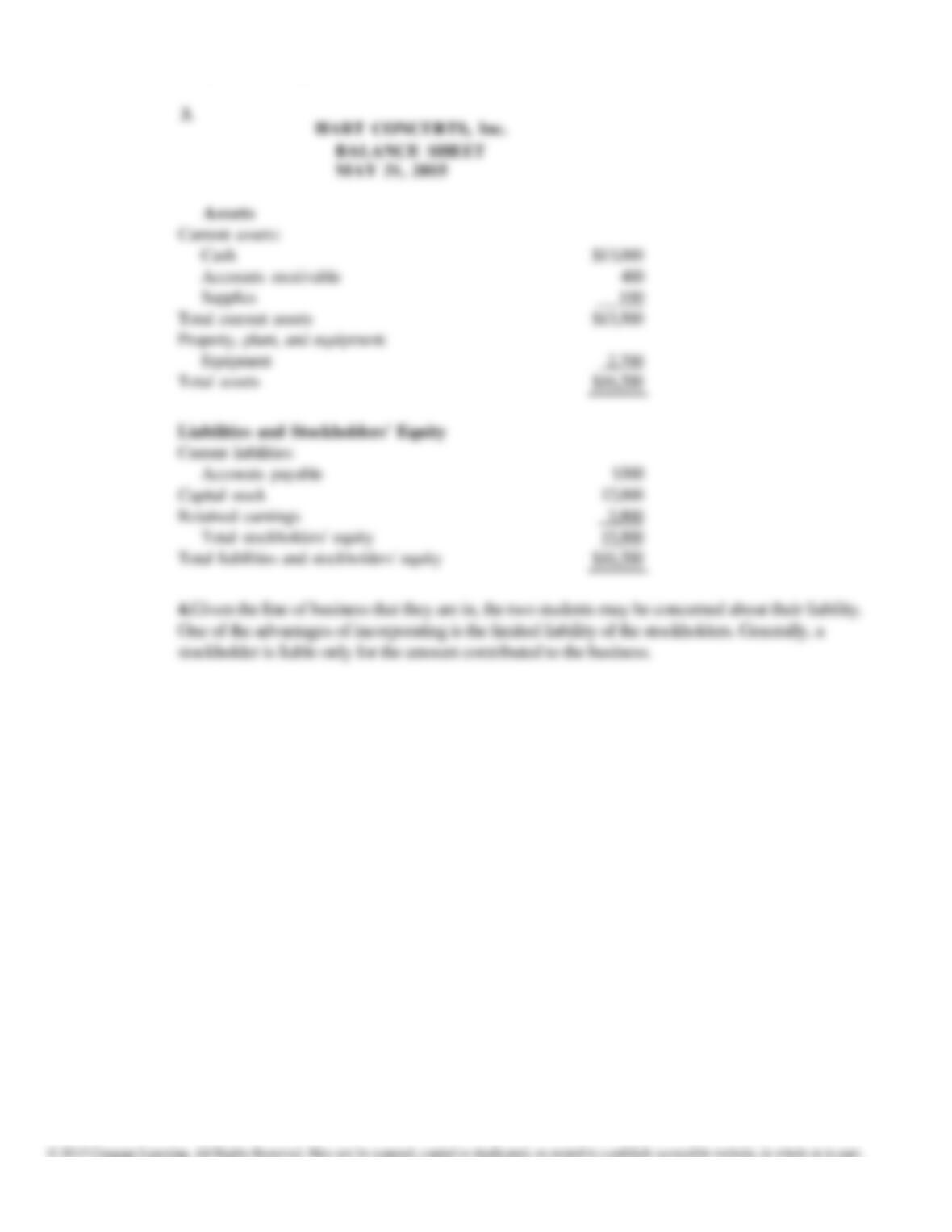
140. Hart Concerts Inc. was organized on May 1, 2015, by two students majoring in education. The two
entrepreneurs provided entertainment for children’s birthday parties to supplement their college career.
The following transactions occurred during the first month of operations:
May 1: Received contribution of $6,000 from each of the two principal owners of the new business in
exchange for shares of stock.
May 1: Purchased lighting equipment for $300 on an open account. The company has 30 days to
pay for the equipment.
May 5: Registered as a vendor with the city and paid the $25
monthly fee. May 9: Purchased an event tent to set up at
parties for $2,400 cash.
May 10: Purchased $100 in miscellaneous supplies on account. The company has 30 days to pay for
the supplies. May 15: Paid a $75 bill from local printer for advertisement signs.
May 17: Customers paid for services with cash of $1,500.
May 24: Billed the local park district $800 entertainment provided to a summer camp.
The park district is to pay one–half of the bill within five working days and the rest within
30 days. May 29: Received 50% of the amount billed to the park district.
May 30: Customers paid cash for parties of $2,000.
May 30: Paid wages of $300 to a friend who helped over the
weekend. May 31: Paid the balance due on the supplies.
Required
1. Prepare a table to summarize the preceding transactions as they affect the
accounting equation. Use the following format. Identify each transaction with
the date.
Assets =
Liabilities
+
Stock. Equity
Date
Cash
Accts. Rec.
Equipment
Supplies
Accts. Pay.
Cap. Stock
Ret.
Earn.
2. Prepare an income statement for the month ended May 31, 2015.
3. Prepare a classified balance sheet at May 31, 2015.
4. Why do you think the two students decided to incorporate their business rather than operate it as a
partnership?
Chapter 3: Processing Accounting Information
Chapter 3: Processing Accounting Information
Chapter 3: Processing Accounting Information
141. Prepare the journal entry to record each of the following independent transactions. (Use the number of the
transaction in place of a date for identification purposes.)
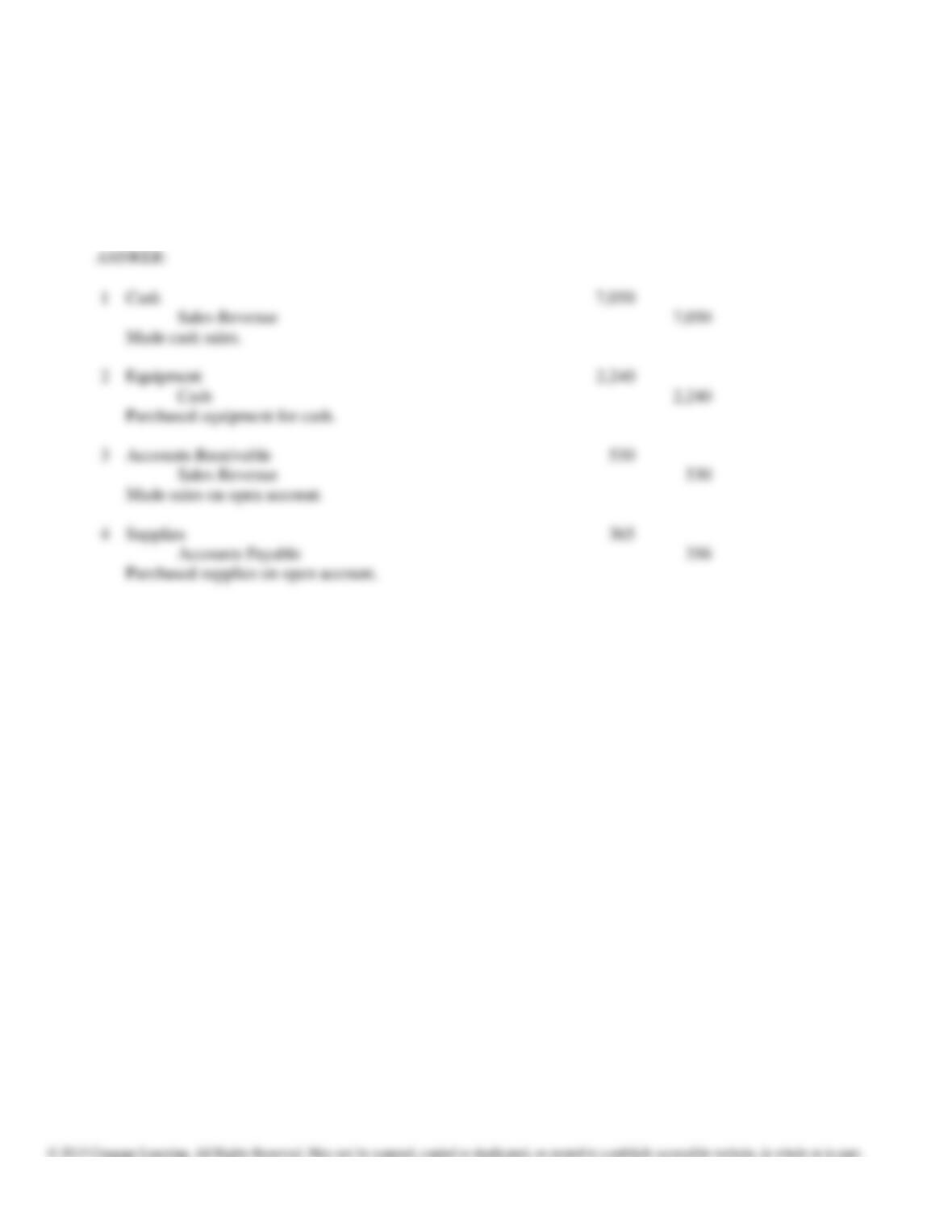
1. Services provided for cash of $7,050.
2. Purchase of equipment for cash of $2,240.
3. Services provided on account of $530.
4. Purchases of supplies on account for $365.
Chapter 3: Processing Accounting Information
142. Prepare the journal entry to record each of the following independent transactions. (Use the number of the
transaction in place of a date for identification purposes.)
1. Sale of capital stock in exchange for a parcel of land; the land is appraised at $75,000
2. Payment of $3,400 in salaries and wages
3. Payment of open account in the amount of $850
4. Issuance of a promissory note for $2,750
5. Collections on account for $689
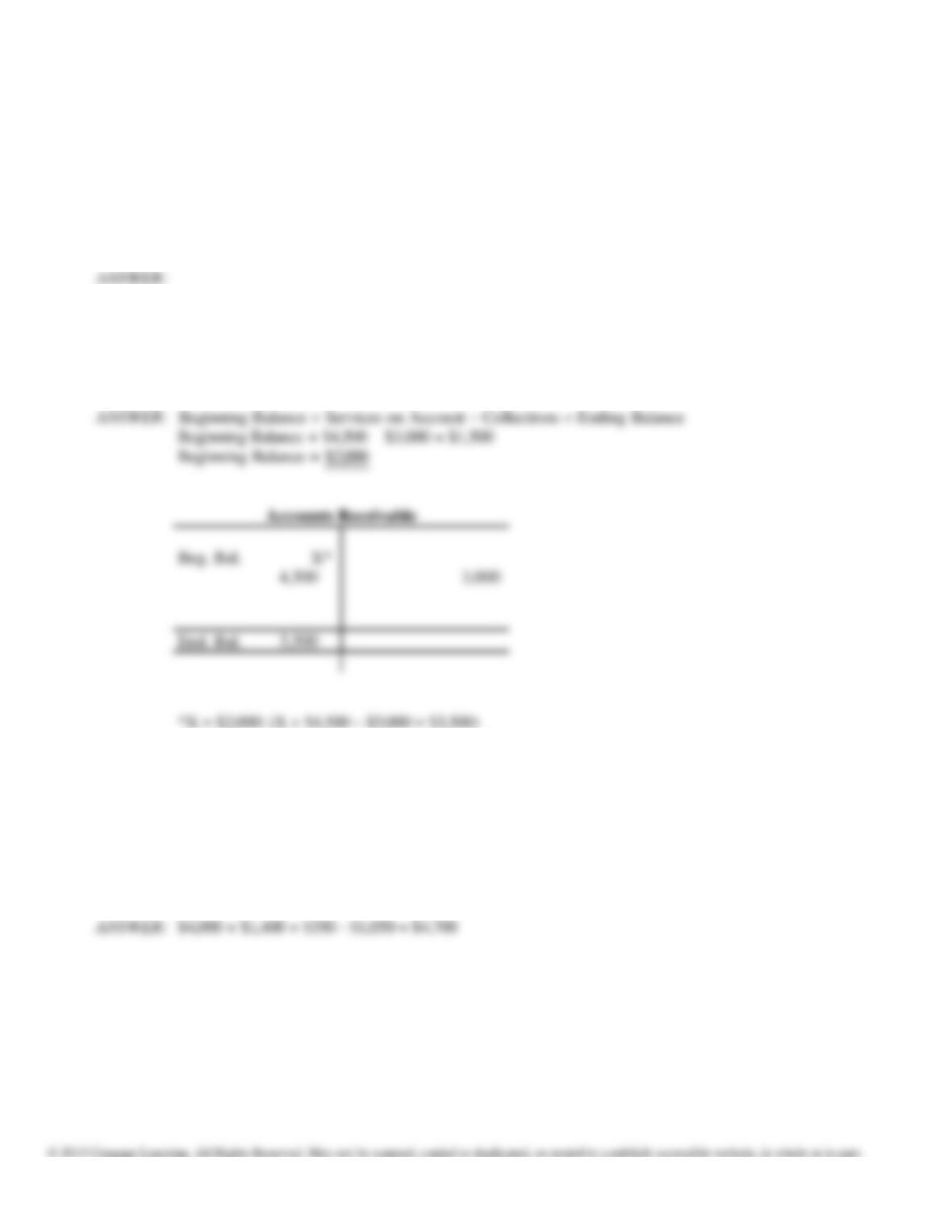
143. During the month, services performed for customers on account amounted to $4,500 and collections from
customers in payment of their accounts totaled $3,000. At the end of the month, the Accounts Receivable account
had a balance of $3,500. What was the Accounts Receivable balance at the beginning of the month? (Show your
work using a T account.)
144. Falcon Services was organized on May 1, 2015. The company received a contribution of $2,000 from each of the
two principal owners. During the month, Falcon Services provided services for cash of $1,400 and services on
account for $600, received $350 from customers in payment of their accounts, purchased supplies on account for
$800 and equipment on account for $1,050, received a utility bill for $150 that will not be paid until June, and paid
the full amount due on the equipment.
REQUIRED: Show your work to determine the company’s Cash balance on May 31, 2015.
Chapter 3: Processing Accounting Information
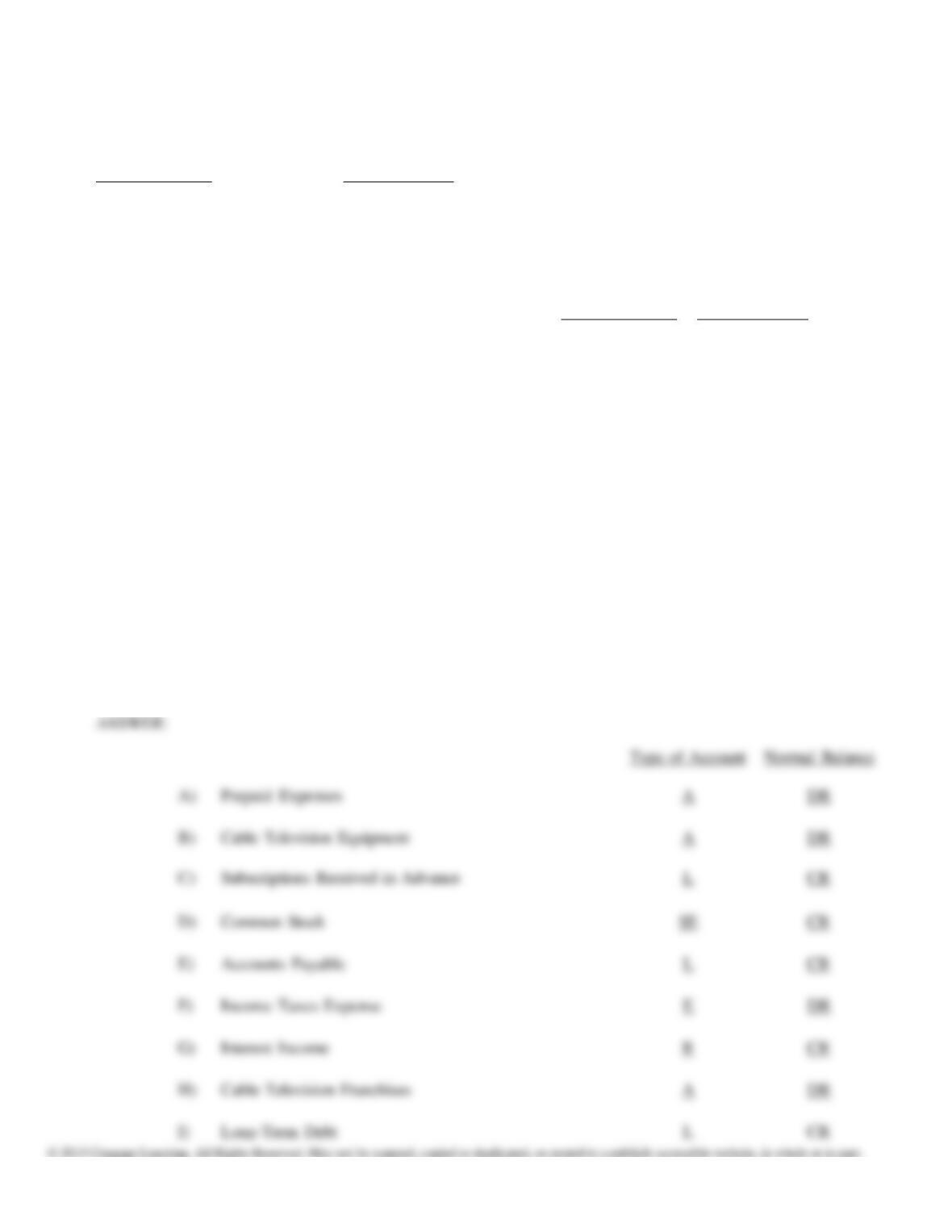
145. Several accounts from the financial statements of Robot Technologies are listed below. In the two columns
provided for answers, indicate the type of account and the normal account balance. Use the following identification
codes for your answers:
Type of Account
Normal Balance
A = Asset
DR = Debit
L = Liability
CR = Credit
SE = Stockholders’ Equity
R = Revenue
E = Expense
Type of Account
Normal Balance
A)
Prepaid Expenses
_______
_______
B)
Cable Television Equipment
_______
_______
C)
Subscriptions Received in Advance
_______
_______
D)
Common Stock
_______
_______
E)
Accounts Payable
_______
_______
F)
Income Taxes Expense
_______
_______
G)
Interest Income
_______
_______
H)
Cable Television Franchises
_______
_______
I)
Long-Term Debt
_______
_______

Chapter 3: Processing Accounting Information
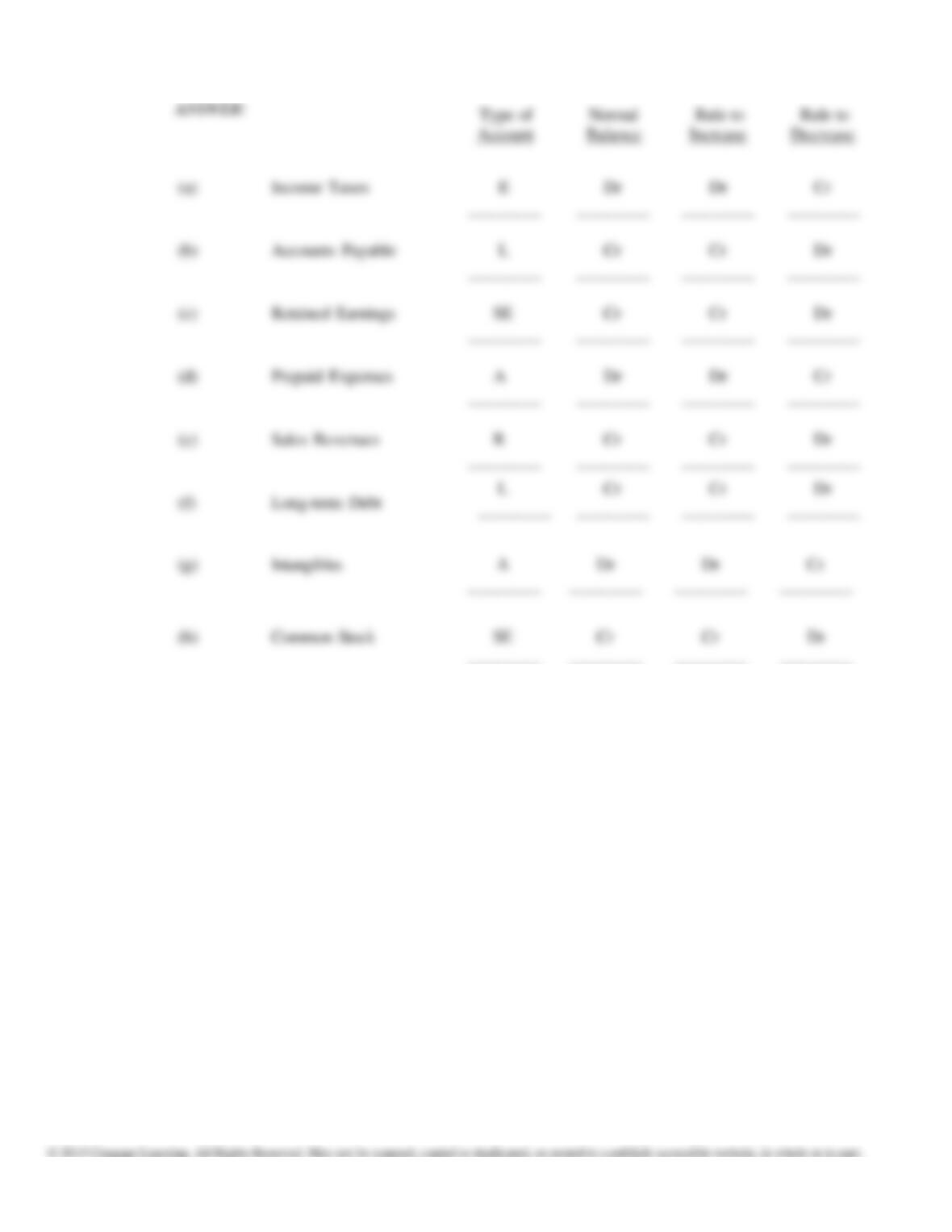
146. Listed below are selected accounts from the financial statements of Bargain Mart for the year ended December
31, 2014. In the blank space provided for each account, indicate what type of account it is, its normal balance, and
the debit/credit rules for increasing and decreasing it. Use the following abbreviations for your answers:
Type of Account
Normal Account
Balance
Rules to Increase or
Decrease the Account
A = Asset
Dr = Debit
Dr = Debit
L = Liability
Cr = Credit
Cr = Credit
SE = Stockholders’ Equity
R = Revenue
E = Expense
Example:
Cash
Type of
Account
A
Normal
Balance
Dr
Rule to
Increase
Dr
Rule to
Decrease
Cr
(a)
Income Taxes
_______
_______
_______
_______
(b)
Accounts Payable
_______
_______
_______
_______
(c)
Retained Earnings
_______
_______
_______
_______
(d)
Prepaid Expenses
_______
_______
_______
_______
(e)
Sales Revenues
_______
_______
_______
_______
(f)
Long-term Debt
_______
_______
_______
_______
(g)
Intangibles
_______
_______
_______
_______
(h)
Common Stock
_______
_______
_______
_______
Chapter 3: Processing Accounting Information
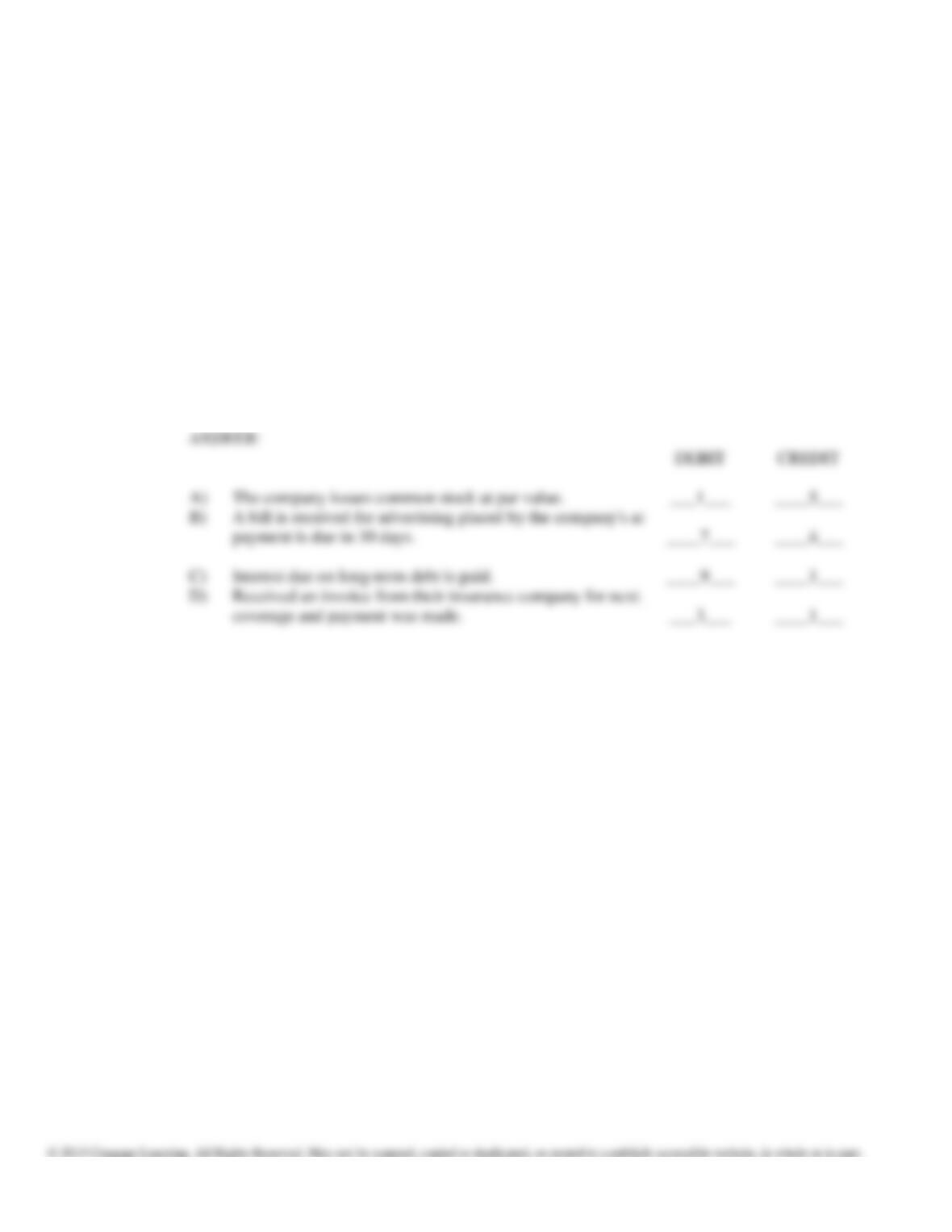
147. Presented below are several accounts from the financial statements of Eagle, Inc. for the year ended
December 31, 2015:
1. Cash
2. Accounts Receivable
3. Prepaid Expenses
4. Accounts Payable
5. Common Stock
6. Sales
7. Selling Expenses
8. Administrative Expenses
9. Interest Expense
10. Income Taxes Expense
Each of these accounts has been assigned an identification number which you will use as answers for the
transactions described below. Enter the account number(s) in the blank spaces under the headings DEBIT and
CREDIT to indicate the accounts debited and credited when each transaction is recorded in a general journal.
Chapter 3: Processing Accounting Information
DEBIT
CREDIT
A)
The company issues common stock at par value.
________
________
B)
A bill is received for advertising placed by the company’s
ad agency; payment is due in 30 days.
________
________
C)
Interest due on long-term debt is paid.
________
________
D)
Received an invoice from their insurance company for next y
coverage and payment was made.
________
________
DEBIT
The company issues common stock at par value.
Interest due on long-term debt is paid.
D)
Received an invoice from their insurance company for next y
coverage and payment was made.

Chapter 3: Processing Accounting Information
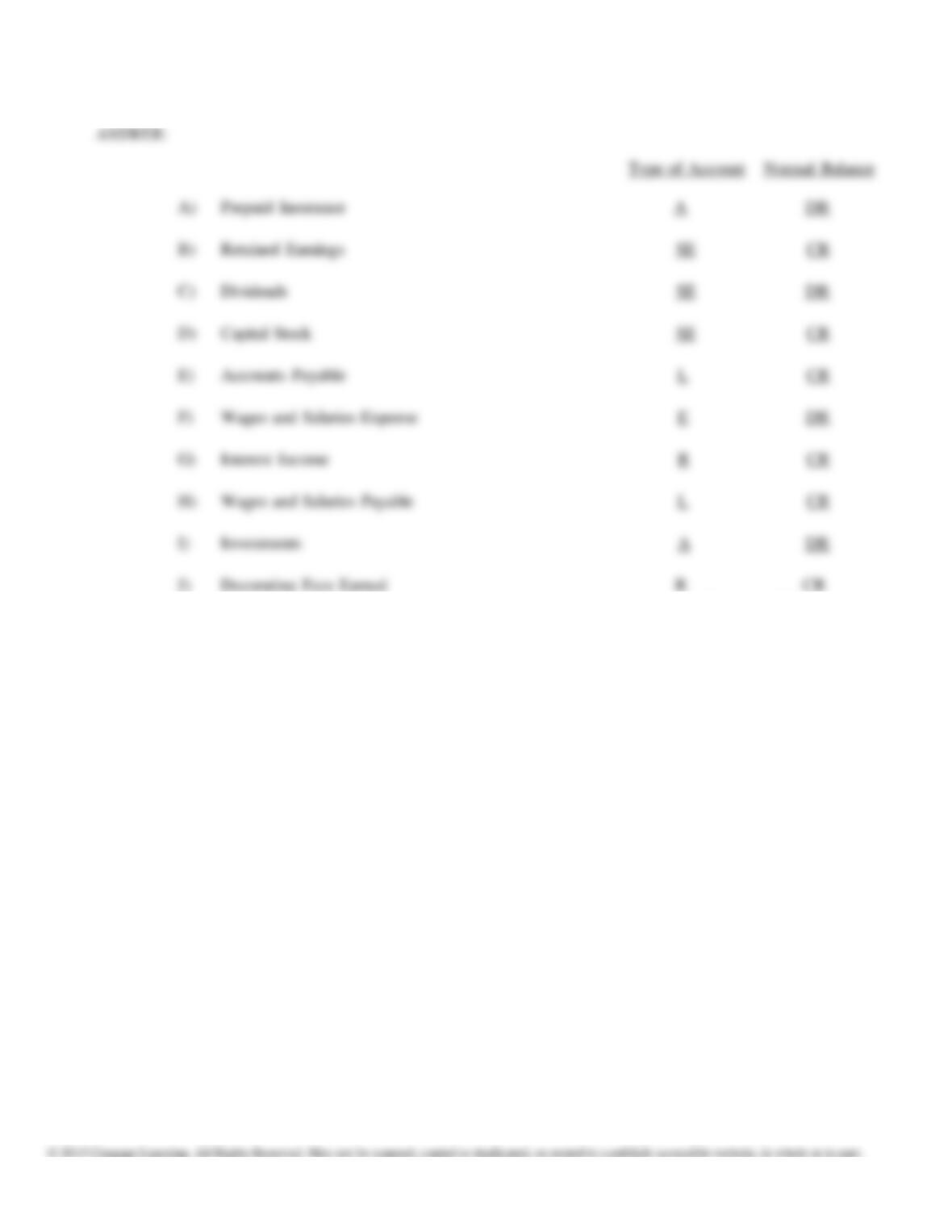
148. Several accounts from the financial statements of Madison Company are listed below. In the two columns provided
for answers, indicate the type of account and the normal account balance. Use the following identification codes for
your answers:
Type of Account Normal Balance
A = Asset DR = Debit
L = Liability CR = Credit
SE = Stockholders’ Equity
R = Revenue
E = Expense
Type of Account
Normal Balance
A)
Prepaid Insurance
_______
_______
B)
Retained Earnings
_______
_______
C)
Dividends
_______
_______
D)
Capital Stock
_______
_______
E)
Accounts Payable
_______
_______
F)
Wages and Salaries Expense
_______
_______
G)
Interest Income
_______
_______
H)
Wages and Salaries Payable
_______
_______
I)
Investments
_______
_______
J)
Decorating Fees Earned
_______
_______
Chapter 3: Processing Accounting Information