Chapter 03 – Job-Order Costing
135. The finished goods inventory at the end of November after allocation of any
underapplied or overapplied manufacturing overhead for the month is closest to:
136. The journal entry to record the allocation of any underapplied or overapplied
manufacturing overhead for November would include the following:
Chapter 03 – Job-Order Costing
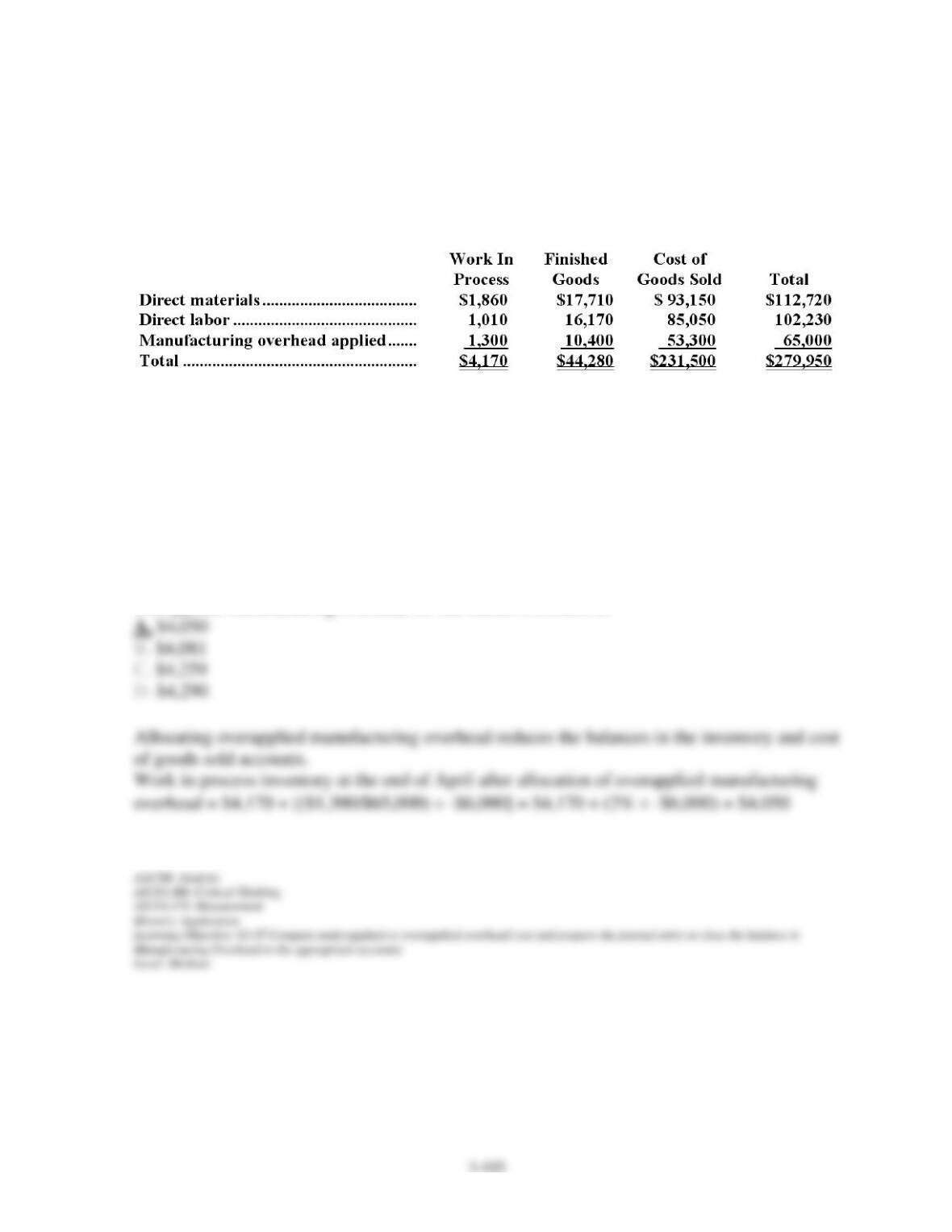
Gressett Inc. has provided the following data for the month of April. There were no
beginning inventories; consequently, the direct materials, direct labor, and manufacturing
overhead applied listed below are all for the current month.
Manufacturing overhead for the month was overapplied by $6,000.
The company allocates any underapplied or overapplied manufacturing overhead among work
in process, finished goods, and cost of goods sold at the end of the month on the basis of the
overhead applied during the month in those accounts.
137. The work in process inventory at the end of April after allocation of any underapplied or
overapplied manufacturing overhead for the month is closest to:
Chapter 03 – Job-Order Costing
3-103
138. The journal entry to record the allocation of any underapplied or overapplied
manufacturing overhead for April would include the following:
Essay Questions
Chapter 03 – Job-Order Costing
3-104
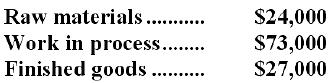
139. Alam Company is a manufacturing firm that uses job-order costing. At the beginning of
the year, the company’s inventory balances were as follows:
The company applies overhead to jobs using a predetermined overhead rate based on
machine-hours. At the beginning of the year, the company estimated that it would work
45,000 machine-hours and incur $180,000 in manufacturing overhead cost. The following
transactions were recorded for the year:
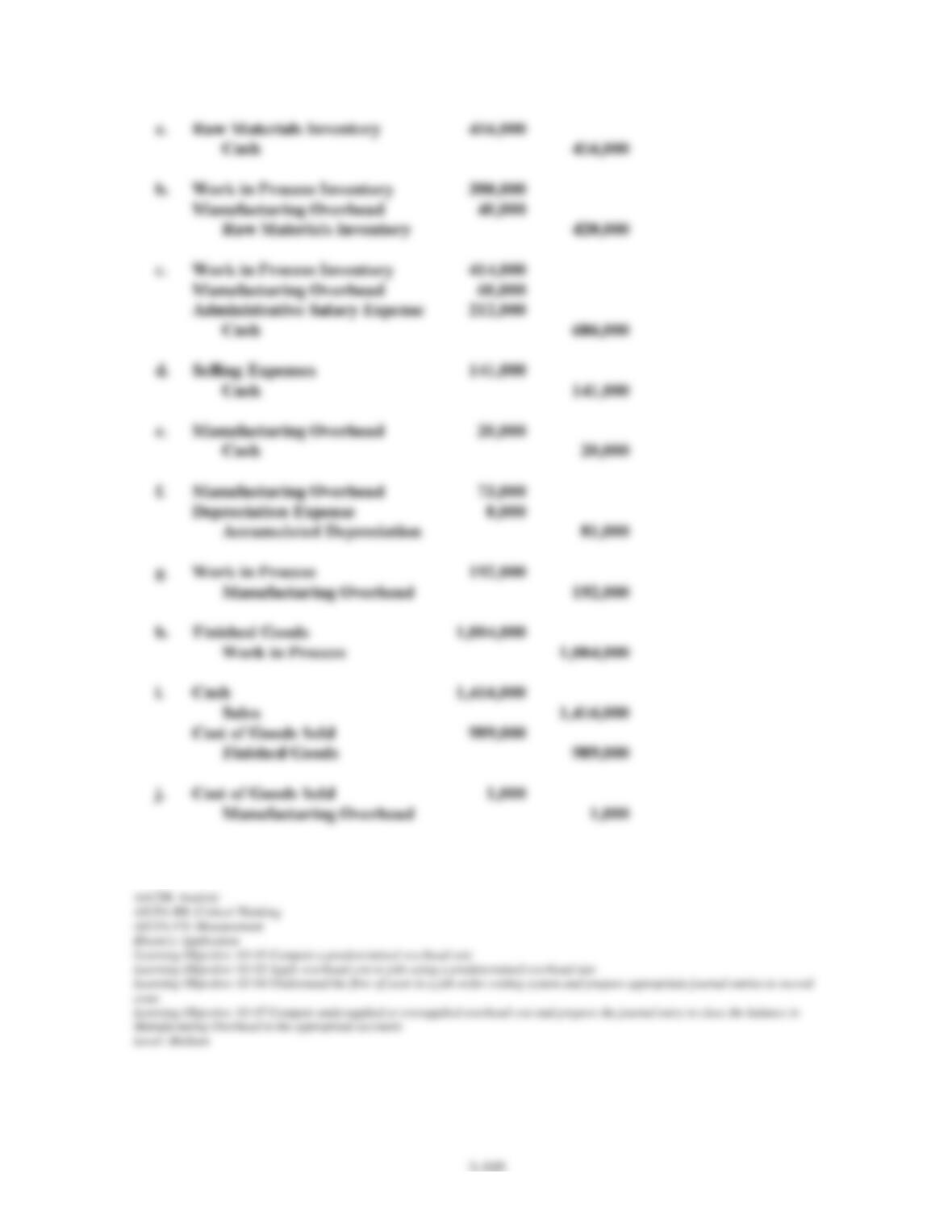
a. Raw materials were purchased, $416,000.
b. Raw materials were requisitioned for use in production, $420,000 ($380,000 direct and
$40,000 indirect).
c. The following employee costs were incurred: direct labor, $414,000; indirect labor,
$60,000; and administrative salaries, $212,000.
d. Selling costs, $141,000.
e. Factory utility costs, $20,000.
f. Depreciation for the year was $81,000 of which $73,000 is related to factory operations and
$8,000 is related to selling, general, and administrative activities.
g. Manufacturing overhead was applied to jobs. The actual level of activity for the year was
48,000 machine-hours.
h. The cost of goods manufactured for the year was $1,004,000.
i. Sales for the year totaled $1,416,000 and the costs on the job cost sheets of the goods that
were sold totaled $989,000.
j. The balance in the Manufacturing Overhead account was closed out to Cost of Goods Sold.
Required:
Prepare the appropriate journal entry for each of the items above (a. through j.). You can
assume that all transactions with employees, customers, and suppliers were conducted in
cash.
Chapter 03 – Job-Order Costing

Chapter 03 – Job-Order Costing
3-106
140. Babb Company is a manufacturing firm that uses job-order costing. The company’s
inventory balances were as follows at the beginning and end of the year:
The company applies overhead to jobs using a predetermined overhead rate based on
machine-hours. At the beginning of the year, the company estimated that it would work
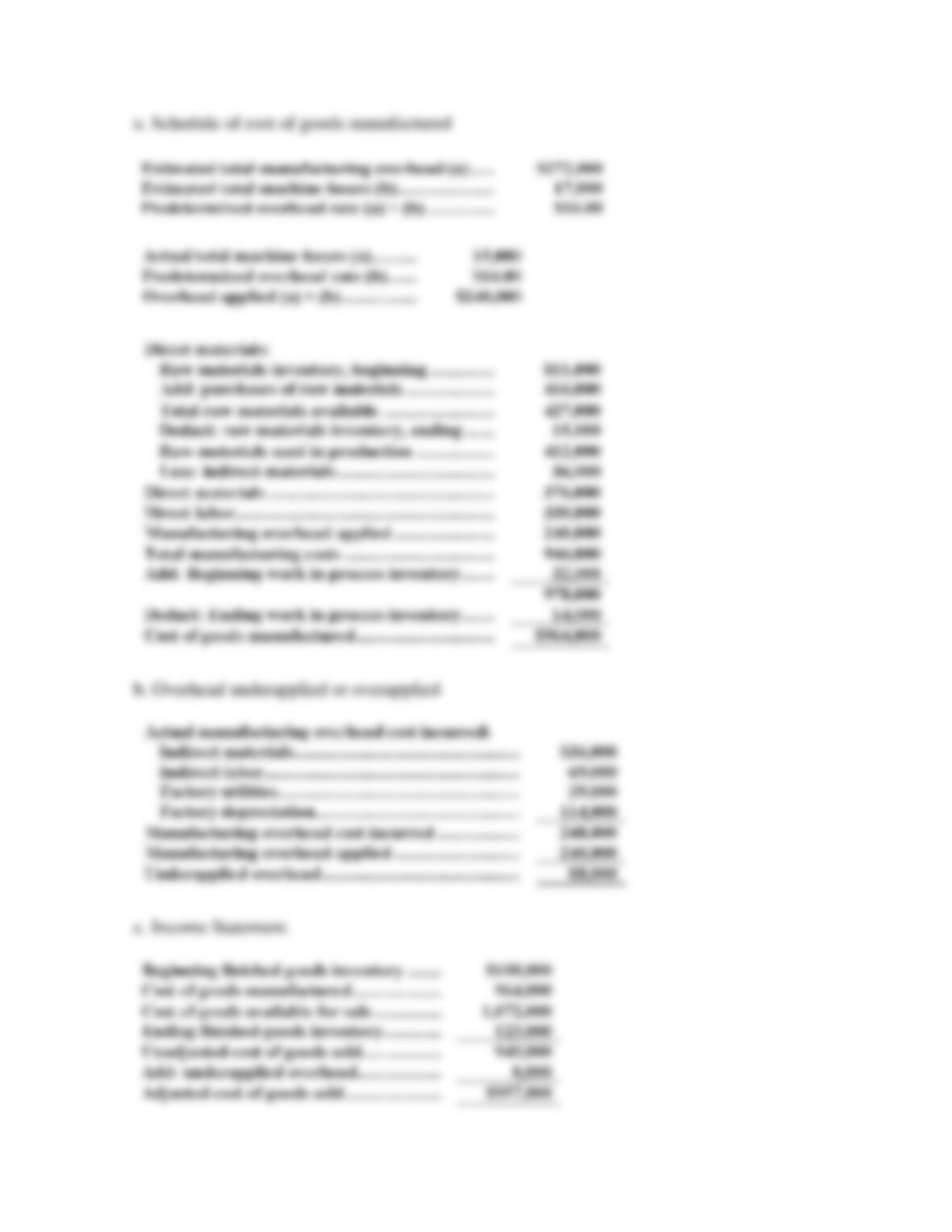
17,000 machine-hours and incur $272,000 in manufacturing overhead cost. The following
transactions were recorded for the year:
•Raw materials were purchased, $416,000.
•Raw materials were requisitioned for use in production, $412,000 $(376,000 direct and
$36,000 indirect).
•The following employee costs were incurred: direct labor, $330,000; indirect labor, $69,000;
and administrative salaries, $157,000.
•Selling costs, $113,000.
•Factory utility costs, $29,000.
•Depreciation for the year was $121,000 of which $114,000 is related to factory operations
and $7,000 is related to selling, general, and administrative activities.
•Manufacturing overhead was applied to jobs. The actual level of activity for the year was
15,000 machine-hours.
• Sales for the year totaled $1,282,000.
Required:
a. Prepare a schedule of cost of goods manufactured in good form.
b. Was the overhead underapplied or overapplied? By how much?
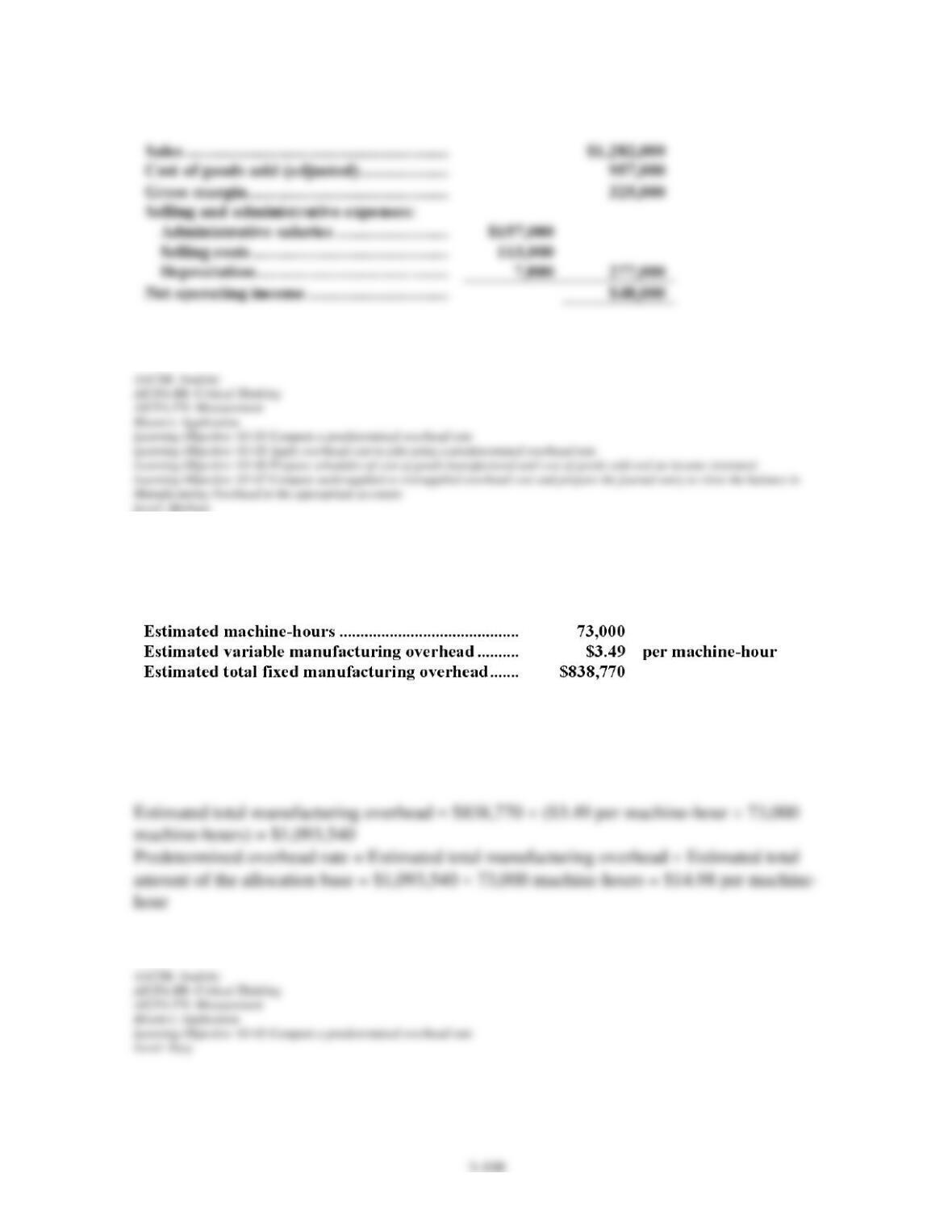
c. Prepare an income statement for the year in good form. The company closes any
underapplied or overapplied manufacturing overhead to Cost of Goods Sold.
Chapter 03 – Job-Order Costing
3-107
Chapter 03 – Job-Order Costing
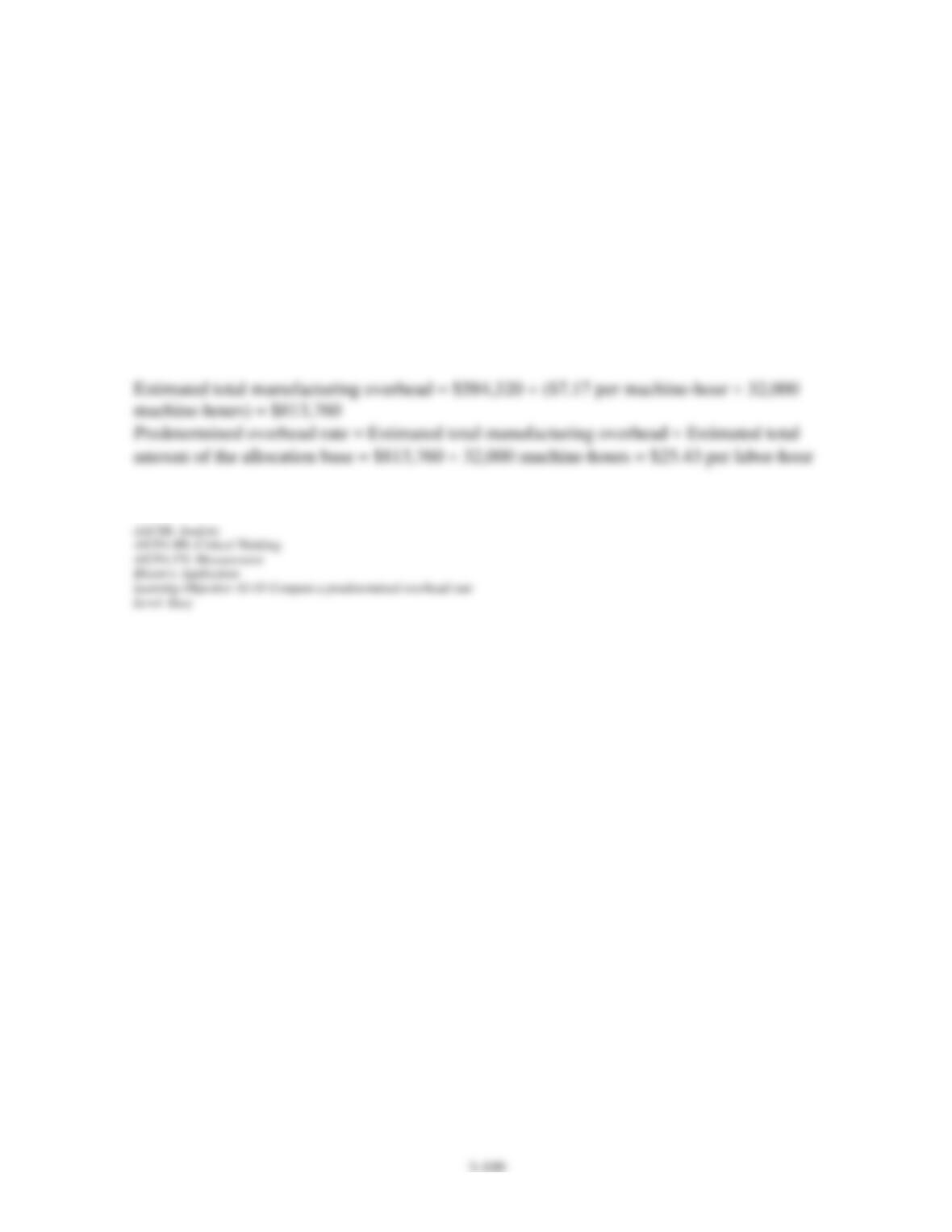
141. Sandler Corporation bases its predetermined overhead rate on the estimated machine-
hours for the upcoming year. Data for the upcoming year appear below:
Required:
Compute the company’s predetermined overhead rate.
Chapter 03 – Job-Order Costing
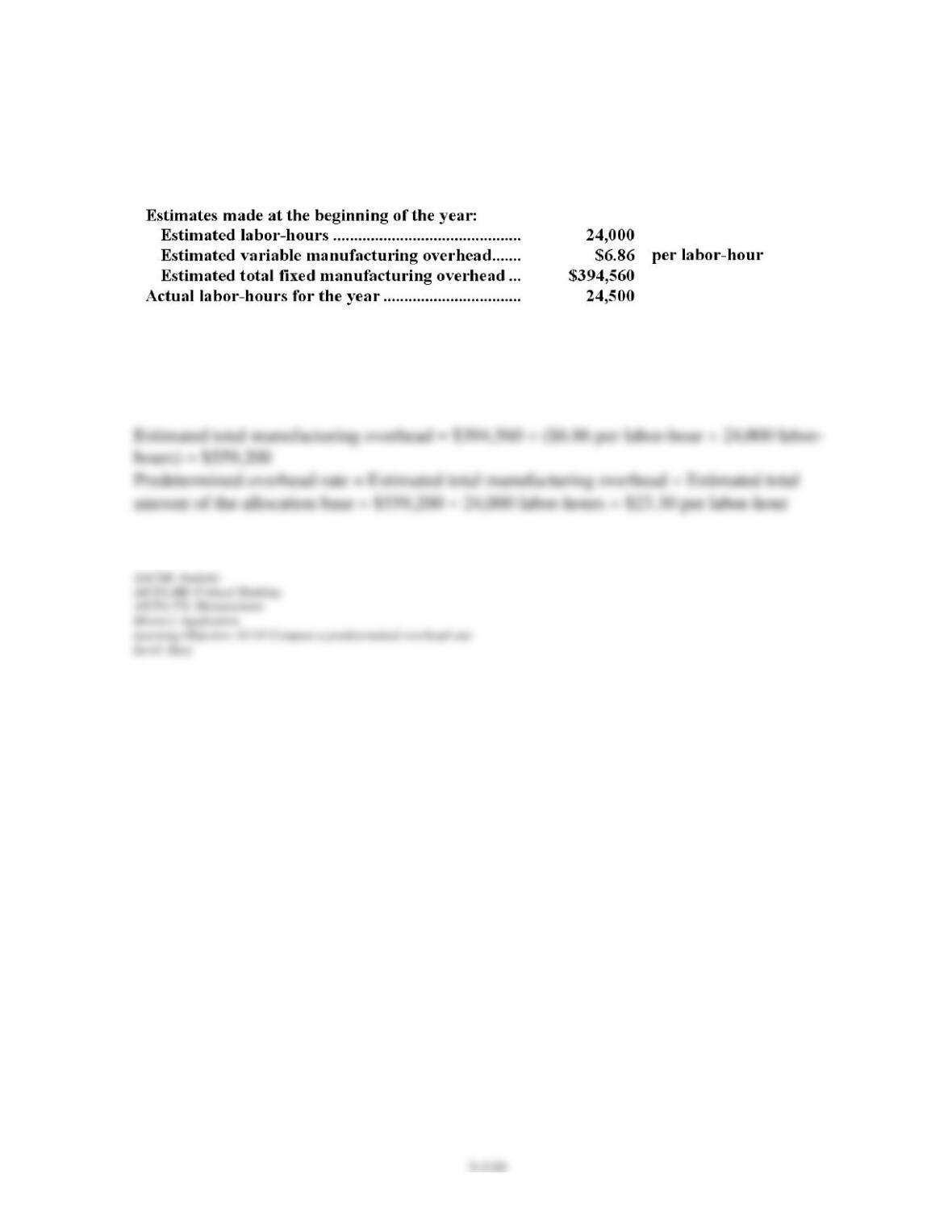
142. Wahr Corporation bases its predetermined overhead rate on the estimated labor-hours for
the upcoming year. At the beginning of the most recently completed year, the company
estimated the labor-hours for the upcoming year at 32,000 labor-hours. The estimated variable
manufacturing overhead was $7.17 per labor-hour and the estimated total fixed manufacturing
overhead was $584,320. The actual labor-hours for the year turned out to be 33,300 labor-
hours.
Required:
Compute the company’s predetermined overhead rate for the recently completed year.
Chapter 03 – Job-Order Costing
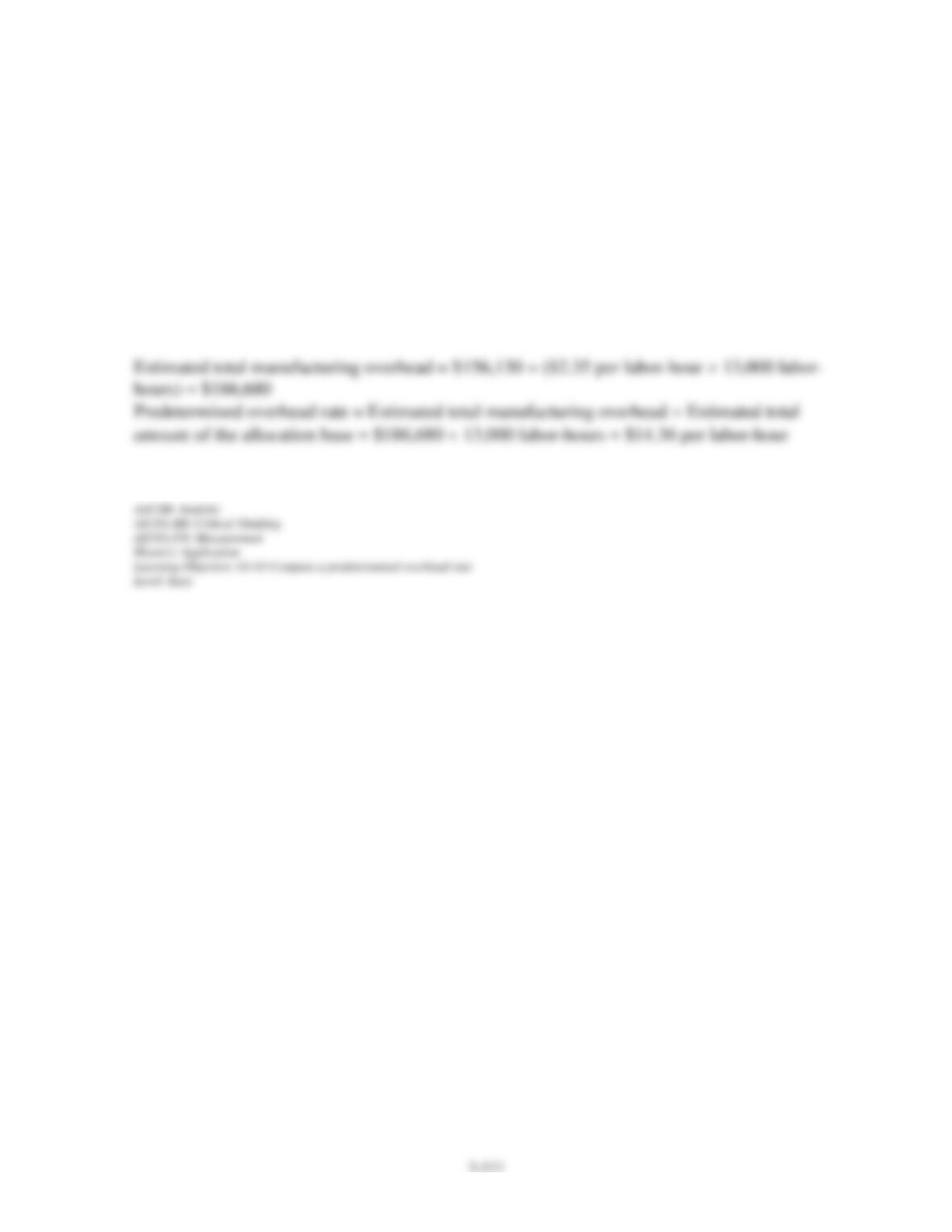
143. Escatel Corporation bases its predetermined overhead rate on the estimated labor-hours
for the upcoming year. Data for the most recently completed year appear below:
Required:
Compute the company’s predetermined overhead rate for the recently completed year.
Chapter 03 – Job-Order Costing
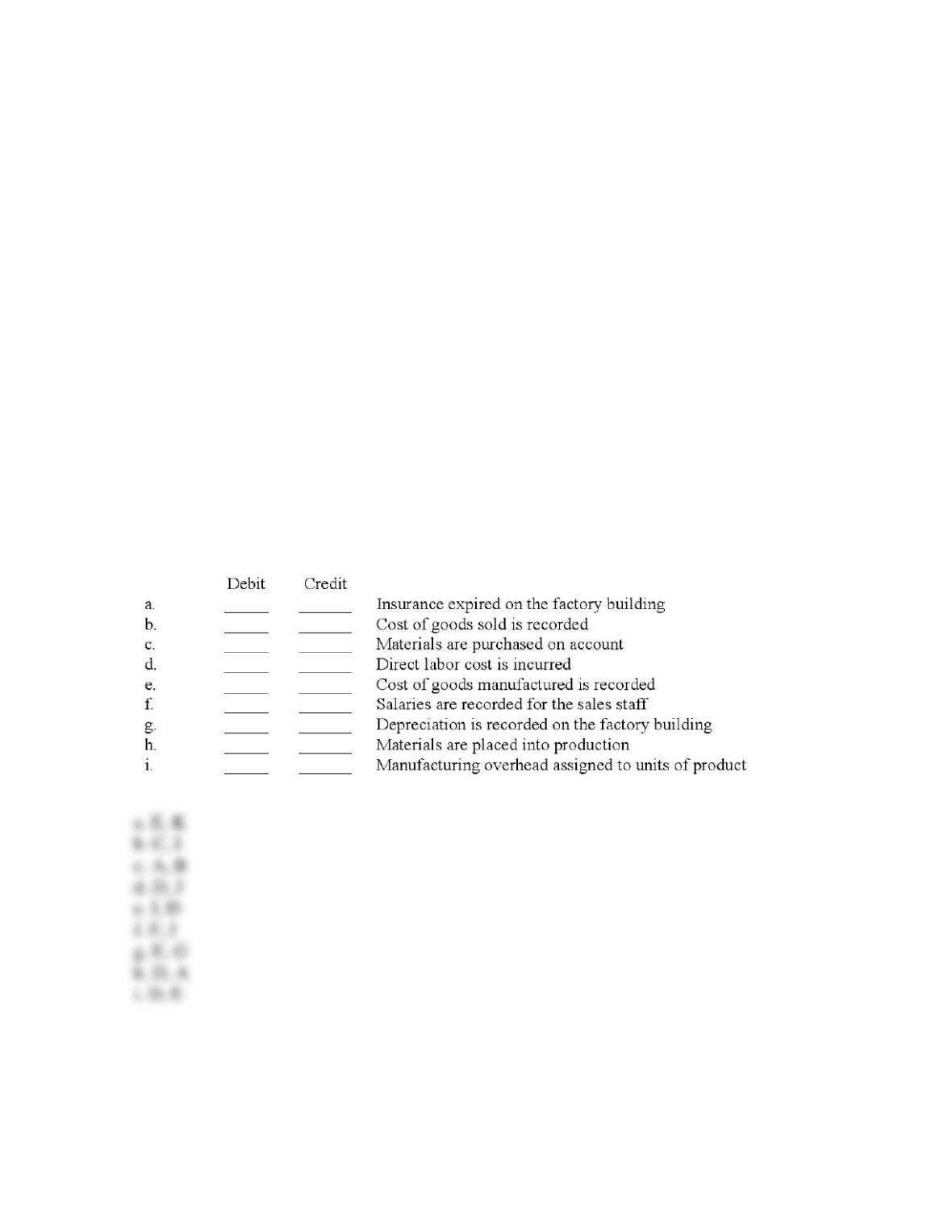
144. Dobrinski Corporation bases its predetermined overhead rate on the estimated labor-
hours for the upcoming year. At the beginning of the most recently completed year, the
company estimated the labor-hours for the upcoming year at 13,000 labor-hours. The
estimated variable manufacturing overhead was $2.35 per labor-hour and the estimated total
fixed manufacturing overhead was $156,130.
Required:
Compute the company’s predetermined overhead rate.
Chapter 03 – Job-Order Costing
3-112
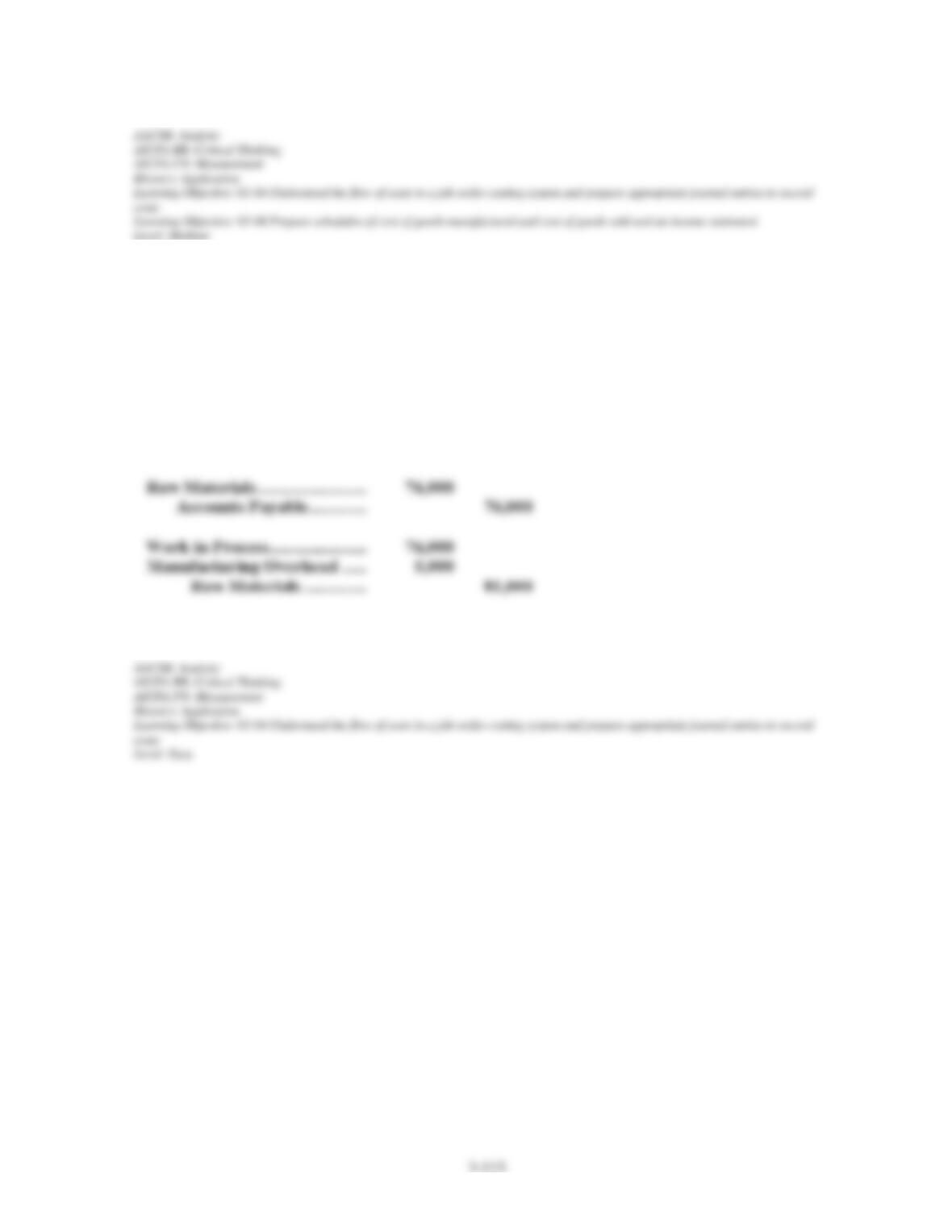
145. The following accounts will be used in this problem:
A. Raw materials inventory
B. Accounts payable
C. Cost of goods sold
D. Work in process inventory
E. Manufacturing overhead
F. Wages and salaries expense
G. Accumulated depreciation
H. Depreciation expense
I. Finished goods inventory
J. Wages and salaries payable
K. Prepaid insurance
L. Insurance expense
Required:
Enter identifying letters in the blanks below to indicate the accounts debited and credited
under a job-order costing system for each of the following summary transactions:
Chapter 03 – Job-Order Costing
146. During June, Catlin Corporation purchased $76,000 of raw materials on credit to add to
its raw materials inventory. A total of $81,000 of raw materials was requisitioned from the
storeroom for use in production. These requisitioned raw materials included $5,000 of indirect
materials.
Required:
Prepare journal entries to record the purchase of materials and their use in production.
Chapter 03 – Job-Order Costing
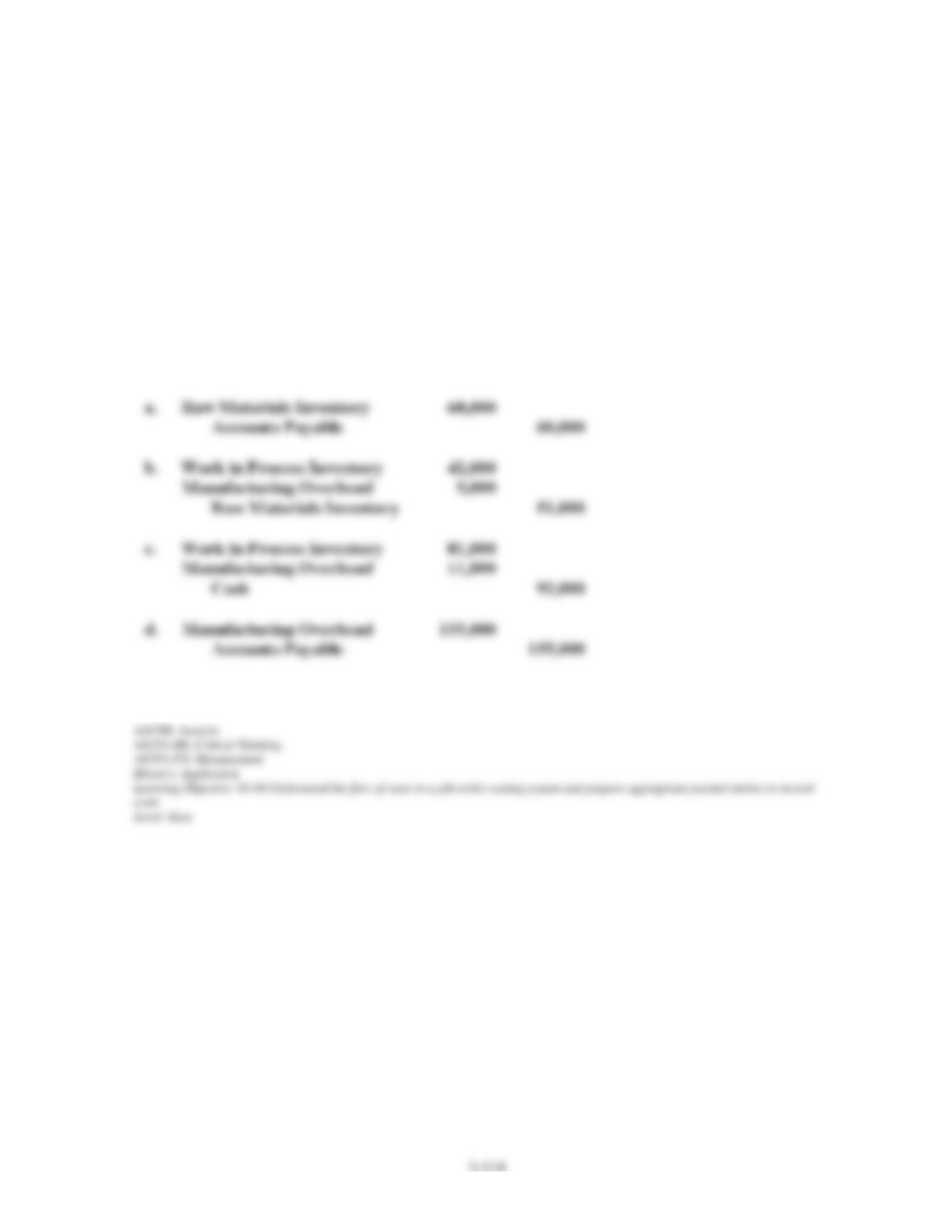
147. Glen Lake Corporation recorded the following transactions for the just completed month:
a. $60,000 in raw materials were purchased on account.
b. $51,000 in raw materials were requisitioned for use in production. Of this amount, $42,000
was for direct materials and the remainder was for indirect materials.
c. Total labor wages of $92,000 were incurred and paid. Of this amount, $81,000 was for
direct labor and the remainder was for indirect labor.
d. Additional manufacturing overhead cost of $155,000 were incurred. All were on account.
Required:
Record the above transactions in journal entries.