Topic Area: Transaction analysis-T-accounts
117.
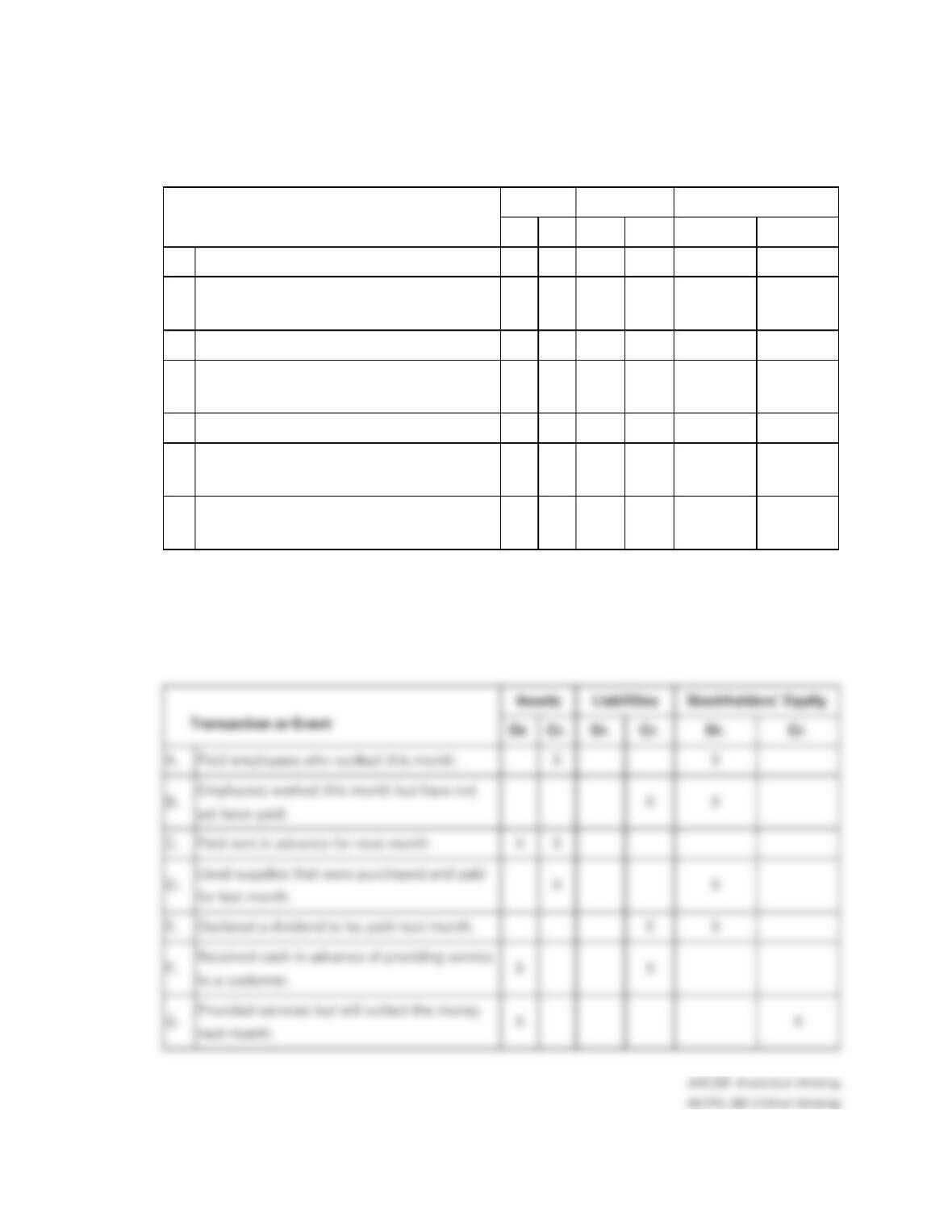
Complete the chart below for Monticello Corporation by placing an X in the appropriate boxes
to indicate how the transaction should be recorded.
Transaction
Assets
Liabilities
Stockholders’ Equity
Dr.
Cr.
Dr.
Cr.
Dr.
Cr.
A.
Paid employees who worked this month.
B.
Employees worked this month but have not
yet been paid.
C.
Paid rent in advance for next month.
D.
Used supplies that were purchased and paid
for last month.
E.
Declared a dividend to be paid next month.
F.
Received cash in advance of providing service
to a customer.
G.
Provided services but will collect the money
next month.
Assets
Liabilities
Stockholders’ Equity
Dr.
Cr.
Dr.
Cr.
Dr.
Cr.
A.
Paid employees who worked this month.
B.
Employees worked this month but have not
yet been paid.
C.
Paid rent in advance for next month.
Used supplies that were purchased and paid
for last month.
Declared a dividend to be paid next month.
F.
Received cash in advance of providing service
to a customer.
G.
Provided services but will collect the money
next month.


118.
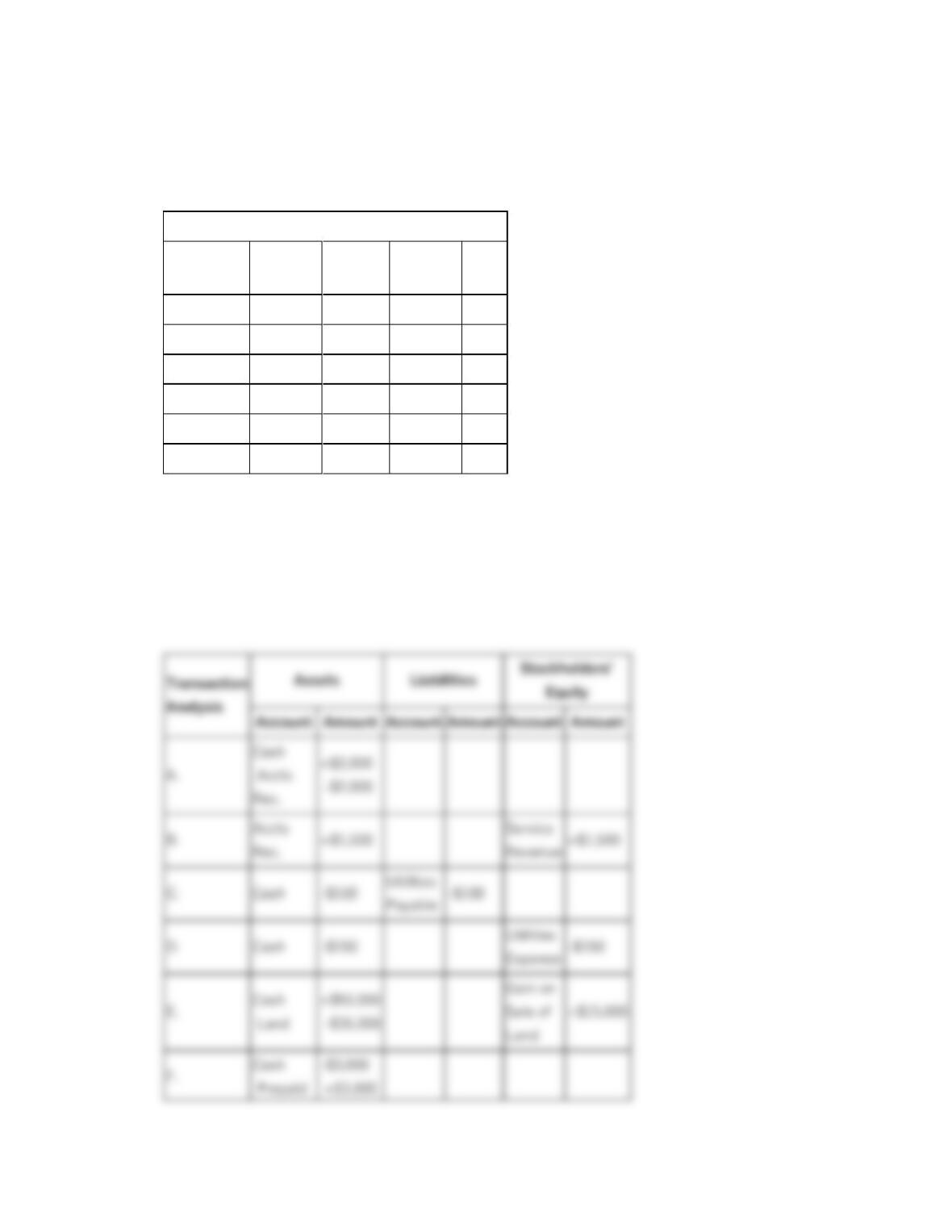
Part A. Perform transaction analysis for Blake Company regarding the following transactions
for the month of March. Indicate the account affected by the transaction as well as the
increase (+) or decrease (-) to the components of the accounting equation and the amount.
Transaction
Assets
Liabilities
Stockholders’ Equity
Account
Amount
Account
Amount
Account
Amount
Ex.
Paid wages for
two weeks in
March. The total
cash paid was
$500.
Cash
-$500
Wage
expense
-$500
A.
Collected $2,000
on accounts
receivable.
B.
Services were
completed for
customers. A
total of $1,500
was billed but
none of it was
received in
March.
C.
Paid the
February utilities
bill for $100. It
was recorded as
an expense in
February.
D.
Received and
paid the March
utilities bill for
$150.
E.
Sold land for
$50,000 that had
cost $35,000.
F.
Paid $3,000 for
rent for April,
May, and June.
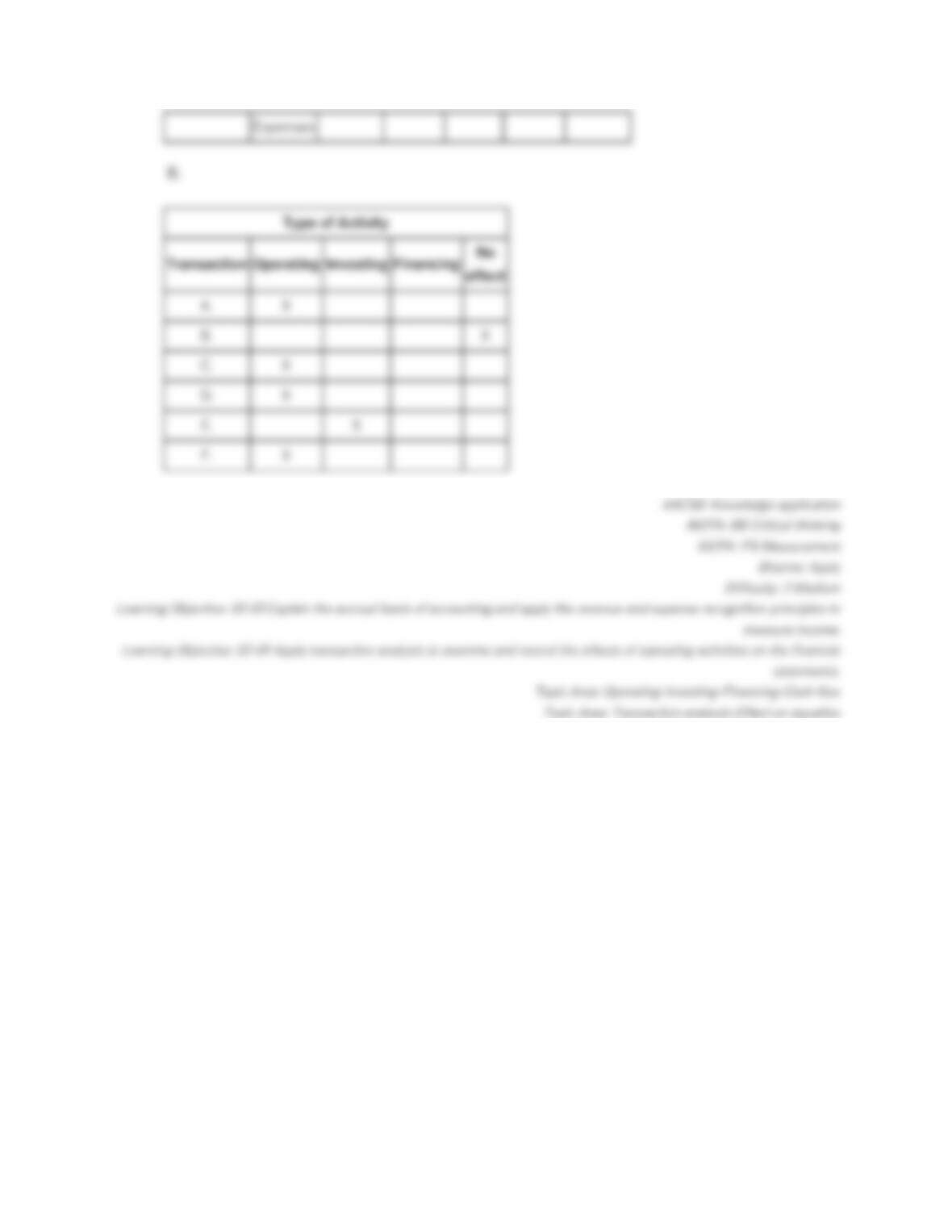
Part B. Determine whether the transactions A-F above affected cash flows during March. If
so, determine the type of activity as an operating activity, an investing activity, or a financing
activity. If cash is not affected use “no effect.” Place an X under the appropriate column for
each transaction.
Type of Activity
Transaction
Operating
Investing
Financing
No
effect
A.
B.
C.
D.
E.
F.
A.
119.
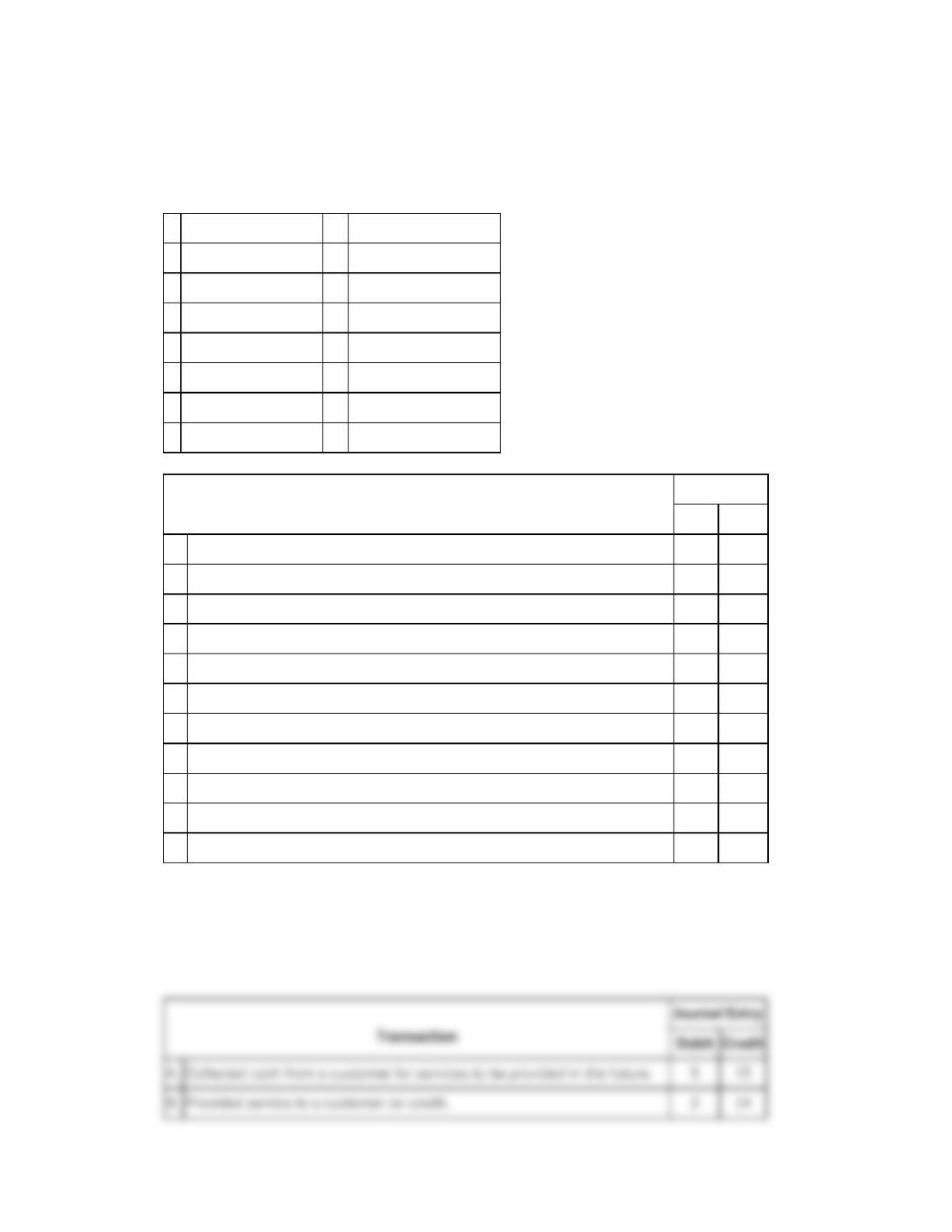
The following accounts for Carthage Enterprises, Inc. are listed randomly. Enter the number
associated with each transaction to identify the accounts that would be used in the journal
entry for each transaction given below.
1.
Accounts payable
9.
Income taxes payable
2.
Accounts receivable
10.
Prepaid expenses
3.
Supplies
11.
Operating expenses
4.
Building
12.
Prepaid insurance
5.
Cash
13.
Retained earnings
6.
Common stock
14.
Service revenue
7.
Dividends
15.
Unearned revenue
8.
Income tax expense
Transaction
Journal Entry
Debit
Credit
Ex.
Service revenue earned and cash collected in full.
5
14
A.
Collected cash from a customer for services to be provided in the future.
B.
Provided service to a customer on credit.
C.
Paid current operating expenses.
D.
Recorded income tax expense for the period; all of it will be paid next year.
E.
Paid insurance premiums for next year.
F.
Used supplies previously purchased.
G.
Provided services to customers pertaining to transaction A.
H.
Paid cash for income tax owed from last year.
I.
Received payment for transaction B above.
J.
Declared and paid dividends to stockholders.
120.
World Coffee, Inc. has provided the following information pertaining to the store’s month
ended October 31, 2016:
Sales
revenue
$100,000
Supplies
expense
$1,500
Interest
expense
6,900
Rent expense
4,000
Cost of
goods sold
60,000
Wages
expense
9,500
Dividends
paid
5,000
Utilities
expense
1,100
Advertising
expense
4,500
Loss on sale of
coffee
equipment
3,200
Dividends
declared
7,100
Income tax
expense
3,800
Unearned
revenues
6,100
Prepare an income statement through operating income for the month ended October 31,
2016.
121.
The following information has been provided by Flatiron Company for the year ended
December 31, 2016:
Net income was $71,000;
Income tax expense was $47,000;
Dividends declared and paid totaled $7,500;
Interest expense was $8,700;
Loss on sale of plant assets was $15,000;
Operating expenses for rent, wages, and insurance totaled $91,000;
Cash collected from customers was $220,000.
Required:
Calculate Flatiron’s operating income.
122.
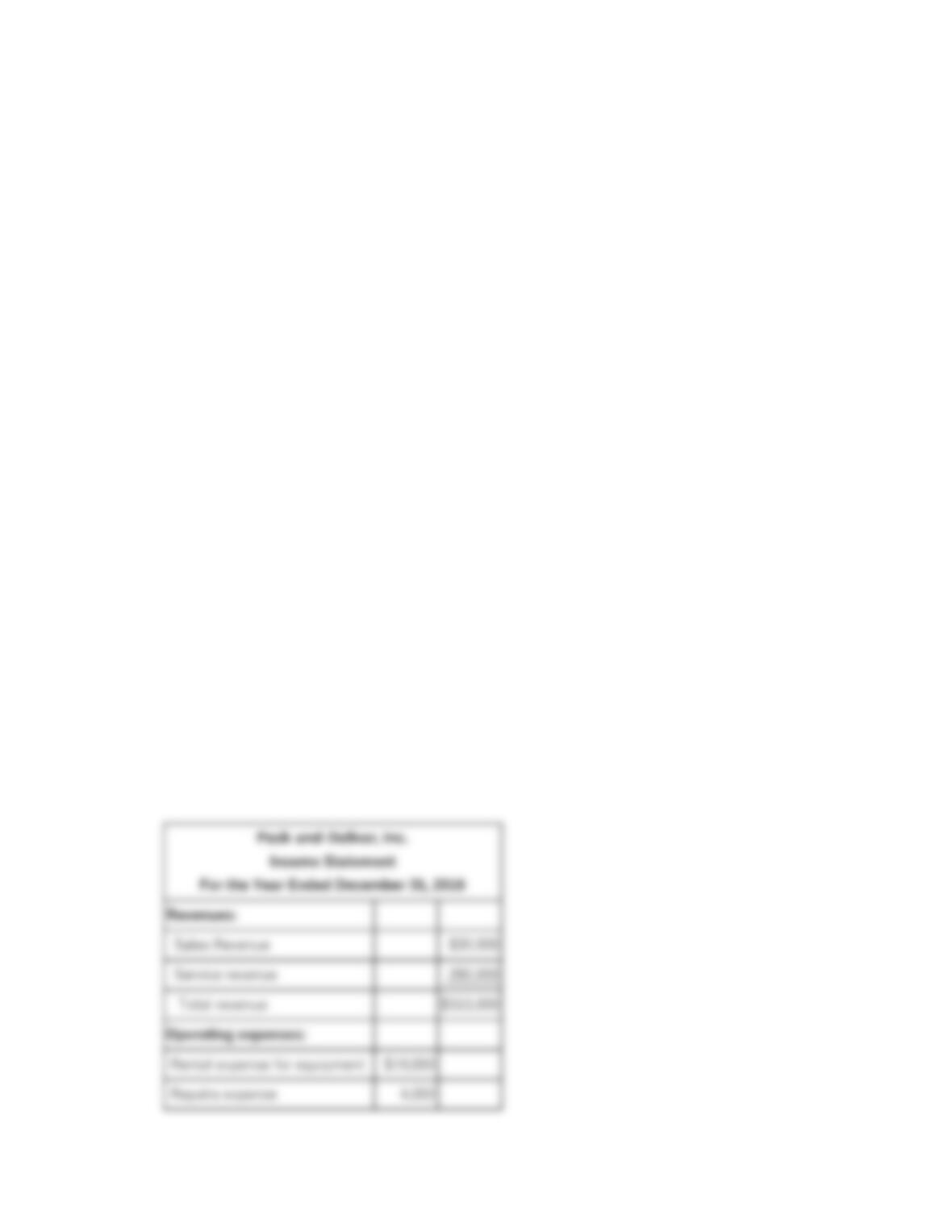
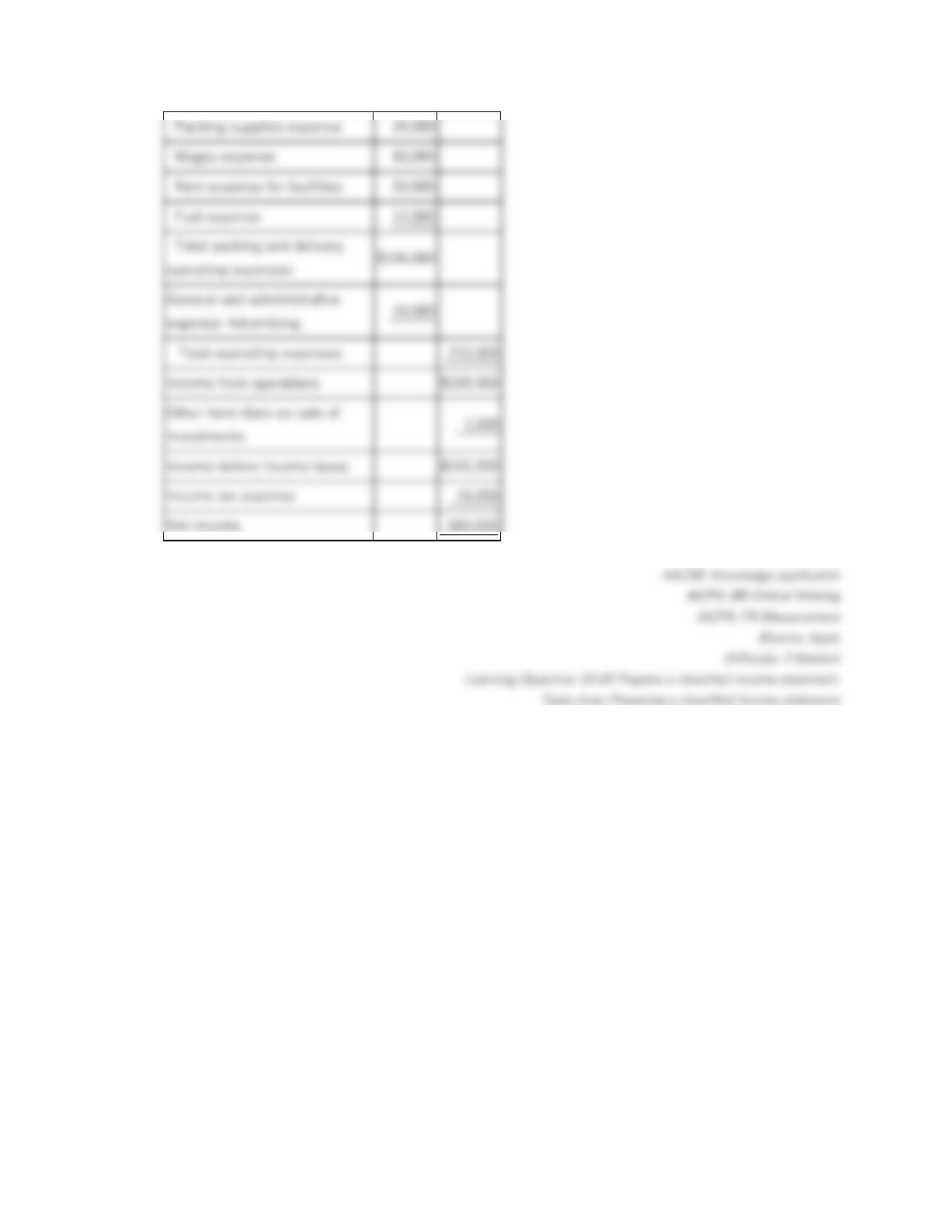
On December 31, 2016, Pack-and-Deliver Company completed its first year of operations. The
following information has been provided for the year:
a. Sold packing supplies for $30,000 and provided $280,000 of delivery services.
b. All packing supplies sales were for cash.
c. Collected $212,000 of delivery service revenue.
d. Paid $15,000 cash to rent packing equipment, with $10,000 for rental in 2016 and the
remaining amount for rental in 2017.
e. Spent $4,000 cash to repair delivery equipment during the year.
f. Bought packing supplies at a total cost of $46,000 and paid for $25,000 of these supplies.
There were $20,000 of these supplies that have not yet been sold or used.
g. Paid employees $80,000 during the year.
h. Paid $16,000 for advertising for the year.
i. Paid $$55,000 to rent facilities. Pack-and-Deliver has not yet paid the $5,000 rent for
December, 2016.
j. Used $14,000 in fuel for the delivery equipment.
k. Sold investments for $8,000 that had been purchased earlier in the year for $7,000.
l. Ordered $500 in spare parts and supplies.
m. Income tax expense for the year is $18,000.
Required:
Prepare an income statement for Pack-and-Deliver Company for the year ended December
31, 2016.
123.
Describe the transaction that created the following journal entries (amounts omitted).
1.
Cash
xxx
Unearned revenue
xxx
2.
Utilities expense
xxx
Utilities payable
xxx
3.
Accounts receivable
xxx
Sales Revenue
xxx
4.
Wages expense
xxx
Cash
xxx
5.
Unearned Revenue
xxx
Sales revenue
xxx
124.
Explain why the net income reported on the income statement is usually not equal to net cash
flows from operating activities on the statement of cash flows.
125.
Describe the operating activities section of the cash flow statement and provide three
examples of operating activities cash flows.
126.
Colby Company has provided the following selected information for the year ended December
31, 2016:
Cash collected from customers was $392,000.
Cash received from stockholders in exchange for stock totaled $46,000.
Cash paid to suppliers was $183,000.
Cash paid to employees was $102,000.
Cash received from a long-term bank loan was $75,000.
Cash paid to stockholders for dividends was $17,000.
Cash received from sale of a building was $125,000.
Cash paid for rent was $19,000.
Cash received for interest and dividends was $4,000.
Cash paid for income taxes was $28,000.
Required:
Based on the selected information provided, calculate Colby’s cash flow from operating
activities.
127.
Toy Shop Inc. has provided the following income statements:
2017
2016
2015
Net revenues
$3,787.2
$4,232.2
$3,304.5
Cost of goods sold
1,674.0
$1,698.2
1,366.1
Gross profit
2,113.2
2,534.0
1,938.4
Operating expenses
2,217.5
2,206.5
1,613.5
Income (loss) from
operations
(104.3)
327.5
324.9
Nonoperating income
(loss)
(121.7)
(53.7)
(21.4)
Income (loss) before
taxes
(226.0)
273.8
303.5
Income tax
(expense)/benefit
81.4
(84.9)
(97.1)
Net income (loss)
(144.6)
188.9
206.4
Required:
(1) Compute net profit margin for each year.
(2) Discuss some of the events that could have caused the changes to the net profit margin
based on the income statement information above.
128.
The following income statement was reported for Bauer Inc. for the first year of operations
ending December 31, 2016 reported (in thousands of dollars):
Sales revenue
$24,500
Expenses:
Cost of sales
$12,100
Wages
5,300
Rent
900
Utilities
500
Miscellaneous
600
Total expenses
19,400
Income before taxes
5,100
Income tax expense
1,785
Net income
$3,315
Required:
A. Calculate net profit margin.
B. Calculate earnings per share if there are 200,000 weighted average shares of common
stock outstanding.