Solve.
150)
If the force acting on an object stays the same, then the acceleration of the object is inversely
proportional to its mass. If an object with a mass of 28 kilograms accelerates at a rate of 6 meters
per second per second by a force, find the rate of acceleration of an object with a mass of
4 kilograms that is pulled by the same force.
150)
A)
42 meters per second per second
B)
36 meters per second per second
C)
35 meters per second per second
D)
6
7 meters per second per second
Find the degree of the polynomial function.
151)
f(x) = – 2x +6x4
151)
A)
B)
C)
D)
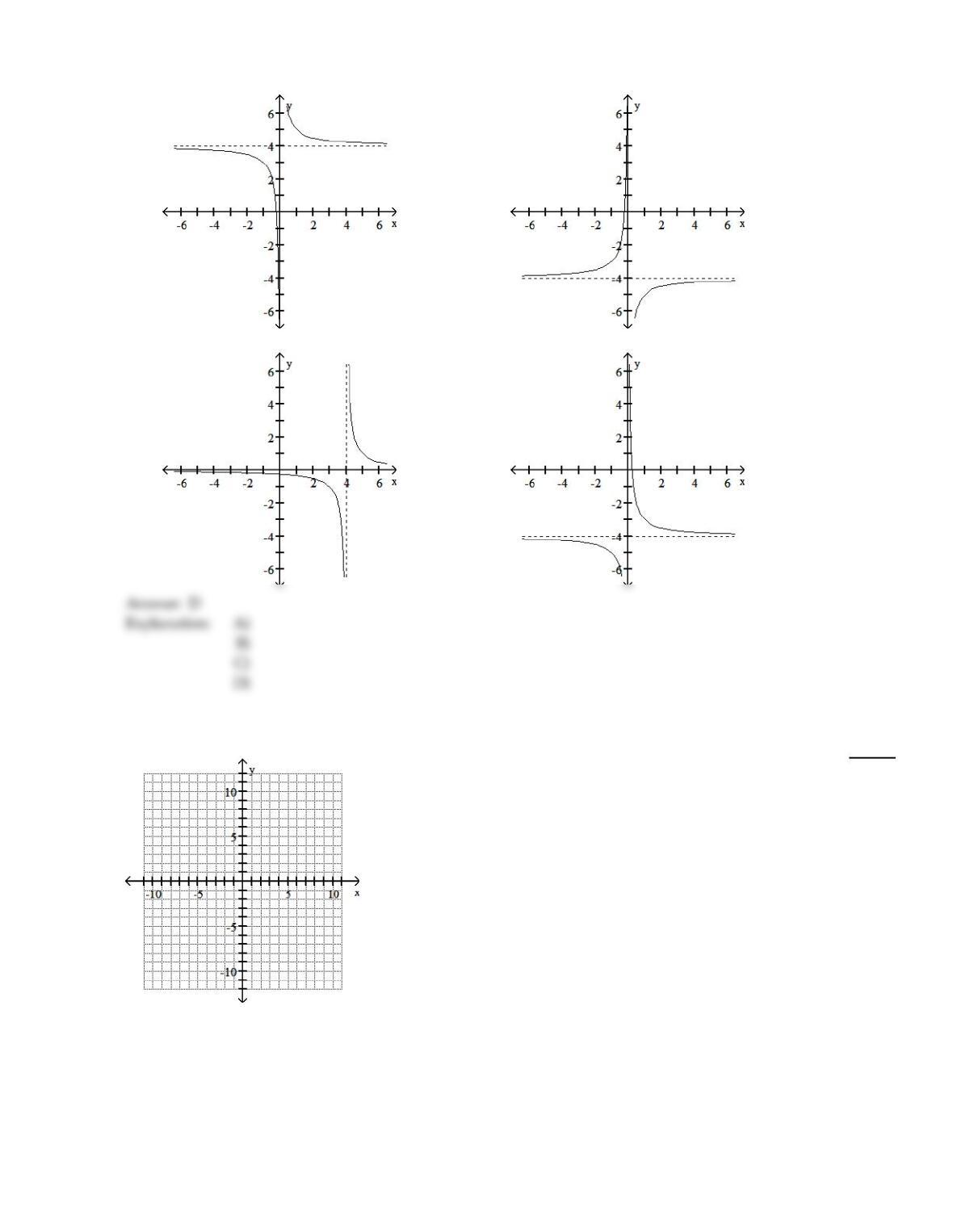
Use transformations of f(x) =1
x or f(x) =1
x2 to graph the rational function.
152)
f(x) =1
x– 4
152)
61
A)
B)
C)
D)
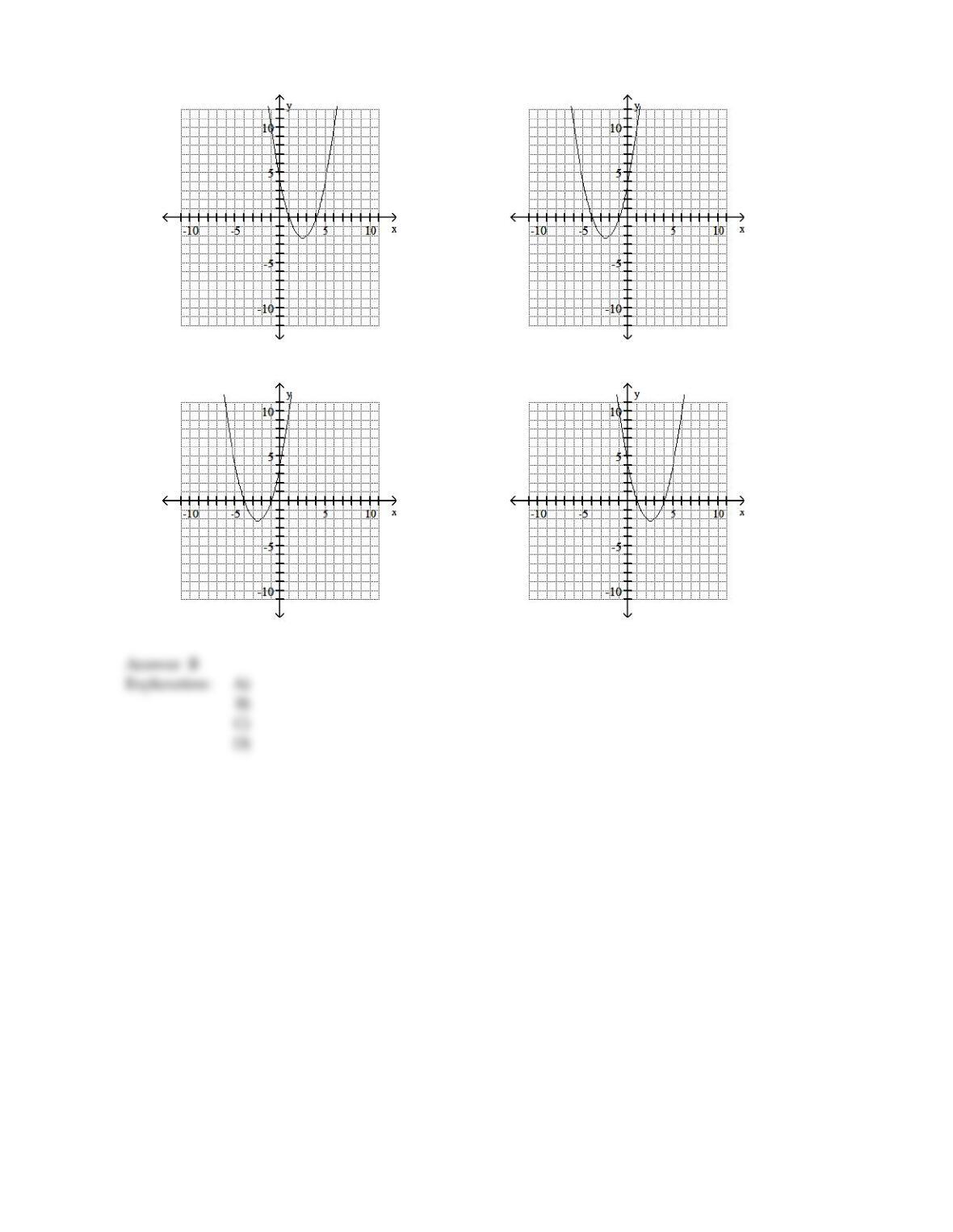
Use the vertex and intercepts to sketch the graph of the quadratic function.
153)
f(x) =4+5x + x2
153)
62
A)
B)
C)
D)
63
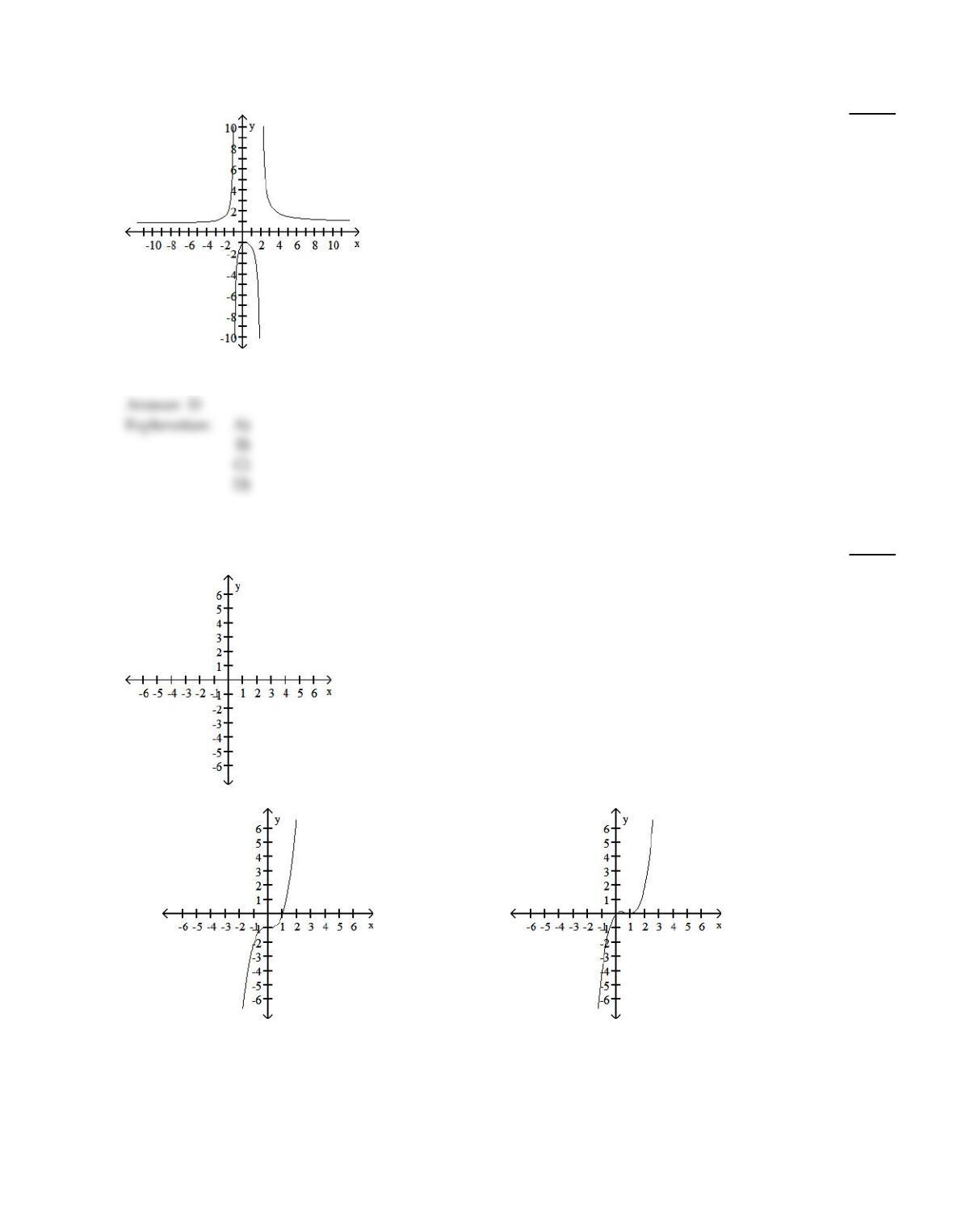
Use the graph of the rational function shown to complete the statement.
154)
As x+, f(x)
?
154)
A)
+
B)
–
C)
–1
D)
1
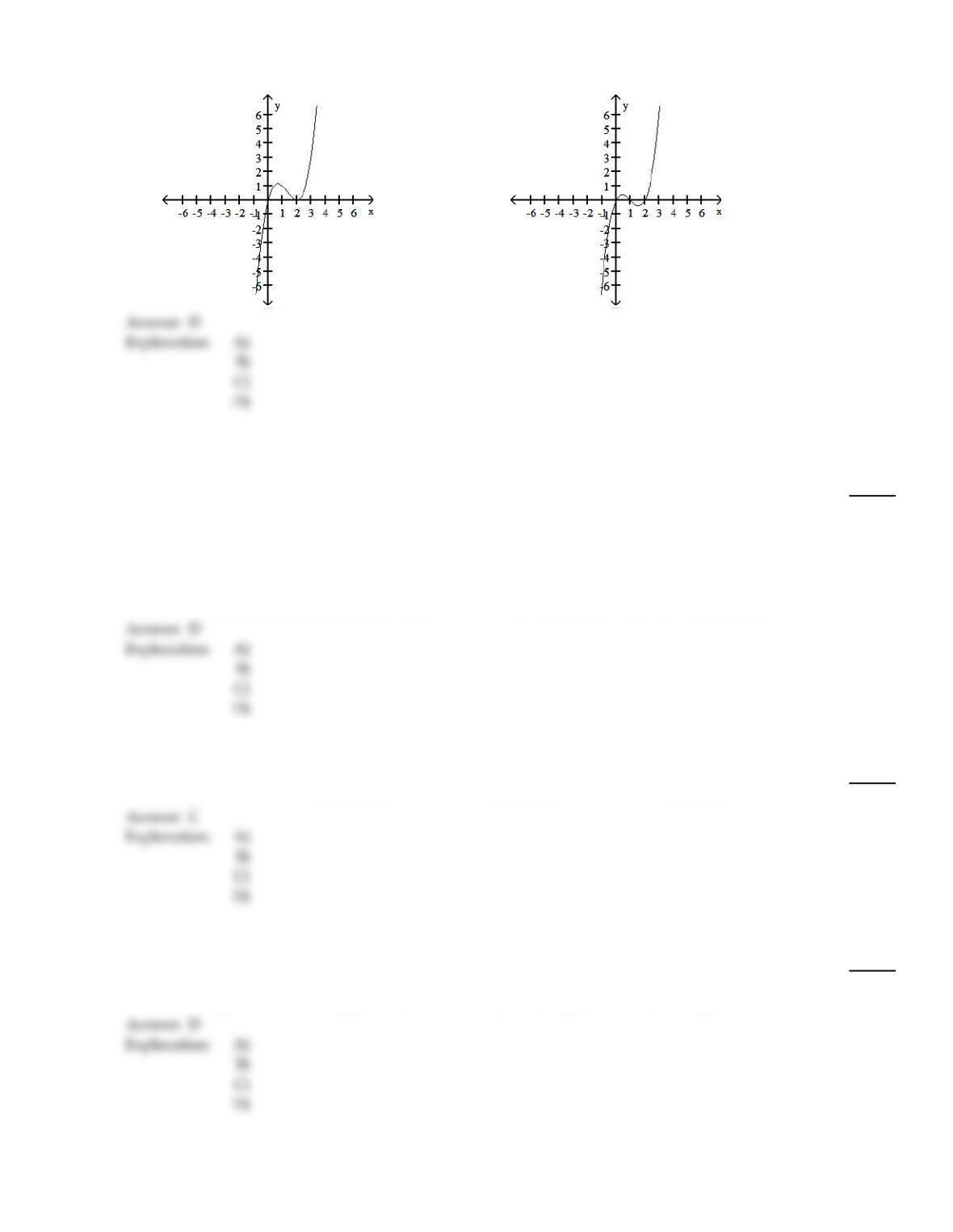
Graph the polynomial function.
155)
f(x) = x(x – 2)(x – 1)
155)
A)
B)
64
C)
D)
Find the x–intercepts of the polynomial function. State whether the graph crosses the x–axis, or touches the x–axis and
turns around, at each intercept.
156)
f(x) = (x + 1)(x –8)(x – 1)2
156)
A)
1, crosses the x–axis;
–8, touches the x–axis and turns around;
–1, touches the x–axis and turns around
B)
–1, crosses the x–axis;
8, crosses the x–axis;
1, crosses the x–axis
C)
1, crosses the x–axis;
–8, crosses the x–axis;
–1, touches the x–axis and turns around
D)
–1, crosses the x–axis;
8, crosses the x–axis;
1, touches the x–axis and turns around
Find the coordinates of the vertex for the parabola defined by the given quadratic function.
157)
f(x) =3x2– 6x – 5
157)
A)
(2, 1)
B)
(–2, 19)
C)
(1, –8)
D)
(–1, 4)
Use Descartes’s Rule of Signs to determine the possible number of positive and negative real zeros for the given function.
158)
f(x) =6x6– 10x5+x4–3x3+20
158)
A)
4 positive zeros, no negative zeros
B)
4 or 2 positive zeros, no negative zeros
C)
4, 2 or 0 positive zeros, 1 negative zeros
D)
4, 2 or 0 positive zeros, no negative zeros
65
Solve the polynomial equation. In order to obtain the first root, use synthetic division to test the possible rational roots.
159)
3x4+ 23x3+ 71x2+ 77x + 26 = 0
159)
A)
{1, –2
3, –3+ 2i, –3–2i}
B)
{–1, +2
3, –2+ 3i, –2– 3i}
C)
{1, +2
3, –2+ 3i, –2– 3i}
D)
{–1, –2
3, –3+ 2i, –3– 2i}
Determine the maximum possible number of turning points for the graph of the function.
160)
f(x) = (x + 7)(x + 1)(5x + 4)
160)
A)
5
B)
3
C)
2
D)
0
If y varies inversely as x, find the inverse variation equation for the situation.
161)
y =9 when x =2
161)
A)
y =1
18x
B)
y =x
18
C)
y =9
2x
D)
y =18
x
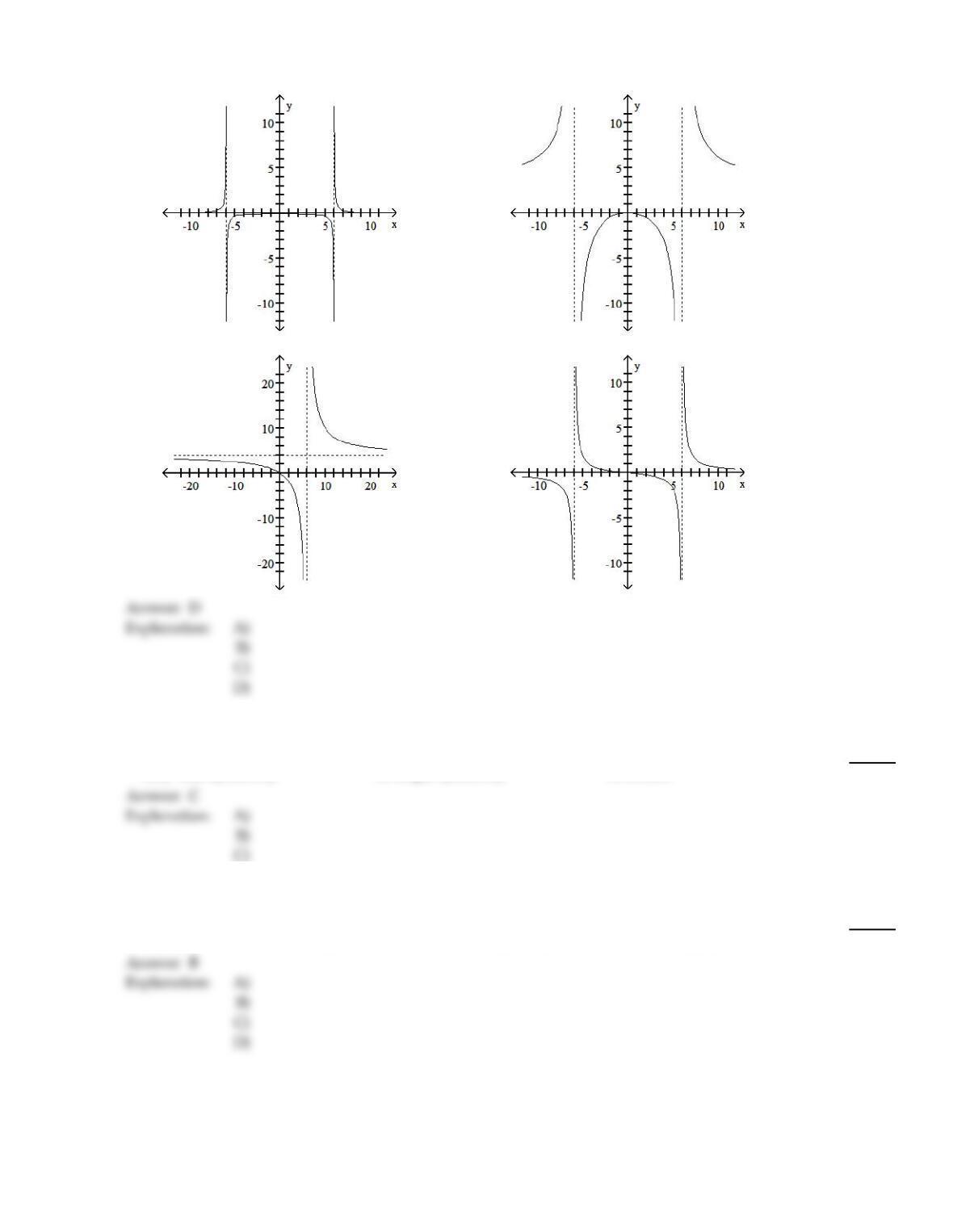
Graph the rational function.
162)
f(x) =4x
x2– 36
162)
66
A)
B)
C)
D)
Determine whether the graph of the polynomial has y–axis symmetry, origin symmetry, or neither.
163)
f(x) = – x3(x +1)2(x –6)
163)
A)
y–axis symmetry
B)
origin symmetry
C)
neither
Find the coordinates of the vertex for the parabola defined by the given quadratic function.
164)
f(x) = (x + 4)2– 8
164)
A)
(4, –8)
B)
(–4, –8)
C)
(–4, 8)
D)
(4, 8)
67
Solve the problem.
165)
Write an equation in standard form of the parabola that has the same shape as the graph of f(x) = – 7
x2, but which has a maximum of 5 at x =3.
165)
A)
f(x) = – 7(x –3)2–5
B)
f(x) = – 7(x +3)2+ 5
C)
f(x) = – 7(x –3)2+ 5
D)
f(x) = 7(x –3)2+ 5
166)
Two people are 31 years old and 25 years old, respectively. In x years from now, their ages can be
represented by x +31 and x +25. Use long division to find the ratio of the older person’s age to the
younger person’s age in x years.
166)
A)
1 +6
x +25
B)
1 +56
x +25
C)
1 +56
x +31
D)
1.2400
167)
You have 240 feet of fencing to enclose a rectangular region. What is the maximum area?
167)
A)
14,400 square feet
B)
3600 square feet
C)
57,600 square feet
D)
3596 square feet
Find the axis of symmetry of the parabola defined by the given quadratic function.
168)
f(x) = 11(x –3)2+ 5
168)
A)
x = – 3
B)
x =5
C)
x = 11
D)
x =3
Use synthetic division to show that the number given to the right of the equation is a solution of the equation, then solve
the polynomial equation.
169)
6x3+ 11x2– 92x + 15 = 0; 3
169)
A)
–1
6, –5, 3
B)
1
6, –5, 3
C)
1
6, 5, 3
D)
–5
6, 1, 3
68
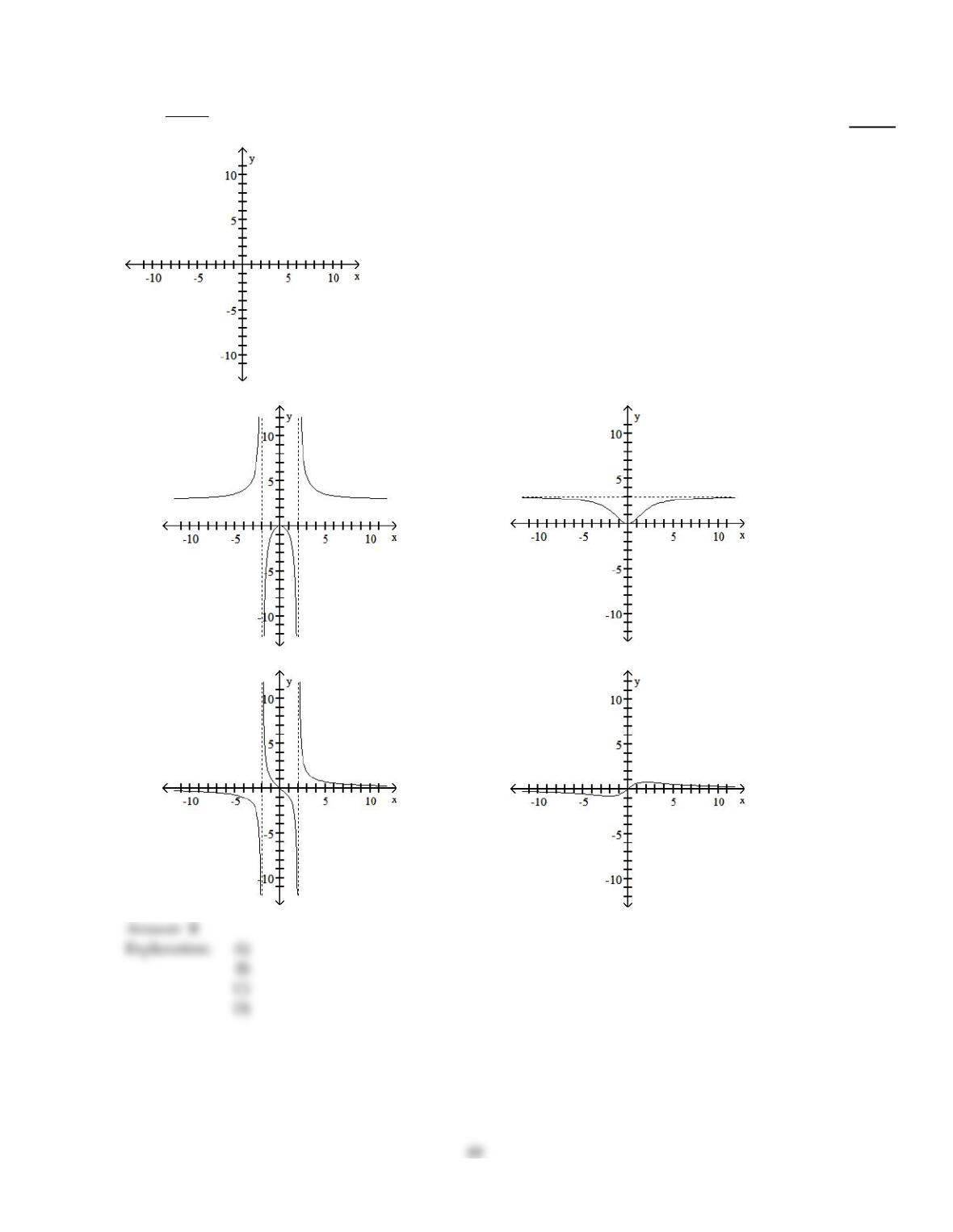
Graph the rational function.
170)
f(x) =3x2
x2+ 4
170)
A)
B)
C)
D)
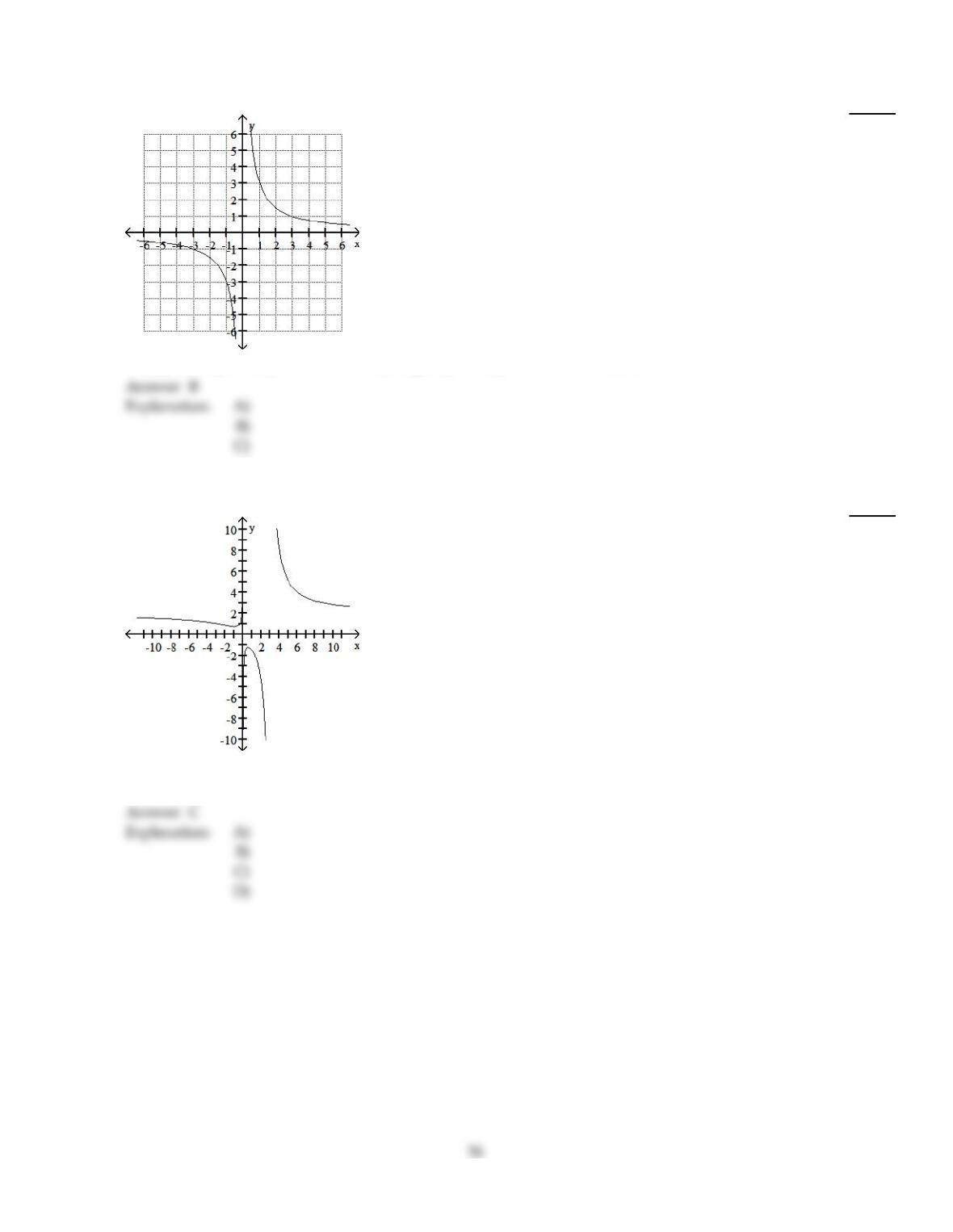
Determine whether the graph of the polynomial has y–axis symmetry, origin symmetry, or neither.
171)
171)
A)
y–axis symmetry
B)
origin symmetry
C)
neither
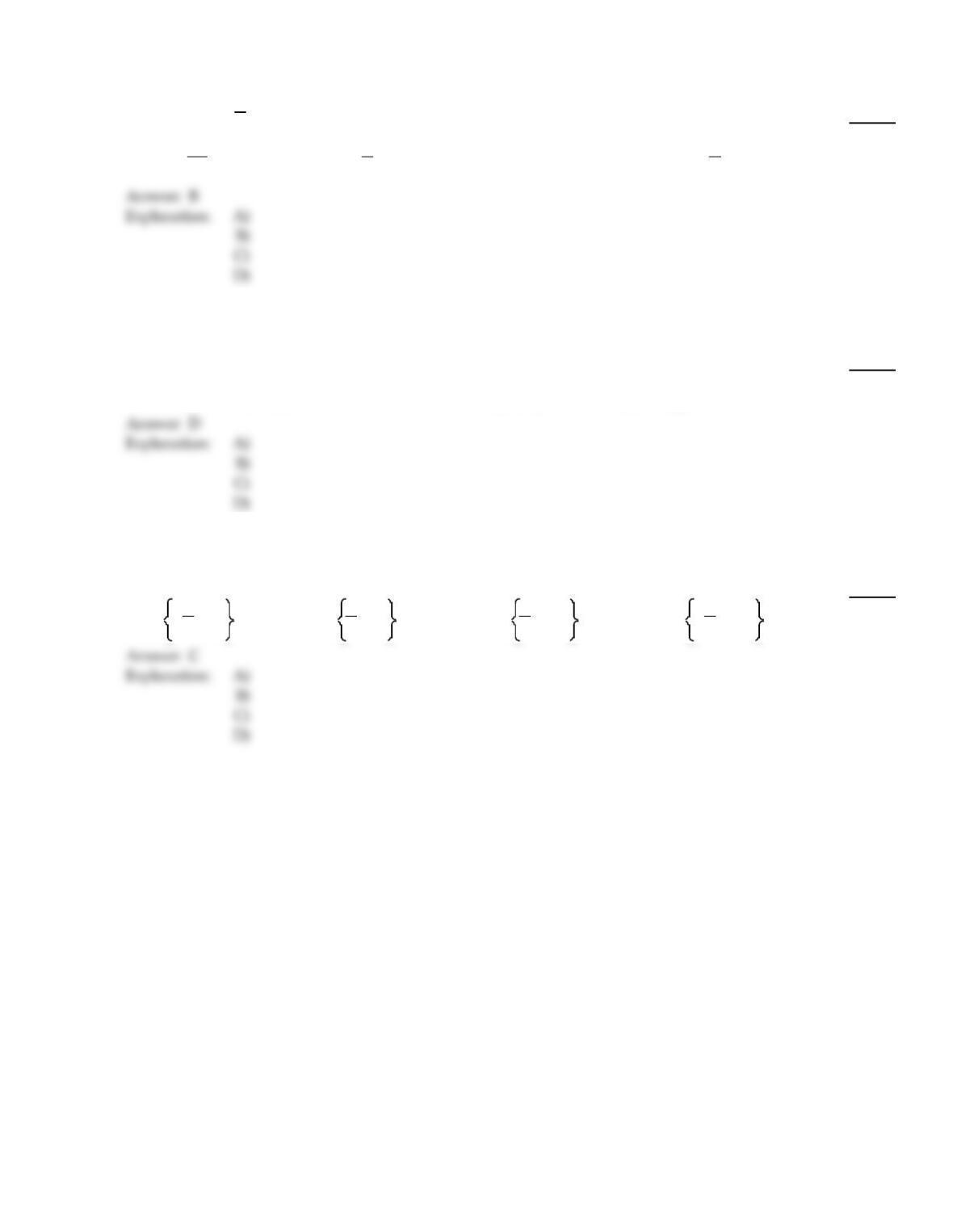
Use the graph of the rational function shown to complete the statement.
172)
As x
3–, f(x)
?
172)
A)
2
B)
–3
C)
–
D)
+

Solve the problem.
173)
The revenue achieved by selling x graphing calculators is figured to be x(49 – 0.2x) dollars. The cost
of each calculator is $21. How many graphing calculators must be sold to make a profit (revenue –
cost) of at least $975.00?
173)
A)
between 67 and 73 calculators
B)
between 30 and 40 calculators
C)
between 65 and 75 calculators
D)
between 66 and 64 calculators
Solve.
174)
The amount of time it takes a swimmer to swim a race is inversely proportional to the average
speed of the swimmer. A swimmer finishes a race in 30 seconds with an average speed of 5 feet per
second. Find the average speed of the swimmer if it takes 50 seconds to finish the race.
174)
A)
3 feet per second
B)
5 feet per second
C)
4 feet per second
D)
2 feet per second
Find the range of the quadratic function.
175)
f(x) = (x + 3)2+ 7
175)
A)
[–3, )
B)
[7, )
C)
[–7, )
D)
[3, )
Divide using synthetic division.
176)
x4– 3x3+x2+ 4x – 5
x – 1
176)
A)
x3+ 2x2– x + 5 –2
x – 1
B)
x3– 2x2– x + 3 –2
x – 1
C)
x3– 2x2+ x + 3 +4
x – 1
D)
x3– 2x2+ x + 5 +4
x – 1
If y varies inversely as x, find the inverse variation equation for the situation.
177)
y =30 when x =1
6
177)
A)
y =1
5x
B)
y =5
x
C)
y =180x
D)
y =x
5
Use the Intermediate Value Theorem to determine whether the polynomial function has a real zero between the given
integers.
178)
f(x) =7x3– 4x2+ 9x + 3; between –1 and 0
178)
A)
f(–1) =17 and f(0) = – 3; yes
B)
f(–1) =17 and f(0) =3; no
C)
f(–1) = – 17 and f(0) = – 3; no
D)
f(–1) = – 17 and f(0) =3; yes
Use synthetic division to show that the number given to the right of the equation is a solution of the equation, then solve
the polynomial equation.
179)
2x3– 5x2– 21x + 36 = 0; 4
179)
A)
–3
2, 3, 4
B)
3
2, 3, 4
C)
3
2, –3, 4
D)
–3
2, –3, 4
72
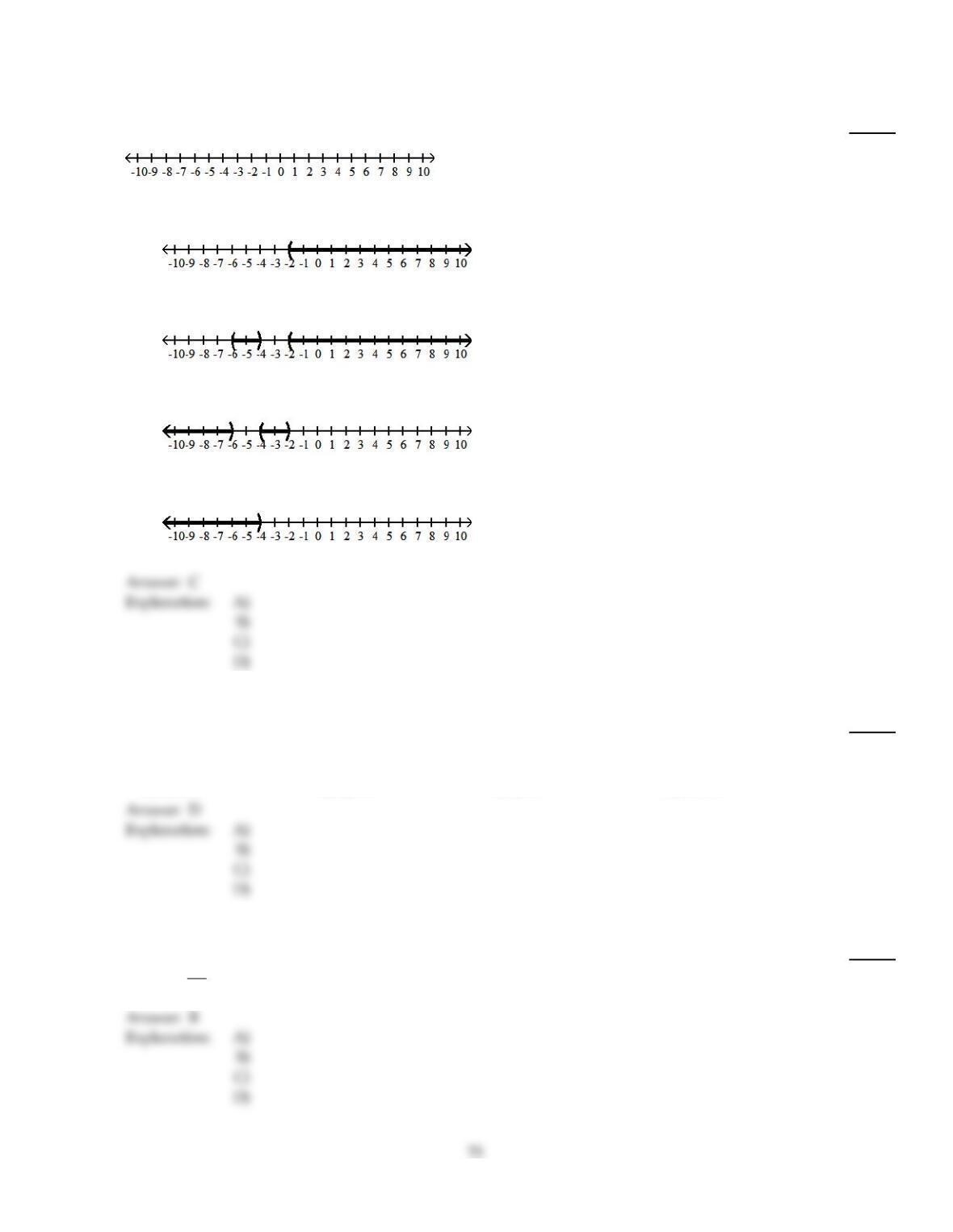
Solve the polynomial inequality and graph the solution set on a number line. Express the solution set in interval
notation.
180)
(x + 6)(x + 4)(x + 2) < 0
180)
A)
(–2, )
B)
(–6, –4) (–2, )
C)
(–, –6)
(–4, –2)
D)
(–, –4)
Solve the problem.
181)
An arrow is fired into the air with an initial velocity of 96 feet per second. The height in feet of the
arrow t seconds after it was shot into the air is given by the function h(x) = – 16t2+96t. Find the
maximum height of the arrow.
181)
A)
432 ft
B)
240 ft
C)
48 ft
D)
144 ft
D
Determine the constant of variation for the stated condition.
182)
g varies directly as f, and g=84 when f=6.
182)
A)
k =1
14
B)
k =14
C)
k =78
D)
k =16
B
C
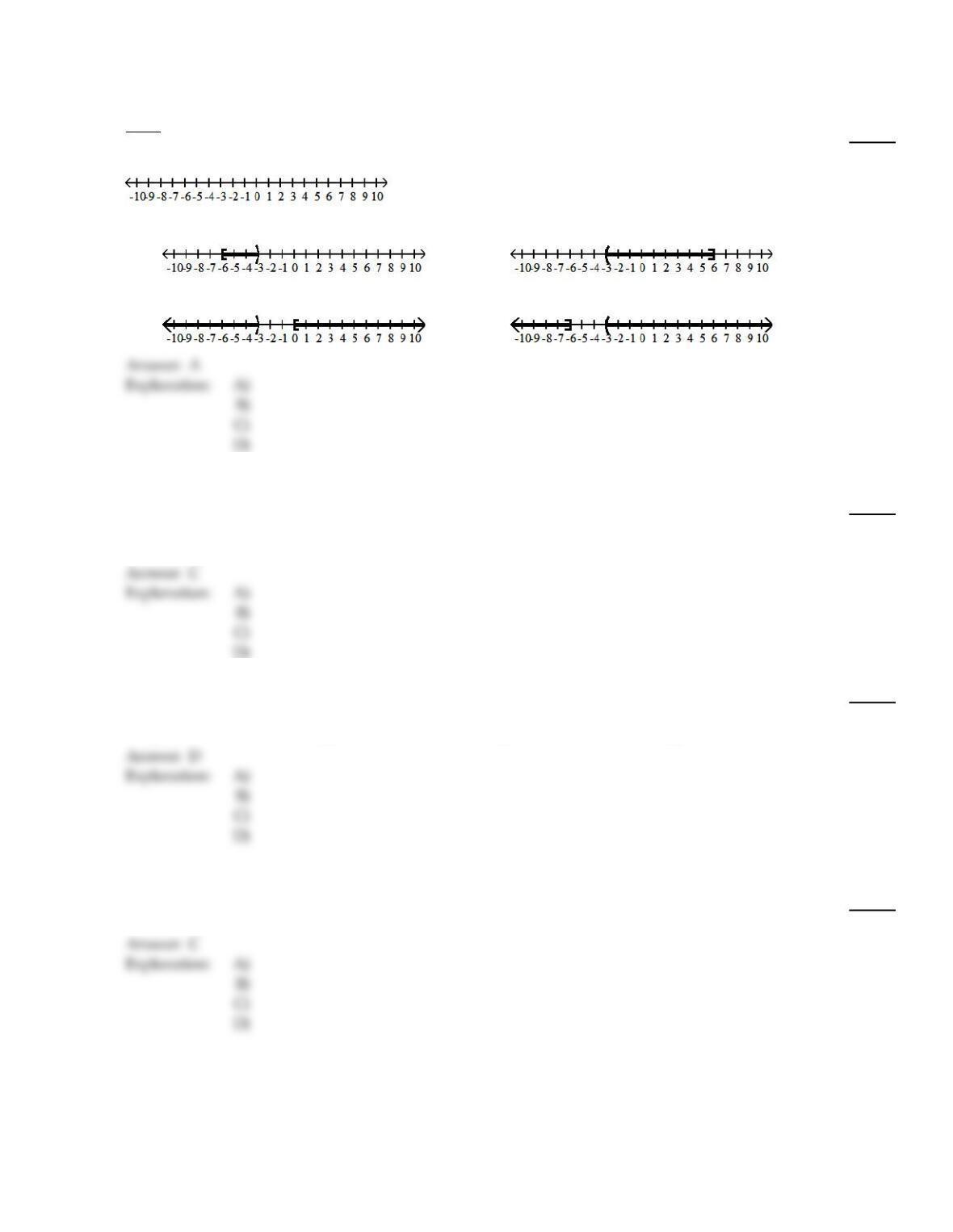
Solve the rational inequality and graph the solution set on a real number line. Express the solution set in interval
notation.
183)
x
x +3 2
183)
A)
[–6, –3)
B)
(–3, 6]
C)
(–, –3) or [0, )
D)
(–, –6] or (–3, )
Solve the problem.
184)
A rectangular playground is to be fenced off and divided in two by another fence parallel to one
side of the playground. 600 feet of fencing is used. Find the maximum area of the playground.
184)
A)
22,500 ft2
B)
16,875 ft2
C)
15,000 ft2
D)
11,250 ft2
185)
y varies jointly as a and b and inversely as the square root of c. y =10 when a =2, b =10, and c =36.
Find y when a =6, b =3, and c =4.
185)
A)
108
B)
13.5
C)
9
D)
27
Find the degree of the polynomial function.
186)
f(x) =18x5+ 4x4– 9
186)
A)
18
B)
10
C)
5
D)
4
74