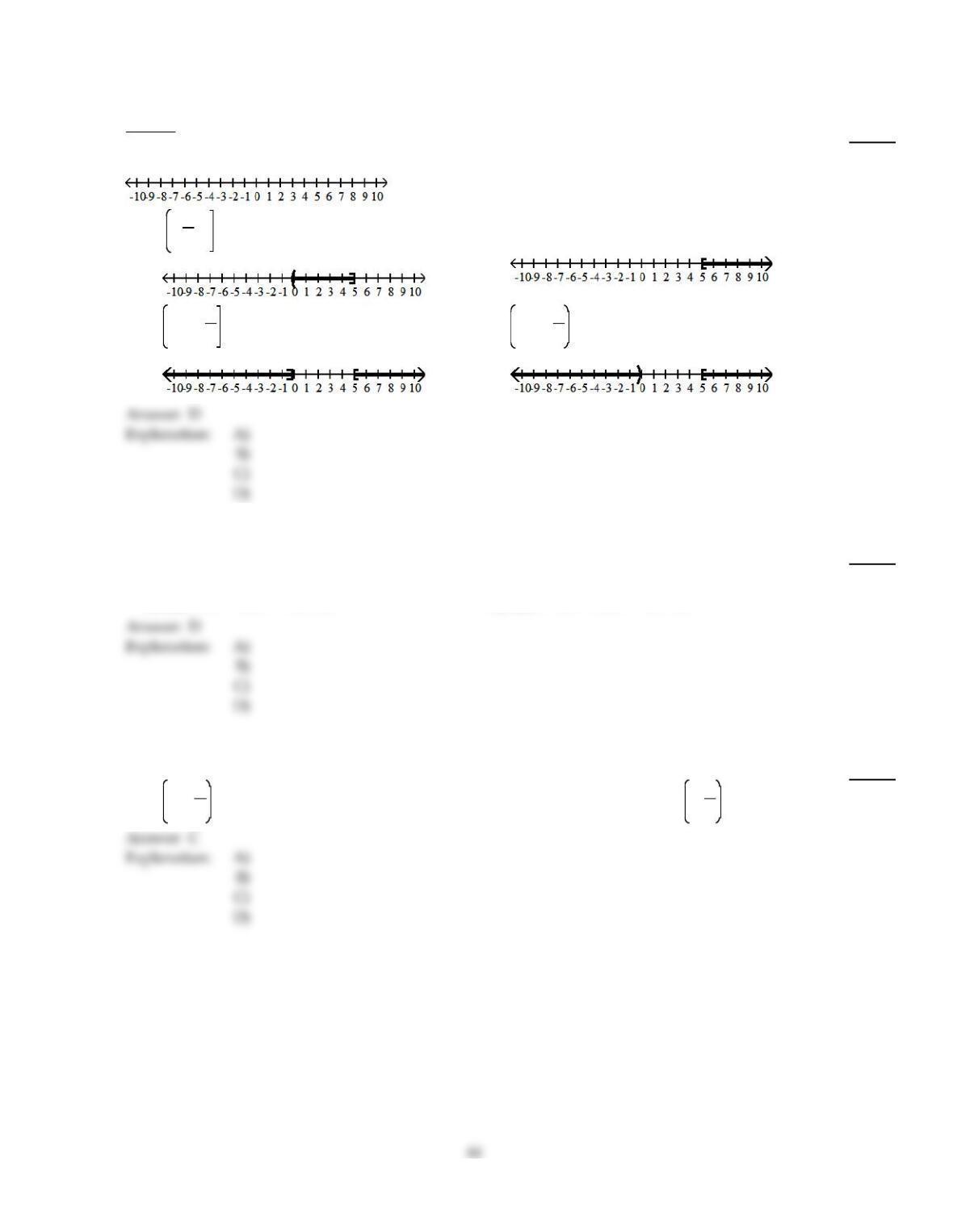
Solve the rational inequality and graph the solution set on a real number line. Express the solution set in interval
notation.
143)
15 –3x
6x +1 0
143)
A)
–1
6, 5
B)
[5, )
C)
–, –1
6or [5, )
D)
–, –1
6or [5, )
Find an nth degree polynomial function with real coefficients satisfying the given conditions.
144)
n = 3; 3 and i are zeros; f(2) =25
144)
A)
f(x) = – 5x3+ 15x2+ 5x – 15
B)
f(x) =5x3– 15x2+ 5x – 15
C)
f(x) =5x3– 15x2– 5x + 15
D)
f(x) = – 5x3+ 15x2– 5x + 15
Find the y–intercept for the graph of the quadratic function.
145)
f(x) =4x2– 3x – 7
145)
A)
0, –7
4
B)
(0, 7)
C)
(0, –7)
D)
0, 7
4
Solve the polynomial equation. In order to obtain the first root, use synthetic division to test the possible rational roots.
146)
3x3–x2–21x +7= 0
146)
A)
{1
3, 7, –7}
B)
{–1
3, 7, –7}
C)
{–3, 7, –7}
D)
{3, 7, –7}
Solve the problem.
147)
The following table shows the number of fires in a county for the years 1994–1998, where 1
represents 1994, 2 represents 1995, and so on.
Year, x Fires, T
1994, 1 2720.68
1995, 2 2770.36
1996, 3 2831.3
1997, 4 2883.56
1998, 5 2947.2
This data can be approximated using the third–degree polynomial
T(x) = – 0.49x3+0.57x2+65.40x +2655.2.
Use this function to predict the number of fires in 2004. Round to the nearest whole number.
147)
A)
2777
B)
2791
C)
2072
D)
148
B
Determine whether the graph of the polynomial has y–axis symmetry, origin symmetry, or neither.
148)
f(x) =(x –2)2(x2–16)
148)
A)
origin symmetry
B)
y–axis symmetry
C)
neither
C
Write an equation that expresses the relationship. Use k as the constant of variation.
149)
r varies jointly as the square of s and the square of t.
149)
A)
rs2t2= k
B)
r= k +s2+t2
C)
r+s2+t2= k
D)
r= ks2t2
D
A
Solve the problem.
150)
The total profit function P(x) for a company producing x thousand units is given by
P(x) = – 2x2+ 28x – 96. Find the values of x for which the company makes a profit. [Hint: The
company makes a profit when P(x) > 0.]
150)
A)
x is greater than 6 thousand units
B)
x is less than 8 thousand units
C)
x is between 6 thousand units and 8 thousand units
D)
x is less than 6 thousand units or greater than 8 thousand units
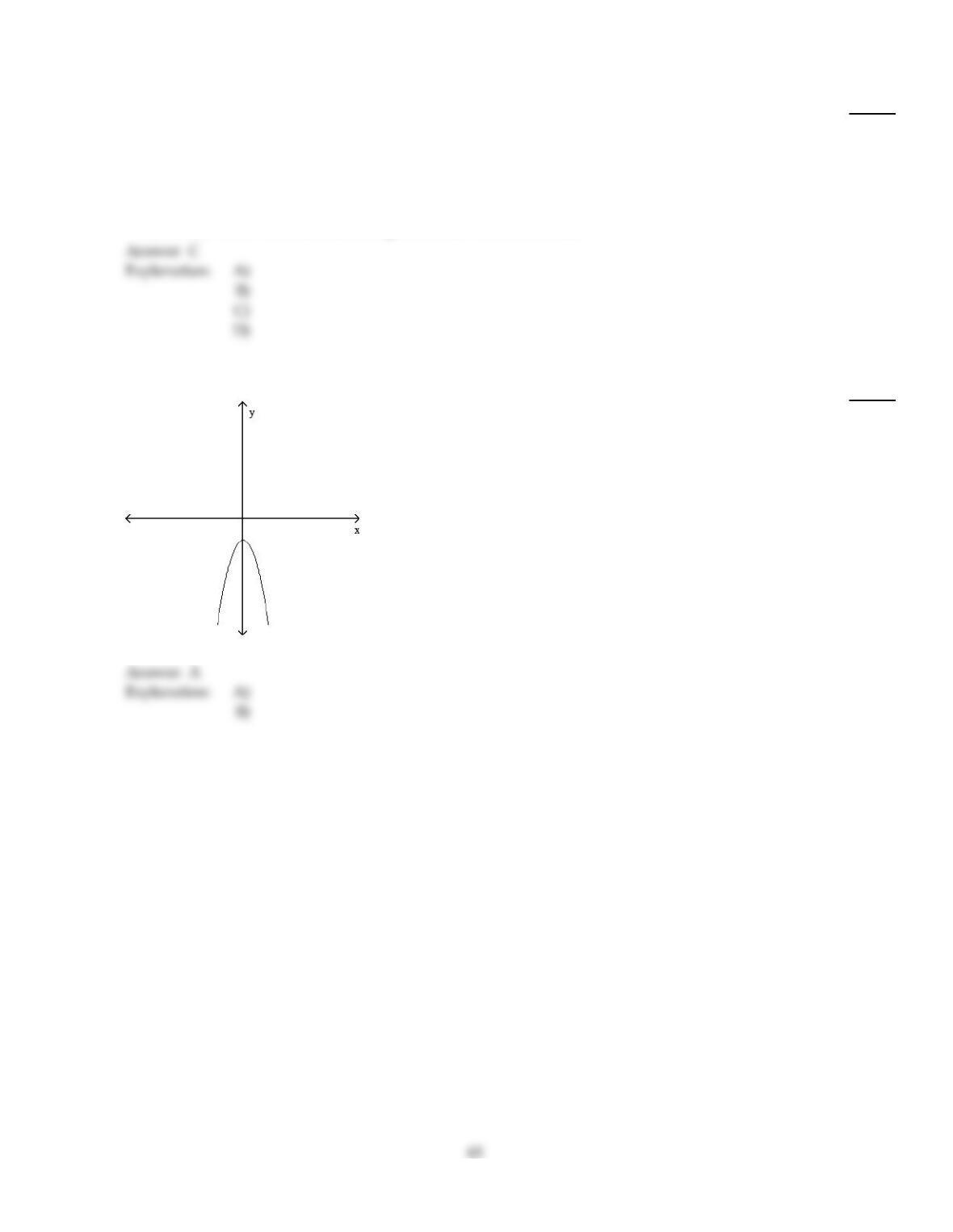
Determine whether the graph shown is the graph of a polynomial function.
151)
151)
A)
polynomial function
B)
not a polynomial function
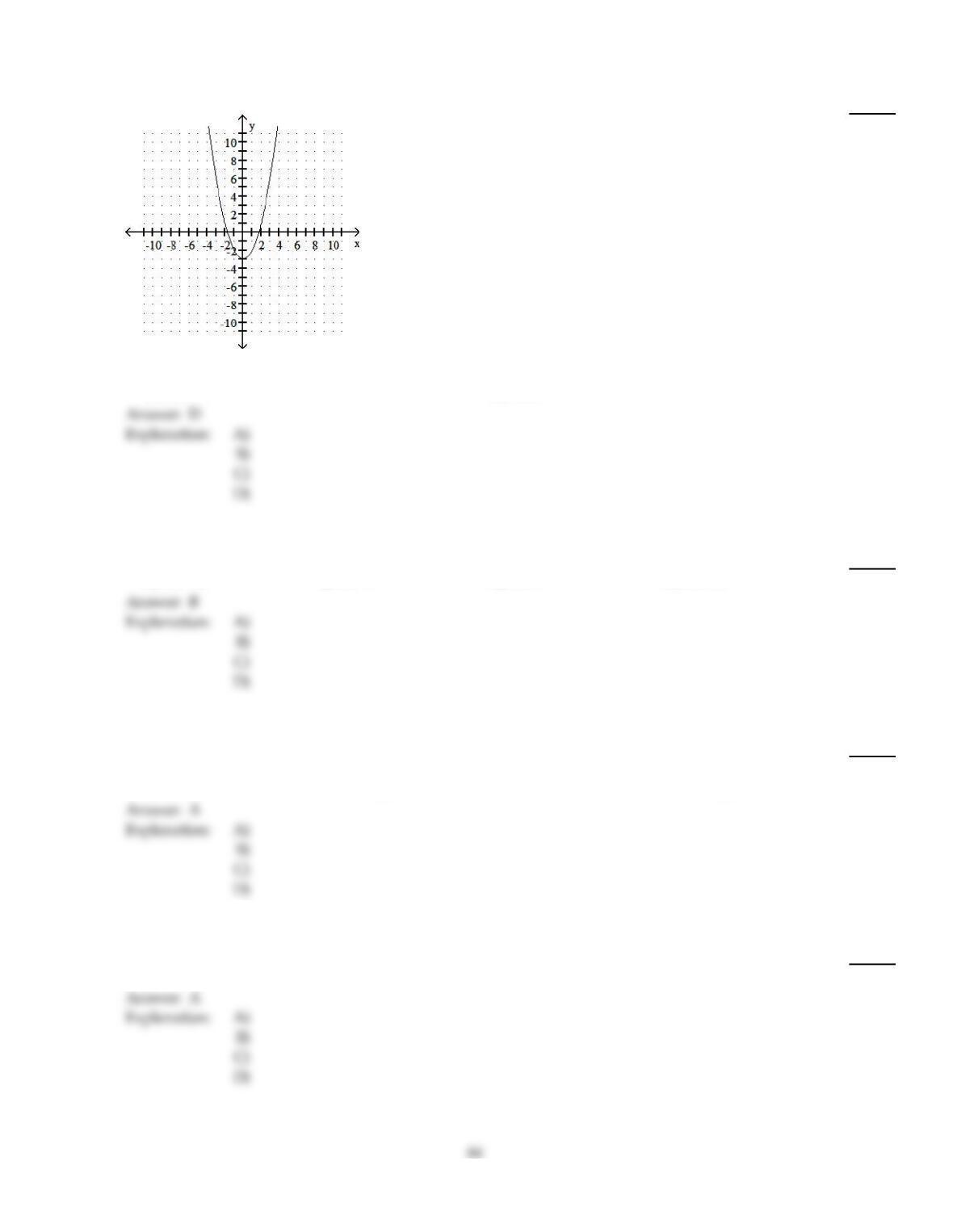
The graph of a quadratic function is given. Determine the function’s equation.
152)
152)
A)
j(x) =x2+3
B)
g(x) =x2+6x +9
C)
f(x) =x2–6x +9
D)
h(x) =x2–3
Find the axis of symmetry of the parabola defined by the given quadratic function.
153)
f(x) =x2+ 14x – 8
153)
A)
x = – 57
B)
x = – 7
C)
x =7
D)
x =14
Use the Leading Coefficient Test to determine the end behavior of the polynomial function.
154)
f(x) = x + 5x2–5x3
154)
A)
rises to the left and falls to the right
B)
falls to the left and rises to the right
C)
rises to the left and rises to the right
D)
falls to the left and falls to the right
Find the axis of symmetry of the parabola defined by the given quadratic function.
155)
f(x) =4x2– 8x – 9
155)
A)
x =1
B)
x = – 13
C)
x = – 1
D)
x =2
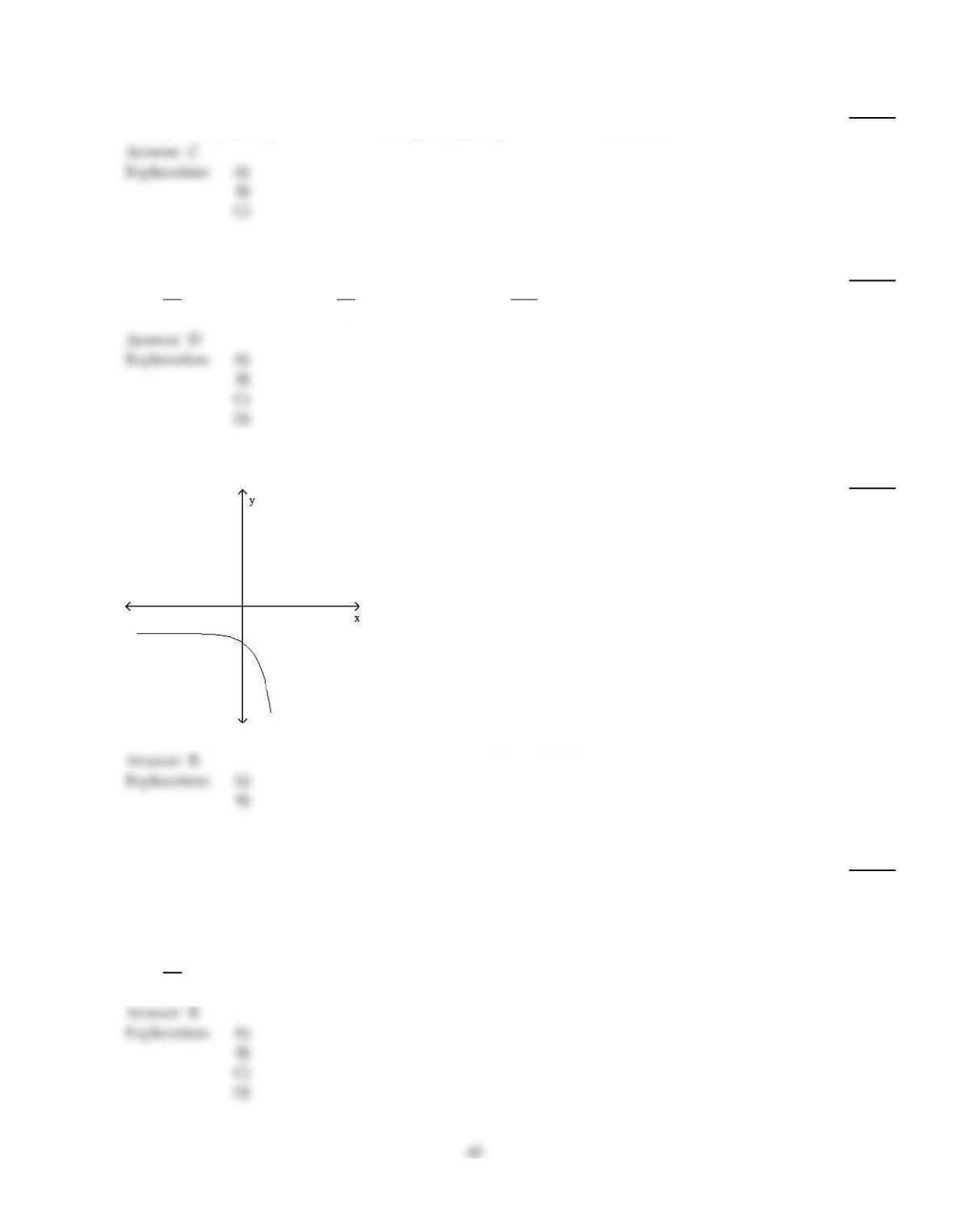
Determine whether the graph of the polynomial has y–axis symmetry, origin symmetry, or neither.
156)
f(x) = – x2(x +8)(x2– 1)
156)
A)
y–axis symmetry
B)
origin symmetry
C)
neither
Solve the problem.
157)
If y varies directly as the square root of x, and y =10 when x =25, find y when x =16.
157)
A)
32
5
B)
25
2
C)
125
8
D)
8
Determine whether the graph shown is the graph of a polynomial function.
158)
158)
A)
polynomial function
B)
not a polynomial function
Solve.
159)
When the temperature stays the same, the volume of a gas is inversely proportional to the pressure
of the gas. If a balloon is filled with 54 cubic inches of a gas at a pressure of 14 pounds per square
inch, find the new pressure of the gas if the volume is decreased to 9 cubic inches.
159)
A)
70 pounds per square inch
B)
84 pounds per square inch
C)
9
14 pounds per square inch
D)
78 pounds per square inch
Find the indicated intercept(s) of the graph of the function.
160)
x–intercepts of f(x) =x2+ 3
x2+ 9x + 3
160)
A)
(3, 0)
B)
( 3, 0), (–3, 0)
C)
(3, 0)
D)
none
Use synthetic division to show that the number given to the right of the equation is a solution of the equation, then solve
the polynomial equation.
161)
x3+ 6x2+ 5x – 12 = 0; –3
161)
A)
{1, 4, –3}
B)
{1, –4, –3}
C)
{–1, –4, –3}
D)
{–1, 4, –3}
B
Find the x–intercepts (if any) for the graph of the quadratic function.
162)
f(x) = x2+ 16x + 41 Give your answers in exact form.
162)
A)
(–16 ±41, 0)
B)
(8 ±41, 0)
C)
(–8±23, 0)
D)
(8 +23, 0)
C
Solve the problem.
163)
The amount of water used to take a shower is directly proportional to the amount of time that the
shower is in use. A shower lasting 20 minutes requires 8 gallons of water. Find the amount of
water used in a shower lasting 5 minutes.
163)
A)
12.5 gallons
B)
1.6 gallons
C)
2 gallons
D)
32 gallons
C
Graph the polynomial function.
66
D
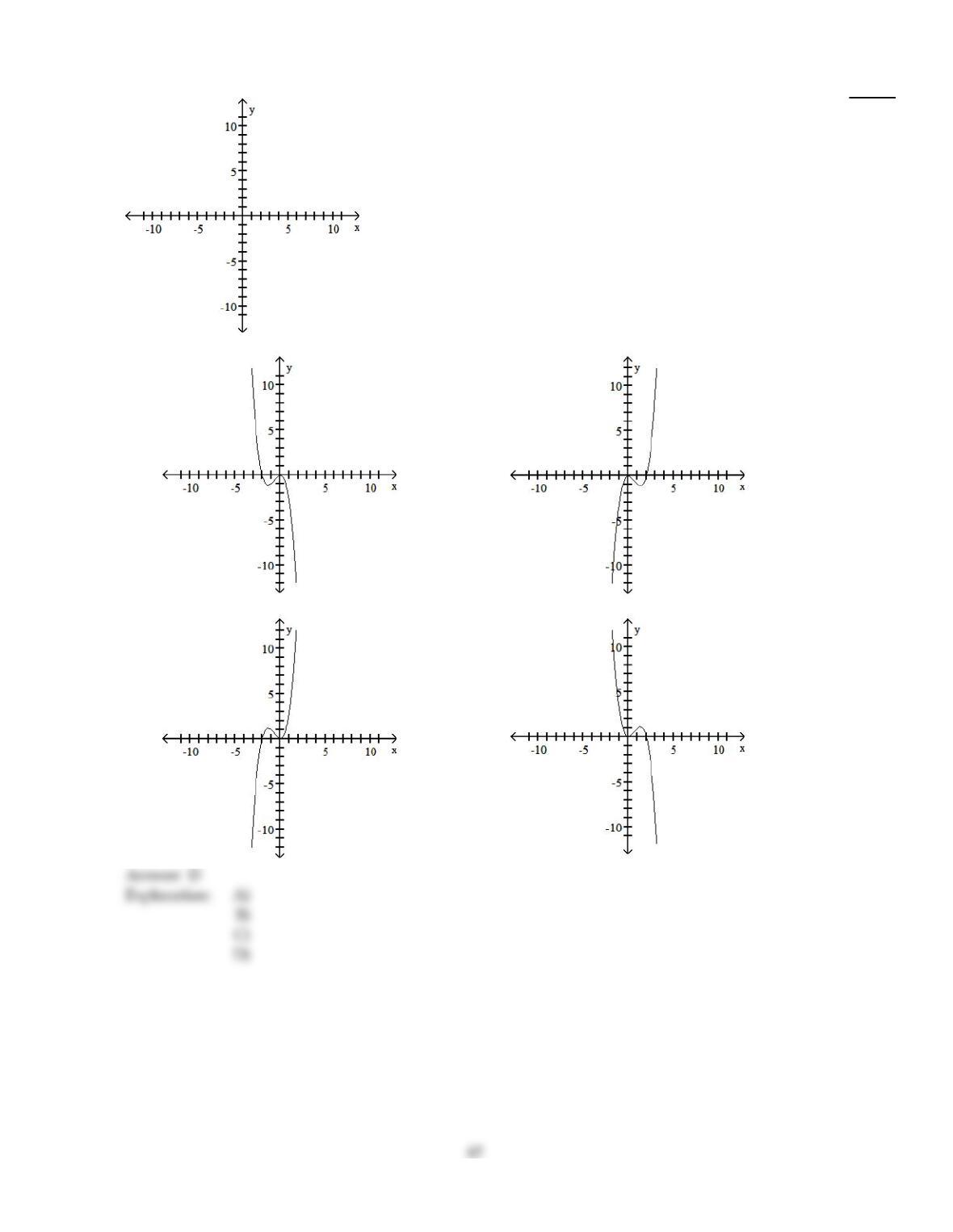
164)
f(x) =2x2–x3
164)
A)
B)
C)
D)
Write an equation that expresses the relationship. Use k for the constant of proportionality.
165)
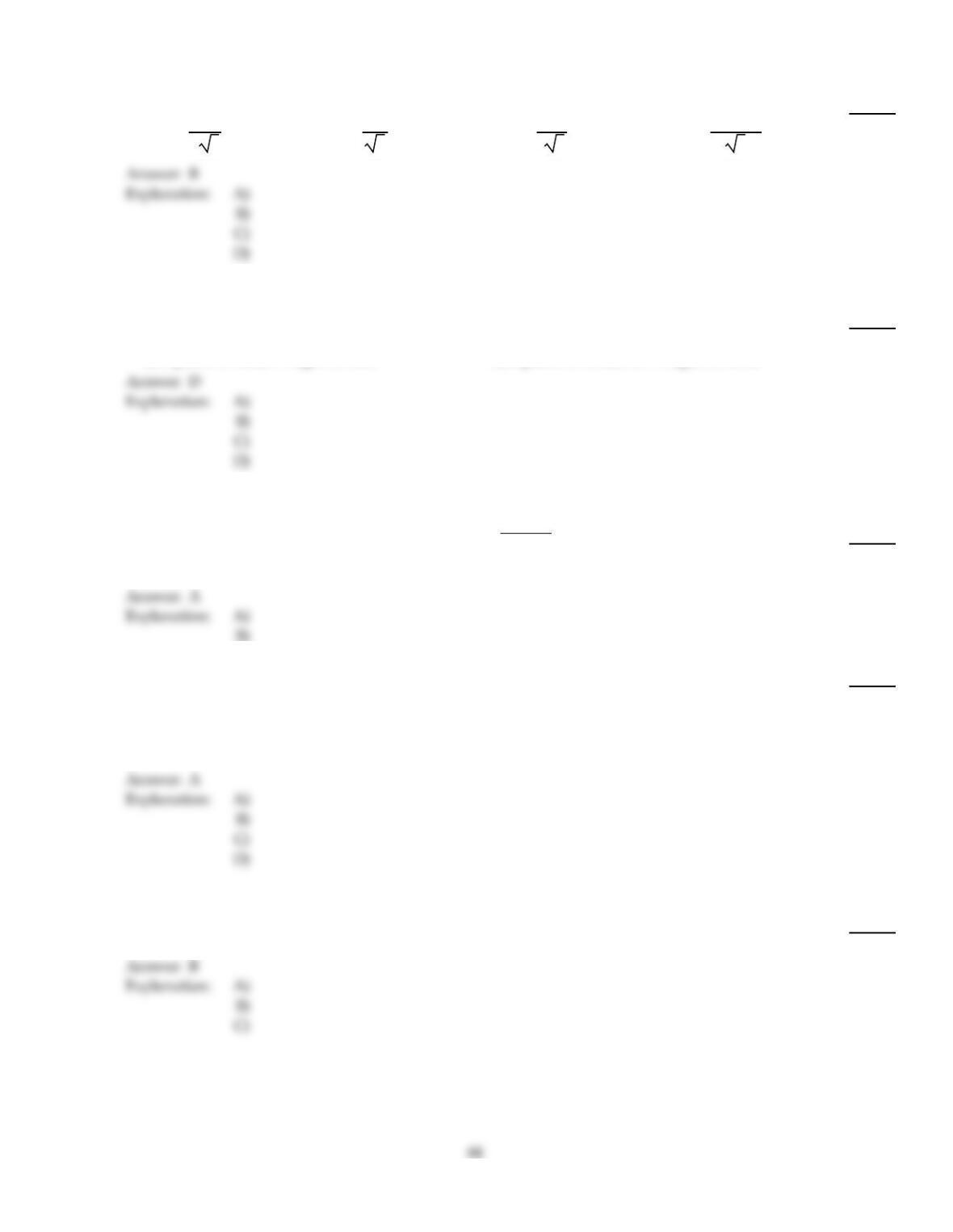
p varies jointly as q and r and inversely as the square root of a.
165)
A)
p=qr
k a
B)
p=kqr
a
C)
p=kq
r a
D)
p=k(q+r)
a
Use Descartes’s Rule of Signs to determine the possible number of positive and negative real zeros for the given function.
166)
f(x) =x7+x6+x2+ x +4
166)
A)
0 positive zeros, 0 negative zeros
B)
0 positive zeros, 2 or 0 negative zeros
C)
0 positive zeros, 1 negative zero
D)
0 positive zeros, 3 or 1 negative zeros
Solve the problem.
167)
Is there y–axis symmetry for the rational function f(x) =8x2
5x4– 5 ?
167)
A)
Yes
B)
No
168)
The amount of simple interest earned on an investment over a fixed amount of time is jointly
proportional to the principle invested and the interest rate. A principle investment of $3200.00 with
an interest rate of 5% earned $320.00 in simple interest. Find the amount of simple interest earned if
the principle is $1800.00 and the interest rate is 2%.
168)
A)
$72.00
B)
$7200.00
C)
$128.00
D)
$180.00
Determine whether the graph of the polynomial has y–axis symmetry, origin symmetry, or neither.
169)
f(x) = x3– 4x
169)
A)
y–axis symmetry
B)
origin symmetry
C)
neither
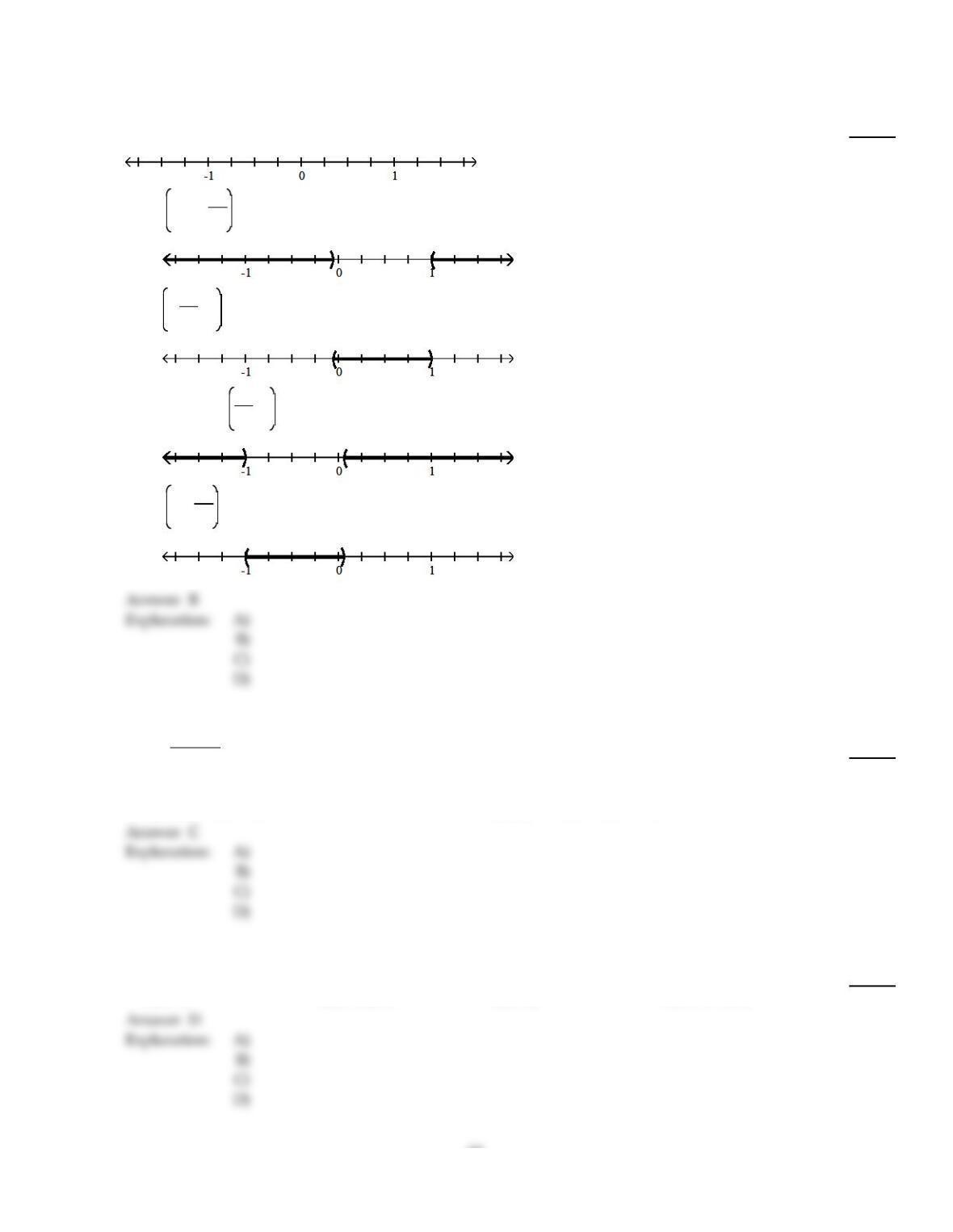
Solve the polynomial inequality and graph the solution set on a number line. Express the solution set in interval
notation.
170)
18x2<17x + 1
170)
A)
–, –1
18 (1, )
B)
–1
18 , 1
C)
(–, –1) 1
18 ,
D)
–1, 1
18
Find the domain of the rational function.
171)
h(x) =x +9
x2–25
171)
A)
{x|x
0, x 25}
B)
all real numbers
C)
{x|x –5, x 5}
D)
{x|x –5, x 5, x –9}
Find a rational zero of the polynomial function and use it to find all the zeros of the function.
172)
f(x) =x3+ 2x2– 9x – 18
172)
A)
{–3}
B)
{–3, 2, 3}
C)
{–2}
D)
{–3, –2, 3}
69
Solve the problem.
173)
x varies inversely as y2, and x =6 when y =8. Find x when y =2.
173)
A)
x =96
B)
x =144
C)
x =4
D)
x =24
Write the equation of a polynomial function with the given characteristics. Use a leading coefficient of 1 or –1 and make
the degree of the function as small as possible.
174)
Crosses the x–axis at –1, 0, and 3; lies above the x–axis between –1 and 0; lies below the x–axis
between 0 and 3.
174)
A)
f(x) = – x3– 2x2+ 3x
B)
f(x) =x3+ 2x2– 3x
C)
f(x) = – x3+ 2x2+ 3x
D)
f(x) =x3– 2x2– 3x
Solve the problem.
175)
You have 120 feet of fencing to enclose a rectangular region. Find the dimensions of the rectangle
that maximize the enclosed area.
175)
A)
60 ft by 60 ft
B)
30 ft by 30 ft
C)
32 ft by 28 ft
D)
60 ft by 15 ft
Solve.
176)
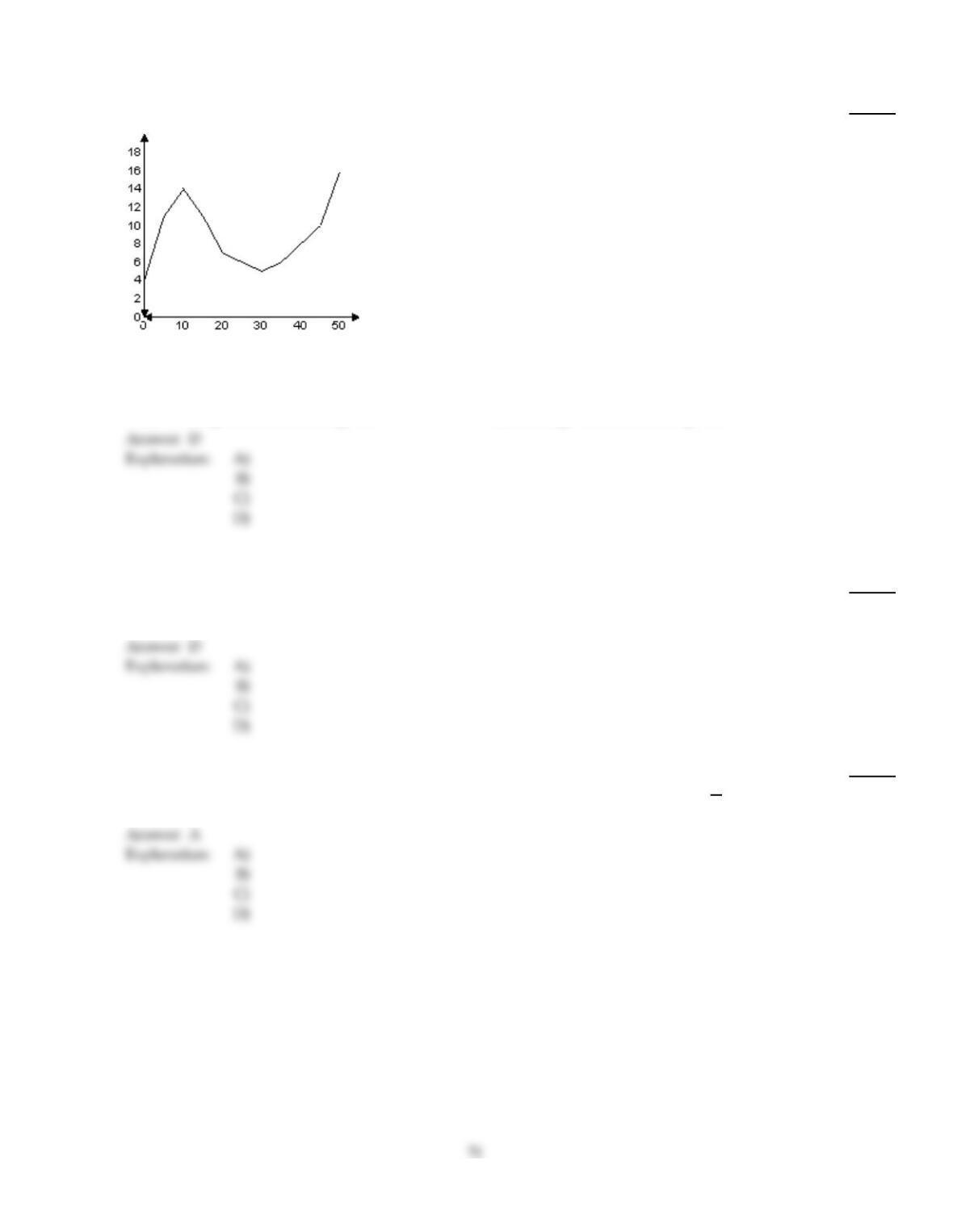
Suppose that a polynomial function is used to model the data shown in the graph below.
For what intervals is the function increasing?
176)
A)
0 through 50
B)
0 through 10 and 40 through 50
C)
0 through 20 and 30 through 50
D)
0 through 10 and 30 through 50
Solve the problem.
177)
Use synthetic division to divide f(x) =x3– 1x2– 52x + 160 by x + 8. Use the result to find all zeros
of f.
177)
A)
{–8 , –4, –5}
B)
{8, 4, 5}
C)
{8, –4, –5}
D)
{–8, 4, 5}
178)
h varies jointly as f and g. Find h when f=24, g=14, and k =4.
178)
A)
h=1344
B)
h=84
C)
h=336
D)
h=7
3
179)
A developer wants to enclose a rectangular grassy lot that borders a city street for parking. If the
developer has 332 feet of fencing and does not fence the side along the street, what is the largest
area that can be enclosed?
179)
A)
13,778 ft2
B)
20,667 ft2
C)
27,556 ft2
D)
6889 ft2
Divide using long division.
180)
4m3+ 21m2– 42m + 49
m + 7
180)
A)
4m2– 7m + 7
B)
m2+ 8m + 9
C)
4m2+ 7m + 7
D)
m2+ 7m + 4
Find the domain of the rational function.
181)
f(x) =x +8
x2– 4x
181)
A)
all real numbers
B)
{x|x –2, x 2, x –8}
C)
{x|x
0, x 4}
D)
{x|x –2, x 2}
72
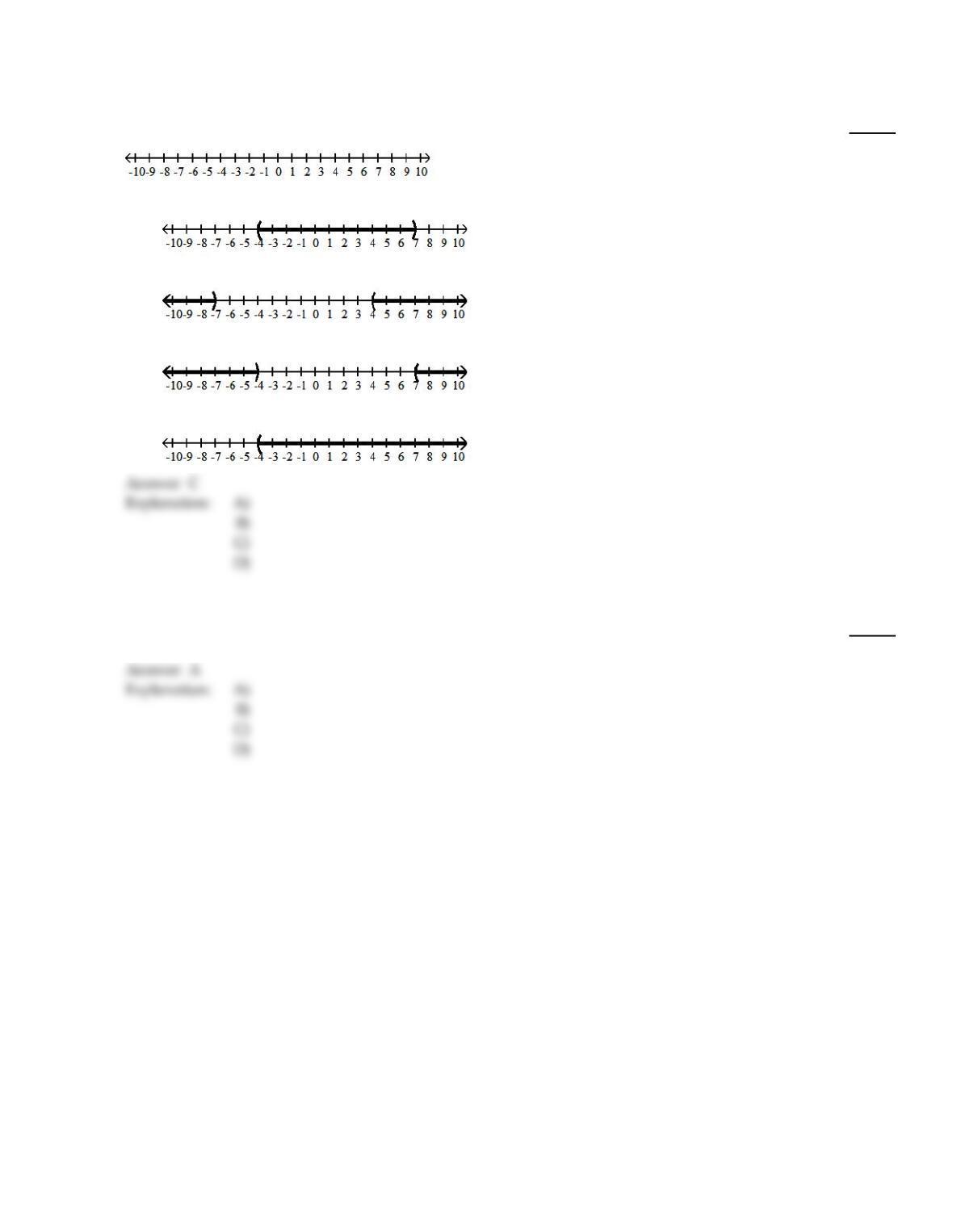
Solve the polynomial inequality and graph the solution set on a number line. Express the solution set in interval
notation.
182)
(x – 7)(x + 4) > 0
182)
A)
(–4, 7)
B)
(–, –7)
(4, )
C)
(–, –4)
(7, )
D)
(–4, )
Find the coordinates of the vertex for the parabola defined by the given quadratic function.
183)
f(x) = (x + 4)2– 8
183)
A)
(–4, –8)
B)
(–4, 8)
C)
(4, –8)
D)
(4, 8)
73