C)
D)
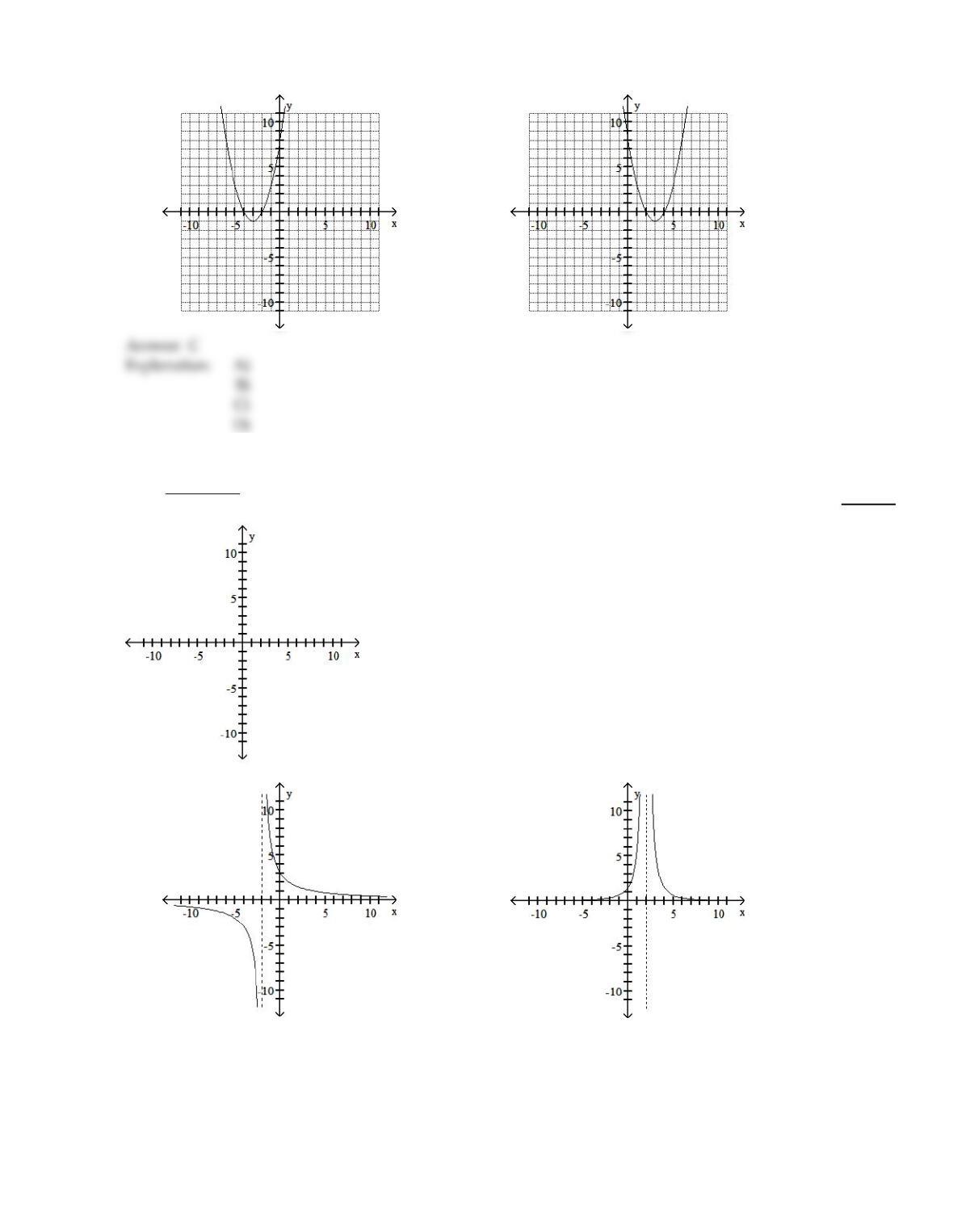
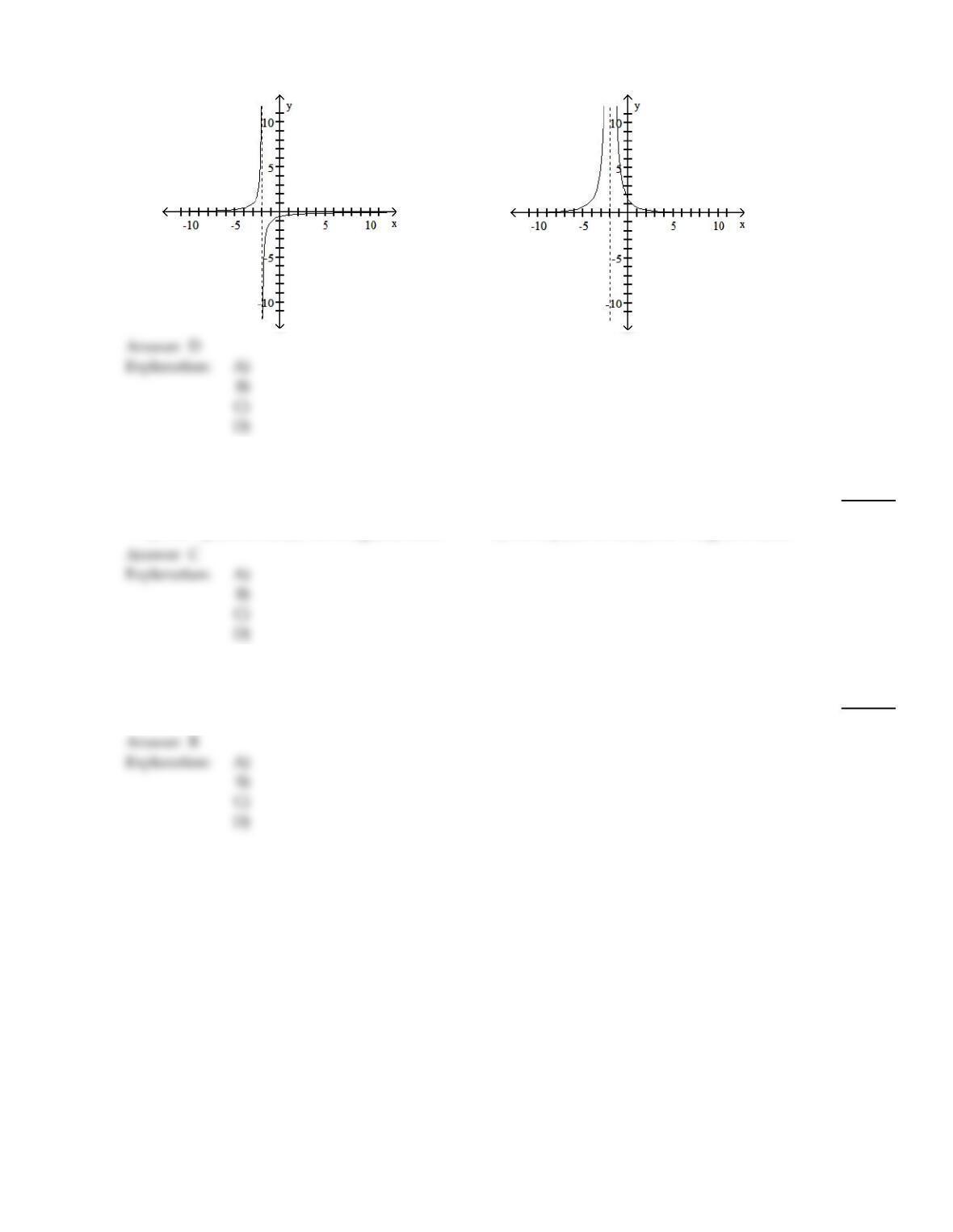
Graph the rational function.
95)
f(x) =6
x2+4x +4
95)
A)
B)
41
C)
D)
Use Descartes’s Rule of Signs to determine the possible number of positive and negative real zeros for the given function.
96)
f(x) = – 6x9+x5–x2+8
96)
A)
3 or 1 positive zeros, 3 or 1 negative zeros
B)
2 or 0 positive zeros, 2 or 0 negative zeros
C)
3 or 1 positive zeros, 2 or 0 negative zeros
D)
2 or 0 positive zeros, 3 or 1 negative zeros
Find the axis of symmetry of the parabola defined by the given quadratic function.
97)
f(x) = – x2+ 2x – 6
97)
A)
x = – 5
B)
x =1
C)
x =2
D)
x = – 1
Graph the rational function.
42
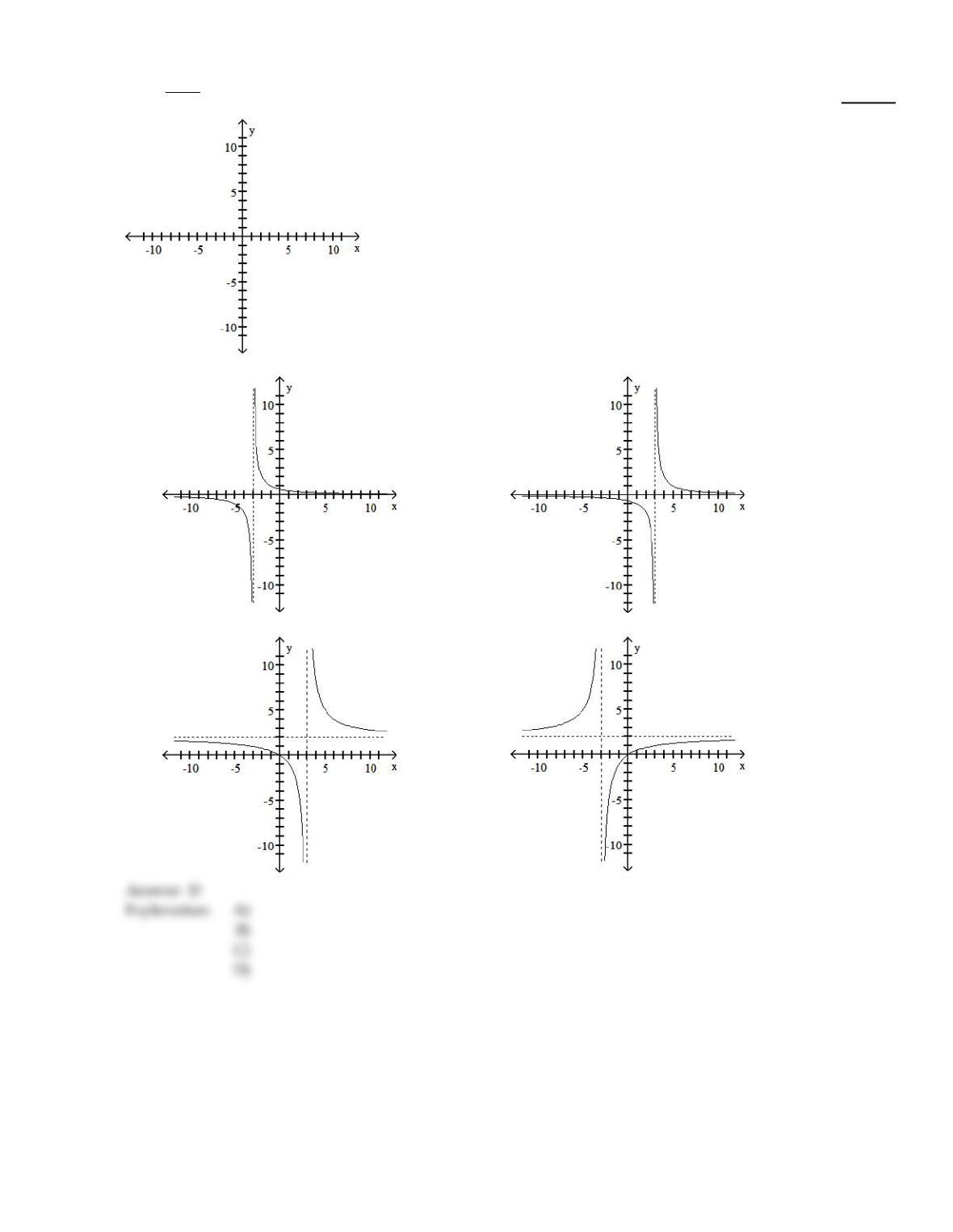
98)
f(x) =2x
x + 3
98)
A)
B)
C)
D)
43
Find the x–intercepts of the polynomial function. State whether the graph crosses the x–axis, or touches the x–axis and
turns around, at each intercept.
99)
x4+ 3x3– 10x2= 0
99)
A)
0, crosses the x–axis;
–5, crosses the x–axis;
2, crosses the x–axis
B)
0, touches the x–axis and turns around;
5, crosses the x–axis;
–2, crosses the x–axis
C)
0, touches the x–axis and turns around;
–5, crosses the x–axis;
2, crosses the x–axis
D)
0, touches the x–axis and turns around;
5, touches the x–axis and turns around;
–2, touches the x–axis and turns around
D)
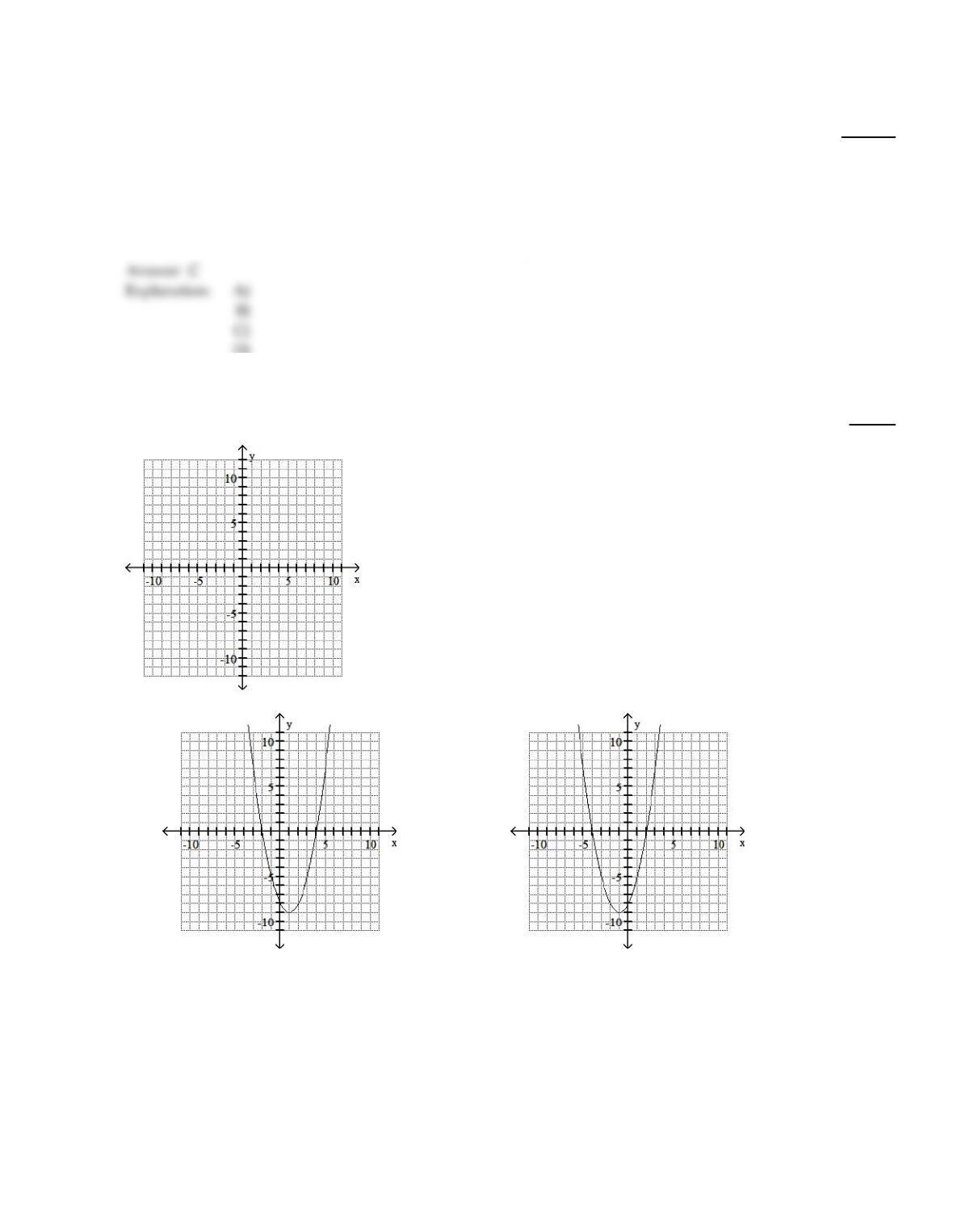
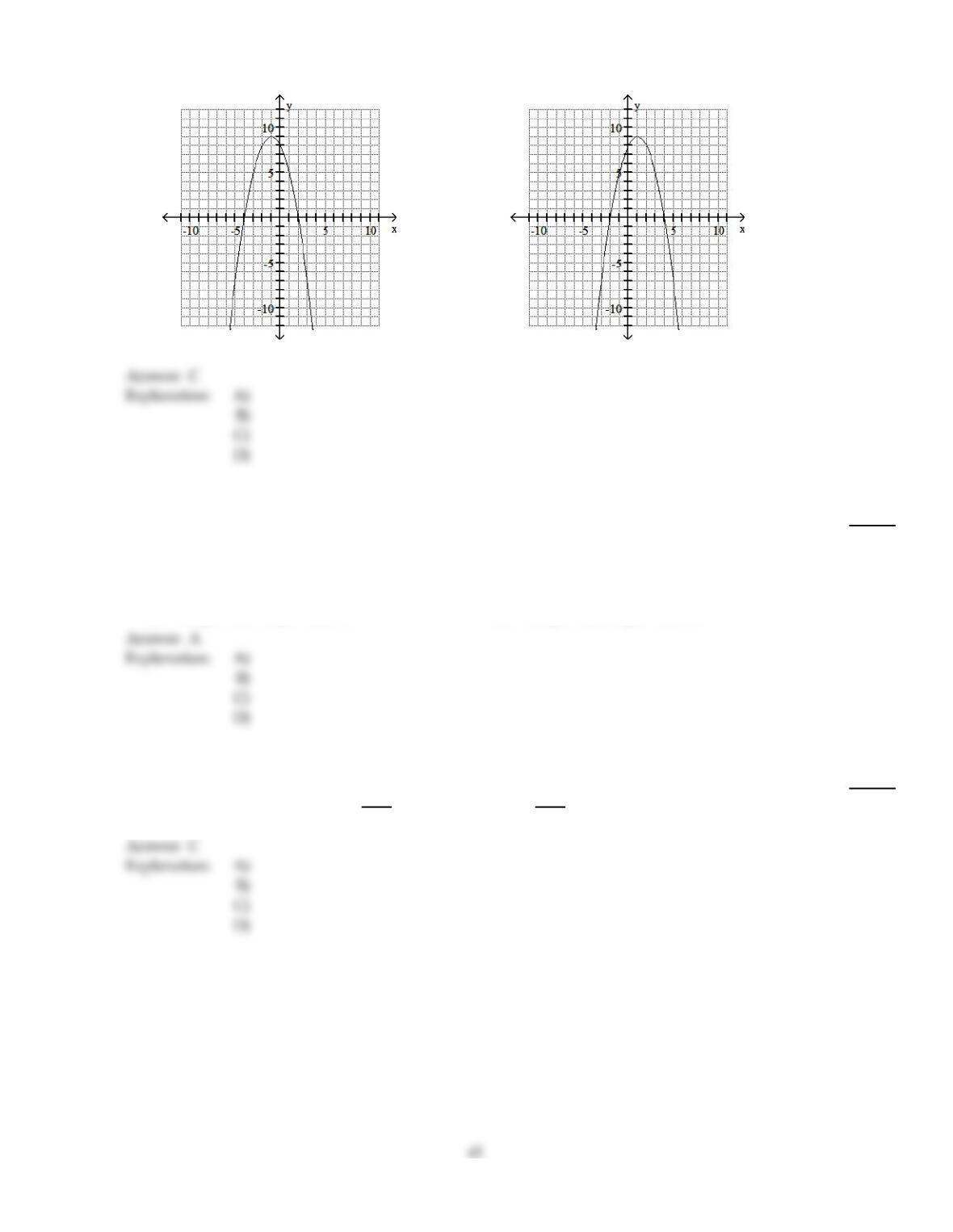
Use the vertex and intercepts to sketch the graph of the quadratic function.
100)
f(x) =8–x2– 2x
100)
A)
B)
44
C)
D)
Solve.
101)
While traveling at a constant speed in a car, the centrifugal acceleration passengers feel while the
car is turning is inversely proportional to the radius of the turn. If the passengers feel an
acceleration of 8 feet per second per second when the radius of the turn is 80 feet, find the
acceleration the passengers feel when the radius of the turn is 160 feet.
101)
A)
4 feet per second per second
B)
6 feet per second per second
C)
7 feet per second per second
D)
5 feet per second per second
If y varies inversely as x, find the inverse variation equation for the situation.
102)
y =0.2 when x =0.4
102)
A)
y =12.5x
B)
y =12.5
x
C)
y =0.08
x
D)
y =0.5x
Solve the problem.
103)
The profit that the vendor makes per day by selling x pretzels is given by the function
P(x) = – 0.004x2+2.4x – 400. Find the number of pretzels that must be sold to maximize profit.
103)
A)
–40 pretzels
B)
600 pretzels
C)
300 pretzels
D)
1.2 pretzels
Find the axis of symmetry of the parabola defined by the given quadratic function.
104)
f(x) =4x2– 8x – 9
104)
A)
x = – 13
B)
x =2
C)
x = – 1
D)
x =1
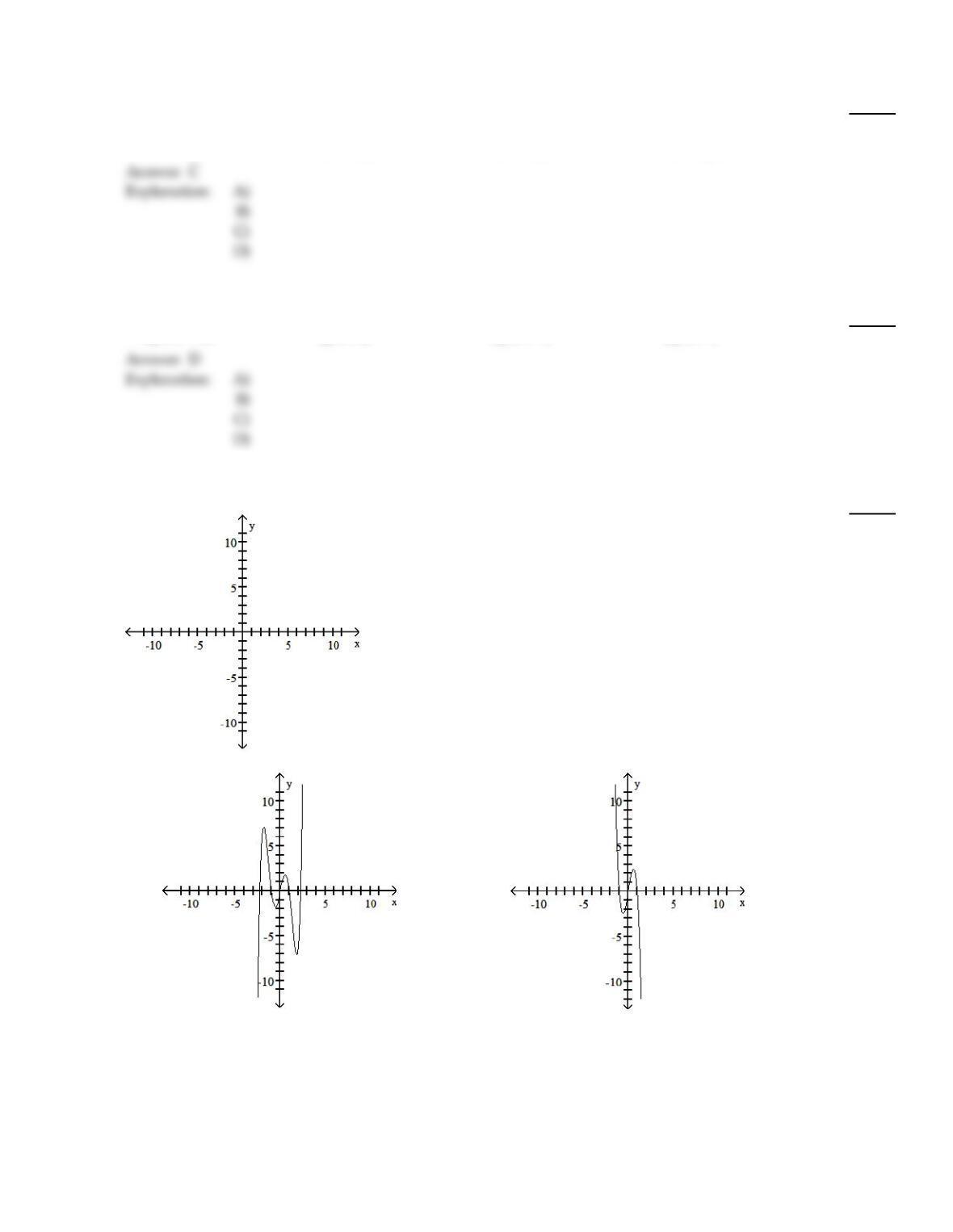
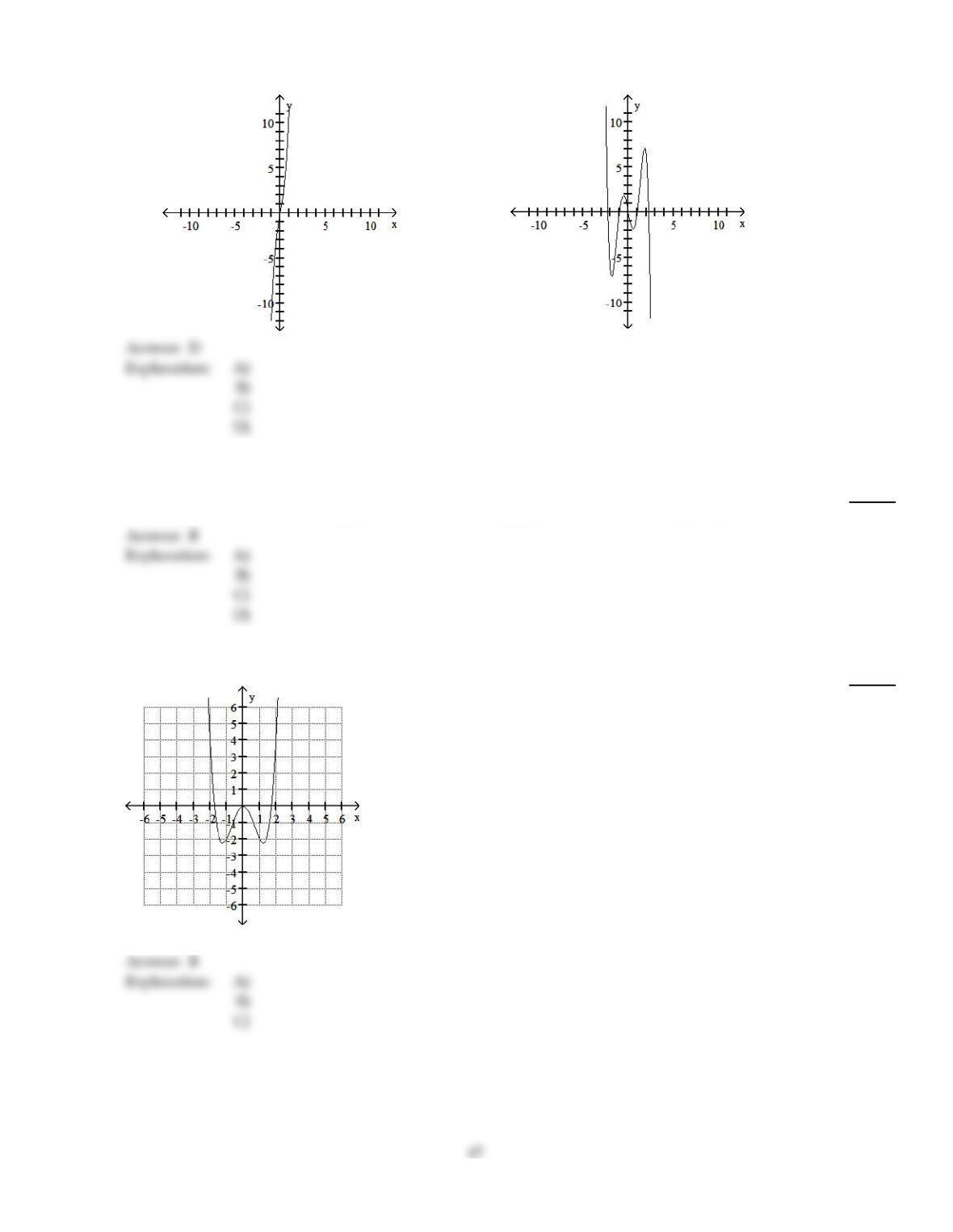
Graph the polynomial function.
105)
f(x) =6x3–5x –x5
105)
A)
B)
46
C)
D)
Find the y–intercept for the graph of the quadratic function.
106)
f(x) = – x2– 2x +8
106)
A)
(0, –4)
B)
(0, 8)
C)
(8, 0)
D)
(0, –8)
Determine whether the graph of the polynomial has y–axis symmetry, origin symmetry, or neither.
107)
107)
A)
origin symmetry
B)
y–axis symmetry
C)
neither
Determine whether the function is a polynomial function.
108)
f(x) =x2–3
x4
108)
A)
No
B)
Yes
Use Descartes’s Rule of Signs to determine the possible number of positive and negative real zeros for the given function.
109)
f(x) =x5–2.1x4–14.44x3+ 3x2+41.67x –15.216
109)
A)
3 or 1 positive zeros, 3 or 1 negative zeros
B)
2 or 0 positive zeros, 2 or 0 negative zeros
C)
2 or 0 positive zeros, 3 or 1 negative zeros
D)
3 or 1 positive zeros, 2 or 0 negative zeros
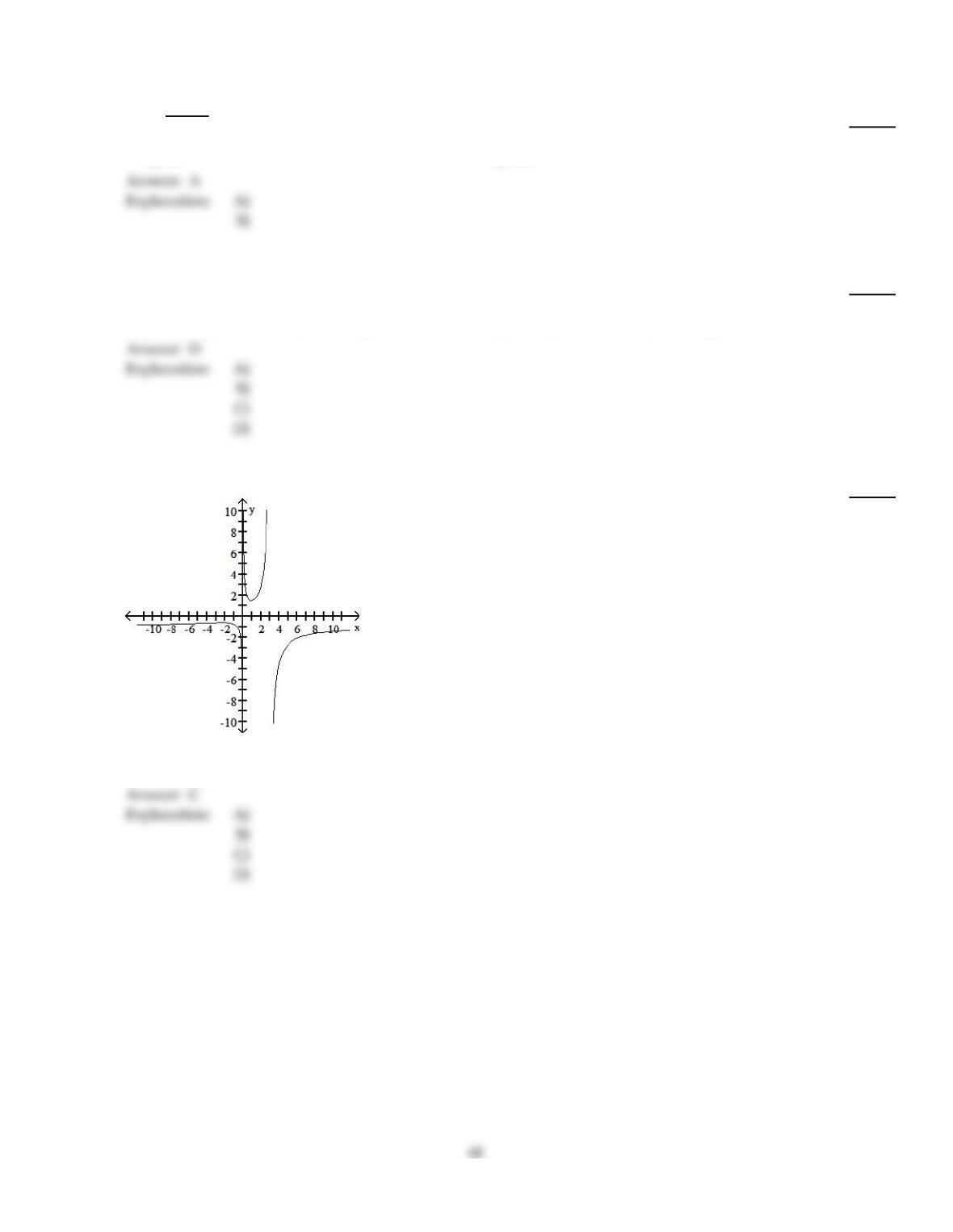
Use the graph of the rational function shown to complete the statement.
110)
As x
0+, f(x)
?
110)
A)
–
B)
1
C)
+
D)
–1
Find the zeros for the polynomial function and give the multiplicity for each zero. State whether the graph crosses the
x–axis or touches the x–axis and turns around, at each zero.
111)
f(x) =2x –5
2(x – 4)3
111)
A)
–5
2, multiplicity 1, touches the x–axis and turns around; –4, multiplicity 3, touches x–axis
and turns around
B)
5
2, multiplicity 1, crosses x–axis; 4, multiplicity 3, crosses x–axis
C)
5
2, multiplicity 1, touches the x–axis and turns around; 4, multiplicity 3, touches x–axis and
turns around
D)
–5
2, multiplicity 1, crosses x–axis; –4, multiplicity 3, crosses x–axis
Use the Intermediate Value Theorem to determine whether the polynomial function has a real zero between the given
integers.
112)
f(x) =5x3– 7x + 7; between –2 and –1
112)
A)
f(–2) =19 and f(–1) =9; no
B)
f(–2) = – 19 and f(–1) = – 9; no
C)
f(–2) =19 and f(–1) = – 9; yes
D)
f(–2) = – 19 and f(–1) =9; yes
Find the x–intercepts of the polynomial function. State whether the graph crosses the x–axis, or touches the x–axis and
turns around, at each intercept.
113)
f(x) =6x2–x3
113)
A)
0, touches the x–axis and turns around;
6, crosses the x–axis
B)
0, touches the x–axis and turns around;
6, touches the x–axis and turns around
C)
0, touches the x–axis and turns around;
6, crosses the x–axis;
–6, crosses the x–axis
D)
0, crosses the x–axis;
6, crosses the x–axis;
–6, crosses the x–axis
Determine the maximum possible number of turning points for the graph of the function.
114)
f(x) = (x + 1)(x – 2)(x – 7)(x – 4)
114)
A)
0
B)
1
C)
3
D)
4
Write the equation of a polynomial function with the given characteristics. Use a leading coefficient of 1 or –1 and make
the degree of the function as small as possible.
115)
Crosses the x–axis at –2, 0, and 4; lies below the x–axis between –2 and 0; lies above the x–axis
between 0 and 4.
115)
A)
f(x) =x3– 2x2– 8x
B)
f(x) = – x3– 2x2+ 8x
C)
f(x) = – x3+ 2x2+ 8x
D)
f(x) =x3+ 2x2– 8x
C
Determine the constant of variation for the stated condition.
116)
g varies directly as f, and g=5 when f=70.
116)
A)
k =65
B)
k =15
C)
k =14
D)
k =1
14
D
C
Solve.
117)
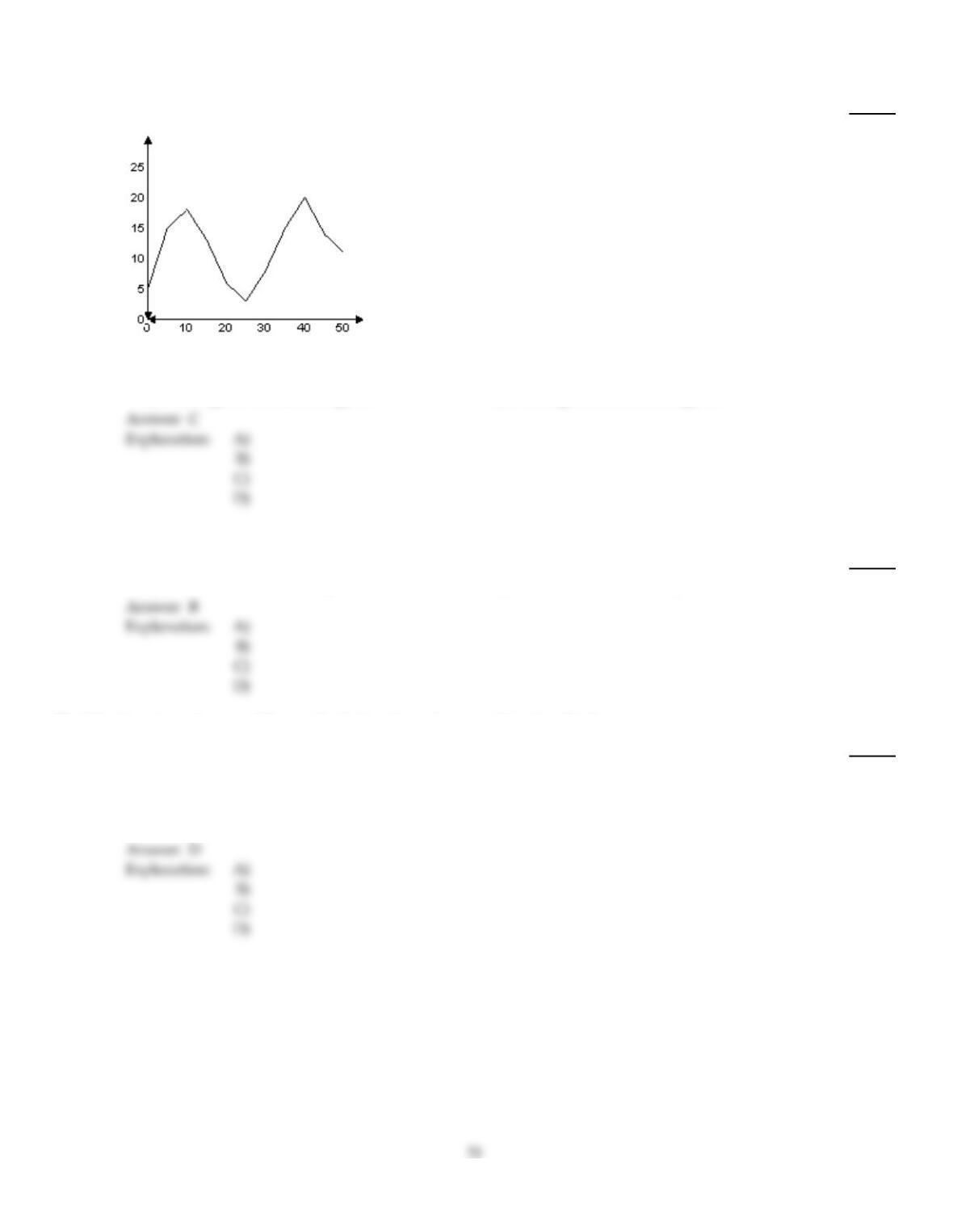
Suppose that a polynomial function is used to model the data shown in the graph below.
For what intervals is the function increasing?
117)
A)
10 through 25 and 40 through 50
B)
0 through 40
C)
0 through 10 and 25 through 40
D)
0 through 10 and 20 through 50
Write an equation that expresses the relationship. Use k as the constant of variation.
118)
r varies jointly as the square of s and the square of t.
118)
A)
r+s2+t2= k
B)
r= ks2t2
C)
rs2t2= k
D)
r= k +s2+t2
B
Find the domain and range of the quadratic function whose graph is described.
119)
The maximum is –6 at x = – 1
119)
A)
Domain: (–, –1]
Range: (–, –6]
B)
Domain: (–, )
Range: [–6, )
C)
Domain: (–, )
Range: (–, –1]
D)
Domain: (–, )
Range: (–, –6]
D
C
Solve the problem.
120)
The following table shows the number of fires in a county for the years 1994–1998, where 1
represents 1994, 2 represents 1995, and so on.
Year, x Fires, T
1994, 1 2720.68
1995, 2 2770.36
1996, 3 2831.3
1997, 4 2883.56
1998, 5 2947.2
This data can be approximated using the third–degree polynomial
T(x) = – 0.49x3+0.57x2+65.40x +2655.2.
Use this function to predict the number of fires in 2004. Round to the nearest whole number.
120)
A)
148
B)
2791
C)
2777
D)
2072
Find a rational zero of the polynomial function and use it to find all the zeros of the function.
121)
f(x) =x3+ 6x2+ 21x + 26
121)
A)
{–2, 3+2i, 3–2i}
B)
{–2, 3+5, 3–5}
C)
{–2, –2+3i, –2–3i}
D)
{2, –2+5, –4–5}
C
Solve the problem.
122)
The distance that an object falls when it is dropped is directly proportional to the square of the
amount of time since it was dropped. An object falls 88.2 meters in 3 seconds. Find the distance the
object falls in 5 seconds.
122)
A)
15 meters
B)
147 meters
C)
49 meters
D)
245 meters
D
Use synthetic division to show that the number given to the right of the equation is a solution of the equation, then solve
the polynomial equation.
123)
x3+ 6x2+ 5x – 12 = 0; –3
123)
A)
{1, 4, –3}
B)
{–1, 4, –3}
C)
{1, –4, –3}
D)
{–1, –4, –3}
C
52
B
Find the coordinates of the vertex for the parabola defined by the given quadratic function.
124)
f(x) = (x + 3)2+ 8
124)
A)
(–8, 3)
B)
(8, –9)
C)
(8, –3)
D)
(–3, 8)
Determine the constant of variation for the stated condition.
125)
z varies directly as x and inversely as y, and z=4 when x=52 and y=52.
125)
A)
k =13
B)
k =1
4
C)
k =1
D)
k =4
D
Find the horizontal asymptote, if any, of the graph of the rational function.
126)
f(x) =
–20x
5x3+x2+ 1
126)
A)
y = – 1
4
B)
y = – 4
C)
y = 0
D)
no horizontal asymptote
C
Find the indicated intercept(s) of the graph of the function.
127)
x–intercepts of f(x) =x2+ 3x
x2+ 3x – 9
127)
A)
(–3, 0)
B)
(0, 0) and (3, 0)
C)
(3, 0)
D)
(0, 0) and (–3, 0)
D
53
D
Divide using synthetic division.
128)
–2x3– 10x2– 5x + 12
x + 4
128)
A)
–2x2– 2x + 3
B)
2x2– 4x + 3
C)
–2x2 x –5
2+ 3
D)
–1
2x2–5
2x –5
4
Use the Leading Coefficient Test to determine the end behavior of the polynomial function.
129)
f(x) = – 6x3(x + 1)(x + 4)2
129)
A)
falls to the left and falls to the right
B)
rises to the left and falls to the right
C)
falls to the left and rises to the right
D)
rises to the left and rises to the right
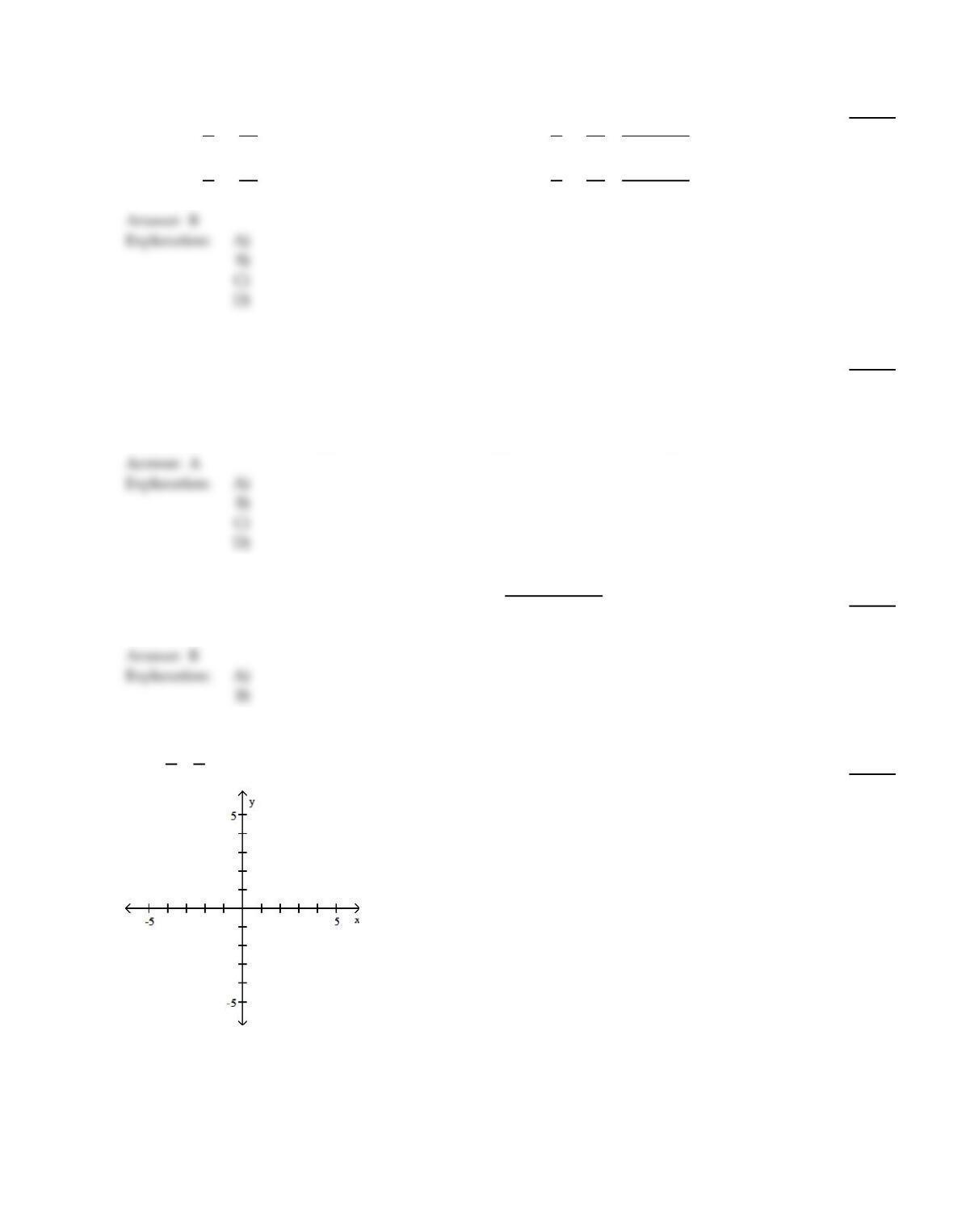
Solve the rational inequality and graph the solution set on a real number line. Express the solution set in interval
notation.
130)
x + 7
x + 8 <3
130)
A)
(–, –17
2) or (8, )
B)
(–8, –17
2)
C)
(–, –8) or (–17
2, )
D)
Divide using long division.
131)
(15x3–3) ÷ (5x – 1)
131)
A)
3x2–3
5x +3
25
B)
3x2+3
5x +3
25 –72
25(5x – 1)
C)
3x2+3
5x +3
25
D)
3x2+3
5x +3
25 +72
25(5x – 1)
Solve the problem.
132)
The pressure of a gas varies jointly as the amount of the gas (measured in moles) and the
temperature and inversely as the volume of the gas. If the pressure is 936 kPa (kiloPascals) when
the number of moles is 8, the temperature is 260° Kelvin, and the volume is 960 cc, find the
pressure when the number of moles is 10, the temperature is 270° K, and the volume is 600 cc.
132)
A)
1944
B)
1872
C)
1008
D)
972
133)
Is there y–axis symmetry for the rational function f(x) =
–8x2– 8x – 12
6x + 14 ?
133)
A)
Yes
B)
No
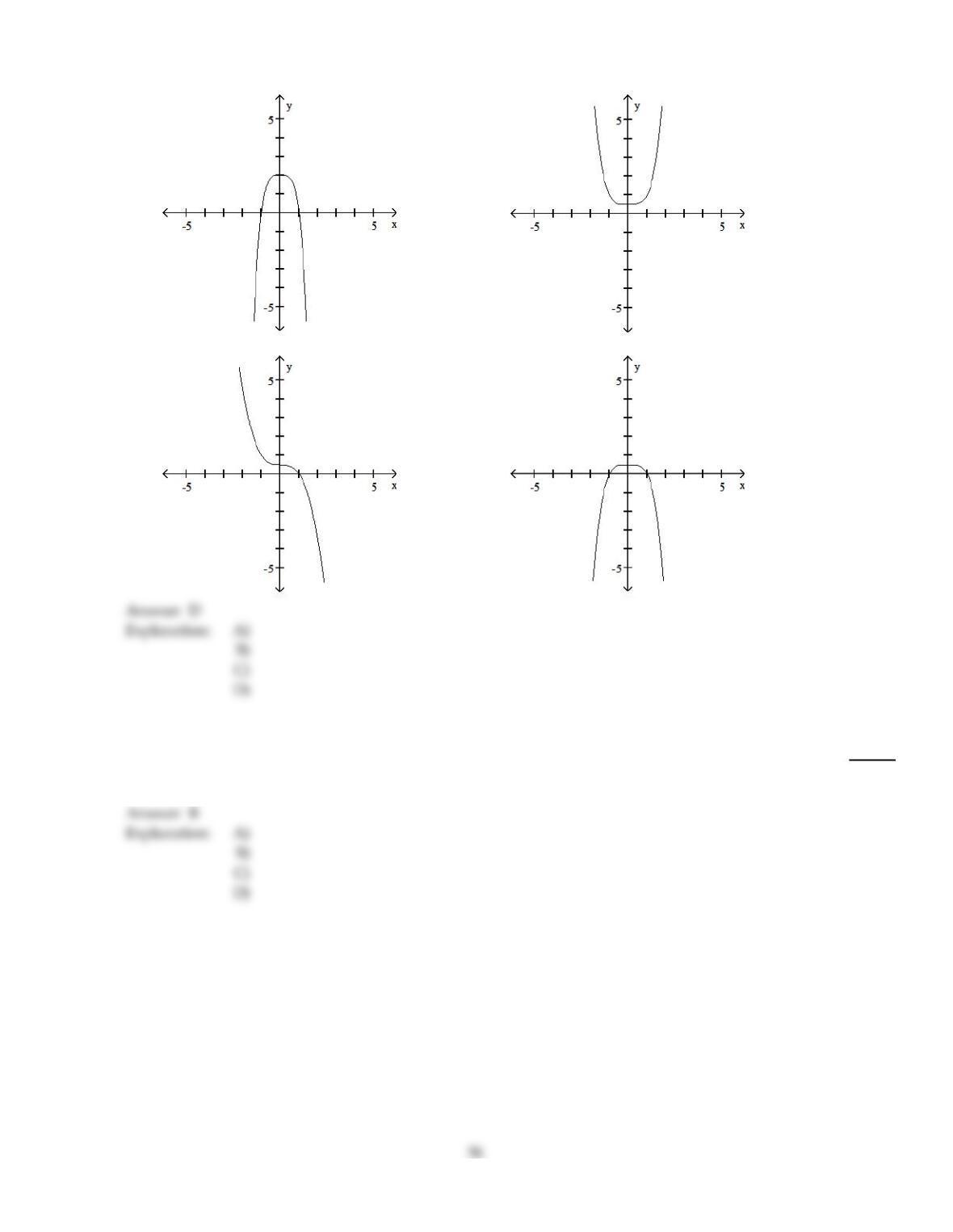
Graph the polynomial function.
134)
f(x) =1
2–1
2x4
134)
55
A)
B)
C)
D)
Solve the problem.
135)
Among all pairs of numbers whose difference is 36, find a pair whose product is as small as
possible.
135)
A)
–54 and –18
B)
–18 and 18
C)
18 and 18
D)
54 and 18
Find the x–intercepts of the polynomial function. State whether the graph crosses the x–axis, or touches the x–axis and
turns around, at each intercept.
136)
f(x) =x4–36x2
136)
A)
0, touches the x–axis and turns around;
36, touches the x–axis and turns around
B)
0, touches the x–axis and turns around;
6, crosses the x–axis;
–6, crosses the x–axis
C)
0, crosses the x–axis;
6, crosses the x–axis;
–6, crosses the x–axis
D)
0, touches the x–axis and turns around;
36, crosses the x–axis
Find the zeros for the polynomial function and give the multiplicity for each zero. State whether the graph crosses the
x–axis or touches the x–axis and turns around, at each zero.
137)
f(x) =x3+4x2– x –4
137)
A)
1, multiplicity 2, touches the x–axis and turns around;
–4, multiplicity 1, crosses the x–axis.
B)
–1, multiplicity 1, crosses the x–axis;
1, multiplicity 1, crosses the x–axis;
–4, multiplicity 1, crosses the x–axis.
C)
4, multiplicity 1, crosses the x–axis;
1, multiplicity 1, crosses the x–axis;
–4, multiplicity 1, crosses the x–axis.
D)
–1, multiplicity 1, touches the x–axis and turns around;
1, multiplicity 1, touches the x–axis and turns around;
–4, multiplicity 1, touches the x–axis and turns around
B
Write an equation that expresses the relationship. Use k as the constant of variation.
138)
s varies directly as the square of t.
138)
A)
s= k t
B)
s= kt2
C)
s=k
t2
D)
s=k
t
B
B
Use synthetic division and the Remainder Theorem to find the indicated function value.
139)
f(x) =2x3 – 7x2– 5x + 11; f(–3)
139)
A)
–91
B)
–121
C)
57
D)
–17
Solve the polynomial equation. In order to obtain the first root, use synthetic division to test the possible rational roots.
140)
x3+ 2x2– 9x – 18 = 0
140)
A)
{–3, 2, 3}
B)
{–3, –2, 3}
C)
{–2}
D)
{–3}
Divide using long division.
141)
(5x4– 32x3– 20x2– 13x + 42) ÷ (7– x)
141)
A)
–5x3– 3x2– x + 6
B)
–5x3– 3x2– x – 6 +84
7– x
C)
–5x3– 3x2– x – 6
D)
–5x3– 3x2+ x – 6
Solve the problem.
142)
If y varies directly as the square of x, and y =90 when x =2, find y when x =6.
142)
A)
30
B)
10
C)
810
D)
270
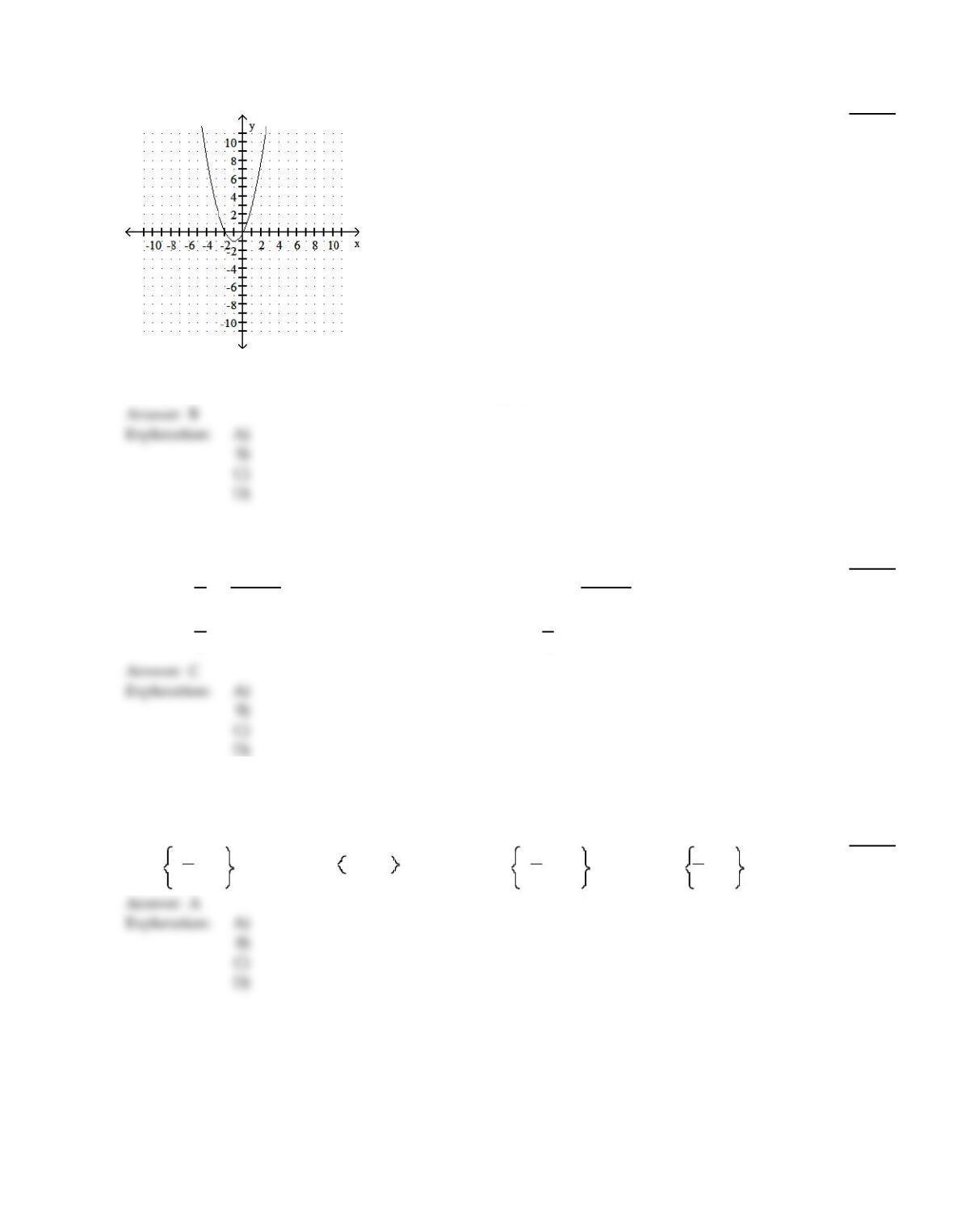
The graph of a quadratic function is given. Determine the function’s equation.
143)
143)
A)
h(x) =(x –1)2+1
B)
g(x) =(x +1)2–1
C)
j(x) =(x –1)2–1
D)
f(x) =(x +1)2+1
Divide using long division.
144)
(2x4–7x2+14x3–49x) ÷ (2x +14)
144)
A)
x3–7
2x –98x
2x +14
B)
x3–14x +4x
2x +14
C)
x3–7
2x
D)
x3+7
2x
Use synthetic division to show that the number given to the right of the equation is a solution of the equation, then solve
the polynomial equation.
145)
2x3– 13x2+ 17x + 12 = 0; 3
145)
A)
–1
2, 4, 3
B)
2, –1, 3
C)
–1
2, –4, 3
D)
1
2, 4, 3
59
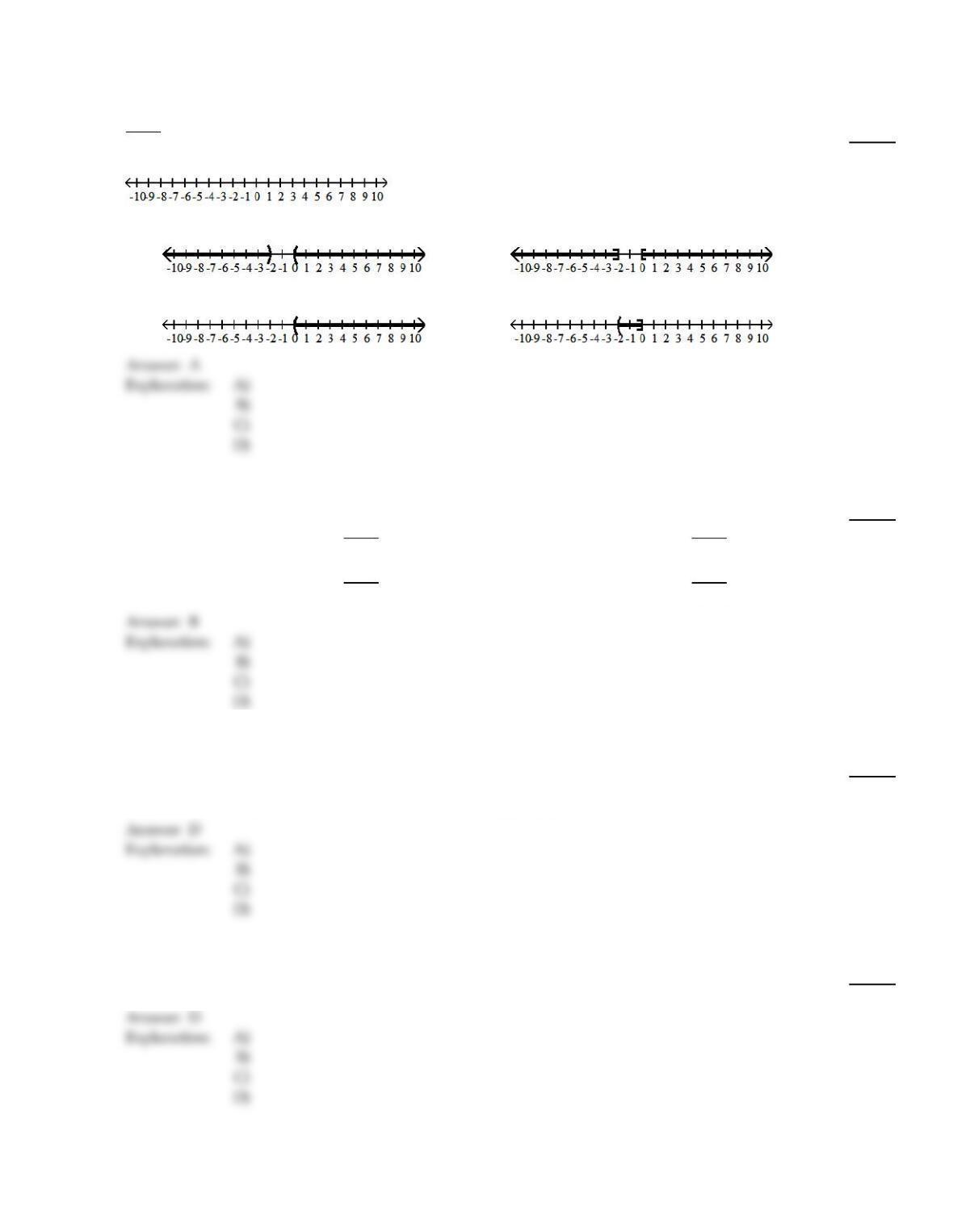
Solve the rational inequality and graph the solution set on a real number line. Express the solution set in interval
notation.
146)
x
x +2> 0
146)
A)
(–, –2) or (0, )
B)
(–, –2] or [0, )
C)
(0, )
D)
(–2, 0]
Divide using synthetic division.
147)
(5x5+ 12x4– 7x3+x2– x + 50) ÷ (x + 3)
147)
A)
5x4– 3x3+ 2x2– 5x – 15 +8
x + 3
B)
5x4– 3x3+ 2x2+ 5x + 14 +8
x + 3
C)
5x4– 3x3+ 2x2– 6x + 15 +14
x + 3
D)
5x4– 3x3+ 2x2– 6x – 15 +14
x + 3
Find the zeros of the polynomial function.
148)
f(x) =x3– 10x2+25x
148)
A)
x = 0, x = – 5
B)
x = 1, x =5
C)
x = 0, x = – 5, x =5
D)
x = 0, x =5
Find the range of the quadratic function.
149)
y +4=(x + 2)2
149)
A)
(–, 2]
B)
(–, 4]
C)
[4, )
D)
[– 4, )
60