Divide using long division.
85)
(2x4–7x2+14x3–49x) ÷ (2x +14)
85)
A)
x3+7
2x
B)
x3–14x +4x
2x +14
C)
x3–7
2x
D)
x3–7
2x –98x
2x +14
Find the x–intercepts of the polynomial function. State whether the graph crosses the x–axis, or touches the x–axis and
turns around, at each intercept.
86)
f(x) =x3+ 11x2+ 40x + 48
86)
A)
4, crosses the x–axis;
–4, crosses the x–axis;
–3, crosses the x–axis.
B)
4, crosses the x–axis;
–4, touches the x–axis and turns around;
–3, crosses the x–axis.
C)
–4, crosses the x–axis;
–3, touches the x–axis and turns around
D)
–4, touches the x–axis and turns around;
–3, crosses the x–axis.
Find the degree of the polynomial function.
87)
g(x) =10x4+ 2
87)
A)
0
B)
10
C)
4
D)
5
Use the Leading Coefficient Test to determine the end behavior of the polynomial function.
88)
f(x) = – x2(x – 3)(x + 2)
88)
A)
falls to the left and falls to the right
B)
rises to the left and falls to the right
C)
rises to the left and rises to the right
D)
falls to the left and rises to the right
41
Determine the constant of variation for the stated condition.
89)
g varies directly as f2, and g=45 when f=3.
89)
A)
k =42
B)
k =1
5
C)
k =45
D)
k =5
Find the vertical asymptotes, if any, of the graph of the rational function.
90)
x – 9
x2– 10x + 24
90)
A)
x = – 6, x = – 4
B)
x =6, x =4, x = – 9
C)
x = – 9
D)
x =6, x =4
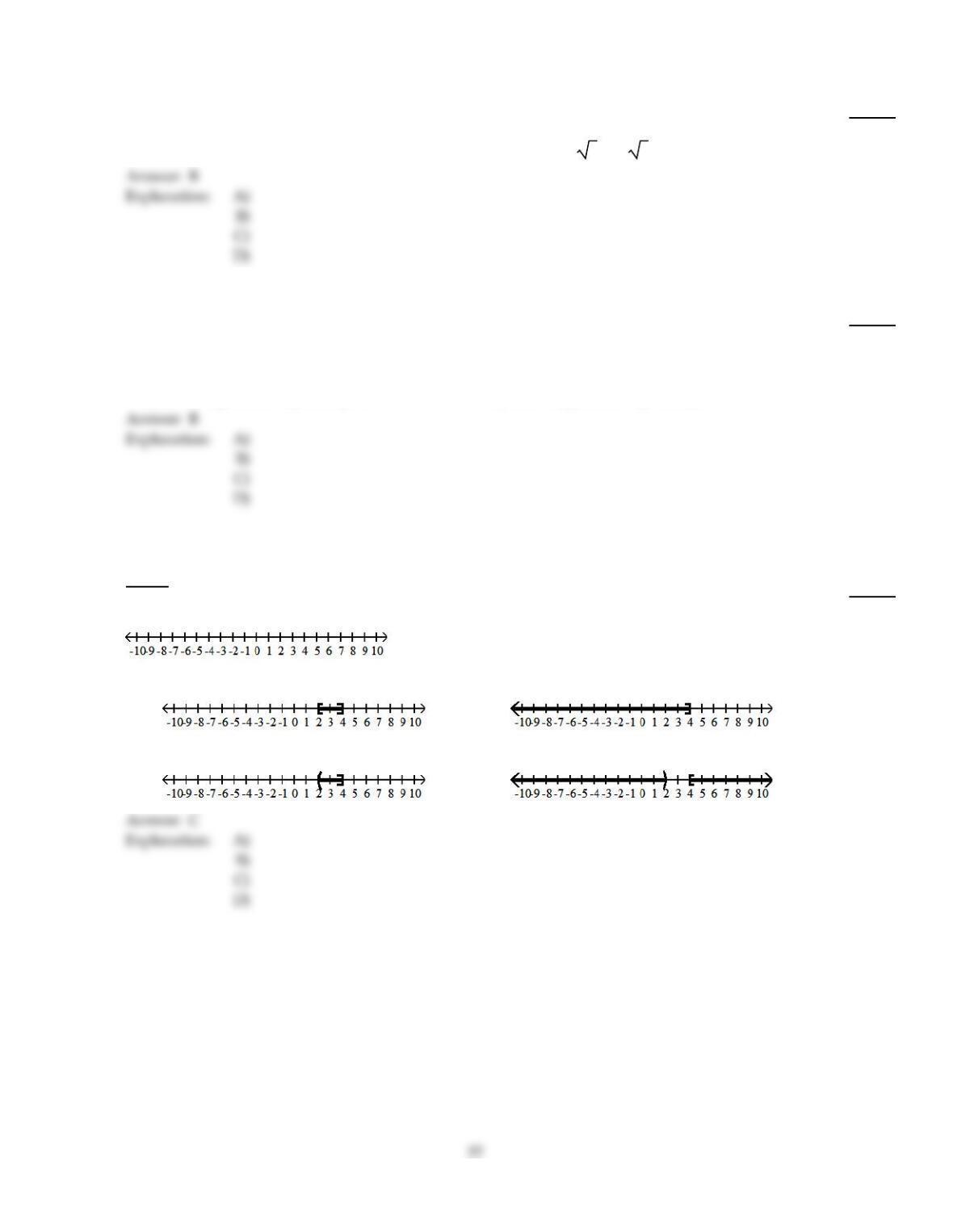
Solve the polynomial inequality and graph the solution set on a number line. Express the solution set in interval
notation.
91)
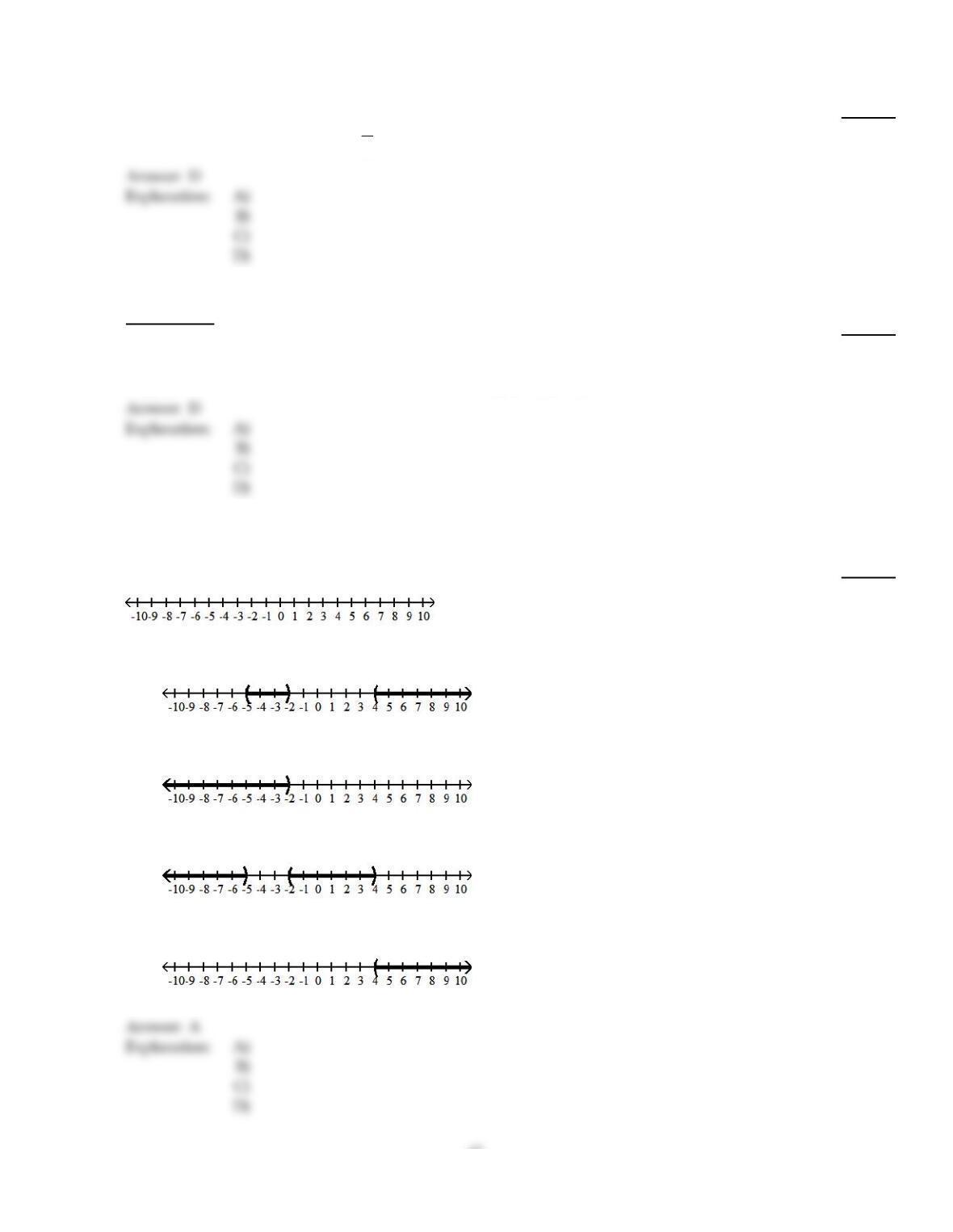
(x + 5)(x + 2)(x – 4) > 0
91)
A)
(–5, –2) (4, )
B)
(–, –2)
C)
(–, –5)
(–2, 4)
D)
(4, )
42
Determine the maximum possible number of turning points for the graph of the function.
92)
f(x) =x7+3x8
92)
A)
3
B)
1
C)
7
D)
8
Find the range of the quadratic function.
93)
f(x) = – 7(x –2)2–9
93)
A)
[–2, )
B)
[–9, )
C)
(–, –9]
D)
(–, 2]
Divide using long division.
94)
(5x4– 32x3– 20x2– 13x + 42) ÷ (7– x)
94)
A)
–5x3– 3x2+ x – 6
B)
–5x3– 3x2– x – 6 +84
7– x
C)
–5x3– 3x2– x + 6
D)
–5x3– 3x2– x – 6
Find the zeros for the polynomial function and give the multiplicity for each zero. State whether the graph crosses the
x–axis or touches the x–axis and turns around, at each zero.
95)
f(x) =5(x2+ 2)(x + 1)2
95)
A)
–2, multiplicity 1, crosses the x–axis; –1, multiplicity 2, crosses the x–axis
B)
–1, multiplicity 2, touches the x–axis and turns around
C)
–1, multiplicity 2, crosses the x–axis
D)
–2, multiplicity 1, crosses the x–axis; –1, multiplicity 2, touches the x–axis and turns around.
Use transformations of f(x) =1
x or f(x) =1
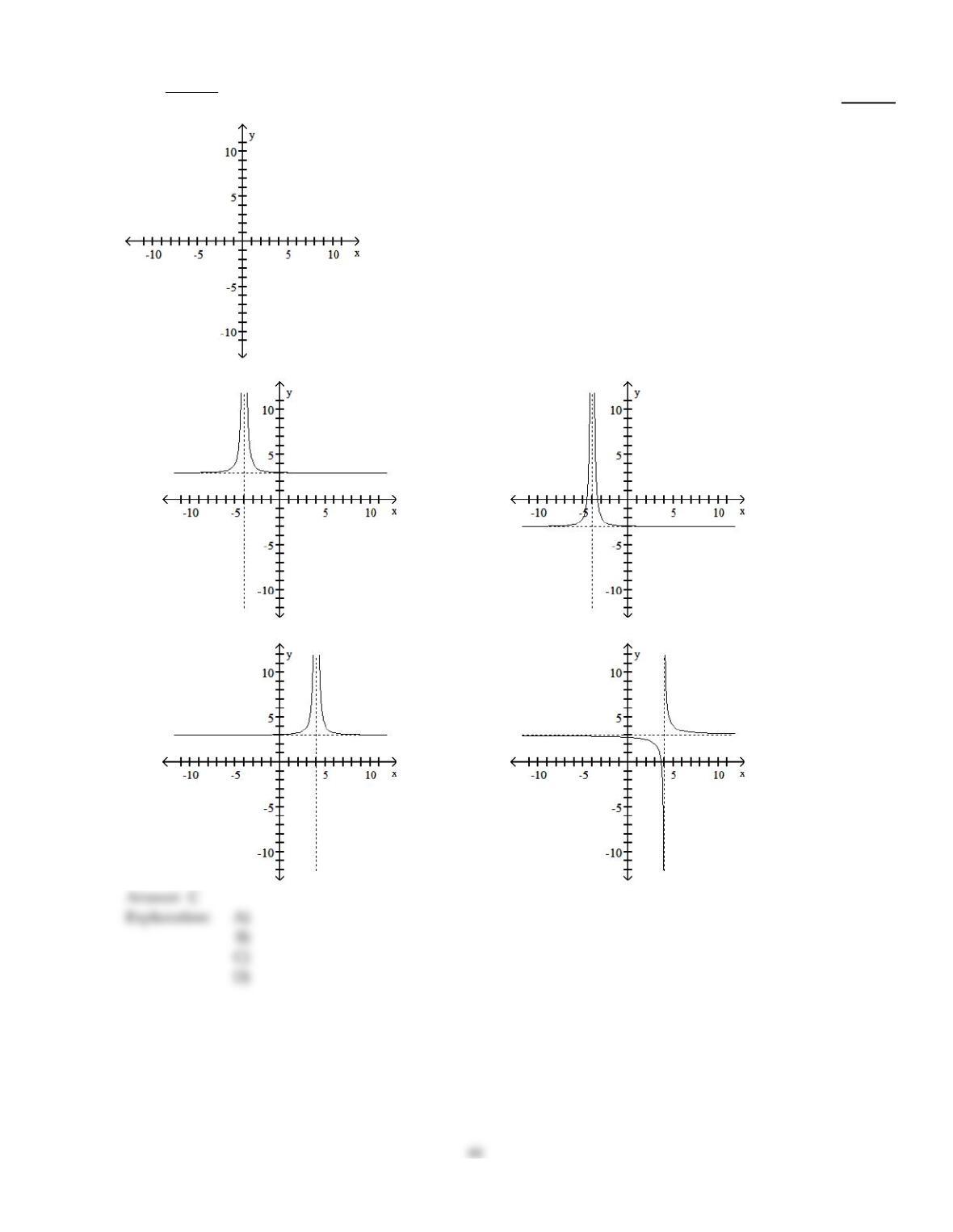
x2 to graph the rational function.
43
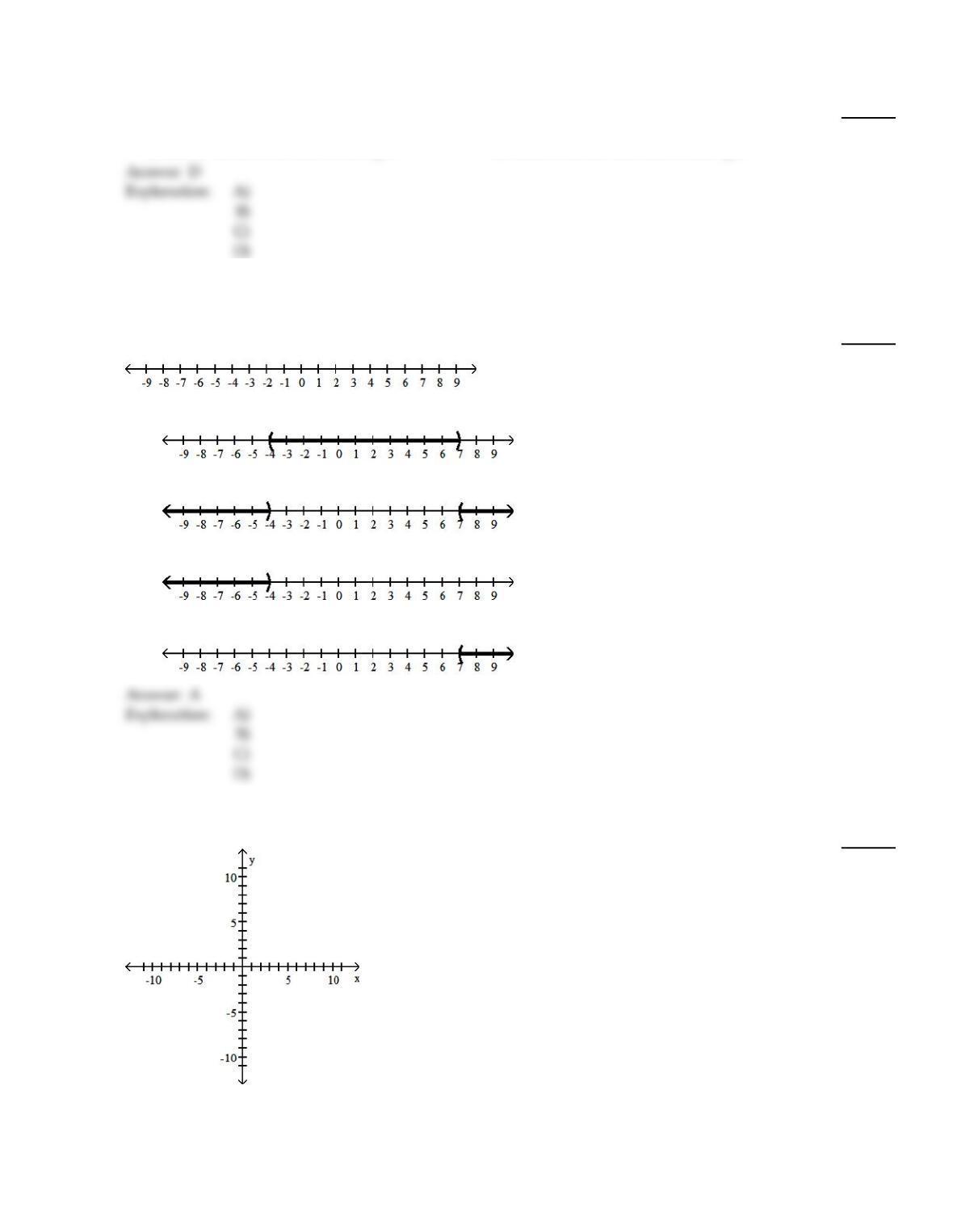
96)
f(x) =1
(x – 4)2+3
96)
A)
B)
C)
D)
Use the Leading Coefficient Test to determine the end behavior of the polynomial function.
97)
f(x) =4x3+ 5x3–x5
97)
A)
rises to the left and rises to the right
B)
falls to the left and rises to the right
C)
falls to the left and falls to the right
D)
rises to the left and falls to the right
Solve the polynomial inequality and graph the solution set on a number line. Express the solution set in interval
notation.
98)
x2– 3x – 28 < 0
98)
A)
(–4, 7)
B)
(–, –4)
(7, )
C)
(–, –4)
D)
(7, )
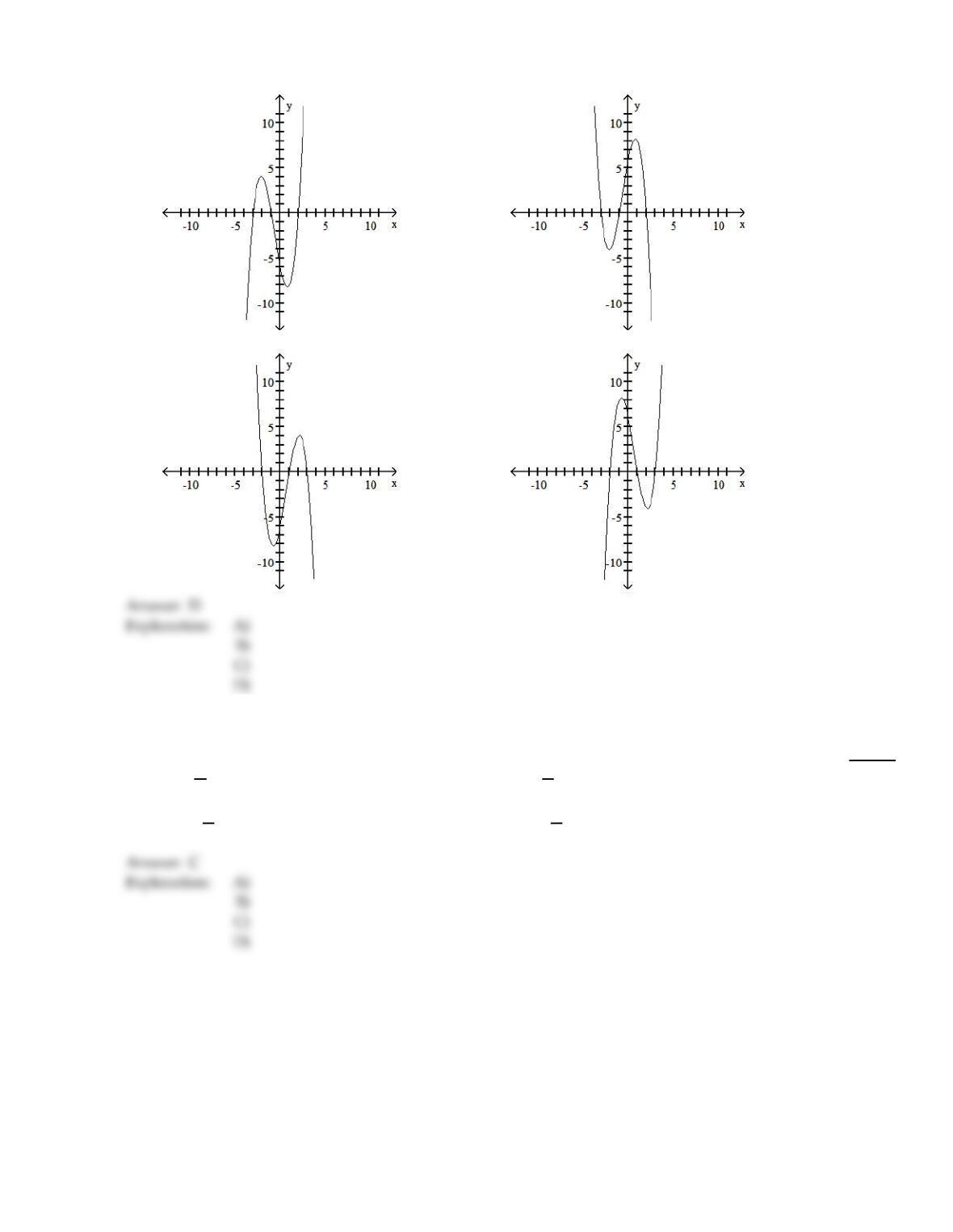
Graph the polynomial function.
99)
f(x) =x3– 2x2– 5x + 6
99)
45
A)
B)
C)
D)
Find a rational zero of the polynomial function and use it to find all the zeros of the function.
100)
f(x) =3x4+ 29x3+ 111x2+ 179x + 78
100)
A)
{3, +2
3, –2+ 3i, –2– 3i}
B)
{3, –2
3, –3+ 2i, –3–2i}
C)
{–3, –2
3, –3+ 2i, –3– 2i}
D)
{–3, +2
3, –2+ 3i, –2– 3i}
46
101)
f(x) =x3+ 6x2+ 21x + 26
101)
A)
{2, –2+5, –4–5}
B)
{–2, 3+2i, 3–2i}
C)
{–2, –2+3i, –2–3i}
D)
{–2, 3+5, 3–5}
Determine whether the function is a polynomial function.
102)
f(x) =2–x5
3
102)
A)
Yes
B)
No
A
Find the axis of symmetry of the parabola defined by the given quadratic function.
103)
f(x) =8– (x + 2)2
103)
A)
x =8
B)
x =2
C)
x = – 8
D)
x = – 2
D
Find the horizontal asymptote, if any, of the graph of the rational function.
104)
f(x) =–20x
5x3+x2+ 1
104)
A)
y = – 1
4
B)
y = 0
C)
y = – 4
D)
no horizontal asymptote
B
Solve the polynomial equation. In order to obtain the first root, use synthetic division to test the possible rational roots.
105)
x3+ 6x2– 14x + 16 = 0
105)
A)
{1 + i, 1 – i, –8}
B)
{–8, 8}
C)
{1 + i, 1 – i, 8}
D)
{1 + i, 1 – i, 8i}
A
47
C
Find a rational zero of the polynomial function and use it to find all the zeros of the function.
106)
f(x) =3x3– 17x2+ 18x + 8
106)
A)
–1
3, 2, 4
B)
–4
3, –1, –2
C)
1
3, 2, –4
D)
4
3, –1, 2
Use Descartes’s Rule of Signs to determine the possible number of positive and negative real zeros for the given function.
107)
f(x) =x5–2.1x4–14.44x3+ 3x2+41.67x –15.216
107)
A)
2 or 0 positive zeros, 3 or 1 negative zeros
B)
3 or 1 positive zeros, 3 or 1 negative zeros
C)
2 or 0 positive zeros, 2 or 0 negative zeros
D)
3 or 1 positive zeros, 2 or 0 negative zeros
Determine whether the given quadratic function has a minimum value or maximum value. Then find the coordinates of
the minimum or maximum point.
108)
f(x) = – 2x2+ 6x
108)
A)
minimum; –3
2, –9
2
B)
minimum; 3
2, 9
2
C)
maximum; –3
2, –9
2
D)
maximum; 3
2, 9
2
If y varies inversely as x, find the inverse variation equation for the situation.
109)
y =9 when x =2
109)
A)
y =9
2x
B)
y =18
x
C)
y =x
18
D)
y =1
18x
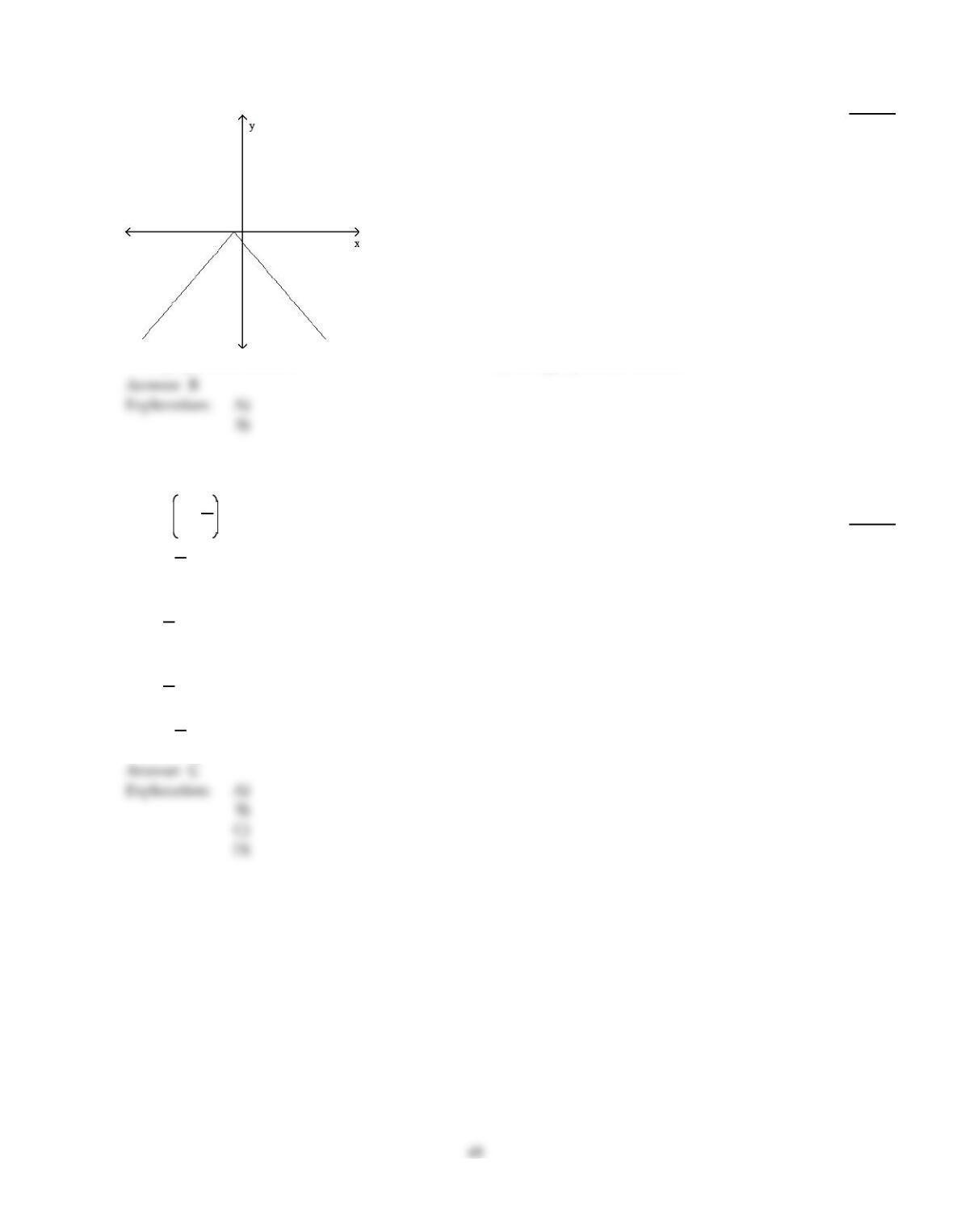
Determine whether the graph shown is the graph of a polynomial function.
110)
110)
A)
polynomial function
B)
not a polynomial function
Find the zeros for the polynomial function and give the multiplicity for each zero. State whether the graph crosses the
x–axis or touches the x–axis and turns around, at each zero.
111)
f(x) =2x –5
2(x – 4)3
111)
A)
–5
2, multiplicity 1, touches the x–axis and turns around; –4, multiplicity 3, touches x–axis
and turns around
B)
5
2, multiplicity 1, touches the x–axis and turns around; 4, multiplicity 3, touches x–axis and
turns around
C)
5
2, multiplicity 1, crosses x–axis; 4, multiplicity 3, crosses x–axis
D)
–5
2, multiplicity 1, crosses x–axis; –4, multiplicity 3, crosses x–axis
Use the Rational Zero Theorem to list all possible rational zeros for the given function.
112)
f(x) = 6x4+3x3–4x2+3x – 5
112)
A)
± 1, ± 5, ±1
5, ±2
5, ±3
5, ±6
5
B)
± 1, ± 2, ± 3, ± 6, ±1
2, ±5
2, ±1
3, ±5
3, ±1
6, ±5
6
C)
± 1, ± 2, ± 3, ± 6, ±1
5, ±2
5, ±3
5, ±6
5
D)
± 1, ± 5, ±1
2, ±5
2, ±1
3, ±5
3, ±1
6, ±5
6
Solve.
113)
The amount of time it takes a swimmer to swim a race is inversely proportional to the average
speed of the swimmer. A swimmer finishes a race in 30 seconds with an average speed of 5 feet per
second. Find the average speed of the swimmer if it takes 50 seconds to finish the race.
113)
A)
2 feet per second
B)
5 feet per second
C)
3 feet per second
D)
4 feet per second
Find the y–intercept for the graph of the quadratic function.
114)
y +9=(x + 3)2
114)
A)
(9, 0)
B)
(0, 6)
C)
(0, –6)
D)
(0, 0)
Write an equation that expresses the relationship. Use k for the constant of proportionality.
115)
x varies directly as y and inversely as the square of z.
115)
A)
x=ky
z2
B)
x=kz2
y
C)
x+y–z2= k
D)
xyz2= k
Divide using long division.
116)
(15x3+x2– 30x – 2) ÷ (5x2–10)
116)
A)
3x +1
5
B)
3x +–2
5x2–10
C)
3x +2
5x2–10
D)
3x +5
Find the domain of the rational function.
117)
f(x) =9x
(x + 5)(x + 3)
117)
A)
{x|x–5, x –3, x –9}
B)
{x|x–5, x –3}
C)
{x|x5, x 3}
D)
all real numbers
Find the x–intercepts (if any) for the graph of the quadratic function.
118)
5x2+ 12x + 3 = 0
Give your answers in exact form.
118)
A)
–6±51
5, 0
B)
–12 ±21
5, 0
C)
–6±21
5, 0
D)
–6±21
10 , 0
Find the indicated intercept(s) of the graph of the function.
119)
y–intercept of f(x) =x2– 2x
x2+ 6x – 7
119)
A)
(0, 2)
B)
0, –7
2
C)
0, 2
7
D)
(0, 0)
Graph the function.
51
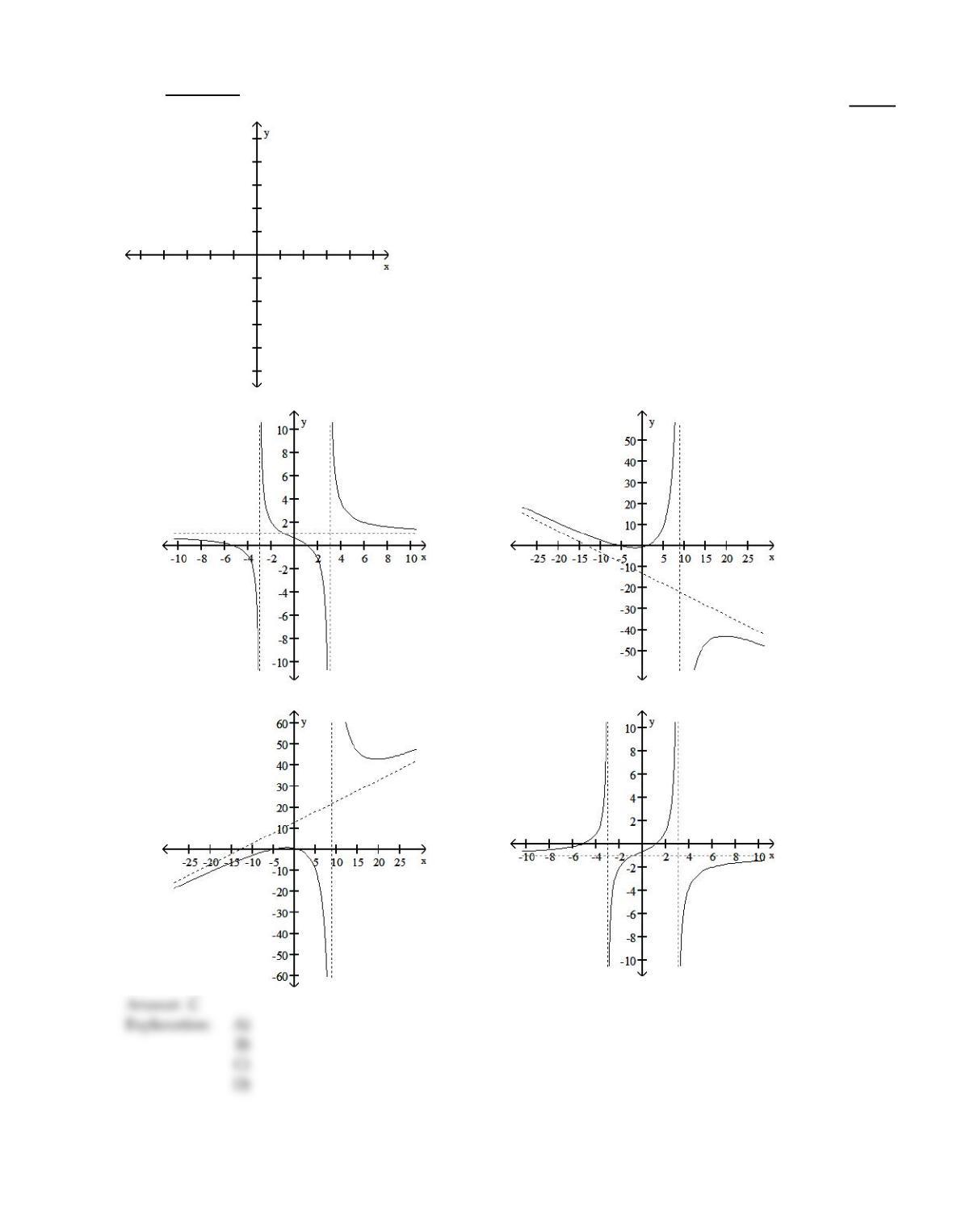
120)
f(x) =x2+ 4x – 6
x – 9
120)
A)
B)
C)
D)
52
Write an equation that expresses the relationship. Use k as the constant of variation.
121)
g varies directly as v.
121)
A)
k =gv
B)
g= kv
C)
v=k
g
D)
g=k
v
Find the vertical asymptotes, if any, of the graph of the rational function.
122)
h(x) =x
x(x + 1)
122)
A)
x = – 1
B)
x = 0 and x =1
C)
x = 0 and x = – 1
D)
no vertical asymptote
A
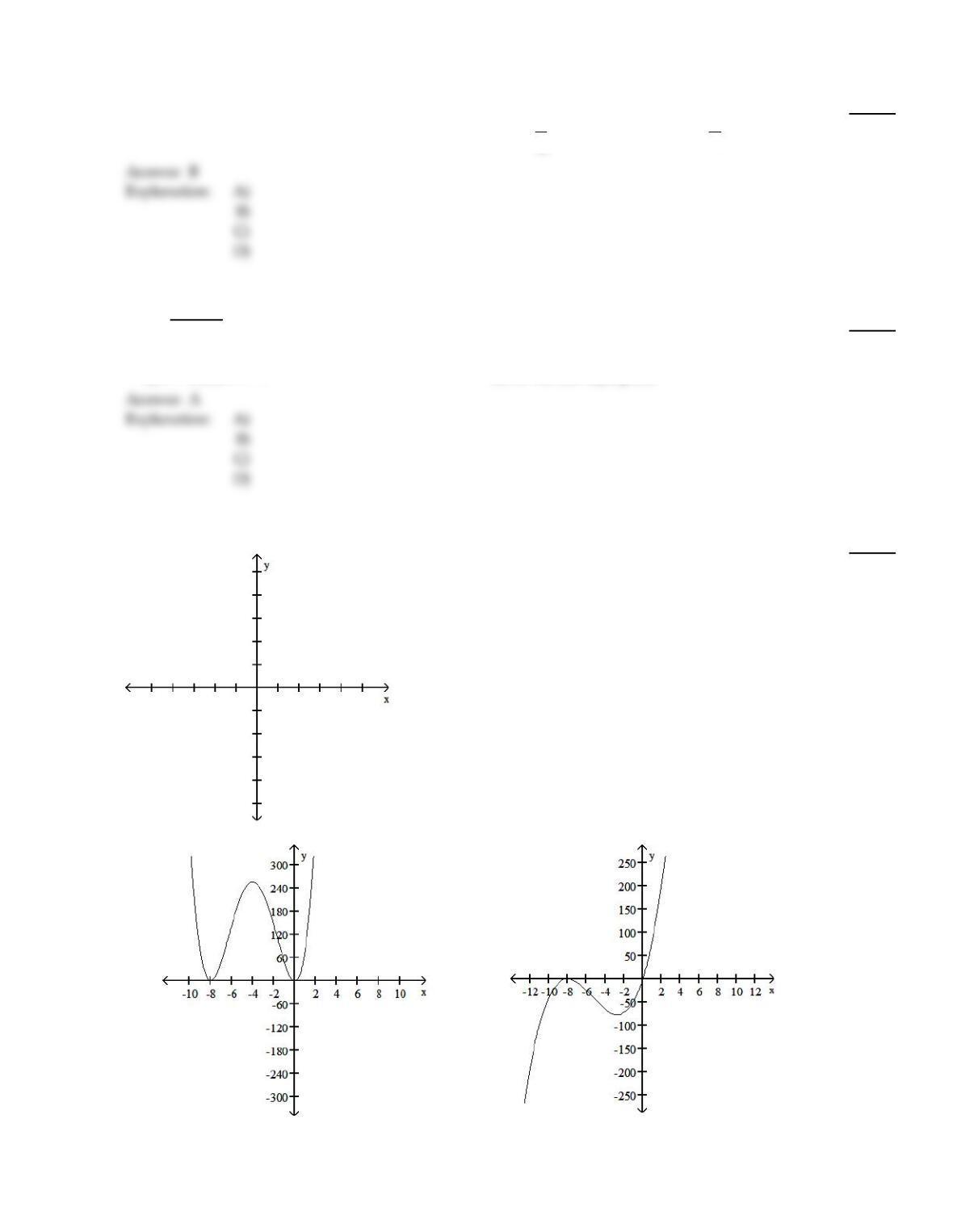
Graph the polynomial function.
123)
f(x) = x4+ 16x3+ 64x2
123)
A)
B)
53
B
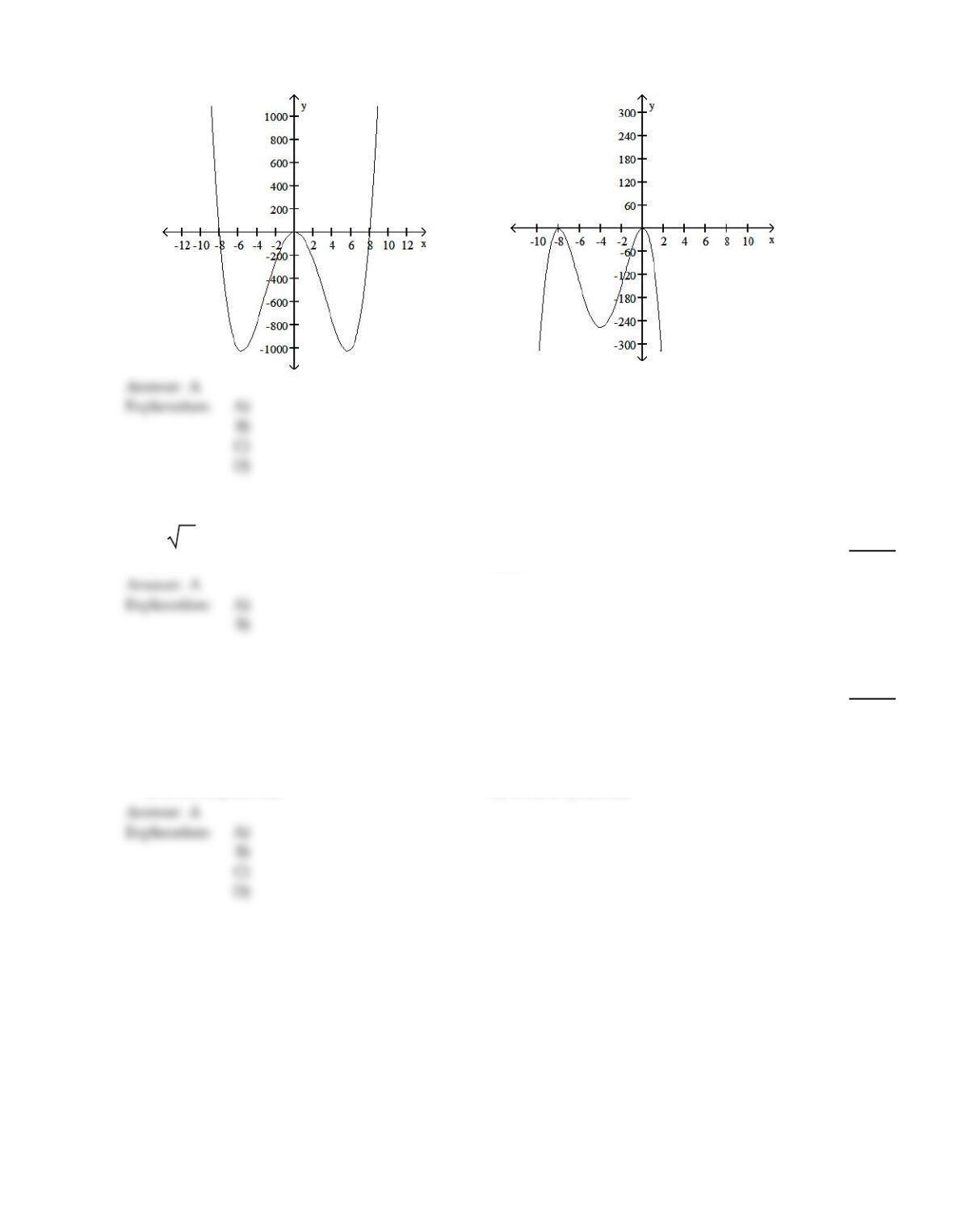
C)
D)
Determine whether the function is a polynomial function.
124)
f(x) =
4x5–x6– 8
124)
A)
No
B)
Yes
Solve the problem.
125)
In one U.S. city, the quadratic function f(x) =0.0042x2–0.46x +36.44 models the median, or
average, age, y, at which men were first married x years after 1900. In which year was this average
age at a minimum? (Round to the nearest year.) What was the average age at first marriage for that
year? (Round to the nearest tenth.)
125)
A)
1955, 23.8 years old
B)
1955, 49 years old
C)
1953, 36 years old
D)
1936, 49 years old
54
Solve.
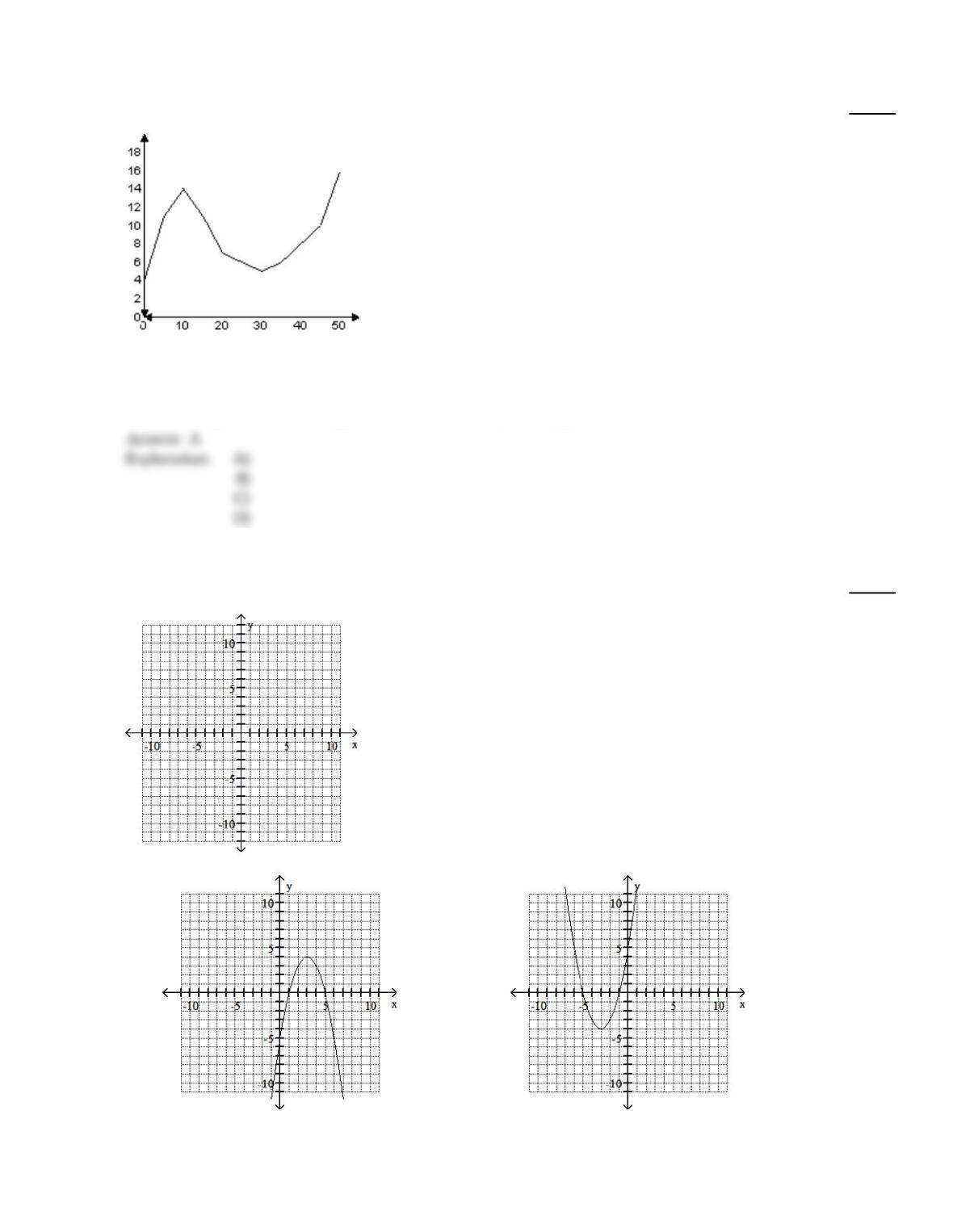
126)
Suppose that a polynomial function is used to model the data shown in the graph below.
For what intervals is the function decreasing?
126)
A)
10 through 30
B)
10 through 20 and 30 through 50
C)
0 through 10 and 30 through 50
D)
0 through 30
Use the vertex and intercepts to sketch the graph of the quadratic function.
127)
f(x) =x2– 6x + 5
127)
A)
B)
55
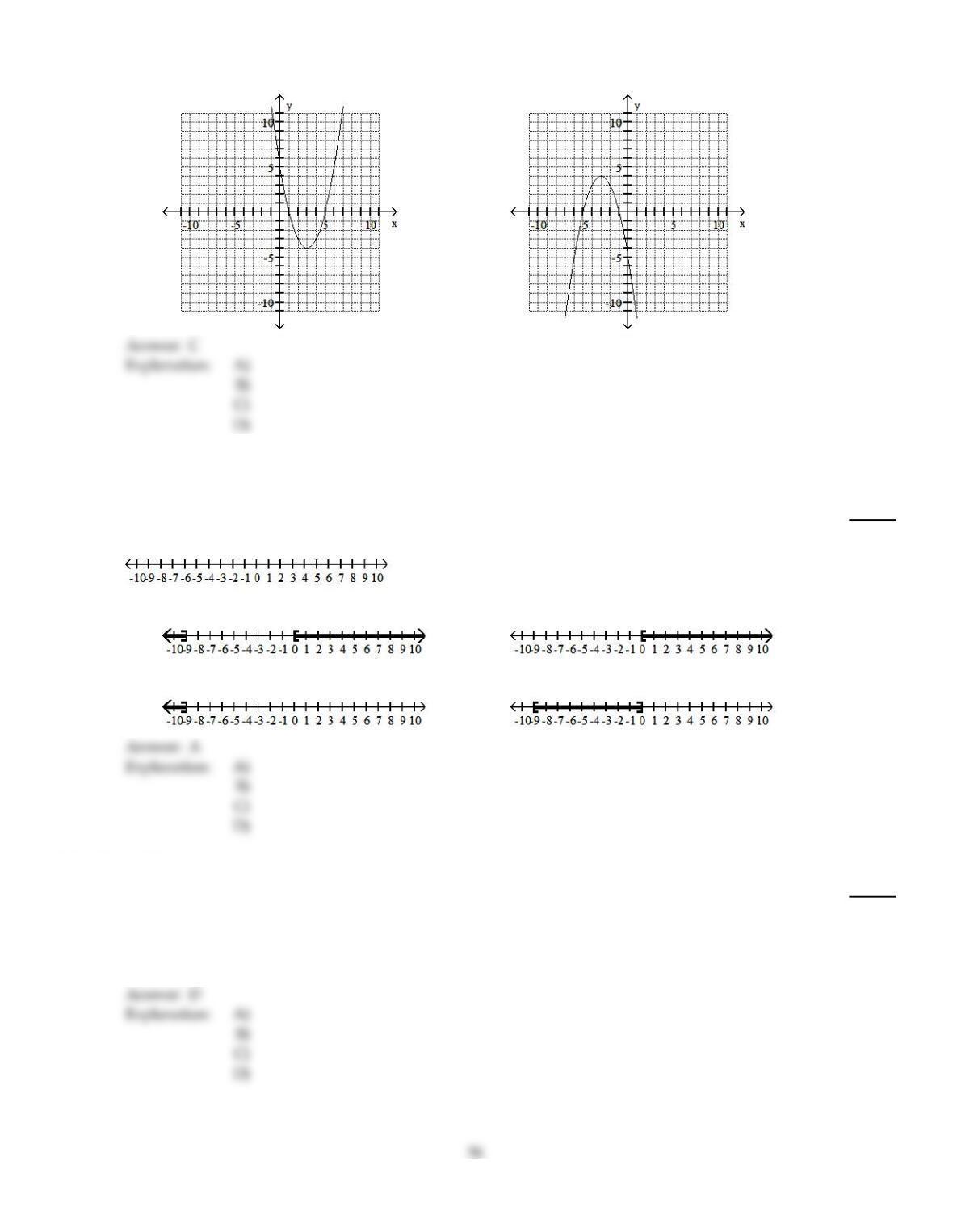
C)
D)
Solve the polynomial inequality and graph the solution set on a number line. Express the solution set in interval
notation.
128)
x2+9x
0
128)
A)
(–, –9]
[0, ]
B)
[0, ]
C)
(–, –9]
D)
[–9, 0]
Solve the problem.
129)
An arrow is fired straight up from the ground with an initial velocity of 128 feet per second. Its
height, s(t), in feet at any time t is given by the function s(t) = – 16t2+128t. Find the interval of time
for which the height of the arrow is greater than 112 feet.
129)
A)
after 1 sec
B)
before 7 sec
C)
before 1 sec or after 7 sec
D)
between 1 and 7 sec
Solve the polynomial equation. In order to obtain the first root, use synthetic division to test the possible rational roots.
130)
x4– 3x3+ 2x2+ 16x – 16 = 0
130)
A)
{2, –1, 2+2i, 2–2i}
B)
{–2, 1, 2+2i, 2–2i}
C)
{–2, 1, 2+3i, 2–3i}
D)
{2, –1, 2+2, 2–2}
Write an equation that expresses the relationship. Use k as the constant of variation.
131)
The weight of a body above the surface of the earth is inversely proportional to the square of its
distance from the center of the earth. What is the effect on the weight when the distance is
multiplied by 5?
131)
A)
The weight is divided by 5
B)
The weight is divided by 25
C)
The weight is multiplied by 25
D)
The weight is multiplied by 5
B
Solve the rational inequality and graph the solution set on a real number line. Express the solution set in interval
notation.
132)
–x +4
x –2
0
132)
A)
[2, 4]
B)
(–, 4]
C)
(2, 4]
D)
(–, 2) or [4, )
C
B
Use synthetic division and the Remainder Theorem to find the indicated function value.
133)
f(x) =x4+ 8x3– 2x2+ 4x – 5; f –1
4
133)
A)
–1599
256
B)
1599
256
C)
1599
1024
D)
–25
4
Solve the problem.
134)
You have 240 feet of fencing to enclose a rectangular region. What is the maximum area?
134)
A)
14,400 square feet
B)
3596 square feet
C)
57,600 square feet
D)
3600 square feet
Find an nth degree polynomial function with real coefficients satisfying the given conditions.
135)
n = 4; 3, 1
2, and 3+ 2i are zeros; f(1) =32
135)
A)
f(x) =2x4– 19x3+ 71x2+ 218x – 78
B)
f(x) = – 6x4+ 57x3– 213x2+ 327x – 117
C)
f(x) = – 2x4+ 38x3– 142x2+ 218x – 78
D)
f(x) = – 4x4+ 38x3– 142x2+ 218x – 78
Find the slant asymptote, if any, of the graph of the rational function.
136)
f(x) =8x2
4x2+ 6
136)
A)
y = x +2
B)
y = x + 8
C)
y =8x
D)
no slant asymptote
58
Determine whether the graph of the polynomial has y–axis symmetry, origin symmetry, or neither.
137)
f(x) =3–x4
137)
A)
origin symmetry
B)
y–axis symmetry
C)
neither
Solve the problem.
138)
f varies jointly as q2 and h, and f = – 54 when q =3 and h =3. Find f when q =2 and h =5.
138)
A)
f = – 10
B)
f = – 40
C)
f = – 8
D)
f = – 20
If y varies directly as x, find the direct variation equation for the situation.
139)
y =0.5 when x =4
139)
A)
y = x – 3.5
B)
y =0.5x
C)
y =8x
D)
y =0.125x
Find the y–intercept for the graph of the quadratic function.
140)
f(x) =(x + 1)2–1
140)
A)
(0, 1)
B)
(0, –1)
C)
(0, 0)
D)
(0, 2)
Find an nth degree polynomial function with real coefficients satisfying the given conditions.
141)
n = 3; – 5 and i are zeros; f(–3) = 60
141)
A)
f(x) = – 3x3– 15x2– 3x – 15
B)
f(x) = – 3x3– 15x2+ 3x + 15
C)
f(x) =3x3+ 15x2+ 3x + 15
D)
f(x) =3x3+ 15x2– 3x – 15
Graph the polynomial function.
59
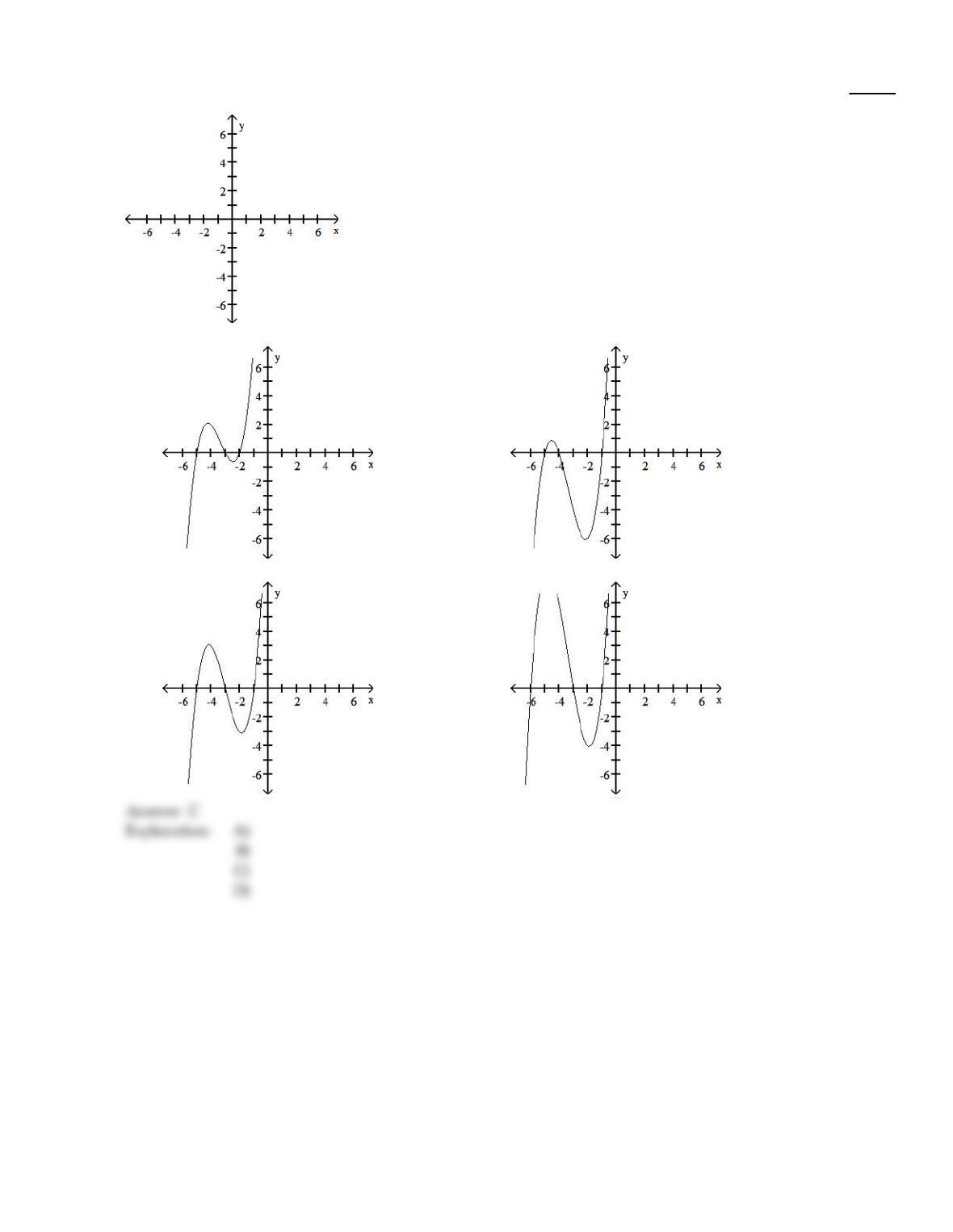
142)
f(x) = (x + 1)(x + 3)(x + 5)
142)
A)
B)
C)
D)
60