39
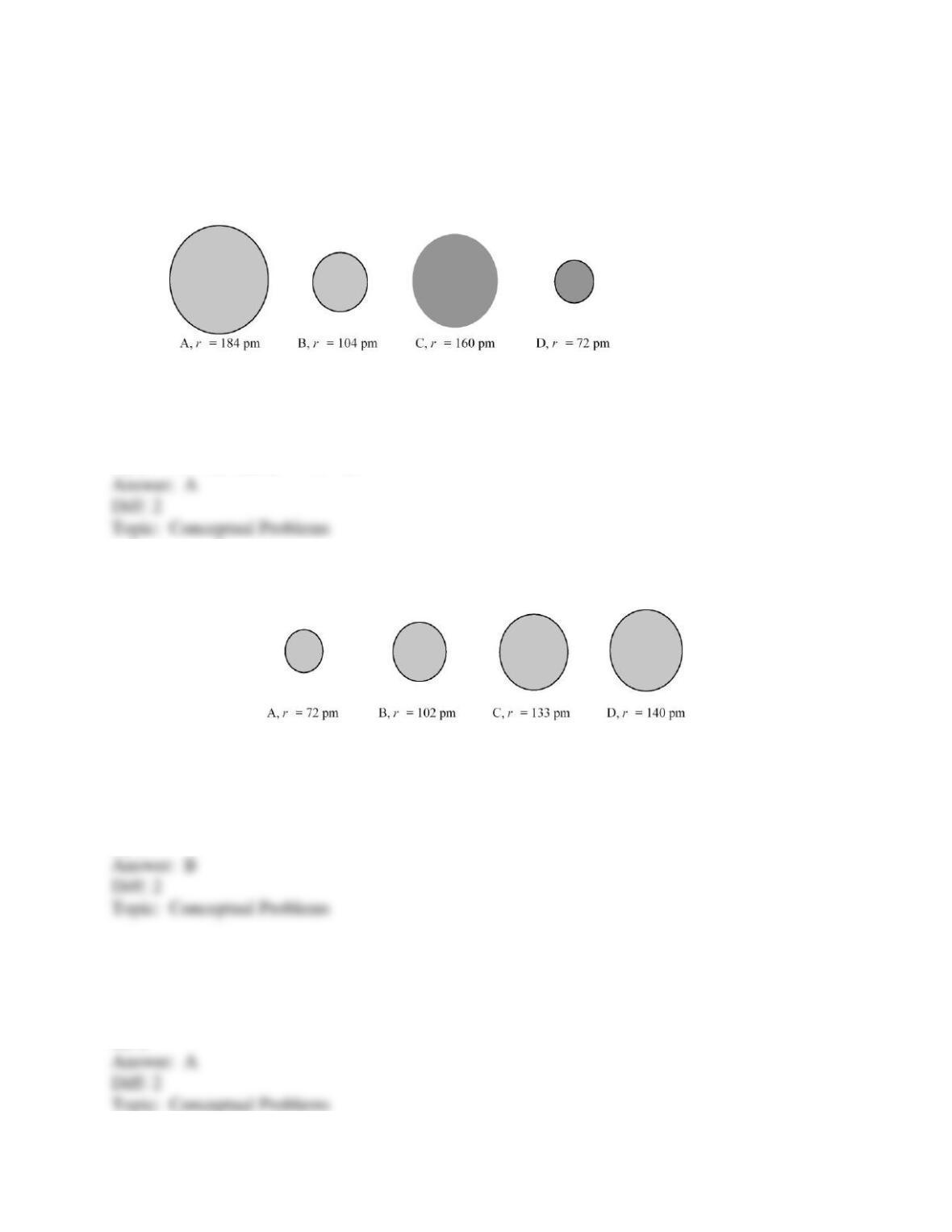
145) The following four spheres represent an Mg atom, an Mg2+ ion, a S atom, and a S2- ion,
not necessarily in that order. Use your knowledge about the relative sizes of atoms, cations, and
anions to determine which of the following sets of reactions is most consistent with the sizes of
the atoms and ions shown below.
A) A → B + 2e⁻ and C → D + 2e⁻
B) A → B + 2e⁻ and D → C + 2e⁻
C) B → A + 2e⁻ and C → D + 2e⁻
D) B → A + 2e⁻ and D → C + 2e⁻
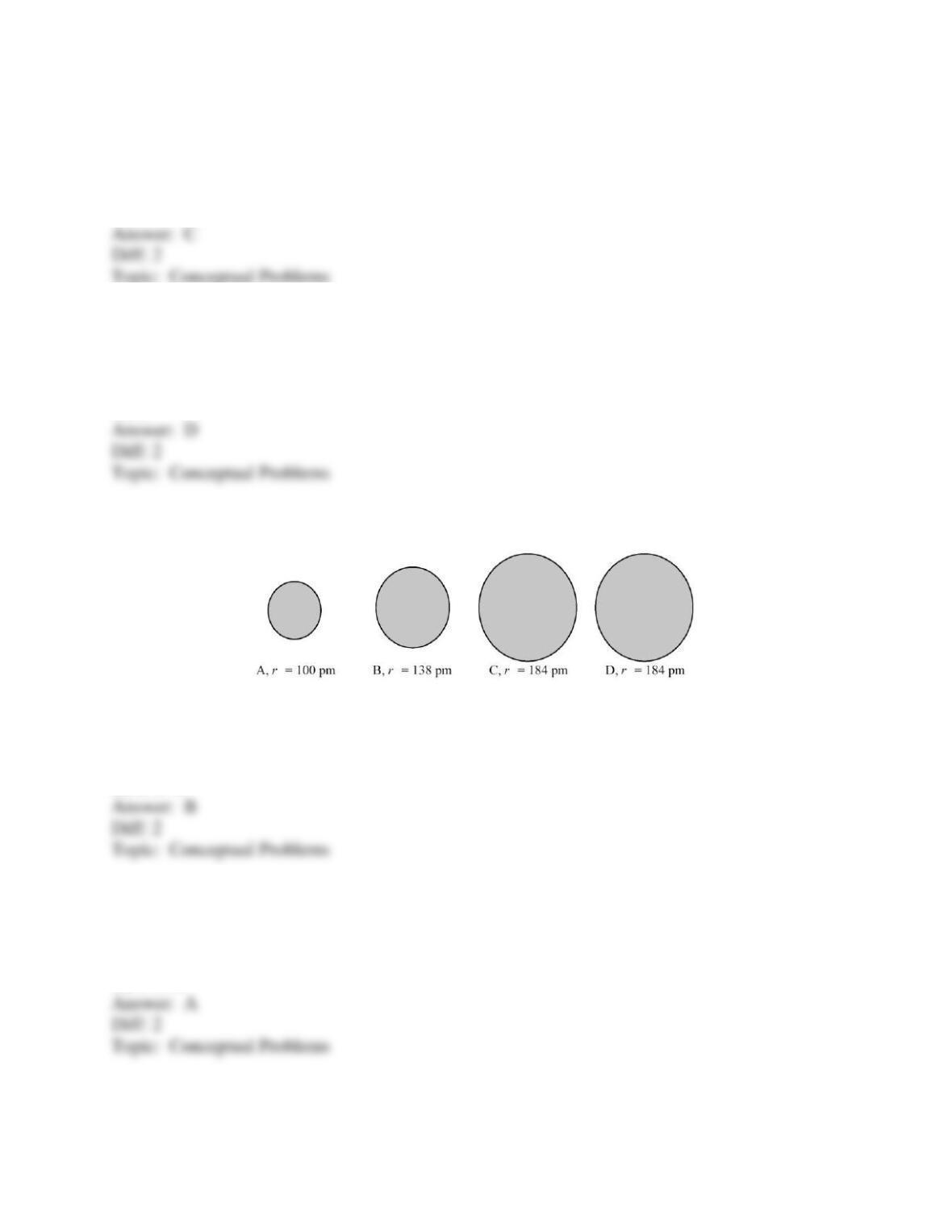
The four spheres below represent Na+, Mg2+, F⁻, and O2-, not necessarily in that order.
146) Which sphere most likely represents the Na⁺ ion?
A) A
B) B
C) C
D) D
147) Which sphere most likely represents the Mg2+ ion?
A) A
B) B
C) C
D) D
40
148) Which sphere most likely represents the F– ion?
A) A
B) B
C) C
D) D
149) Which sphere most likely represents the O2- ion?
A) A
B) B
C) C
D) D
The four spheres below represent K+, Ca2+, Cl–, and S2-, not necessarily in that order.
150) Which sphere most likely represents the K+ ion?
A) A
B) B
C) A or B
D) C or D
151) Which sphere most likely represents the Ca2+ ion?
A) A
B) B
C) A or B
D) C or D
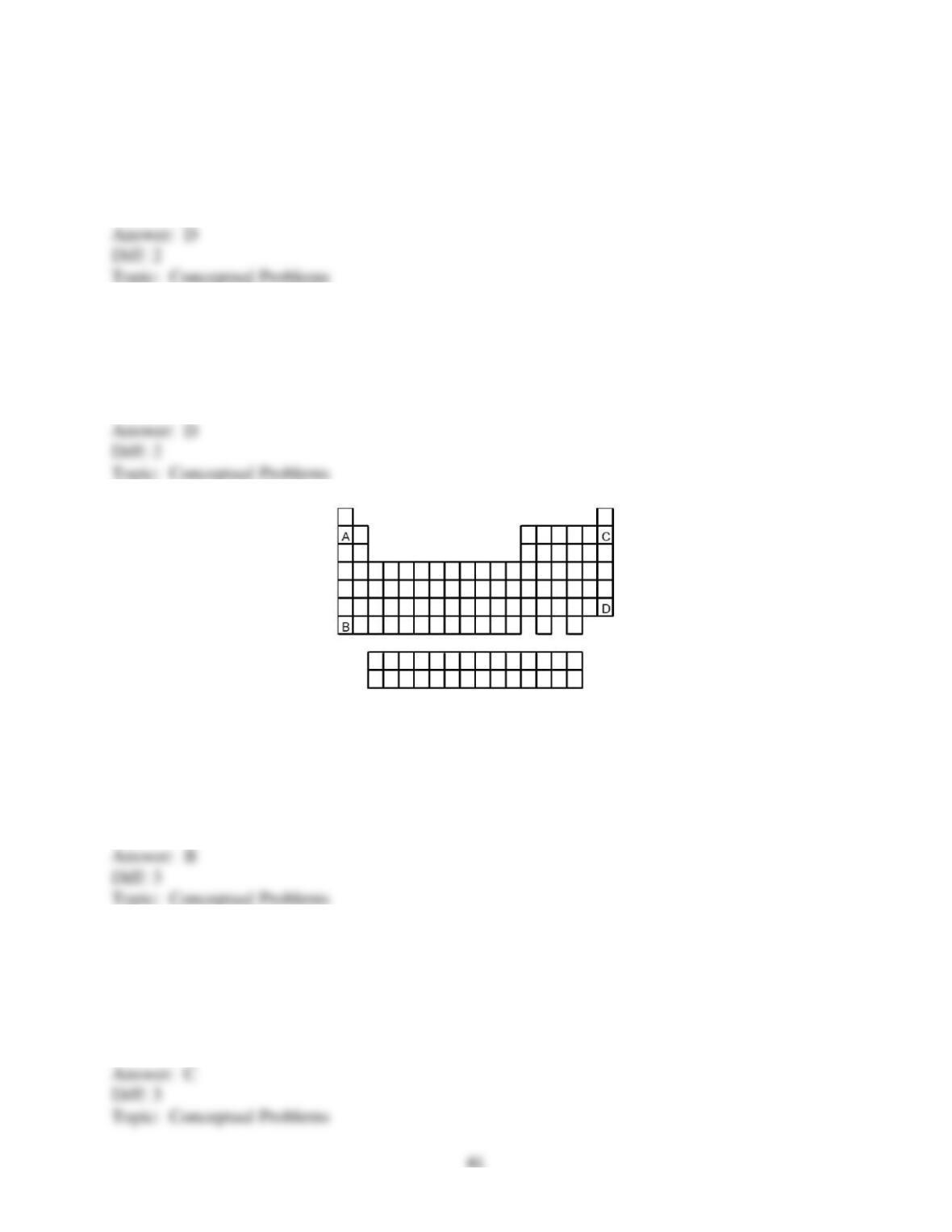
152) Which sphere most likely represents the Cl⁻ ion?
A) A
B) B
C) A or B
D) C or D
153) Which sphere most likely represents the S2- ion?
A) A
B) B
C) A or B
D) C or D
154) Atoms of which element, indicated by letter on the periodic table above, would be expected
to have the smallest first ionization energy, Ei1?
A) A
B) B
C) C
D) D
155) Atoms of which element, indicated by letter on the periodic table above, would be expected
to have the highest first ionization energy, Ei1?
A) A
B) B
C) C
D) D
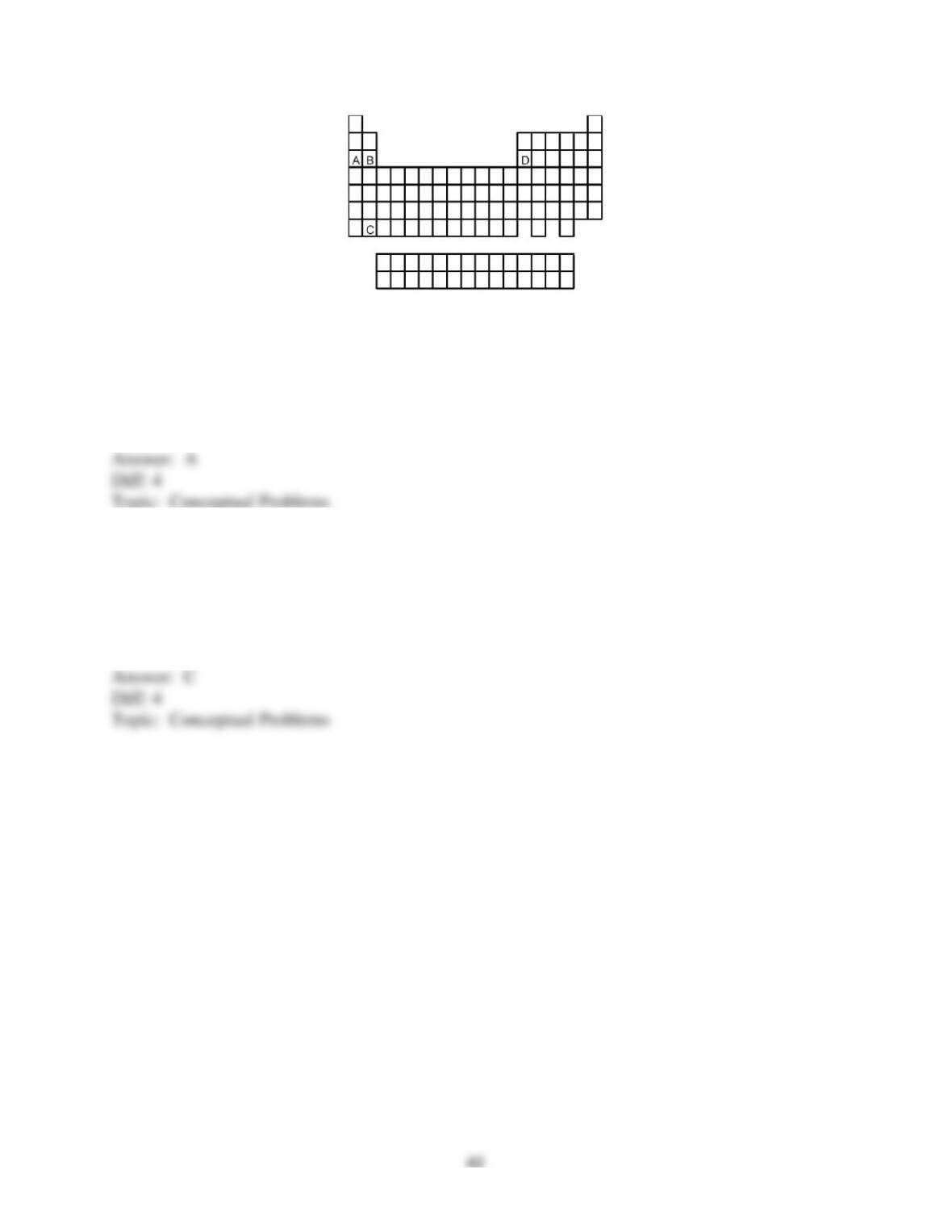
156) Atoms of which element, indicated by letter on the periodic table above, would be expected
to have the highest second ionization energy, Ei2?
A) A
B) B
C) C
D) D
157) Atoms of which element, indicated by letter on the periodic table above, would be expected
to have the lowest second ionization energy, Ei2?
A) A
B) B
C) C
D) D
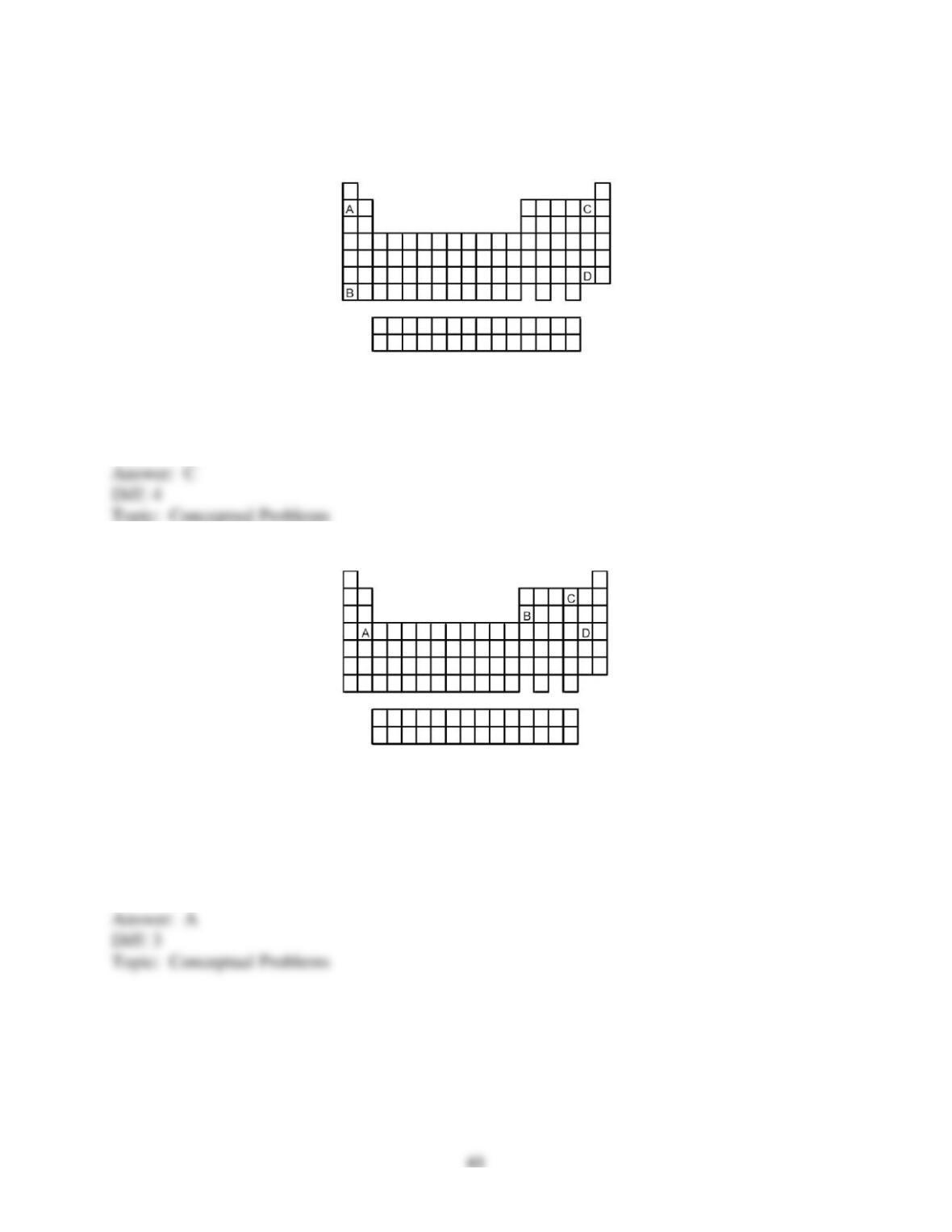
158) Atoms of which element, indicated by letter on the periodic table, would be expected to
have the most negative value of Eea?
A) A
B) B
C) C
D) D
159) What is the likely formula for the binary compound formed from the elements represented
by letters A and C on the periodic table above?
A) AC
B) A2C
C) AC2
D) A2C3
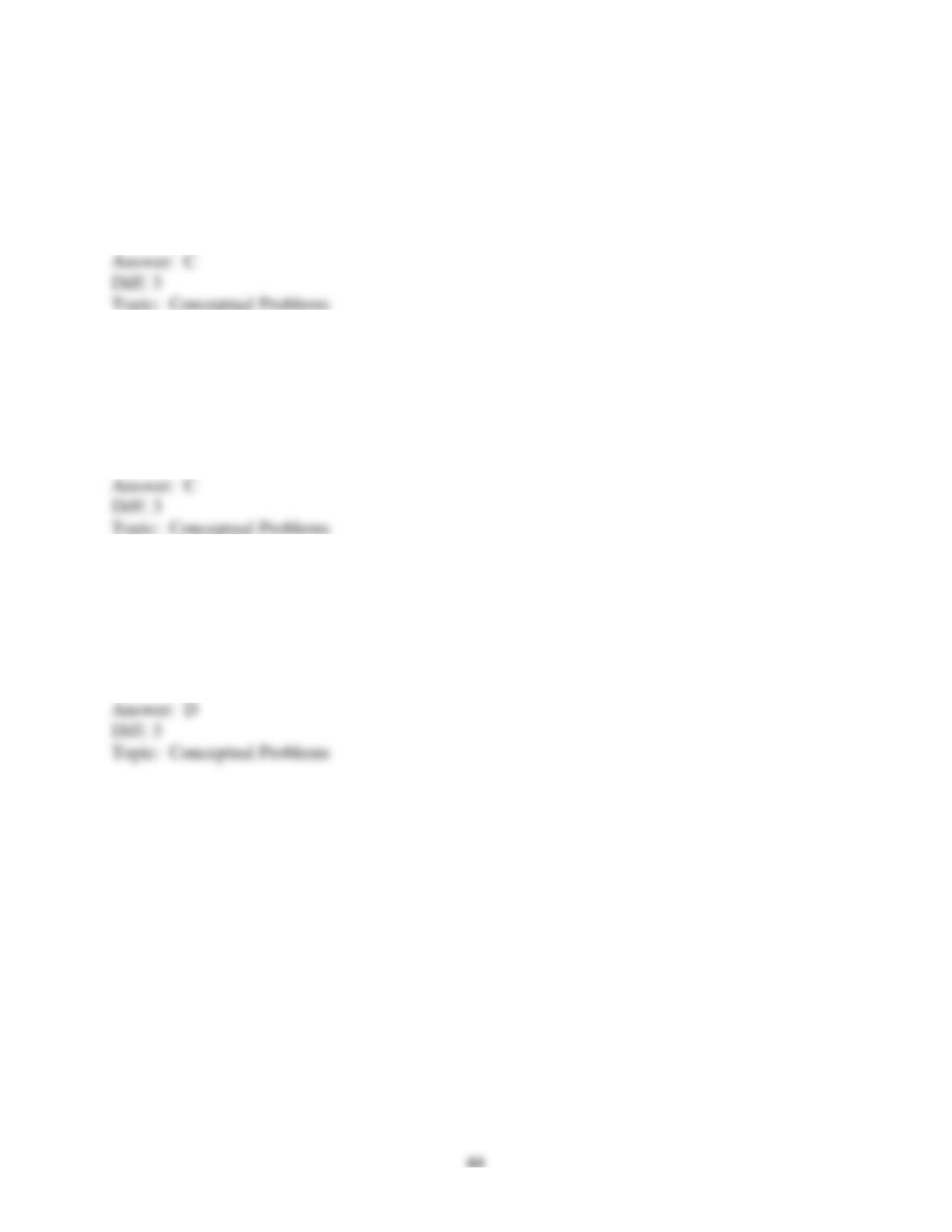
160) What is the likely formula for the binary compound formed from the elements represented
by letters A and D on the periodic table above?
A) AD
B) A2D
C) AD2
D) A2D3
161) What is the likely formula for the binary compound formed from the elements represented
by letters B and D on the periodic table above?
A) BD
B) B3D
C) BD3
D) B2D3
162) What is the likely formula for the binary compound formed from the elements represented
by letters B and C on the periodic table above?
A) BC
B) B3C
C) BC3
D) B2C3
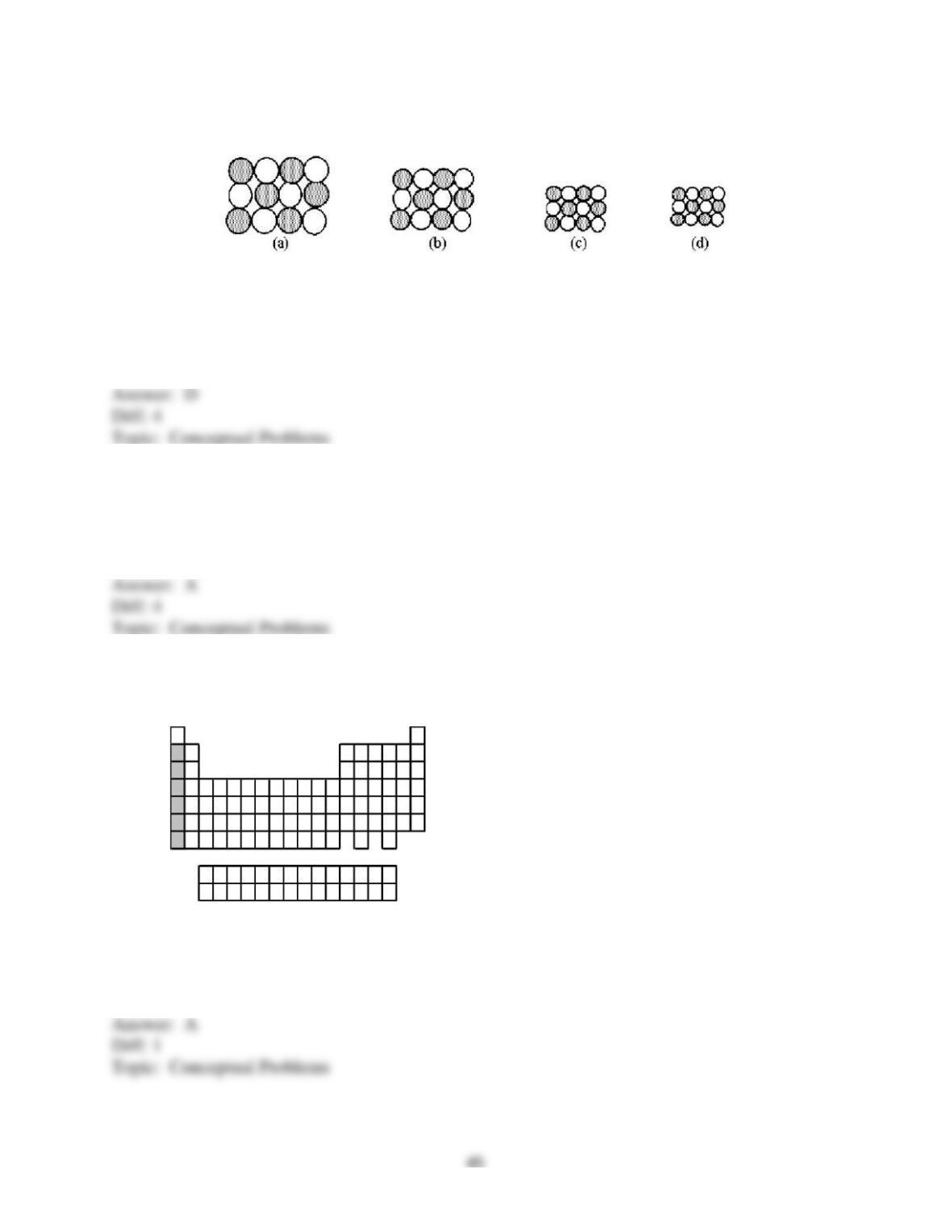
The following pictures represent alkali halide salts.
163) Which salt has the highest lattice energy?
A) picture (a)
B) picture (b)
C) picture (c)
D) picture (d)
164) Which salt has the lowest lattice energy?
A) picture (a)
B) picture (b)
C) picture (c)
D) picture (d)
165) What is the name for the group of elements indicated by the shaded portion of the periodic
table?
A) alkali metals
B) alkaline earth metals
C) inner-transition metals
D) transition metals
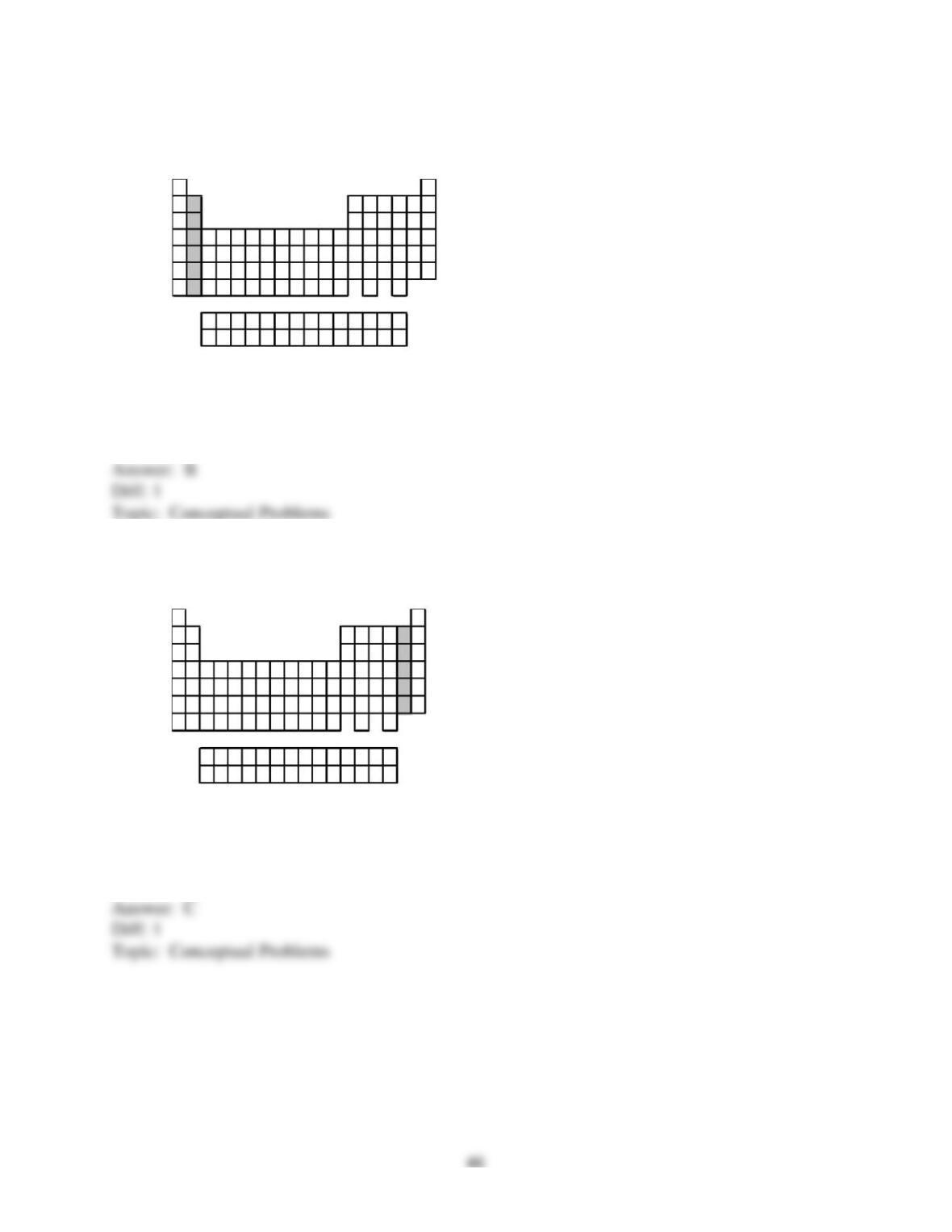
166) What is the name for the group of elements indicated by the shaded portion of the periodic
table?
A) alkali metals
B) alkaline earth metals
C) inner-transition metals
D) transition metals
167) What is the name for the group of elements indicated by the shaded portion of the periodic
table?
A) alkaline earth metals
B) group 3A elements
C) halogens
D) noble gases
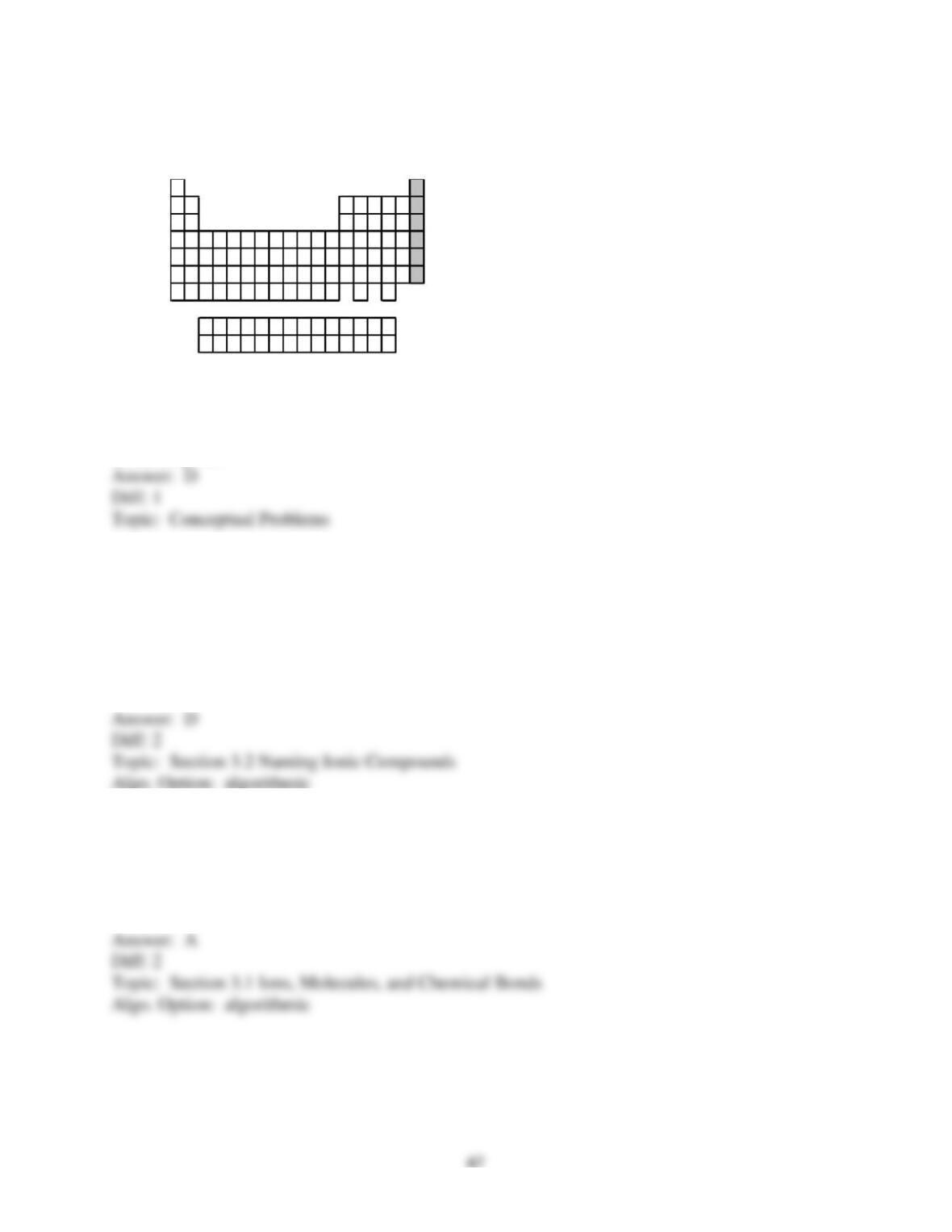
168) What is the name for the group of elements indicated by the shaded portion of the periodic
table?
A) alkaline earth metals
B) group 3A elements
C) halogens
D) noble gases
3.2 Algorithmic Questions
1) Which of the following is the correct chemical formula for a molecule of astatine?
A) At
B) At–
C) At+
D) At2
2) Which one of the following compounds contains ionic bonds?
A) SrO
B) HBr
C) PBr3
D) SiO2
3) What type of bonding is found in the compound OF2?
A) covalent bonding
B) hydrogen bonding
C) ionic bonding
D) metallic bonding
4) In which set do all elements tend to form anions in binary ionic compounds?
A) C, S, Pb
B) K, Fe, Br
C) Li, Na, K
D) N, O, I
5) Which of the compounds, Li3N , N H3, C3H8, IF3 are ionic compounds?
A) only C3H8
B) only Li3N
C) Li3N and N H3
D) N H3, C3H8, and IF3
6) Which of the compounds C H4, SrCl2, Cr(NO3)3, XeF2 are expected to exist as molecules?
A) only C H4
B) C H4 and XeF2
C) C H4, Cr(NO3)2, and XeF2
D) SrCl2 and Cr(NO3)2
7) How many electrons are in the outermost shell of the Ga3+ ion in its ground state?
A) 2
B) 3
C) 6
D) 18
8) How many electrons are in the ion, Cu2+?
A) 27
B) 29
C) 31
D) 64
9) How many electrons are in the ion, P3-?
A) 12
B) 18
C) 28
D) 34
10) In which of the following sets do all species have the same number of electrons?
A) F–, Ne, Mg2+
B) Ge, Se2-, Br–
C) K+, Rb+, Cs+
D) Br, Br–, Br+
11) In which of the following sets do all species have the same number of protons?
A) F–, Ne, Mg2+
B) Ge, Se2-, Br–
C) K+, Rb+, Cs+
D) Br, Br–, Br+
12) Which ion does not have a noble gas configuration in its ground state?
A) Sc3+
B) Al3+
C) Ga3+
D) As3-
13) What is the identity of element Q if the ion Q2+ contains 10 electrons?
A) C
B) O
C) Ne
D) Mg
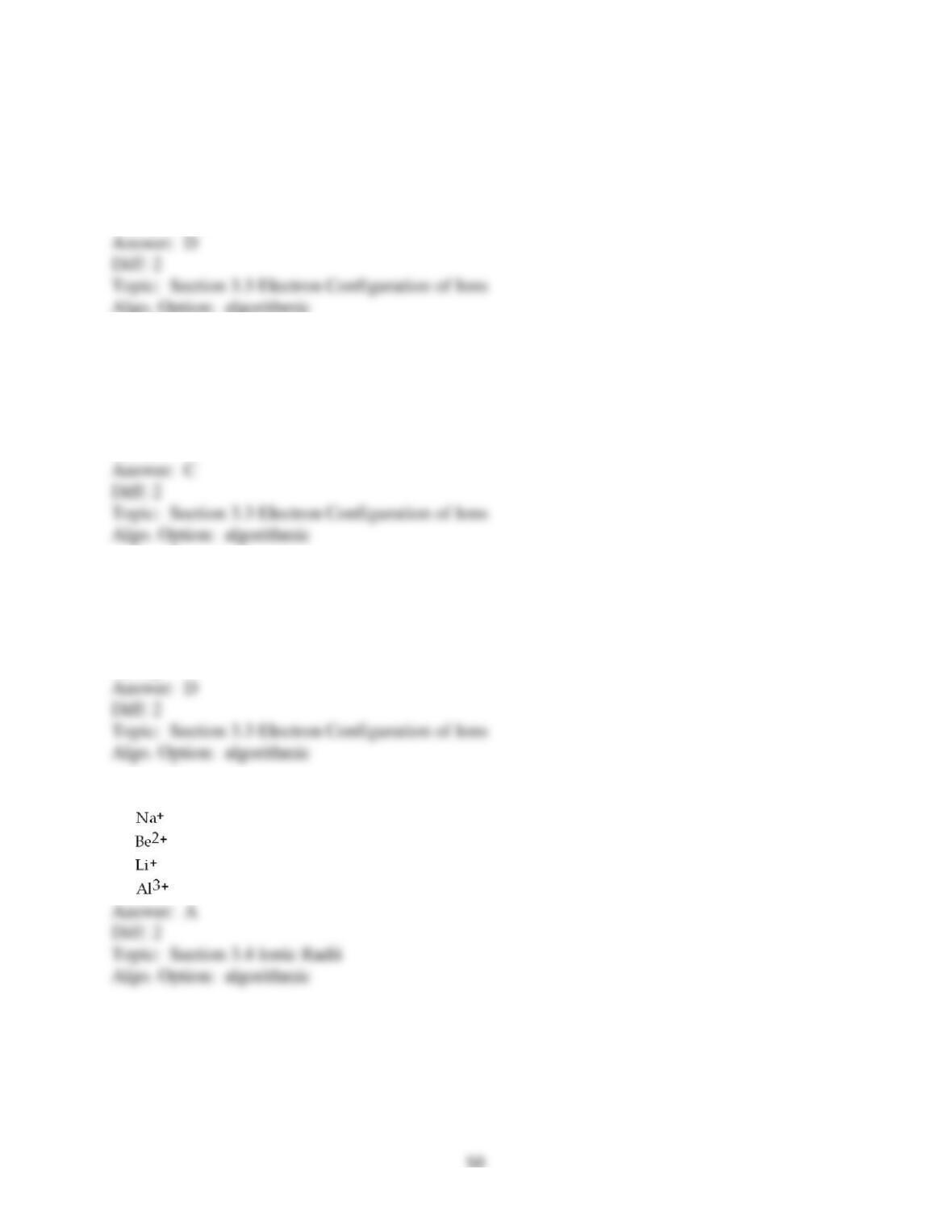
14) Which of these ions is the largest?
A)
B)
C)
D)
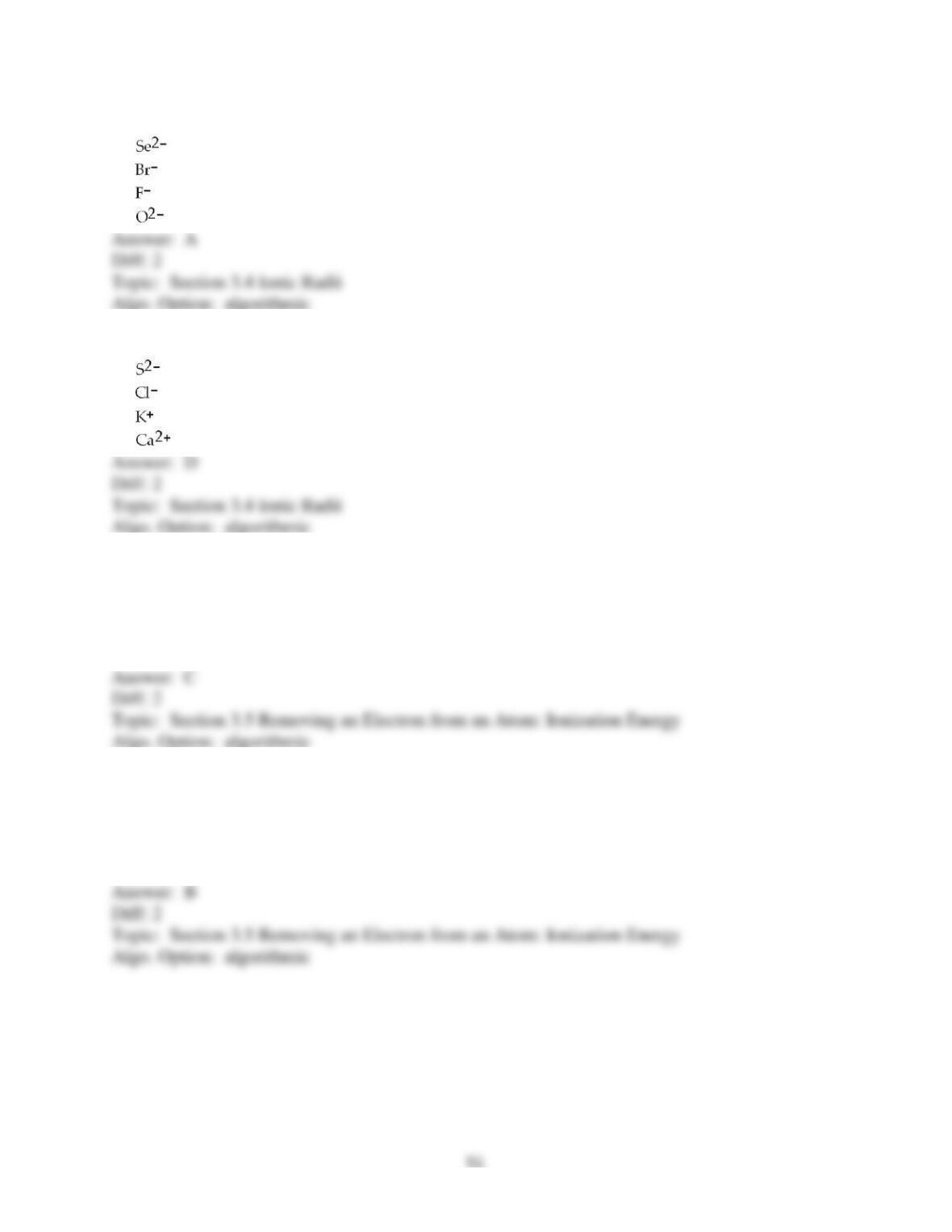
15) Which of these ions is the largest?
A)
B)
C)
D)
16) Which of thes ions is the smallest?
A)
B)
C)
D)
17) Of the following, which element has the highest first ionization energy?
A) beryllium
B) boron
C) carbon
D) lithium
18) Of the following, which element has the highest first ionization energy?
A) Al
B) Cl
C) Na
D) P
19) Of the following, which element has the highest first ionization energy?
A) Sr
B) Rb
C) Na
D) Ca
20) Of the following, which element has the highest first ionization energy?
A) Sr
B) Br
C) K
D) Te
21) Which ionization process requires the most energy?
A) W(g) → W+(g) + e–
B) W+(g) → W2+(g) + e–
C) W2+(g) → W3+(g) + e–
D) W3+(g) → W4+(g) + e–
22) Which ionization process requires the most energy?
A) O(g) → O+(g) + e–
B) O+(g) → O2+(g) + e–
C) F(g) → F+(g) + e–
D) F+(g) → F2+(g) + e–
23) Which of the following represents the change in electronic configuration that is associated
with the first ionization energy of strontium?
A) [Kr]5s15p1 → [Kr]5s1 + e–
B) [Kr]5s2 → [Kr]5s15p1
C) [Kr]5s2 → [Kr]5s1 + e–
D) [Kr]5s2 + e– → [Kr]5s25p1
24) Which element has the highest (most negative) electron affinity?
A) Na
B) Mg
C) O
D) Ne
25) Which of the following elements has the least tendency to form an ion?
A) Ca
B) K
C) Kr
D) Se
26) How many valence shell electrons does an atom of indium have?
A) 1
B) 2
C) 3
D) 49
27) An element that has the valence electron configuration 6s26p6 belongs to which period and
group?
A) period 6; group 6A
B) period 6; group 8A
C) period 7; group 6A
D) period 7; group 8A
28) Which of the following ionic compounds would be expected to have the highest lattice
energy?
A) LiF
B) LiCl
C) LiBr
D) LiI
29) Which of the following ionic compounds would be expected to have the highest lattice
energy?
A) Li Cl
B) Na Cl
C) K Cl
D) Rb Cl
30) Which ionic compound would be expected to have the highest lattice energy?
A) Rb2O
B) SrO
C) In2O3
D) CO2
31) The solid compound, Na2CO3, contains
A) Na+, C4+, and O2- ions.
B) Na+ ions and CO32- ions.
C) Na2+ and CO32- ions.
D) Na2CO3 molecules.
3.3 Short Answer Questions
1) The bonding in MgO is ________, whereas the bonding in CO is ________.
2) Using shorthand notation, the ground-state electron configuration for Sr2+ is predicted to be
________.
3) Using shorthand notation, the ground-state electron configuration for C4– is predicted to be
________.
4) The ionic radius of Cs+ is ________ than the atomic radius of Cs, and the ionic radius of I– is
________ than the atomic radius of I.
5) The element in period 4 with the smallest first ionization energy is ________.
6) The element in period 3 with the smallest seventh ionization energy is ________.
7) The element in group 7A with the least favorable (least negative) electron affinity is
________.
8) The group 4A element that always obeys the octet rule in its stable compounds is ________.
9) Lattice energy increases with ________ cation and anion charges and ________ cation and
anion radii.
10) Phosphate ion has the formula ________.
11) The formula of iron(III) oxide contains ________ iron(III) and ________ oxide ions.