9) Olives are used to produce olive oil. If the price of olives increases
A) the demand for olive oil increases.
B) the demand for olive oil decreases.
C) the supply of olive oil increases.
D) the supply of olive oil decreases.
10) If a technological advance makes it possible to produce computers at a lower cost
A) the demand for computers increases.
B) the demand for computers decreases.
C) the supply of computers increases.
D) the supply of computers decreases.
11) If the number of automobile manufacturers decreases,
A) the demand for automobiles increases.
B) the demand for automobiles decreases.
C) the supply of automobiles increases.
D) the supply of automobiles decreases.
12) If there is an advancement in the technology used to produce a product, what is the likely
effect it may have on the supply?
A) The company would not change its manufacturing.
B) More people would be needed to produce the product.
C) It would decrease the supply.
D) It would increase the supply.
13) An increase in supply of a product results when
A) taxes on the product are increased.
B) the companies that produce the product have higher materials costs.
C) technological innovations are introduced in the manufacturing process.
D) the government reduces subsidies on the product.
14) Suppose that in 2011, 3 million plasma TVs were purchased at $950 each, while in 2012, 4
million plasma TVs were purchased at $800 each. What might have caused this change?
A) The price of LCD TVs (a substitute for plasma TVs) fell.
B) The price of LCD TVs (a substitute for plasma TVs) rose.
C) There was an advance in plasma TV manufacturing technology.
D) There were fewer workers in plasma TV manufacturing.
15) Suppose that a technological advancement substantially reduces the cost of laser eye surgery.
This would cause the equilibrium
A) price of technology to increase.
B) quantity of technology to decrease.
C) quantity of laser eye surgery to increase.
D) quantity of laser eye surgery to decrease.
16) If the number of wine producers decreases,
A) the demand for wine increases.
B) the demand for wine decreases.
C) the supply of wine increases.
D) the supply of wine decreases.
17) Corn is used to produce tortillas. If the price of corn increases,
A) the demand for tortillas increases.
B) the demand for tortillas decreases.
C) the supply of tortillas increases.
D) the supply of tortillas decreases.
18) If producers have an expectation of higher future prices, the supply of the good that is
currently available
A) will be all that is produced.
B) will increase.
C) will decrease.
D) will not change.
19) Suppose that in October the price of a cup of cafe latte was $2.50 and 400 lattes were
consumed. In November the price of a latte was $2.00 and 600 lattes were consumed. What
might have caused this change?
A) The price of tea (a substitute for cafe lattes) fell.
B) The price of tea (a substitute for cafe lattes) rose.
C) The price of coffee beans (an input of production of cafe lattes) rose.
D) The price of coffee beans (an input of production of cafe lattes) fell.
20) If the equilibrium price of a good increases and the equilibrium quantity of the good
decreases, we can conclude that
A) demand increased.
B) demand decreased.
C) supply increased.
D) supply decreased.
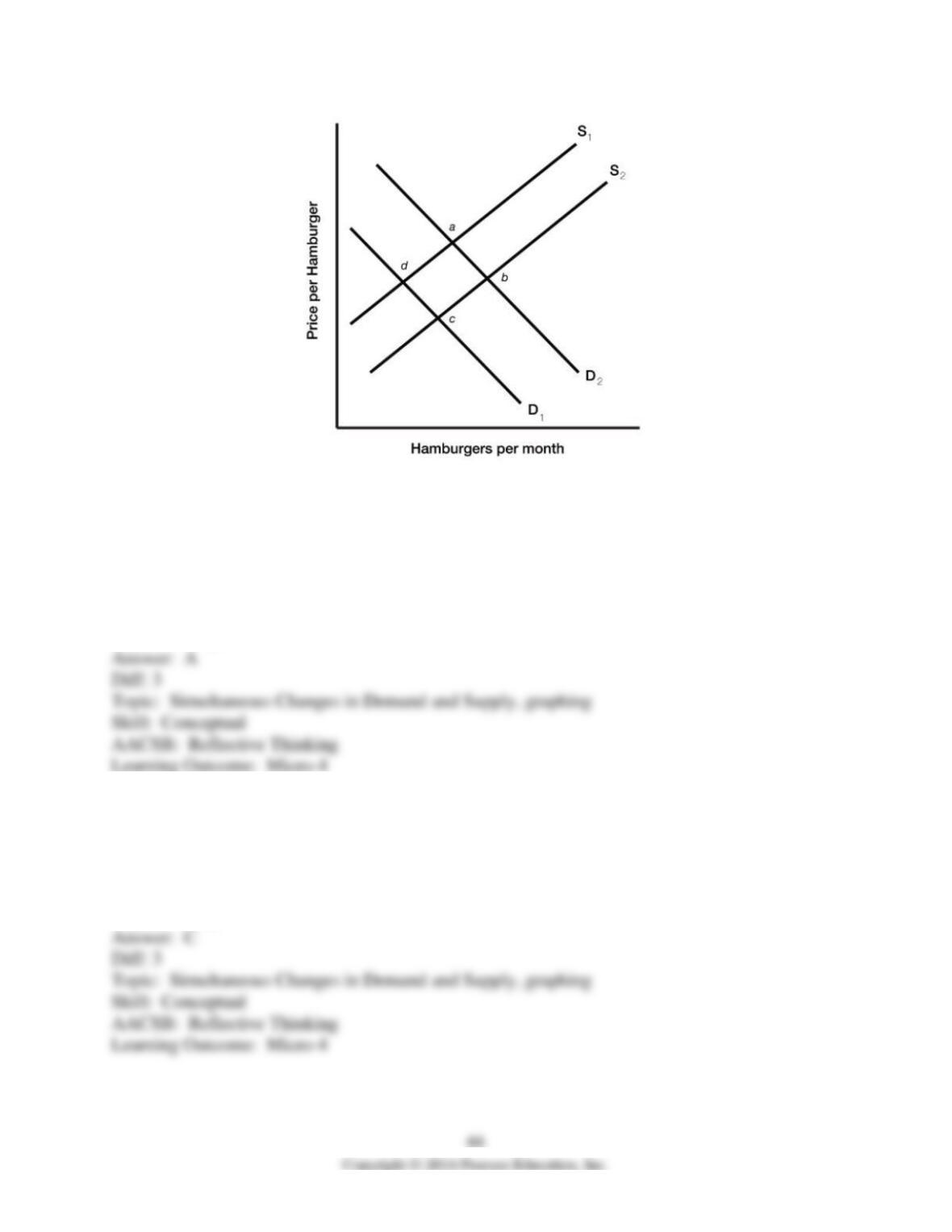
Figure 3.5
21) Figure 3.5 illustrates a set of supply and demand curves for hamburgers. An increase in
supply and an increase in quantity demanded are represented by a movement from
A) point a to point b.
B) point a to point c.
C) point d to point b.
D) point c to point d.
22) Figure 3.5 illustrates a set of supply and demand curves for hamburgers. A decrease in
demand and a decrease in quantity supplied are represented by a movement from
A) point c to point a.
B) point a to point c.
C) point b to point c.
D) point d to point b.
23) Figure 3.5 illustrates a set of supply and demand curves for hamburgers. A decrease in
supply and a decrease in quantity demanded are represented by a movement from
A) point a to point d.
B) point c to point d.
C) point c to point a.
D) point b to point c.
24) Figure 3.5 illustrates a set of supply and demand curves for hamburgers. An increase in
demand and an increase in quantity supplied are represented by a movement from
A) point b to point a.
B) point c to point d.
C) point d to point a.
D) point b to point d.
25) Figure 3.5 illustrates a set of supply and demand curves for hamburgers. A decrease in
supply and an increase in demand are represented by a movement from
A) point d to point c.
B) point c to point b.
C) point b to point d.
D) point c to point a.
26) Figure 3.5 illustrates a set of supply and demand curves for hamburgers. An increase in
supply and a decrease in demand are represented by a movement from
A) point d to point b.
B) point d to point a.
C) point a to point c.
D) point b to point d.
27) Figure 3.5 illustrates a set of supply and demand curves for hamburgers. An increase in
supply and an increase in demand are represented by a movement from
A) point d to point b.
B) point d to point a.
C) point c to point a.
D) point b to point c.
28) Figure 3.5 illustrates a set of supply and demand curves for hamburgers. A decrease in
supply and a decrease in demand are represented by a movement from
A) point c to point a.
B) point b to point d.
C) point d to point a.
D) point a to point b.
29) Bananas and apples are substitutes. When the price of bananas falls, and a technological
advance in apple production occurs at the same time
A) the equilibrium price of apples rises and the equilibrium quantity of apples falls.
B) the equilibrium price of apples rises and the equilibrium quantity of apples rises.
C) the equilibrium price of apples rises and the equilibrium quantity of apples might rise or fall.
D) the equilibrium price of apples falls and the equilibrium quantity of apples might rise or fall.
30) Bananas and apples are substitutes. When the price of bananas rises, and a technological
advance in apple production occurs at the same time
A) the equilibrium price of apples rises and the equilibrium quantity of apples falls.
B) the equilibrium price of apples rises and the equilibrium quantity of apples rises.
C) the equilibrium price of apples rises and the equilibrium quantity of apples might rise or fall.
D) the equilibrium quantity of apples rises and the equilibrium price of apples might rise or fall.
31) If the demand for jelly decreases, and the price of grapes (used to make jelly) rises
A) the equilibrium price of jelly rises and the equilibrium quantity of jelly might rise or fall.
B) the equilibrium price of jelly falls and the equilibrium quantity of jelly might rise or fall.
C) the equilibrium price of jelly might rise or fall, and the equilibrium quantity of jelly falls.
D) the equilibrium price of jelly might rise or fall, and the equilibrium quantity of jelly rises.
32) If the demand for jelly increases, and the price of grapes (used to make jelly) rises
A) the equilibrium price of jelly rises and the equilibrium quantity of jelly might rise or fall.
B) the equilibrium price of jelly falls and the equilibrium quantity of jelly might rise or fall.
C) the equilibrium price of jelly falls and the equilibrium quantity of jelly rises.
D) the equilibrium quantity of jelly falls and the equilibrium price of jelly might rise or fall.
33) Suppose that a new advertising campaign extolling the virtues of apple juice is successful,
and a major freeze destroys half of the country’s apple crop. What happens to the price and
quantity of apple juice?
A) The equilibrium price of apple juice might rise or fall and the equilibrium quantity of apple
juice falls.
B) The equilibrium price of apple juice might rise or fall and the equilibrium quantity of apple
juice rises.
C) The equilibrium price of apple juice rises and the equilibrium quantity of apple juice might
rise or fall.
D) The equilibrium price of apple juice falls and the equilibrium quantity of apple juice might
rise or fall.
34) Suppose that a new study is released stating that consumption of orange juice (a substitute
for apple juice) reduces the risk of cancer, and a major freeze destroys half of the country’s apple
crop. What happens to the price and quantity of apple juice?
A) The price of apple juice might rise or fall and the quantity of apple juice falls.
B) The price of apple juice might rise or fall and the quantity of apple juice rises.
C) The price of apple juice falls and the quantity of apple juice falls.
D) The quantity of apple juice might rise or fall, and the price of apple juice rises.
Recall the Application about the decline in honeybee colonies and its effect on the price of
ice cream to answer the following question(s). In the last few years thousands of honeybee
colonies have vanished, a result of bee colony collapse disorder (CCD). Roughly one third
of the U.S. food supply—including a wide variety of fruits, vegetables, and nuts—depends on
pollination from bees. The decline of honeybees threatens $15 billion worth of crops in the
United States.
35) Recall the application. The decline in honeybee colonies has caused ________ of fruits and
nuts used in ice cream production.
A) a decrease in the supply
B) an increase in the supply
C) an increase in the demand
D) a decrease in the demand
36) Recall the application. The decline in honeybee colonies and its subsequent effect on the
ingredients used in the production of ice cream has ________ the equilibrium price and
________ the equilibrium quantity of ice cream.
A) increased; increased
B) increased; decreased
C) decreased; increased
D) decreased; decreased
37) Recall the application. The decline in honeybee colonies has impacted the supply curve for
ice cream, shifting the supply curve to the ________ due to a(n) ________ in production costs.
A) right; increase
B) right; decrease
C) left; increase
D) left; decrease
38) This Application exemplifies how a change in ________ in one market impacts the
________ in a different market.
A) demand; demand
B) demand; supply
C) supply; supply
D) supply; demand
39) A change in the price of a product will change the supply of that product.
40) A decrease in the cost of production will shift the supply curve down and to the right.
41) An increase in wages will shift the supply curve up and to the left.
42) If supply of a product increases and demand for the product decreases, equilibrium quantity
will definitely change.
43) If supply of a product increases and demand for the product decreases, equilibrium price will
definitely change.
44) Explain the difference between a change in quantity supplied and a change in supply.
45) Describe the changes in the variables that will cause supply for a product to increase, shifting
the supply curve down and to the right.
46) Describe the changes in the variables that will cause supply for a product to decrease,
shifting the supply curve up and to the left.
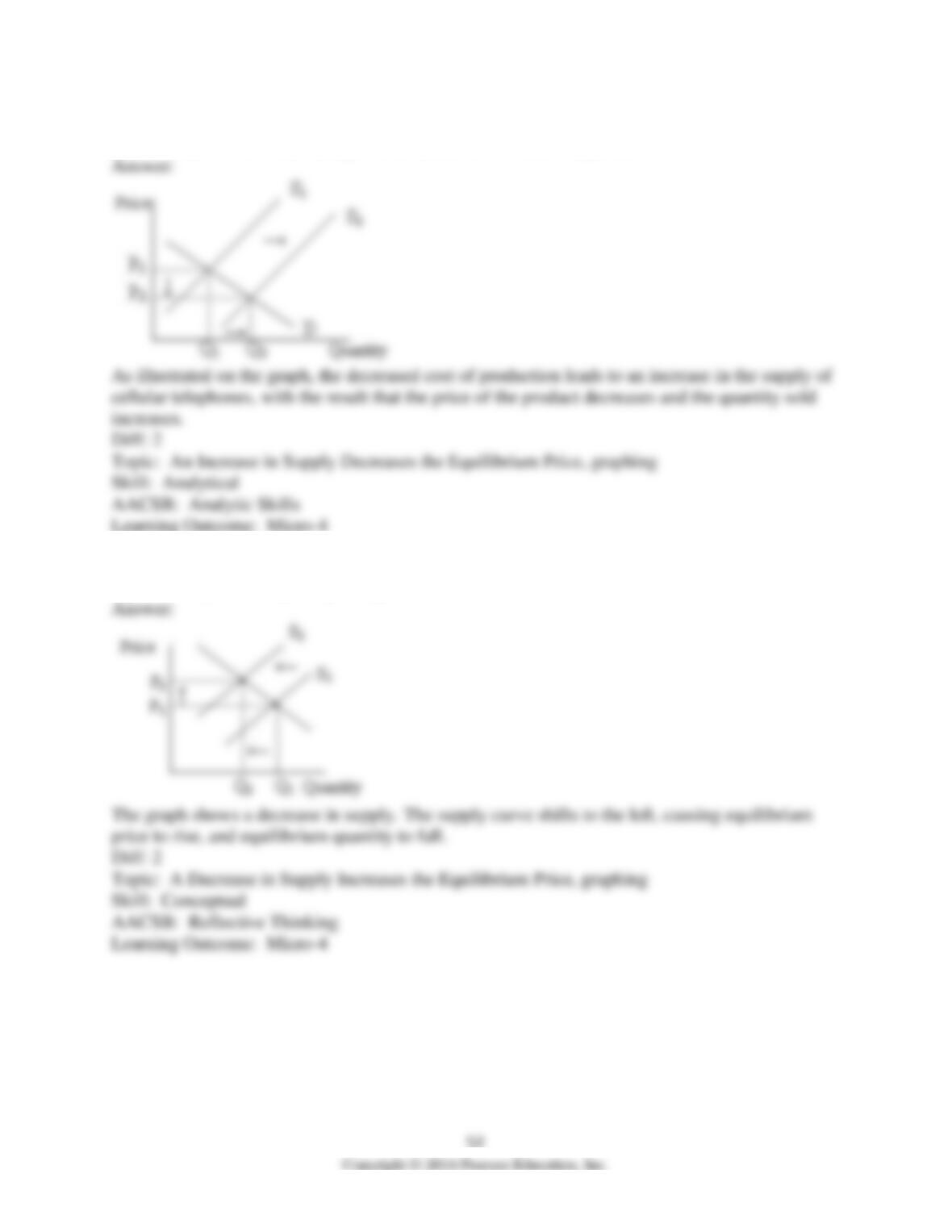
47) As a result of advances in technology, cellular telephones have become cheaper to produce.
Illustrate the effect of this change on the market for cellular telephones.
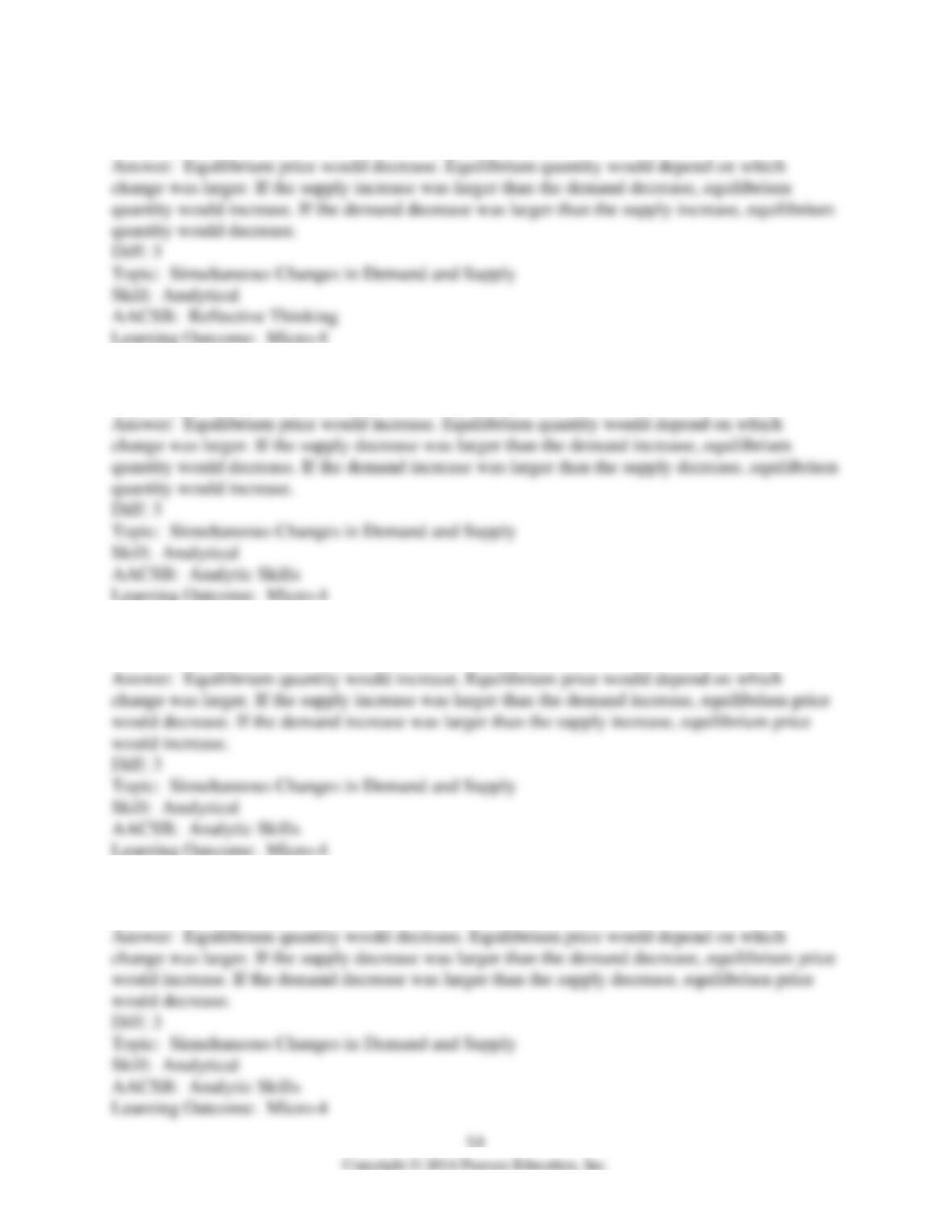
48) Using a graph, illustrate the effect that an increase in production costs will have on the
equilibrium price and quantity of a good.
49) Explain what would happen to the equilibrium price and quantity of oranges if the supply of
oranges increased while the demand for oranges decreased.
50) Explain what would happen to the equilibrium price and quantity of pineapples if the supply
of pineapples decreased while the demand for pineapples increased.
51) Explain what would happen to the equilibrium price and quantity of iPhones if the supply of
iPhones increased while the demand for iPhones also increased.
52) Explain what would happen to the equilibrium price and quantity of gasoline if the supply of
gasoline decreased while the demand for gasoline also decreased.
53) Explain what will happen to the equilibrium price and quantity of hybrid automobiles if there
are technological advancements in the production of hybrid automobiles while at the same time
consumer preference for hybrid automobiles increases.
54) Explain what will happen to the equilibrium price and quantity of satellite TV service if the
wages of the workers who provide the satellite TV service increase while at the same time the
price of cable television service (a substitute for satellite TV service) also increases.
3.6 Predicting and Explaining Market Changes
1) When demand increases and the demand curve shifts to the right, equilibrium price ________
and equilibrium quantity ________.
A) increases; increases
B) increases; decreases
C) decreases; increases
D) decreases; decreases
2) When demand decreases and the demand curve shifts to the left, equilibrium price ________
and equilibrium quantity ________.
A) increases; increases
B) increases; decreases
C) decreases; increases
D) decreases; decreases
3) When supply increases and the supply curve shifts to the right, equilibrium price ________
and equilibrium quantity ________.
A) increases; increases
B) increases; decreases
C) decreases; increases
D) decreases; decreases
4) When supply decreases and the supply curve shifts to the left, equilibrium price ________ and
equilibrium quantity ________.
A) increases; increases
B) increases; decreases
C) decreases; increases
D) decreases; decreases
Recall the Application about the decrease in price of illegal drugs in the United States to
answer the following question(s).
5) Recall the Application. The decrease in price of illegal drugs could be caused by either a(n)
________ in demand or a(n) ________ in supply of the drugs.
A) increase; increase
B) increase; decrease
C) decrease; increase
D) decrease; decrease
6) Recall the Application. If the decrease in price of illegal drugs is primarily due to a change in
demand, the equilibrium quantity of drugs
A) will increase.
B) will decrease.
C) will not change.
D) may or may not change.
7) Recall the Application. If the decrease in price of illegal drugs is primarily due to a change in
supply, the equilibrium quantity of drugs
A) will increase.
B) will decrease.
C) will not change.
D) may or may not change.
8) Recall the Application. If the decrease in price of illegal drugs is due to equal changes in
demand and supply, the equilibrium quantity of drugs
A) will increase.
B) will decrease.
C) will not change.
D) may or may not change.
9) Recall the Application. If it is not known whether the decrease in price of illegal drugs is
primarily due to a change in supply, a change in demand, or equal changes in both, the
equilibrium quantity of drugs
A) will increase.
B) will decrease.
C) will not change.
D) may or may not change.
10) When demand changes and the demand curve shifts, equilibrium price and equilibrium
quantity change in the same direction.
11) When supply increases and the supply curve shifts to the right, equilibrium price and
equilibrium quantity will both increase.