
84) A boy throws a ball with an initial velocity of 25 m/s at an angle of 30° above the horizontal.
If air resistance is negligible, how high above the projection point is the ball after 2.0 s?
A) 5.4 m
B) 13 m
C) 25 m
D) 43 m
E) 50 m
85) A projectile is fired from ground level with a speed of 150 m/s at an angle 30° above the
horizontal on an airless planet where g = 10.0 m/s2. What is the horizontal component of its
velocity after 4.0 s?
A) 150 m/s
B) 35 m/s
C) 130 m/s
D) 75 m/s
E) 38 m/s
86) A high-speed dart is shot from ground level with a speed of 150 m/s at an angle 30° above
the horizontal. What is the vertical component of its velocity after 4.0 s if air resistance is
neglected?
A) 150 m/s
B) 36 m/s
C) 130 m/s
D) 75 m/s
E) 38 m/s
87) A projectile leaves the ground at 150 m/s and reaches a maximum height of 0.57 km. If there
was no air resistance, at what angle above the horizontal did it leave the ground?

88) A child is trying to throw a ball over a fence. She gives the ball an initial speed of 8.0 m/s at
an angle of 40° above the horizontal. The ball leaves her hand 1.0 m above the ground and the
fence is 2.0 m high. The ball just clears the fence while still traveling upwards and experiences
no significant air resistance. How far is the child from the fence?
A) 0.73 m
B) 1.6 m
C) 2.7 m
D) 3.8 m
E) 7.5 m
89) A boy kicks a football from ground level with an initial velocity of 20 m/s at an angle of 30°
above the horizontal. What is the horizontal distance to the point where the football hits the
ground if we neglect air resistance?
A) 20 m
B) 35 m
C) 18 m
D) 60 m
E) 30.0 m
90) An athlete competing in the long jump leaves the ground with a speed of 9.14 m/s at an angle
of 55° with the vertical. What is the length of the athlete’s jump if air resistance is of no
significance?
A) 0.88 m
B) 8.0 m
C) 12 m
D) 17 m
E) 4.0 m
91) An athlete competing in the long jump leaves the ground with a speed of 9.14 m/s at an angle
of 35° above the horizontal. How long does the athlete stay in the air, assuming no significant air
resistance?
A) 0.50 s
B) 0.88 s
C) 1.1 s
D) 2.5 s
E) 0.54 s

92) An athlete participates in an interplanetary discus throw competition during an Olympiad
that takes place on a planet where the acceleration due to gravity is 9.7 m/s2. He throws the
discus with an initial velocity of 20 m/s at an angle of 60° from the vertical. Neglecting air
resistance and the height of the discus at the point of release, what is the range of the discus?
A) 21 m
B) 60 m
C) 36 m
D) 40 m
E) 32 m
93) A child throws a ball with an initial speed of 8.0 m/s at an angle of 40° above the horizontal.
The ball leaves her hand 1.0 m above the ground and experiences no appreciable air resistance as
it moves.
(a) How far from where the child is standing does the ball hit the ground?
(b) How long is the ball in flight before it hits the ground?
(c) What is the magnitude of the ball’s velocity just before it hits the ground?
94) A child throws a ball with an initial speed of 8.0 m/s at an angle of 40° above the horizontal.
The ball leaves her hand 1.0 m above the ground. At what angle below the horizontal does the
ball approach the ground?
A) 35°
B) 42°
C) 48°
D) 40°
E) 65°
95) The horizontal and vertical components of the initial velocity of a football are 16 m/s and 20
m/s respectively. If there is no air resistance, how long does it take the football to reach the top
of its trajectory?
A) 1.0 s
B) 2.0 s
C) 3.0 s
D) 4.0 s
E) 5.0 s
96) A projectile is fired at an angle above the horizontal at a location where g = 9.8 m/s2. The
initial x and y components of its velocity are 86.6 m/s and 50 m/s respectively. At what angle
was the projectile fired above the horizontal?
A) 45°
B) 60°
C) 30°
D) 90°
E) 75°
97) A projectile is fired from ground level at an angle above the horizontal on an airless planet
where g = 10.0 m/s2. The initial x and y components of its velocity are 86.6 m/s and 50.0 m/s
respectively. How long after firing does it take before the projectile hits the level ground?
A) 5.00 seconds
B) 10.0 seconds
C) 15.0 seconds
D) 20.0 seconds
98) A projectile is fired from ground level with an initial speed of 55.6 m/s at an angle of 41.2°
above the horizontal. Neglect air resistance, take upward as the positive direction, and use g =
9.8 m/s2.
(a) Determine the time necessary for the projectile to reach its maximum height.
(b) Determine the maximum height reached by the projectile.
(c) Determine the horizontal and vertical components of the velocity vector at the maximum
height.
(d) Determine the horizontal and vertical components of the acceleration vector at the maximum
height.
99) At a location where g = 9.80 m/s2, a projectile returns to its original height after 4.08
seconds, during which time it travels 76.2 meters horizontally. If air resistance can be neglected,
what was the projectile’s initial speed?
100) A rock is thrown from the roof of a building, with an initial velocity of 10 m/s at an angle of
30° above the horizontal. The rock is observed to strike the ground 43 m from the base of the
building. What is the height of the building assuming no air resistance?
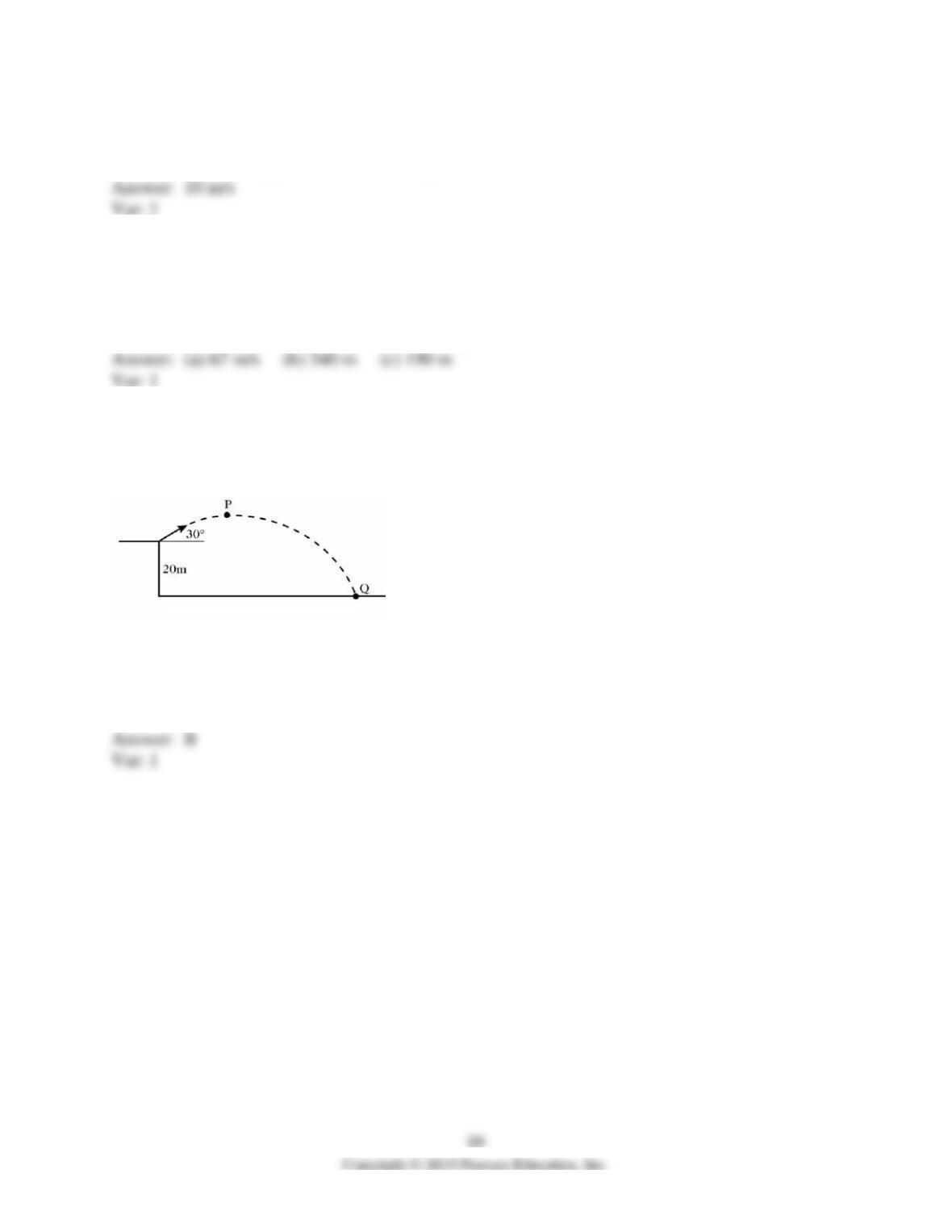
101) A 5.0-kg stone is thrown upward at 7.5 m/s at an angle of 51° above the horizontal from the
upper edge of a cliff, and it hits the ground 1.5 s later with no air resistance. Find the magnitude
of its velocity vector just as it reaches the ground.
102) A projectile is thrown upward at 24° with the vertical and returns to the horizontal ground
12.5 s later with no air drag.
(a) How fast was it thrown?
(b) How far from its original position did it land?
(c) How high above its original position did it go?
103) A projectile is fired from the edge of a cliff as shown in the figure. The initial velocity
components are 940 m/s (horizontal) and 96 m/s (vertical). The projectile reaches maximum
height at point P and then falls and strikes the ground at point Q. How high is point P above
point Q, assuming no air resistance?
A) 470 m
B) 490 m
C) 45,000 m
D) 940 m
E) 90,000 m
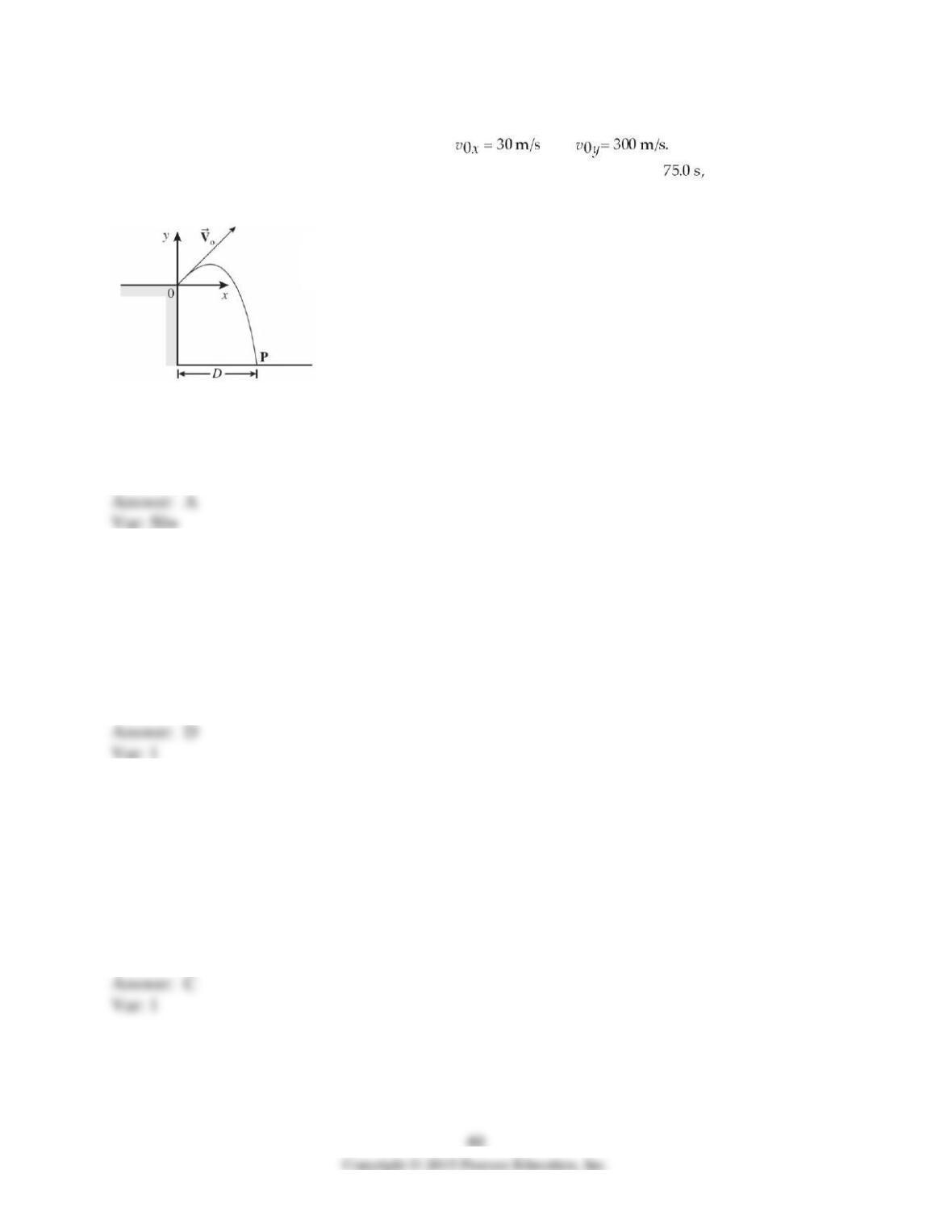
104) As shown in the figure, a projectile is fired at time t = 0.00 s, from point 0 at the upper edge
of a cliff, with initial velocity components of and The projectile rises
and then falls into the sea at point P. The time of flight of the projectile is and air resistance
is negligible. At this location, g = 9.80 m/s2. What is the horizontal distance D?
A) 2250 m
B) 2520 m
C) 2790 m
D) 3060 m
E) 3330 m
105) A projectile is launched with an initial velocity of 80 m/s at 30° above the horizontal.
Neglecting air resistance, what is horizontal component of the projectile’s acceleration?
A) 80 m/s2
B) 40 m/s2
C) 9.8 m/s2
D) 0 m/s2
E) 69 m/s2
106) A boy kicks a football with an initial velocity of 20 m/s at an angle of 25° above the
horizontal. If we neglect air resistance, the magnitude of the acceleration of the ball while it is in
flight is
A) 25 m/s2.
B) 18 m/s2.
C) 9.8 m/s2.
D) 8.5 m/s2.
E) 0 m/s2.
107) A projectile is fired from ground level on a horizontal plain. If the initial speed of the
projectile is now doubled, and we neglect air resistance,
A) its range will be increased by .
B) its range will double.
C) its range will be decreased by a factor of two.
D) its range will quadruple.
E) its range will decrease by a factor of four.
108) A hobbyist launches a projectile from ground level on a horizontal plain. It reaches a
maximum height of 72.3 m and lands 111 m from the launch point, with no appreciable air
resistance. What was the angle of launch if g = 9.80 m/s2?
A) 69.0°
B) 67.4°
C) 22.6°
D) 44.8°
109) Sarah drives at a constant speed of 15 m/s around a circular horizontal curve of diameter 60
m. What are the magnitude and direction of her acceleration?
110) You need to design a wheel for testing purposes such that its rim will have an acceleration
of 1.5 g when the rim is moving at 37 m/s while spinning. What should be the diameter of this
wheel?
111) A child sits on a merry-go-round, 1.5 meters from the center. The merry-go-round is turning
at a constant rate, and the child is observed to have a radial acceleration of 2.3 m/s2. How long
does it take for the merry-go-round to make one revolution?
112) A disk-shaped space station 125 m in diameter spins at a uniform rate about an axis through
its center and perpendicular to the plane of the disk. If the acceleration of a point on the rim of
the disk is to be equal to g, how long does it take for the station to make one revolution? Use g =
9.8 m/s2.

113) An object moves with a constant speed of 30 m/s on a circular track of radius 150 m. What
is the acceleration of the object?
A) 0 m/s2
B) 0.17 m/s2
C) 5.0 m/s2
D) 6.0 m/s2
114) A point on a wheel of radius 40 cm that is rotating at a constant 5.0 revolutions per second
is located 0.20 m from the axis of rotation. What is the acceleration of that point due to the spin
of the wheel?
A) 0.050 m/s2
B) 1.4 m/s2
C) 48 m/s2
D) 200 m/s2
E) 0.00 m/s2
115) You are driving at on a freeway curve of radius What is the magnitude of
your acceleration?
A) 36.0 m/s2
B) 1.20 m/s2
C) 20.8 m/s2
D) 0.833 m/s2
116) The maximum acceleration a pilot can stand without blacking out is about 7.0 g. In an
endurance test for a jet plane’s pilot, what is the maximum speed he can tolerate if he is spun in a
horizontal circle of diameter 85 m?
117) A race car traveling at a constant speed of 50 m/s drives around a circular track that is 500
m in diameter. What is the magnitude of the acceleration of the car?
A) 0 m/s2
B) 1.0 m/s2
C) 10 m/s2
D) 0.63 m/s2
E) 2.2 m/s2
118) A jet plane flying 600 m/s experiences an acceleration of 4.0 g when pulling out of the
circular section of a dive. What is the radius of curvature of this section of the dive?
A) 1.2 km
B) 5.8 km
C) 0.64 km
D) 9.2 km
E) 7.0 km
119) The Moon is 3.84 × 10⁸ m from Earth and takes 27.3 days to complete each orbit. What are
the magnitude and direction of the acceleration of the Moon, assuming a circular orbit?
120) You are traveling at 55 mi/h along the +x-axis relative to a straight, level road and pass a
car that is traveling at 45 mi/h. The relative velocity of your car to the other car is
A) -10 mi/h.
B) 10 mi/h.
C) 65 mi/h.
D) 35 mi/h.
121) Your motorboat can move at 30 km/h in still water. What is the minimum time it will take
you to move 12 km downstream in a river flowing at 6.0 km/h?
A) 20 min
B) 22 min
C) 24 min
D) 30 min
122) An airplane with an airspeed of 140 km/h has a heading of 50° west of north in a wind that
is blowing toward the east at 25 km/h. What is the groundspeed of the plane?
123) A plane has an airspeed of 200 m/s northward, and is in a wind of 50.0 m/s to the west. The
plane’s speed relative to the ground is
A) 150 m/s.
B) 200 m/s.
C) 206 m/s.
D) 250 m/s.
124) An airplane with an airspeed of 120 km/h has a heading of 30° east of north in a wind that
is blowing toward the west at 30 km/h. What is the speed of the plane relative to the ground?
A) 90 km/h
B) 110 km/h
C) 140 km/h
D) 150 km/h
125) A plane moving 200 m/s horizontally fires a projectile with speed 50 m/s in a forward
direction 30.0° below the horizontal. At that instant, what is the speed of the projectile with
respect to a stationary observer on the ground?
A) 245 m/s
B) 250 m/s
C) 268 m/s
D) 293 m/s
126) Alicia intends to swim to a point straight across a 100 m wide river with a current that flows
at 1.2 m/s. She can swim 2.5 m/s in still water. At what angle, measured from the upstream
direction, must she swim upstream to achieve her goal?
127) On a calm day with no wind, you can run a 1500-m race at a velocity of 4.0 m/s. If you run
the same race on a day when you have a constant headwind that slows your speed by 2.0 m/s,
how much time would it take you to finish the race?
A) 250 s
B) 750 s
C) 1125 s
D) 9000 s
128) A pickup truck moves at 25 m/s toward the east. Ahmed is standing in the back and throws
a baseball in what to him is the southwest direction at 28 m/s (with respect to the truck). A
person at rest on the ground would see the ball moving how fast in what direction?
129) A submarine must travel how fast (with respect to the water) and be pointed in what
direction such that it moves 10 m/s directly northward (relative to the earth) if the water moves
westward at 5.0 m/s?
130) An airplane is pointed at 45° north of east and is moving at 71 m/s with respect to the air.
The jet stream (moving air) carries the plane at 30 m/s toward the east. What are the magnitude
and direction of the velocity of the plane relative to the ground?
131) The driver of a motorboat that can move at 10 m/s in still water wishes to travel directly
across a river in which the current flows at 5.0 m/s.
(a) At what angle, measured from the upstream direction, should the driver head the boat?
(b) How many minutes will it take to cross the river if it is 1.6 km wide at that point?
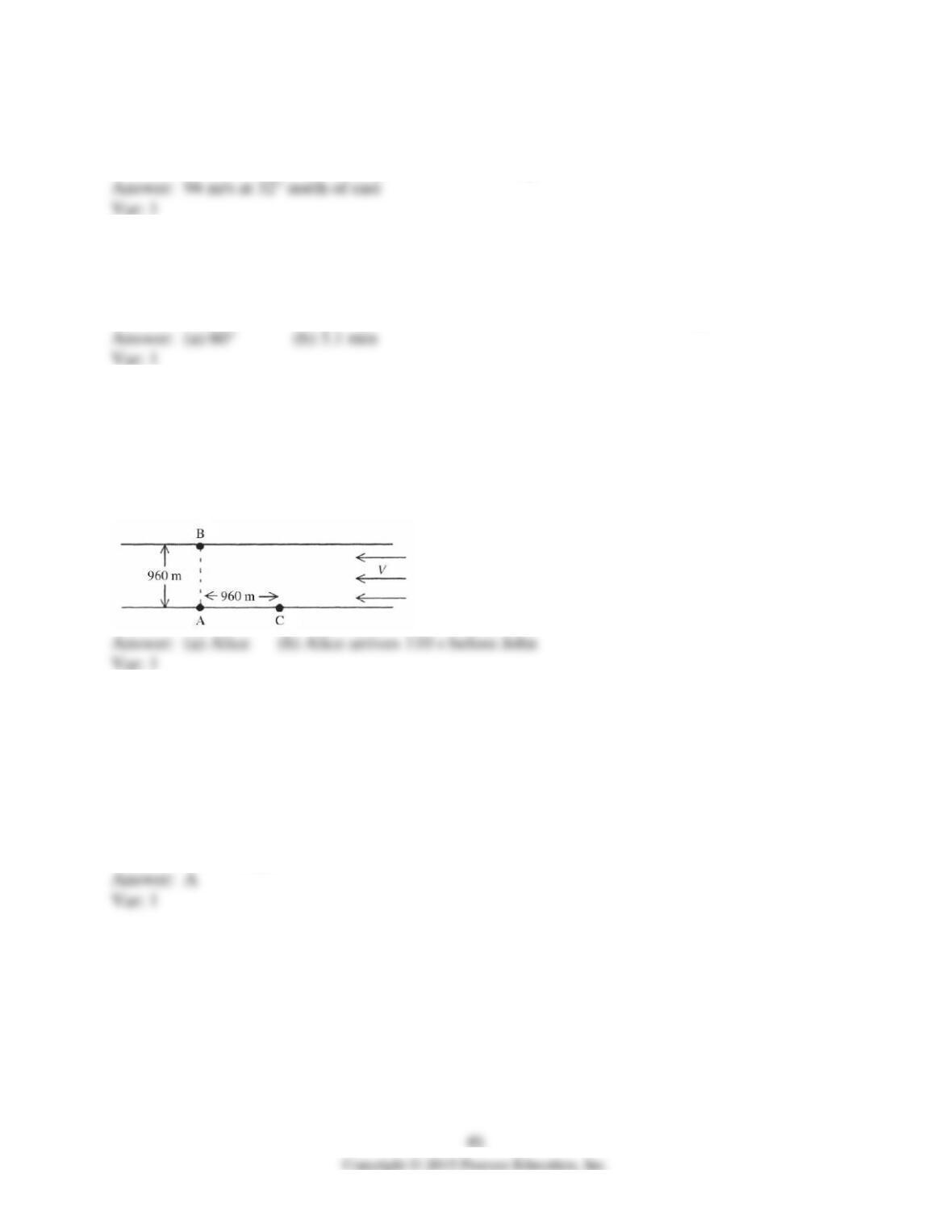
132) A 960-m wide river flows at 16 m/s as shown in the figure. Alice and John have a race in
identical boats which each travel 20 m/s in still water. Alice leaves point A and steers so that she
goes straight to point B directly across and then back to A. John leaves point A and steers up to
point C (960 m upstream) and then returns to A.
(a) Which person arrives back at point A first?
(b) How much sooner than the loser does the winner arrive back at point A?
133) A plane has an eastward heading with an airspeed of 156 m/s. A 20.0 m/s wind is blowing
southward at the same time as the plane is flying. The velocity of the plane relative to the ground
is
A) 157 m/s at an angle 7.31° south of east.
B) 157 m/s at an angle 7.31° east of south.
C) 155 m/s at an angle 7.36° south of east.
D) 155 m/s at an angle 7.36° east of south.
E) 157 m/s at an angle 7.36° south of east.

134) A plane has an airspeed of 142 m/s. A 30.0 m/s wind is blowing southward at the same time
as the plane is flying. What must be the heading of the plane in order to move directly eastward
relative to the ground?
A) 78.1° north of east
B) 11.9° north of east
C) 77.8° north of east
D) 12.2° north of east
E) 55.3° north of east
135) A plane has an airspeed of 142 m/s. A 16 m/s wind is blowing southward at the same time
as the plane is flying. If the velocity of the plane relative to the ground is directly eastward, what
is the magnitude of that velocity?
A) 130 m/s
B) 16 m/s
C) 160 m/s
D) 141 m/s
E) 48 m/s
136) An airplane flies between two points on the ground that are 500 km apart. The destination
is directly north of the point of origin of the flight. The plane flies with an airspeed of 120 m/s.
If a constant wind blows at 10 m/s toward the west during the flight, what direction must the
plane fly relative to the air to arrive at the destination?
A) 4.8° east of north
B) 5.9° east of north
C) 85° west of north
D) 4.8° west of north
E) 5.9° west of north
137) A swimmer heading directly across a river that is 200 m wide reaches the opposite bank in
6 min 40 s. During this swim, she is swept downstream 480 m. How fast can she swim in still
water?
A) 0.50 m/s
B) 0.80 m/s
C) 1.2 m/s
D) 1.4 m/s
E) 1.8 m/s

138) A swimmer heading directly across a river that is 200 m wide reaches the opposite bank in
6 min 40 s. During this swim, she is swept downstream 480 m. What is the speed of the
current?
A) 0.50 m/s
B) 0.80 m/s
C) 1.2 m/s
D) 1.4 m/s
E) 1.8 m/s
139) A boat, whose speed in still water is 1.75 m/s, must aim upstream at an angle of 26.3° (with
respect to a line perpendicular to the shore) in order to travel directly across the stream.
(a) What is the speed of the current?
(b) What is the resultant speed of the boat with respect to the shore?
140) A boat, whose speed in still water is 8.0 m/s, crosses a river with a current of 6.0 m/s. If the
boat heads perpendicular to the current, what is the speed of the boat relative to an observer
standing on the shore as it crosses the river?
A) 5.3 m/s
B) 6.0 m/s
C) 8.0 m/s
D) 10.0 m/s
141) A plane flies directly from city A to city B, which are separated by 2300 mi. From A to B,
the plane flies into a 65 mi/h headwind. On the return trip from B to A, the wind velocity is
unchanged. The trip from B to A takes less than the trip from A to B. What is the airspeed
(assumed constant) of the plane relative to the air (that is, the airspeed)?
A) 530 mi/h
B) 400 mi/h
C) 480 mi/h
D) 610 mi/h