The Accounting Information System
3 – 35
*Ex. 3-131—Accrual basis.
The records for Kiley Company showed the following for 2014:
Jan. 1 Dec. 31
Unearned revenue $1,100 $2,160
Accrued revenue 1,260 920
Cash collected during the year for revenue, $65,000
Show the computation of the amount of revenue that should be reported on the income
statement.
*Solution 3-131
*Ex. 3-132—Cash basis.
Revenue on the income statement was $125,800. Accounts receivable were $3,500 on January 1
and $3,540 on December 31. Unearned revenue was $1,050 on January 1 and $1,670 on
December 31.
Show the computation of revenue for the year on a cash basis.
PROBLEMS
Pr. 3-133—Adjusting entries and account classification.
Selected amounts from Trent Company’s trial balance of 12/31/14 appear below:
1. Accounts Payable $ 160,000
2. Accounts Receivable 150,000
3. Accumulated Depreciation—Equipment 200,000
4. Allowance for Doubtful Accounts 20,000
5. Bonds Payable 500,000
6. Cash 150,000
7. Common Stock 60,000
8. Equipment 960,000
9. Prepaid Insurance 30,000
10. Interest Expense 10,000
11. Inventory 300,000
12. Notes Payable (due 6/1/15) 200,000
13. Prepaid Rent 210,000
14. Retained Earnings 818,000
15. Salaries and Wages Expense 328,000
(All of the above accounts have their standard or normal debit or credit balance.)
Test Bank for Intermediate Accounting, Fifteenth Edition
3 – 36
Part A. Prepare adjusting journal entries at year end, December 31, 2014, based on the
following supplemental information.
a. The equipment has a useful life of 15 years with no salvage value. (Straight-line method being
used.)
b. Interest accrued on the bonds payable is $15,000 as of 12/31/14.
c. Prepaid insurance at 12/31/14 is $25,000.
d. The rent payment of $180,000 covered the six months from November 30, 2014 through May
31, 2015.
e. Salaries and wages earned but unpaid at 12/31/14, $22,000.
Part B. Indicate the proper balance sheet classification of each of the 15 numbered accounts
in the 12/31/14 trial balance before adjustments by placing appropriate numbers after
each of the following classifications. If the account title would appear on the income
statement, do not put the number in any of the classifications.
a. Current assets
b. Property, plant, and equipment
c. Current liabilities
d. Long-term liabilities
e. Stockholders’ equity
The Accounting Information System
3 – 37
Pr. 3-134—Adjusting entries.
Data relating to the balances of various accounts affected by adjusting or closing entries appear
below. (The entries which caused the changes in the balances are not given.) You are asked to
supply the missing journal entries which would logically account for the changes in the account
balances.
1. Interest receivable at 1/1/14 was $1,000. During 2014 cash received from debtors for interest
on outstanding notes receivable amounted to $5,000. The 2014 income statement showed
interest revenue in the amount of $6,400. You are to provide the missing adjusting entry that
must have been made, assuming reversing entries are not made.
2. Unearned rent at 1/1/14 was $5,300 and at 12/31/14 was $8,000. The records indicate cash
receipts from rental sources during 2014 amounted to $55,000, all of which was credited to
the Unearned Rent Revenue account. You are to prepare the missing adjusting entry.
3. Accumulated depreciation—equipment at 1/1/14 was $230,000. At 12/31/14 the balance of
the account was $280,000. During 2014, one piece of equipment was sold. The equipment
had an original cost of $40,000 and was 3/4 depreciated when sold. You are to prepare the
missing adjusting entry.
4. Allowance for doubtful accounts on 1/1/14 was $50,000. The balance in the allowance
account on 12/31/14 after making the annual adjusting entry was $65,000 and during 2014
bad debts written off amounted to $30,000. You are to provide the missing adjusting entry.
5. Prepaid rent at 1/1/14 was $29,000. During 2014 rent payments of $120,000 were made and
charged to “rent expense.” The 2014 income statement shows as a general expense the item
“rent expense” in the amount of $145,000. You are to prepare the missing adjusting entry that
must have been made, assuming reversing entries are not made.
6. Retained earnings at 1/1/14 was $130,000 and at 12/31/14 it was $210,000. During 2014,
cash dividends of $50,000 were paid and a stock dividend of $40,000 was issued. Both
dividends were properly charged to retained earnings. You are to provide the missing closing
entry.
Test Bank for Intermediate Accounting, Fifteenth Edition
3 – 38
Pr. 3-135—Adjusting and closing entries.
The following trial balance was taken from the books of Fisk Corporation on December 31, 2014.
Account Debit Credit
Cash $ 9,000
Accounts Receivable 40,000
Notes Receivable 10,000
Allowance for Doubtful Accounts $ 1,800
Inventory 44,000
Prepaid Insurance 4,800
Equipment 110,000
Accumulated Depreciation—Equip. 15,000
Accounts Payable 10,800
Common Stock 44,000
Retained Earnings 55,000
Sales Revenue 280,000
Cost of Goods Sold 126,000
Salaries and Wages Expense 50,000
Rent Expense 12,800
Totals $406,600 $406,600
The Accounting Information System
3 – 39
Pr. 3-135 (cont.)
At year end, the following items have not yet been recorded.
a. Insurance expired during the year, $2,000.
b. Estimated bad debts, 1% of gross sales.
c. Depreciation on equipment, 10% per year on original cost.
d. Interest at 5% is receivable on the note for one full year.
*e. Rent paid in advance at December 31, $5,400 (originally charged to expense).
f. Accrued salaries and wages at December 31, $5,800.
Instructions
(a) Prepare the necessary adjusting entries.
(b) Prepare the necessary closing entries.
Test Bank for Intermediate Accounting, Fifteenth Edition
3 – 40
*Pr. 3-136—Cash to accrual accounting.
The following information is available for Renn Corporation‘s first year of operations:
Payment for merchandise purchases $335,000
Ending merchandise inventory 135,000
Accounts payable (balance at end of year) 60,000
Collections from customers 280,000
The balance in accounts payable relates only to merchandise purchases. All merchandise items
were marked to sell at 35% above cost. What should be the ending balance in accounts
receivable, assuming all accounts are deemed collectible?
*Pr. 3-137—Accrual accounting.
Yates Company’s records provide the following information concerning certain account balances
and changes in these account balances during the current year. Transaction information is
missing from each item below.
Instructions
Prepare the entry to record the missing information for each account. (Consider each inde-
pendently.)
1. Accounts Receivable: Jan. 1, balance $41,000, Dec. 31, balance $55,000, uncollectible
accounts written off during the year, $6,000; accounts receivable collected during the year,
$139,000. Prepare the entry to record sales revenue.
2. Allowance for Doubtful Accounts: Jan. 1, balance $4,000, Dec. 31, balance $7,500,
uncollectible accounts written off during the year, $20,000. Prepare the entry to record bad
debt expense.
3. Accounts Payable: Jan. 1, balance $25,000, Dec. 31, balance $54,000, purchases on account
for the year, $120,000. Prepare the entry to record payments on account.
4. Interest Receivable: Jan. 1 accrued, $3,000, Dec. 31 accrued, $2,100, recognized for the
year, $35,000. Prepare the entry to record cash interest received.
The Accounting Information System
3 – 41
Test Bank for Intermediate Accounting, Fifteenth Edition
3 – 42
*Pr. 3-138—Accrual basis.
Grier & Associates maintains its records on the cash basis. You have been engaged to convert its
cash basis income statement to the accrual basis. The cash basis income statement, along with
additional information, follows:
Grier & Associates
Income Statement (Cash Basis)
For the Year Ended December 31, 2014
Cash receipts from customers $450,000
Cash payments:
Salaries and wages $170,000
Income taxes 65,000
Insurance 40,000
Interest 25,000 300,000
Net income $150,000
Additional information:
Balances at 12/31
2014 2013
Accounts receivable $50,000 $30,000
Salaries and wages payable 10,000 20,000
Income taxes payable 24,000 19,000
Prepaid insurance 8,000 4,000
Accumulated depreciation 95,000 75,000
Interest payable 3,000 9,000
No plant assets were sold during 2014.

The Accounting Information System
3 – 43
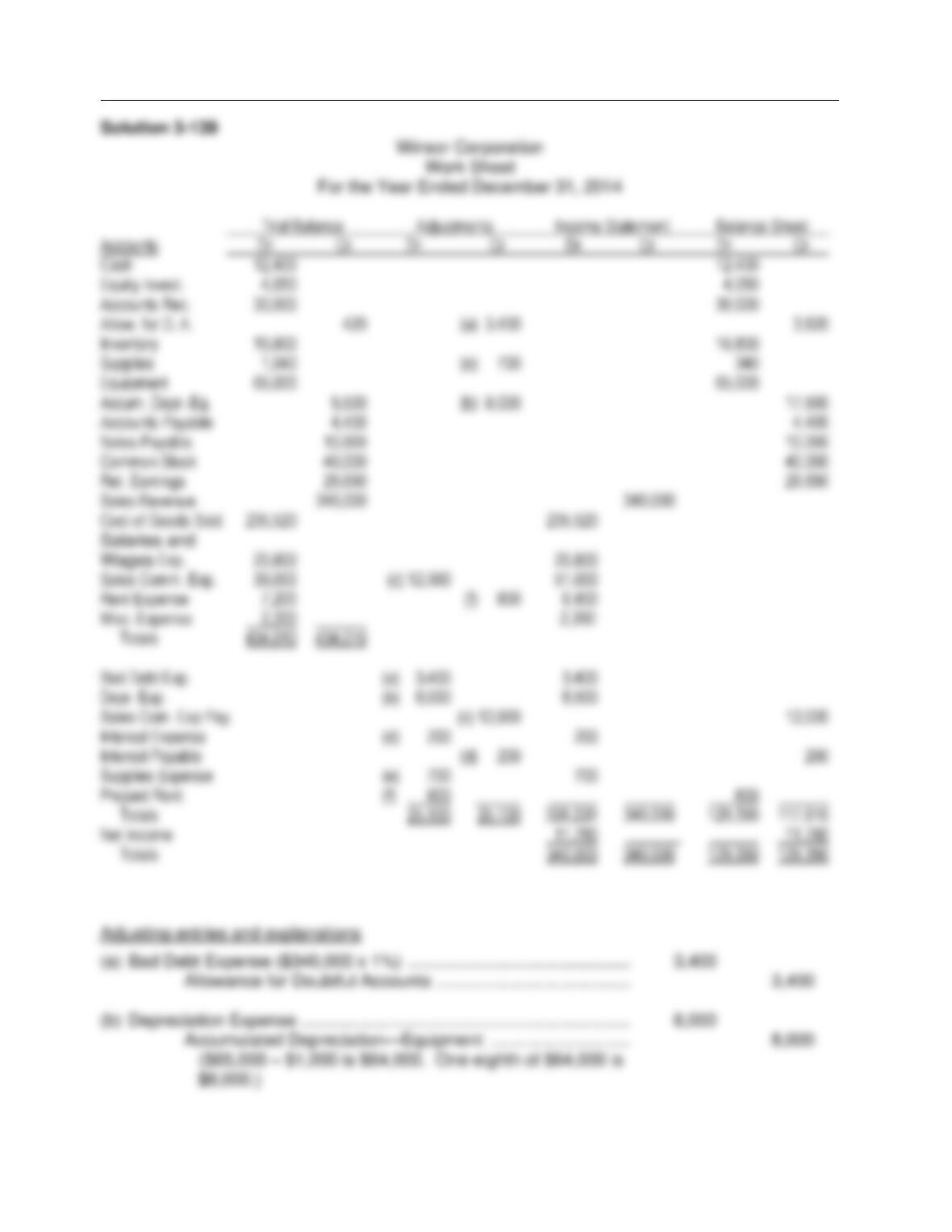
*Pr. 3-139—Eight-column work sheet.
The trial balance of Winsor Corporation is reproduced on the following page. The information
below is relevant to the preparation of adjusting entries needed to both properly match revenues
and expenses for the period and reflect the proper balances in the real and nominal accounts.
Instructions
As the accountant for Winsor Corporation, you are to prepare adjusting entries based on the
following data, entering the adjustments on the work sheet and completing the additional columns
with respect to the income statement and balance sheet. Carefully key your adjustments and
label all items. (Due to time constraints, an adjusted trial balance is not required.) Round all
computations to the nearest dollar.
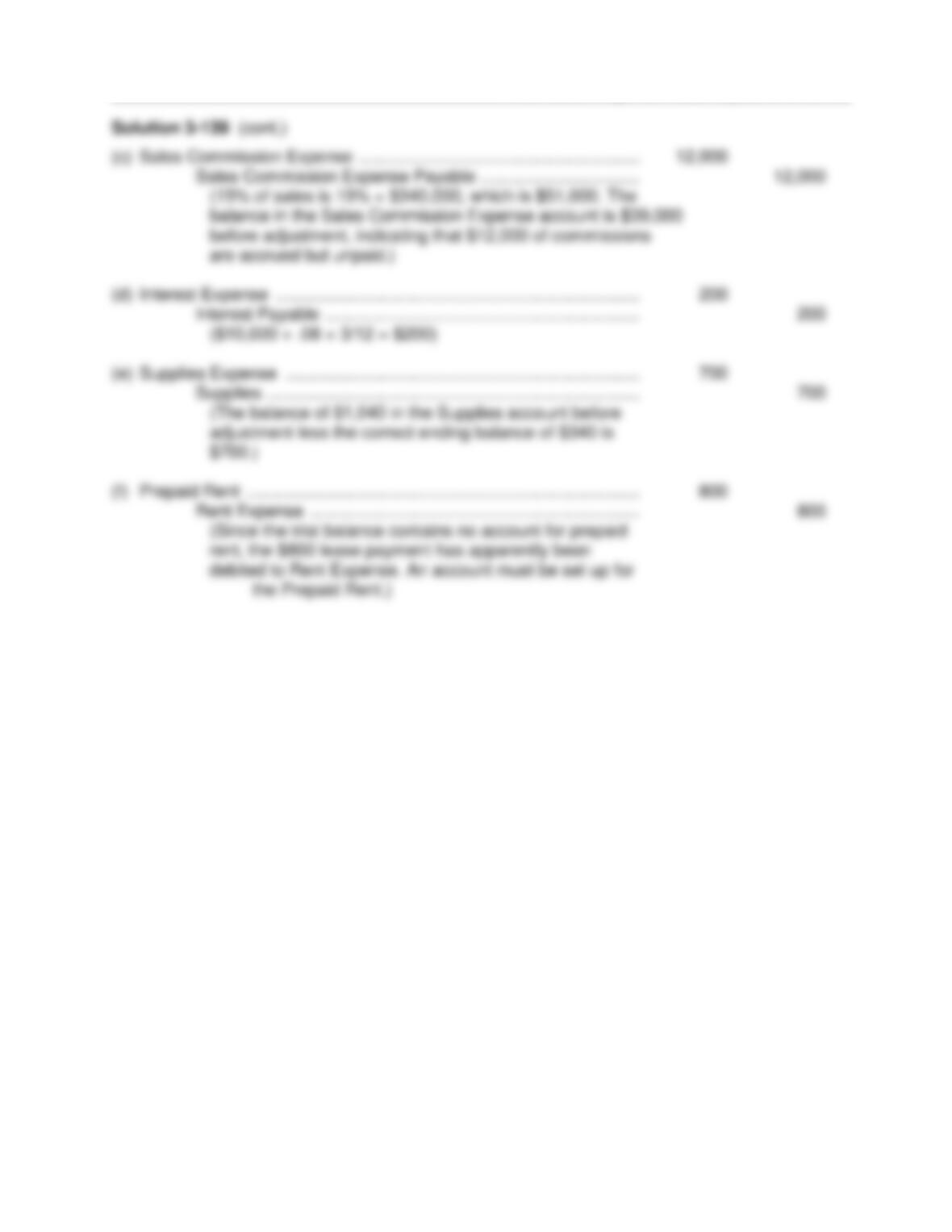
(a) Winsor determined that one percent of sales will become uncollectible.
(b) Depreciation is computed using the straight-line method, with an eight-year life and $1,000
salvage value.
(c) Salesmen are paid commissions of 15% of sales. Commissions on sales for December have
not been paid.
(d) The note was issued on October 1, bearing interest at 8%, due Feb. 1, 2015.
(e) A physical inventory of supplies indicated $340 of supplies currently in stock.
(f) Provisions of a lease contract specify payments must be made one month in advance, with
monthly payments at $800/mo. This provision has been complied with as of Dec. 31, 2014.
Winsor Corporation
Work Sheet
For the Year Ended December 31, 2014
Trial Balance Adjustments Income Statement Balance Sheet
Accounts Dr. Cr. Dr. Cr. Dr. Cr. Dr. Cr.
Cash 12,400
Equity Invest. 4,050
Accounts Rec. 30,000
Allow. for D. A. 420
Inventory 16,800
Supplies 1,040
Equipment 65,000
Accum. Depr.-Equip. 9,500
Accounts Payable 4,400
Notes Payable 10,000
Common Stock 40,000
Ret. Earnings 29,690
Sales Revenue 340,000
Cost of Goods Sold 235,520
Salaries and
Wages Exp. 20,800
Sales Comm. Exp. 39,000
Rent Expense 7,200
Misc. Expense 2,200
Totals 434,010 434,010
Test Bank for Intermediate Accounting, Fifteenth Edition
3 – 44
The Accounting Information System
3 – 45

Test Bank for Intermediate Accounting, Fifteenth Edition
3 – 46
IFRS QUESTIONS
True / False
1. As rules for accounting for specific events sometimes differ across countries, the double-entry
accounting system is difficult to implement as the basis of worldwide accounting system.
2. IASB is working to establish high-quality auditing and assurance quality standards throughout
the world.
Multiple Choice:
3. Icon International, a software company, incorporated on January 1, 2013 is planning to
convert to IFRS. The company decided to present its first IFRS statements for the year ended
December 31, 2015. What is the transition date of Icon International?
a. January 1, 2013
b. January 1, 2015
c. December 31, 2015
d. December 31, 2013
4. Icon International, a software company, incorporated on January 1, 2013 is planning to
convert to IFRS. The company decided to present its first IFRS statements for the year ended
December 31, 2015. What is the reporting date of Icon International?
a. January 1, 2013
b. January 1, 2015
c. December 31, 2015
d. December 31, 2013
5. Which of the following is a reason for recasting prior financial statements based on IFRS?
a. To increase the market value of a company’s shares
b. To report a high income for attracting investors
c. To report a low taxable income reducing the tax liability
d. To provide financial statement users with comparable information
6. IFRS 1 requires information in a company’s first IFRS statement to:
a. be same as in GAAP statement.
b. be transparent.
c. be as lengthy as possible.
d. provide a suitable ending point.
7. Which of the following is the first step to be taken by a company deciding to convert to IFRS?
a. Preparing an opening balance sheet at the date of transition
b. Identifying the timing of first IFRS statement
c. Selecting accounting principles that comply with IFRS
d. Implementing accounting principles retrospectively
The Accounting Information System
3 – 47
Answers to Multiple Choice:
Short Answer:
8. Are all international companies subject to the same internal control standards? Explain.
9. What are some of the consequences of international differences in internal control standards?