3.5-5) The Income Summary account
A) can be found on the Income Statement since it is an expense account.
B) can be found on the Income Statement since it is a revenue account.
C) can be found on the Balance Sheet since it is an asset account.
D) can be found on the Balance Sheet since it is a liability account.
E) cannot be found on any of the financial statements.
3.5-6) Closing entries deal primarily with balance sheet accounts.
3.5-7) The only accounts that are closed are income statement accounts.
3.5-8) Closing entries are generally performed at the beginning of the accounting period.
3.5-9) After all the closing entries are posted, the Income Summary account will have a credit balance if
the entity has net income (revenues exceed expenses).
3.5-10) Expense accounts are closed with credits.
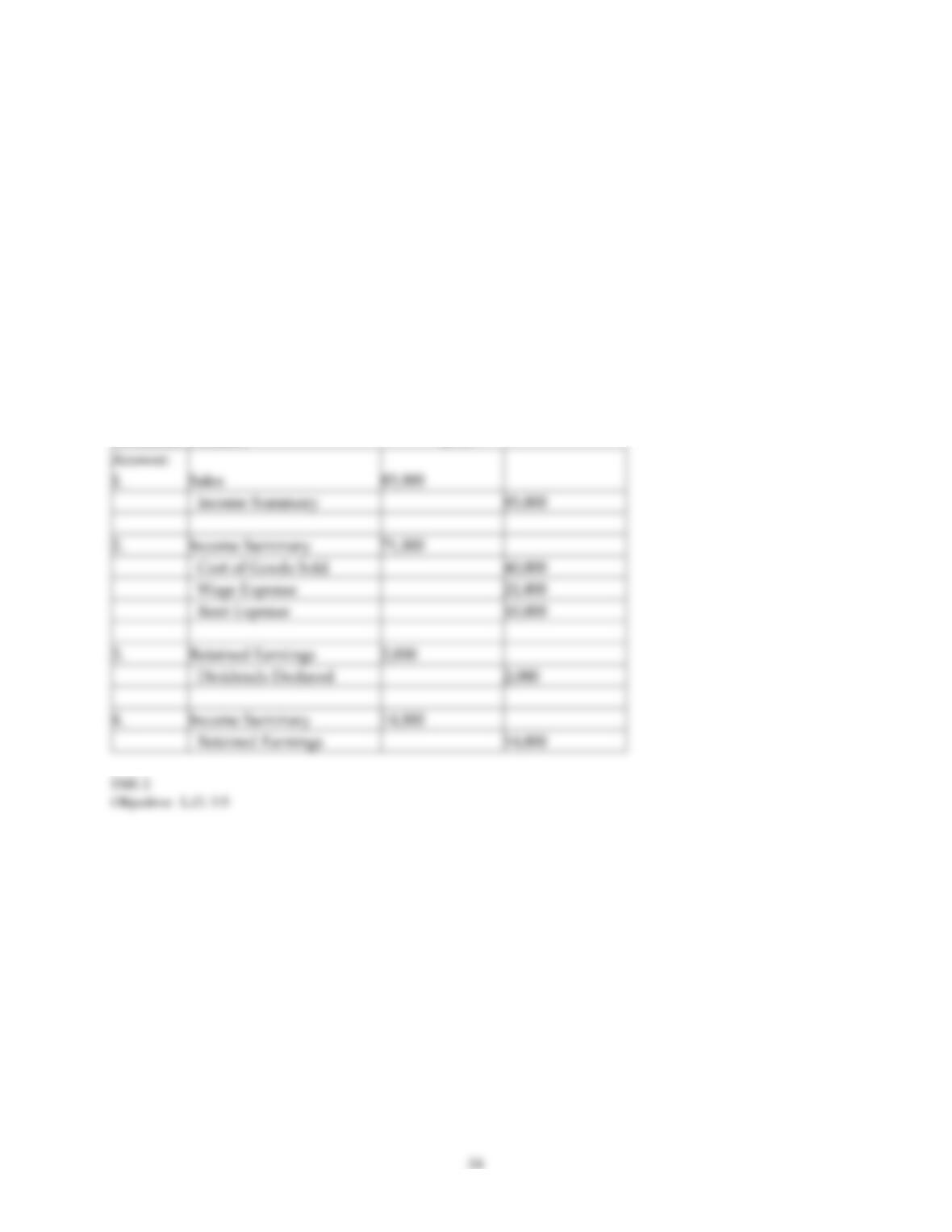
3.5-11) Given the following balances for Kania, Inc., prepare closing entries dated December 31, 20X9.
Accumulated Depreciation $ 6,000
Paid–in Capital 30,000
Cost of Goods Sold 40,000
Wages Payable 2,000
Sales 85,000
Equipment 24,000
Cash 30,000
Supplies 1,000
Accounts Payable 8,000
Retained Earnings 7,000
Wage Expense 21,000
Merchandise Inventory 9,000
Rent Expense 10,000
Dividends Declared 2,000
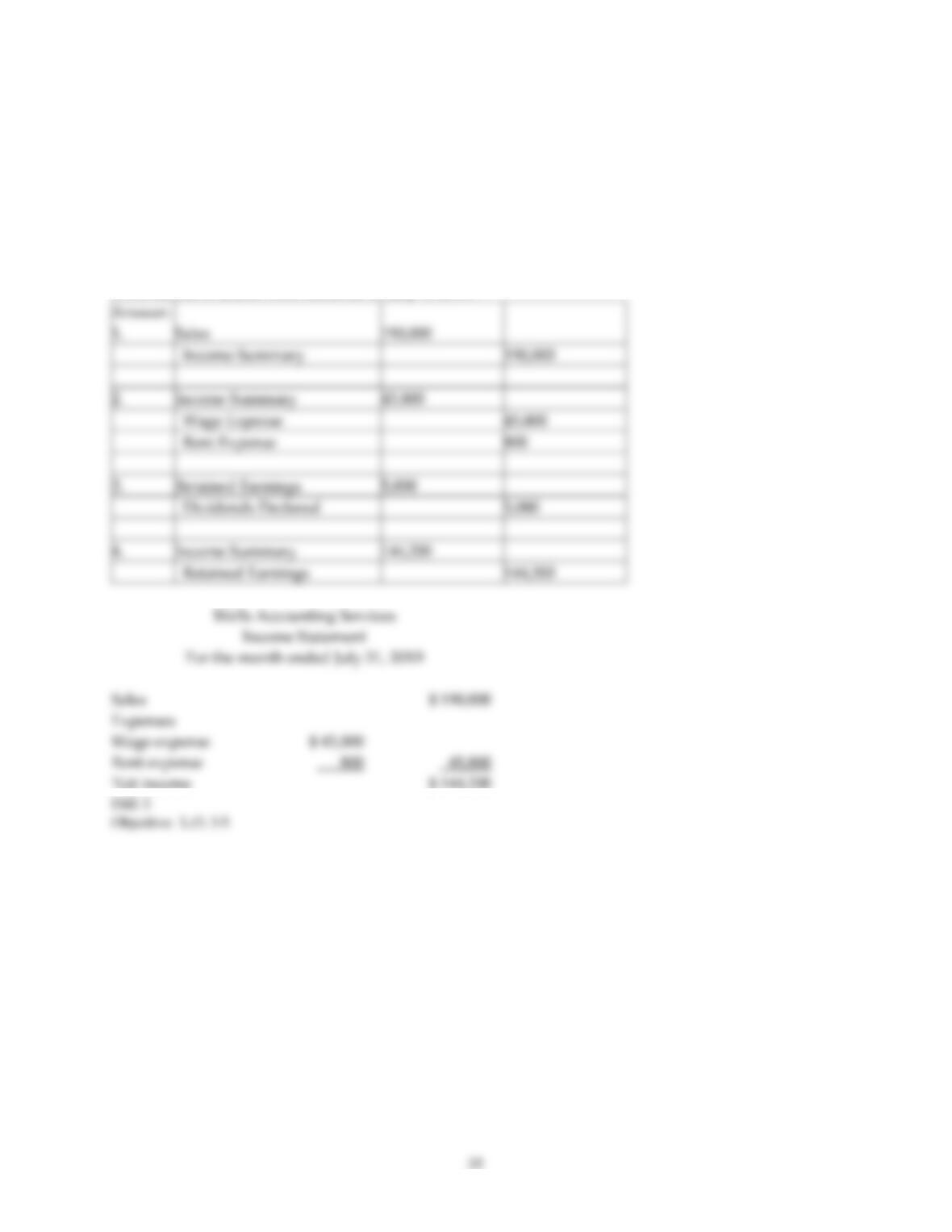
3.5-12) Wells Accounting Services had the following transactions in July, 20X9. Prepare closing entries
followed by an income statement for Wells Accounting Services.
1. Wells Accounting Services sold $190,000 worth of services, collecting half in cash at the point of sale.
2. The company paid wages of $45,000 to its employees.
3. The company’s prepaid rent account expired in the month of July. Wells Accounting Services
purchased an additional 6 months of rent on August 1, 20X9 for $4,800. The landlord did not increase rent
for Wells Accounting Services.
4. Dividends of $5,000 were declared on July 1, 20X9.
Learning Objective 3.6 Questions
3.6-1) Which of the following errors would a trial balance help the accounting staff to find?
A) A sale was made for $7,000, and instead of debiting Cash for $7,000, Accounts Receivable was debited
for $7,000.
B) A sale was made for $7,000, and instead of debiting Cash for $7,000, Accounts Payable was debited for
$7,000.
C) A sale was made for $7,000, and instead of debiting Cash and crediting Sales for $7,000, Cash was
credited and Sales was debited for $7,000.
D) A sale was made for $7,000, and instead of debiting Cash and crediting Sales for $7,000, Cash was
debited for $900, and Sales was credited for $7,000.
3.6-2) Failure to record depreciation at year–end will
A) overstate total liabilities.
B) understate assets.
C) overstate assets.
D) understate owners‘ equity.
E) overstate revenue.
3.6-3) Miller Ice Cream Shop purchased merchandise inventory on account for $200. This transaction was
properly recorded. A week later, Casey’s Company discovered a defect in the merchandise inventory and
returned the merchandise inventory to the supplier for credit. As the accountant, you would tell the
bookkeeper to record the return of the merchandise inventory by
A) debiting Merchandise Inventory and crediting Accounts Payable for $200.
B) debiting Accounts Payable and crediting Merchandise Inventory for $200.
C) debiting Merchandise Inventory and crediting Cash for $200.
D) debiting Cash and crediting Merchandise Inventory for $200.
E) debiting Cash and crediting Accounts Payable for $200.
3.6-4) Failure to record the expiration of a prepaid asset account will
A) overstate assets.
B) understate assets.
C) overstate liabilities.
D) understate liabilities.
E) understate net income.
3.6-5) Given the following two T–accounts, what can be definitely said about this company’s transactions?
Cash Acc. Receivable
(1) 11,800| 800 (2) (3)1,400| 1,000 (4)
(3) 400| 700 (5) |
(4) 1,000| |
A) Transaction 1 indicates the company sold merchandise for $11,800.
B) Transaction 2 indicates the company bought merchandise for $800.
C) Transaction 3 indicates the company returned merchandise for $1,000.
D) Transaction 4 indicates the company received $1,000 from its credit customers.
E) Transaction 5 indicates the company paid $700 in salaries.
3.6-6) Gray Window Washing, Inc., erroneously charged a $900 repair to the machinery account. Which of
the following is the correcting entry to be made?
A) Dr. Cr.
Accounts Payable 900
Machinery 900
B) Dr. Cr.
Repair Expense 900
Cash 900
C) Dr. Cr.
Repair Expense 900
Machinery 900
D) Dr. Cr.
Machinery 900
Repair Expense 900
E) Dr. Cr.
Cash 900
Accounts Payable 900
3.6-7) A credit customer paid $300 to Millhorn, Inc., to reduce the customer’s outstanding balance.
However, Millhorn erroneously increased sales. Which of the following is the correcting entry to be
made?
A) Dr. Cr.
Accounts Receivable 300
Sales 300
B) Dr. Cr.
Cash 300
Accounts Receivable 300
C) Dr. Cr.
Cash 300
Sales 300
D) Dr. Cr.
Sales 300
Accounts Receivable 300
E) Dr. Cr.
Sales 300
Cash 300
3.6-8) Bogdon Company‘s records were partially destroyed in a flood. The company does not know what
sales have been for the year, but it does know all sales were on account. Also, the beginning accounts
receivable balance was $19,000, and its accounts receivable balance at the time of the flood was $25,000.
From the beginning of the year until the flood, cash collections from credit customers was $158,000. Given
this information, what are Bogdon Company‘s sales for the year until the flood?
A) $164,000
B) $114,000
C) $202,000
D) $209,000
E) $189,000
3.6-9) Which of the following is true regarding correcting errors?
A) Only the income statement of the second period is effected.
B) Only the balance sheet of the first period is effected.
C) Errors in the current period may be offset by errors in the next accounting period.
D) Only auditors can change them.
E) Because they reverse, it is not necessary to do anything after the fact.
3.6-10) Which of the following is true regarding T–accounts and incomplete data?
A) T–accounts are the only way to reconstruct incomplete data.
B) T–accounts help organize an accountant’s thinking.
C) T–accounts do not help in discovering unknown amounts.
D) T–accounts are the only way to accurately record data.
E) All of the above statements are true.
3.6-11) If depreciation is not recorded for the current accounting period, total assets will be understated.
3.6-12) If the entry to journalize expired supplies is not prepared, liabilities will be overstated.
3.6-13) If expired insurance is not recorded at the end of the current accounting period, net income will be
overstated.
3.6-14) If the credit portion of a journal entry is posted but the debit side is not, liabilities will always be
overstated.
3.6-15) Some errors are counterbalanced by off–setting errors in the ordinary bookkeeping process in the
next period. Such errors misstate net income in both periods and affect the balance sheet in the first.
40
3.6-16) Gonzalez Company made the following errors in its accounting records for the year ended
December 31, 20X9:
1. Gonzalez Company received $3,000 in 20X9 from a customer in advance of work to be performed. At
the time of the cash receipt, revenue was recognized for the full amount. As of year end, 30% of the work
had been completed, with the remainder completed in 2X10.
2. Gonzalez Company provided services of $2,300 for one of its customers in 20X9, but did not bill the
customer until 2X10.
3. Gonzalez Company paid $5,400 on September 1, 20X9, for one year’s rent in advance. At the time of the
payment, the company used the prepaid rent account for the full amount. No other journal entry was
made with respect to this transaction.
4. Gonzalez Company failed to record wages earned but unpaid as of December 31, 20X9, of $2,600. The
wages were paid and recognized as an expense in 2X10.
State whether each item has understated (U), overstated (O), or had no effect (N) on the 20X9 revenue,
expense, and net income, as well as the year–end total assets, total liabilities, and total stockholder’s
equity balances.
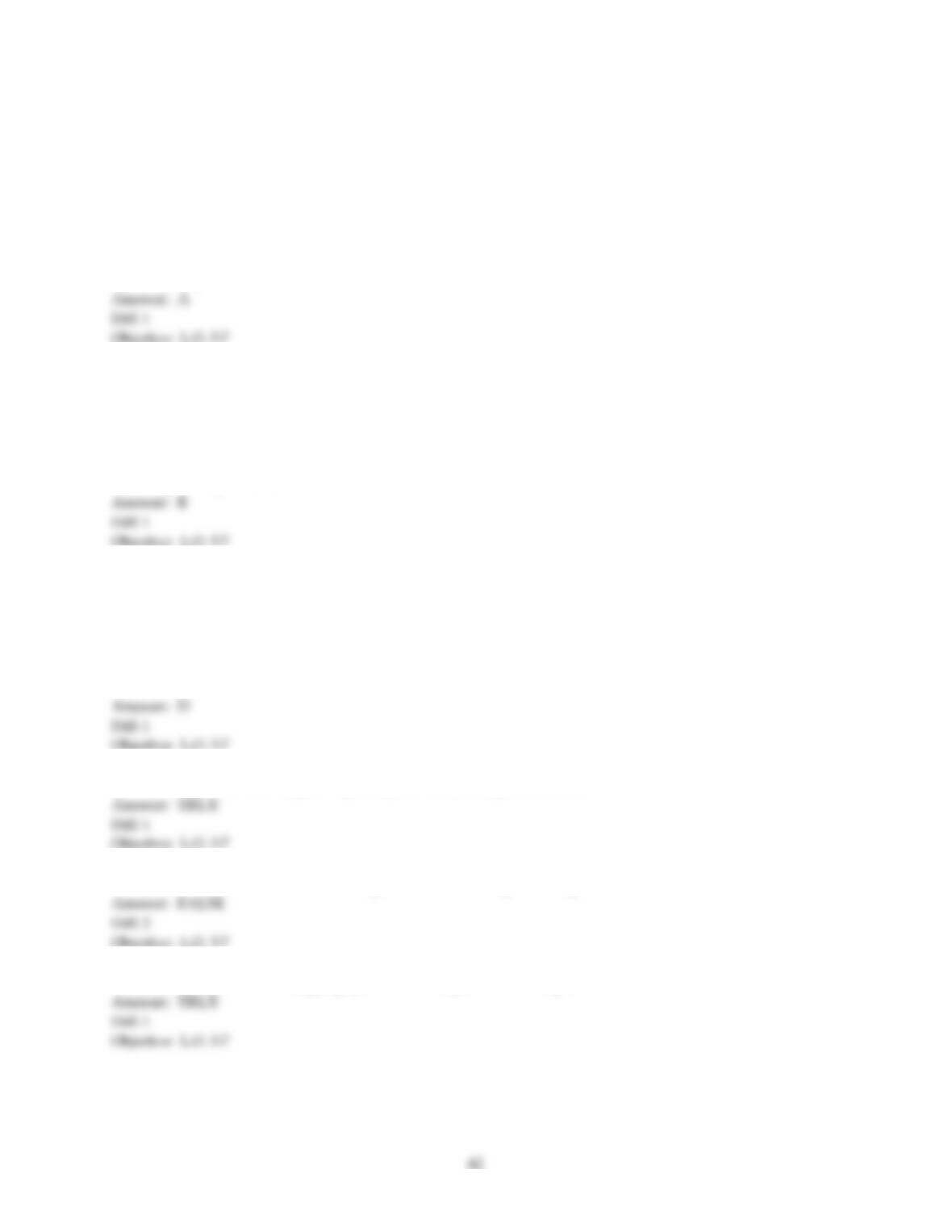
3.6-17) Wyatt Manufacturing Company had the following journal entries for each of the transactions
described. Prepare the correcting entry needed for each transaction.
a. A credit customer paid $200 to Wyatt Manufacturing Company for the customer’s outstanding
balance. The journal entry made by the company was
Cash 200
Sales 200
b. A repair was made on some equipment. The cost was supposed to be charged to Repair Expense. The
journal entry made by the company was
Equipment 550
Accounts Payable 550
c. Depreciation for the current year was supposed to be $2,800, however the following journal entry was
made by the company:
Depreciation Expense 800
Equipment 800
d. Supplies were acquired on account for $1,300. The company made the following journal entry:
Supplies 1,300
Accounts Receivable 1,300
e. A major competitor of the company filed for bankruptcy. It was believed that this would result in an
increase in sales of $100,000 per year. The company made the following journal entry:
Prepaid Revenue 100,000
Retained Earnings 100,000
Learning Objective 3.7 Questions
3.7-1) Keeping track of the merchandise inventory level in a company
A) has become easier with data processing.
B) originated in Italy by Pacioli.
C) has reduced in accuracy in modern accounting from shrinkage.
D) is only possible in ERP systems.
E) works in JIT environments.
3.7-2) Data processing
A) only works in ERP companies.
B) is a procedure used to record, analyze, store, and report on chosen activities.
C) has increased the cost per accounting transaction.
D) has increased the relevance of accounting information.
E) is required by the IRS.
3.7-3) XBRL
A) is only used in the United States.
B) requires ERP programs.
C) has increased the accuracy in modern accounting.
D) is a tagging system for accounting.
E) does not work.
3.7-4) ERP is a means of organizing computer accounting information.
3.7-5) Over time, the cost of accounting information data processing has increased.
3.7-6) XBRL is an account tagging system that simplifies the computer transfer of information.
3.7-7) What attributes does XBRL bring to improve accounting data processing?