69. Ellen loans Nicole $45,000 to start a hair salon. Unfortunately, the business fails in 2011 and she is unable
to pay back Ellen. In 2011, Ellen also had $20,000 of income from her part-time job and $12,000 of capital
gain from the sale of stock. How much of the $45,000 bad debt can Ellen claim as a capital loss in 2011?
A. $45,000, with $33,000 carried forward to 2012
70. Patrick has a business net operating loss of $70,000 in 2011. Patrick’s business did well in 2009 and in
2010. Which of the following is true?
71. Patricia is a business owner who is trying to determine her cost of goods sold for 2011. She bought 20 units
of inventory at $11, then 26 units at $9, and finally 18 units at $14. She sold 30 units in 2011 and uses FIFO
for her inventory valuation. What was her cost of goods sold in 2011 assuming that there was no inventory at
the beginning of the year?
A. $706
72. Which of the following would be a business debt if it were uncollectible?
A. A taxpayer loans his father $1,000 to start a business
73. Stone Pine Corporation, a calendar year taxpayer, has ending inventory of $160,000 on December 31,
2011. During the year, the corporation purchased additional inventory of $415,000. If cost of goods sold for
2011 is $470,000, what was the beginning inventory at January 1, 2011?
74. Janine is a sole proprietor owning a small specialty store. The business records show that the cost of the
store’s individual inventory items has been steadily increasing. The cost of the end of the year inventory is
$125,000 and the cost of the beginning of the year inventory was $150,000. Janine uses the LIFO method of
inventory valuation. Which of the following statements is true?
A. Janine purchased more inventory during the year than she sold during the same one-year period.
75. Greg, a self-employed plumber, commutes from his home to his office which is 10 miles away. He loads
his truck for the day with the parts that he needs. Then he is off to see his first customer of the day, Mr.
Smith. Mr. Smith is 5 miles away from the office. After Mr. Smith’s job, Greg goes to his next job, Martin’s
Dry Cleaning which is 21 miles away from Mr. Smith. Greg spends the rest of the day at Martin’s Dry
Cleaning. From Martin’s Dry Cleaning, Greg goes home which is now only 7 miles away. How much can
Greg count as deductible transportation miles?
76. Which of the following is not a factor that the IRS looks at to determine if a loss is from a hobby or from a
business?
77. Mary is an insurance salesperson and a member of the Country Club. During 2011, Mary used the club 40
percent for entertaining clients (directly-related use) and 60 percent for pleasure. She incurred the following
expenses at the Country Club:
Annual dues
$8,000
Business meals
1,500
Personal meals
2,000
Tennis fees (business use)
500
Calculate the amount that Mary is allowed to deduct as entertainment expense.
78. Dennis is a self-employed hair stylist who operates a salon in his home. The property taxes and interest
allocated to the business amount to $5,000, maintenance and utilities allocated to the business total $2,100, and
depreciation allocated to the business use of the home equals $3,000 for the 2011 tax year.
a.
If Dennis’ gross billings after deducting supplies for his business are $5,800 for the current tax year, calculate his allowable deductions for
the home office.
b.
If Dennis’ gross billings after deducting supplies for his business are $13,800, calculate his allowable deductions for the home office.
b.
79. Larry qualifies for a home office deduction. The amount of space devoted to the business is 500 square feet
of the total 2,000 square feet in his house. Larry’s total rent on the house is $6,000, and he pays utilities (other
than telephone) of $3,000 for the year. Calculate Larry’s deductions for home office expenses before the gross
income limitation.
Rent expense
Utilities
Total home office expenses
Rent expense ($6,000 x 500 sq. ft/2,000 sq. ft)
$1,500
Utilities ($3,000 x 500 sq. ft/2,000 sq. ft)
750
Total home office expenses
80. Dennis, the owner of Dennis Company, incurs the following expenses while away from home on a 3-week
business trip during 2011:
Airfare from Chicago to Boston
$ 700
Hotel charges
1,800
Meal charges
780
Dry cleaning and laundry
100
Local transportation
35
Business entertainment
150
Business gift to Boston manager
45
In addition to the above expenses, Dennis incurred the following expenses for a weekend sightseeing trip to Washington D.C.:
Transportation to Washington D.C.
$200
Hotel charges
125
Meal charges
95
Calculate the amount Dennis may deduct for 2011 as travel expenses for the trip.
81. Peter is a self-employed investment advisor who uses his automobile for business. Peter drove his new
automobile a total of 20,000 miles evenly during 2011; 75 percent was business mileage. The actual cost of
gasoline, oil, depreciation, repairs and insurance for the year was $6,200.
a.
How much is Peter’s transportation deduction based on the standard mileage method?
b.
How much is Peter’s transportation deduction based on the actual cost method?
c.
Which method should Peter use to calculate his transportation deduction, assuming he used the standard mileage method in 2010? Why?
d.
Where should he deduct the expenses on his 2011 tax return?
a.
b.
c.
The standard mileage method; it results in the larger deduction.
d.
On his Schedule C.
Airfare from Chicago to Boston
$ 700
Hotel charges
1,800
Meal charges (50% ´ $780)
390
Dry cleaning and laundry
100
Local transportation
Total travel expense deduction
Entertainment ($150 ´ 50%)
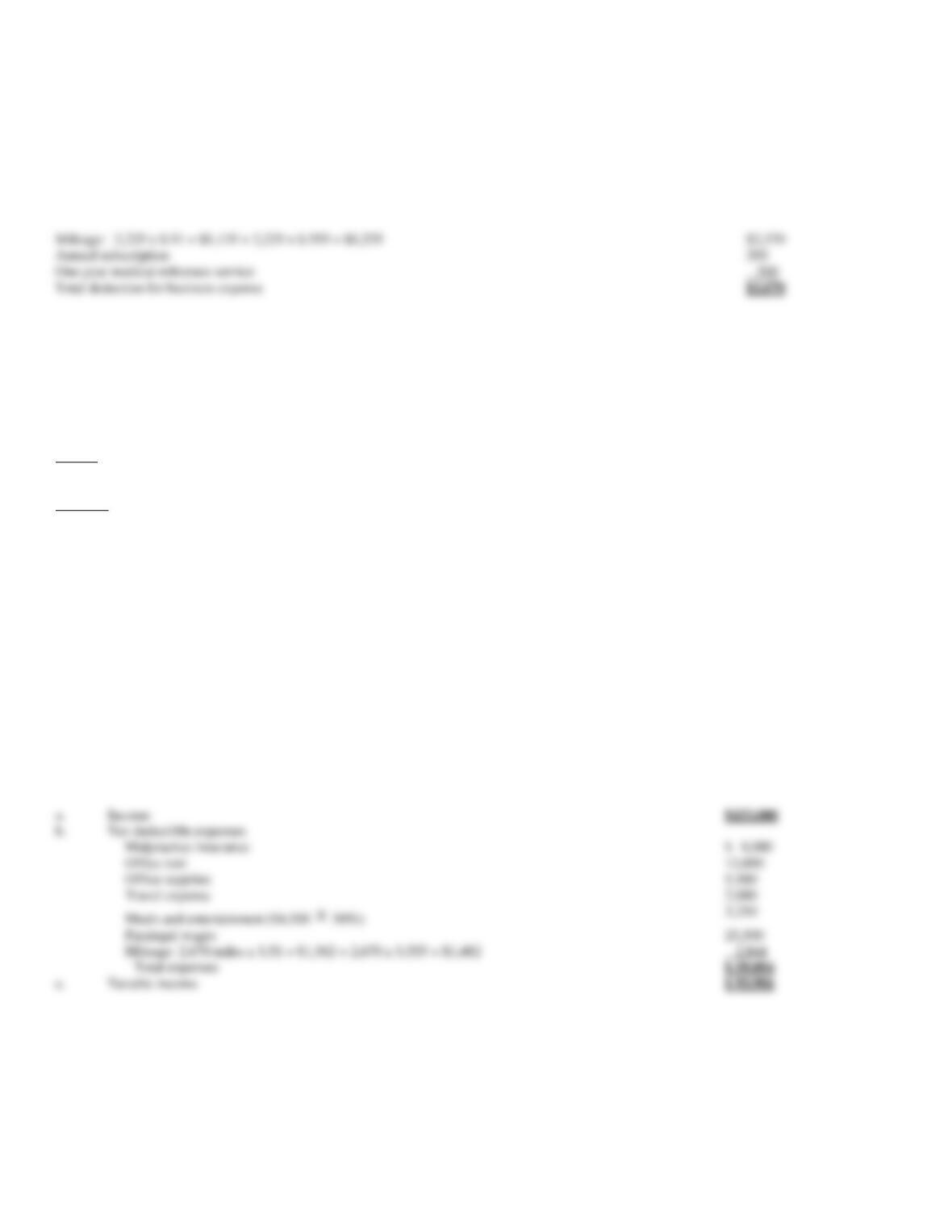
82. Chris opens a chiropractic office in Taos on January 1, 2011. Chris drives from his office to clients’ homes
to do chiropractic adjustments when they are unable to get to his office. His driving for this purpose is 4,450
miles evenly throughout the year and he has 3,000 miles for commuting between his office and his home. He
elects to use the standard mileage method. On January 1, 2011, Chris purchases an annual subscription to a
chiropractic journal for $200 and a 1-year medical reference service for $500. Calculate Chris’s deduction for
the above items for the 2011 tax year.
83. Peter is a self-employed attorney. He gives the following information about his business to his CPA for use
in preparing his 2011 tax return:
Income
Fees from law practice
$153,000
Expenses
Malpractice insurance
$ 8,000
Office rent
12,000
Office supplies
5,500
Travel expense
2,000
Meals and entertainment
6,500
Paralegal wages
25,500
Country club dues (Peter uses the club for business entertainment)
2,500
Peter also drove his car 445 miles per month for business and used the standard mileage method for computing transportation costs. How much will
Peter show on his Schedule C for 2011 for:
a.
Income
b.
Tax deductible expenses
c.
Taxable income
a.
Income
Tax deductible expenses
Malpractice insurance
$ 8,000
Office rent
12,000
Office supplies
5,500
Travel expense
2,000
Meals and entertainment ($6,500 50%)
Paralegal wages
25,500
Mileage: 2,670 miles x $.51 = $1,362 + 2,670 x $.555 = $1,482
2,844
Total expenses
Taxable income
Mileage: 2,225 x $.51 = $1,135 + 2,225 x $.555 = $1,235
$2,370
Annual subscription
One-year medical reference service
500
Total deduction for business expense

84. Rick is a business advisor who lives in Escondido, California and works in San Diego. He makes a 70-mile
round trip commute to his job every workday, for a total of 14,000 miles a year. In addition, he drives 1,000
miles evenly throughout the year to visit clients from his office in San Diego. If Rick uses the standard mileage
method for computing automobile expenses, what is his automobile expense deduction for 2011?
85. David purchases a yacht solely for the purpose of entertaining real estate clients. He wishes to position
himself as a high-end real estate salesperson specializing in very expensive residences and uses the yacht only
for business entertainment. During 2011, his expenses for maintaining the yacht, including depreciation, were
$28,000. In addition, he incurred $8,000 of catering expenses for meals he provided to business clients on the
yacht. What is David’s tax deduction in 2011?
86. Sally and Martha are tax accountant partners sharing an office in San Diego. Every year, they attend the
special Tax Planning Forum in Las Vegas put on by nationally renowned experts. The Forum lasts for 2 days.
One evening Sally and Martha attend a show and another evening they lose $10 gambling on the nickel slot
machines. Their expenses are as follows:
Airfare
$ 200
Hotels
300
Meals
150
Seminar registration
1,000
Tickets to show
100
Gambling loss
10
$1,760
87. Carol, a CPA, is always required by her employer to wear to work either a gray or a blue business suit with
matching shoes. Carol would never consider wearing her gray or blue suits and matching shoes anywhere other
than work since she considers them uncomfortable as well as unattractive. Can Carol deduct the cost of the suits
and shoes as special work clothing or uniforms? Explain.

88. Christine is a self-employed tax accountant who drives her car to visit clients occasionally throughout the
year. She drives her car 1,000 miles for business, 5,000 miles for commuting and 5,000 miles for personal use.
Assuming that Christine drives the miles evenly throughout the year and that she uses the standard mileage
method, how much is her auto expense for the year? Where in her tax return should Christine claim this
deduction?
89. Curt is self-employed as a real estate salesman and drives his car frequently to take clients to see homes for
sale. Curt drove his car 20,000 miles for business purposes and 25,000 miles in total. His actual expenses for
operating the auto including depreciation are $10,000 since he drove it so much during the year. Curt has used
the actual cost method since he started his business. How much is Curt’s deductible auto expense for the year?
90. Anna is a self-employed newspaper columnist who does her work exclusively from a home office. Anna had
a bad year and her income is only $2,000 before the home office expenses this year. Her office takes up 250
square feet of her 1,000 square foot apartment. The total expenses for her apartment are $8,000 for rent, $1,000
for utilities, $200 of renter’s insurance and $800 for pest control and other maintenance. What is Anna’s home
office deduction? Please show your calculations.
91. Girard is a self-employed marketing consultant who spends significant time entertaining potential
customers. He keeps all the appropriate records to substantiate his entertainment. He has the following expenses
in the current year.
Business meals
$7,000
Tickets to baseball games
500
Tickets to football games
500
Yacht maintenance (all business use)
6,000
What is the tax deductible entertainment expense Girard may claim in the current year. On which tax form should he claim the deduction?
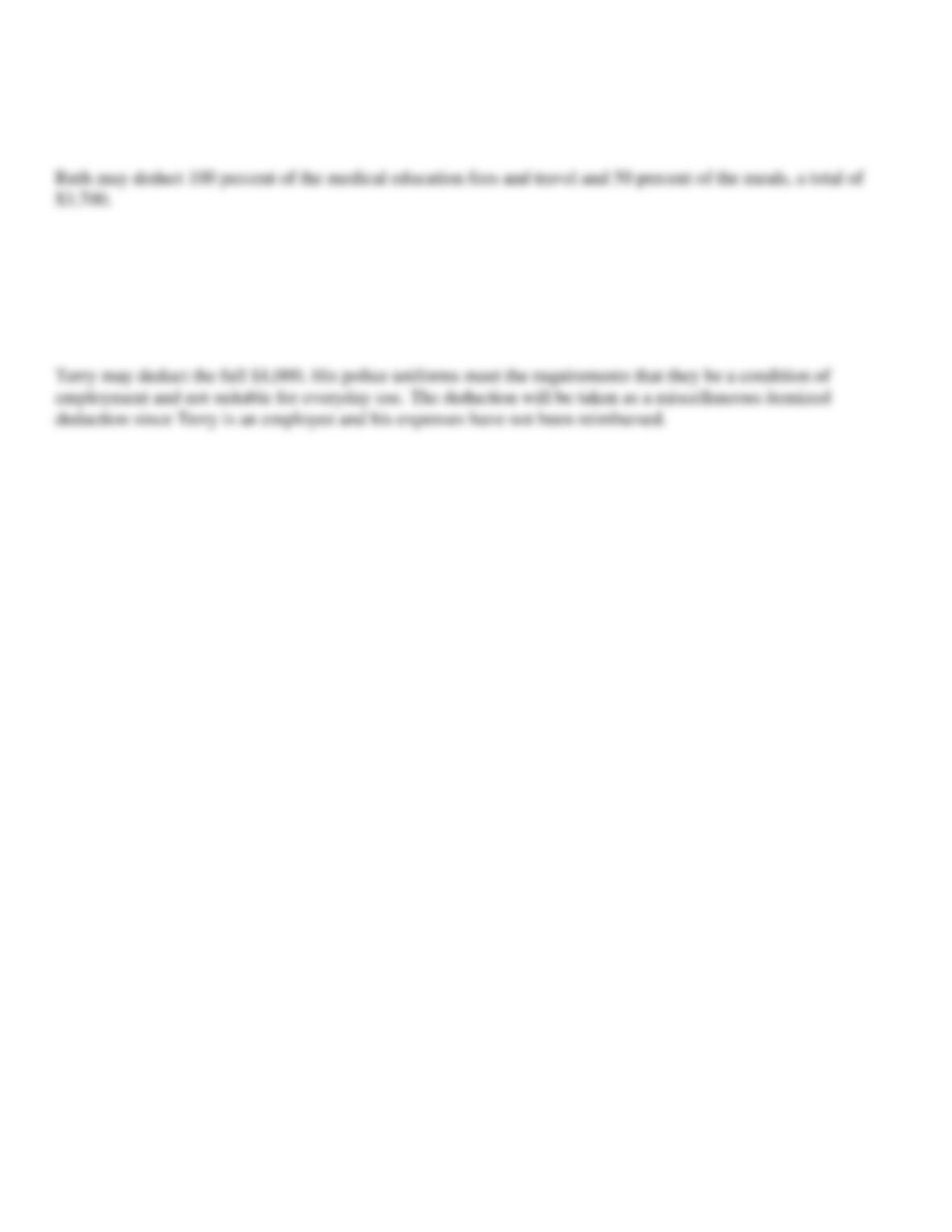
92. Ruth is a self-employed surgeon and is required to take a week of continuing medical education every year
to keep her license. This year she paid $2,000 in course fees for her continuing medical education in Honolulu.
She also paid $1,500 for airfare and a hotel room and $400 for meals. What is the total amount she can deduct
on her Schedule C related to these expenses?
93. Terry is a policeman employed by the city. He must purchase and maintain his uniforms. The total cost of
purchasing and maintaining uniforms is $1,000 for the current year. How much may he deduct, why, and where
on his tax return?
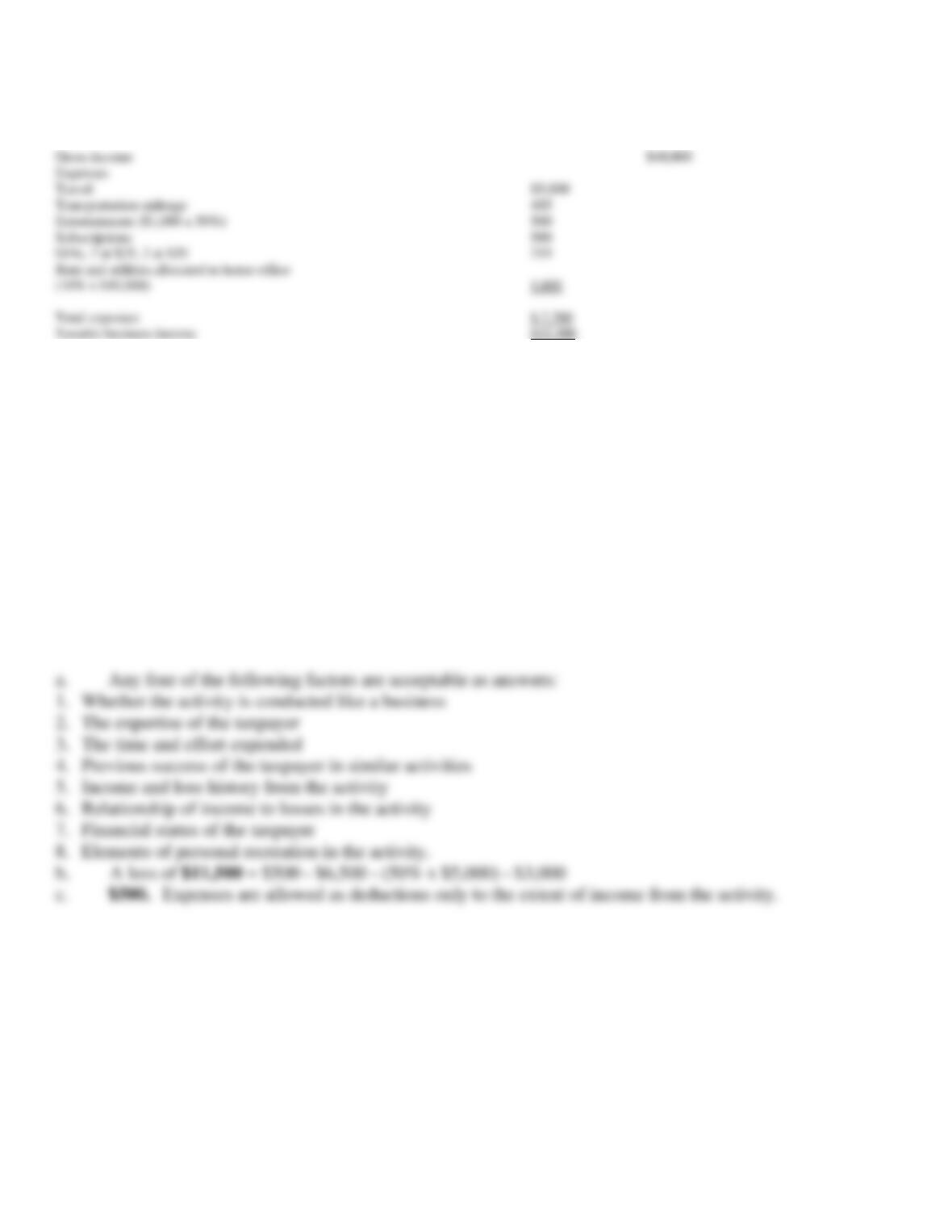
94. Lew started a business writing a popular syndicated Japanese gardening column in the current year and will
report a profit for his first year. His results of operations are as follows:
Gross income
$40,000
Travel
5,000
Business suits, to visit magazine editors
1,000
Transportation, 911 miles
485
Entertainment
1,000
Subscription to bonsai and Japanese
gardening magazines
500
Gifts: 7 at $100 each; 2 at $20 each
740
Rent and utilities for apartment, in total
(10 percent is used for a home office)
10,000
What is the net income Lew should show on his Schedule C? Show the calculation of his taxable income.
Gross income
_________
Expenses (describe each)
_________
_________
_________
_________
_________
_________
_________
_________
Taxable business income
_________
95. Terry is a practicing attorney who decides to become an agent for musical groups on the side. Terry
engages in the activity and has the following revenue and expenses:
Agent fees from clients
$ 500
Travel to concert sites around the country
6,500
Business meals and entertainment
5,000
Depreciation on video and TV equipment used to showcase clients
3,000
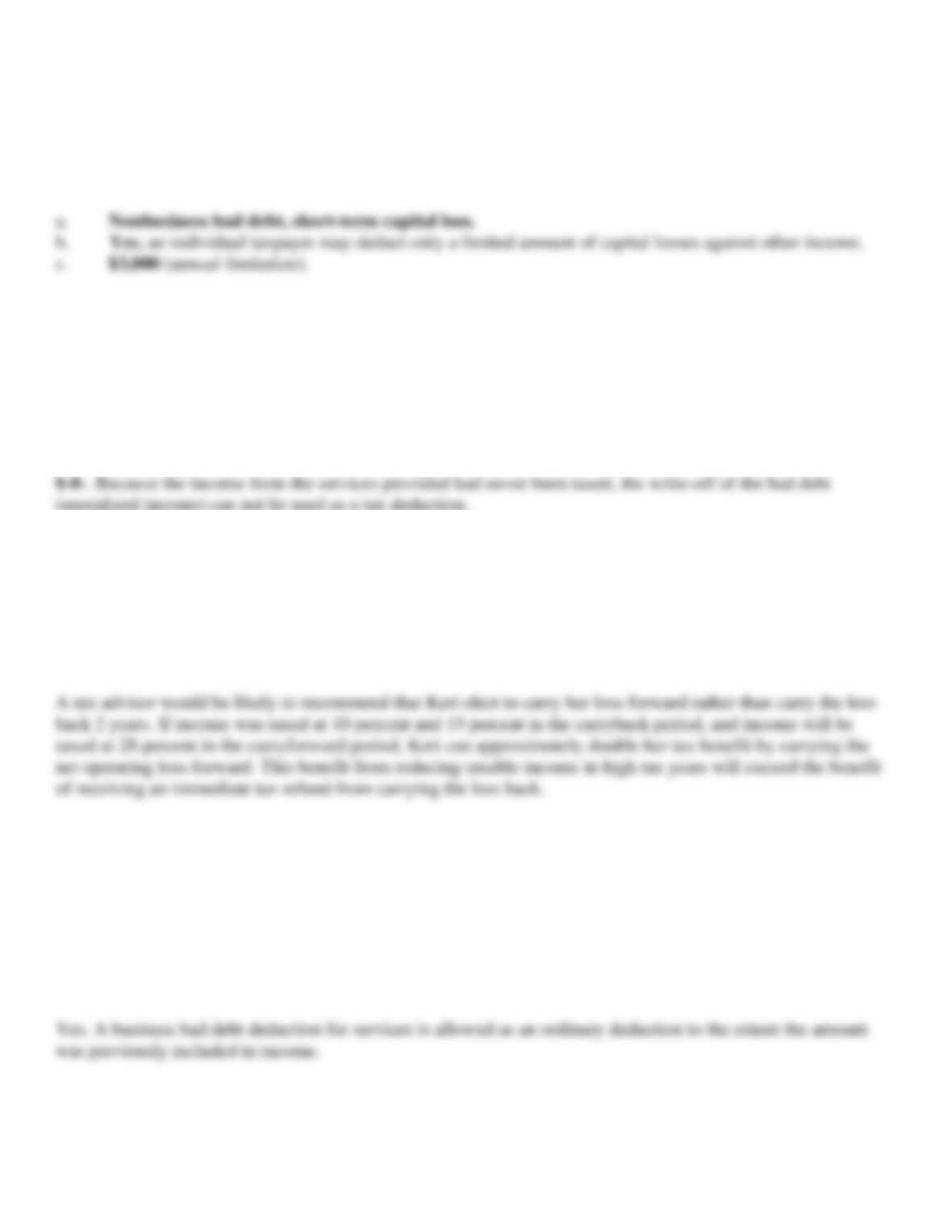
a. What are four of the factors the IRS will consider when evaluating whether her activity is a hobby?
b. If the activity is deemed to be a regular business, what is the amount of Terry’s net income or loss from the activity?
c. If the activity is deemed to be a hobby, what is the amount (if any) of Terry’s expenses from the activity that may be deducted, before
applying the 2 percent of AGI floor for miscellaneous itemized deductions?
Gross income
$40,000
Expenses
Travel
$5,000
Transportation-mileage
Entertainment ($1,000 x 50%)
Subscriptions
Gifts, 7 at $25, 2 at $20
Taxable business income
$32,300
96. Hope Springs, a teacher, loaned Hugh Owens, a friend, $10,000 to invest in real estate. Hugh declared
bankruptcy in 2011 and cannot repay the $10,000.
a. What is the nature of Hope’s loss?
b. Assuming Hope has no other capital transactions, is there a limit on the amount she may deduct for
2011? Explain.
c. What amount of the loss may Hope deduct in 2011?
97. Donald, a cash basis dentist, had $7,000 of uncollectible accounts receivable in 2011. Because Donald had
always been a cash basis taxpayer, he had not reported the $7,000 in taxable income when the services were
performed.
How much of the $7,000 bad debt can Donald take as a bad debt deduction on his 2011 tax return? Explain.
98. Keri is a single taxpayer and has a net operating loss of $30,000 in 2011. Her taxable income for the last 5
years has been about $10,000 each year. She expects 2012 to be a very good year and projects that her income
will be over $100,000. If you were Keri’s tax advisor, what would you recommend that she do with her 2011
operating loss? Explain.
99. Sherri is a tax accountant. She prepared a large corporate tax return 2 years ago and billed $5,000 to her
client. After 2 years of attempting to collect the money, it is clear that she will not be able to collect anything
since the business has gone bankrupt. She reports income on her tax return on the accrual basis as she bills it, so
the $5,000 was included in her taxable income 2 years ago. Can she claim a bad debt deduction for the $5,000?
Explain.
100. Jezebel loaned her friend $7,000 to buy a used car. She had her friend sign a note with repayment terms
and set a reasonable interest rate on the note because she wanted her friend to understand that this was purely a
loan and not a gift. Her friend is now on disability and has made it clear she has no way of paying back the loan.
How should Jezebel treat the bad loan for tax purposes?
101. Jess has had a couple of good years in his new business. In the current year, however, he has a net
operating loss of $8,000. He is uncertain about the future of the business, and has a serious cash flow problem.
As his tax accountant, how would you recommend Jess treat his net operating loss?
102. Karen was ill for most of the current year. She received tax-free disability income that covered most of her
expenses. She paid the deductible expense of owning her home, interest on the mortgage and property taxes out
of this income. Her tax return shows negative taxable income of $25,000. How should this loss be treated?
103. Vinnie has a small retail store and sells one product. His beginning inventory consisted of 1,000 products
at $4.00 each for a total of $4,000. During the year, Vinnie made the following purchases of the product:
March 1 5,000 products at $5.00 each = $25,000
August 1 1,000 products at $6.00 each = 6,000
Vinnie uses the FIFO method of inventory valuation and he sells 5,000 products during the current year.
a. Calculate the total cost of goods available for sale.
b. Calculate the cost of the ending inventory.
c. Calculate the cost of goods sold.
104. What is the advantage of carrying a net operating loss back against prior years’ income rather than forward
against future years?
105. What is the purpose of Schedule C?